
Deepfake attacks are changing how organizations need to think about digital trust.
Artificial intelligence can now generate or manipulate convincing images, videos, voices, and other digital content that imitates real people. For businesses, this creates risks across customer onboarding, account recovery, payments, executive communications, workforce identity, and fraud prevention.
The problem is bigger than whether a video or image looks realistic.
Organizations have traditionally treated a familiar face or voice as evidence that the person is genuine. That assumption is becoming less reliable as synthetic media becomes easier to create and customize.
The FBI has warned about scammers using AI-generated videos to impersonate trusted individuals and create false credibility around fraudulent schemes. (Internet Crime Complaint Center)
The answer is not to rely on one deepfake detector.
Businesses need layered defenses that combine trusted identity evidence, biometric verification, liveness detection, application security, risk signals, employee procedures, and independent authorization for sensitive actions.
What Is a Deepfake Attack?
A deepfake attack uses AI-generated or manipulated media to imitate a real person or create false evidence.
The content may involve:
- Facial images
- Video
- Voice
- Audio
- Real-time interactions
- Prerecorded material
The attack becomes dangerous when an organization trusts that content enough to make a decision.
For example, an attacker could impersonate an executive during a video call and request a payment. A fraudster could use synthetic facial media during digital onboarding. Another attacker might manipulate video or audio to convince support staff that they are a legitimate customer.
FIDO’s identity-verification requirements recognize deepfakes as a fraud method that can be used in both presentation and injection attacks, depending on how the content reaches the verification system. (FIDO Alliance)
This distinction matters because the right defense depends on the attack path.
Why Deepfakes Create New Identity Risks
Remote identity verification depends on digital evidence.
A customer may upload an identity document and then capture their face through a smartphone camera. A biometric system compares the facial sample with a trusted reference.
That can provide strong evidence, but it does not automatically establish that the captured face is genuine.
An attacker may attempt to present a photograph, replayed video, or synthetic facial representation of the legitimate identity holder.
NIST’s current Digital Identity Guidelines specifically added controls for forged media and injection attacks, reflecting the growing role of generative AI in attacks against remote identity proofing. (NIST Pages)
This means businesses need to evaluate both identity correspondence and media authenticity.
Start With Strong Identity Proofing
Deepfake protection begins before the biometric stage.
If a fraudulent identity is established during enrollment, later biometric controls may simply confirm the wrong person.
Imagine a fraudster creates an account using stolen personal information and enrolls their own face. The face-recognition system can recognize that face perfectly in future interactions.
The problem is not the matching algorithm.
The problem is that the initial identity was never trustworthy.
A strong process should therefore establish reliable identity evidence before creating a biometric relationship.
NIST’s identity-proofing guidance explains that identity evidence needs to be validated and verified and that strong evidence should provide sufficient assurance that the claimed identity is associated with the subject. (NIST Pages)
A practical architecture can therefore begin with:
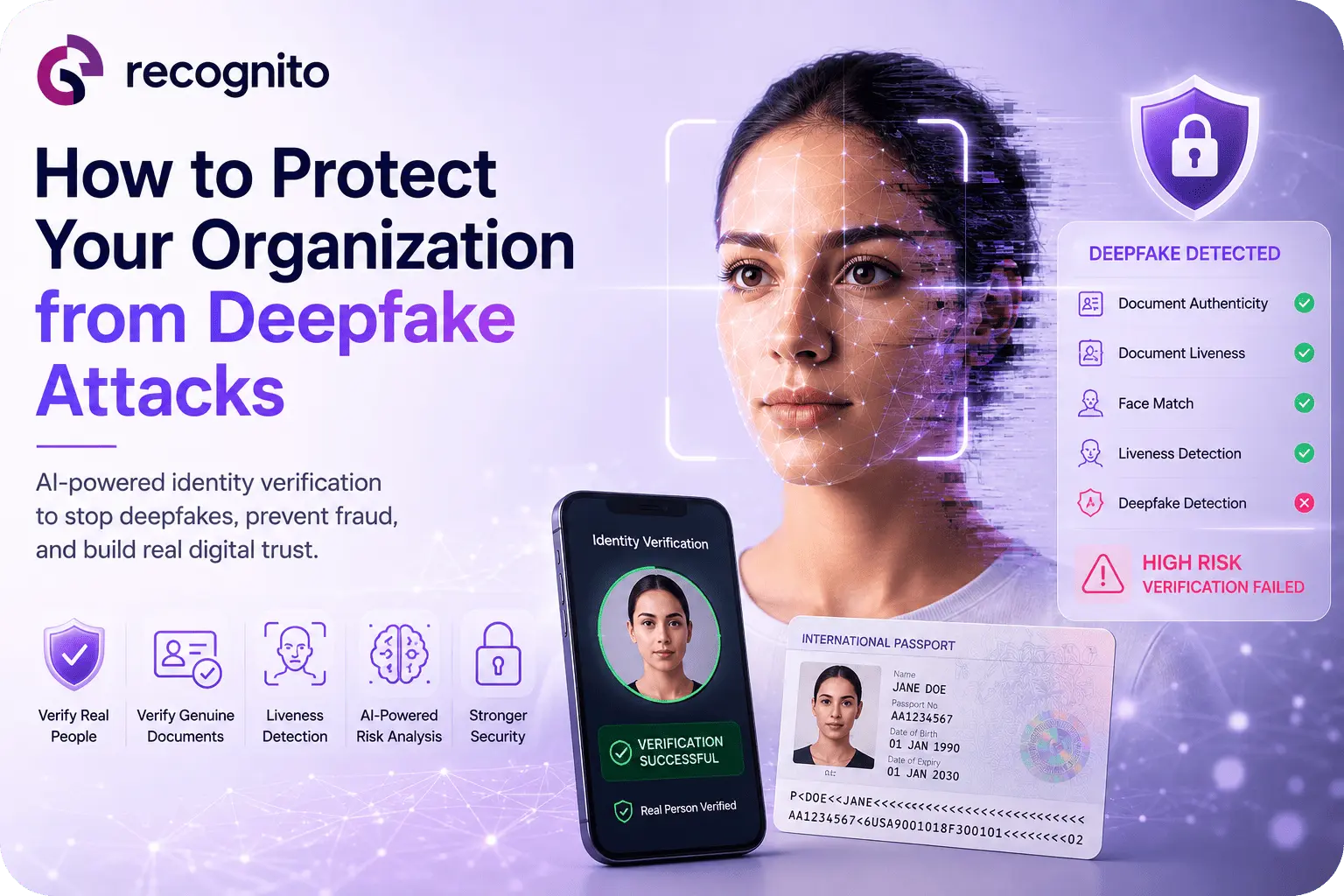
Identity evidence → document validation → biometric verification → liveness → risk assessment
Combine Document Verification With Biometrics
An identity document provides an important reference for many digital verification workflows.
A passport, identity card, or other accepted credential can provide biographical information and a facial photograph.
Document processing helps determine whether the evidence is readable, consistent, and credible.
A document recognition SDK can support this stage inside a custom onboarding experience.
The applicant can then provide a facial sample.
The system compares:
Customer face → trusted document photograph
This creates a stronger connection between the person and the identity evidence.
However, facial verification still does not answer whether the facial presentation itself is genuine.
That is where liveness becomes important.
Add Facial Verification and Liveness
Facial verification answers:
Does this person correspond with the trusted identity?
A facial biometric SDK can provide this matching capability inside a digital application.
Liveness adds another question:
Does the biometric presentation appear to come from a genuine person?
A face liveness SDK can provide presentation-attack protection around remote facial capture.
These capabilities should not be treated as interchangeable.
Face verification establishes person-to-identity correspondence.
Liveness helps protect the presentation.
That separation makes it easier to design, test, and troubleshoot the identity workflow.
What Types of Attacks Should Organizations Consider?
The right threat model depends on the application, but common scenarios include:
Photo Presentation
A photograph of the target is shown to the camera.
Screen Presentation
A digital image or video is displayed on another device.
Replay Attack
Previously recorded footage is presented as a current interaction.
Physical Replica
An attacker uses an artificial representation of another person’s face.
Synthetic Media
AI-generated or manipulated facial content is presented during verification.
The security team should identify which scenarios are realistic for its customer population and attack incentives.
ISO/IEC 30107-3:2023 provides principles and methods for assessing presentation attack detection mechanisms and reporting their performance. It also clarifies that PAD testing is not equivalent to a complete system-level security assessment. (ISO)
Do Not Treat Liveness as Complete Deepfake Protection
Liveness is important, but it is not a universal deepfake defense.
A synthetic-media attack can target several layers:
The media itself
The biometric presentation
The application
The capture pipeline
The employee receiving the communication
This is why organizations should not expect one model to stop every form of synthetic fraud.
A related deepfake prevention strategy can combine biometric controls with application security, behavioral intelligence, and human procedures.
The goal is to make a single manipulated signal insufficient to complete a high-risk action.
Protect Against Injection Attacks
Not every biometric attack happens in front of the camera.
An attacker may attempt to insert manipulated media directly into the application’s processing path instead of physically presenting it to a sensor.
This is an injection attack.
NIST’s identity-proofing requirements address this problem by calling for technical controls that increase confidence that digital media originates from a genuine sensor and by requiring analysis of submitted media for potential manipulation, forgery, and tampering. (NIST Pages)
Organizations should therefore consider:
- Camera and sensor integrity
- Device security
- Application integrity
- SDK integrity
- API authentication
- Secure transport
- Input validation
- Protection of biometric results
A strong liveness model cannot compensate for an application that allows attackers to bypass the expected capture path.
Protect High-Risk Account Recovery
Account recovery can become a hidden entry point for deepfake attacks.
A business might have strong authentication but a weaker recovery process.
An attacker can then focus on convincing a support employee or recovery system that they are the legitimate account owner.
For higher-risk recovery events, businesses can combine:
Identity evidence + facial verification + liveness + device signals + additional authentication
Stronger verification can be triggered when a customer is using an unfamiliar device, changing sensitive information, or making an unusual recovery request.
The point is not to force every customer through biometric verification.
It is to apply stronger controls where the consequences of unauthorized access are significant.
Protect Against Executive Impersonation
Deepfakes can target internal business processes as well as customer identity systems.
An attacker may imitate a CEO, finance executive, manager, or other trusted employee and request a sensitive action.
The FBI has documented scams involving AI-generated videos used to impersonate trusted officials and create false legitimacy. (Internet Crime Complaint Center)
Organizations should therefore establish a simple rule:
A video call is not sufficient authorization for a high-risk action.
Payment requests, vendor banking changes, privileged-access requests, or sensitive data transfers should require independent verification.
For example:
Video request → independent confirmation → authorized approval
This makes it much harder for synthetic media alone to trigger a sensitive action.
Use Independent Authorization
Deepfake defense should not depend entirely on detecting whether media is fake.
A stronger strategy makes the media insufficient by itself.
Suppose someone appears on video and asks an employee to transfer funds.
Instead of trusting the video, the employee can confirm the request through an independently established channel.
This principle is particularly useful for:
- Payment approvals
- Banking-detail changes
- Privileged access
- Password resets
- Sensitive data requests
The idea is simple:
The same potentially manipulated channel should not both establish identity and authorize the action.
This is a procedural control, but it can significantly reduce the impact of successful deepfake impersonation.
Use Risk-Based Verification
Not every customer or transaction represents the same risk.
Applying maximum verification to everyone can increase friction, slow onboarding, and create unnecessary abandonment.
A risk-based model is more practical.
Normal Risk
Use standard identity and authentication controls.
Elevated Risk
Add stronger biometric or identity checks.
High Risk
Combine document evidence, face verification, liveness, device intelligence, additional authentication, and manual review where appropriate.
This lets organizations increase protection when the potential consequences are higher without unnecessarily complicating ordinary interactions.
Use Device and Behavioral Signals
Biometric results become more useful when combined with context.
A suspicious event may involve:
- A new device
- Multiple failed attempts
- Unusual recovery activity
- Reused device characteristics
- Abnormal transaction behavior
- Unusual account activity
None of these signals necessarily proves fraud.
Their value comes from combination.
For example, a successful biometric check from a known device during normal activity may present less risk than the same biometric result after repeated recovery attempts from a new device.
The broader question should be:
Does the entire event make sense for this identity?
Train Employees to Question Synthetic Media
Technology cannot prevent every deepfake attack.
Employees remain important targets for social engineering.
Security training should teach staff that:
A familiar face is not proof.
A familiar voice is not proof.
A video call is not proof.
Employees who handle payments, customer accounts, sensitive information, or privileged access should know when independent verification is required.
Training should also include realistic exercises.
A simulated executive deepfake requesting an urgent transfer can reveal weaknesses in approval processes, escalation procedures, and employee awareness.
Monitor for Repeated Identity Signals
Deepfake campaigns can become more difficult to detect when attackers create multiple accounts or repeatedly target the same service.
Organizations can therefore examine relationships across identity events.
Useful signals can include:
Repeated devices
Similar account behavior
Multiple applications sharing related information
Repeated biometric similarities
Unusual verification patterns
This information can feed a wider fraud engine.
Related coverage on face recognition for preventing online account fraud explains how facial biometrics can contribute to broader account-security strategies.
The objective is not to label every similarity as fraudulent.
It is to identify patterns that deserve additional investigation.
One Table: Deepfake Protection Layers
| Layer | Purpose | Example Control |
| Identity proofing | Establish trustworthy identity | Validated identity evidence |
| Document verification | Assess identity credentials | Document recognition and validation |
| Facial verification | Connect person and identity | 1:1 face matching |
| Liveness | Protect biometric presentation | Presentation-attack detection |
| Capture security | Protect biometric data path | Device and injection controls |
| Risk intelligence | Add context | Device and behavioral signals |
| Human review | Resolve uncertainty | Escalation of high-risk cases |
| Independent authorization | Protect sensitive actions | Out-of-band confirmation |
This layered model helps ensure that one manipulated signal does not become enough to approve a sensitive action.
How to Test Deepfake Defenses
A production evaluation should reflect the environment in which the technology will actually operate.
Test Different Devices
Use the smartphones, webcams, browsers, and operating systems used by real customers or employees.
Test Different Attack Types
Include relevant photographs, replayed media, synthetic content, and presentation attacks.
Test Injection Scenarios
Determine whether manipulated content can bypass the expected capture process.
Test Genuine Users
Measure completion rates, retries, false rejection, and processing time.
Test Difficult Conditions
Include realistic lighting, motion, image quality, and network conditions.
NIST recommends testing automated media-analysis algorithms against available attack artifacts as well as genuine media and documenting expected false-positive and false-negative behavior. (NIST Pages)
The objective is to understand how the complete system behaves, not merely whether a model performs well in a demonstration.
Evaluate Vendors Using Evidence
Organizations should be cautious about claims such as “deepfake-proof” or “100% spoof detection.”
Ask vendors:
- Which attacks were tested?
- What methodology was used?
- Was testing independent?
- What attack-acceptance results were measured?
- How were genuine users evaluated?
- How is injection risk addressed?
- How frequently are models and SDKs updated?
FIDO’s biometric requirements provide a useful example of the type of evidence buyers can seek because they evaluate biometric matching and presentation attack resistance separately. (FIDO Alliance)
Independent testing does not guarantee production performance, but it provides a much stronger basis for comparison than a product demonstration alone.
Protect Biometric and Identity Data
Deepfake prevention can involve sensitive identity and biometric information.
Organizations should determine:
What information is captured
Where it is processed
Whether raw images or video are retained
Whether biometric templates are created
How long data is stored
Who can access it
How it is deleted
Privacy requirements depend on the jurisdiction and use case.
For European organizations, the GDPR provides specific protections for biometric data used to uniquely identify individuals. (EUR-Lex GDPR)
Security and privacy should be considered together.
A system does not become safer simply because it stores more biometric information.
Keep Deepfake Protection Up to Date
Deepfake defense cannot stop when a solution is deployed.
Attack techniques evolve.
Generative AI tools improve.
Devices change.
Applications receive updates.
New vulnerabilities can emerge.
Organizations should regularly review:
- Biometric performance
- Liveness results
- Suspicious identity patterns
- Account-recovery anomalies
- Device signals
- Manual-review rates
- Confirmed fraud
A sudden rise in biometric failures might indicate an attack, but it could also result from an application or device change.
Monitoring provides the information needed to tell the difference.
Common Deepfake Prevention Mistakes
Relying on Facial Matching Alone
A face match does not prove that the presentation is genuine.
Treating Liveness as Complete Deepfake Protection
Deepfakes can target the application, communication process, and human decision-makers.
Ignoring Injection Attacks
Synthetic media may bypass the expected camera interaction.
Trusting Video Calls for High-Risk Authorization
A convincing video should not independently authorize a sensitive action.
Skipping Employee Training
Strong technology can still be bypassed through social engineering.
Applying Maximum Verification to Everyone
Risk-based verification can provide stronger protection with less unnecessary friction.
Building a Practical Deepfake Defense Strategy
A strong program can be built around five priorities.
Establish trustworthy identity.
Make identity enrollment and proofing difficult to manipulate.
Layer biometric controls.
Use facial verification and liveness where remote biometrics are part of the workflow.
Secure the application.
Protect the device, capture process, SDK, APIs, and biometric data path.
Protect sensitive decisions.
Require independent authorization for high-impact actions.
Continuously test and adapt.
Update threat models and defenses as synthetic-media techniques change.
This approach treats deepfake prevention as an ongoing security capability rather than a one-time software purchase.
SDK-Based Biometric Protection
Businesses building their own applications can integrate biometric verification and liveness directly into existing identity workflows.
An SDK gives developers control over when biometric checks occur, how the user journey works, and how the resulting signals feed the organization’s risk engine.
For technical teams evaluating integration options, the Recognito GitHub repository can provide additional development resources.
This approach is especially useful when identity verification needs to operate naturally inside onboarding, authentication, account recovery, or workforce workflows.
How Recognito Fits Into a Deepfake-Resistant Workflow
A modern identity workflow can combine document recognition, facial verification, and liveness.
The biometric liveness solution can help protect remote facial capture against relevant presentation attacks.
Facial matching can connect the individual with trusted identity evidence, while document processing provides an additional identity layer.
The surrounding application can then combine these results with device, behavioral, and transaction signals.
This allows organizations to make deepfake protection part of their broader identity architecture rather than treating it as an isolated detection feature.
Conclusion
Deepfake attacks are ultimately attacks on digital trust.
They exploit the assumption that a familiar face, voice, or video is enough to establish who is on the other side of an interaction.
That assumption is becoming increasingly dangerous.
Organizations should therefore avoid relying on one detector, one biometric signal, or one communication channel.
A stronger architecture combines:
Trusted identity evidence → document verification → facial verification → liveness → capture security → contextual risk analysis → independent authorization
NIST’s current digital identity guidance recognizes forged-media and injection threats in remote identity proofing, while ISO/IEC 30107-3 provides a framework for presentation-attack detection testing and FIDO addresses biometric performance and attack resistance. (NIST Pages)
Technology is only one part of the solution.
Organizations also need employee training, strong approval procedures, secure account recovery, privacy controls, continuous monitoring, and realistic attack testing.
The objective is not to make every digital interaction difficult.
It is to make high-risk actions difficult to impersonate.
A synthetic face should not be enough to open a sensitive account.
A synthetic voice should not be enough to approve a payment.
A convincing video should not be enough to bypass an organization’s authorization process.
The most resilient organizations will be those that stop asking whether one piece of media “looks real” and instead evaluate whether the entire identity event is trustworthy.
Businesses evaluating SDK-based facial verification, liveness, and identity technologies can explore Recognito as part of a broader digital identity and fraud-prevention architecture.
Frequently Asked Questions
What is a deepfake attack?
A deepfake attack uses AI-generated or manipulated media to impersonate a real person or create false digital evidence. It can involve facial images, video, voice, audio, or combinations of these.
Can facial recognition prevent deepfake attacks?
Facial recognition alone is not sufficient. It can evaluate facial similarity, while liveness, secure capture, trusted identity evidence, device intelligence, and risk controls address other parts of the attack surface.
Does liveness detection prevent deepfakes?
Liveness can help protect biometric capture against artificial presentations, but it is not a complete deepfake defense. Injection attacks, social engineering, and application-level attacks require additional controls.
How can businesses protect employees from deepfake impersonation?
Organizations should train employees to question unexpected video and voice requests and use independent verification for sensitive actions such as payments, privileged access, and banking-detail changes.
What is the best way to protect against deepfake fraud?
Use layered controls: establish trusted identity, validate documents, verify the face, add liveness, secure the biometric capture path, assess contextual risk, require independent authorization for sensitive actions, and continuously test against evolving attacks.