
Biometric systems are often described using a single number: accuracy.
That number can be useful, but it is rarely enough for a security team deciding whether a biometric verification system is performing acceptably in production.
A facial verification system can appear highly accurate while still producing too many false accepts for a high-risk authentication workflow. Another system may reduce false acceptance aggressively but reject too many legitimate customers. Two vendors may report impressive percentages while using completely different datasets, thresholds, or testing conditions.
This is why security teams need to understand biometric accuracy at the metric level.
For organizations using facial biometrics, the most important questions are not simply whether the system is “accurate,” but:
How often does it incorrectly accept an impostor?
How often does it incorrectly reject the legitimate user?
What happens when the security threshold changes?
Does performance remain consistent across the actual users, devices, and conditions in production?
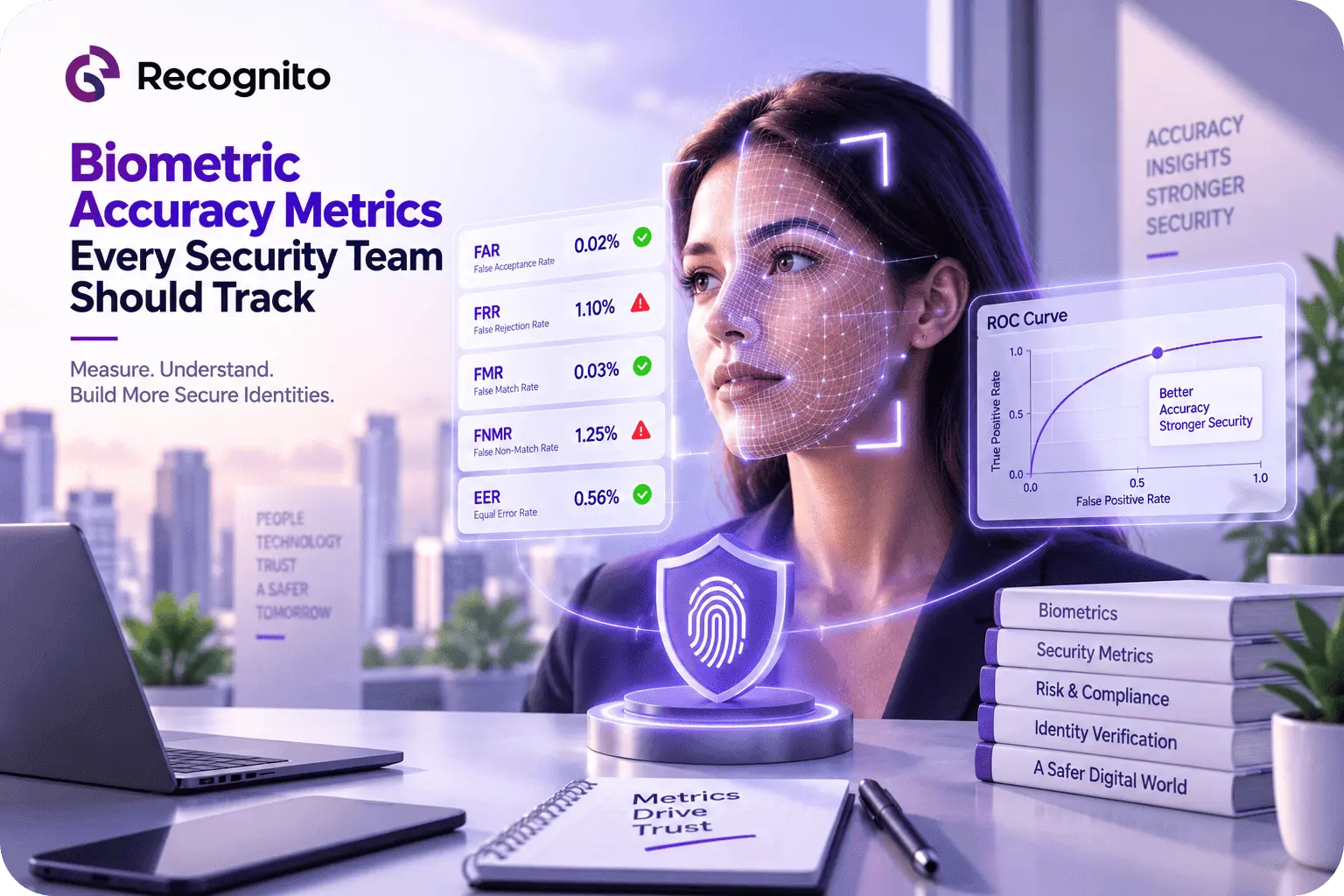
These questions make metrics such as false acceptance rate, false rejection rate, false match rate, false non-match rate, equal error rate, and ROC curves important components of a serious biometric evaluation.
This guide explains the most useful biometric verification accuracy metrics, what they mean, how they relate to one another, and which ones security teams should actually monitor.
Why a Single Biometric Accuracy Percentage Is Not Enough
The word “accuracy” can hide important trade-offs.
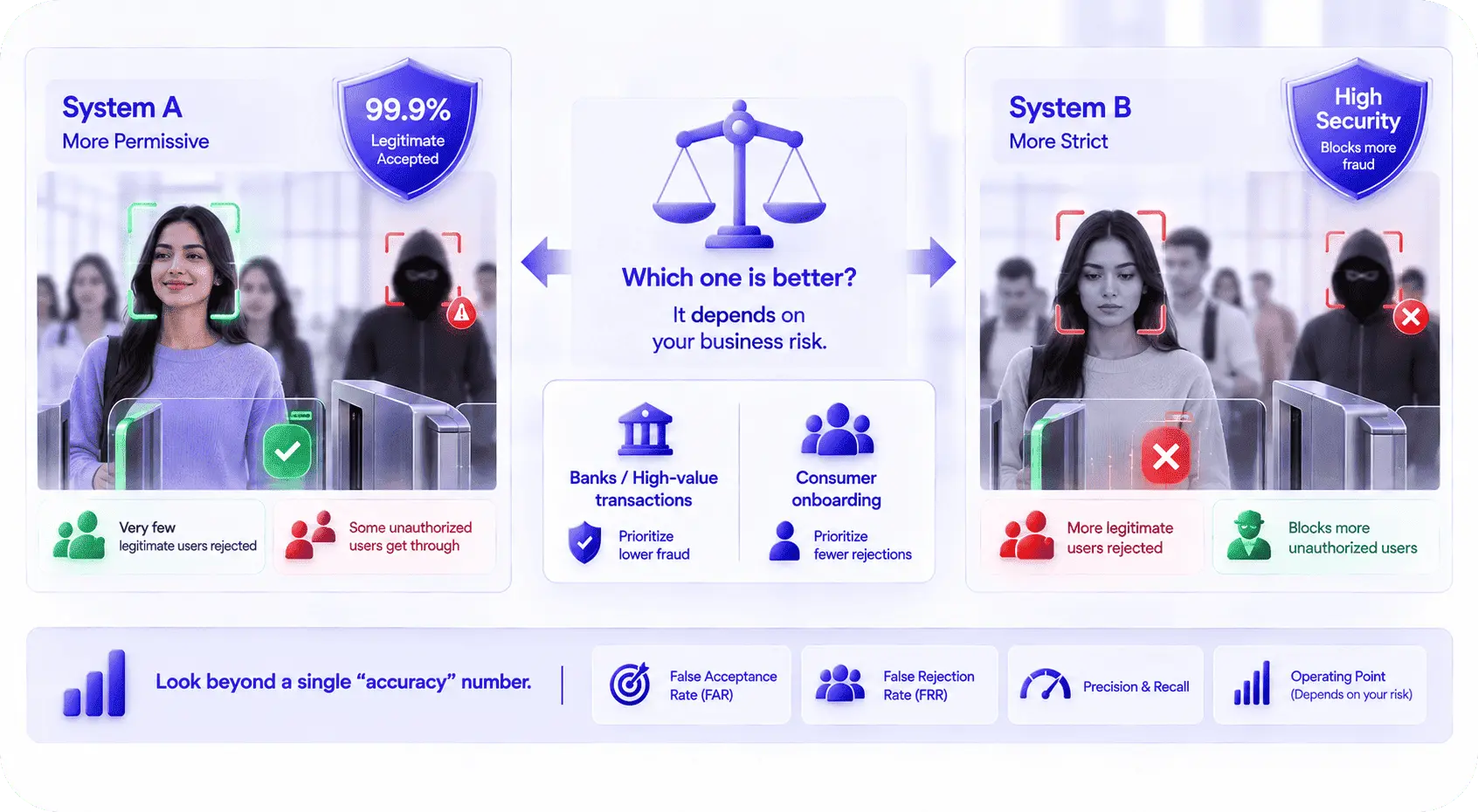
Imagine two systems:
System A accepts 99.9% of legitimate customers but also allows a small number of unauthorized users through.
System B is much stricter and blocks more unauthorized attempts but rejects more legitimate users.
Which one is better?
There is no universal answer.
A bank authenticating customers for high-value transactions may prioritize minimizing false acceptance. A consumer onboarding service may place greater importance on reducing unnecessary customer rejection.
The appropriate operating point depends on the business risk.
This is why security teams should look at several related metrics rather than accepting one headline accuracy number.
NIST’s Face Technology Evaluations provide useful independent context for evaluating facial recognition performance, including the distinction between different error measures and testing scenarios.
Recognito’s existing guide on NIST face recognition benchmarks can also help teams understand how external biometric evaluation should be interpreted.
Understanding Biometric Verification Accuracy
Before examining individual metrics, it helps to understand what a biometric verification system is actually doing.
In a typical 1:1 verification workflow, the system compares a newly captured biometric sample with an enrolled reference associated with a claimed identity.
The system then produces a similarity score or another decision signal.
A threshold determines whether the comparison is treated as a match or non-match.
If the threshold is changed, the balance between false acceptance and false rejection can also change.
This is one of the most important concepts in biometric security:
There is usually no single threshold that maximizes every desirable outcome at the same time.
A stricter threshold can reduce false accepts while increasing false rejects. A more permissive threshold can improve legitimate-user acceptance while increasing the chance of accepting an impostor.
Security teams therefore need to choose and monitor the operating point according to the business risk.
1. False Acceptance Rate
False Acceptance Rate, commonly abbreviated as FAR, describes how often an unauthorized or non-matching user is incorrectly accepted as a match.
For a security team, this is one of the most important metrics because it relates directly to unauthorized access.
Consider a facial authentication system protecting a financial account.
If an impostor presents a face that should not match the enrolled customer but the system accepts the attempt, that is a false acceptance.
A high FAR can create serious security exposure even when overall accuracy appears impressive.
The exact terminology can vary between biometric standards and testing methodologies, so security teams should always confirm how a vendor defines and calculates the metric.
Why FAR Matters
FAR is particularly important for:
- High-value financial authentication
- Account access
- Privileged access
- Identity verification
- Fraud prevention
- High-assurance onboarding
However, FAR should not be evaluated in isolation.
A vendor may achieve a very low false acceptance rate by making the matching threshold extremely strict, which could cause legitimate customers to be rejected too frequently.
That leads to the next critical metric.
2. False Rejection Rate
False Rejection Rate, commonly called FRR, measures how often a legitimate user is incorrectly rejected.
In a customer verification workflow, a legitimate person may fail because the system decides their biometric sample does not sufficiently match the enrolled reference.
This can happen because of actual biometric differences or because of conditions such as:
- Poor lighting
- Low-quality camera capture
- Facial pose
- Motion blur
- Image compression
- Changes in appearance
- Poor enrollment quality
FRR is therefore closely connected to customer experience.
A high FRR can lead to repeated verification attempts, manual review, onboarding abandonment, and increased support costs.
Recognito’s article on face recognition accuracy factors provides additional context on why real-world image and environmental conditions can affect recognition results.
Why FRR Matters
FRR is especially important when biometric verification is part of a high-volume customer journey.
A system that rejects too many legitimate customers may be technically secure but commercially ineffective.
Security teams should therefore assess FAR and FRR together rather than optimizing one without considering the other.
3. False Match Rate and False Non-Match Rate
Security teams will also encounter the terms False Match Rate (FMR) and False Non-Match Rate (FNMR).
These concepts are closely related to false acceptance and false rejection, but the terminology is commonly used in formal biometric performance evaluation.
FMR generally describes the probability that a biometric system incorrectly declares a match between biometric samples from different identities.
FNMR describes the probability that the system incorrectly fails to match biometric samples that belong to the same identity.
The distinction is particularly important when reviewing independent benchmark reports because formal evaluation programs may use FMR and FNMR rather than FAR and FRR.
Security teams should not assume that every vendor uses the same terminology in exactly the same way.
Always check:
- The metric definition
- The test methodology
- The threshold
- The dataset
- Whether the test is verification or identification
- Whether the result is vendor-generated or independently evaluated
This helps prevent misleading comparisons between products that use similar terminology but different measurement methodologies.
4. Equal Error Rate
Equal Error Rate, or EER, is the point where the false acceptance and false rejection error rates are equal.
EER can provide a convenient way to summarize the trade-off between the two error types.
A lower EER generally indicates stronger overall discrimination between genuine and impostor attempts under the relevant test conditions.
However, EER is not always the most useful metric for a production security decision.
A real application usually operates at a particular threshold based on its risk requirements rather than at the threshold where false acceptance and false rejection happen to be equal.
For example, a financial institution may deliberately operate at a point where false acceptance is extremely low, even if that results in a higher false rejection rate.
That means security teams should use EER as a comparison metric, not automatically as the final operating target.
5. Receiver Operating Characteristic Curves
A Receiver Operating Characteristic curve, or ROC curve, shows how verification performance changes as the decision threshold changes.
Instead of looking at one point, the security team can examine the broader trade-off between accepting genuine users and rejecting impostors.
ROC curves are useful because they show whether a biometric algorithm maintains strong separation across different operating points.
For enterprise evaluation, the curve can help answer questions such as:
- How does security change as the threshold increases?
- How much legitimate-user rejection occurs when false accepts are reduced?
- Is there a stable operating region?
- How sensitive is performance to threshold changes?
This is particularly valuable during procurement because security teams can assess whether a vendor’s technology gives them sufficient flexibility to choose an operating point suitable for their risk model.
6. Threshold Selection
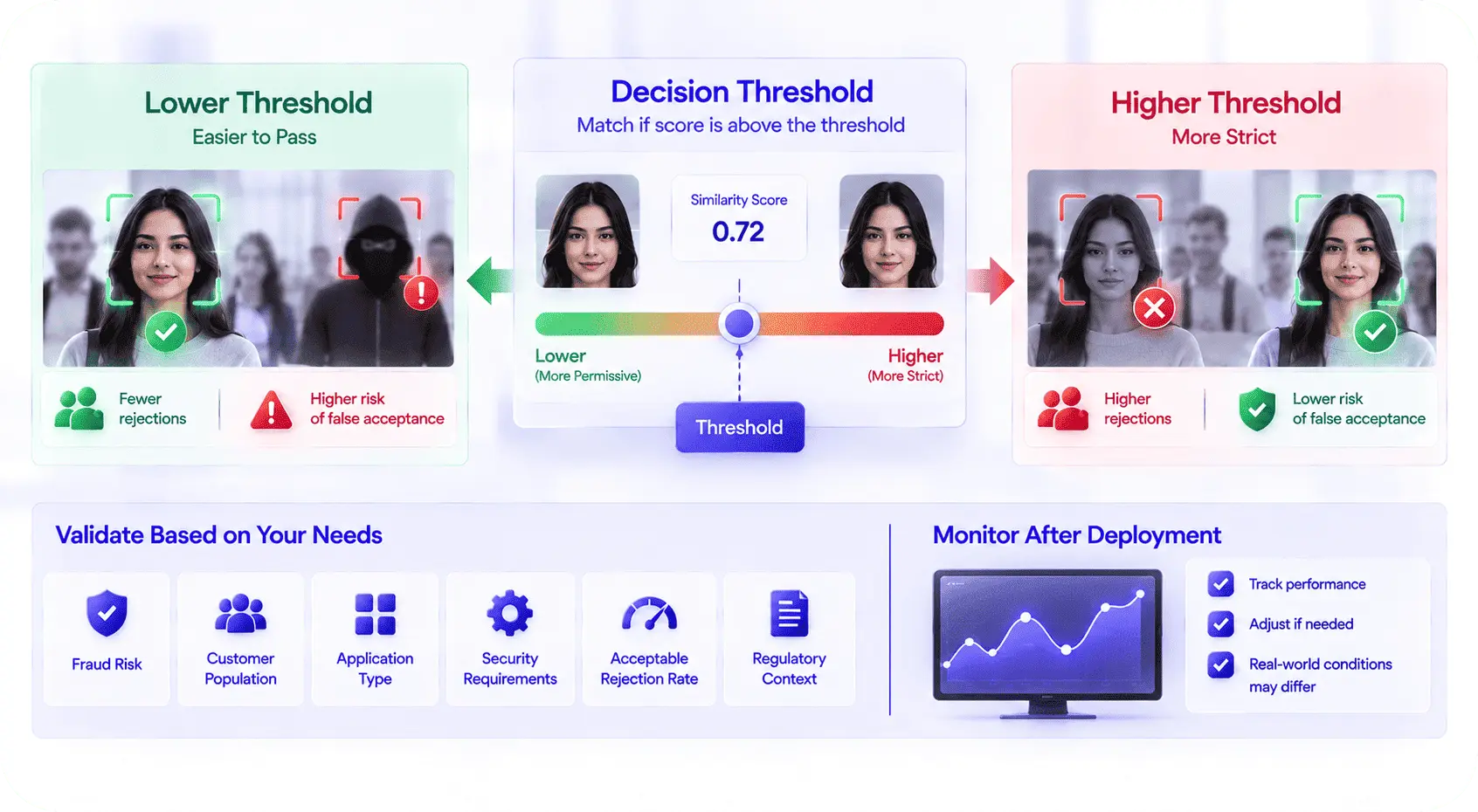
Biometric systems generally rely on a decision threshold.
Two facial samples may produce a similarity score. If the score is above the threshold, the system may treat the samples as a match. If the score is below it, the system may treat them as a non-match.
The threshold is therefore a critical operational security setting.
A lower threshold may make it easier for legitimate users to pass but can also increase false acceptance.
A higher threshold may reduce false acceptance but increase legitimate-user rejection.
Security teams should avoid choosing a threshold solely because a vendor recommends it.
The correct value should be validated against the organization’s:
- Fraud risk
- Customer population
- Application type
- Security requirements
- Acceptable rejection rate
- Regulatory context
Thresholds should also be monitored after deployment because real-world performance can differ from initial testing.
7. Genuine and Impostor Attempts
Understanding the test populations behind biometric metrics is essential.
A genuine attempt compares samples that belong to the same identity.
An impostor attempt involves samples from different identities.
The quality of the testing population directly affects the usefulness of the results.
For example, a security team should ask whether the vendor’s testing includes realistic variations in:
- Age
- Lighting
- Camera quality
- Facial pose
- Image quality
- Capture environment
NIST’s facial recognition evaluations are useful partly because standardized testing provides a structured basis for comparing algorithm performance rather than relying entirely on vendor-generated claims.
However, enterprise buyers should still conduct application-specific testing.
8. 1:1 Verification vs 1:N Identification Metrics
Another important distinction is whether the biometric system is performing verification or identification.
1:1 verification asks whether a biometric sample matches a particular claimed identity.
1:N identification asks which identity, if any, corresponds to a biometric sample within a larger gallery.
The risk model can be very different.
A customer login may use 1:1 verification. A large-scale identification system may involve searching against thousands or millions of enrolled identities.
Security teams should therefore avoid directly comparing a 1:1 verification result with a 1:N identification result as though they were equivalent metrics.
The evaluation must reflect the actual biometric workflow.
Organizations developing broader identity processes can also consider how verification fits into identity proofing and identity verification.
9. Biometric Accuracy Under Real-World Conditions
Laboratory performance can be informative, but real-world performance is what ultimately affects customers.
A facial verification system may encounter:
- Different smartphones
- Web cameras
- Poor lighting
- Movement
- Different camera distances
- Image compression
- Occlusions
- Facial appearance changes
Security teams should therefore establish a representative test environment before deployment.
A useful proof of concept should include the actual devices, environments, and customer flows expected in production.
This is where biometric verification accuracy becomes more than a benchmark question.
The organization needs to know whether the measured performance remains acceptable when the technology operates under real-world conditions.
10. Demographic Performance
Biometric accuracy should also be examined across relevant demographic groups.
Differences in performance can affect both security and customer experience.
Security teams should ask whether independent testing provides demographic performance information and whether the vendor can explain any observed differences.
Testing should consider relevant populations and operating conditions rather than assuming that one overall accuracy figure applies equally to everyone.
This can be especially important for global organizations with diverse customer populations.
The goal is not simply fairness in an abstract sense. Significant differences in false acceptance or false rejection can create measurable operational, compliance, and customer-experience consequences.
11. Liveness and Presentation Attack Performance
Facial matching accuracy does not tell the complete biometric security story.
A system can correctly compare two facial images while remaining vulnerable to attacks involving photographs, replayed videos, masks, or other presentation techniques.
That is why biometric verification should be evaluated alongside liveness and presentation attack detection where the risk profile requires it.
A liveness detection SDK can provide an additional layer to help determine whether the biometric presentation appears genuine.
The ISO/IEC 30107-3:2023 standard provides principles and methods for testing and reporting presentation attack detection performance.
This is important because security teams should not assume that a strong face matching score automatically means the biometric interaction is secure.
Which Metrics Should Security Teams Track?
Different metrics serve different purposes, and not all should receive equal weight.
| Metric | What It Measures | Why It Matters |
| FAR | Incorrect acceptance of unauthorized attempts | Direct indicator of authentication risk |
| FRR | Incorrect rejection of legitimate users | Shows customer and operational friction |
| FMR | Incorrect match between different identities | Useful for formal biometric testing |
| FNMR | Failure to match the same identity | Useful for evaluating legitimate-user performance |
| EER | Point where error rates are equal | Useful for broad algorithm comparison |
| ROC | Performance across thresholds | Helps select an appropriate operating point |
| Verification latency | Time required to produce a result | Affects customer experience and system capacity |
| Failure rate | Proportion of attempts that cannot complete successfully | Reveals deployment and usability problems |
The most important metric depends on the application.
For a high-security financial authentication workflow, FAR or FMR may receive greater attention.
For a consumer onboarding workflow, FRR, completion rate, and overall customer friction may also be critical.
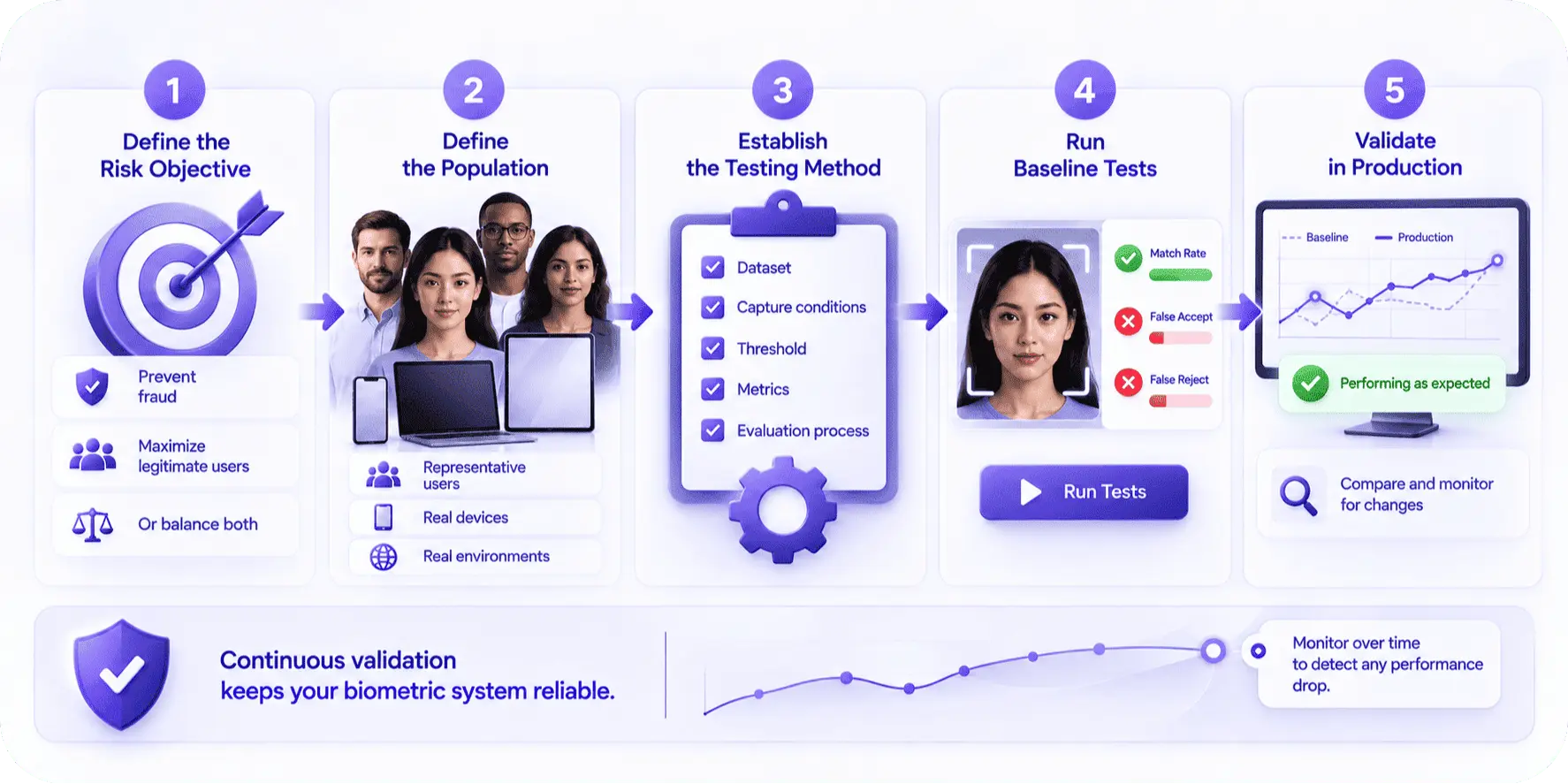
How Security Teams Should Establish an Accuracy Baseline
A useful biometric accuracy program begins before production.
1. Define the Risk Objective
Determine whether the primary objective is preventing unauthorized acceptance, maximizing legitimate-user completion, or balancing both.
2. Define the Population
Use representative users, devices, and environments.
3. Establish the Testing Method
Document the dataset, capture conditions, threshold, metrics, and evaluation process.
4. Run Baseline Tests
Measure biometric performance before deployment and record the results.
5. Validate in Production
Compare production metrics against the original baseline after launch.
This allows security teams to identify performance deterioration rather than assuming that a successful pre-launch test will remain valid indefinitely.
Using SDK-Based Biometrics in Production
For organizations integrating biometrics directly into their products, the accuracy of the underlying SDK is only one part of implementation quality.
A biometric verification SDK can provide facial matching capabilities, but the organization still controls how the SDK is integrated, how images are captured, what threshold is selected, and how failures are handled.
Developers should also consider the broader user journey.
A technically accurate biometric system can still perform poorly from a business perspective if poor capture guidance causes excessive retries.
Teams can review the Recognito GitHub repository as part of the technical evaluation and implementation process.
How Organizations Should Monitor Accuracy After Deployment
Biometric accuracy should not be measured only during procurement.
Production monitoring is essential because the operating environment can change.
For example, the organization may introduce a new mobile application version, support new devices, expand into another country, or change the camera capture workflow.
All of these changes can affect biometric performance.
Security teams should monitor:
- FAR or FMR where measurable
- FRR or FNMR where measurable
- Verification completion
- Retry rates
- Failure rates
- Latency
- Manual review rates
- Device-specific performance
- Demographic performance where appropriate
The purpose is to identify meaningful changes rather than reacting to every individual verification failure.
Accuracy, Security, and Customer Experience Must Be Balanced
The best biometric deployment is not necessarily the one with the lowest error rate in a laboratory.
It is the one that provides an appropriate level of security while allowing legitimate customers to complete the intended workflow.
Consider an online banking application.
If the system is extremely strict, unauthorized access may be reduced but legitimate customers may struggle to authenticate.
If the threshold is too relaxed, the user experience may improve but the risk of false acceptance could increase.
The ideal operating point depends on the organization’s risk tolerance.
That is why security, fraud, product, compliance, and engineering teams should jointly evaluate biometric performance rather than leaving threshold decisions entirely to one department.
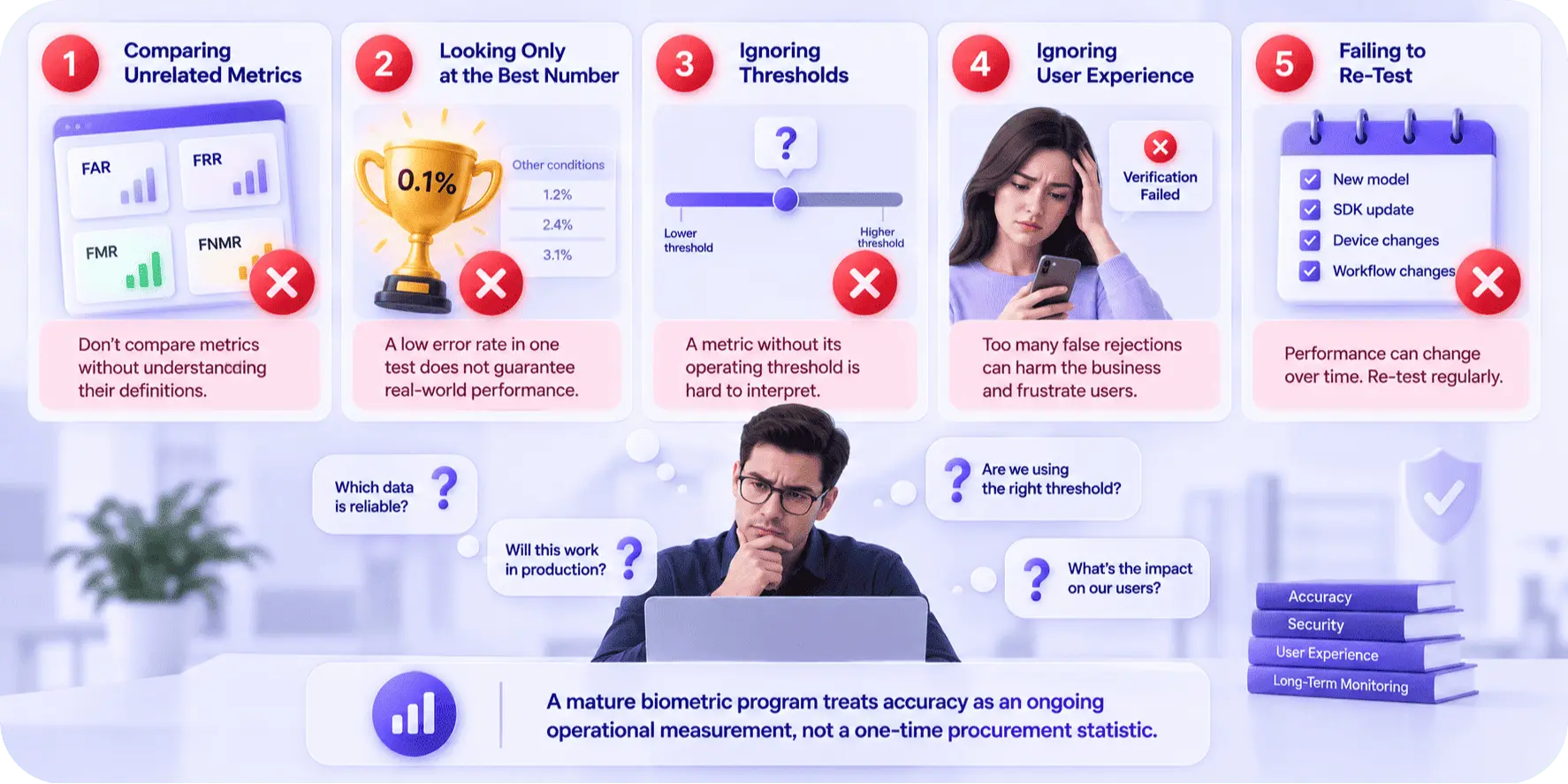
Common Mistakes When Evaluating Biometric Accuracy
Organizations can misinterpret otherwise useful biometric data.
Comparing Unrelated Metrics
FAR, FRR, FMR, and FNMR should not be compared without understanding their definitions and test methodologies.
Looking Only at the Best Number
A low error rate under one test condition does not guarantee equivalent production performance.
Ignoring Thresholds
A metric without its operating threshold can be difficult to interpret.
Ignoring User Experience
Security improvements that create excessive legitimate-user rejection can damage the business.
Failing to Re-Test
A model, SDK version, device fleet, or workflow change can alter biometric performance.
A mature biometric program treats accuracy as an ongoing operational measurement rather than a one-time procurement statistic.
What Security Teams Should Ask Biometric Vendors
Before selecting a biometric technology provider, security teams should request enough information to reproduce or understand the vendor’s claims.
Questions should include:
- Which metrics are reported?
- How are FAR and FRR defined?
- Are FMR and FNMR available?
- What datasets were used?
- What thresholds were applied?
- Was testing independent?
- What demographic performance information is available?
- What conditions were included?
- Which technology version was tested?
- How does performance compare under representative production conditions?
For high-assurance applications, organizations should request evidence rather than relying exclusively on marketing percentages.
Conclusion
Biometric accuracy is not a single number.
Security teams need to understand how false acceptance, false rejection, false matching, false non-matching, thresholds, ROC curves, and real-world conditions affect the security and usability of a biometric verification system.
FAR and FMR help organizations understand the risk of incorrectly accepting unauthorized attempts. FRR and FNMR help reveal the impact on legitimate users. EER can provide a useful broad comparison, while ROC curves help teams understand the trade-off across different operating thresholds.
But metrics are meaningful only when their definitions, test conditions, datasets, and thresholds are understood.
The most reliable approach is to combine independent benchmark evidence with application-specific testing and continuous production monitoring.
Organizations implementing biometric verification should therefore evaluate accuracy as part of the wider security architecture, including liveness, presentation attack protection, privacy, customer experience, scalability, and operational reliability.
Businesses evaluating SDK-based biometric technologies can explore the broader capabilities available from Recognito as part of their biometric verification strategy.
Frequently Asked Questions
What is the most important biometric accuracy metric?
There is no single metric that is most important for every use case. FAR or FMR may be particularly important for high-security authentication, while FRR or FNMR can be critical when legitimate-user experience and verification completion are major concerns.
What is the difference between FAR and FRR?
FAR measures how often unauthorized attempts are incorrectly accepted, while FRR measures how often legitimate users are incorrectly rejected. Lowering one can sometimes increase the other depending on the system threshold.
What is the difference between FMR and FNMR?
FMR refers to incorrectly declaring a match between different identities, while FNMR refers to incorrectly failing to match samples belonging to the same identity. These terms are commonly used in formal biometric performance evaluations.
Should enterprises use EER to choose a biometric system?
EER can be useful for broad comparison, but it should not be the only selection criterion. Production systems normally operate at a specific threshold determined by the organization’s security and customer-experience requirements.
Should biometric accuracy be monitored after deployment?
Yes. Production conditions can change when new devices, application versions, markets, or capture workflows are introduced. Ongoing monitoring helps organizations detect meaningful changes in biometric performance and maintain appropriate security.