


Implementing face recognition software in a production environment is very different from demonstrating it in a proof of concept.
A development team may successfully compare two faces in a controlled test, yet encounter unexpected problems when the same technology is deployed across thousands of users, devices, cameras, operating systems, and real-world environments.
These problems can affect recognition accuracy, integration, performance, privacy, security, customer experience, and long-term maintenance.
That is why face recognition implementation should be treated as a complete engineering and operational project rather than simply installing a biometric component.
Organizations deploying facial recognition need to consider how the technology will work with their existing architecture, how biometric data will be handled, how spoofing will be controlled, how failures will be managed, and how the system will scale as usage grows.
This article examines the most common face recognition deployment challenges and practical ways organizations can overcome them.
Why Face Recognition Implementation Is More Difficult in Production
Facial recognition systems operate at the intersection of computer vision, software engineering, security, privacy, hardware, and user experience.
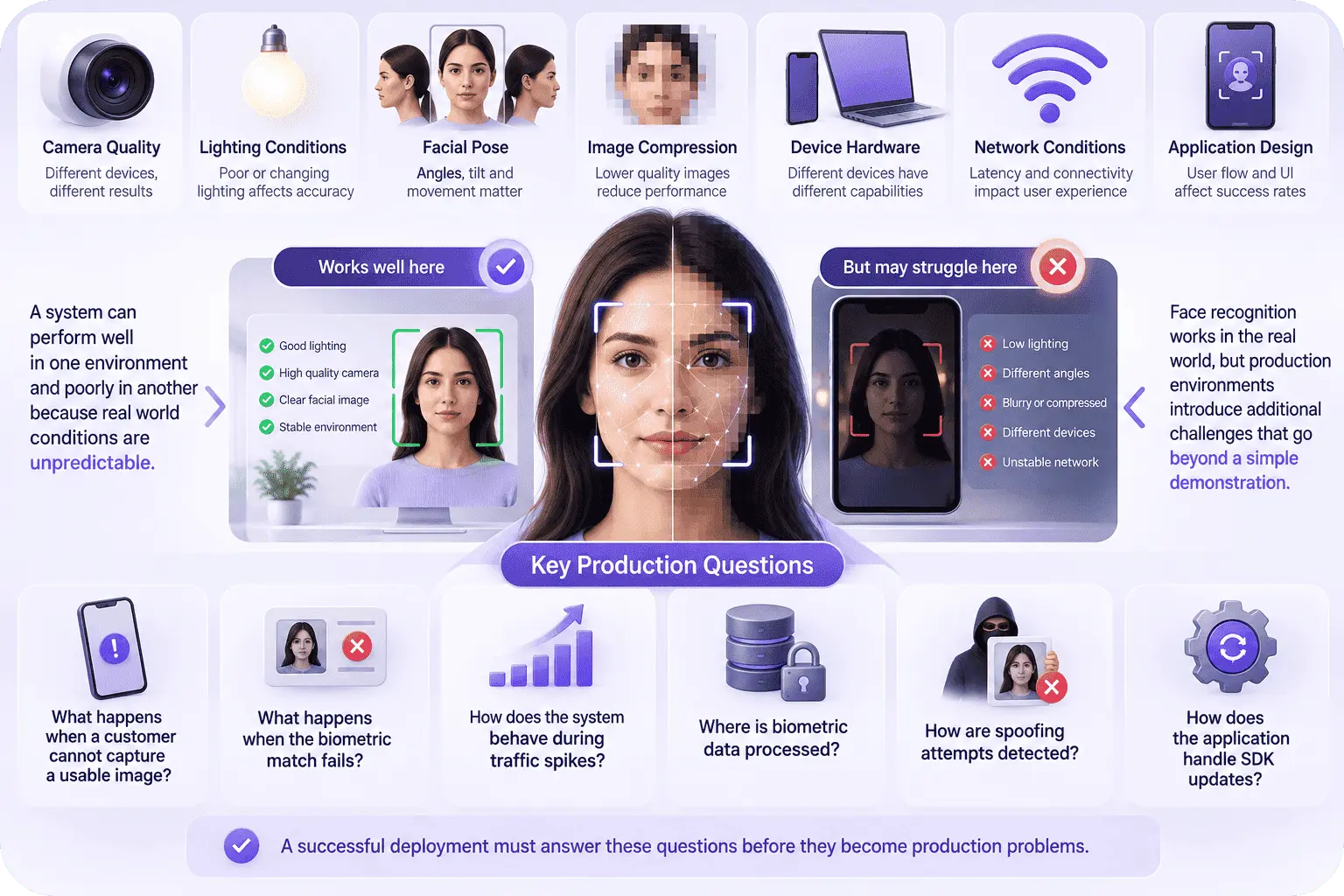
A system can perform well in one environment and poorly in another because of changes in camera quality, lighting, facial pose, image compression, device hardware, network conditions, or application design.
Production environments also introduce operational questions that are easy to overlook during an initial demonstration.
For example:
- What happens when a customer cannot capture a usable image?
- What happens when the biometric match fails?
- How does the system behave during traffic spikes?
- Where is biometric data processed?
- How are spoofing attempts detected?
- How does the application handle SDK updates?
A successful deployment must answer these questions before they become production problems.
1. Inconsistent Image Quality
One of the most common implementation challenges is image quality.
Face recognition depends on the quality of the biometric sample being captured. Real users do not all have identical cameras, lighting, positioning, or capture conditions.
A production application may receive images affected by:
- Poor lighting
- Motion blur
- Low camera resolution
- Extreme facial angles
- Incorrect capture distance
- Image compression
- Occlusion
- Poor framing
These conditions can increase failed or inaccurate verification attempts even when the underlying algorithm performs well under controlled conditions.
Recognito’s resource on face recognition accuracy factors provides additional context on the conditions that can influence biometric performance.
How Organizations Overcome It
The solution is not always to choose a more powerful algorithm.
The capture process itself should be optimized.
Organizations can improve results by providing clear capture guidance, detecting unsuitable frames before submission, defining appropriate image-quality thresholds, and testing the application across the actual devices expected in production.
A strong proof of concept should therefore use representative users and devices rather than only ideal test images.
2. Integration With Existing Application Architecture
A technically capable biometric solution can still create problems if it does not fit the application’s architecture.
An enterprise may have mobile applications, backend services, identity databases, authentication systems, fraud engines, and customer relationship systems that all need to exchange information during verification.
The biometric component must fit into that workflow without introducing unnecessary complexity.
When evaluating a facial recognition SDK, engineering teams should consider how the technology interacts with their existing application rather than evaluating the biometric function in isolation.
Important questions include:
- How is the SDK initialized?
- Where does processing occur?
- How are results returned?
- How are errors handled?
- How does the application manage SDK updates?
- What happens when the biometric service is unavailable?
How Organizations Overcome It
A dedicated integration design should be created before production deployment.
The team should define where biometric processing occurs, how results move through the system, which components own the data, and how failures are handled.
Developers should also work from the actual implementation documentation rather than designing the architecture around assumptions.
The developer documentation can be reviewed during this stage to understand the available integration resources and technical requirements.
3. Balancing Recognition Accuracy With User Experience
A biometric system can become too strict.
Increasing matching sensitivity may reduce some fraudulent attempts but can also increase false rejections for legitimate users.
This creates a direct relationship between security and customer experience.
A customer who repeatedly fails facial verification may abandon an onboarding process even if the organization’s fraud controls are technically effective.
For enterprise applications, implementation should therefore consider both sides of the equation.
Useful metrics include:
- Verification success rate
- False rejection rate
- Verification completion time
- Retry frequency
- Customer abandonment
- Manual review rate
How Organizations Overcome It
Thresholds should be selected based on actual business requirements and tested using representative users.
The objective should not be to maximize rejection.
It should be to find an operating point that provides appropriate security while allowing legitimate users to complete verification efficiently.
This is another reason why production testing is more valuable than relying solely on vendor specifications.
4. Presentation Attacks and Liveness Detection
A facial recognition system can produce a correct facial match while still being vulnerable to presentation attacks.
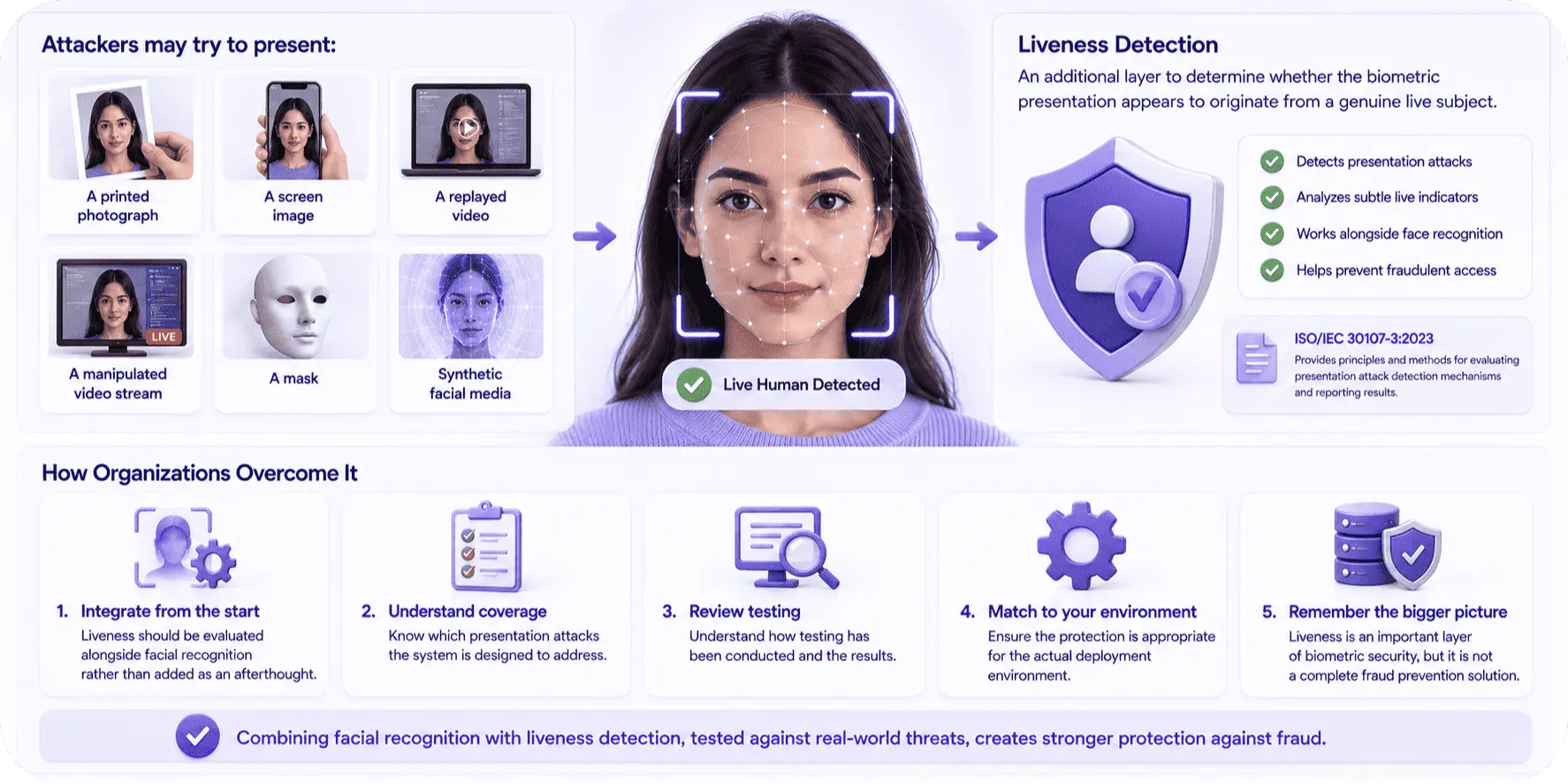
An attacker may try to present:
- A printed photograph
- A screen image
- A replayed video
- A manipulated video stream
- A mask
- Synthetic facial media
This makes liveness detection an important part of many biometric deployments.
A liveness detection SDK can provide an additional layer for determining whether a biometric presentation appears to originate from a genuine live subject.
How Organizations Overcome It
Liveness should be evaluated alongside facial recognition rather than added as an afterthought.
Teams should understand which presentation attacks the system is designed to address, how testing has been conducted, and whether the protection is appropriate for the actual deployment environment.
The ISO/IEC 30107-3:2023 standard provides principles and methods for evaluating presentation attack detection mechanisms and reporting results.
Organizations should also understand that liveness is one part of biometric security, not a complete fraud prevention solution.
5. Device and Platform Variability
Face recognition deployment becomes more difficult when users operate across many different devices.
A mobile application may run across multiple generations of smartphones with different front-facing cameras, processing capabilities, operating systems, and image pipelines.
A web-based application introduces another layer of variability because browsers and webcams behave differently across devices.
This can affect image capture and the overall verification experience.
How Organizations Overcome It
Organizations should define a supported device and platform matrix before launch.
Testing should cover the devices that represent a meaningful proportion of the expected user base rather than only the latest hardware.
Where appropriate, the application should also detect whether a device or capture environment is unsuitable before starting the biometric workflow.
The objective is to make the supported experience predictable rather than allowing every possible environment into production without testing.
6. Performance and Scalability
A biometric solution that works well for a small pilot may not behave the same way when transaction volume increases dramatically.
An enterprise may eventually process thousands or millions of face verification events, with usage concentrated around particular times.
Scalability therefore needs to be assessed before production.
Important considerations include:
- Processing latency
- Concurrent requests
- CPU and memory requirements
- Infrastructure capacity
- Database performance
- Horizontal scaling
- Peak traffic handling
How Organizations Overcome It
Load testing should be performed using realistic traffic assumptions.
A fintech platform should test volumes that resemble expected customer onboarding rather than simply confirming that a small demonstration works.
The team should also identify bottlenecks outside the biometric engine itself. Network latency, API orchestration, database access, and application logic can all affect the overall verification time.
7. Privacy and Biometric Data Management
Biometric deployment introduces another major consideration: data handling.
Organizations need to understand where facial images and biometric representations are processed, whether information is stored, how long it is retained, and who can access it.
For enterprises serving multiple markets, the situation can become more complicated because privacy requirements vary between jurisdictions.
Relevant questions include:
- Is facial data processed locally or remotely?
- Are raw images stored?
- Are biometric templates retained?
- What is the retention period?
- How is data deleted?
- Who can access biometric information?
- Where is the information stored?
The GDPR framework is an important reference for organizations processing European personal data.
How Organizations Overcome It
Privacy should be designed into the architecture from the beginning.
Organizations should minimize unnecessary data collection, define retention periods, restrict access, document data flows, and evaluate vendor responsibilities before deployment.
A technical implementation that ignores data governance can create compliance problems even when the biometric functionality itself works correctly.
8. Security Beyond the Biometric Algorithm
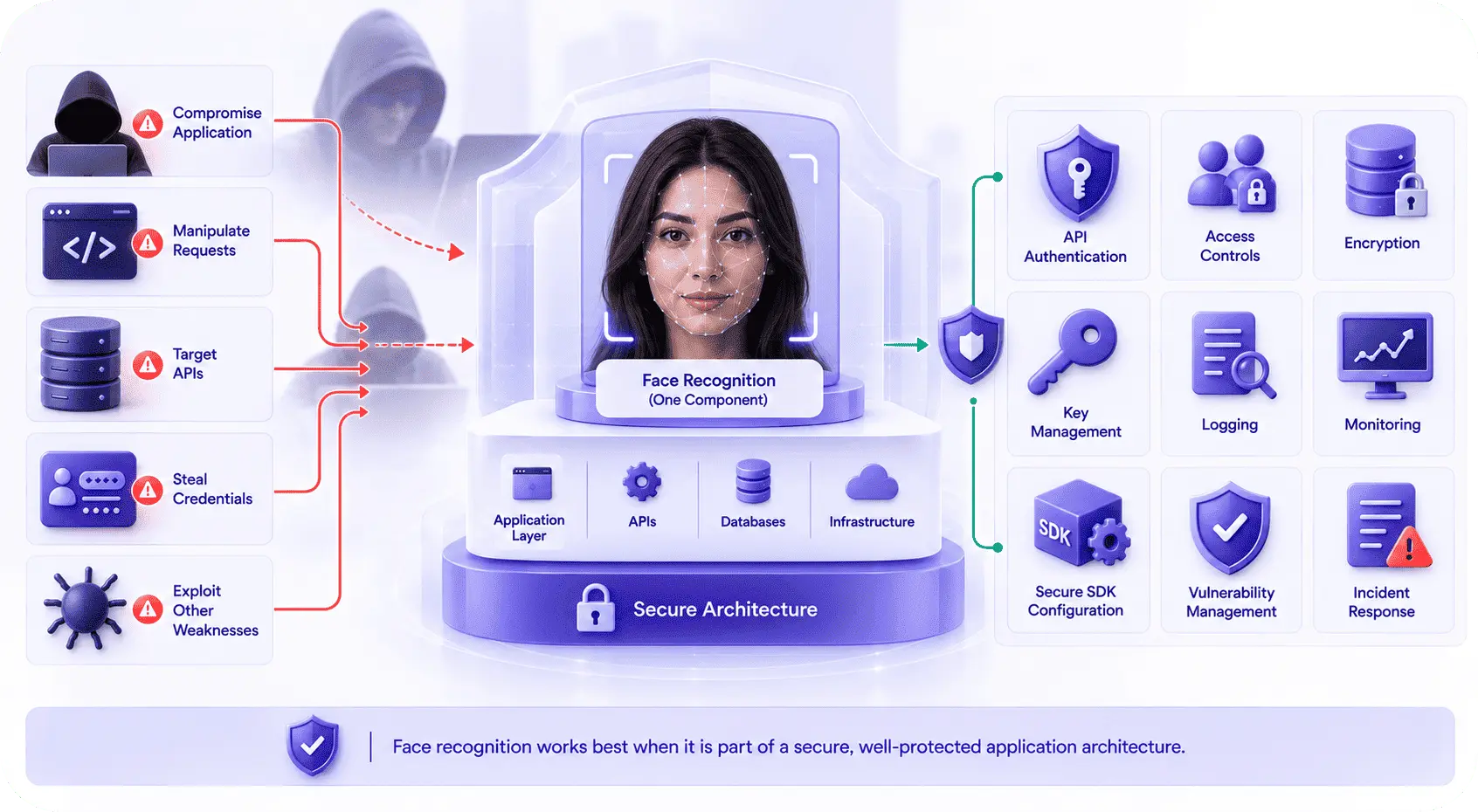
A strong biometric algorithm does not automatically create a secure application.
The surrounding architecture also needs protection.
An attacker may attempt to compromise the application, manipulate requests, target APIs, steal credentials, or exploit weaknesses in other parts of the identity workflow.
Face recognition should therefore be treated as one security component within the broader system.
The presentation attack detection and biometric security resource provides additional context on why biometric security involves more than matching accuracy.
How Organizations Overcome It
Security teams should evaluate:
- API authentication
- Access controls
- Encryption
- Key management
- Logging
- Monitoring
- Secure SDK configuration
- Vulnerability management
- Incident response
The biometric engine should sit within a secure application architecture rather than being expected to compensate for weaknesses elsewhere.
9. Managing SDK Updates and Long-Term Maintenance
Once a biometric SDK becomes part of a production application, it becomes a long-term dependency.
Operating systems change. New devices appear. Security vulnerabilities are discovered. Biometric technologies evolve.
An upgrade that appears minor from the vendor’s perspective can still affect application behavior.
How Organizations Overcome It
Organizations should establish an SDK lifecycle management process before deployment.
That includes testing new releases in a controlled environment, documenting dependencies, maintaining rollback procedures, and monitoring for changes that could affect biometric performance.
Teams should also avoid treating SDK updates as routine dependency upgrades without validation.
A biometric component can influence security, onboarding conversion, and identity decisions, so changes should receive appropriate regression testing.
10. Handling Failed Verification and Edge Cases
Not every biometric attempt will succeed.
A customer may have poor lighting, an unsuitable device, a damaged identity document, an unusual facial pose, or another condition that prevents successful verification.
If the application only has two outcomes, “verified” and “rejected,” legitimate users may become trapped.
How Organizations Overcome It
A production system should provide a clear recovery path.
Depending on the risk level, this could involve:
- A second capture attempt
- Additional capture guidance
- Another verification method
- Manual review
- Escalation to customer support
The important point is that biometric failure should be treated as an operational event that needs to be handled deliberately.
Comparing Face Recognition Deployment Challenges
Organizations can use a structured framework to prioritize implementation risks before production.
| Deployment Challenge | Potential Impact | Practical Response |
| Poor image quality | Failed or inaccurate verification | Improve capture guidance and quality controls |
| Integration complexity | Longer development and maintenance | Design architecture and test integration early |
| Device variability | Inconsistent user experience | Establish a supported device matrix |
| Presentation attacks | Increased fraud exposure | Add liveness and PAD controls |
| High traffic | Latency or service degradation | Conduct realistic load and scalability testing |
| Privacy requirements | Compliance and reputational risk | Minimize data and document processing |
| SDK updates | Compatibility or security issues | Use controlled release and regression testing |
| Failed verification | Customer abandonment | Provide recovery and escalation paths |
The table is a planning tool, not a replacement for testing the actual application.
Building a Better Face Recognition Implementation Strategy
A successful deployment usually begins before any production code is released.
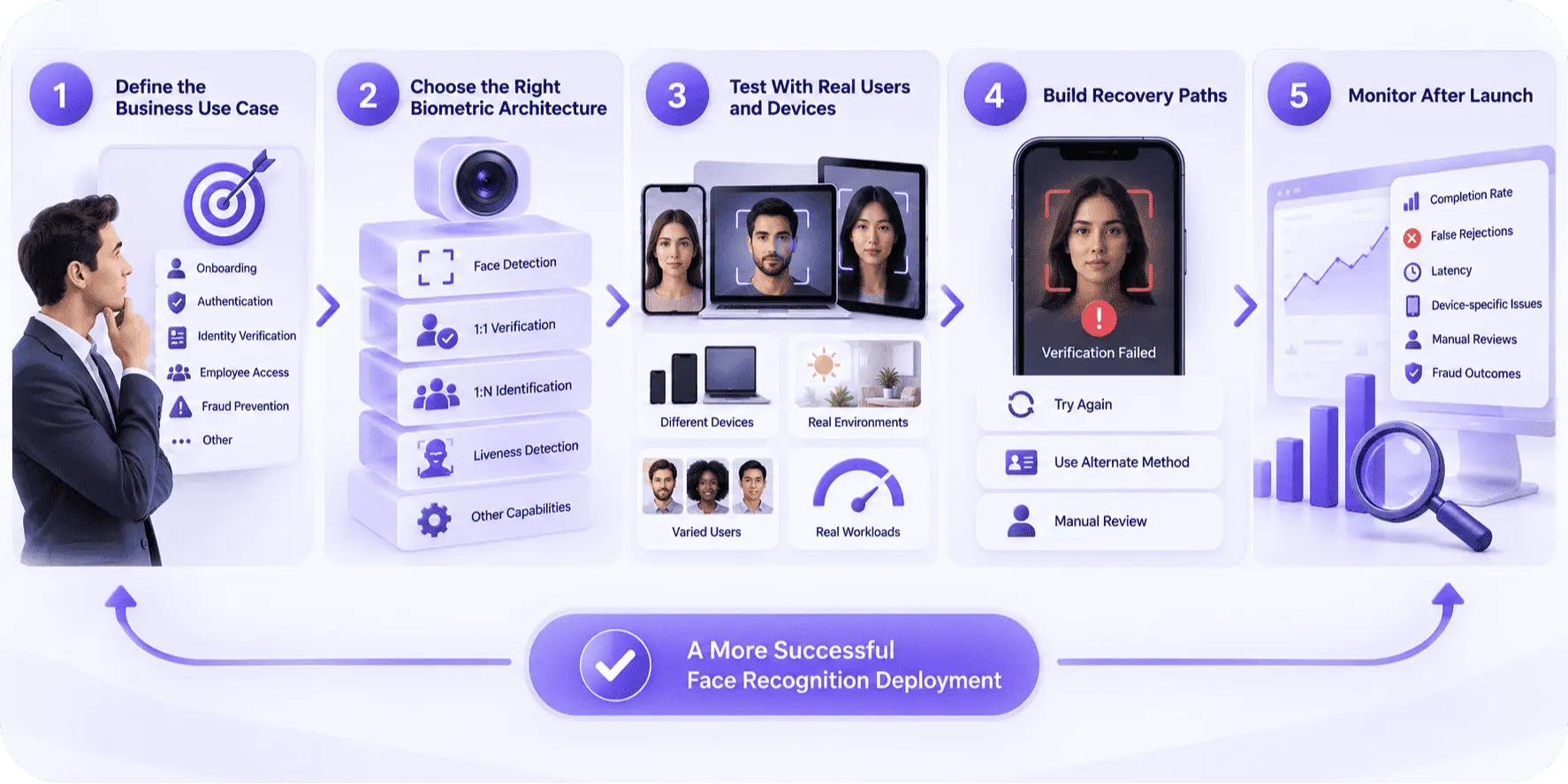
Define the Business Use Case
First establish exactly what the biometric system is supposed to accomplish.
Is it customer onboarding, authentication, identity verification, employee access, fraud prevention, or another use case?
The answer determines the security, accuracy, latency, and user experience requirements.
Choose the Appropriate Biometric Architecture
Determine whether the application requires face detection, 1:1 verification, 1:N identification, liveness, or other biometric capabilities.
The architecture should match the actual workflow rather than simply implementing every available feature.
Test With Representative Users and Devices
Use realistic images, devices, environments, and workloads.
This is one of the most important steps because controlled demonstrations rarely reflect production conditions.
Build Recovery Paths
Determine what happens when verification fails.
A resilient workflow should provide an appropriate next step rather than simply rejecting the user.
Monitor After Launch
Track performance continuously.
Useful indicators include verification completion, false rejections, latency, device-specific failure rates, manual reviews, and fraud outcomes.
Face Recognition Implementation vs Building From Scratch
Some organizations consider developing face recognition technology internally rather than integrating an existing SDK.
Building internally can provide greater control, but it also requires substantial expertise across computer vision, machine learning, biometric algorithms, security, optimization, testing, and ongoing maintenance.
For many businesses, an SDK can reduce that development burden.
The decision should depend on the organization’s internal expertise, time-to-market requirements, customization needs, expected scale, security responsibilities, and long-term maintenance capacity.
Organizations that choose an SDK should still conduct their own technical evaluation rather than assuming integration will be effortless.
How SDK-Based Biometrics Fit Into Production
SDKs can give organizations greater control over how biometric verification becomes part of their own application.
For example, a financial onboarding system may combine an enterprise face recognition SDK with document verification, liveness, risk analysis, and the organization’s own customer records.
This allows the business to control the wider customer journey while using specialized biometric capabilities underneath it.
Where identity documents are part of the workflow, an ID document verification SDK can support the document stage.
Technical teams can also explore the Face Biometric Playground during the evaluation stage to understand the user-facing biometric experience.
For developers, the Recognito GitHub repository provides additional implementation resources.
The objective should be to build an architecture that is easy to test, maintain, secure, and scale.
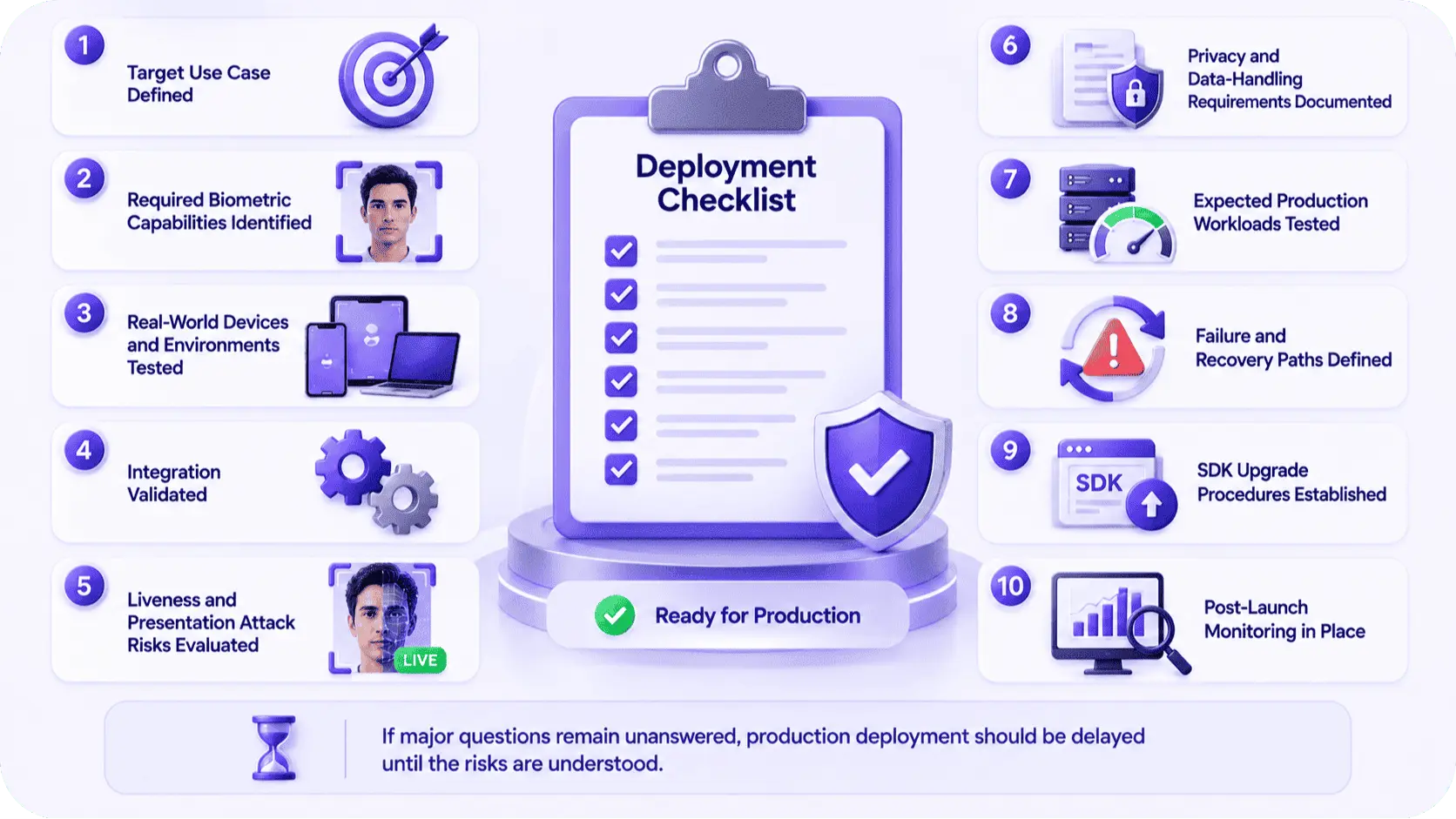
A Practical Deployment Checklist
Before taking face recognition software into production, organizations should be confident that:
- The target use case is clearly defined.
- Required biometric capabilities are identified.
- Real-world devices and environments have been tested.
- Integration has been validated by the development team.
- Liveness and presentation attack risks have been evaluated.
- Privacy and data-handling requirements are documented.
- Expected production workloads have been tested.
- Failure and recovery paths are defined.
- SDK upgrade procedures are established.
- Post-launch monitoring is in place.
If major questions remain unanswered, production deployment should be delayed until the risks are understood.
Conclusion
Successful face recognition implementation requires much more than integrating a biometric library and confirming that face matching works.
Organizations need to address image quality, platform variability, application integration, liveness, security, privacy, scalability, SDK maintenance, user experience, and failed verification scenarios before moving into production.
The strongest implementations treat facial recognition as part of a wider identity and security architecture.
That means testing the technology under realistic conditions, creating recovery paths for legitimate failures, monitoring production performance, and maintaining the biometric component throughout its lifecycle.
Organizations evaluating SDK-based biometric deployment can explore the broader capabilities available from Recognito as part of their implementation planning.
Frequently Asked Questions
What are the biggest challenges when implementing face recognition?
Common challenges include image quality, device variability, integration complexity, biometric security, liveness detection, privacy, scalability, user experience, and long-term SDK maintenance.
How can organizations improve face recognition deployment reliability?
They should test representative devices and users, optimize the capture experience, validate integration early, perform realistic load testing, establish recovery paths, and continuously monitor production performance.
Is liveness detection necessary for every face recognition deployment?
Not every use case has identical requirements, but liveness can be an important security layer for remote identity verification and authentication because it helps address presentation attacks.
Should organizations build face recognition software internally?
Organizations with specialized biometric expertise may choose to build internally, but an SDK can reduce development and maintenance requirements for businesses that need to integrate biometric capabilities into an existing product.
What should be tested before deploying face recognition software?
Organizations should test recognition performance, image quality, device compatibility, integration, liveness, latency, scalability, privacy controls, failure handling, security, and the overall customer experience.