
Online account fraud is no longer just a password problem.
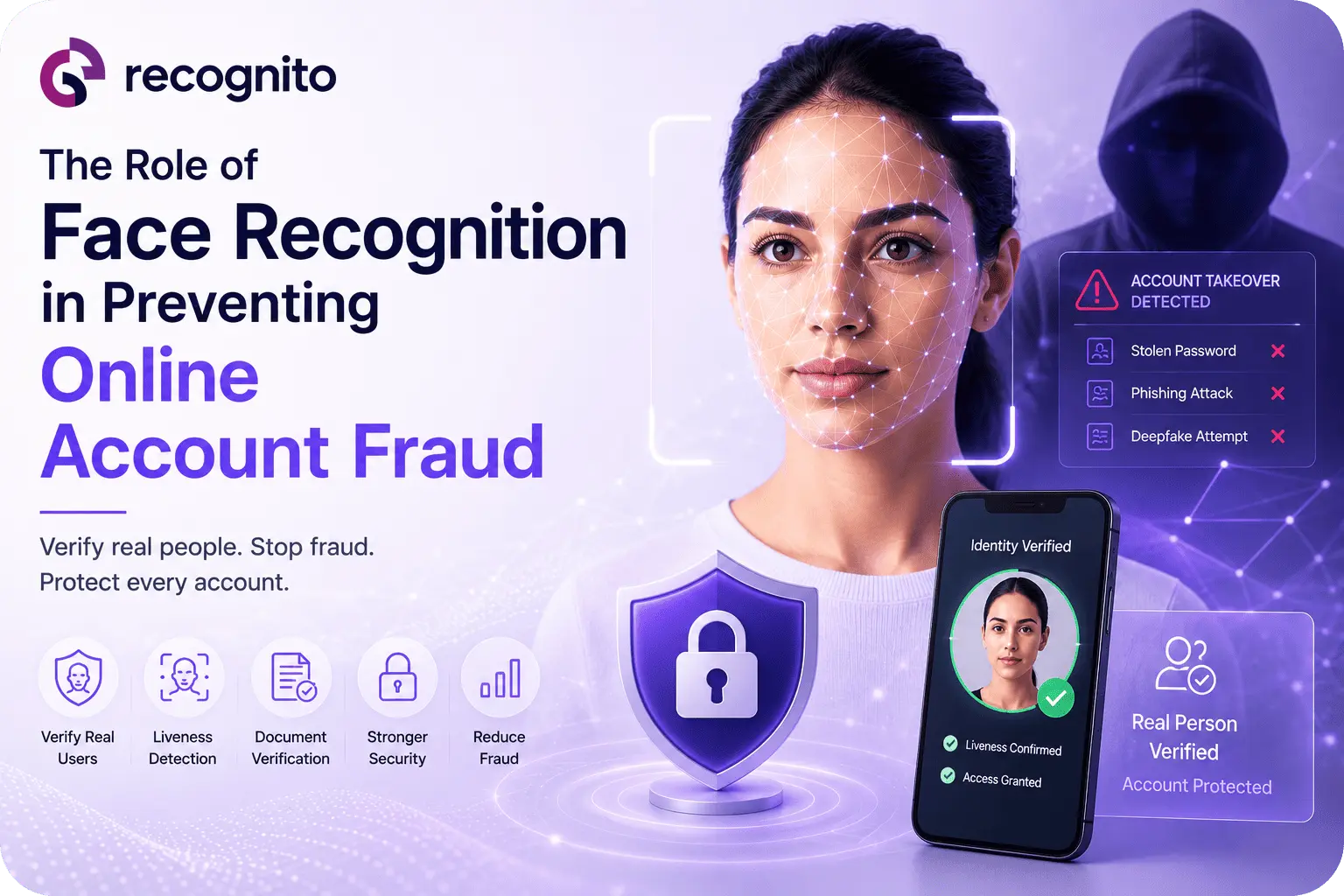
Attackers can combine stolen credentials, phishing, social engineering, compromised devices, identity documents, and synthetic media to impersonate legitimate customers. Once they gain control of an account, they may change credentials, access sensitive information, transfer funds, or use the account for further fraud.
The FBI has warned about account-takeover schemes in which criminals impersonate financial institutions and manipulate victims into revealing credentials or authentication codes. Its 2025 warning reported more than 5,100 account-takeover complaints and losses exceeding $262 million since January of that year. (FBI account-takeover warning)
This makes identity assurance increasingly important.
Face recognition can add a person-based layer to account security.
Instead of relying only on something a customer knows or possesses, an organization can verify whether the person attempting to create, recover, or access an account corresponds with a trusted facial reference.
Used with liveness, identity documents, authentication controls, and risk signals, facial verification can become an important part of a broader account-fraud prevention strategy.
Why Online Accounts Are Vulnerable
Traditional authentication relies heavily on credentials.
These may include:
- Passwords
- PINs
- One-time passcodes
- Authentication apps
- Security tokens
- Email or phone access
These controls remain important, but attackers increasingly target the people and processes surrounding them.
Phishing can expose passwords. Social engineering can trick users into revealing verification codes. Malware can compromise devices. Stolen personal information can make fraudulent requests appear convincing.
The result is a key security problem:
A person can possess valid account credentials without being the legitimate account holder.
This is where biometric verification can provide another layer of assurance.
Where Face Recognition Fits Into Account Security
Facial recognition introduces a biometric identity signal into the authentication process.
Instead of asking only:
“Were the correct credentials supplied?”
the organization can also ask:
“Does the person presenting this verification correspond with the trusted identity?”
This can be valuable during higher-risk events such as:
- Account enrollment
- Account recovery
- Password resets
- High-risk authentication
- Sensitive profile changes
- High-value transactions
The goal is not to replace passwords or multifactor authentication.
It is to make compromised credentials less useful when an additional identity check is warranted.
Face Verification vs Face Identification
For online account security, face verification is generally more relevant than broad face identification.
Face verification is a 1:1 comparison.
The organization already knows which account or identity is being claimed and asks whether the new facial sample matches the trusted reference.
Face identification, by contrast, is typically a 1:N search against multiple possible identities.
This distinction matters because most account-security events involve a specific account holder.
FIDO’s face-verification program specifically addresses remote identity verification in which a subject’s photo or video is compared with a reference face associated with an identity document. (FIDO face-verification documentation)
How Facial Verification Can Prevent Account Fraud
Facial verification can support several stages of the account lifecycle.
During Enrollment
A business can establish a trusted relationship between an identity and a facial reference.
During Account Recovery
A customer who has lost access can provide another form of identity evidence through facial verification.
During High-Risk Authentication
A biometric check can be triggered when other risk signals indicate unusual behavior.
During Sensitive Changes
Changing recovery information, payment details, or other critical settings can require stronger identity assurance.
During Fraud Investigation
Authorized biometric comparisons can provide another signal when multiple accounts appear suspicious.
The strongest applications use facial verification for clearly defined identity events rather than requiring it for every interaction.
Why Liveness Matters
A face match does not automatically establish that a genuine person is presenting the face.
An attacker could potentially use:
- A photograph
- A screen image
- Replayed video
- A physical replica
- Synthetic facial media
Liveness detection addresses a different question:
Does the biometric presentation appear genuine?
A face liveness SDK can add presentation-attack protection to a facial verification workflow.
The roles can therefore be separated:
Face verification: Does the person correspond with the identity?
Liveness: Does the biometric presentation appear genuine?
ISO/IEC 30107-3 provides principles and methods for evaluating presentation attack detection mechanisms and reporting their performance. (ISO/IEC 30107-3)
Liveness should still be treated as one layer within the wider security architecture.
Deepfakes Add Another Attack Surface
Generative AI has made synthetic facial media more convincing.
This matters because a remote identity system may receive a manipulated image or video instead of a genuine representation of the customer.
FIDO’s biometric requirements distinguish deepfakes from the specific attack methods through which they may be used. Synthetic content can become a presentation attack when shown to a biometric sensor, or it may support an injection attack when introduced directly into the processing pipeline. (FIDO biometric requirements)
Organizations therefore need more than a basic face-matching model.
A layered approach can combine:
Facial verification
Liveness
Document verification
Secure capture
Device intelligence
Behavioral signals
Risk analysis
Related guidance on deepfake fraud in financial institutions explains why synthetic-media threats are increasingly relevant to digital financial security.
Protect the Identity Established During Onboarding
Biometric security is only as trustworthy as the identity associated with the biometric reference.
Suppose a fraudulent applicant creates an account using stolen personal information and successfully enrolls their own face.
The biometric system may recognize that face perfectly during future authentication.
The system is functioning correctly, but the underlying identity is wrong.
This is why businesses should treat identity proofing as the foundation.
NIST’s Digital Identity Guidelines address identity proofing, enrollment, authentication, fraud, and security across the digital identity lifecycle. (NIST Digital Identity Guidelines)
A practical architecture can therefore begin with trusted identity evidence before adding biometric authentication.
Combine Facial Verification With Identity Documents
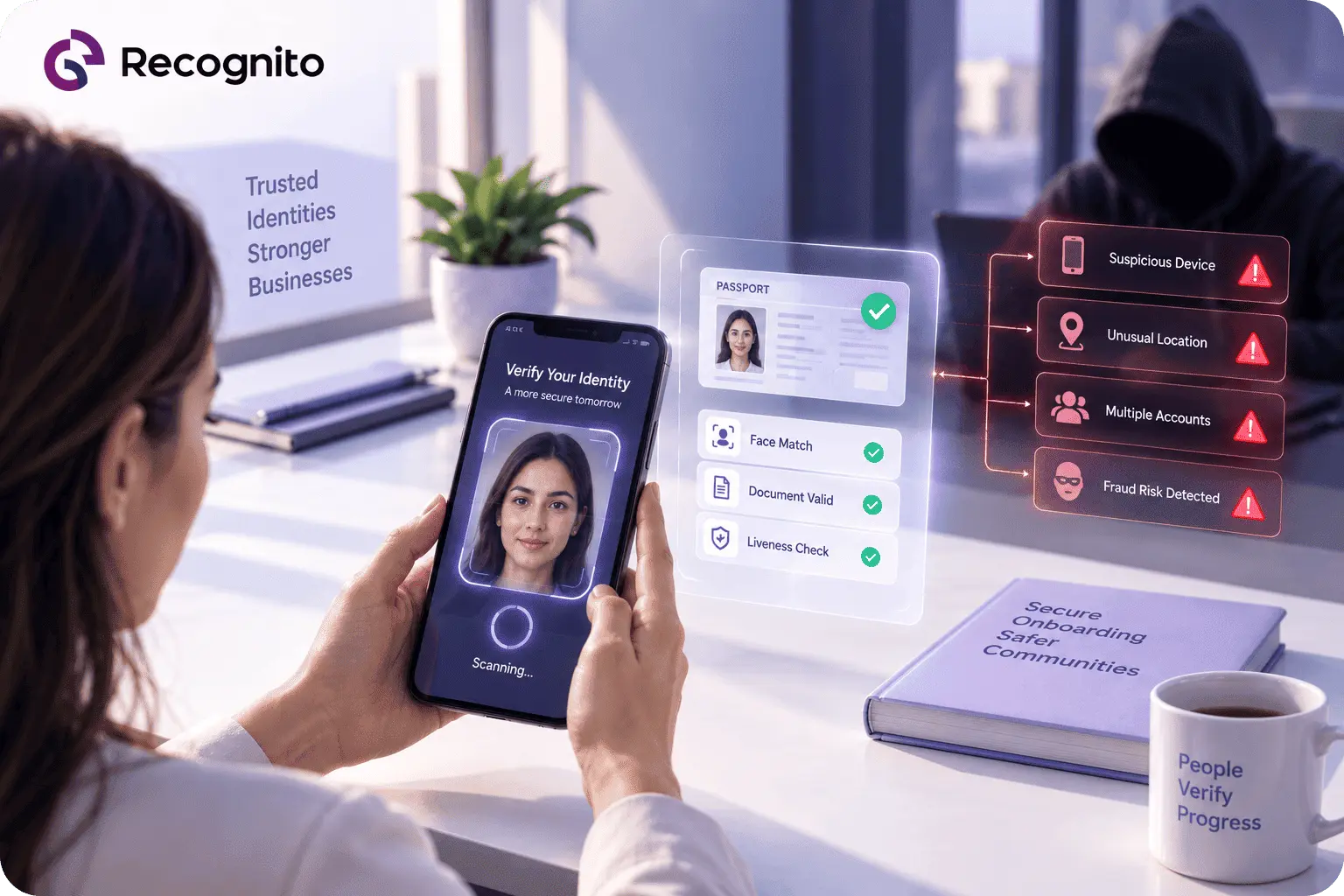
An identity document can provide the trusted reference needed during onboarding.
The customer submits a supported passport, identity card, or other credential.
The organization validates the document and obtains the associated photograph.
The customer then provides a live facial sample.
The system compares the two.
A document verification SDK can support the document-processing stage in a custom digital workflow.
This produces a stronger identity relationship:
Identity evidence → trusted facial reference → verified person → account
That relationship can later support recovery and higher-risk account activity.
Account Recovery Is a Critical Use Case
Many organizations protect account creation carefully but overlook recovery.
That can create an alternative route for attackers.
Someone who cannot access a customer’s password may instead try to convince support personnel or an automated process that they are the account holder.
Facial verification can provide another identity signal during high-risk recovery.
A possible workflow is:
Recovery request → risk assessment → identity verification → facial verification → liveness → decision
Not every recovery request needs this level of verification.
It can be reserved for circumstances such as:
- Unfamiliar devices
- Repeated recovery attempts
- Recently changed account details
- High-value accounts
- Suspicious account activity
This is a more practical approach than imposing biometric verification on every customer interaction.
Use Face Recognition for Step-Up Authentication
Facial verification can also support step-up authentication.
A customer may normally authenticate with a password and multifactor method.
If the risk engine detects something unusual, the account can request stronger identity assurance.
For example:
Normal login → standard authentication
Elevated risk → additional biometric verification
High risk → biometric verification, liveness, and additional review
This approach allows businesses to increase security without adding friction to every login.
It also makes biometrics more useful as part of risk-based authentication rather than treating facial recognition as a mandatory step for all sessions.
Combine Biometric Signals With Device Intelligence
Face recognition becomes more useful when combined with information about the session.
Consider a facial verification attempt that comes from a familiar device with normal account behavior.
Now compare it with the same biometric result occurring during:
- A new-device login
- Repeated recovery attempts
- Unusual location activity
- Recently changed credentials
- Abnormal transaction behavior
The face result itself may be identical.
The risk context is not.
This is why businesses should avoid making the biometric signal the sole fraud decision.
Instead, they can evaluate:
Biometric evidence + device context + behavioral signals + account history
The resulting risk assessment can be more nuanced.
Facial Verification for Sensitive Account Changes
Account security should not end after authentication.
Certain account changes can create significant risk.
Examples include changing:
- Recovery email
- Phone number
- Payment information
- Beneficiary details
- Authentication methods
- Privileged access
Organizations can require stronger verification before permitting high-impact changes.
Facial verification can be one of those controls.
The decision should be based on risk and the consequences of compromise.
One Table: How Face Recognition Supports Account-Fraud Prevention
| Account Stage | Facial Technology | Main Purpose | Supporting Control |
| Enrollment | Face verification | Establish a biometric identity relationship | Document verification |
| Login | Step-up face verification | Increase assurance when risk rises | MFA and device intelligence |
| Recovery | Face verification + liveness | Confirm the person requesting access | Risk analysis |
| Sensitive changes | Biometric verification | Reconfirm identity before a critical action | Transaction controls |
| Fraud investigation | Facial comparison | Identify potentially related records | Behavioral and account signals |
The table highlights that facial biometrics can support multiple stages without becoming the only security mechanism.
Facial Recognition Can Support Fraud Investigations
Some fraud campaigns involve multiple accounts.
An organization may discover several profiles associated with suspicious activity and need to determine whether there are potential connections.
Authorized facial comparison can provide another investigative signal.
For example, multiple accounts may show:
- Similar biometric references
- Shared device characteristics
- Related contact information
- Similar behavioral patterns
Facial similarity does not automatically prove that two accounts belong to the same person.
It can, however, help investigators identify cases that deserve additional review.
This makes biometric search and comparison particularly useful within a broader fraud-investigation process.
Accuracy Still Matters
Facial recognition is probabilistic.
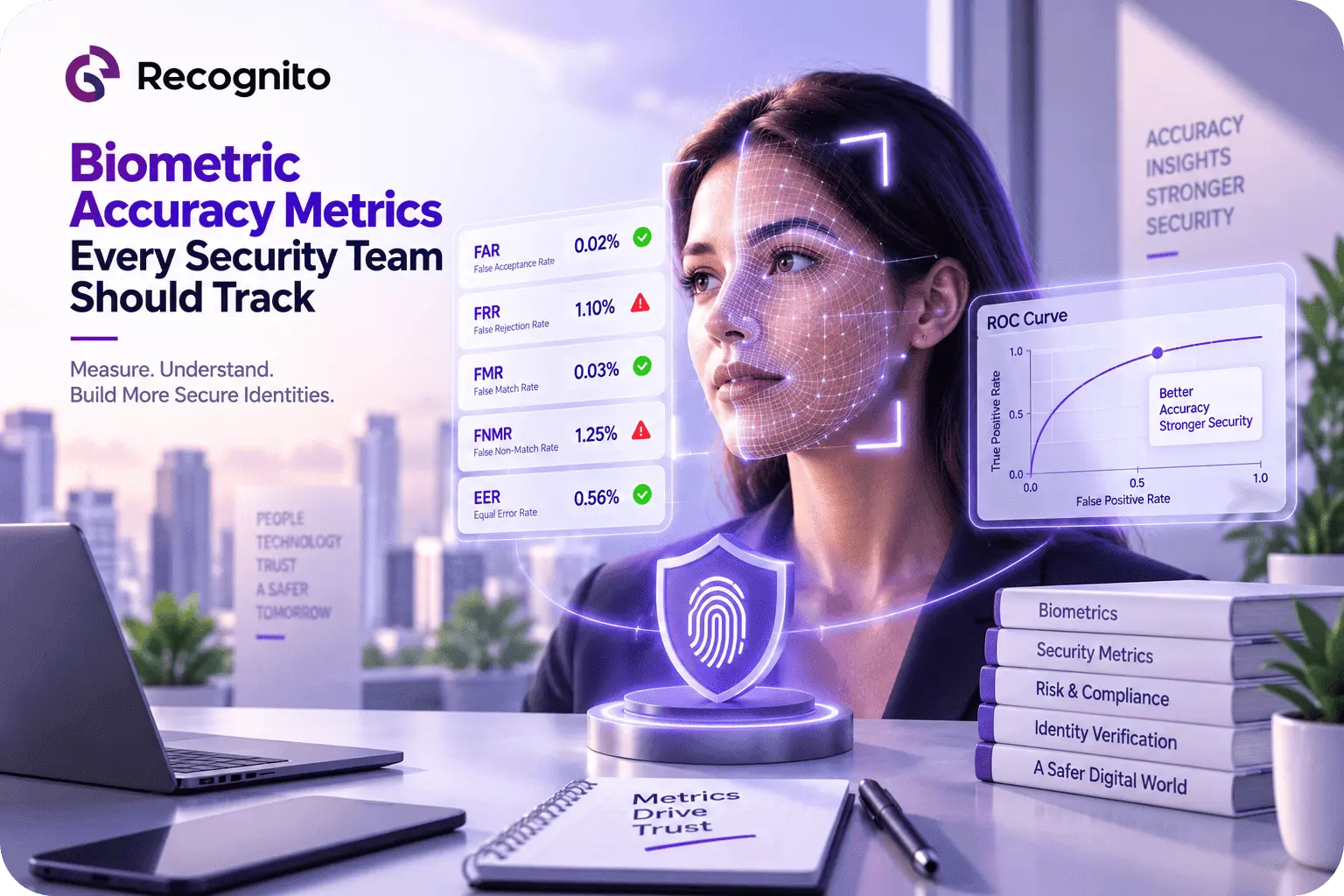
Two important error categories are:
False acceptance: an unauthorized person is incorrectly accepted.
False rejection: a legitimate person is incorrectly rejected.
Both matter.
False acceptance creates security risk.
False rejection creates friction, support costs, and potential customer abandonment.
NIST’s face-technology evaluations measure biometric performance using specific operating conditions and metrics rather than treating accuracy as one universal percentage. (NIST Face Technology Evaluations)
Businesses should therefore evaluate performance under the conditions they actually expect in production.
Image Quality Affects Biometric Results
A customer’s face will not always be captured under perfect conditions.
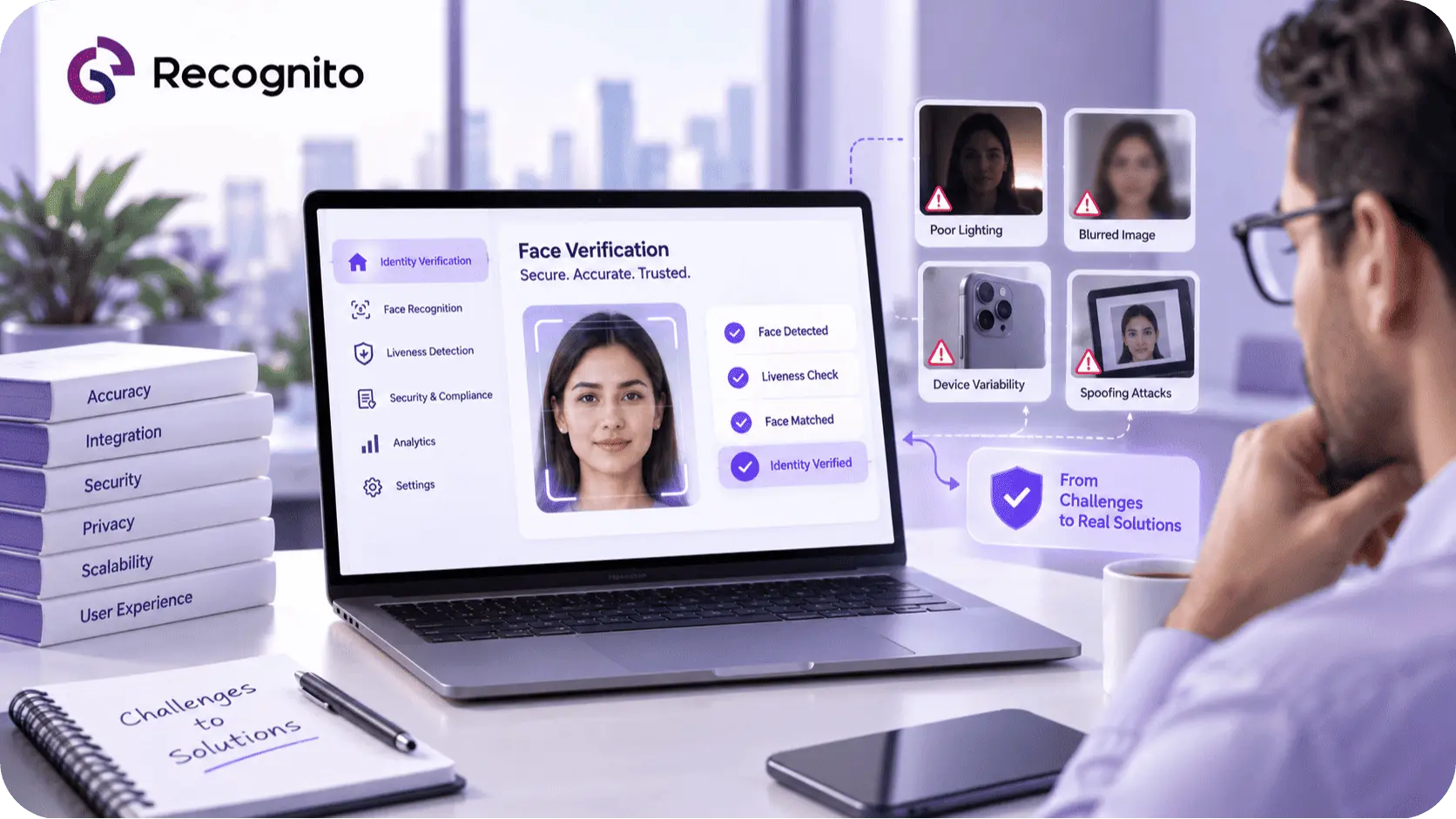
The image may be affected by:
- Low light
- Poor camera quality
- Motion
- Extreme angles
- Partial obstruction
- Compression
This can influence matching performance.
User guidance can reduce some avoidable capture problems.
A reliable workflow should also have a fallback when a legitimate customer cannot complete biometric verification.
Not every failed biometric attempt indicates malicious behavior.
Privacy Is Part of Account Security
Facial recognition can strengthen account security while introducing additional privacy obligations.
Organizations should understand:
- What biometric information is collected
- Whether raw images or video are retained
- Whether biometric templates are created
- Where processing occurs
- How long data is retained
- Who can access it
- How it is deleted
The GDPR establishes specific protections for biometric data processed for uniquely identifying individuals. (EU General Data Protection Regulation)
Businesses should therefore consider privacy at the architecture stage rather than treating it as an administrative task after deployment.
How Businesses Should Evaluate Facial Verification
Choosing a biometric system requires more than looking at a claimed accuracy rate.
Define the Use Case
Clarify whether facial verification will support onboarding, account recovery, step-up authentication, or fraud investigation.
Evaluate Attack Resistance
Understand how the vendor tests photographs, replayed media, screens, and other relevant presentation attacks.
Review Independent Testing
Independent evaluation provides stronger evidence than a marketing demonstration.
Test Real Devices
Use the cameras, browsers, operating systems, and network conditions customers actually encounter.
Measure Genuine-User Performance
Track completion, false rejection, retries, and verification time.
Examine Integration
Determine how facial verification and liveness will connect with the account, authentication, and fraud systems.
Review Privacy
Understand the complete biometric-data lifecycle.
A strong evaluation looks at the whole workflow, not just the model.
Common Implementation Mistakes
Relying on Facial Recognition Alone
A face match does not address presentation attacks or every other form of account fraud.
Skipping Liveness
Remote biometric capture can require protection against artificial presentations.
Ignoring Account Recovery
Recovery may become the easiest route for an attacker.
Treating Liveness as Identity Proof
A genuine person can still be the wrong account holder.
Ignoring Device and Behavioral Signals
Context can materially change the risk of an otherwise similar biometric result.
Applying Maximum Verification to Everyone
Risk-based step-up controls can improve security without unnecessary friction.
Build a Layered Account-Fraud Strategy
The strongest approach treats facial recognition as one component of defense in depth.
A modern account-security architecture can combine:
Trusted identity proofing
Document verification
Facial verification
Liveness
Multifactor authentication
Device intelligence
Behavioral monitoring
Transaction controls
Human review
The exact combination should reflect the organization’s threat model.
A retail application may need less biometric friction than a high-value financial account.
A privileged enterprise account may warrant stronger verification than an ordinary consumer session.
The technology should follow the risk.
SDK-Based Facial Verification
Businesses often already have their own customer applications, authentication systems, and fraud platforms.
An SDK can make facial verification part of that existing architecture.
Developers can control when biometric checks occur, how the customer experience works, and where the result enters the risk workflow.
For technical teams, the Recognito GitHub repository provides an additional development resource when evaluating implementation options.
This can make biometric verification more flexible than adopting a completely separate identity interface.
Measuring Success After Deployment
The value of facial recognition should be measured continuously.
Useful metrics include:
- Verification success rate
- False rejection rate
- False acceptance rate
- Liveness failure rate
- Recovery completion
- Step-up verification success
- Manual-review rate
- Account-takeover incidents
- Customer abandonment
- Average verification time
These measures help determine whether facial verification is producing the intended security improvement.
For example, a low fraud rate is useful only if legitimate customers can still complete verification efficiently.
Likewise, a very high completion rate could be concerning if attack resistance is weak.
Security and usability need to be evaluated together.
How Recognito Fits Into Account-Fraud Prevention
A layered biometric workflow can combine document identity evidence, facial verification, and liveness.
The facial verification technology can support person-to-identity matching inside a digital application, while liveness provides an additional layer around remote face capture.
These capabilities can be connected with the organization’s account, authentication, and fraud systems so biometric verification is applied when it provides meaningful additional assurance.
The Future of Face Recognition in Account Security
The role of biometrics in account security is likely to expand as digital fraud becomes more identity-centric.
Traditional credentials will remain important, but organizations will increasingly evaluate whether the person behind those credentials is actually the legitimate user.
At the same time, generative AI will continue to make synthetic identity and impersonation attacks more sophisticated.
That makes layered security increasingly important.
The future is unlikely to be:
Face recognition replaces the password.
It is more likely to be:
Credentials + biometrics + liveness + device intelligence + behavioral risk + adaptive authentication
This allows each signal to compensate for weaknesses in another.
Conclusion
Online account fraud is increasingly difficult to prevent with credentials alone.
Passwords can be stolen.
Authentication codes can be socially engineered.
Recovery processes can be abused.
Personal information can be compromised.
Face recognition can strengthen account security by creating a direct biometric relationship between an account and the person attempting to use it.
Its greatest value appears when it is combined with other controls:
Trusted identity → document verification → facial verification → liveness → device and behavioral signals → risk-based decisioning
The objective is not to turn every login into a complicated biometric process.
It is to introduce stronger identity assurance when the risk demands it.
NIST’s digital identity guidance, FIDO’s remote face-verification requirements, and ISO’s presentation-attack framework provide useful foundations for evaluating these systems. (NIST Digital Identity Guidelines) (FIDO Face Verification)
For organizations, the best facial-verification strategy is therefore not simply choosing the most accurate model.
It is building an identity architecture in which a stolen password, compromised device, fraudulent document, or convincing synthetic face is not enough by itself to take control of an account.
Businesses evaluating biometric verification and liveness technology can explore Recognito as part of a broader account-security and digital identity strategy.
Frequently Asked Questions
Can face recognition prevent online account fraud?
It can reduce certain forms of impersonation by adding a biometric identity signal to enrollment, recovery, authentication, and high-risk account actions. Its effectiveness is strongest when combined with other security controls.
Is facial recognition enough to protect an online account?
No. Facial verification should complement multifactor authentication, device security, fraud monitoring, identity evidence, and appropriate risk controls. Liveness may also be needed for remote biometric capture.
Why is liveness important for account security?
Liveness helps assess whether the facial presentation appears genuine rather than being an artificial presentation such as a photograph, replay, or other spoof.
Should users complete facial verification at every login?
Not necessarily. Risk-based step-up authentication can trigger facial verification when a login or account action presents elevated risk while keeping routine access more convenient.
What should businesses consider before deploying facial verification?
Organizations should evaluate biometric performance, presentation attacks, liveness, capture security, device compatibility, privacy, user experience, integration, recovery procedures, and performance in realistic production conditions.