
When a person verifies their identity online, the identity document is often the first piece of trusted evidence entering the workflow. A passport, national ID card, driving licence, or residence permit can provide a person’s name, date of birth, document number, photograph, and other attributes needed to establish who they claim to be.
The problem is that a digital image of an identity document is not automatically trustworthy.
A document may be genuine but stolen. It may be expired, altered, counterfeit, or digitally manipulated. Even a legitimate document can produce unreliable results when it is captured poorly and important information cannot be read correctly.
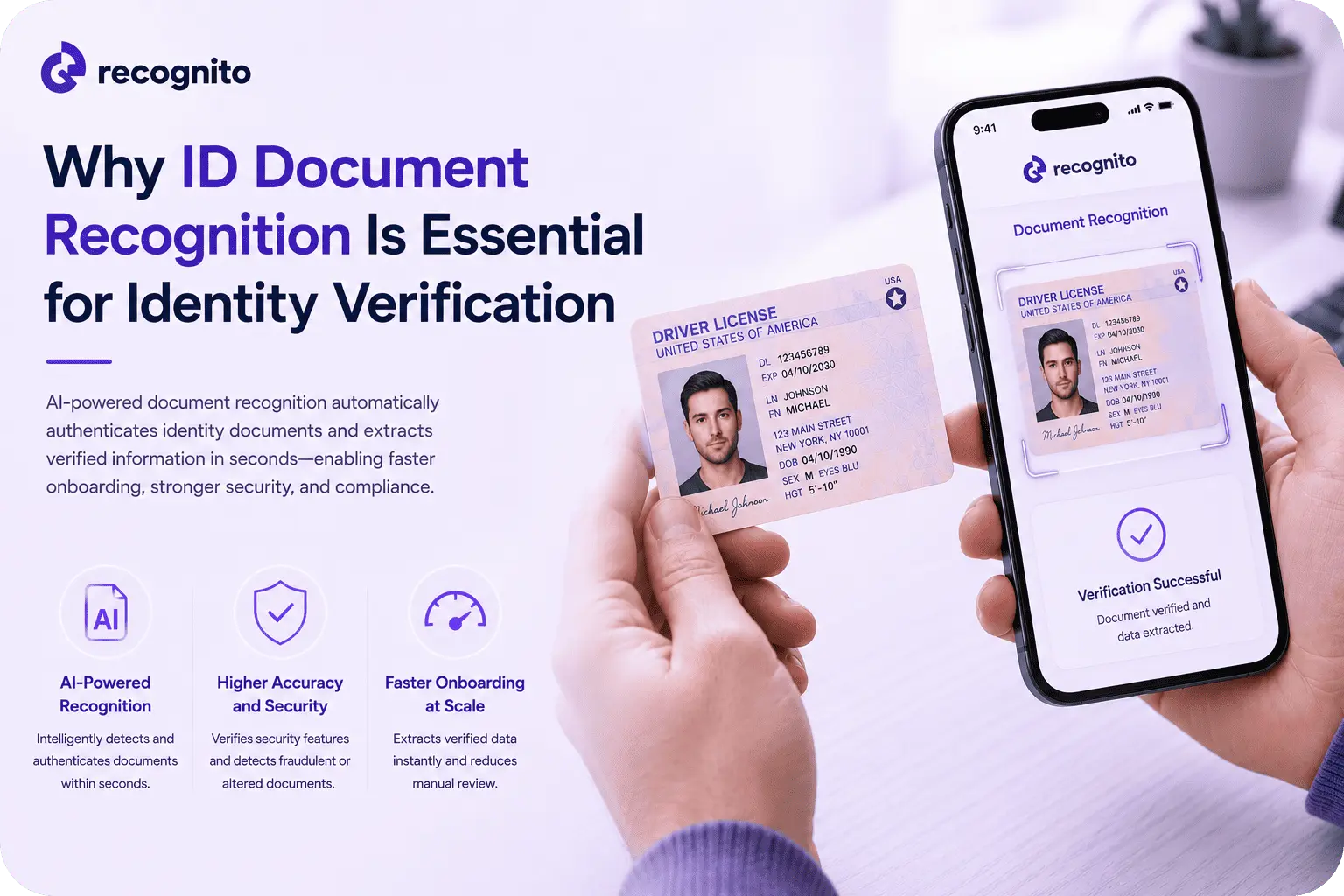
That is why ID document recognition has become a core component of digital identity verification. It combines document detection, classification, optical character recognition, image analysis, and validation capabilities to turn a photographed identity document into structured evidence that can be assessed by an identity system.
For organizations building remote onboarding, KYC, fraud-prevention, or access-control workflows, the goal is not merely to “read an ID.” The goal is to determine whether the evidence is usable, consistent, and trustworthy enough to support the identity decision.
Why Identity Verification Starts With the Document
Identity verification requires evidence connecting a real-world person to a claimed identity.
NIST’s current identity-proofing guidance explains that identity evidence supports proofing and must be validated for factors such as authenticity, accuracy, and validity. Its framework also recognizes automated document validation as an accepted method for validating presented evidence.
This makes the document-processing stage strategically important. If the information extracted from the document is incomplete or incorrect, later checks may be working from flawed data.
Consider a digital banking application. The applicant submits a passport, and the system needs to determine:
- what type of document was submitted
- whether the document is supported
- whether the captured image is usable
- what identity attributes it contains
- whether those attributes are internally consistent
- whether the document appears authentic
- whether the document is still valid
- whether the person presenting it corresponds to the identity evidence
ID document recognition creates the structured foundation for answering those questions.
A useful introduction to the underlying technology is what ID document recognition is and how it works, particularly for understanding how document detection, OCR, and verification fit together.
What ID Document Recognition Actually Does
A modern ID document recognition system typically combines several capabilities.
Document detection and classification
The first task is identifying the document in the camera frame and determining its type.
The system may need to distinguish between a passport, identity card, driving licence, residence permit, or another supported credential. Different documents have different layouts, fields, security features, and machine-readable structures.
Classification matters because downstream processing depends on knowing what document is being analyzed.
OCR and data extraction
Optical character recognition converts visible text into structured data.
Instead of requiring a customer to type their full name, date of birth, document number, and expiration date manually, the application can extract those values from the document image.
That improves both speed and data consistency. It can also reduce transcription errors that occur when users manually enter information.
The extracted information can then populate the verification workflow, customer record, or compliance system.
Image quality analysis
Recognition depends on the quality of the submitted evidence.
Blur, glare, shadows, poor focus, cropped edges, reflections, or low-resolution cameras can prevent important fields from being read accurately.
A robust capture workflow should therefore identify poor-quality submissions early rather than silently processing unreliable evidence.
This is more than a usability improvement. Poor-quality input can create false exceptions, inaccurate data, unnecessary manual reviews, and weaker fraud decisions.
Recognition Is Not the Same as Authentication
One of the most important distinctions in identity verification is the difference between reading a document and establishing that the document is genuine.
OCR can correctly extract a name from a counterfeit document.
Document recognition can correctly identify a driving licence template that has been altered.
Neither result, by itself, proves authenticity.
That is why document recognition should be part of a broader validation process. NIST’s identity evidence validation requirements state that presented evidence should be assessed for authenticity, accuracy, and validity, including checks for counterfeit or tampered evidence and relevant security features.
FIDO takes a similar layered approach. Its Document Authenticity certification program evaluates remote document-authentication solutions against threats including counterfeit documents, physical and digital tampering, invalid documents, presentation attacks, and face morphing.
The practical lesson is simple: document recognition provides information; document authentication provides confidence in that information.
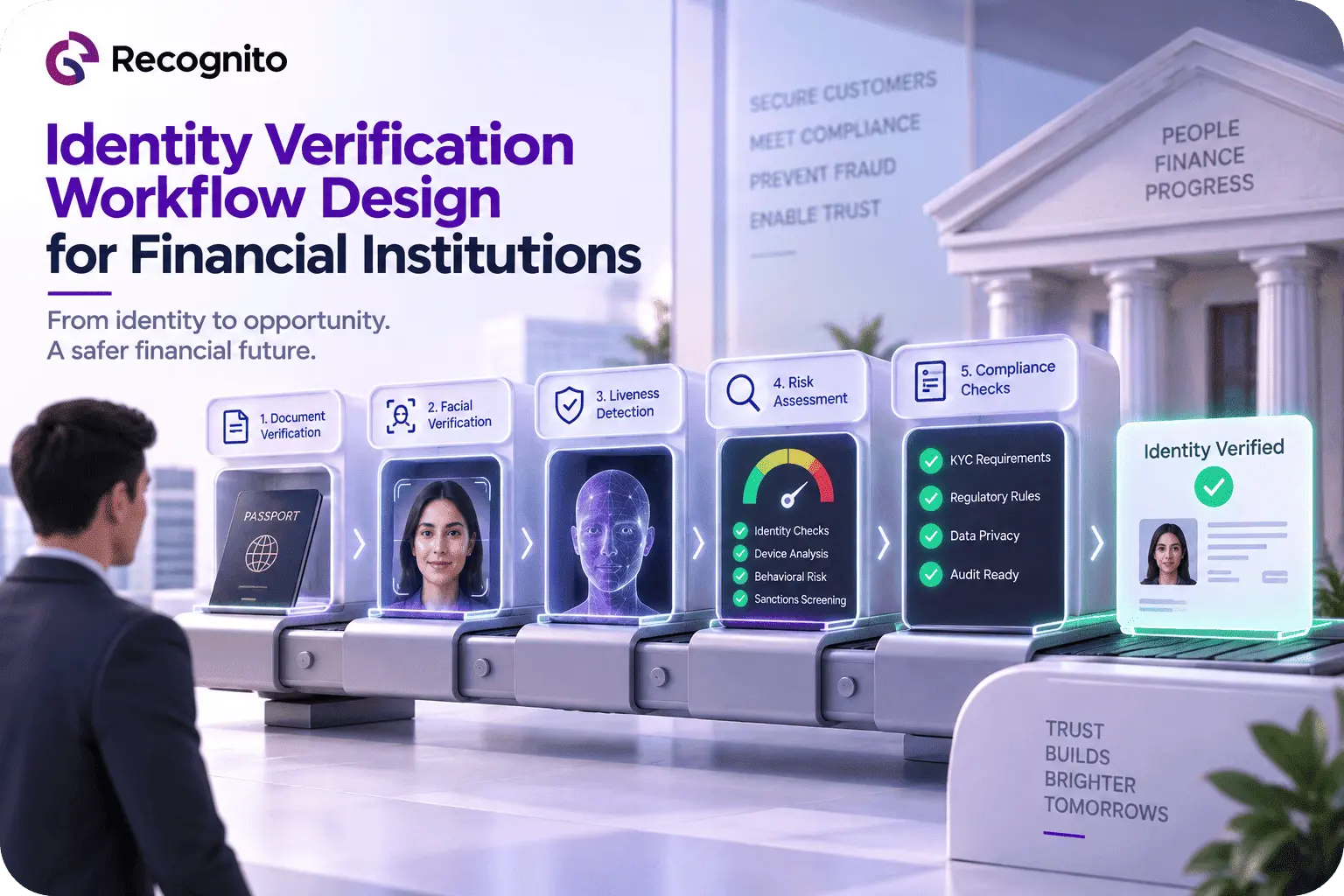
How ID Document Recognition Fits Into the Verification Workflow
A strong identity verification process usually treats document recognition as one stage in a larger evidence pipeline.
A typical remote workflow may look like this:
1. Capture: The customer uses a camera to capture an identity document.
2. Detection: The system identifies the document and determines whether the image is suitable for processing.
3. Classification: The document type and relevant template or structure are identified.
4. Extraction: OCR and other recognition methods convert fields into structured data.
5. Validation: The system examines document characteristics, fields, security indicators, and available authenticity signals.
6. Biometric comparison: The portrait on the document can be compared with a customer selfie or other biometric sample.
7. Liveness: The biometric capture can be tested for signs of presentation attacks.
8. Decisioning: Verification results are combined with business rules and other risk indicators.
This architecture is more resilient than asking one component to determine whether a customer is legitimate.
Why Automated Recognition Matters for KYC
KYC teams often have to process large volumes of identity evidence while maintaining consistency.
Manual data entry and document inspection can become expensive as application volume grows. Recognition technology moves repetitive work into software so human reviewers can focus on exceptions.
That can produce several operational improvements.
Faster onboarding
Customers do not need to manually enter every document field. Structured information can be extracted during capture and passed to the verification platform.
Lower data-entry error
The system reads information directly from the source document instead of relying entirely on customer transcription.
More consistent processing
Automated rules can evaluate the same document characteristics repeatedly without reviewer fatigue or variation.
Better scalability
A digital verification system can process far more applications without increasing manual review headcount at the same rate.
The goal is not to eliminate human review. It is to reserve human attention for cases where automated evidence is incomplete, conflicting, or suspicious.
Fraudsters Target the Document Layer
Identity fraud often begins before biometric verification even takes place.
An attacker may use a stolen genuine document, alter an identity field, fabricate a document, or manipulate a digital image. More sophisticated attacks may combine legitimate document information with synthetic identity attributes.
This makes the document layer one of the most important places to establish trust.
A useful related resource is document fraud detection techniques, which examines how organizations can identify suspicious or manipulated identity documentation as part of a broader fraud-control strategy.
The key point is that a document should not be treated as trusted simply because it resembles a familiar government-issued credential.
Why Digital Capture Changes the Security Model
Physical document inspection gives a trained employee access to tactile and visual characteristics that may not be available in a conventional upload.
Remote verification changes that model. The organization receives digital media, often captured from a consumer smartphone, and must establish confidence in what the camera actually observed.
That is one reason live capture, document presence checks, and media-integrity controls are becoming increasingly important.
At the same time, not every identity credential is necessarily physical. Digital identity credentials and mobile documents create different validation requirements.
The newly published ISO/IEC 30108-1:2026 standard addresses identity-attribute verification services and includes support for biometric, biographic, and document-related identity assurance mechanisms delivered through service-based architectures.
This reflects a broader shift toward identity verification as a connected service rather than a standalone document-scanning function.
Document Recognition and Biometric Verification Work Better Together
A document tells you what identity is being claimed. A biometric comparison helps establish whether the person making the claim corresponds to the identity evidence.
That combination is powerful because the two technologies answer different questions.
| Verification component | Primary question | Example risk addressed |
| Document recognition | What document and identity data were submitted? | Manual entry errors and unsupported documents |
| Document authentication | Does the evidence appear genuine? | Counterfeit or altered IDs |
| Document presence detection | Is the physical document being presented? | Static images and digital representations |
| Face matching | Does the applicant resemble the document portrait? | Impersonation |
| Face liveness | Is the applicant physically present? | Presentation attacks |
| Risk decisioning | Does the combined evidence support approval? | Multi-signal fraud |
The result is a layered identity decision instead of dependence on one technology.
For businesses comparing document and biometric approaches, document verification vs biometric verification explains how the two evidence types serve different roles in an identity workflow.
What Businesses Should Evaluate in an ID Recognition Solution
Not every document-recognition system is suitable for production identity verification.
Document coverage
Start with the documents your customers actually use. A provider that handles passports well but has weak coverage for regional identity cards may create unnecessary failure rates.
Extraction accuracy
Fields should be extracted reliably across languages, scripts, layouts, and document generations relevant to your market.
Authenticity capabilities
Understand whether the system only performs OCR or also offers meaningful document-authentication checks.
Capture experience
Customers should receive clear guidance when the document is blurred, poorly positioned, partially hidden, or affected by glare.
Security testing
Ask how the technology has been tested against counterfeit, tampered, manipulated, replayed, and otherwise fraudulent inputs.
Integration
The recognition layer should fit naturally into the identity workflow. APIs, mobile compatibility, response structure, latency, error states, and monitoring all matter once the technology reaches production.
For teams building document-processing capabilities directly into an application, an identity document recognition SDK can provide a software layer for integrating document capture and recognition into a broader verification journey.
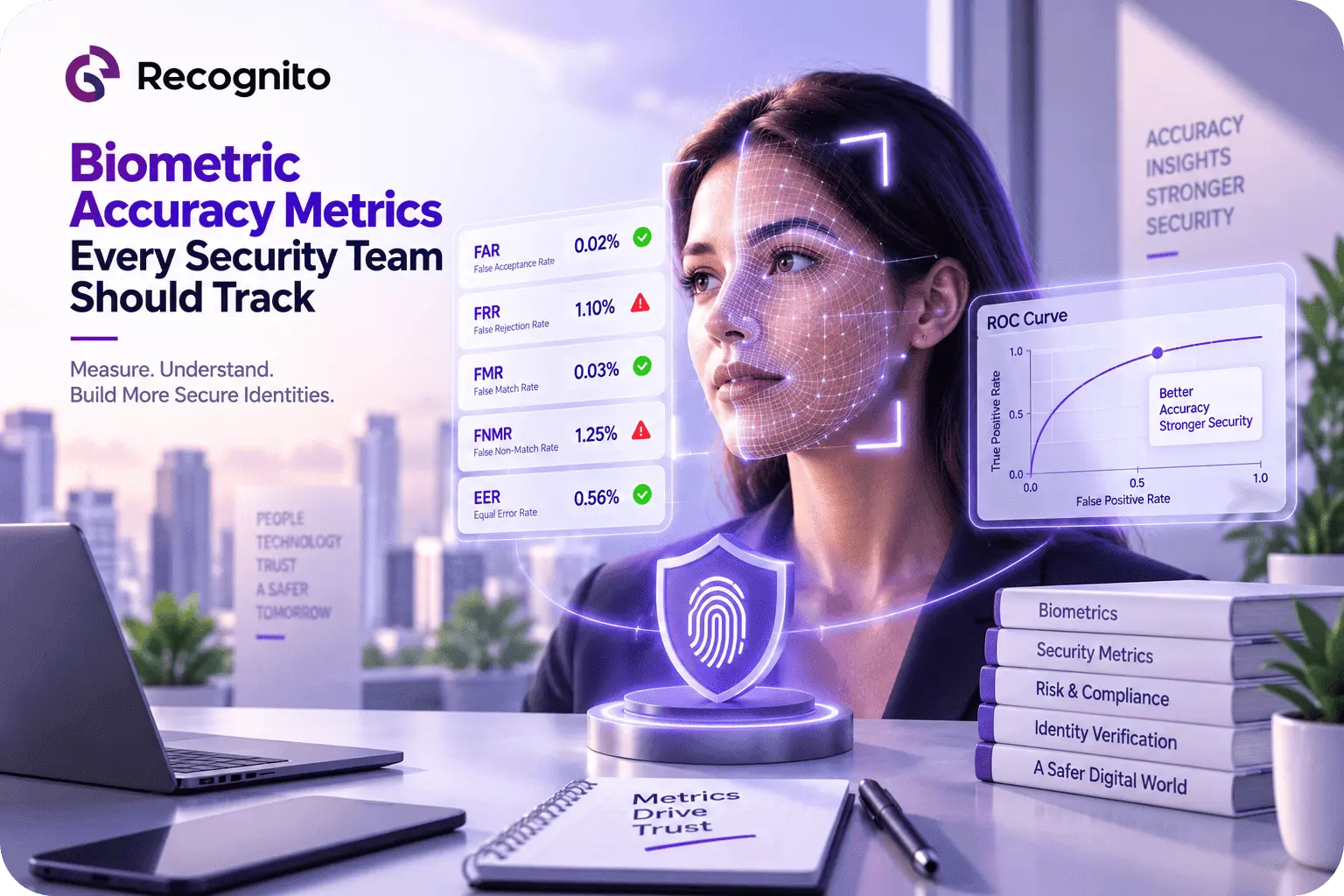
Accuracy Should Be Measured Across Real Conditions
A vendor’s claimed recognition accuracy is only useful when the test conditions are understood.
A system may perform well with high-quality images of common documents but struggle with damaged IDs, reflective surfaces, low-end cameras, poor lighting, unusual layouts, or older document versions.
Production testing should therefore reflect the real customer population.
Measure:
- successful first-time captures
- document rejection rates
- OCR field accuracy
- manual-review rates
- unsupported-document frequency
- capture retries
- fraud detection outcomes
- verification completion time
These measurements show whether the technology improves the actual identity process rather than just succeeding in a controlled demonstration.
Security and Privacy Need to Be Designed Together
Identity documents contain highly sensitive information, so a secure recognition system needs more than accurate OCR.
Organizations should establish clear policies for:
- what information is collected
- which images are retained
- how extracted fields are stored
- who can access identity evidence
- how data is encrypted
- when records are deleted
- which external processors receive the information
Data minimization is particularly important. Storing every image indefinitely is not a substitute for effective verification controls.
The system architecture should also distinguish between data needed for the immediate identity decision and data required for legitimate compliance or operational purposes.
Automation Should End With a Decision, Not a Guess
The role of document recognition is to produce trustworthy evidence for the next stage of the workflow.
A good system should not simply return “document detected.”
It should provide enough structured information for the verification platform to determine what was captured, whether it is usable, what attributes were extracted, and whether further validation is necessary.
That enables more precise outcomes.
For example, an application may fail because the document is unsupported, because image quality is insufficient, because authenticity checks raise concerns, or because biometric evidence does not correspond with the document.
Those are very different cases. Treating all of them as the same rejection makes the system harder to manage and harder for customers to navigate.
A Stronger Identity Verification Architecture
The most effective document-recognition deployments connect several controls rather than treating document scanning as the entire identity process.
The architecture might combine:
Document recognition for identification and data extraction.
Document authentication for evidence integrity.
Document presence detection for remote physical-document assurance.
Face verification for person-to-document binding.
Face liveness for biometric presentation-attack resistance.
Risk orchestration for the final business decision.
This layered model makes each component responsible for a specific security question. It also makes failures easier to investigate and improve.
Development teams evaluating implementation resources can also review the Recognito GitHub repository alongside product documentation and integration testing.
The Business Case for ID Document Recognition
The value of document recognition extends beyond faster onboarding.
When identity information is extracted consistently and validation is automated, organizations can reduce repetitive manual work while increasing the amount of evidence available for each decision.
That can help reduce operational costs, improve customer conversion, accelerate account creation, and provide more consistent compliance processes.
The strongest business case comes from measuring the complete workflow rather than document-recognition accuracy in isolation.
A successful deployment should reduce both unnecessary friction for legitimate customers and the likelihood that unreliable identity evidence reaches the final approval decision.
Conclusion
ID document recognition is essential to modern identity verification because identity systems need more than a photograph of a document. They need structured, usable, and increasingly trustworthy evidence.
Recognition technology provides the foundation by detecting documents, identifying their types, extracting attributes, and supporting automated analysis. Authentication, presence detection, biometric verification, liveness, and risk decisioning then add the controls needed to turn that evidence into a stronger identity decision.
The right approach is therefore not to ask whether document recognition is enough. It is to determine how effectively it works as part of a layered verification architecture.
For organizations building secure identity workflows, Recognito provides technologies that can support document and biometric verification as part of that broader architecture.
Frequently Asked Questions
What is ID document recognition?
ID document recognition uses technologies such as computer vision and OCR to detect, classify, read, and process identity documents such as passports, identity cards, and driving licences.
Is document recognition the same as document verification?
No. Recognition focuses on identifying and extracting information from a document. Verification adds checks designed to establish whether the document and its information are genuine, accurate, and valid.
Can ID document recognition prevent identity fraud?
By itself, no. It can support fraud detection by identifying document characteristics and providing structured evidence, but strong identity protection requires additional controls such as document authentication, biometric matching, liveness, and risk analysis.
Why is OCR important in identity verification?
OCR converts document text into structured information, reducing manual entry and allowing identity attributes to be compared with application data and other verification evidence.
Should businesses use an ID document recognition SDK?
An SDK can be useful when a company needs document capture and recognition directly inside its own application. The decision should also consider document coverage, security capabilities, integration, performance, privacy, and the wider identity-verification architecture.