
A digital onboarding process can successfully verify a customer’s identity and still allow a fraudulent account to enter the system.
A genuine identity document may belong to someone else. A convincing selfie may come from manipulated media. A stolen set of personal details may be used to create multiple accounts, while an attacker may take control of an existing account after passing the initial verification process.
These scenarios highlight a fundamental weakness in many digital onboarding systems: treating identity verification as a single security checkpoint rather than part of a broader fraud prevention strategy.
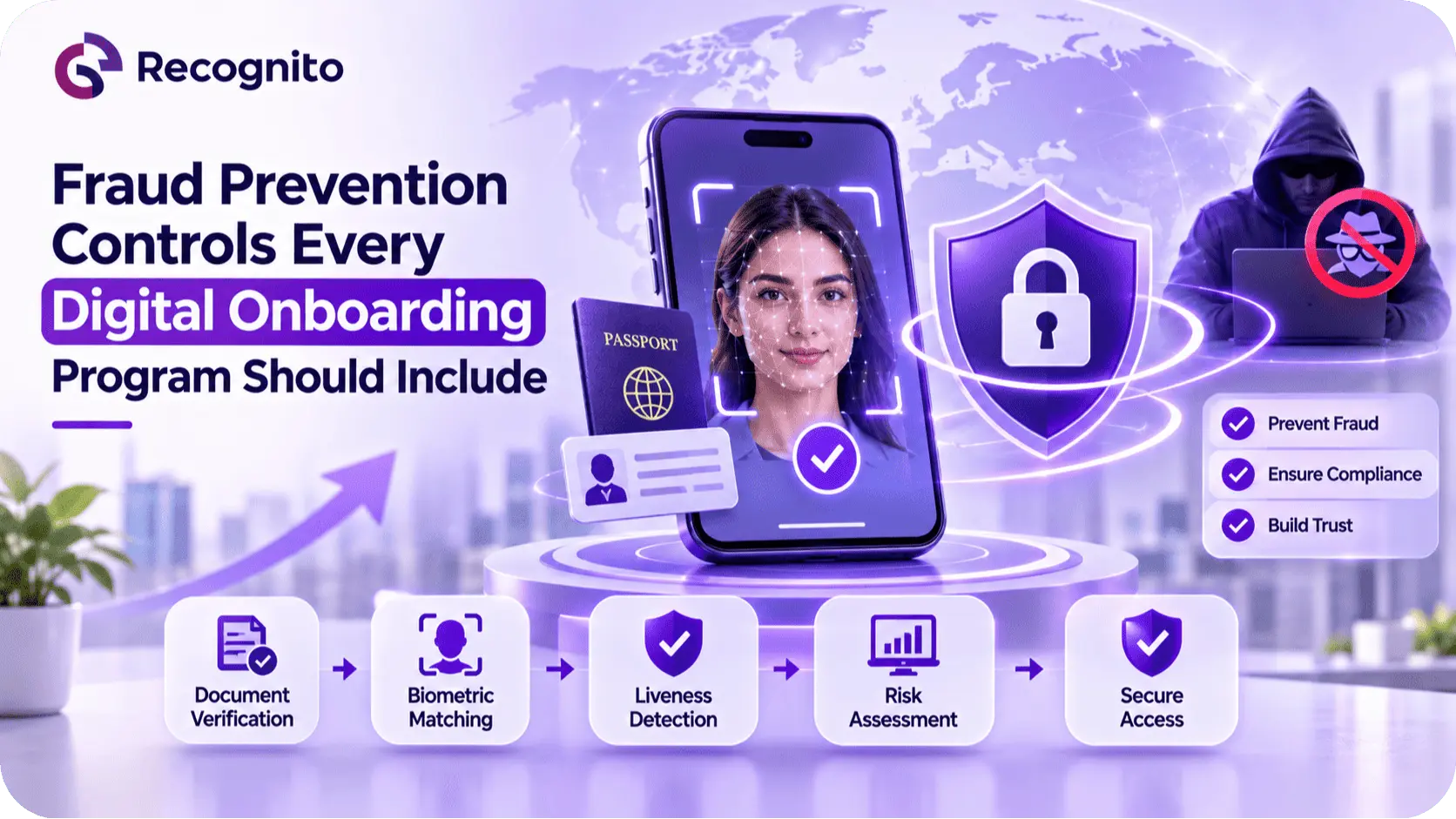
For banks, fintech companies, payment providers, cryptocurrency exchanges, and other digital businesses, preventing fraud requires multiple controls working together. Identity proofing, document authentication, biometric verification, liveness detection, device intelligence, transaction monitoring, and account protection each address different attack methods.
The objective is not to introduce unnecessary friction into every customer journey. It is to establish sufficient confidence at each stage while identifying suspicious behavior before it results in financial or operational damage.
Why Digital Onboarding Needs Multiple Fraud Prevention Controls
Traditional customer onboarding often involved physical documents, face-to-face interactions, and employees who could inspect identity evidence.
Digital onboarding removes much of that direct interaction. Customers submit documents through applications, complete biometric checks remotely, and receive access without visiting a physical location.
This improves accessibility and operational efficiency but creates opportunities for attackers to manipulate the evidence entering the verification process.
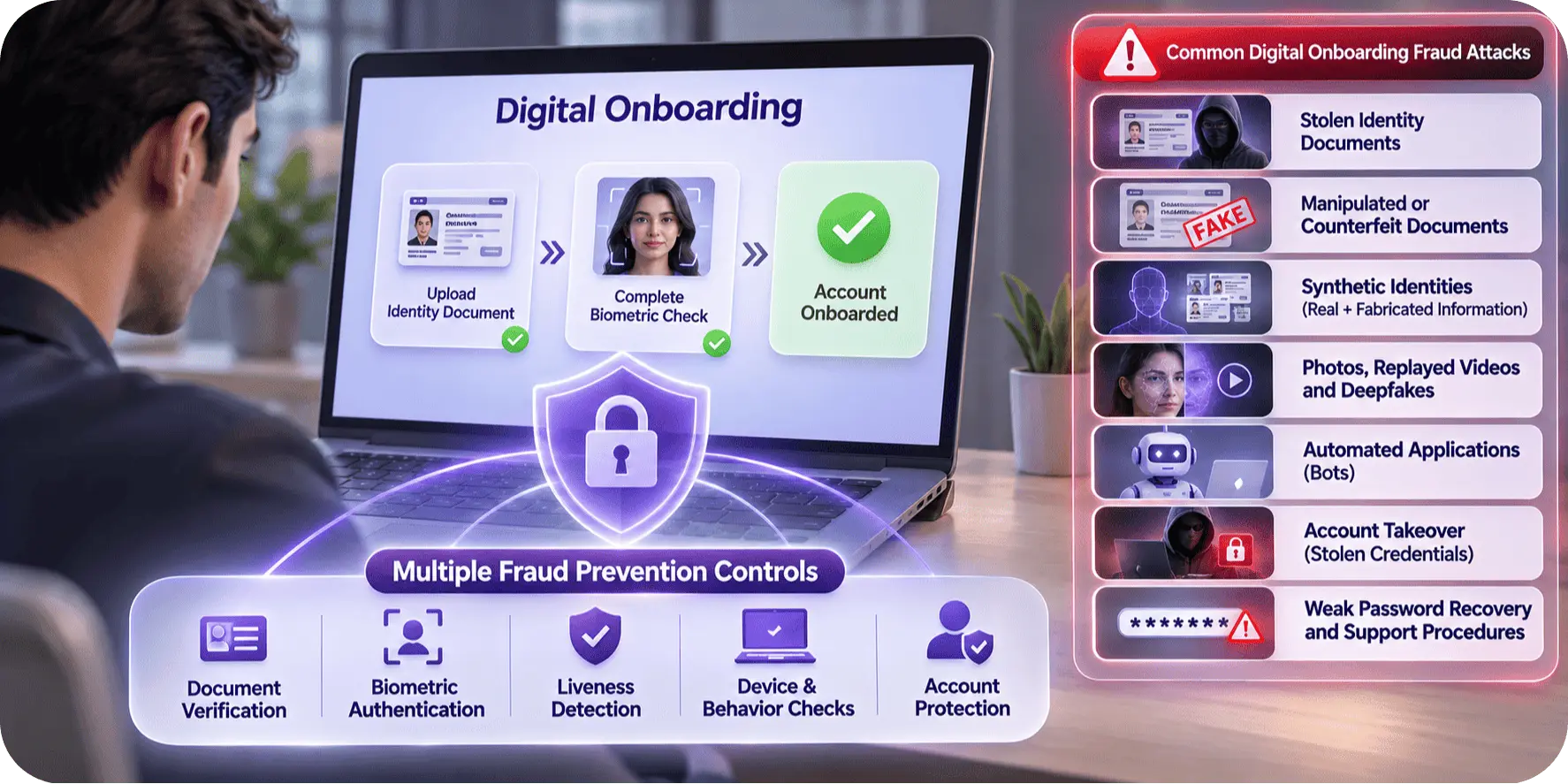
Common attack scenarios include:
- Using stolen identity documents to impersonate legitimate individuals.
- Submitting manipulated or counterfeit identity documents.
- Creating synthetic identities using combinations of genuine and fabricated information.
- Using photographs, replayed videos, and deepfakes to bypass biometric checks.
- Automating applications through bots to create fraudulent accounts.
- Taking over legitimate accounts through stolen credentials.
- Exploiting weak password recovery and customer-support procedures.
The FBI’s Internet Crime Complaint Center explains how account takeover fraud can involve phishing, social engineering, compromised credentials, and malware.
These attacks demonstrate why a single identity verification check cannot protect an entire digital onboarding journey.
1. Establish Reliable Identity Proofing at Enrollment
The first fraud prevention control should establish whether the applicant is genuinely associated with the identity being presented.
Identity proofing involves collecting and validating evidence that connects an applicant to a real-world identity.
Depending on the business and risk level, evidence may include:
- Government-issued identity documents.
- Trusted identity databases.
- Personal information and identity attributes.
- Address and residency evidence.
- Existing verified customer records.
- Supported digital identity credentials.
The quality of the evidence matters more than simply collecting more information.
For example, requesting a passport photograph does not establish that the person submitting it is the rightful passport holder. Additional checks must connect the applicant to the document and establish whether the evidence is reliable.
NIST’s SP 800-63A-4 identity proofing and enrollment guidelines, finalized in July 2025, provide requirements for evaluating identity evidence and establishing identity assurance levels.
Although these guidelines are designed for their defined digital identity context, they offer useful technical guidance for businesses developing remote identity proofing processes.
2. Implement Automated ID Document Fraud Detection
Document fraud remains one of the most important threats to digital onboarding.
Attackers may use counterfeit documents, stolen passports, edited identity cards, modified photographs, or manipulated document information.
Traditional OCR can extract information from an uploaded document, but information extraction alone does not establish document authenticity.
A stronger document verification process should examine multiple characteristics:
Document classification: Identify the document type, issuing country, and supported format.
Field extraction: Extract names, dates of birth, document numbers, and other relevant attributes.
Consistency checks: Compare extracted information against expected formats and available reference data.
Visual inspection: Examine relevant document characteristics, including layout and available security indicators.
Tampering detection: Identify suspicious alterations, image manipulation, and inconsistencies.
The objective is to establish whether the submitted evidence is sufficiently trustworthy before using it to make an identity decision.
Businesses implementing automated document processing can consider an ID document recognition SDK to integrate document capture, classification, and recognition into their onboarding workflows.
For additional technical context, document fraud detection techniques explores the different ways fraudulent identity documents can be identified.
3. Add Document Liveness Detection
Document authenticity and document presence are different security questions.
An attacker may possess a genuine passport photograph or a digitally manipulated representation of an otherwise legitimate identity document. Even if some document characteristics appear correct, the submitted image may not have been captured from a physical document during the verification session.
Document liveness detection addresses this problem by assessing whether the physical identity document is present during capture.
Depending on the technology, this may involve passive image analysis, guided movements, or multiple capture observations.
It is particularly valuable for remote customer onboarding, where the organization cannot physically inspect the document.
Importantly, document liveness does not replace authenticity checks. A physically present document can still be counterfeit or altered. Both controls need to work together.
4. Use Facial Recognition to Connect Customers With Their Identity Documents
Document verification establishes information about an identity document. Facial recognition helps determine whether the individual completing onboarding resembles the person represented in that document.
A typical process captures a facial image or video and compares it with the portrait extracted from the submitted identity evidence.
This creates another verification layer against impersonation using stolen identity documents.
However, facial matching should be evaluated using more than a single similarity score.
Important considerations include:
- False-match and false-non-match performance.
- Image quality and camera conditions.
- Demographic performance.
- Matching thresholds.
- Capture reliability.
- Processing speed and operational consistency.
Facial recognition should also be separated from authentication. Matching a selfie against an identity document helps establish identity consistency, but does not automatically prove that the same individual will control the account securely in the future.
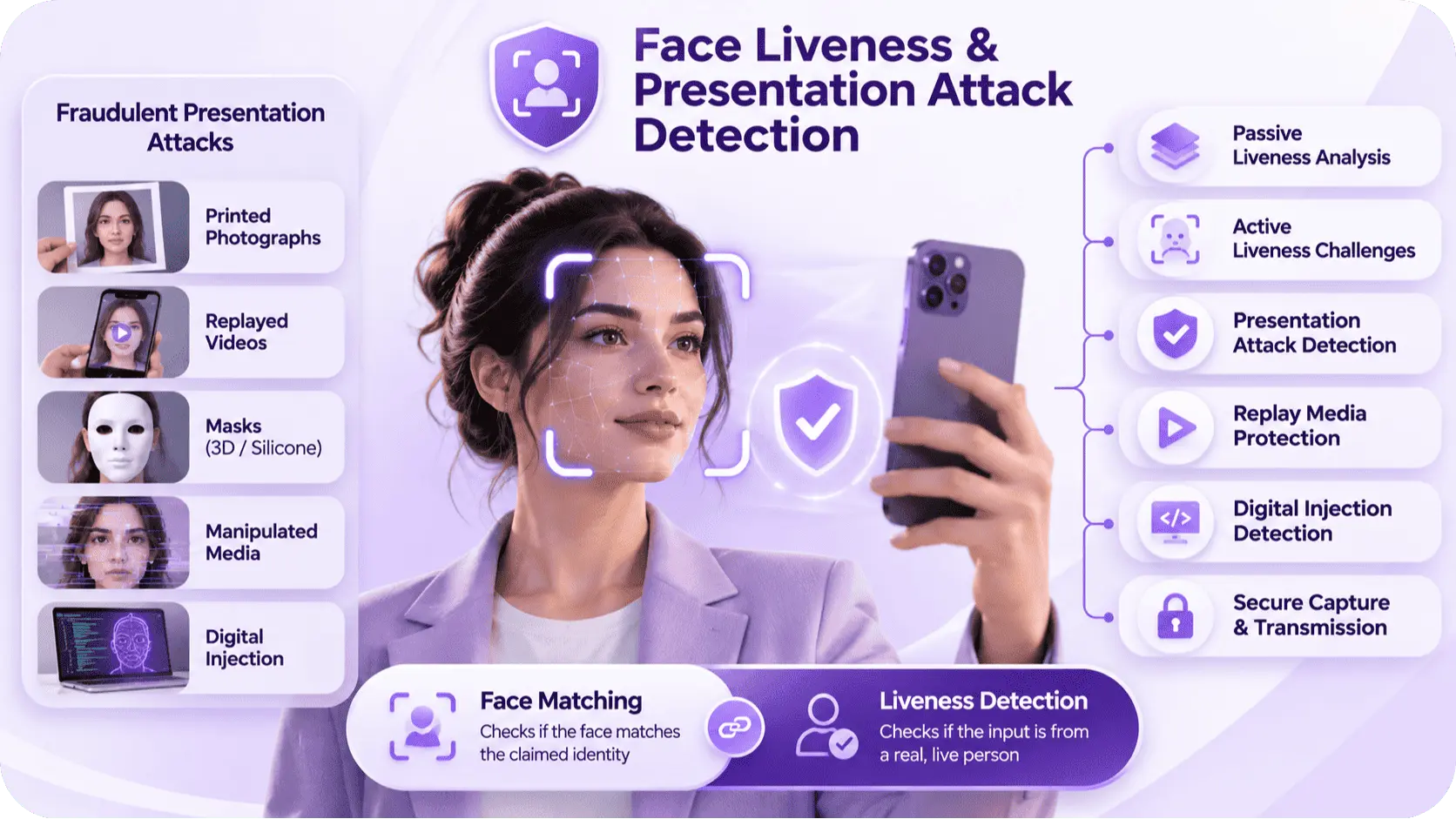
5. Introduce Face Liveness and Presentation Attack Detection
A facial recognition system may produce a strong similarity result even when the input comes from a fraudulent presentation.
Attackers can attempt to use printed photographs, replayed videos, masks, manipulated media, or injected digital content to deceive a verification system.
Face liveness detection evaluates whether the biometric input appears to originate from a live person rather than an artificial presentation.
For a more complete security architecture, organizations should consider:
- Passive liveness analysis.
- Active liveness challenges where appropriate.
- Presentation attack detection.
- Protection against replayed media.
- Detection of relevant digital injection attacks.
- Secure biometric capture and transmission.
A face liveness detection SDK can provide a dedicated liveness component within a remote verification workflow.
The important distinction is that face matching and liveness address different threats. Both may be necessary, depending on the application’s risk profile.
For a deeper understanding of manipulated biometric inputs, deepfake detection for AI fraud prevention explores the growing importance of detecting AI-generated identity attacks.
6. Identify Synthetic Identity Fraud
Synthetic identity fraud is particularly difficult because attackers may not rely on one completely stolen identity.
Instead, they combine genuine personal information with fabricated or manipulated attributes to construct an identity that appears legitimate.
For example, an application might contain a real person’s address, a fabricated date of birth, and an identity number that does not belong to the applicant.
Such an application may pass basic document or database checks because individual attributes appear plausible.
Preventing this type of fraud requires examining relationships between identity attributes rather than evaluating each field independently.
Useful controls include:
- Cross-checking identity information against reliable sources.
- Identifying inconsistent personal attributes.
- Examining unusual application patterns.
- Detecting repeated identity information across multiple accounts.
- Monitoring suspicious combinations of device, contact, and application details.
- Reviewing discrepancies that cannot be resolved automatically.
A document that looks genuine does not necessarily establish that the complete identity is legitimate.
7. Implement Device Intelligence and Behavioral Risk Analysis
Fraudsters frequently use multiple devices, automated environments, proxies, and manipulated browser sessions to submit applications at scale.
Device intelligence helps identify potentially suspicious characteristics associated with the environment from which an application originates.
Depending on the implementation, relevant signals may include:
- Device and browser characteristics.
- IP address and network reputation.
- VPN and proxy indicators.
- Device consistency across applications.
- Unusual session behavior.
- Automation and bot indicators.
- Geolocation inconsistencies.
These signals should contribute to risk assessment rather than acting as automatic proof of fraud.
For example, an application from an unfamiliar location may be legitimate, especially when the customer is travelling. The risk becomes more meaningful when location anomalies are combined with repeated failed verification attempts, inconsistent identity evidence, and suspicious device behavior.
8. Introduce Bot Detection and Application Abuse Prevention
Fraudulent onboarding is not always performed manually.
Automated scripts can submit large numbers of applications, test stolen identity information, exploit promotional offers, and attempt to create accounts faster than manual review teams can handle.
Bot mitigation should therefore begin before identity verification.
Useful controls include:
- Rate limiting for application submissions.
- Automated request detection.
- Suspicious IP and network monitoring.
- CAPTCHA or alternative challenges where appropriate.
- Detection of repeated application patterns.
- Session and device behavior analysis.
- Protection against credential and identity enumeration.
These controls help prevent verification infrastructure from becoming an easy target for automated abuse.
Importantly, bot detection should avoid indiscriminately blocking legitimate users who share networks, use privacy technologies, or experience unusual connectivity conditions.
9. Secure Authentication and Account Creation
Passing onboarding does not guarantee that an account will remain secure.
Once a legitimate account is created, attackers may attempt to gain access using stolen credentials, phishing, credential stuffing, or social engineering.
This makes account authentication another essential fraud prevention layer.
A strong approach includes:
Multi-factor authentication: Require additional verification beyond a password, particularly for sensitive accounts and actions.
Phishing-resistant authentication: Prefer passkeys or security keys where supported and appropriate.
Secure credential enrollment: Bind authenticators to the correctly verified account.
Risk-based authentication: Request additional verification when login or session behavior indicates elevated risk.
Session security: Protect authentication tokens and monitor suspicious session activity.
CISA’s phishing guidance for stopping the attack cycle discusses credential theft, malware-based phishing, and defensive measures for organizations.
Authentication controls should be designed alongside identity proofing, rather than treated as an unrelated feature added after onboarding.
10. Establish Risk-Based Decisions and Manual Review
Not every application should receive the same verification treatment.
A low-risk application with consistent document information, successful biometric checks, and ordinary device behavior may proceed automatically.
Another application may contain conflicting identity attributes, suspicious device characteristics, or failed liveness results.
A centralized risk engine can combine these signals and determine the appropriate next action.
Possible outcomes include:
- Automatic approval.
- Additional document capture.
- Step-up biometric verification.
- Additional customer information.
- Manual compliance review.
- Temporary application suspension.
- Rejection when evidence supports that decision.
A useful risk-based model is:
| Risk condition | Recommended control | Possible outcome |
| Incomplete document image | Capture quality assessment | Request another capture |
| Suspicious document alterations | Document authenticity checks | Escalate for review |
| Failed face comparison | Additional identity verification | Hold application |
| Liveness failure | Presentation attack assessment | Retry or investigate |
| Unusual device activity | Device and session analysis | Additional checks |
| Multiple suspicious applications | Cross-application fraud analysis | Restrict or investigate |
| Conflicting identity information | Human review | Resolve before approval |
| Elevated account access risk | Stronger authentication | Step-up verification |
Automated decisions should remain explainable to the operational teams responsible for investigating exceptions.
A risk score should support a decision, not replace evidence-based judgment.
11. Apply Sanctions, PEP, and Financial Crime Screening
Identity verification and financial-crime screening serve different purposes.
A person may successfully prove their identity but still require additional due diligence because of sanctions exposure, politically exposed person status, adverse information, or other financial-crime concerns.
Digital onboarding programs should therefore integrate appropriate screening into the wider customer due-diligence process.
Depending on the product, jurisdiction, and customer risk, relevant checks may include:
- Sanctions screening.
- Politically exposed person screening.
- Adverse-media assessment.
- Beneficial ownership verification.
- Source-of-funds information.
- Customer risk classification.
FATF’s Guidance on Digital Identity explains how digital identity systems can support customer identification and verification within a risk-based customer due-diligence framework.
The important point is that biometric verification should never be treated as a substitute for broader AML and financial-crime controls.
12. Monitor Accounts After Onboarding
Fraud prevention must continue after the customer receives access.
An account that was legitimately opened can later become compromised, sold, or misused.
Digital onboarding programs should connect identity verification with ongoing monitoring.
Important activities include:
- Monitoring unusual login patterns.
- Detecting unexpected changes to customer details.
- Reviewing suspicious payment activity.
- Identifying unusual account creation or usage patterns.
- Monitoring repeated failed authentication.
- Detecting abnormal device changes.
- Applying additional checks before sensitive account modifications.
For example, changing a registered phone number immediately before a high-value transaction may warrant additional verification.
The face recognition approach to preventing online account fraud provides additional context on using biometric controls beyond the initial registration process.
13. Protect Customer Data and Verification Infrastructure
Fraud prevention systems process sensitive personal and biometric information, which makes their own security a priority.
Poorly protected identity databases, unsecured APIs, excessive employee permissions, and weak vendor integrations can expose the same information that the verification process was designed to protect.
Organizations should implement:
- Encryption in transit and at rest.
- Role-based access controls.
- Secure API authentication.
- Data minimization.
- Defined retention and deletion policies.
- Audit logging.
- Vendor security assessments.
- Incident response procedures.
Biometric information also requires appropriate legal and privacy assessment. For example, the GDPR treats biometric data processed for uniquely identifying a person as special-category personal data.
Security controls should extend to the entire verification infrastructure, including third-party services and data-processing arrangements.
Measuring the Effectiveness of Fraud Prevention Controls
Implementing multiple controls is not enough. Organizations need evidence that those controls are improving security without creating unnecessary friction.
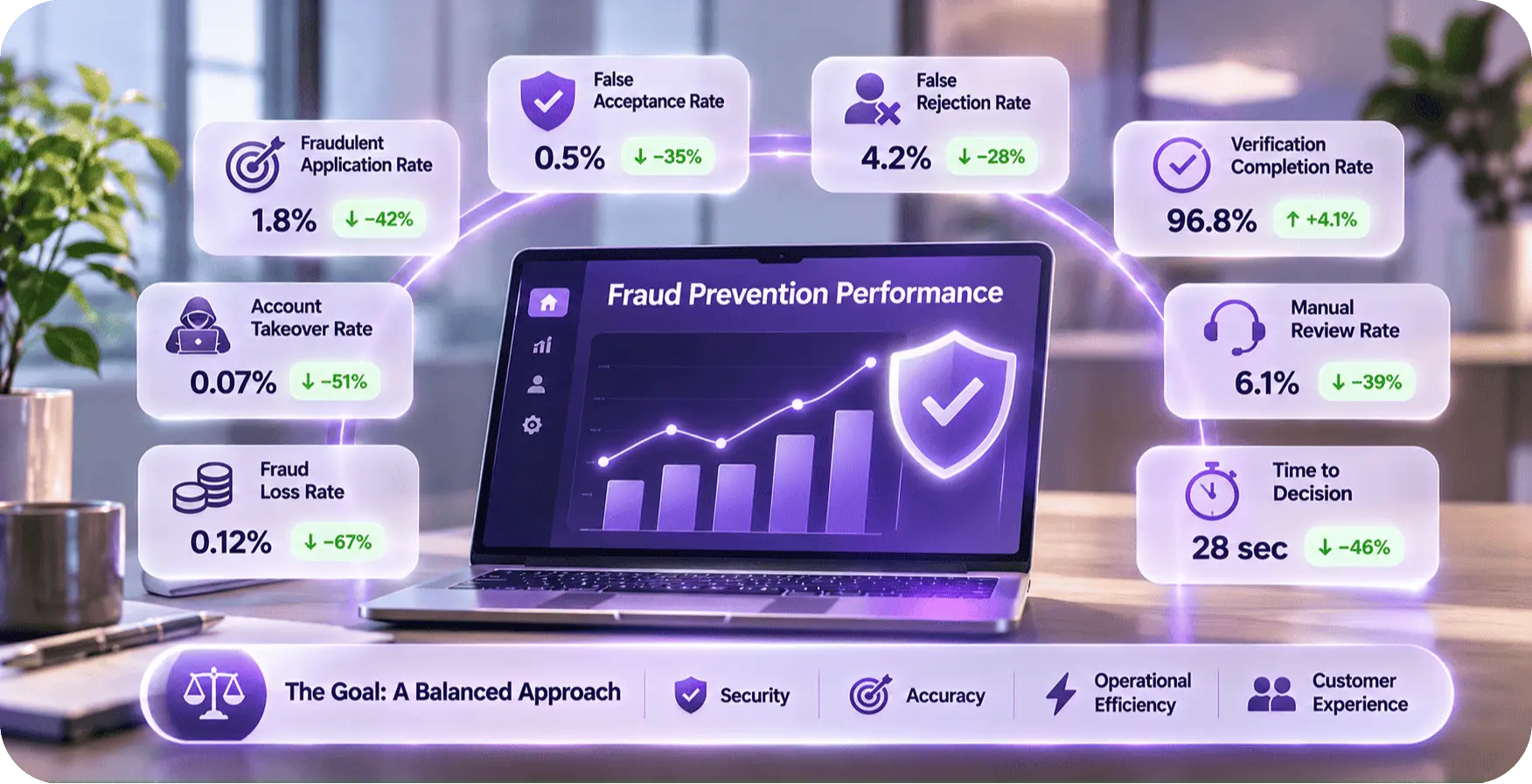
Important performance indicators include:
- Fraudulent application rate: The proportion of applications confirmed as fraudulent.
- False acceptance rate: The frequency of fraudulent inputs incorrectly accepted by a particular verification control.
- False rejection rate: The frequency of legitimate applicants incorrectly rejected.
- Verification completion rate: The percentage of applicants successfully completing onboarding.
- Manual review rate: The percentage of applications requiring human intervention.
- Account takeover rate: The frequency of confirmed unauthorized account access.
- Fraud loss rate: Financial losses associated with successful fraudulent activity.
- Time to decision: The time required to reach an onboarding outcome.
Measure these indicators across customer segments, products, devices, and markets where appropriate.
A decrease in rejected applications does not necessarily mean fraud prevention has improved. The system may simply have become more permissive.
Similarly, a lower fraud rate achieved through excessive customer rejection may damage legitimate acquisition.
The strongest strategy balances security, accuracy, operational efficiency, and customer experience.
Building a Layered Digital Onboarding Architecture
A comprehensive fraud prevention strategy should connect the controls rather than implement them as disconnected products.
A practical architecture can be organized into six layers:
- Identity evidence: Document collection, recognition, validation, and identity proofing.
- Biometric assurance: Facial comparison, liveness detection, and presentation attack prevention.
- Digital risk intelligence: Device signals, network indicators, bot detection, and application behavior.
- Customer due diligence: Sanctions, PEP, screening, and customer risk assessment.
- Decision management: Risk scoring, automated approvals, additional verification, and manual review.
- Continuous protection: Authentication, account monitoring, recovery controls, and fraud investigation.
Each layer addresses a different vulnerability. The objective is to prevent a failure in one component from automatically compromising the complete onboarding process.
For development teams connecting these capabilities with existing applications, the Recognito GitHub repository can be reviewed alongside product documentation and integration requirements.
Conclusion
Digital onboarding fraud cannot be addressed through identity document verification or facial recognition alone.
Fraudsters exploit weaknesses across the entire customer lifecycle, from application submission and identity proofing to authentication, account recovery, and financial transactions.
An effective strategy combines document authenticity, document liveness, facial verification, presentation attack detection, device intelligence, automated abuse prevention, customer due diligence, and continuous monitoring.
The most important consideration is how these controls work together. Each should address a defined threat, produce useful evidence, and contribute to a decision proportionate to the potential risk.
For organizations strengthening their identity verification infrastructure, Recognito offers biometric and document-verification technologies that can support a layered approach to digital onboarding security.
Frequently Asked Questions
What is the most important fraud prevention control in digital onboarding?
There is no single control that prevents every type of fraud. Reliable identity proofing, document verification, biometric checks, liveness detection, and risk-based decision-making should operate together.
Can facial recognition prevent all identity fraud?
No. Facial recognition helps establish biometric similarity but cannot independently verify document authenticity, prevent every spoofing technique, or identify all synthetic identities.
Why is liveness detection important for digital onboarding?
Liveness detection helps identify attempts to use photographs, replayed videos, masks, or other presentation attacks instead of a genuine live person during biometric verification.
Should every suspicious onboarding application be rejected automatically?
Not necessarily. Suspicious signals may result from legitimate technical or customer circumstances. Additional verification or trained manual review can help distinguish genuine applications from fraudulent attempts.
How often should digital onboarding fraud controls be reviewed?
Controls should be monitored continuously and reassessed periodically, particularly following new fraud patterns, major technology changes, market expansion, or significant changes in customer behavior.