
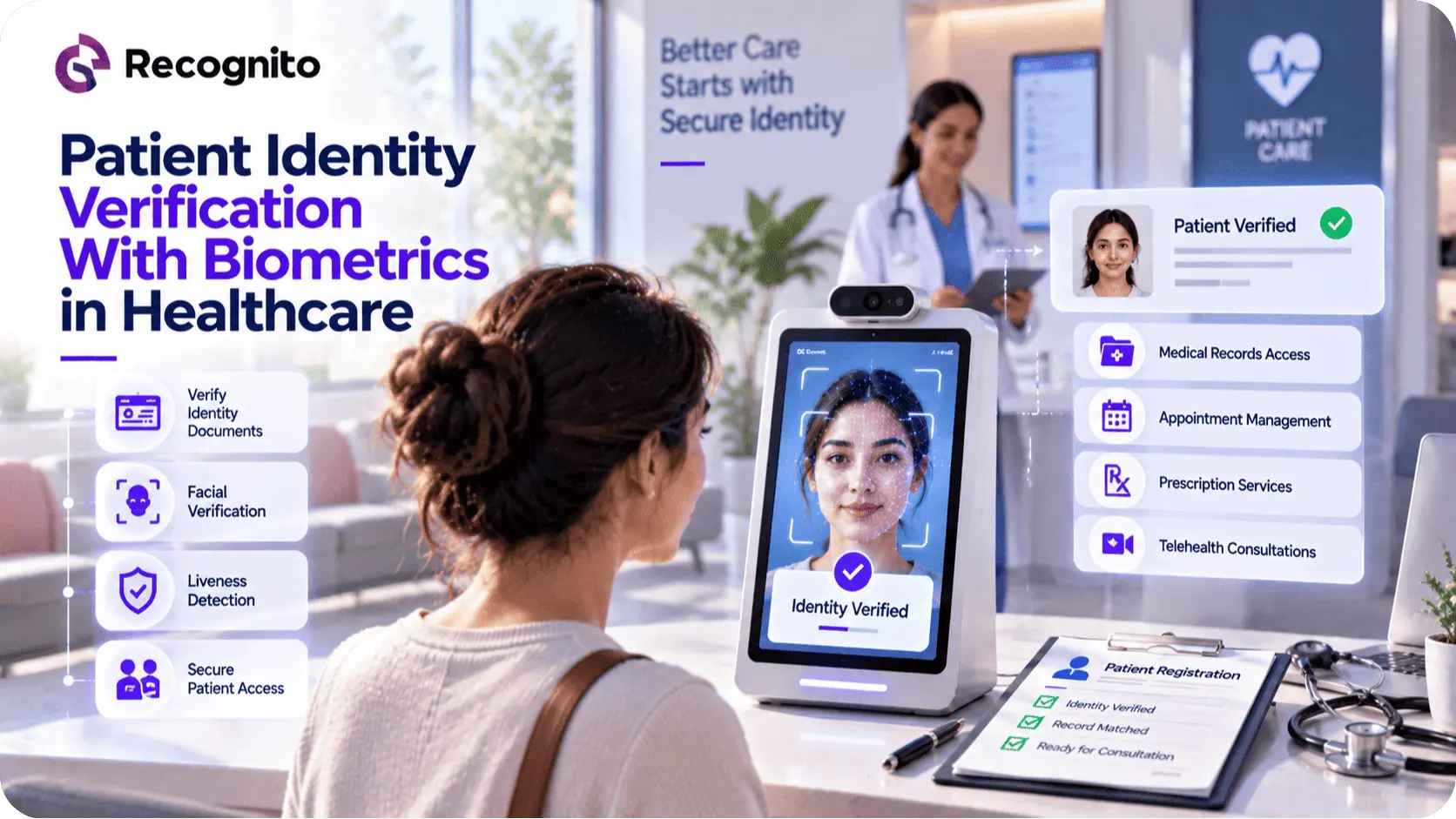
Healthcare organizations are increasingly providing services through digital channels.
Patients can register remotely, schedule appointments, access medical records, complete telehealth consultations, manage prescriptions, and communicate with providers without visiting a facility. This improves accessibility and convenience, but it also creates an important challenge: how can healthcare organizations establish that the person accessing a service is the correct patient?
This is where patient identity verification becomes important.
Accurate patient identification has implications far beyond account security. A mismatch between a patient and their medical information can affect privacy, billing, clinical workflows, insurance processing, and the overall quality of care.
Biometric verification can provide another layer of confidence by helping connect a patient’s identity with the person participating in the digital interaction. Facial verification can be particularly useful in remote environments because cameras are already available on most modern devices.
However, biometrics should not be treated as a replacement for every existing identity control. Strong healthcare identity verification usually combines identity information, document or credential checks, biometric verification, liveness detection, privacy controls, and appropriate operational processes.
This guide explains how biometric technology can support patient identity management, where it fits into healthcare workflows, and what organizations should consider before implementation.
Why Patient Identity Management Matters in Healthcare
Patient identity is fundamental to healthcare operations.
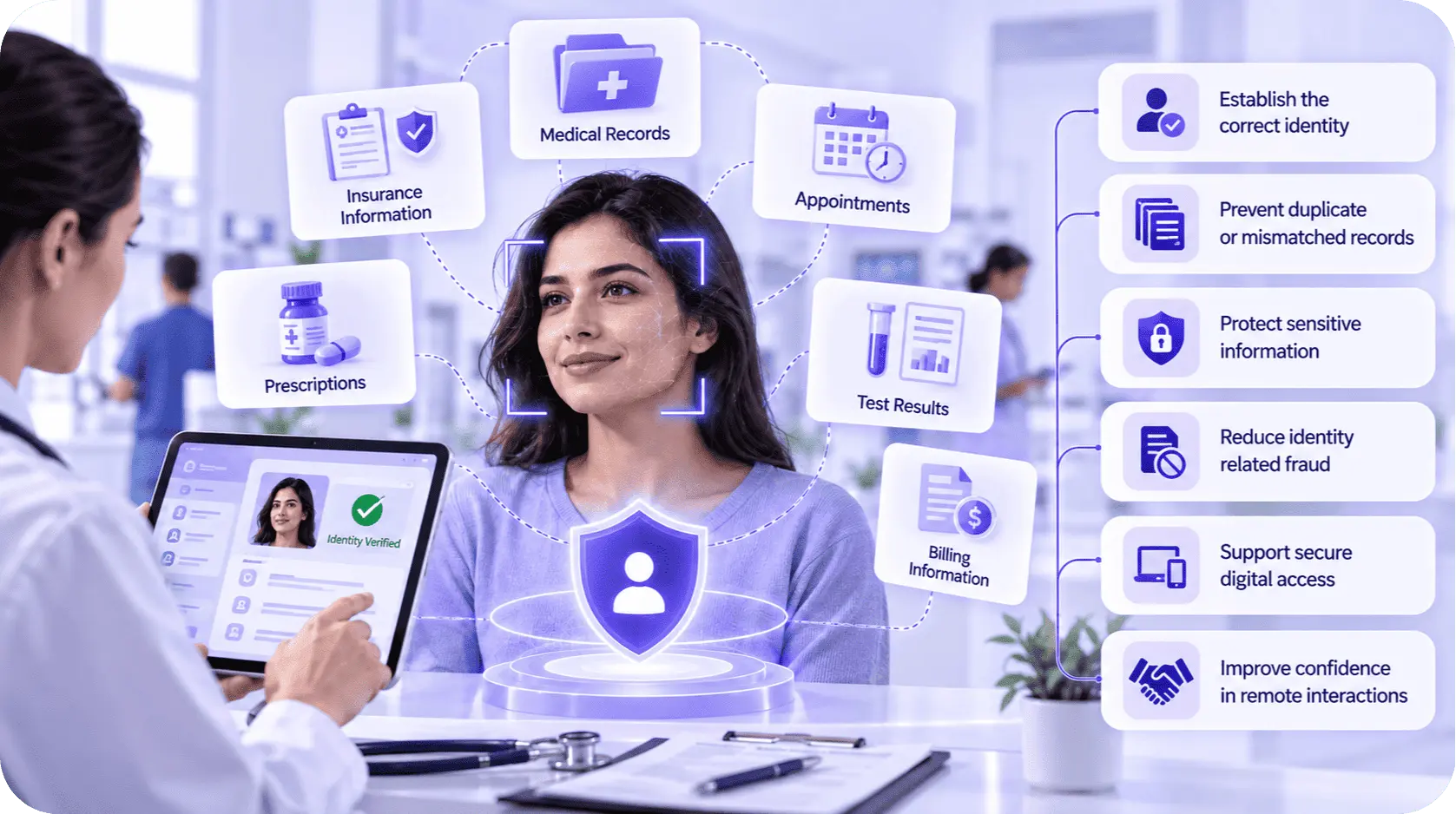
A healthcare provider may need to associate a person with their medical record, insurance information, appointments, prescriptions, test results, and billing information.
If the wrong identity is associated with a record, the consequences can extend beyond fraud.
A patient may be exposed to another person’s private medical information. Staff may have difficulty locating the correct record. Administrative processes can become more complicated, and digital services may be accessed by the wrong individual.
Patient identity management therefore serves several objectives at once.
It can help organizations:
- Establish the correct patient identity
- Prevent duplicate or mismatched records
- Protect sensitive information
- Reduce identity-related fraud
- Support secure digital access
- Improve confidence in remote patient interactions
The challenge becomes especially important as more healthcare interactions move online.
What Is Patient Identity Verification?
Patient identity verification is the process of establishing that an individual is the person they claim to be before allowing a healthcare service or identity-dependent action to proceed.
The exact process varies by organization and use case.
A patient registering for an online portal may need a relatively simple verification process. A new patient completing remote onboarding for a telehealth service may require stronger assurance. A sensitive account recovery event may justify additional authentication.
The important distinction is between identity information and identity assurance.
A person can provide a name, date of birth, phone number, or other information, but those attributes alone do not necessarily establish that the individual is the legitimate owner of the identity.
Biometric verification provides another signal by connecting the identity to a physical characteristic of the person.
How Biometric Verification Supports Patient Identity Management
Biometric verification compares a newly captured biometric sample with a trusted reference associated with the patient.
For facial verification, the system may compare a live facial image with a previously established reference image.
This can be useful when a healthcare organization needs stronger confidence that the person accessing a service is the correct patient.
A facial biometric SDK can provide the matching capability within an organization’s own application or patient portal.
The biometric step can be especially useful when paired with other identity evidence.
For example, a healthcare organization may first establish a patient’s identity using trusted records or credentials, then use facial verification to confirm that the individual participating in a remote interaction corresponds with that identity.
This creates a stronger connection between the patient record and the person accessing it.
Why Biometrics Can Be Valuable for Digital Patient Onboarding
Traditional patient registration can involve forms, identity information, insurance details, and manual verification.
Digital onboarding can make this process faster, but remote registration also removes some of the contextual cues that staff receive during an in-person interaction.
Biometric verification can provide an additional layer of assurance in that environment.
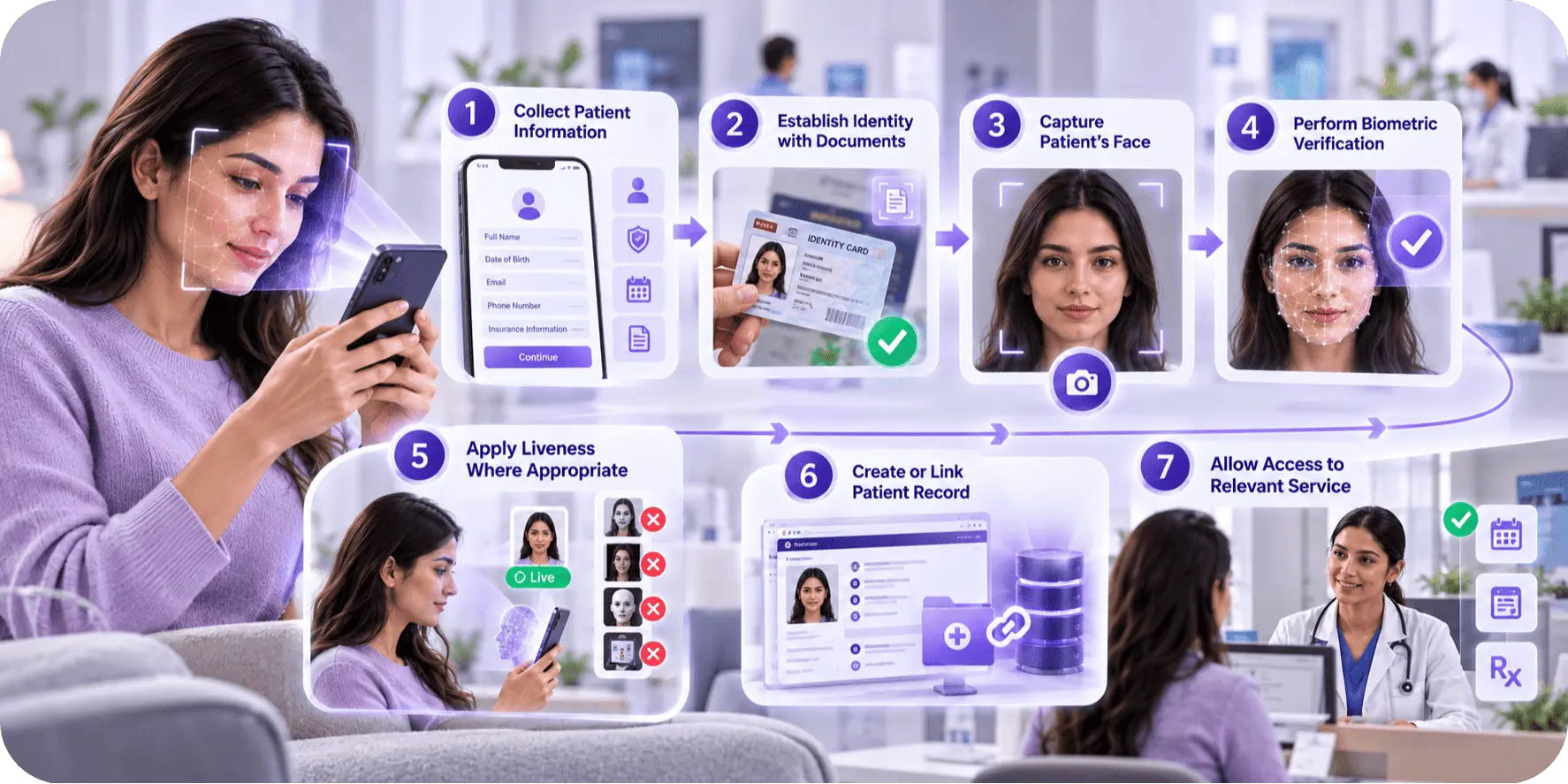
A digital onboarding workflow may involve:
- Collecting required patient information.
- Establishing identity using appropriate evidence.
- Capturing the patient’s face.
- Performing biometric verification.
- Applying liveness where appropriate.
- Creating or linking the patient record.
- Allowing access to the relevant service.
The precise sequence depends on the organization’s workflow.
The objective is not to maximize the number of verification steps. It is to establish an appropriate level of confidence while keeping the patient experience manageable.
The Role of Identity Documents and Other Credentials
Biometrics work best when there is a trustworthy reference identity.
For some healthcare workflows, that reference may be an existing patient record. For new patient onboarding, it may come from an identity document or another trusted credential.
Document verification can help establish identity evidence before the biometric stage.
An ID document recognition SDK can support automated analysis of supported identity documents as part of a broader onboarding process.
This creates a useful relationship:
Identity evidence establishes who the patient claims to be.
Biometric verification helps establish whether the person is consistent with that identity.
This layered approach can be stronger than relying on either documents or biometrics alone.
Why Liveness Detection Matters in Healthcare
Facial verification introduces another security question.
How does the organization know that the captured facial image or video comes from the genuine patient rather than an artificial presentation?
An attacker might attempt to use a photograph, replayed video, image displayed on another device, mask, or manipulated facial media.
Liveness detection provides an additional control by assessing whether the biometric presentation appears to originate from a live person.
A biometric liveness SDK can be integrated alongside facial verification when the use case requires stronger protection against presentation attacks.
The two controls perform different jobs.
Facial verification: Does the presented face correspond with the trusted patient identity?
Liveness detection: Does the biometric presentation appear to come from a genuine live person?
For healthcare organizations handling sensitive patient information, separating these questions is important when designing a remote identity architecture.
Healthcare Fraud and Identity-Related Risk
Healthcare fraud can take many forms, and biometric verification is not designed to solve all of them.
However, identity controls can help address certain identity-related risks.
Potential scenarios include:
Impersonation
Someone attempts to access a patient’s account or services using another person’s identity.
Account Takeover
An attacker gains access to an existing patient account and attempts to make sensitive changes or access confidential information.
Identity Misuse
A person’s identity information is used to create an account or access a healthcare service without authorization.
Duplicate or Inconsistent Identity Records
Information associated with one individual may be incorrectly created or associated with another record.
Biometrics can provide an additional identity signal in these scenarios, particularly when access or onboarding is remote.
Healthcare organizations should nevertheless combine biometric results with authentication, access controls, audit logging, fraud monitoring, and other security mechanisms.
Biometric Verification for Telehealth
Telehealth creates an especially interesting use case for patient identity verification.
The patient and provider may interact entirely remotely, meaning the healthcare organization needs to establish identity without physical registration at a facility.
A biometric workflow can potentially be used during:
- New patient registration
- Remote consultations
- Account recovery
- High-risk account changes
- Access to sensitive services
The organization should determine the right verification frequency based on risk.
A patient may not need to complete full biometric verification during every routine interaction if the account is already strongly authenticated.
Instead, stronger verification can be triggered when an event creates greater identity risk.
This reduces unnecessary friction while preserving stronger controls for sensitive actions.
Patient Privacy and Biometric Data
Healthcare already involves highly sensitive personal information.
Adding biometric information creates additional privacy and security considerations.
Organizations should understand:
- What biometric information is processed
- Where processing takes place
- Whether facial images are stored
- Whether biometric templates are retained
- How long information is kept
- Who can access it
- How data is deleted
- How vendors handle the information
In the United States, healthcare organizations may need to consider HIPAA requirements depending on the organization, data, and activity involved. The U.S. Department of Health and Human Services provides the official HIPAA Privacy Rule guidance.
Privacy requirements can also differ across jurisdictions.
The important principle is that biometric architecture should be designed around the actual healthcare use case, applicable law, data minimization, security requirements, and patient expectations.
Designing a Patient Identity Verification Workflow
A healthcare organization should define the identity workflow before selecting individual technologies.
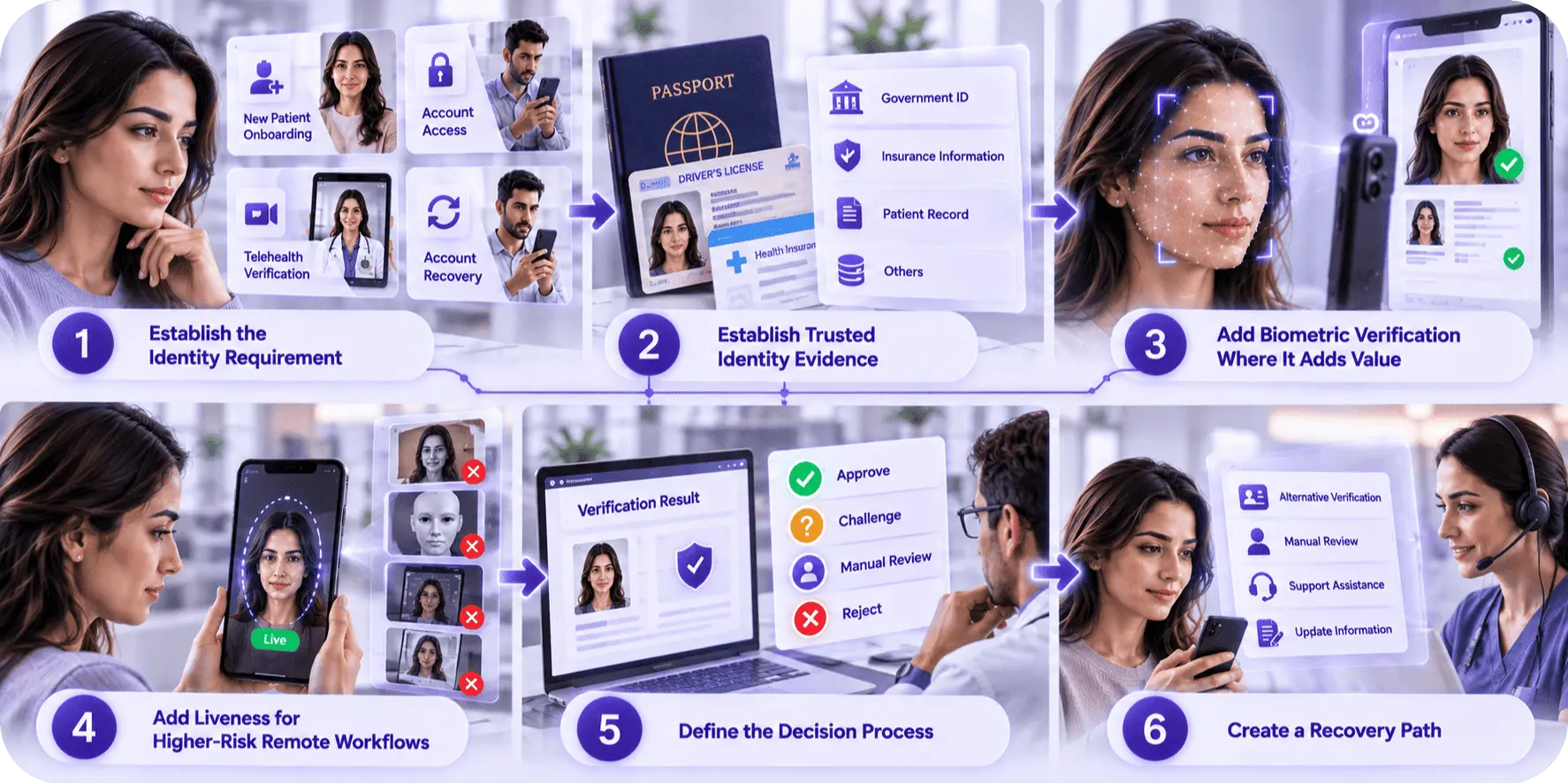
1. Establish the Identity Requirement
Determine what the organization needs to prove and why.
Is the goal new patient onboarding, account access, telehealth verification, account recovery, or another sensitive activity?
2. Establish Trusted Identity Evidence
Determine which source establishes the patient’s identity and how that information is maintained.
3. Add Biometric Verification Where It Adds Value
Use biometric verification when stronger person-to-identity assurance is needed.
4. Add Liveness for Higher-Risk Remote Workflows
Where presentation attacks are a meaningful concern, liveness can provide an additional security layer.
5. Define the Decision Process
Determine when an interaction should be approved, challenged, reviewed, or rejected.
6. Create a Recovery Path
Legitimate patients need a way forward when verification fails because of technical or biometric conditions.
This structure prevents the technology from becoming the workflow.
The workflow should come first, and the technology should support it.
Handling Failed Patient Verification
Biometric verification can fail for legitimate reasons.
A patient may have:
- Poor lighting
- A low-quality camera
- An unsuitable capture angle
- Temporary network problems
- Significant appearance changes
- Difficulty following capture instructions
A failed biometric result therefore should not automatically be interpreted as healthcare fraud.
The system should distinguish between technical failure and genuine identity risk.
Depending on the situation, the workflow could provide:
- Another capture attempt
- Better instructions
- An alternate verification method
- Additional identity evidence
- Manual review
- Support intervention
This is particularly important in healthcare because legitimate patients may have accessibility, device, or environmental challenges that affect biometric capture.
Accessibility and Patient Experience
Healthcare identity verification should be designed for a broad patient population.
Not every patient will have the latest smartphone, ideal lighting, or the same level of technical confidence.
An overly difficult biometric workflow can create unnecessary barriers.
Organizations should therefore evaluate:
- Ease of capture
- Clarity of instructions
- Device compatibility
- Accessibility
- Retry behavior
- Alternative verification methods
- Patient abandonment
Security improvements are valuable only when legitimate patients can actually use the service.
Biometric Verification and Patient Record Integrity
One of the less obvious benefits of strong identity verification is the potential to support more reliable patient record management.
Healthcare organizations can face difficulties when patient identities are duplicated, inconsistently recorded, or incorrectly linked.
A stronger identity architecture can help connect digital interactions to the correct identity record.
Biometrics should not be treated as a universal solution to record matching, but they can provide an additional signal when identity confidence matters.
The result can be a more consistent relationship between:
Patient identity → patient record → digital account → healthcare service
That relationship is especially important when sensitive information is accessible through digital channels.
Comparing Biometric Controls in Patient Identity Management
Healthcare organizations should assess each control according to the problem it solves.
| Identity Control | Primary Purpose | Example Healthcare Use |
| Identity information | Establish claimed identity details | New patient registration |
| Document verification | Validate identity credentials | Remote onboarding |
| Facial verification | Connect person with trusted identity | Telehealth or account access |
| Liveness detection | Protect biometric capture | Remote high-risk verification |
| Authentication | Restrict account access | Patient portal login |
| Risk assessment | Combine identity and security signals | High-risk account activity |
| Manual review | Handle ambiguous cases | Failed or elevated-risk verification |
The goal is not to deploy every control for every patient.
It is to use the appropriate level of assurance for the specific situation.
Measuring Healthcare Identity Verification Performance
A healthcare organization should monitor both security and patient experience.
Useful biometric verification metrics can include:
- Verification completion rate
- First-attempt success
- False rejection rate
- Liveness failure rate
- Retry rate
- Average verification time
- Manual review rate
- Account recovery events
The organization should also track operational outcomes such as patient abandonment and support requests.
A high failure rate may indicate a technical problem rather than increased fraud.
Breaking metrics down by device, workflow, and failure reason can help the organization identify where improvements are needed.
How SDK-Based Biometrics Fit Into Healthcare Applications
Healthcare providers developing their own applications may prefer SDK-based biometric capabilities because they can integrate identity verification directly into existing patient journeys.
For example, a face verification SDK can provide facial matching within a patient application, while liveness can add another layer of capture security.
Document-based onboarding can use the document recognition capability described earlier.
Technical teams can also explore the Face Biometric Playground while evaluating the user experience and implementation requirements.
The Recognito GitHub repository can provide additional technical resources for development teams assessing integration options.
This approach can give the healthcare organization greater control over its application experience while allowing specialized biometric capabilities to operate underneath the identity workflow.
Common Mistakes in Healthcare Biometric Implementation
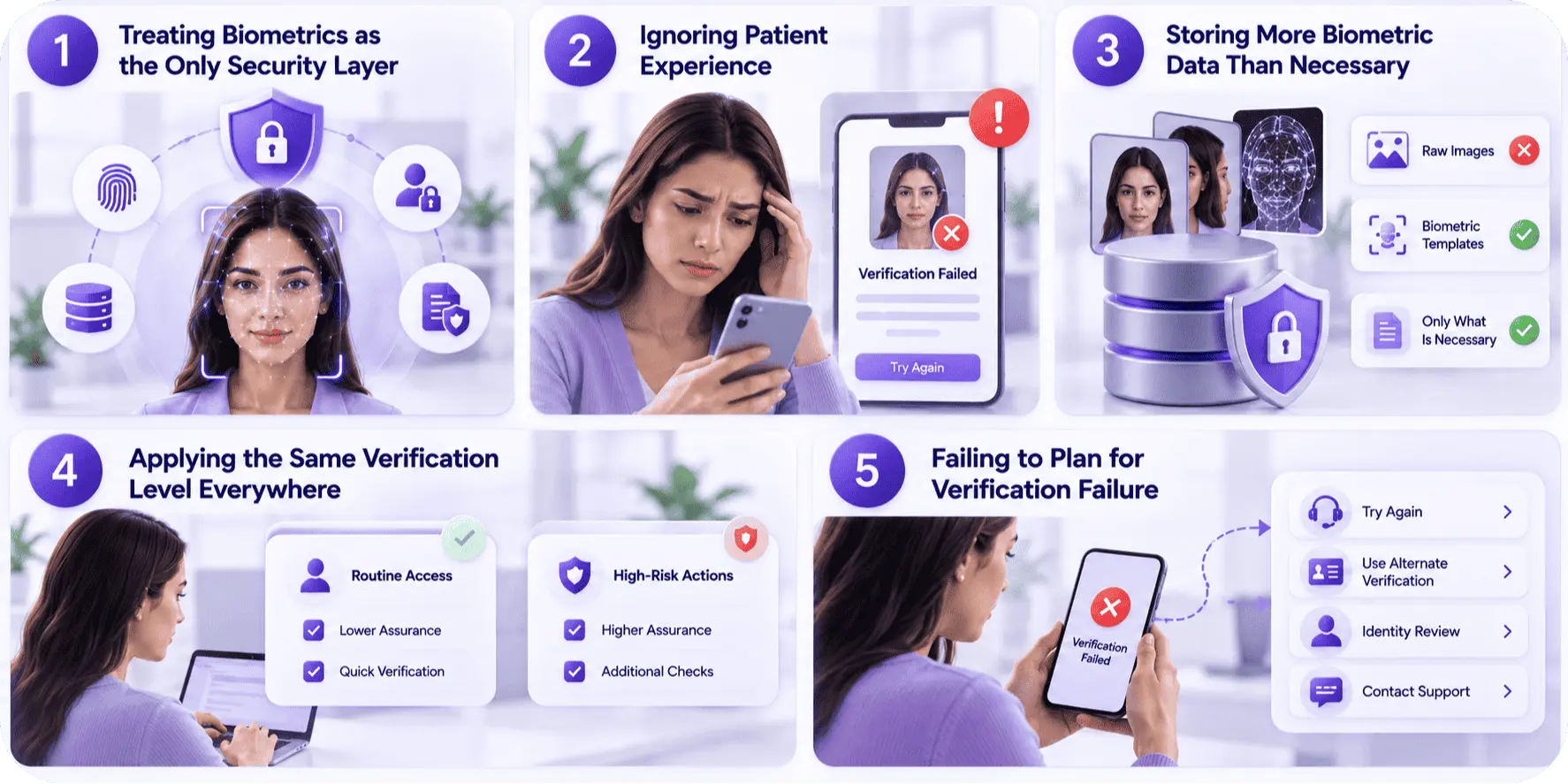
Treating Biometrics as the Only Security Layer
Biometrics should complement authentication, access controls, fraud monitoring, and privacy controls.
Ignoring Patient Experience
A technically strong system can still fail if legitimate patients cannot complete verification.
Storing More Biometric Data Than Necessary
Organizations should carefully evaluate whether raw images or biometric representations need to be retained.
Applying the Same Verification Level Everywhere
Routine portal access and high-risk identity changes may require different levels of assurance.
Failing to Plan for Verification Failure
Patients need clear recovery and alternative verification paths when biometric capture fails.
How Organizations Should Evaluate Biometric Technology
Healthcare organizations should test biometric systems under realistic conditions.
The proof of concept should include different devices, lighting environments, patient workflows, legitimate-user scenarios, and relevant identity fraud scenarios.
Security teams should also evaluate liveness and presentation attack protection where the risk profile requires it.
The ISO/IEC 30107-3:2023 standard provides principles and methods for assessing presentation attack detection mechanisms and reporting evaluation results.
The organization’s own testing should then determine whether the technology behaves appropriately in the actual healthcare environment.
Where Recognito Can Fit Into Patient Identity Management
Recognito’s biometric technologies can support different parts of a healthcare identity workflow.
A biometric face recognition SDK can provide facial matching, while a separate liveness capability can strengthen the biometric capture process for remote verification.
Where identity documents are required, document recognition can support the initial identity evidence stage.
The Face Biometric Playground can help technical teams explore facial biometric functionality before integrating it into a production patient application.
Development teams can also consult the Recognito GitHub repository when evaluating implementation resources.
The appropriate architecture will depend on the healthcare organization’s identity requirements, privacy model, risk profile, patient population, and existing technology stack.
Building a Sustainable Patient Identity Strategy
Patient identity verification should be treated as an ongoing capability rather than a one-time onboarding feature.
Healthcare organizations can gradually strengthen their identity architecture by:
Reviewing High-Risk Activities
Identify which patient actions require stronger identity assurance.
Monitoring Performance
Track verification failures, patient completion, false rejection, and operational outcomes.
Reviewing Security
Assess whether new fraud and presentation attack techniques require changes to the biometric controls.
Maintaining the Technology
Keep SDKs, application components, security controls, and supporting infrastructure appropriately maintained.
Preserving Alternative Access Paths
Ensure patients have appropriate options when biometric verification is unavailable or unsuccessful.
This makes the identity system more resilient while keeping patient access practical.
Conclusion
Patient identity verification is becoming increasingly important as healthcare moves more services into digital environments.
Biometric verification can help healthcare organizations connect a patient to a trusted identity, while liveness detection can provide additional protection against presentation attacks during remote capture.
However, biometrics should be part of a layered identity architecture rather than a standalone solution.
Strong healthcare identity verification can combine identity evidence, document checks, facial verification, liveness, authentication, risk assessment, privacy controls, and appropriate manual review.
The best implementation also considers the patient experience. A secure system must remain usable, accessible, and capable of handling legitimate verification failures without unnecessarily blocking patients.
Healthcare organizations evaluating biometric technologies for patient onboarding and identity management can explore the broader capabilities available from Recognito as part of their identity security strategy.
Frequently Asked Questions
Why is patient identity verification important in healthcare?
It helps healthcare organizations establish that the person accessing a service or patient record is associated with the correct identity. This can support privacy, reduce identity-related fraud, and improve confidence in digital healthcare interactions.
How can biometric verification improve healthcare identity verification?
Biometric verification can help connect a patient to a trusted identity reference, providing an additional identity signal beyond names, account credentials, or documents.
Is liveness detection necessary for healthcare biometrics?
It depends on the use case and risk level. For remote facial verification, liveness can provide additional protection against photographs, replayed media, and other presentation attacks.
How should healthcare organizations handle failed biometric verification?
They should distinguish technical failure from genuine identity risk and provide appropriate recovery options such as another capture, alternative verification, additional evidence, or manual review.
What should healthcare organizations consider before implementing biometric verification?
They should evaluate biometric performance, privacy, security, liveness, accessibility, integration, device compatibility, scalability, patient experience, regulatory requirements, and the long-term maintenance of the technology.