

Cryptocurrency exchanges operate in an identity environment that is more complex than simply creating an account and verifying a name.
An exchange may need to establish who a customer is, understand the purpose and risk of the relationship, monitor transactions, identify suspicious activity, comply with sanctions requirements, and keep customer information secure.
At the same time, cryptocurrency transactions can move across jurisdictions, blockchain addresses, custodial services, decentralized protocols, and other parts of the digital asset ecosystem.
This creates a challenging environment for crypto KYC and AML compliance.
The Financial Action Task Force applies anti-money laundering and counter-terrorist financing standards to virtual assets and virtual asset service providers, and its 2025 targeted update called for stronger global implementation and highlighted continuing illicit-finance risks in the sector. (FATF)
For cryptocurrency exchanges, the challenge is therefore not simply collecting a passport or asking a customer to complete a selfie.
The real challenge is building an identity and compliance process that remains effective across onboarding, account activity, transactions, risk changes, and different regulatory environments.
What Is Crypto KYC?
Crypto KYC refers to the identity verification and customer due diligence processes used by cryptocurrency businesses to understand who their customers are and assess the associated risk.
The exact obligations depend on the exchange’s activities and the jurisdictions in which it operates.
For many regulated or covered businesses, the process can include:
- Customer identity collection
- Identity document verification
- Customer risk assessment
- Beneficial ownership checks where relevant
- Sanctions screening
- Ongoing monitoring
- Suspicious activity escalation
- Recordkeeping
In the United States, FinCEN has explained that certain businesses involved in exchanging or transmitting convertible virtual currency can fall within the money-transmitter framework and related Bank Secrecy Act obligations. (FinCEN.gov)
That makes the distinction between a simple crypto registration process and a genuine compliance program extremely important.

Why KYC Is Challenging for Cryptocurrency Exchanges
Traditional financial institutions generally operate within established banking and payment infrastructures.
Cryptocurrency exchanges may interact with blockchain addresses, self-hosted wallets, other virtual asset service providers, decentralized services, multiple fiat currencies, and customers across different jurisdictions.
This creates several challenges at once.
An exchange may know the customer’s identity but still need to determine:
What is the customer using the platform for?
Does the transaction activity match the customer’s expected risk profile?
Is the customer connected to a sanctioned person or jurisdiction?
Does the transaction involve suspicious activity?
Has the customer’s risk changed since onboarding?
This is why effective cryptocurrency verification needs to be connected to a broader AML and transaction-monitoring framework.
1. Identity Verification Across Global Customer Bases
One of the first challenges is establishing customer identity across different countries and document systems.
An international exchange may need to support passports, national identity cards, driver’s licenses, residence permits, and other documents from multiple jurisdictions.
Those documents can differ considerably in:
- Format
- Language
- Security features
- Data structure
- Image quality
- Expiration rules
- Available machine-readable information
A verification process that performs well for one market may not deliver the same results in another.
An ID document verification SDK can support automated document analysis as part of a broader exchange onboarding workflow.
However, document verification should not be treated as the entire identity decision.
The exchange still needs to determine whether the person presenting the document corresponds with the claimed identity.
2. Connecting the Customer to the Identity
A genuine identity document can still be used by someone other than its rightful owner.
This is particularly important for remote cryptocurrency onboarding because there may be no physical interaction between the customer and the exchange.
Biometric verification can provide an additional person-to-identity signal.
A facial sample can be compared with the trusted photograph associated with the identity document, helping the exchange determine whether the individual completing onboarding corresponds with the submitted identity.
For exchanges integrating biometric capabilities directly into their own applications, a facial verification SDK can provide the matching component.
The objective is not to replace KYC with biometrics.
It is to strengthen the identity assurance layer within the KYC process.
3. Liveness and Biometric Spoofing
Facial matching introduces another security problem.
What happens if the customer is not actually presenting their genuine face?
An attacker could attempt to use photographs, replayed video, screen images, masks, or synthetic media.
That makes liveness detection particularly relevant to remote cryptocurrency verification.
A biometric liveness SDK can add an additional layer by assessing whether the facial presentation appears to originate from a live subject.
This creates a clearer identity chain:
Identity document → trusted identity evidence
Facial verification → person-to-identity comparison
Liveness → biometric presentation protection
For crypto exchanges dealing with higher-risk account activity, these controls can be particularly valuable when combined with broader fraud and AML measures.
4. Different Countries Have Different Requirements
One of the biggest challenges in global crypto compliance is that there is no single KYC rulebook that can simply be applied identically everywhere.
FATF standards provide an international baseline for virtual assets and VASPs, but individual jurisdictions implement requirements through their own legal and regulatory frameworks.
FATF’s 2025 review found that global implementation remains incomplete even though jurisdictions have made progress in developing and enforcing AML/CFT frameworks for virtual assets. (FATF)
This means exchanges need a jurisdiction-aware compliance strategy.
The onboarding process may need to account for:
- Customer location
- Entity location
- Available services
- Local licensing requirements
- Applicable KYC obligations
- Transaction restrictions
- Sanctions requirements
- Data protection rules
An exchange should therefore avoid treating “global KYC” as one static workflow.

5. AML Compliance Goes Beyond Customer Onboarding
KYC is only the beginning.
Once a customer has been verified, the exchange still needs to understand whether activity remains consistent with the customer’s expected profile.
This is where AML compliance becomes broader than identity verification.
An exchange may need to monitor for activity such as unusual transaction patterns, rapid movement of assets, suspicious account behavior, or other indicators relevant to its risk framework.
The FATF’s virtual asset framework specifically addresses AML/CFT measures for virtual assets and VASPs, including customer due diligence and ongoing risk management. (FATF)
A strong architecture therefore connects:
KYC → customer risk profile → transaction monitoring → investigation → reporting
rather than treating KYC as a one-time onboarding checkbox.
6. Sanctions Screening and Crypto Transactions
Sanctions compliance presents another challenge for cryptocurrency exchanges.
Virtual assets can move quickly across borders, creating additional complexity for organizations responsible for sanctions compliance.
OFAC states that sanctions obligations apply to transactions involving virtual currencies as well as traditional fiat currencies, and its guidance encourages the virtual currency industry to use risk-based sanctions compliance programs. (OFAC)
This means an exchange’s compliance architecture needs to consider more than the customer’s identity.
Depending on the applicable framework, screening and risk analysis may need to consider customer information, transaction context, counterparties, jurisdictional exposure, and blockchain-related information.
A verified customer is not automatically a low-risk customer.
7. Crypto Addresses Add Another Identity Problem
Traditional financial systems generally operate around identifiable accounts and regulated intermediaries.
Blockchain transactions can involve addresses that do not inherently reveal the real-world identity of their owner.
This creates an important distinction:
Customer identity tells the exchange who the customer is.
Blockchain intelligence can provide additional information about how digital assets move.
These two layers can complement one another.
An exchange may therefore need to combine KYC information with blockchain transaction analysis, risk scoring, and monitoring.
The exact implementation depends on the exchange’s business model and regulatory obligations.
8. Identity Fraud and Synthetic Identities
Cryptocurrency exchanges can also face traditional identity fraud.
Attackers may use stolen documents, compromised personal information, or synthetic identities to create accounts.
A fraudulent customer may appear legitimate during basic registration but become problematic later.
This is why exchanges can benefit from combining:
- Document verification
- Biometric verification
- Liveness
- Device intelligence
- Behavioral signals
- Transaction monitoring
- Identity history
Recognito’s article on cryptocurrency identity verification explores how biometric and identity technologies can support verification within cryptocurrency exchanges.
The more independent signals the exchange can evaluate, the less dependent it becomes on any single identity attribute.
9. Balancing KYC With Customer Experience
Crypto platforms operate in a highly digital environment where users often expect fast account creation.
A lengthy or confusing KYC process can lead to customer abandonment.
At the same time, weakening verification simply to improve conversion can create significant compliance and fraud exposure.
The challenge is therefore to reduce unnecessary friction, not necessary verification.
A well-designed onboarding experience can:
- Explain why verification is required
- Make document capture simple
- Provide clear biometric instructions
- Give users recovery options
- Avoid unnecessary duplicate checks
- Apply stronger verification according to risk
The exchange should monitor completion rates alongside security outcomes.
A high verification rate is not meaningful if fraudulent accounts are being approved.
10. Handling Failed Crypto Verification
Not every failed verification attempt indicates criminal activity.
A customer may fail because of poor lighting, an unsupported document, a damaged document, camera limitations, or inconsistent application data.
The system should distinguish between technical failure and genuine risk.
A useful workflow can route cases into different outcomes:
Technical Retry
The user receives better instructions or another capture opportunity.
Additional Verification
The user provides further evidence when identity confidence remains insufficient.
Enhanced Review
The case is routed to compliance or fraud specialists.
Restriction
Access to specific exchange functionality is limited until verification is completed.
Rejection
The relationship is not established when available evidence supports that decision.
This helps avoid treating every technical problem as fraud while maintaining stronger controls for genuinely suspicious cases.
11. Risk-Based KYC for Cryptocurrency Exchanges
Not every exchange customer presents the same level of risk.
A risk-based model allows the platform to apply verification and monitoring according to the circumstances.
A lower-risk customer may complete standard onboarding.
A customer exhibiting elevated risk may trigger stronger biometric verification, enhanced due diligence, additional source-of-funds information, or additional review depending on the applicable framework.
Potential risk factors can include:
- Customer geography
- Product usage
- Transaction patterns
- Device information
- Identity inconsistencies
- Screening results
- Account behavior
- Blockchain-related risk signals
Risk-based KYC allows the exchange to concentrate compliance resources where they have the greatest value.
12. Travel Rule and Information-Sharing Requirements
Another significant challenge for crypto businesses is the FATF Travel Rule.
FATF has extended requirements around originator and beneficiary information to relevant virtual asset transfers and continues to monitor implementation across jurisdictions. Its 2025 targeted update specifically identifies uneven implementation and continued need for stronger global action. (FATF)
For exchanges, this means compliance architecture can extend beyond customer onboarding.
The organization may need systems capable of collecting, transmitting, receiving, and managing required transfer information according to the rules applicable to the transaction and jurisdiction.
This demonstrates why crypto KYC cannot be treated as a standalone identity-verification product.
It is part of a broader compliance infrastructure.
The Core Components of Crypto KYC Compliance
A cryptocurrency exchange’s compliance architecture can involve several connected layers.
| Compliance Layer | Primary Purpose | Example Control |
| Customer identification | Establish who the customer is | Identity information and document verification |
| Biometric verification | Connect the person to the identity | Facial verification |
| Liveness | Protect biometric capture | Presentation attack detection |
| Risk assessment | Determine customer risk | Risk-based scoring |
| AML monitoring | Identify suspicious activity | Transaction and behavioral monitoring |
| Sanctions compliance | Identify prohibited exposure | Customer and transaction screening |
| Travel Rule | Manage required transfer information | Originator and beneficiary data handling |
| Ongoing due diligence | Maintain customer risk understanding | Periodic or event-driven review |
The exact controls required will depend on the exchange’s activities and applicable jurisdictions.
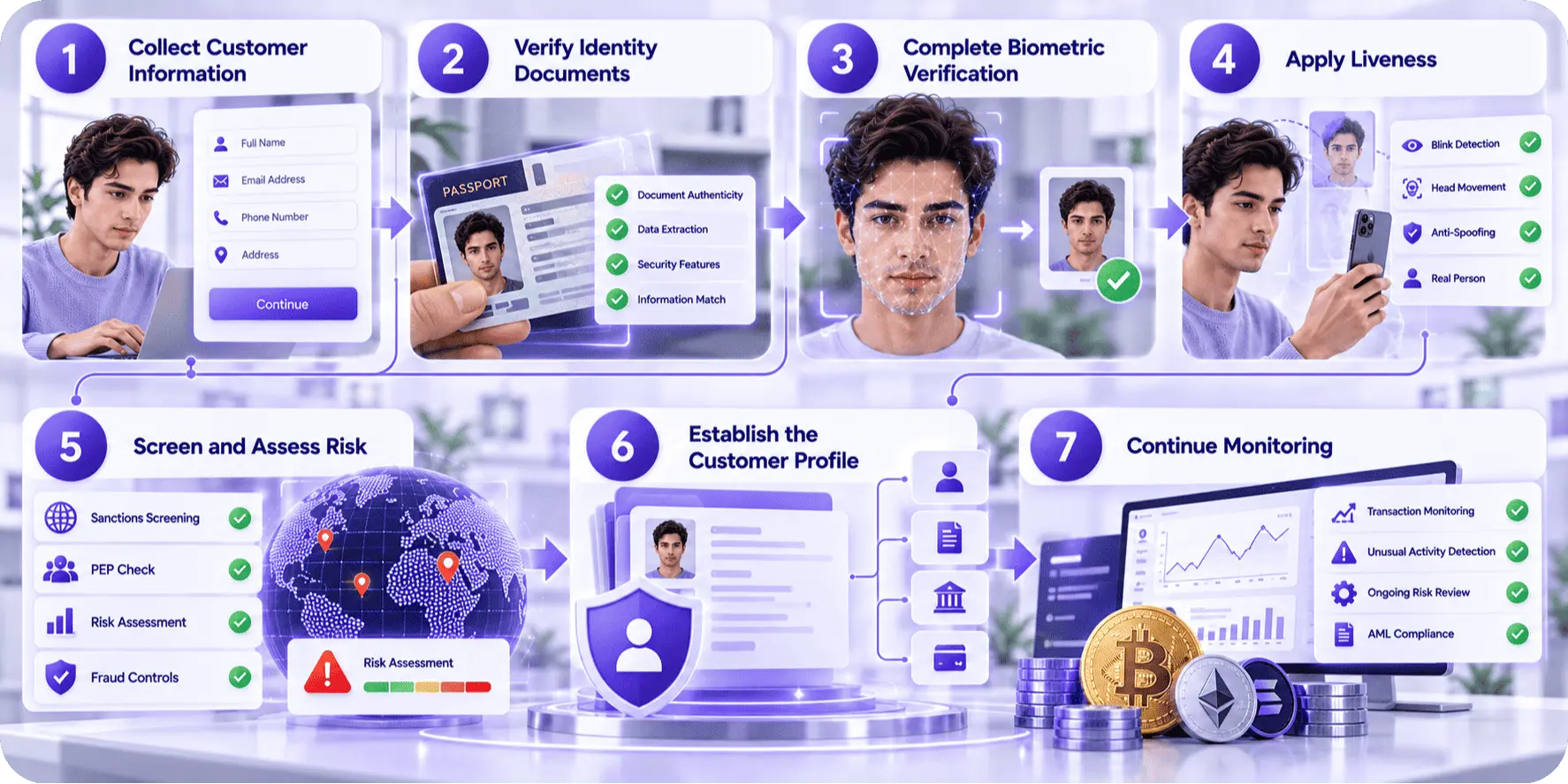
Designing a Crypto Onboarding Workflow
The customer journey should be designed around both compliance requirements and user experience.
1. Collect Customer Information
Gather the information required to establish the customer’s identity and determine applicable verification requirements.
2. Verify Identity Documents
Analyze the submitted document and establish whether the identity evidence is credible.
3. Complete Biometric Verification
Where appropriate, compare the customer’s facial sample against the trusted identity reference.
4. Apply Liveness
Protect the biometric capture process against relevant presentation attacks.
5. Screen and Assess Risk
Apply sanctions screening, customer risk assessment, and relevant fraud controls.
6. Establish the Customer Profile
Record the information needed for the ongoing compliance relationship.
7. Continue Monitoring
Identity verification should feed into ongoing AML and transaction-monitoring systems.
This makes onboarding the first stage of a wider customer lifecycle rather than the final compliance event.
Why Digital Identity Can Change Crypto KYC
Digital identity wallets and verifiable credentials may eventually reduce some of the repetition associated with identity verification.
A customer could potentially present a trusted credential rather than repeatedly submitting the same identity documents to different services.
This may improve privacy and user experience.
However, crypto exchanges would still need to assess whether the credential is trustworthy, whether it remains valid, and whether the person presenting it is genuinely associated with the credential.
Biometric verification may therefore remain relevant even as reusable digital identity becomes more common.
The technologies are complementary rather than mutually exclusive.
SDK-Based Crypto Identity Verification
For cryptocurrency exchanges building their own web or mobile applications, SDK-based identity technologies can provide more control over the verification experience.
A facial biometric SDK can integrate face matching into the exchange’s onboarding flow, while liveness and document capabilities can provide additional verification layers.
Technical teams can also review the Recognito GitHub repository during implementation and architecture planning.
The exchange can then connect the verification results to its own compliance engine, risk scoring, account system, and transaction-monitoring infrastructure.
The important point is that biometric SDKs should support the compliance architecture rather than replace it.
How Cryptocurrency Exchanges Should Evaluate KYC Technology
Before choosing a verification provider, an exchange should test more than successful onboarding.
The evaluation should consider:
- Supported identity documents
- Geographic coverage
- Facial verification performance
- Liveness and presentation attack protection
- Integration effort
- Verification speed
- Privacy and data handling
- Scalability
- Auditability
- Vendor support
- Total cost
The exchange should also test realistic customer and fraud scenarios.
A system that works perfectly with a clean passport and good lighting may behave differently when customers use older devices, poor image conditions, different documents, or international identity credentials.
Common Crypto KYC Compliance Mistakes
Treating KYC as a One-Time Event
Customer risk can change after onboarding. Ongoing monitoring and due diligence remain important.
Relying Only on Document Verification
A genuine document does not necessarily prove the person presenting it is the legitimate owner.
Treating Biometrics as a Complete AML Solution
Biometrics help establish identity but do not replace transaction monitoring, sanctions controls, or broader AML processes.
Ignoring Jurisdictional Differences
FATF provides an international baseline, but local requirements can differ considerably.
Optimizing Only for Onboarding Conversion
A fast KYC process is not successful if it allows unacceptable fraud or compliance risk.
How Exchanges Can Build More Sustainable Compliance
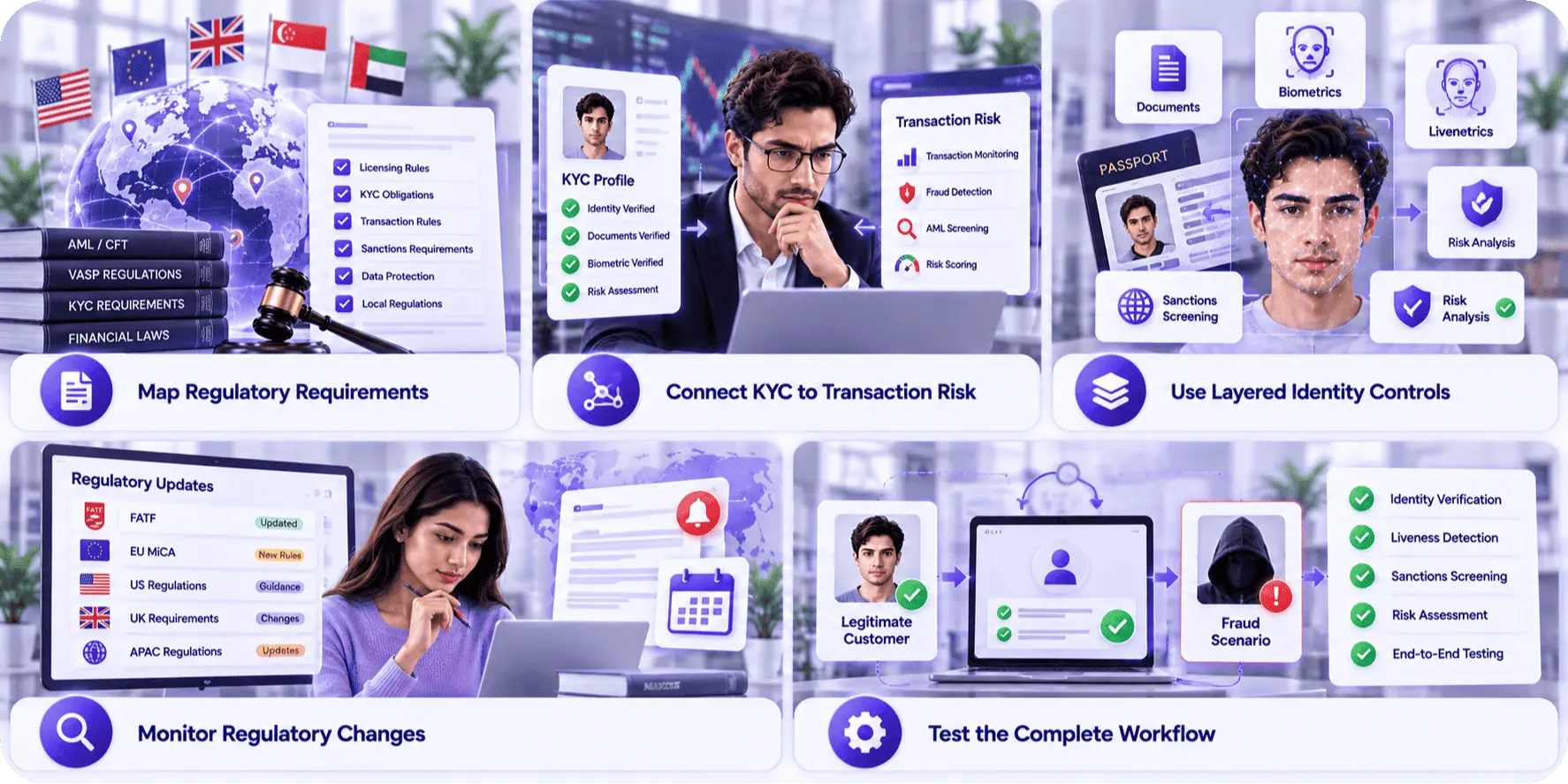
A mature crypto compliance program should be designed as a continuously evolving system.
Map Regulatory Requirements
Identify the rules applicable to every market and product the exchange supports.
Connect KYC to Transaction Risk
Customer identity should feed into broader AML and fraud decisioning.
Use Layered Identity Controls
Combine documents, biometrics, liveness, sanctions screening, and risk analysis where appropriate.
Monitor Regulatory Changes
Virtual asset regulation continues to develop, so compliance frameworks should be reviewed regularly.
Test the Complete Workflow
Evaluate both legitimate customers and realistic fraud scenarios before production deployment.
The objective is not to create the longest possible KYC process.
It is to create a defensible, risk-based system that establishes sufficient confidence in the customer and remains effective throughout the relationship.
Conclusion
Crypto KYC is becoming increasingly important as cryptocurrency exchanges operate within a more developed global AML and financial-crime compliance environment.
The challenge goes well beyond checking an identity document.
An effective cryptocurrency verification process needs to connect customer identification, document verification, biometric verification, liveness, risk assessment, sanctions screening, transaction monitoring, ongoing due diligence, and applicable information-sharing requirements.
FATF’s recent work shows that global implementation of virtual asset AML/CFT standards remains uneven and that significant illicit-finance risks continue to require stronger controls. (FATF)
For U.S.-connected businesses, FinCEN’s guidance also demonstrates that certain virtual-currency business models can fall within money-transmitter and BSA requirements, while OFAC makes clear that sanctions obligations can apply to virtual-currency transactions as well. (FinCEN.gov)
The strongest approach is therefore to treat KYC as part of a broader digital identity and AML architecture rather than as a standalone onboarding step.
Cryptocurrency exchanges evaluating biometric and identity technologies can explore the broader capabilities available from Recognito as part of their compliance and customer verification strategy.
Frequently Asked Questions
What is crypto KYC?
Crypto KYC refers to the identity verification and customer due diligence processes cryptocurrency businesses use to establish who their customers are and assess the associated risk.
Do cryptocurrency exchanges need KYC?
Requirements depend on the exchange’s business model and jurisdictions. FATF standards apply AML/CFT measures to virtual assets and relevant VASPs, while individual countries implement their own legal and regulatory requirements. (FATF)
Is biometric verification required for crypto exchanges?
Not universally. The appropriate identity controls depend on the exchange, jurisdiction, risk profile, and applicable regulatory requirements. Biometrics can provide an additional layer of person-to-identity assurance where appropriate.
Why is liveness detection useful for cryptocurrency onboarding?
Liveness can help protect remote facial verification against presentation attacks such as photographs, replayed media, and other artificial biometric presentations.
Does KYC alone satisfy crypto AML compliance?
No. KYC is one component of a broader AML/CFT program. Depending on the applicable framework, exchanges may also need risk assessment, transaction monitoring, sanctions controls, suspicious activity processes, recordkeeping, ongoing due diligence, and other measures.