
Gig economy platforms depend on trust.
A rideshare company needs confidence that the person accepting a trip is the approved driver. A delivery platform needs to know that the contractor receiving customer orders is the same person who completed verification. A freelance marketplace needs to distinguish genuine professionals from fraudulent accounts, impersonators, and coordinated networks.
This makes gig economy fraud prevention a different challenge from ordinary account security.
The platform is not simply protecting a login. It is protecting a two-sided or multi-sided ecosystem in which workers, customers, businesses, payments, and platform operations are connected.
Fraudsters can exploit weaknesses at several points. They may create fake contractor accounts, use stolen identities, share credentials, operate multiple accounts, manipulate onboarding information, or take control of legitimate worker accounts.
The most effective approach is therefore layered.
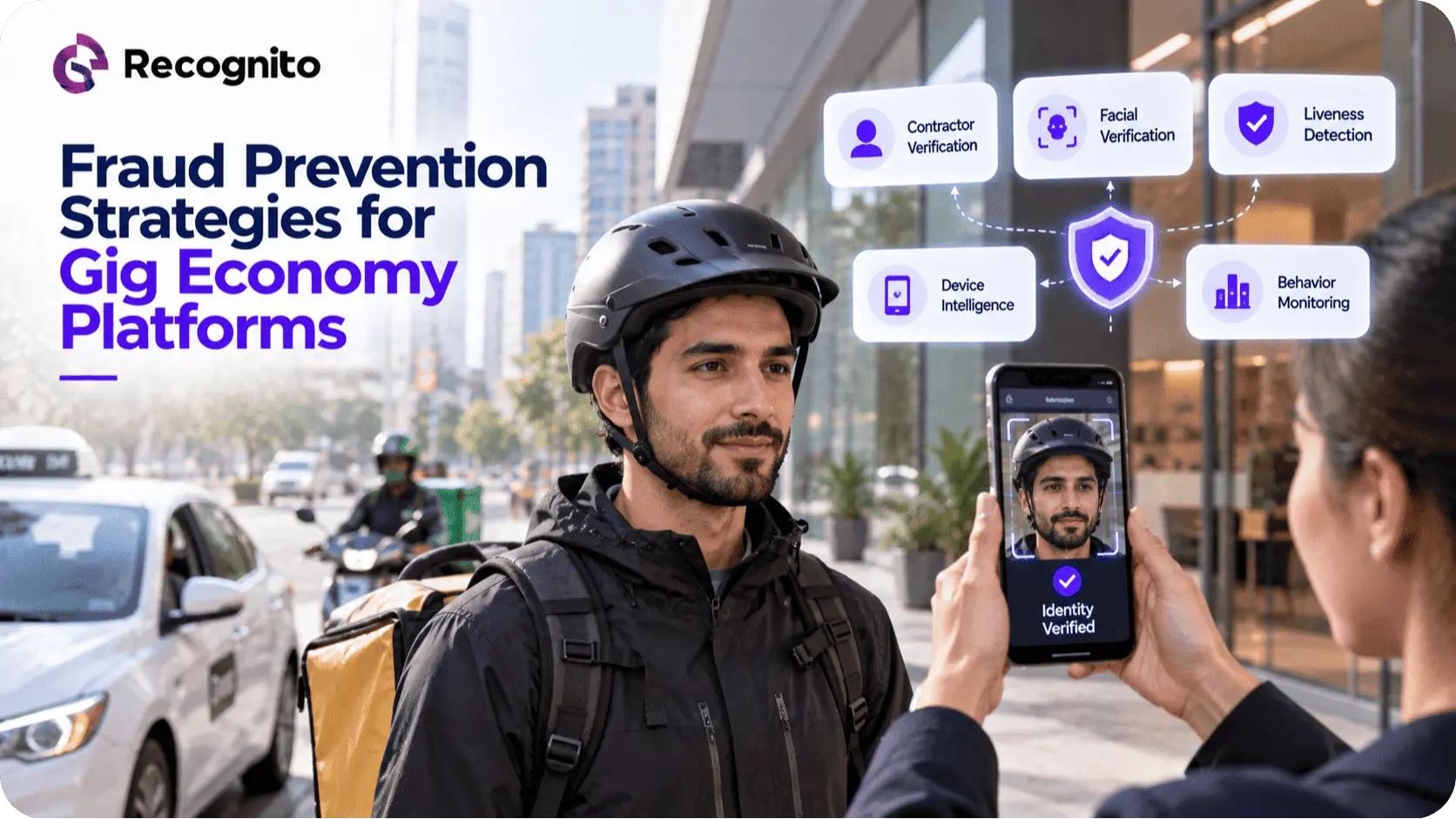
Identity verification can establish who a contractor claims to be. Biometric verification can help connect that identity to the actual person. Liveness detection can protect remote facial capture against presentation attacks. Device, behavioral, transaction, and platform signals can then provide additional context.
The objective is not to make every worker complete the maximum possible number of checks.
It is to establish an appropriate level of trust before granting access to sensitive platform functions and continue monitoring identity risk throughout the contractor lifecycle.
Why Gig Platforms Face Unique Fraud Risks
Traditional businesses may have a relatively stable employee population and controlled access environment.
Gig platforms have something very different.
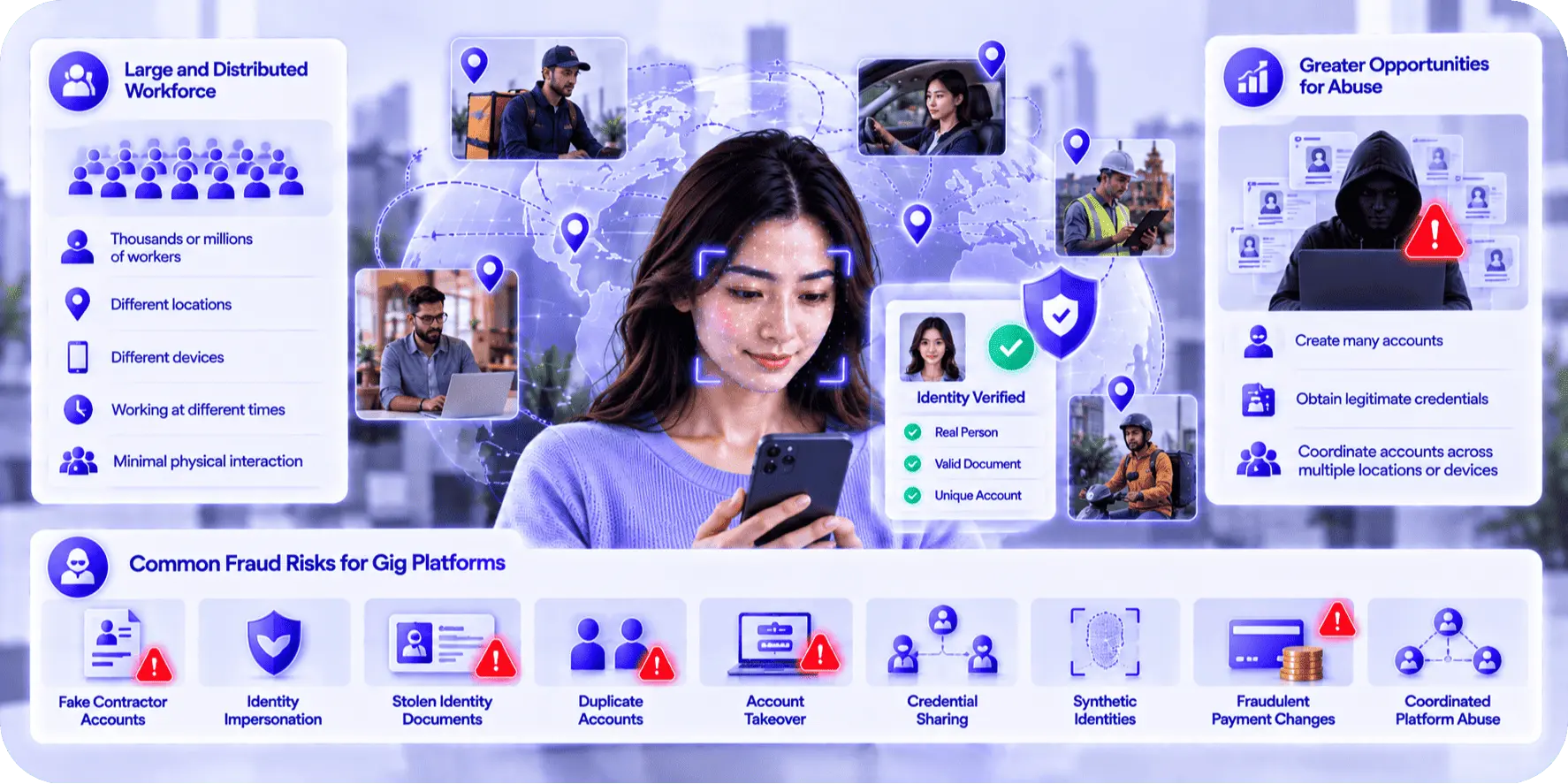
They can have thousands or millions of independent workers operating from different locations, using different devices, working at different times, and joining the platform with minimal physical interaction.
That scale creates several opportunities for abuse.
A fraudster may create many accounts rather than one. An attacker may obtain a legitimate worker’s credentials. A group may coordinate accounts across multiple locations or devices.
Platforms can also face identity-related problems such as:
- Fake contractor accounts
- Identity impersonation
- Stolen identity documents
- Duplicate accounts
- Account takeover
- Credential sharing
- Synthetic identities
- Fraudulent payment changes
- Coordinated platform abuse
The larger the workforce, the more difficult manual verification becomes.
This is why automation and risk-based verification are particularly valuable for gig platforms.
What Is Gig Economy Fraud Prevention?
Gig economy fraud prevention refers to the combination of identity, security, behavioral, payment, and operational controls a platform uses to detect and reduce fraudulent activity involving workers, customers, or accounts.
Contractor identity is one important layer, but it is not the entire system.
A platform may need to determine:
Who is this worker?
Is the submitted identity information legitimate?
Is this the same person who was originally verified?
Is the person physically present during biometric verification?
Does the account behave consistently with a genuine worker?
Are multiple accounts connected to the same suspicious environment?
The answers can come from different systems.
A strong platform security architecture connects those signals instead of expecting one verification tool to identify every fraud attempt.
Contractor Verification Should Start With Identity
For many gig platforms, contractor verification is the most important initial control.
Before a worker can accept jobs, receive payments, access customer information, or perform other sensitive actions, the platform should establish the worker’s identity according to the requirements of its business model and jurisdiction.
This may involve:
- Personal identity information
- Government-issued identity documents
- Contact information
- Address information
- Business or contractor details
- Required licenses or registrations
The exact requirements depend on the type of gig work.
A food delivery platform may need different checks from a marketplace for professional contractors or transportation providers.
The important principle is that access should be connected to a verified identity, not simply to an account created with an email address and password.
Document Verification for Contractor Onboarding
Identity documents provide an important source of evidence during worker onboarding.
A platform may accept passports, national identity cards, driver’s licenses, or other recognized credentials depending on the operating market.
Document verification can help identify inconsistencies, unsupported documents, expired credentials, and potential signs of manipulation.
An ID document recognition SDK can support the document stage by allowing the platform to integrate automated document analysis into its own contractor onboarding flow.
However, document verification has an important limitation.
A legitimate document can still be used by somebody who is not the rightful owner.
That means a platform using documents as the main identity signal may still be vulnerable to impersonation.
The next question becomes:
Is the person completing onboarding actually the person represented by the document?
Facial Verification Connects the Worker to the Identity
This is where biometric verification can strengthen contractor verification.
The worker provides a facial sample, and the system compares it with the trusted facial image associated with the established identity.
A face verification SDK can provide this matching capability directly within a gig platform’s web or mobile application.
That creates a stronger connection between:
Verified identity
and
Actual person
This can be particularly useful when the platform never meets workers physically.
For example, a fraudulent contractor may possess a genuine driver’s license belonging to another person. The document can appear valid while the facial comparison identifies a mismatch.
Facial verification is therefore not a replacement for document verification.
The two technologies answer different questions and can work together.
Why Liveness Detection Matters for Gig Platforms
Facial matching creates another potential attack path.
An attacker may attempt to present:
- A photograph
- An image displayed on another screen
- Replayed video
- A physical mask
- Synthetic facial media
If the platform only compares facial images, it may not have enough information to determine whether the biometric presentation is genuine.
Liveness detection adds another layer.
A liveness detection SDK can assess whether the captured biometric presentation appears to originate from a genuine live person.
The distinction is important:
Facial verification asks whether the face corresponds with the trusted worker identity.
Liveness verification asks whether the presented biometric appears genuine.
Used together, they can make remote contractor verification more resistant to impersonation and presentation attacks.
Platforms deciding how much user interaction to require can also review active and passive liveness detection when designing the worker experience.
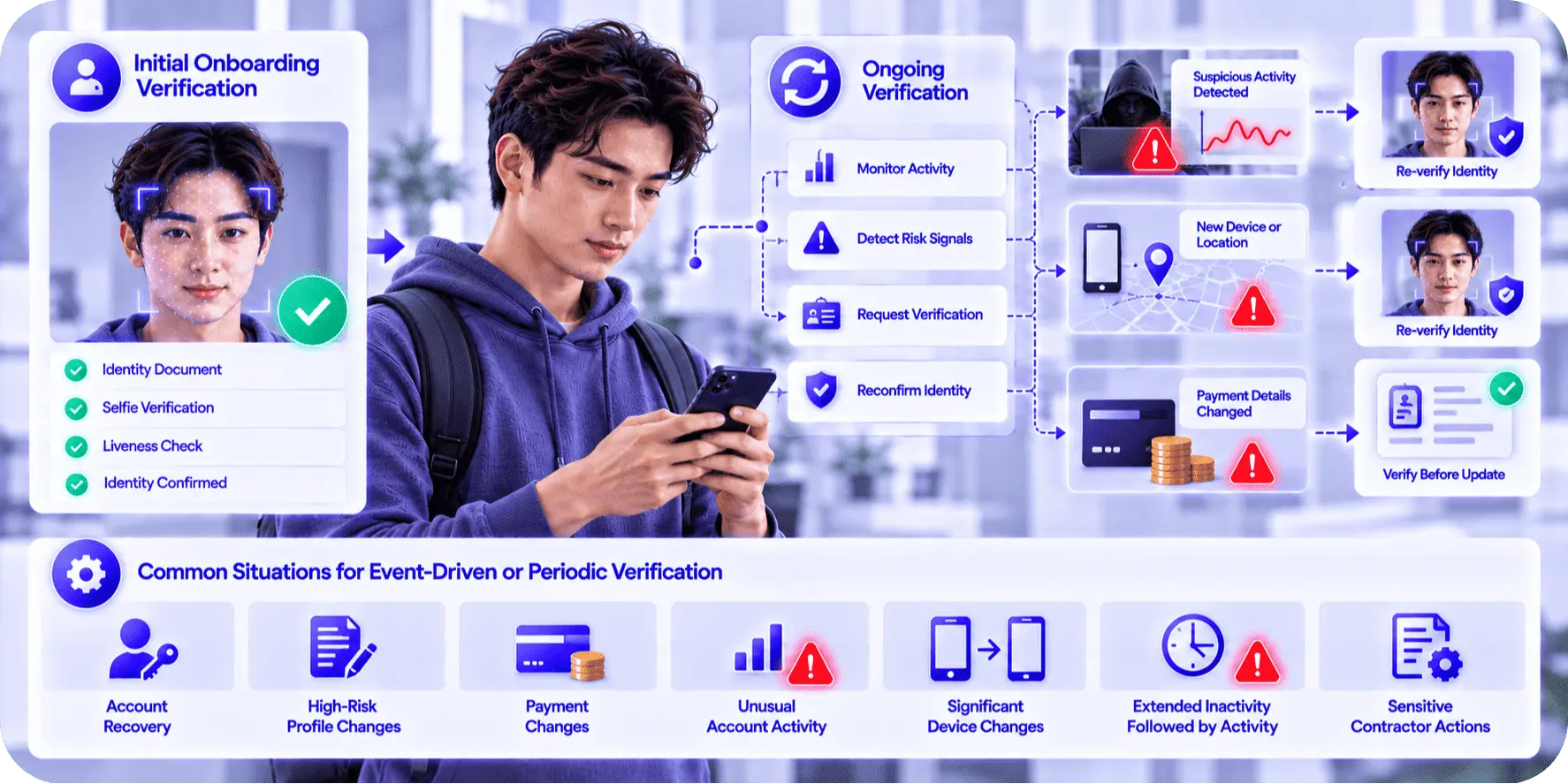
Worker Identity Should Not Be Verified Only Once
One of the biggest mistakes a gig platform can make is treating onboarding verification as the end of identity assurance.
A worker may pass verification on Monday and behave differently on Friday.
An account could be compromised. Credentials could be shared. A different person could begin using the worker’s device or account.
This means identity risk can change after onboarding.
A mature platform can therefore use event-driven or periodic verification for situations such as:
- Account recovery
- High-risk profile changes
- Payment changes
- Unusual account activity
- Significant device changes
- Extended inactivity followed by unusual activity
- Sensitive contractor actions
The goal is not to repeatedly inconvenience every worker.
It is to request stronger verification when the risk justifies it.
Detecting Duplicate and Multiple Contractor Accounts
Multiple-account abuse is a significant consideration for large gig platforms.
A fraudster may attempt to create several worker accounts to bypass platform restrictions, manipulate incentives, exploit referral systems, or continue operating after an account is suspended.
Identity verification can help identify duplicate identities, but it becomes more powerful when combined with other signals.
A platform may analyze connections involving:
- Identity information
- Biometric references
- Devices
- Phone numbers
- Email addresses
- Payment information
- Network characteristics
- Account behavior
One shared signal may be legitimate.
Several shared signals across many accounts can indicate coordinated activity.
This is where fraud prevention becomes more about relationship analysis than simple pass or fail verification.
Device Intelligence Adds Another Layer
The device used by a contractor can provide useful context.
For example, a single device associated with many newly created contractor accounts may deserve additional scrutiny.
Other potentially relevant signals can include:
- Unusual device configurations
- Repeated account switching
- Emulator or automation indicators
- Abrupt device changes
- Suspicious network patterns
Device intelligence should not be treated as proof of fraud.
Shared devices, family use, and legitimate device changes can all occur.
The right approach is to use device characteristics as contextual signals that become stronger when combined with identity, biometric, and behavioral evidence.
Behavioral Signals Can Reveal Risk
Gig platforms have access to a type of information that traditional identity systems may not have: how workers actually use the platform.
Behavior can provide useful context.
A platform might monitor changes such as:
- Unusual login times
- Sudden geographic changes
- Rapid account switching
- Unusual job acceptance patterns
- Activity inconsistent with historical behavior
- Repeated changes to important account information
Behavioral signals become especially useful after onboarding because they help determine whether the account continues to behave consistently with the identity and history already established.
This creates a broader model:
Identity verification establishes initial trust.
Behavior monitoring helps determine whether that trust remains appropriate.
Applying Risk-Based Verification
Not every worker requires the same level of verification at every moment.
A newly registered contractor should generally receive more scrutiny than an established worker with a long history of normal activity.
Likewise, a routine profile update may not require the same verification as changing the bank account used to receive earnings.
A practical model could include:
Standard Risk
Normal onboarding with identity and document verification.
Elevated Risk
Additional biometric verification after suspicious device or account signals.
High Risk
Biometric verification plus liveness, stronger identity evidence, or manual review.
This provides more security without forcing maximum verification on the entire workforce.
The Relationship Between Security and Worker Experience
Gig platforms depend on worker participation.
An identity process that is too complicated can reduce contractor onboarding and increase support volume.
A system that frequently rejects legitimate workers can create another type of platform risk.
That means worker experience should be measured alongside security.
Useful metrics include:
- Onboarding completion
- First-attempt verification
- Retry rate
- Verification time
- Manual review rate
- False rejection
- Worker abandonment
The objective is not to make verification as difficult as possible.
It is to make fraudulent activity difficult while allowing legitimate contractors to start working efficiently.
Fraud Risk Can Change After a Worker Is Approved
The strongest gig economy fraud prevention programs do not treat identity verification as a one-time checkbox.
A platform can establish identity during onboarding and then continue monitoring relevant risk signals.
Examples include:
- Sudden device changes
- Unusual account access
- Payment-account changes
- Multiple accounts linked to the same environment
- Suspicious geographic changes
- Unusual platform activity
A higher-risk event can then trigger additional verification.
This model allows the platform to use biometric verification strategically instead of requiring workers to repeat the full onboarding process every time they access the application.
Designing a Contractor Verification Workflow
A practical workflow can follow several stages.
1. Collect Contractor Information
Gather the minimum identity and work-related information required for onboarding.
2. Verify the Identity Document
Analyze the submitted credential and compare its information with the application.
3. Perform Facial Verification
Connect the contractor’s face with the established identity.
4. Apply Liveness Where Appropriate
Protect remote facial capture against presentation attacks.
5. Assess Risk
Combine identity, biometric, device, behavioral, and account signals.
6. Grant Appropriate Access
Activate contractor privileges according to the verification and risk result.
7. Continue Monitoring
Trigger stronger verification when relevant risk indicators appear later.
This creates a continuous identity model rather than a single onboarding event.
Identity Verification and Contractor Payments
Payments can create an especially sensitive identity event.
A worker may need to change payment details, update banking information, or connect a new payout method.
Because payment changes can redirect earnings, the platform may want to treat them as elevated-risk events.
Instead of relying solely on the worker’s existing login session, the platform can request stronger identity assurance before applying certain changes.
This could involve:
- Biometric verification
- Liveness
- Additional account authentication
- Manual review
The exact process depends on the risk of the platform and transaction.
The principle is simple:
Sensitive actions should be able to trigger stronger identity verification.
Protecting Against Account Takeover
Account takeover is another important concern for gig platforms.
A fraudster may gain access to a contractor’s credentials and attempt to operate the account.
The attacker already has a legitimate account, meaning basic account authentication may not be enough to establish that the original worker is still present.
Biometric verification can provide an additional identity signal for certain high-risk events.
For example, the platform might request facial verification when:
- Account recovery occurs
- Payment information changes
- A new device appears
- Unusual access is detected
- Sensitive account settings are modified
This is more practical than forcing full biometric verification during every routine interaction.
Gig Platform Security Requires More Than Biometrics
Biometrics are useful, but they should not become the only security control.
A strong platform security architecture can combine:
- Identity verification
- Biometric verification
- Liveness detection
- Device intelligence
- Behavioral analytics
- Authentication
- Payment controls
- Risk decisioning
- Ongoing monitoring
Each layer should have a clearly defined role.
This reduces the chance that one compromised control becomes a complete platform failure.
Measuring Gig Economy Fraud Prevention
Security teams should track both fraud and worker experience.
| KPI | What It Measures | Why It Matters |
| Contractor verification completion | Workers who successfully complete onboarding | Measures onboarding effectiveness |
| First-attempt success | Workers verified without retry | Indicates capture and workflow quality |
| False rejection rate | Legitimate workers incorrectly rejected | Reveals unnecessary friction |
| Biometric verification success | Successful facial checks | Measures biometric performance |
| Liveness failure rate | Unsuccessful liveness attempts | Identifies spoofing and capture issues |
| Manual review rate | Cases needing human intervention | Measures operational workload |
| Duplicate account detection | Multiple accounts connected to related identities | Helps detect coordinated fraud |
| Account takeover events | Compromised worker accounts | Measures post-onboarding risk |
| Fraud loss | Financial impact of detected fraud | Connects controls to business outcomes |
The most useful interpretation comes from looking at these metrics together.
For example, a sudden increase in liveness failures alongside a new application release may indicate a technical issue rather than a sudden increase in fraud.
Common Gig Platform Fraud Prevention Mistakes
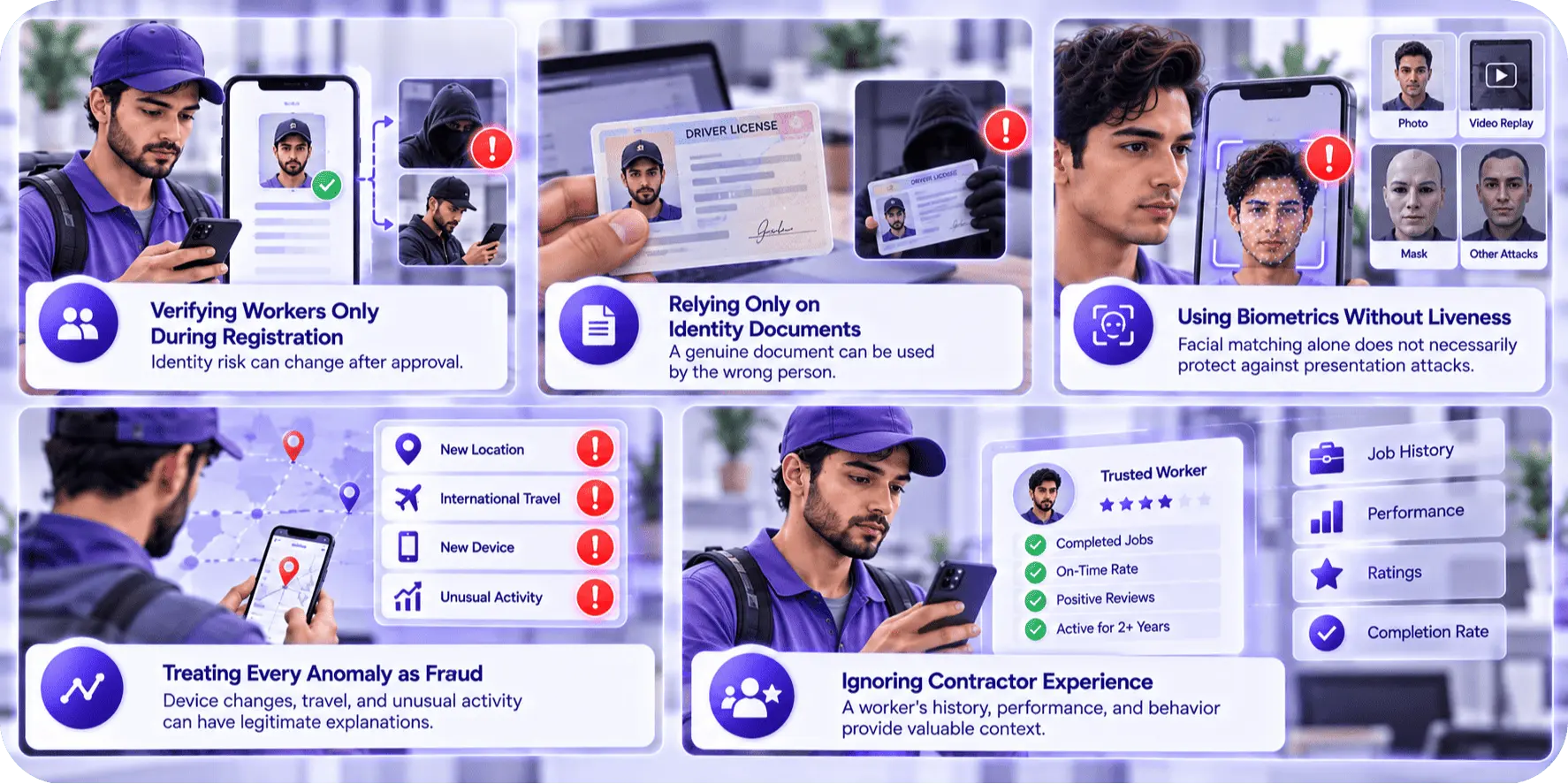
Verifying Workers Only During Registration
Identity risk can change after approval.
Relying Only on Identity Documents
A genuine document can be used by the wrong person.
Using Biometrics Without Liveness
Facial matching alone does not necessarily protect against presentation attacks.
Treating Every Anomaly as Fraud
Device changes, travel, and unusual activity can have legitimate explanations.
Ignoring Contractor Experience
Excessive verification friction can reduce worker acquisition and increase support demands.
SDK-Based Identity Verification for Gig Platforms
Gig platforms often build their own web and mobile applications, making SDK-based verification particularly useful.
A biometric verification SDK can provide facial matching directly inside the contractor onboarding or higher-risk verification workflow.
Document analysis can be integrated alongside it, while liveness can provide an additional anti-spoofing layer.
Technical teams can also explore the Face Biometric Playground when evaluating how biometric capture fits within the worker experience.
The Recognito GitHub repository can provide another development resource during technical evaluation and integration planning.
An SDK-based architecture also allows the platform to decide exactly when verification occurs and how the result connects to its own risk engine, contractor management system, and account controls.
How to Build a Sustainable Fraud Prevention Program
Fraud prevention should evolve with the platform.
Understand the Highest-Risk Events
Identify which actions create the greatest potential financial or operational damage.
Define Verification Triggers
Determine when additional biometric or identity checks should occur.
Connect Identity and Behavioral Data
Look for patterns across accounts, devices, payments, and platform activity.
Test Real Fraud Scenarios
Evaluate the workflow using impersonation, stolen documents, account takeover, duplicate accounts, and presentation attacks relevant to the business.
Monitor and Tune
Review fraud outcomes, false rejection, worker completion, and operational performance continuously.
This creates a fraud strategy that can adapt instead of relying on fixed rules indefinitely.
Conclusion
Gig economy fraud prevention requires more than verifying a contractor during registration.
The strongest platforms establish identity before granting sensitive access, connect workers to trusted identities through biometric verification where appropriate, use liveness to protect remote facial capture, and continue monitoring identity and behavioral risk after onboarding.
Document verification can provide identity evidence. Facial verification can connect the contractor to that identity. Liveness can provide additional protection against biometric presentation attacks, while device and behavioral signals can reveal suspicious activity that a single identity check would not detect.
The most effective strategy is risk-based.
Routine activity should remain convenient for legitimate workers, while account recovery, payment changes, suspicious device activity, or other high-risk events can trigger stronger verification.
This creates a better balance between platform security and contractor experience.
Gig platforms evaluating SDK-based identity and biometric verification can explore the broader capabilities available from Recognito as part of their contractor verification and fraud prevention architecture.
Frequently Asked Questions
What is gig economy fraud prevention?
Gig economy fraud prevention is the combination of identity, biometric, behavioral, device, payment, and security controls used to protect platforms from fraudulent contractors, account takeovers, impersonation, duplicate accounts, and other forms of platform abuse.
Why is contractor verification important for gig platforms?
Contractor verification helps establish that workers are who they claim to be before they receive access to platform functions, customer information, jobs, or payment capabilities.
Can biometrics prevent contractor impersonation?
Biometric verification can help connect a contractor to a trusted identity, making it more difficult for another person to use a legitimate worker’s identity. Liveness can add protection against presentation attacks during remote biometric capture.
Should gig platforms verify workers after onboarding?
For higher-risk events, yes. Account recovery, payment changes, unusual device activity, or suspicious behavior can justify additional identity or biometric verification.
How can gig platforms reduce fraud without creating excessive worker friction?
A risk-based approach is generally more practical than applying maximum verification to everyone. Standard onboarding can remain efficient, while stronger identity checks are triggered when risk signals indicate they are necessary.