
Fleet safety programs often focus on speeding, harsh braking, distraction, fatigue, and vehicle maintenance. One basic risk can receive less attention because it seems too simple to need technology: whether the driver is actually wearing a seatbelt.
For a fleet operator, however, seatbelt compliance is not just a personal safety issue. It affects driver protection, workplace safety, operational risk, and the organization’s ability to enforce consistent safety policies across vehicles and routes.
Seatbelts remain one of the most effective ways to reduce injury severity in a crash. NHTSA reports that wearing a seatbelt in the front seat reduces the risk of fatal injury by 45% for passenger-car occupants and by 60% for light-truck occupants. Its current safety guidance also reports that 48% of passenger-vehicle occupants killed in crashes in 2024 were unrestrained. NHTSA’s current seatbelt safety guidance provides the latest figures and safety recommendations.
The challenge for fleet managers is that a policy saying “always wear your seatbelt” does not provide continuous visibility into whether that policy is actually being followed.
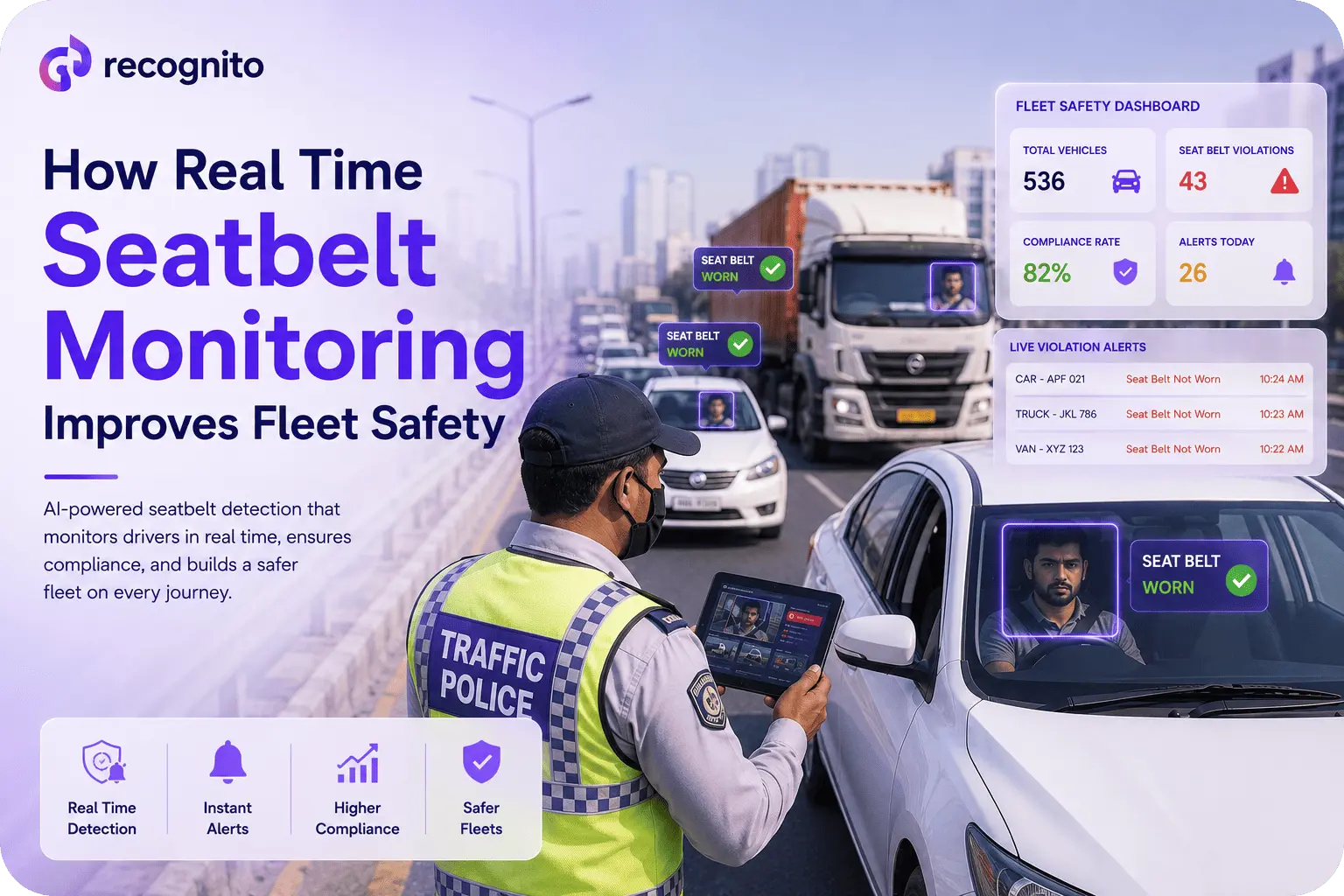
Real-time seatbelt monitoring changes that by using cameras and computer vision to detect whether a driver appears to be properly restrained while the vehicle is operating. Instead of relying entirely on periodic inspections, self-reporting, or post-incident investigation, fleets can create a technology-assisted feedback loop that identifies unsafe behavior much closer to when it occurs.
Why Seatbelt Compliance Matters in Fleet Operations
Commercial drivers spend considerably more time on the road than many private motorists, increasing exposure to potential crashes and other driving hazards.
A seatbelt policy is therefore only effective when drivers consistently follow it. FMCSA’s commercial motor vehicle seatbelt safety guidance explicitly encourages CMV drivers to buckle up and highlights the consequences of remaining unrestrained in serious crashes.
The operational problem is enforcement.
A fleet may have written policies, onboarding training, safety meetings, and disciplinary procedures, yet managers may have limited visibility into what happens after a vehicle leaves the yard. A supervisor cannot realistically watch hundreds of drivers throughout every shift.
This is where real-time monitoring becomes valuable. It moves part of the safety program from periodic oversight toward continuous detection.
The objective should not be to create a surveillance-heavy environment. It should be to identify a specific, high-impact safety behavior and provide an objective signal that can support coaching and intervention.
What Real-Time Seatbelt Monitoring Does
A camera inside the vehicle captures the driver’s upper-body area while computer vision analyzes the image to determine whether the seatbelt is being worn.
The system may identify visual characteristics such as:
- the driver’s body position
- the location and orientation of the belt
- whether the belt crosses the torso
- whether the belt appears properly positioned
- whether another object is obscuring the relevant area
The analysis can run continuously or at defined intervals, depending on the system architecture.
When the system determines that a driver may be unbelted, the event can trigger an alert, be logged for review, or feed into a broader fleet-safety platform.
The important distinction is between detection and discipline. Computer vision identifies a potentially unsafe condition. The organization then decides how that signal should be handled.
For example, an operator might use immediate in-cab alerts for first-level intervention while sending repeated or persistent events to a fleet dashboard for follow-up coaching.
How Computer Vision Detects Seatbelt Use
Seatbelt monitoring is fundamentally an image-recognition problem.
A typical system needs to locate the driver and analyze the area where the seatbelt should appear. Object-detection or image-classification models can be trained to distinguish restrained and unrestrained states.
Performance depends heavily on the quality and diversity of the training data.
The model needs to encounter realistic variations in:
- body size and seating position
- clothing
- belt color
- lighting
- camera angle
- vehicle interiors
- daylight and nighttime conditions
- partial occlusion
- steering-wheel placement
- image quality
This is one reason datasets matter. The seatbelt detection dataset and model research demonstrates how training data can support the development and evaluation of computer-vision systems for identifying seatbelt use.
A model trained primarily on clean, front-facing images may perform very differently once deployed inside a moving commercial vehicle.
Why Real-Time Detection Is More Useful Than Periodic Inspection
Traditional compliance programs usually discover violations after the behavior has already happened.
A supervisor may notice an unrestrained driver during a yard inspection. A safety officer may identify a pattern during an audit. A post-crash investigation may reveal that a driver was not properly restrained.
Those approaches remain useful, but they provide limited coverage.
Real-time monitoring can detect behavior during normal operations. That creates opportunities for intervention before an unsafe habit becomes routine.
Consider a driver who regularly begins a shift without fastening the seatbelt. A continuous system can identify the behavior repeatedly rather than relying on someone happening to observe it.
Over time, the fleet can analyze patterns:
- Which vehicles generate the most events?
- Are violations concentrated among certain routes or shifts?
- Are events isolated or repeated?
- Do particular camera positions produce more false alerts?
- Does driver behavior improve following coaching?
The data becomes useful not only for enforcement but for understanding why compliance is inconsistent.
Real-Time Alerts Can Change Driver Behavior
Detection by itself does not make a driver safer. The value comes from what happens after an event.
An in-cab warning can provide immediate feedback when a driver starts moving without fastening the belt. A fleet dashboard can then retain the event for safety management.
This creates a simple behavioral loop:
detect → alert → correct → record → review
The system can support a graduated safety approach rather than immediately treating every event as a disciplinary violation.
For example, a fleet might use an immediate reminder for an isolated event, coaching for repeated behavior, and formal review when a persistent pattern continues.
That approach helps distinguish between a one-time oversight and a sustained compliance problem.
It also allows safety teams to measure whether interventions actually work.
The Importance of Accuracy
False alerts are one of the biggest risks in computer-vision monitoring.
A system that incorrectly labels a properly restrained driver as unrestrained can create frustration, unnecessary interventions, and distrust in the technology.
The reverse problem is more serious: failing to detect an actually unrestrained driver.
Accuracy therefore needs to be evaluated using operational metrics rather than a single model-performance number.
A fleet should examine:
| Metric | What it measures | Why it matters |
| Detection accuracy | Correct identification of restrained and unrestrained states | Indicates overall model performance |
| False-positive rate | Properly restrained drivers incorrectly flagged | Protects driver trust |
| False-negative rate | Unrestrained drivers not detected | Indicates residual safety risk |
| Event latency | Time between detection and alert | Matters for real-time intervention |
| Coverage | Performance across vehicles and conditions | Shows how transferable the model is |
| Review rate | Events requiring human validation | Indicates operational workload |
Testing should use images and conditions that represent the actual fleet rather than relying entirely on development datasets.
Environmental Conditions Can Change Results
A camera-based safety system operates in a difficult visual environment.
Cabins differ significantly in design, lighting, camera placement, and available space. A driver’s clothing may partially obscure the belt. Night driving changes illumination. Sunlight can create glare across the windshield or dashboard.
Even small changes in camera positioning can affect the visible portion of the driver’s torso.
This makes deployment testing essential.
A model should be evaluated across multiple vehicle configurations and operating conditions before being treated as a reliable fleet-wide safety control.
The system should also communicate uncertainty appropriately. A low-confidence detection should not necessarily trigger the same response as a high-confidence event.
That distinction reduces unnecessary alerts and gives safety teams better-quality information.
Seatbelt Monitoring Should Be Part of a Larger Safety System
Fleet operators rarely need a technology that solves only one isolated problem.
The same driver-monitoring architecture may support additional safety capabilities such as distraction detection, phone-use detection, fatigue indicators, or other visual safety checks.
This creates an opportunity to build a broader in-cab computer-vision system rather than deploying disconnected hardware for every individual requirement.
Recognito’s real-time seatbelt monitoring analysis explores this concept in more detail, particularly around how computer vision can be applied to continuous safety monitoring.
The strongest architecture keeps each detection task logically separated while allowing results to flow into a common event and analytics layer.
Integrating Seatbelt Detection With Fleet Management
A production deployment becomes more useful when detections are connected to the systems fleet managers already use.
A possible architecture could include:
Camera: Captures the driver’s cabin environment.
Edge or onboard processor: Performs initial image analysis with minimal latency.
Detection model: Determines whether the seatbelt appears to be correctly worn.
Event engine: Applies confidence thresholds and determines whether an event should be recorded.
Alert layer: Provides an immediate driver notification when appropriate.
Fleet platform: Stores events for authorized safety personnel.
Analytics: Identifies recurring trends across vehicles, drivers, routes, and time periods.
This structure also helps avoid unnecessary data transmission. If the system can perform initial detection locally, only relevant events or metadata may need to be transmitted to the central platform, depending on the organization’s design.
For technical teams developing computer-vision safety applications, open engineering resources can also be useful. The Recognito GitHub repository provides developer-oriented material that can complement model and integration work.
Data Privacy Needs to Be Designed From the Start
Driver-monitoring systems involve images of people, so privacy and governance should not be treated as an afterthought.
A fleet should establish:
- what the camera captures
- whether full video is stored
- what data is retained
- who can access events
- how long information is kept
- how alerts are reviewed
- whether footage is used for purposes beyond safety
- how employees are informed about the system
Data minimization can be particularly important.
A system designed to identify seatbelt compliance may not need to retain continuous cabin video indefinitely. Depending on the architecture and legal requirements, retaining event metadata or short event clips may provide sufficient operational value while reducing unnecessary exposure.
The governance model should also clearly distinguish safety monitoring from broader employee surveillance.
Using Monitoring Data Without Creating a Punitive Culture
There is a practical human factor that technology alone cannot solve.
Drivers may resist monitoring when they believe every detection will automatically be used for punishment. That can lead to distrust, attempts to work around the system, or disengagement from safety initiatives.
A better approach is to establish clear rules before deployment.
Drivers should understand what is being detected, why it is being detected, what information is retained, and how events are handled.
Safety programs can then prioritize coaching and measurable improvement.
Repeated monitoring can show whether a driver’s compliance rate improves over time. Managers can also identify whether a recurring problem is behavioral or technical.
For example, if many drivers appear unrestrained in one vehicle, the problem may be an incorrectly positioned camera rather than a sudden fleet-wide safety failure.
Key Challenges in Real-Time Seatbelt Monitoring
Occlusion
Hands, clothing, steering wheels, and body position can obstruct the belt. The model needs to distinguish genuine non-compliance from situations where the belt is simply difficult to see.
Camera placement
A camera mounted too high, too low, or at an unsuitable angle can reduce detection reliability. Installation standards should therefore be part of the deployment plan.
Lighting changes
The system needs to work across daytime, nighttime, shadows, glare, and varying cabin illumination.
Model drift
Vehicle configurations, cameras, and driver populations can change over time. Periodic evaluation helps identify when performance is beginning to deteriorate.
Alert fatigue
Too many notifications can cause drivers or managers to ignore the system. Thresholds should be calibrated so alerts remain meaningful.
Connectivity
A fleet may operate through areas with poor connectivity. Real-time safety functions should not necessarily depend entirely on a constant cloud connection.
How Fleets Should Evaluate a Seatbelt Monitoring System
A practical evaluation should begin with a controlled pilot.
Select a representative group of vehicles rather than testing only one configuration. Include different drivers, routes, camera positions, lighting conditions, and vehicle interiors.
Then measure the complete operational cycle:
capture → detection → confidence → alert → event logging → human review → corrective action
The fleet should also establish a baseline before deployment. Without baseline data, it becomes difficult to determine whether technology actually improved compliance.
Useful business metrics include seatbelt-event frequency, repeat violations, intervention rates, driver compliance trends, false alerts, and review workload.
The goal is not to generate the largest possible volume of detection events. The goal is to create reliable information that leads to safer behavior.
Why Real-Time Monitoring Can Strengthen Fleet Safety
The strongest argument for automated seatbelt monitoring is not that it replaces safety policies or human supervision.
It makes those programs more measurable.
A written rule tells drivers what is expected. Training explains why the rule matters. Real-time detection provides visibility into whether the expected behavior is actually happening during normal operations.
That visibility can improve several parts of the safety process:
- earlier intervention
- more consistent enforcement
- measurable driver coaching
- identification of recurring risk patterns
- better safety reporting
- reduced dependence on occasional inspections
NHTSA continues to emphasize that consistent seatbelt use is one of the most effective ways to reduce crash-related injury and death, while FMCSA specifically addresses seatbelt use in commercial motor vehicles. Technology does not replace those fundamentals; it helps fleet operators monitor adherence to them.
Conclusion
Real-time seatbelt monitoring gives fleet operators a practical way to turn a basic safety rule into a measurable, continuously monitored behavior.
Computer vision can identify potential non-compliance, trigger timely alerts, record relevant events, and help safety teams understand patterns that traditional inspections may miss. But successful deployment depends on more than model accuracy. Camera placement, lighting, vehicle variation, privacy, alert design, connectivity, and driver communication all influence whether the system works effectively.
The best approach is to use seatbelt detection as one part of a broader fleet-safety strategy: detect risky behavior, intervene proportionately, measure results, and continuously improve the system.
For organizations developing intelligent vehicle-safety and computer-vision solutions, Recognito provides technologies that can support practical AI-powered monitoring workflows.
Frequently Asked Questions
How does real-time seatbelt monitoring work?
A camera captures the driver’s cabin area while a computer-vision model analyzes the image to determine whether a seatbelt appears to be properly worn. Depending on the system, the result can trigger an alert or create a safety event.
Can seatbelt detection work at night?
It can, but performance depends on camera capability, cabin illumination, positioning, and model training. Nighttime conditions should be explicitly included in deployment testing rather than assumed to behave like daytime conditions.
Does seatbelt monitoring replace driver safety training?
No. It complements training and fleet policies by providing visibility into actual behavior. Education establishes expectations; monitoring helps identify whether those expectations are being followed.
What causes false seatbelt alerts?
Common causes include poor camera placement, body or clothing occlusion, unusual seating positions, glare, low image quality, and insufficient model coverage of real-world vehicle conditions.
Can the same camera system detect other unsafe behaviors?
Yes. A broader driver-monitoring platform can potentially support additional computer-vision tasks such as distraction or phone-use detection, provided each capability is properly trained, tested, and governed.