
A biometric identity verification system can achieve impressive matching accuracy and still introduce serious security risks if the surrounding verification process is poorly designed.
An organization may use facial recognition to verify customers, fingerprint authentication to protect employee accounts, or liveness detection to prevent remote impersonation. However, each technology introduces different operational, privacy, accuracy, and security considerations.
The challenge is particularly significant for financial institutions, fintech companies, healthcare providers, government services, and enterprises processing sensitive identity information. A failure in biometric verification can result in unauthorized access, identity fraud, regulatory exposure, or the rejection of legitimate users.
This is why biometric risk assessment needs to extend beyond checking whether a face or fingerprint matches. Organizations need a structured approach that evaluates the complete identity lifecycle, including enrollment, biometric capture, verification, authentication, data protection, vendor reliability, and ongoing monitoring.
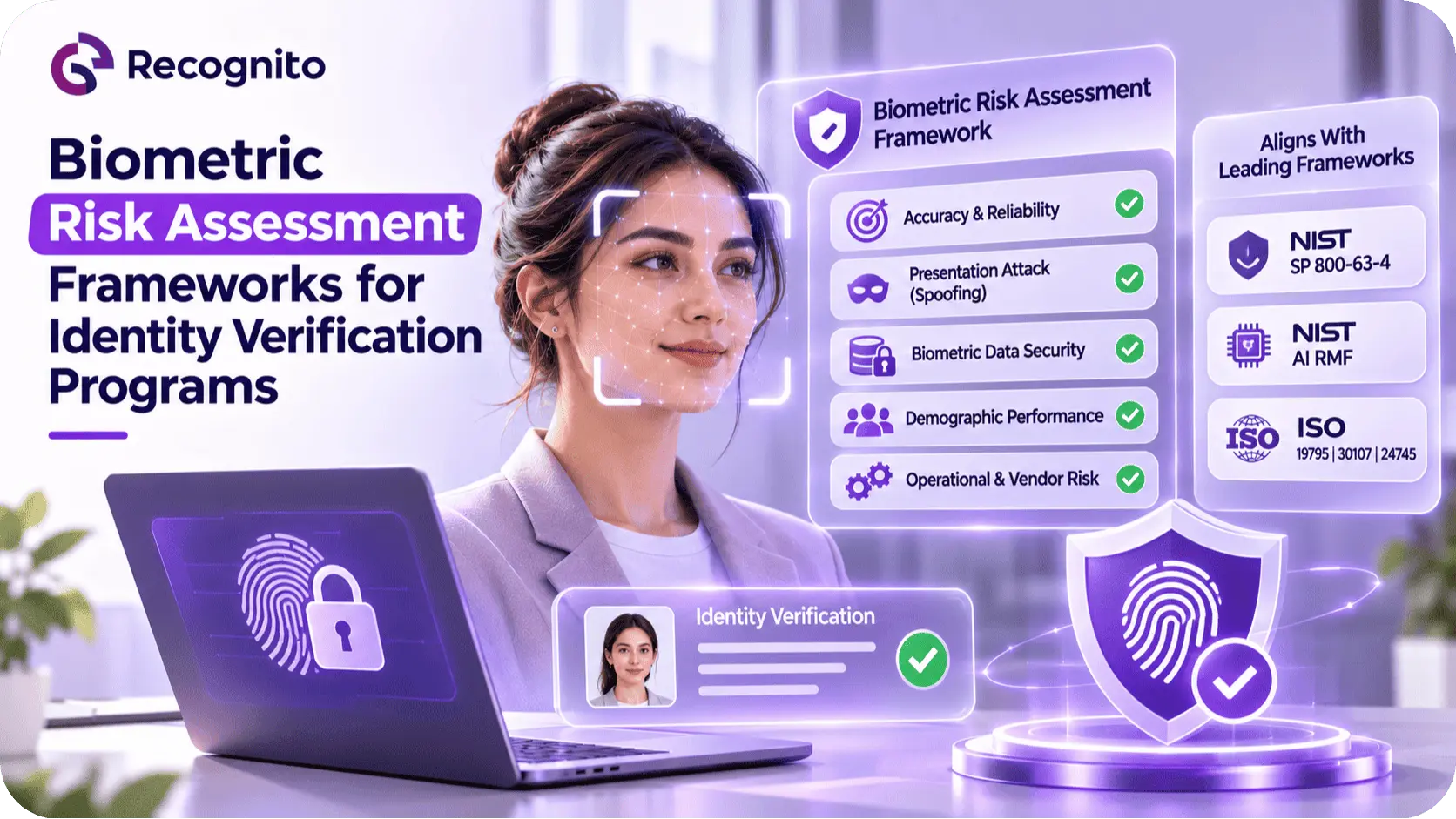
Several established frameworks and international standards can support this process. Their value comes from combining technical performance requirements with organizational risk management rather than relying on one benchmark to determine whether a biometric system is secure.
Why Biometric Identity Verification Needs a Dedicated Risk Assessment
Traditional identity verification relies heavily on documents, personal information, and database checks. Biometrics introduce another form of identity evidence by evaluating physical or behavioral characteristics associated with an individual.
This creates additional risks.
Unlike a password, a person’s face or fingerprint cannot simply be replaced after a data breach. Biometric information also creates privacy concerns because it can be used to identify individuals and may be processed across different systems and jurisdictions.
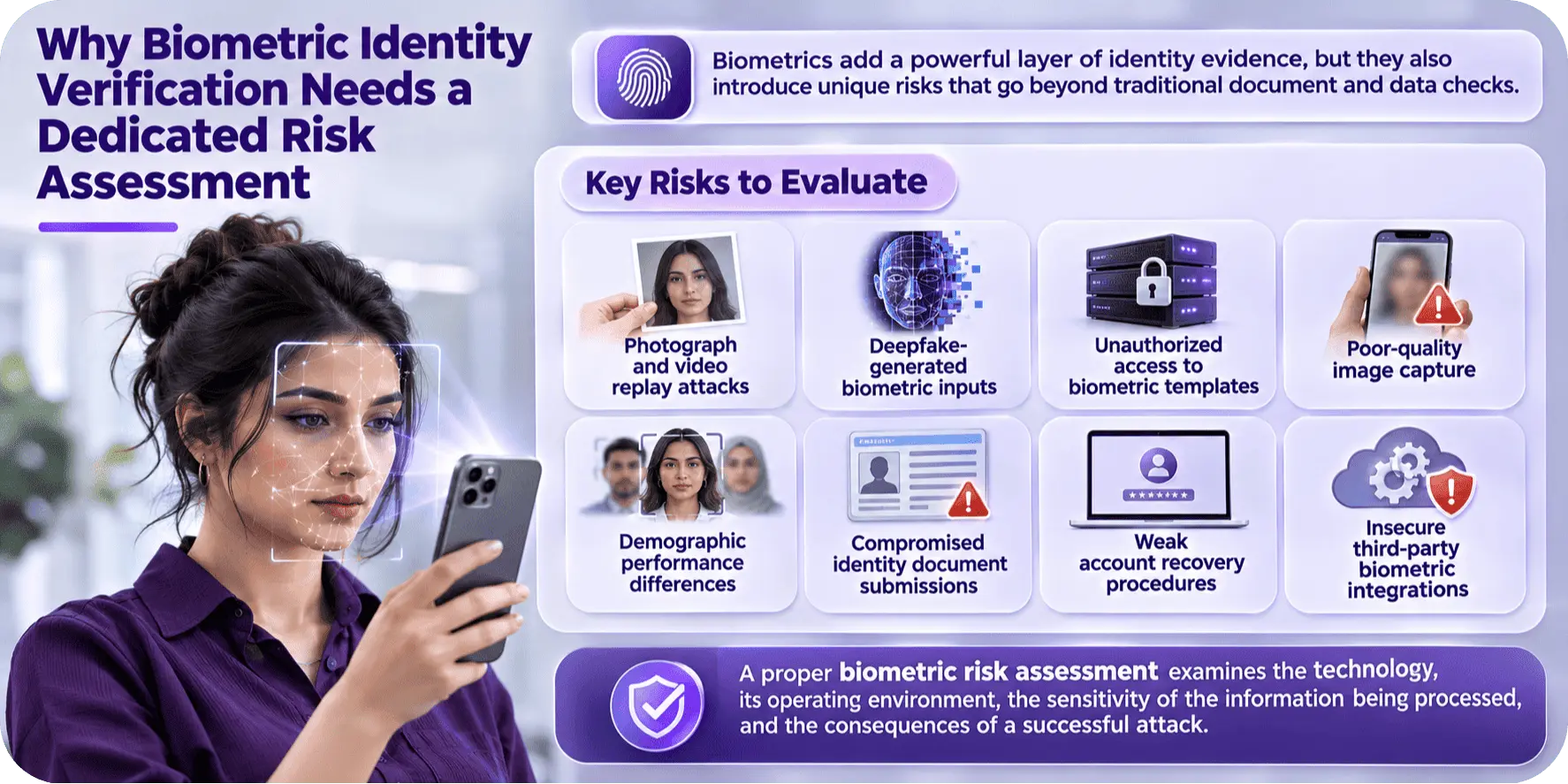
Consider a financial institution implementing facial verification for remote customer onboarding. Its biometric algorithm may perform well during testing, but the complete system could still be vulnerable to:
- Photograph and video replay attacks.
- Deepfake-generated biometric inputs.
- Unauthorized access to biometric templates.
- Poor-quality image capture.
- Demographic performance differences.
- Compromised identity document submissions.
- Weak account recovery procedures.
- Insecure third-party biometric integrations.
These risks cannot be evaluated using facial matching accuracy alone.
A proper biometric risk assessment examines the technology, its operating environment, the sensitivity of the information being processed, and the consequences of a successful attack.
For a broader understanding of governance requirements, biometric compliance in identity verification provides a related perspective on implementing biometric controls within regulated verification environments.
Understanding the Main Biometric Risk Categories
Before selecting a framework, an organization needs to understand what it is assessing.
Biometric risk is not one category. It consists of several interconnected areas that require different testing methods and controls.
1. Biometric accuracy and reliability
Every biometric system produces errors.
A facial recognition system may incorrectly match two different individuals or fail to recognize the same person across different captures. Fingerprint systems can experience similar problems when the sample is incomplete, damaged, or poorly captured.
Two important metrics are:
False Match Rate (FMR): The rate at which biometric samples from different individuals are incorrectly considered a match.
False Non-Match Rate (FNMR): The rate at which samples from the same individual are incorrectly rejected.
Organizations should also examine failure-to-acquire rates, processing time, and performance under different capture conditions.
A system with strong laboratory results may perform differently when deployed across thousands of mobile devices and varied customer environments.
2. Presentation attack and spoofing risks
Presentation attacks involve attempts to manipulate biometric capture by presenting artificial or misleading biometric characteristics.
For facial recognition, examples include photographs, replayed videos, masks, and other presentation techniques.
Fingerprint systems face different threats involving artificial fingerprints and manipulated sensor inputs.
These attacks require dedicated presentation attack detection controls rather than relying exclusively on biometric matching.
3. Biometric information security
Biometric templates, facial images, and fingerprint information require appropriate protection throughout their lifecycle.
The assessment should examine collection, processing, storage, transmission, access permissions, retention, and deletion.
A system that accurately verifies individuals but exposes biometric templates through insecure storage introduces a significant long-term risk.
4. Demographic and environmental performance
Biometric performance can vary across populations and operating environments.
Lighting, camera quality, positioning, age, skin conditions, and other factors may influence the quality of biometric samples or system outcomes.
An organization should assess whether its technology performs consistently across the population it intends to serve.
5. Operational and third-party risks
Biometric verification frequently depends on external SDKs, cloud services, APIs, model providers, and infrastructure.
A vulnerability or service failure within one component can affect the entire verification process.
Vendor assessment, integration security, availability, update procedures, and incident response should therefore form part of the risk framework.
Framework 1: NIST Digital Identity Guidelines
The National Institute of Standards and Technology provides one of the most useful references for organizations designing digital identity verification programs.
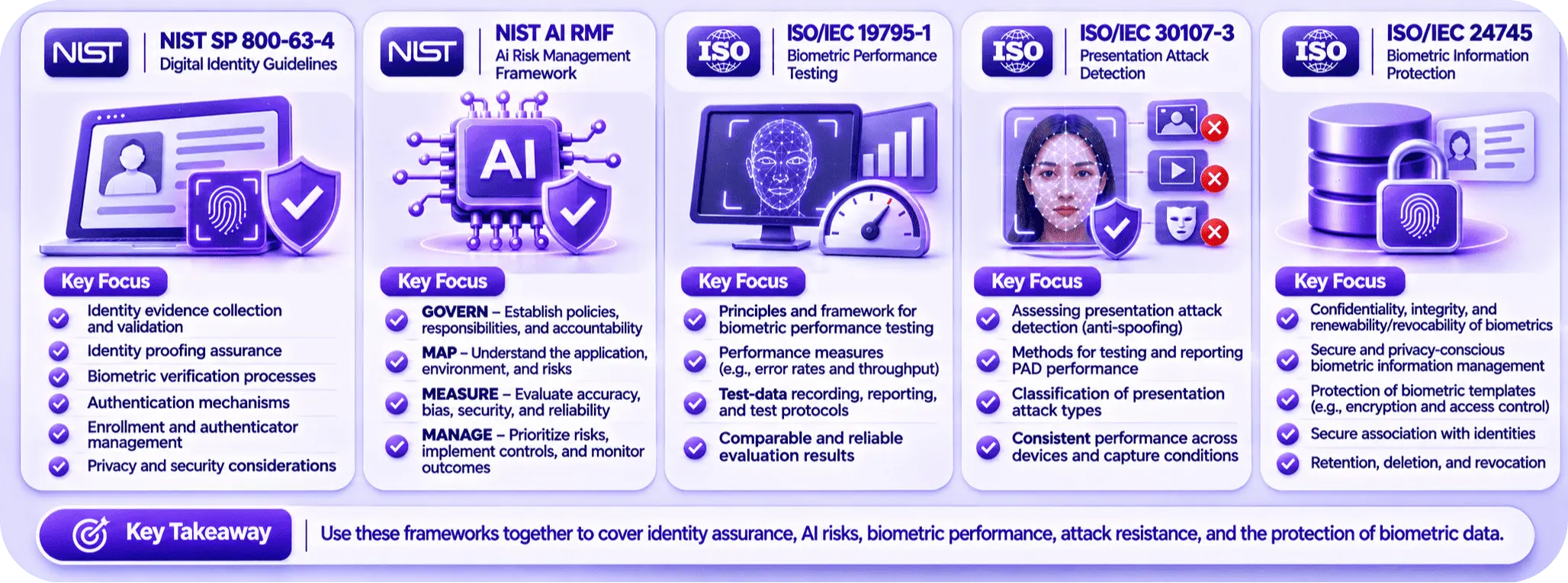
Its NIST SP 800-63-4 Digital Identity Guidelines, finalized in July 2025, cover identity proofing, enrollment, authentication, authenticator management, and federation.
The guidelines distinguish different identity assurance requirements rather than treating every digital identity interaction as equally sensitive.
This is important for biometric programs because the security required to establish a new identity may differ from the security required to authenticate an existing customer.
How organizations can apply NIST guidance
The framework helps organizations establish requirements around:
- Identity evidence collection and validation.
- Identity proofing assurance.
- Biometric verification processes.
- Authentication mechanisms.
- Enrollment and authenticator management.
- Privacy and security considerations.
For example, a fintech offering remote account opening may use document validation and facial comparison during enrollment, then rely on stronger authentication mechanisms for subsequent account access.
These processes should remain connected but should not be confused with one another.
NIST SP 800-63-4 is designed for interactions with government information systems. Commercial organizations can use it as a technical reference, but should not automatically treat its assurance levels as universal regulatory certification.
Framework 2: NIST AI Risk Management Framework
Modern biometric systems increasingly depend on machine learning and artificial intelligence.
Facial recognition, liveness detection, presentation attack detection, and biometric classification models may all introduce AI-specific risks.
NIST’s AI Risk Management Framework provides a voluntary structure for identifying, evaluating, and managing these risks throughout the AI lifecycle.
Its four main functions are:
GOVERN: Establish organizational responsibilities, policies, accountability, and risk-management practices.
MAP: Understand the intended application, operating environment, affected individuals, and potential risks.
MEASURE: Evaluate accuracy, reliability, bias, security, and other relevant characteristics through testing and monitoring.
MANAGE: Prioritize identified risks, implement controls, monitor outcomes, and respond to problems.
The NIST AI Risk Management Framework is particularly relevant when organizations develop, acquire, or deploy AI-powered biometric verification technology.
NIST identifies AI RMF 1.0 as voluntary and notes that a revision is underway. Organizations should therefore check the current framework materials when establishing their governance processes.
The important distinction is that AI risk management does not replace biometric performance testing. It provides the organizational structure within which technical testing and risk treatment should operate.
Framework 3: ISO/IEC 19795 for Biometric Performance Testing
A biometric system should be assessed using measurable performance evidence rather than vendor marketing claims.
ISO/IEC 19795-1 establishes principles and a framework for biometric performance testing and reporting.
The standard covers performance measures such as error rates and throughput, test-data recording, reporting, and test protocols intended to improve the reliability and applicability of results.
The ISO/IEC 19795-1 biometric performance standard is useful when organizations need to compare biometric technologies or establish acceptance criteria before deployment.
For example, when evaluating two facial recognition providers, a procurement team should examine:
- False-match and false-non-match performance.
- Test population characteristics.
- Image-quality conditions.
- Testing methodology.
- Processing performance.
- Limitations of the reported results.
A headline accuracy percentage without testing conditions is insufficient evidence for a security decision.
One important limitation is that ISO/IEC 19795-1 focuses on biometric performance testing and does not measure the success of attacks deliberately designed to subvert biometric capture. Presentation attack testing requires separate consideration.
Framework 4: ISO/IEC 30107 for Presentation Attack Detection
Presentation attack detection is a particularly important part of facial and fingerprint verification security.
A system may correctly identify similarities between biometric samples while remaining vulnerable to fraudulent input presented to its sensor.
ISO/IEC 30107-3:2023 establishes principles and methods for assessing presentation attack detection mechanisms and reporting evaluation results.
The standard also includes a classification of known presentation attack types.
The ISO/IEC 30107-3 presentation attack detection standard provides a foundation for assessing biometric anti-spoofing capabilities.
What should organizations evaluate?
For facial verification, testing should consider relevant attacks such as:
- Printed photographs.
- Display-based replay attacks.
- Three-dimensional masks.
- Replayed video.
- Other presentation materials relevant to the deployment.
Testing should also establish whether the detection mechanism performs consistently across different cameras and capture conditions.
An important scope limitation is that ISO/IEC 30107-3 addresses attacks occurring at the biometric capture device during presentation. It does not establish complete protection against every digital injection, infrastructure, or system-level attack.
Consequently, presentation attack detection should be combined with application security, device integrity, and secure communication controls.
Framework 5: ISO/IEC 24745 for Biometric Information Protection
Biometric performance is only one part of system reliability. Protecting the underlying biometric information is equally important.
ISO/IEC 24745:2022 addresses confidentiality, integrity, and renewability or revocability of biometric information during storage and transfer.
It also provides requirements and recommendations for secure and privacy-conscious biometric information management.
The ISO/IEC 24745 biometric information protection standard is particularly useful when evaluating biometric storage architectures and the relationship between biometric references and identity references.
For enterprises, this creates several practical assessment questions:
- Are biometric templates protected against unauthorized access?
- Is biometric information encrypted during storage and transmission?
- Can access to biometric information be restricted by role?
- Are biometric references securely associated with the correct identities?
- Are retention and deletion procedures documented?
- Can compromised biometric references be replaced or revoked where the implementation supports it?
Organizations should avoid assuming that encrypting a biometric database alone resolves every privacy and security concern.
A Practical Biometric Risk Assessment Matrix
The following matrix brings the different framework areas into one enterprise assessment process.
| Risk category | Potential failure | Recommended assessment |
| Accuracy | False matches or rejections | Measure FMR, FNMR and failure-to-acquire rates |
| Presentation attacks | Photograph, replay or artificial biometric | Conduct PAD testing |
| AI model risk | Bias or inconsistent performance | Evaluate representative populations |
| Data security | Biometric template exposure | Assess storage, encryption and access |
| Privacy | Excessive biometric collection | Review purpose, retention and legal basis |
| Integration | Insecure APIs or compromised components | Conduct technical security testing |
| Vendor risk | Weak controls or service failures | Perform supplier assessment |
| Operations | Uncontrolled failures and exceptions | Review monitoring and incident procedures |
This matrix is a practical organizational assessment tool, not a formal certification or a replacement for the detailed requirements of the referenced standards.
Privacy and Regulatory Risk Assessment
Biometric data requires particular attention because it can be used to identify individuals and may be subject to additional legal protections.
For organizations operating under the GDPR, biometric data processed for the purpose of uniquely identifying a natural person falls within the special categories of personal data addressed by Article 9.
The GDPR legislation on biometric and sensitive personal data should be considered when determining the legal basis, applicable special-category condition, processing purpose, security measures, and retention requirements.
A practical privacy assessment should address:
- The specific purpose of biometric collection.
- Whether biometric processing is necessary and proportionate.
- The applicable legal basis and conditions.
- Data minimization.
- Storage and processing locations.
- Third-party access and processing arrangements.
- Retention and deletion.
- Individual rights and transparency.
Depending on the processing and jurisdiction, organizations may also need a Data Protection Impact Assessment.
Importantly, technical performance compliance does not automatically demonstrate legal compliance. A biometric system can pass technical testing while still being deployed with inappropriate data practices.
How Organizations Should Implement a Biometric Risk Assessment Program
Using several standards is useful only when their requirements become operational controls.
A practical implementation process should involve the following stages.
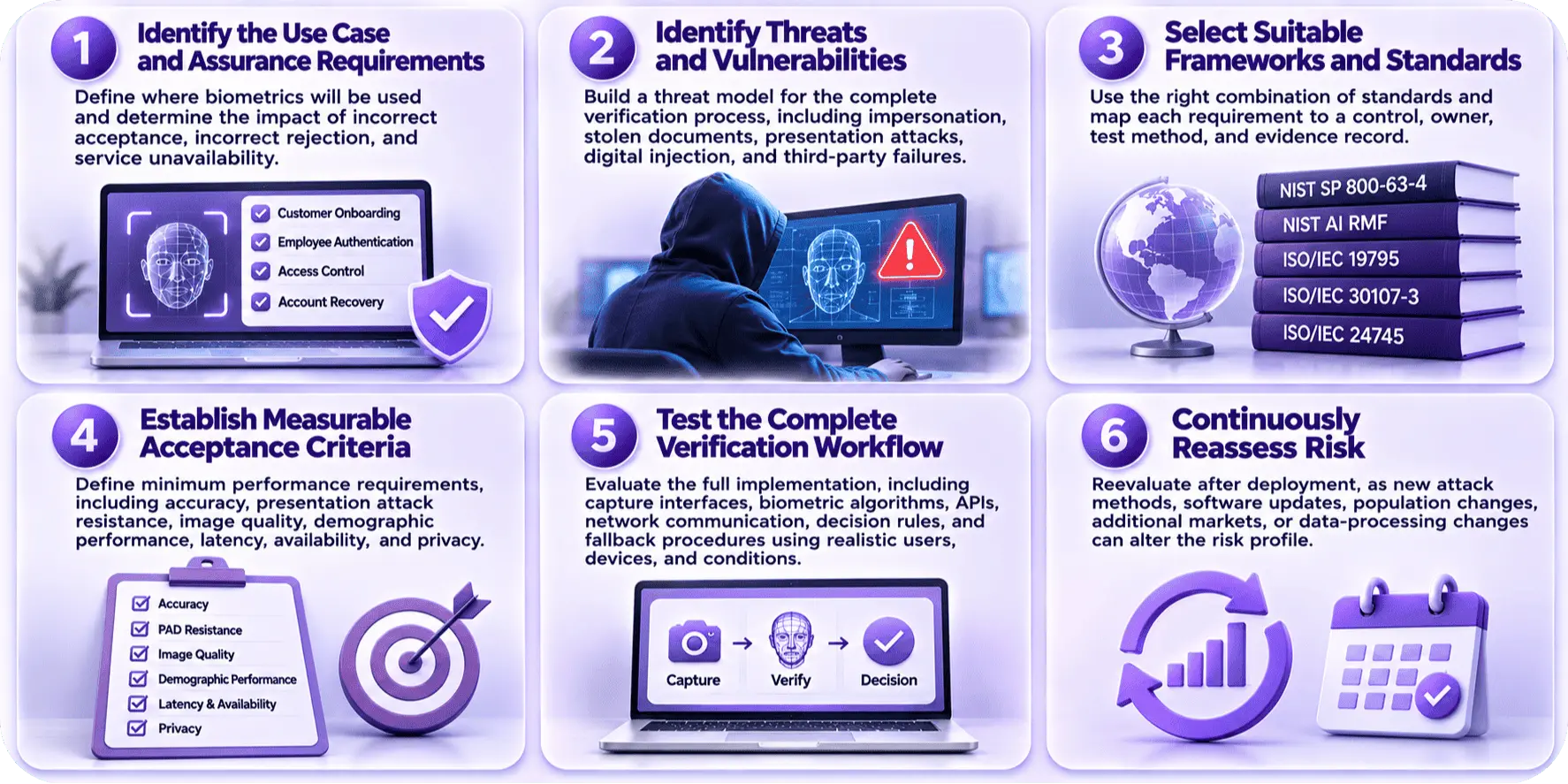
1. Identify the use case and assurance requirements
Start by documenting where biometrics will be used.
Customer onboarding, employee authentication, physical access control, account recovery, and high-value transaction approval have different security requirements.
Determine the consequences of incorrect acceptance, incorrect rejection, and service unavailability.
2. Identify threats and vulnerabilities
Build a threat model covering the complete verification process.
Consider identity impersonation, stolen documents, presentation attacks, digital injection, compromised devices, unauthorized database access, insecure APIs, insider threats, and third-party failures.
3. Select suitable frameworks and standards
Do not attempt to use one framework for every purpose.
A practical combination may include:
- NIST SP 800-63-4 for digital identity proofing and authentication requirements.
- NIST AI RMF for AI governance.
- ISO/IEC 19795 for biometric performance testing.
- ISO/IEC 30107-3 for presentation attack detection.
- ISO/IEC 24745 for biometric information protection.
Map each requirement to an appropriate control, owner, testing method, and evidence record.
4. Establish measurable acceptance criteria
Define the minimum acceptable performance before purchasing or deploying the technology.
Acceptance criteria should cover accuracy, presentation attack resistance, image quality, demographic performance, latency, availability, and privacy.
Avoid selecting providers solely because they report the highest matching accuracy.
5. Test the complete verification workflow
Evaluate the actual implementation, including capture interfaces, biometric algorithms, APIs, network communication, decision rules, and fallback procedures.
Use realistic users, devices, and operating conditions.
6. Continuously reassess risk
Biometric risk does not end after deployment.
New attack methods, software updates, population changes, additional markets, and changes to data-processing arrangements can alter the risk profile.
Schedule periodic testing and reassessment, and repeat evaluations whenever significant system or threat changes occur.
Measuring the Effectiveness of a Biometric Risk Program
Organizations need measurable indicators to determine whether their risk framework is working.
Useful metrics include:
False Match Rate: Measures incorrect biometric acceptance between different individuals.
False Non-Match Rate: Measures incorrect rejection of genuine biometric matches.
Attack Detection Performance: Evaluates how effectively presentation attacks are detected under defined test conditions.
Failure-to-Acquire Rate: Measures how frequently the system cannot obtain a usable biometric sample.
Verification Completion Rate: Shows how many legitimate users successfully complete the process.
Incident Rate: Tracks confirmed biometric-related fraud or security incidents.
Review Rate: Measures how often applications require human intervention.
Data Protection Incidents: Tracks unauthorized access, exposure, or mishandling of biometric information.
These metrics should be reviewed together. A stricter biometric threshold might improve false-match performance while increasing legitimate-user rejection. Risk owners need to understand the trade-off before changing production settings.
The Role of SDK Selection in Biometric Risk Management
An organization’s risk framework should influence its technology procurement decisions.
Choosing a biometric SDK based only on advertised accuracy or supported features can create weaknesses that are difficult to address after integration.
Technical teams should evaluate:
- Supported biometric modalities.
- Performance under realistic capture conditions.
- Presentation attack detection capabilities.
- Available testing and configuration options.
- API security and integration requirements.
- Platform compatibility.
- Documentation and maintenance.
- Error handling and operational reliability.
The face recognition SDK evaluation criteria provide a relevant starting point for comparing biometric development components against technical and operational requirements.
For engineering teams assessing implementation resources, the Recognito GitHub repository can also complement product documentation and integration evaluation.
Conclusion
Biometric risk assessment should be treated as an ongoing governance and security discipline rather than a one-time technology evaluation.
NIST provides useful foundations for identity assurance and AI risk management, while ISO standards address biometric performance, presentation attack detection, and information protection. Together, they help organizations evaluate different dimensions of biometric reliability without assuming that one certification or benchmark establishes complete system security.
The strongest programs connect these standards to practical controls, measurable acceptance criteria, privacy governance, vendor assessments, and continuous monitoring.
For organizations developing biometric identity verification solutions, Recognito offers technologies that can form part of a broader, risk-managed identity verification architecture.
Frequently Asked Questions
What is a biometric risk assessment framework?
It is a structured approach for identifying, measuring, managing, and monitoring risks associated with biometric technologies, including accuracy, spoofing, privacy, data security, and operational reliability.
Which standards are most relevant to biometric risk assessment?
NIST SP 800-63-4, NIST AI RMF, ISO/IEC 19795-1, ISO/IEC 30107-3, and ISO/IEC 24745 address different aspects of digital identity, AI governance, biometric performance, presentation attacks, and biometric information protection.
Is biometric risk assessment the same as biometric certification?
No. Risk assessment examines the overall risks associated with a technology and its deployment. Certification typically evaluates whether a product or system meets defined requirements within a particular certification scope.
How frequently should organizations reassess biometric risks?
Organizations should establish periodic reviews and reassess whenever there are significant changes to the technology, deployment environment, threat landscape, data processing, or regulatory requirements.
Does a high biometric accuracy rate guarantee security?
No. Accuracy measures matching performance under specified conditions. It does not independently establish resistance to presentation attacks, digital injection, data breaches, privacy violations, or insecure system integration.