
As digital identity verification becomes more common across banking, fintech, healthcare, and online platforms, fraudsters are finding new ways to bypass security systems. Photos, video replays, masks, and even AI-generated deepfakes can be used to impersonate legitimate users. This is why liveness detection has become a critical part of modern biometric authentication.
Liveness detection helps verify that a real person is physically present during an identity verification process. Today, organizations typically choose between active liveness detection and passive liveness detection. While both approaches aim to prevent spoofing attacks, they differ significantly in user experience, security, and implementation. Understanding these differences can help businesses choose the right solution for their identity verification needs.
What Is Liveness Detection?
Liveness detection is a biometric security technology designed to determine whether a face presented to a camera belongs to a live person rather than a photo, video, mask, or digital manipulation.
It serves as an additional layer of protection for facial recognition systems by preventing attackers from using fake facial representations to gain access to accounts or services.
Organizations increasingly use liveness detection in:
- Digital onboarding
- Identity verification
- Banking authentication
- Account recovery
- Remote customer verification
According to the FIDO Alliance biometric security guidelines, liveness detection plays an important role in protecting biometric authentication systems from presentation attacks and spoofing attempts.
What Is Active Liveness Detection?
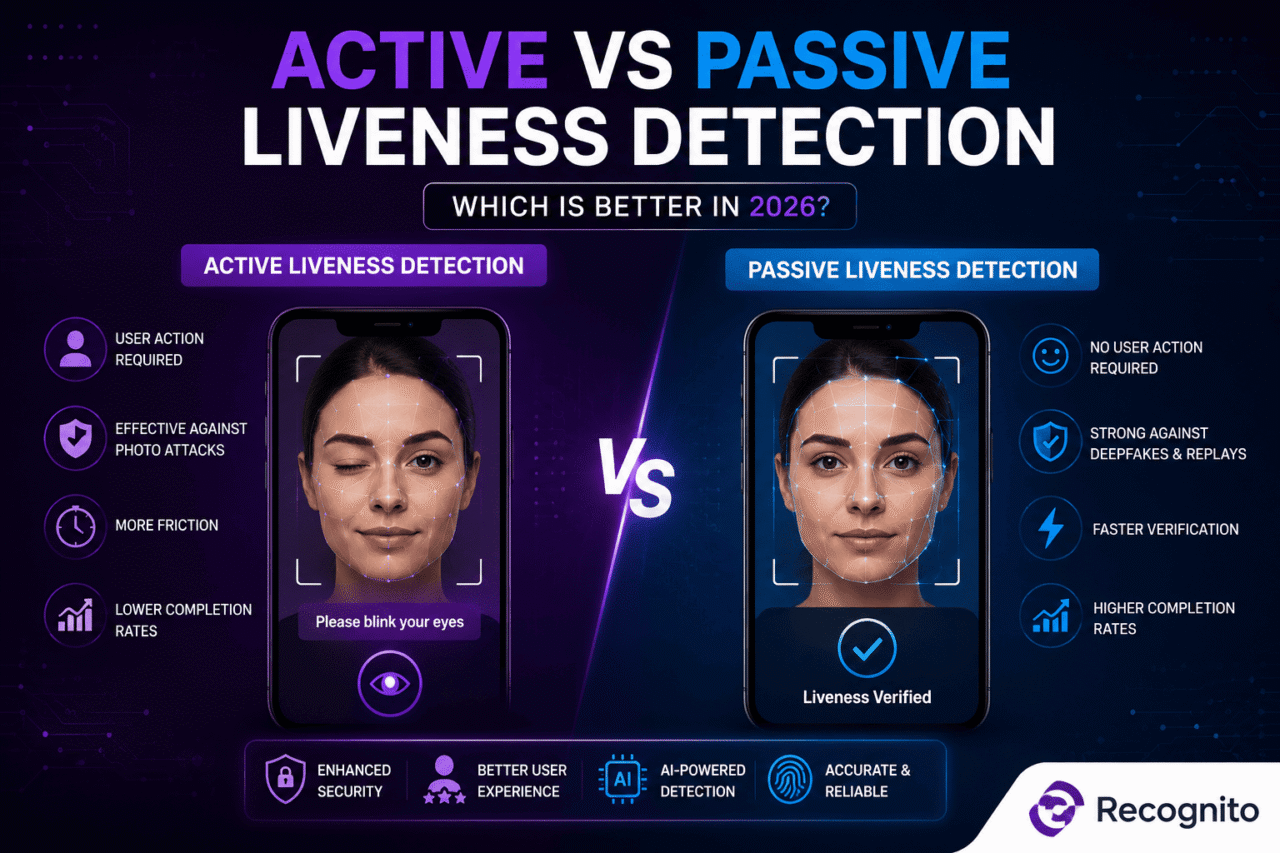
Active liveness detection requires the user to perform a specific action during the verification process.
Common Active Liveness Challenges
Users may be asked to:
- Blink their eyes
- Turn their head
- Smile
- Follow an on-screen prompt
- Read a sequence of numbers
The system analyzes the user’s response to confirm that they are physically present and interacting with the device in real time.
Advantages of Active Liveness Detection
Active liveness offers several benefits:
- Strong protection against simple photo attacks
- Easy to understand verification process
- Effective against static image spoofing
These systems have been widely used in remote identity verification for many years.
Limitations of Active Liveness Detection
Despite its strengths, active liveness introduces friction into the verification process.
Users may struggle with instructions due to:
- Poor camera quality
- Lighting conditions
- Accessibility issues
- Language barriers
As a result, active liveness can increase onboarding abandonment rates and create a less seamless user experience.
What Is Passive Liveness Detection?
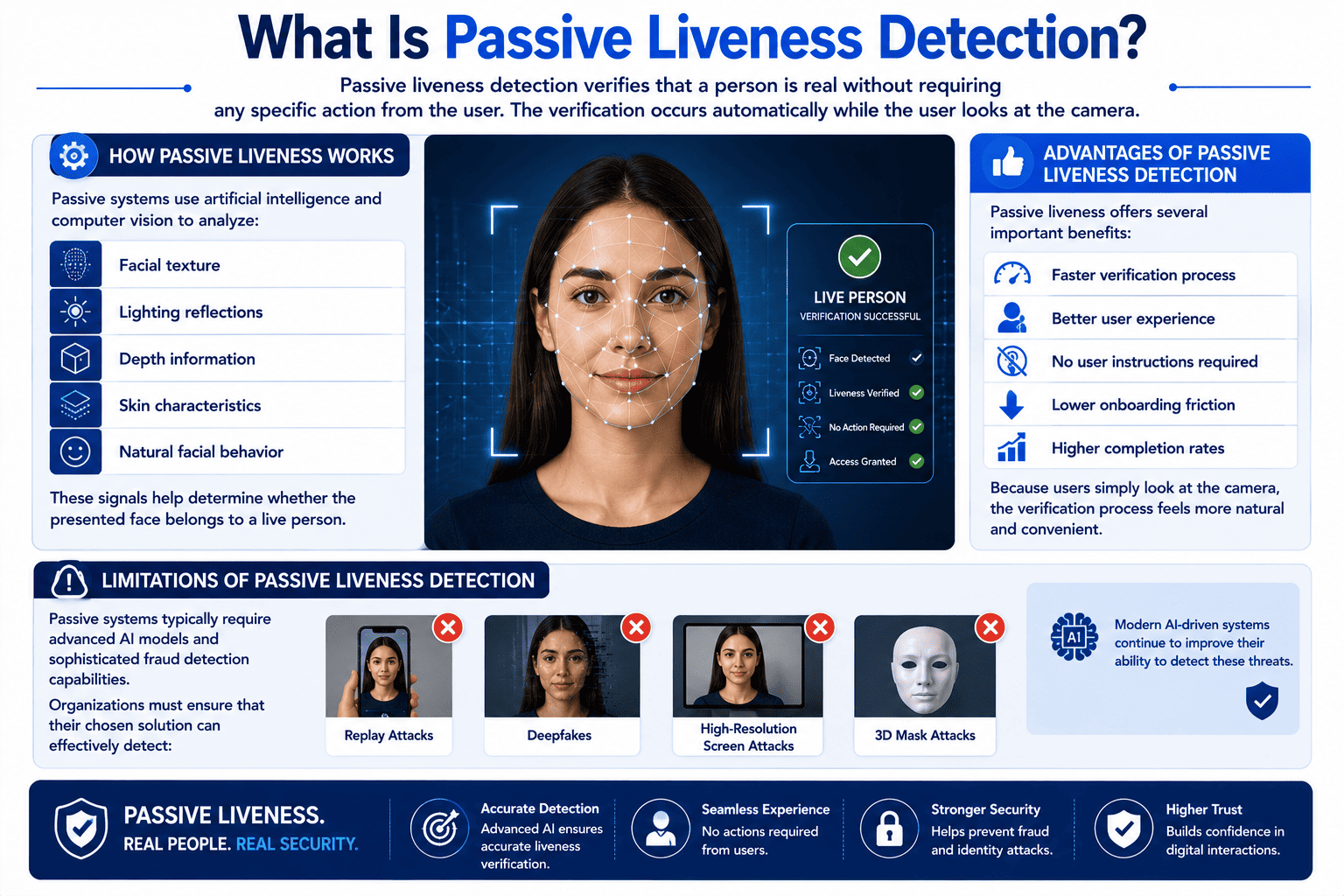
Passive liveness detection verifies that a person is real without requiring any specific action from the user.
The verification occurs automatically while the user looks at the camera.
How Passive Liveness Works
Passive systems use artificial intelligence and computer vision to analyze:
- Facial texture
- Lighting reflections
- Depth information
- Skin characteristics
- Natural facial behavior
These signals help determine whether the presented face belongs to a live person.
Advantages of Passive Liveness Detection
Passive liveness offers several important benefits:
- Faster verification process
- Better user experience
- No user instructions required
- Lower onboarding friction
- Higher completion rates
Because users simply look at the camera, the verification process feels more natural and convenient.
Limitations of Passive Liveness Detection
Passive systems typically require advanced AI models and sophisticated fraud detection capabilities.
Organizations must ensure that their chosen solution can effectively detect:
- Replay attacks
- Deepfakes
- High-resolution screen attacks
- 3D mask attacks
Modern AI-driven systems continue to improve their ability to detect these threats.
Active vs Passive Liveness Detection: Key Differences
| Feature | Active Liveness | Passive Liveness |
| User Interaction | Required | Not required |
| User Experience | Moderate friction | Seamless |
| Verification Speed | Slower | Faster |
| Accessibility | Can be challenging | More user-friendly |
| Onboarding Completion Rates | Lower | Higher |
| Deepfake Detection | Depends on implementation | Strong in modern AI systems |
| Customer Satisfaction | Moderate | Higher |
While both approaches improve security, passive liveness generally provides a smoother user experience.
Security Comparison
Security is often the most important consideration when choosing between active and passive liveness detection.
Protection Against Photo Attacks
Both active and passive systems can effectively detect simple photo spoofing attempts.
Protection Against Video Replays
Modern passive liveness solutions often outperform traditional active systems because they analyze multiple signals simultaneously rather than relying solely on user interaction.
Deepfake Resistance
As synthetic media becomes more sophisticated, passive liveness systems powered by AI are increasingly effective at detecting deepfake content and digitally manipulated facial presentations.
Research from the National Institute of Standards and Technology (NIST) continues to evaluate biometric technologies and their effectiveness in real-world identity verification scenarios.
User Experience Matters
Security is important, but so is usability.
A highly secure verification process that frustrates users can negatively impact customer acquisition and retention.
Active Liveness Challenges
Users may:
- Fail verification due to unclear instructions
- Become frustrated during repeated attempts
- Abandon onboarding altogether
Passive Liveness Benefits
Passive verification removes these barriers by allowing users to complete verification with minimal effort.
For industries such as fintech, digital banking, and online marketplaces, reducing friction often leads to higher conversion rates and improved customer satisfaction.
Industry Applications
Financial Services
Banks and fintech companies increasingly prefer passive liveness detection because it reduces onboarding friction while maintaining strong security.
Healthcare
Healthcare providers use liveness detection to verify patient identities during remote consultations.
Online Marketplaces
Digital marketplaces use liveness detection to reduce fake accounts and identity fraud.
Cryptocurrency Platforms
Crypto exchanges rely on liveness detection to comply with KYC requirements and prevent account takeover attempts.
Across these sectors, the trend is moving toward more seamless verification experiences.
Choosing the Right Liveness Detection Solution
The right choice depends on your organization’s security requirements, customer experience goals, and fraud risk profile.
Organizations should evaluate:
- Detection accuracy
- User experience
- Fraud prevention capabilities
- Deepfake resistance
- Integration flexibility
- Regulatory compliance
Modern solutions such as Recognito’s Face Liveness Detection SDK can help businesses implement passive liveness verification while maintaining strong protection against sophisticated fraud attacks.
Conclusion
Both active and passive liveness detection play important roles in protecting biometric identity verification systems. Active liveness remains effective against basic spoofing attempts, but it often introduces user friction that can impact onboarding success. Passive liveness detection provides a more seamless experience while leveraging advanced AI to detect increasingly sophisticated fraud attacks.
For many modern digital platforms, passive liveness is becoming the preferred choice because it balances security, convenience, and scalability in today’s evolving identity verification landscape.
Frequently Asked Questions
What is active liveness detection?
Active liveness detection requires users to perform actions such as blinking, smiling, or turning their head to prove they are physically present.
What is passive liveness detection?
Passive liveness detection verifies a user’s presence automatically without requiring any specific action or challenge.
Which is more secure: active or passive liveness detection?
Modern AI-powered passive liveness detection often provides stronger protection against advanced attacks while delivering a better user experience.
Which method offers a better user experience?
Passive liveness detection generally offers a smoother experience because users do not need to complete challenges or follow instructions.
Can passive liveness detect deepfakes?
Many advanced passive liveness solutions are designed to detect deepfakes, replay attacks, and other sophisticated spoofing techniques.
Why are businesses moving toward passive liveness detection?
Businesses prefer passive liveness because it reduces onboarding friction, improves completion rates, and provides strong fraud prevention capabilities.
