
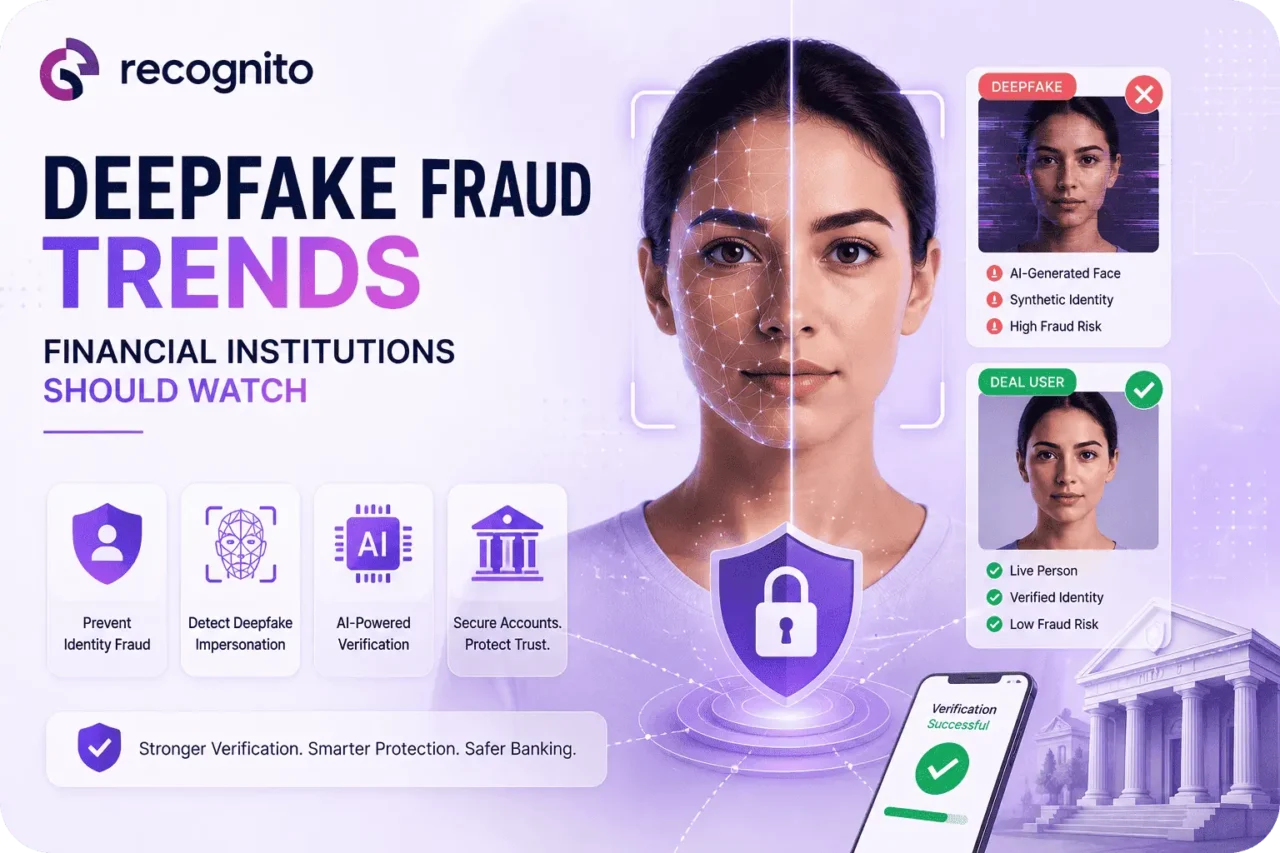
Artificial intelligence has transformed the financial services industry by improving automation, customer onboarding, fraud detection, and operational efficiency. However, the same technologies are also being exploited by cybercriminals to create increasingly sophisticated fraud schemes.
Among the fastest-growing threats is deepfake fraud. Using generative AI, fraudsters can create realistic facial videos, cloned voices, and synthetic identities capable of deceiving traditional verification systems. What once required advanced technical expertise can now be produced using widely available AI tools, making deepfake attacks more accessible and harder to detect.
For banks, fintech companies, payment providers, digital lenders, cryptocurrency exchanges, and insurance companies, this presents a significant challenge. Customers expect fast digital onboarding and frictionless authentication, while regulators expect organizations to maintain robust Know Your Customer (KYC) and Anti-Money Laundering (AML) controls. At the same time, fraudsters continue finding new ways to exploit digital identity verification processes.
To stay ahead, financial institutions must understand how deepfake fraud is evolving and adopt technologies capable of detecting AI-generated impersonation before it leads to financial losses.
This guide explores the latest deepfake fraud trends, the risks they create for financial institutions, and the strategies organizations can use to strengthen identity fraud prevention.
What Is Deepfake Fraud?
Deepfake fraud involves the use of artificial intelligence to create or manipulate images, videos, or audio recordings that convincingly imitate real people.
Unlike traditional identity fraud, which often relies on stolen credentials or forged documents, deepfake fraud creates entirely synthetic media capable of impersonating legitimate individuals during identity verification, customer onboarding, or account authentication.
Criminals may use deepfake technology to:
- Bypass biometric verification
- Impersonate legitimate customers
- Commit account takeover fraud
- Defraud financial institutions
- Circumvent remote onboarding controls
- Support synthetic identity fraud schemes
As generative AI continues to improve, distinguishing genuine users from AI-generated content becomes increasingly difficult without specialized detection technologies.
Organizations implementing secure onboarding workflows often strengthen biometric verification by integrating the face liveness detection SDK, which helps determine whether a real person is physically present during identity verification rather than an AI-generated presentation.
Businesses looking to better understand how anti-spoofing technologies defend against these attacks can also read our guide on presentation attack detection and its role in biometric security.
Why Deepfake Fraud Is Increasing
Several factors have contributed to the rapid growth of deepfake fraud across the financial sector.
AI Tools Are More Accessible
Generative AI platforms have become significantly easier to use.
Attackers no longer require advanced machine learning expertise to create convincing facial videos or cloned voices. Many AI-powered content generation tools are now publicly available, reducing the technical barrier for cybercriminals.
Digital Banking Continues to Expand
Consumers increasingly rely on digital channels to open accounts, transfer money, apply for loans, and manage investments.
While digital banking improves convenience, it also provides fraudsters with more opportunities to exploit remote identity verification systems.
Financial institutions therefore need stronger verification technologies that can establish trust without requiring customers to visit physical branches.
Remote Identity Verification Has Become Standard
Identity verification has shifted from face-to-face interactions to digital onboarding.
Customers now submit identity documents and biometric information through mobile applications or web platforms, making robust verification more important than ever.
Organizations implementing secure digital onboarding increasingly combine biometric authentication with the id document recognition SDK to verify government-issued identity documents before completing customer verification.
Businesses interested in improving their onboarding workflows can also explore our guide on remote customer onboarding best practices, which explains how layered verification helps balance security, compliance, and customer experience.
Common Types of Deepfake Fraud Affecting Financial Institutions
Deepfake technology is now used throughout the customer lifecycle, from onboarding to ongoing authentication.
Understanding these attack methods enables organizations to build more resilient fraud prevention strategies.
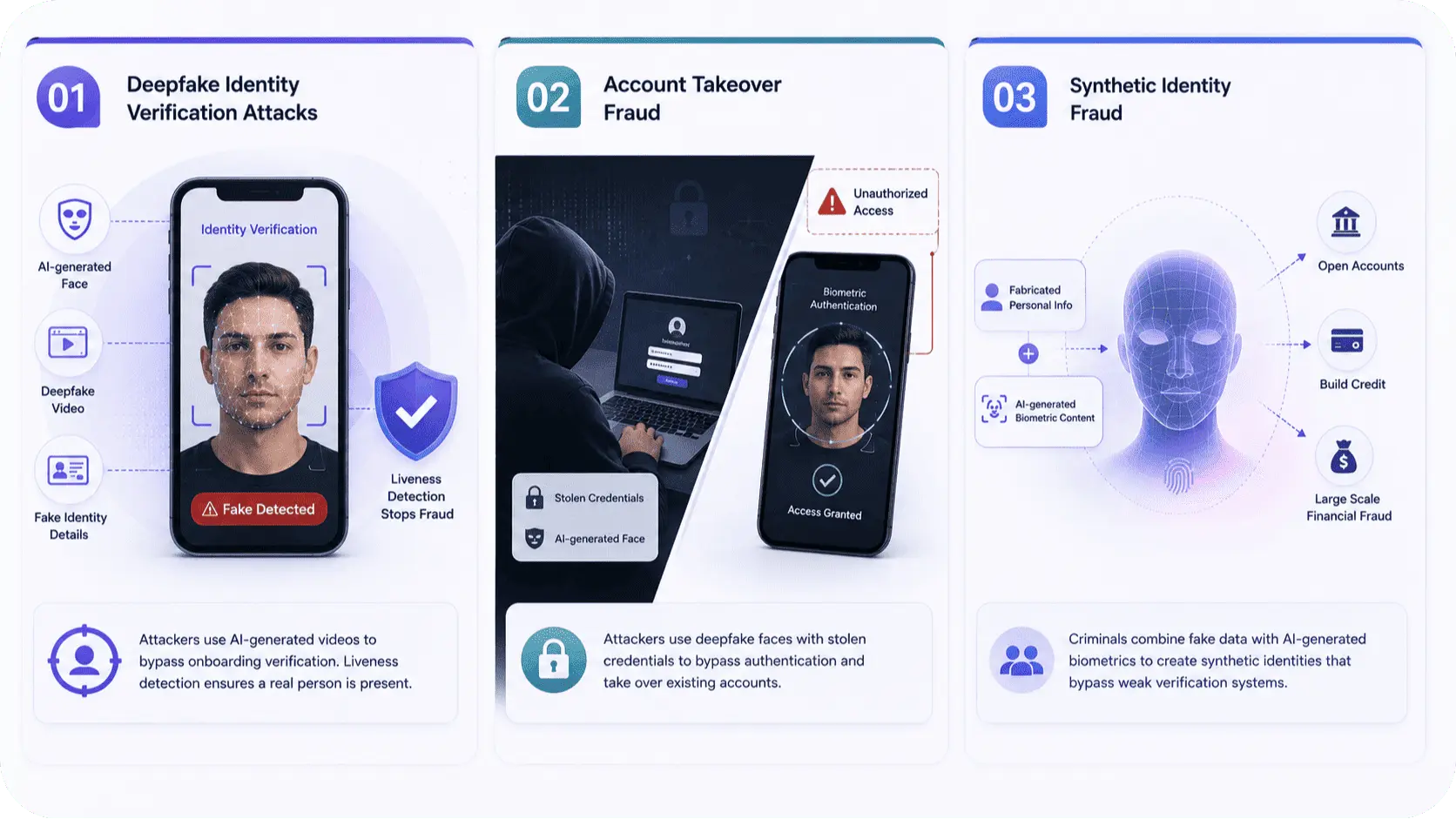
1. Deepfake Identity Verification Attacks
One of the fastest-growing threats involves criminals submitting AI-generated facial videos during digital onboarding.
The objective is to deceive facial recognition systems into approving fraudulent accounts that can later be used for money laundering, financial fraud, or account abuse.
Organizations reduce this risk by combining facial recognition with liveness detection rather than relying on face matching alone.
2. Account Takeover Fraud
Deepfake technology is increasingly being used to compromise existing customer accounts.
Attackers who obtain stolen credentials may use AI-generated facial imagery during biometric authentication to bypass weak security controls and gain unauthorized access.
Financial institutions implementing stronger authentication strategies can also read our guide on how banks prevent account takeover fraud using biometrics, which explores how layered biometric verification helps defend against evolving authentication threats.
3. Synthetic Identity Fraud
Deepfake fraud and synthetic identity fraud increasingly work together.
Criminals combine fabricated personal information with AI-generated biometric content to create convincing digital identities capable of passing weak onboarding systems.
These fraudulent identities may remain active for months before being used to commit large-scale financial fraud.
Organizations looking to strengthen their fraud prevention strategy can also explore our article on how financial institutions detect synthetic identity fraud, which explains how modern identity verification technologies identify fabricated identities before they enter financial systems.
The Business Impact of Deepfake Fraud
Deepfake attacks extend far beyond financial losses.
Successful attacks can result in:
- Regulatory penalties
- AML compliance failures
- Customer trust erosion
- Reputational damage
- Operational disruption
- Increased fraud investigation costs
- Higher account recovery expenses
As AI-generated fraud becomes increasingly sophisticated, financial institutions need verification systems capable of identifying manipulated biometric content before fraudulent accounts are approved or existing accounts are compromised.
How Financial Institutions Can Prevent Deepfake Fraud
As deepfake technology becomes more sophisticated, financial institutions can no longer rely on traditional fraud detection methods alone. Effective protection requires multiple verification layers that work together throughout the customer lifecycle.
Rather than focusing on a single security control, organizations should combine identity verification, biometric authentication, artificial intelligence, and continuous risk monitoring to identify suspicious activity before fraud occurs.
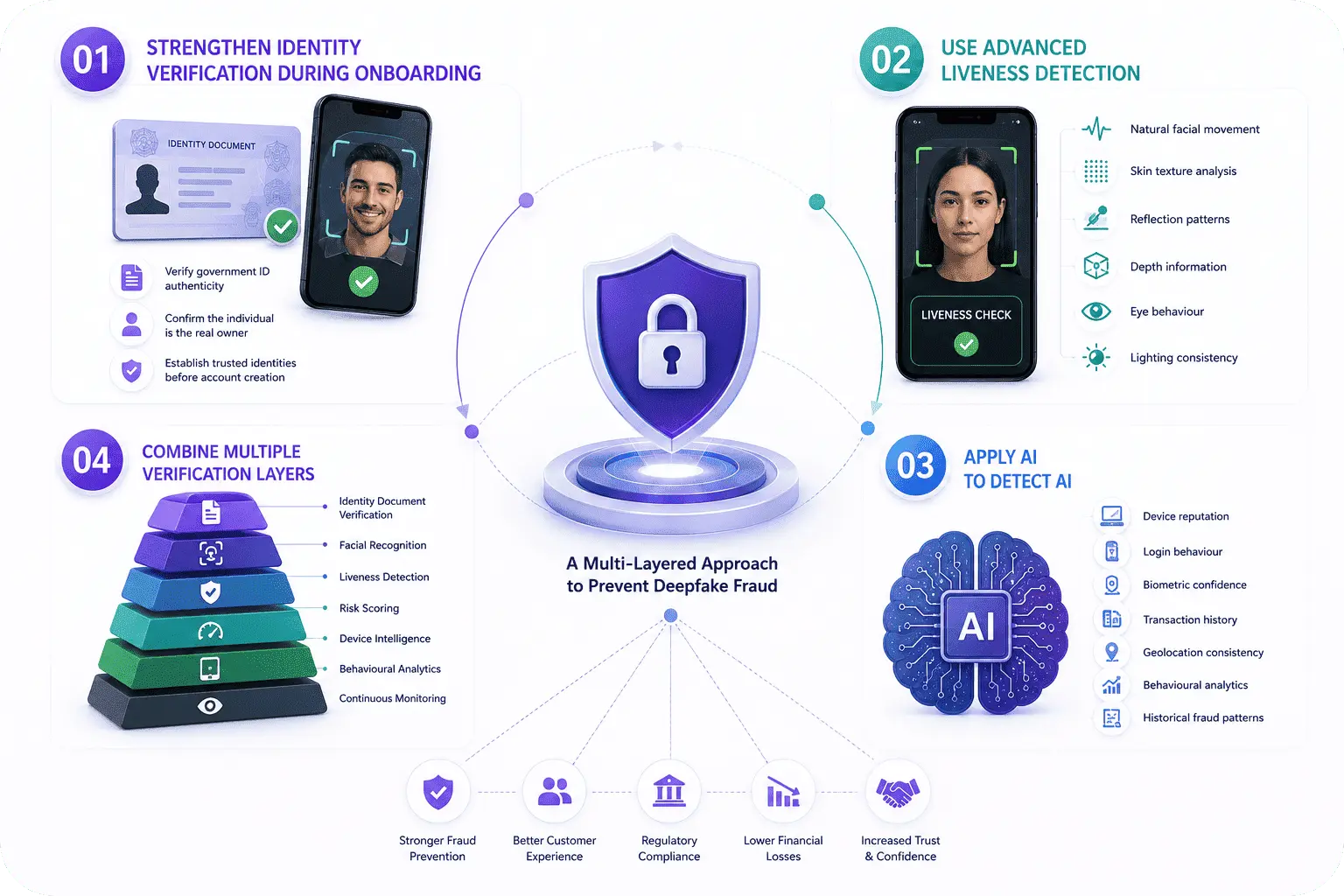
1. Strengthen Identity Verification During Onboarding
The best defense against deepfake fraud begins before a customer account is created.
Organizations should establish trusted identities by verifying both government-issued identity documents and the individual presenting them.
Modern onboarding platforms automate this process by validating document authenticity while confirming that the applicant is the legitimate document owner.
Financial institutions can strengthen onboarding by implementing an identity verification API, allowing identity checks to integrate seamlessly into web and mobile applications.
A trusted identity established during onboarding significantly reduces the likelihood of fraudulent accounts entering the financial ecosystem.
2. Use Advanced Liveness Detection
Facial recognition alone cannot reliably identify AI-generated videos or presentation attacks.
Modern deepfake fraud often relies on manipulated facial content designed to resemble legitimate customers during authentication.
Advanced liveness detection helps determine whether a genuine person is physically present by analysing multiple biometric and environmental signals rather than simply comparing facial images.
These systems evaluate factors such as:
- Natural facial movement
- Skin texture
- Reflection patterns
- Depth information
- Eye behaviour
- Lighting consistency
This additional verification layer significantly improves resistance against AI-generated impersonation attempts.
3. Apply AI to Detect AI
Artificial intelligence has become one of the most effective tools for identifying AI-generated fraud.
Modern fraud detection platforms analyse hundreds of data points simultaneously rather than relying on fixed rules.
Examples include:
- Device reputation
- Login behaviour
- Biometric confidence scores
- Transaction history
- Geolocation consistency
- Behavioural analytics
- Historical fraud patterns
By evaluating these signals together, machine learning systems can identify suspicious behaviour that may indicate a deepfake attack even when the biometric presentation appears convincing.
4. Combine Multiple Verification Layers
No single technology can prevent every type of fraud.
Financial institutions should implement layered verification frameworks that combine several complementary technologies.
A modern fraud prevention workflow often includes:
- Identity document verification
- Facial recognition
- Liveness detection
- Risk scoring
- Device intelligence
- Behavioural analytics
- Continuous monitoring
Organizations using multiple verification layers are generally better positioned to identify sophisticated fraud attempts without introducing unnecessary friction for legitimate customers.
Businesses looking to strengthen their digital onboarding strategy can also explore our guide on AML verification and identity verification in customer onboarding, which explains how compliance and identity verification work together to reduce financial crime.
Emerging Deepfake Fraud Trends
Deepfake fraud continues evolving alongside advances in generative artificial intelligence.
Financial institutions should closely monitor several emerging trends that are reshaping digital fraud.
Real-Time Deepfake Generation
Earlier deepfake attacks relied on pre-recorded videos.
Today’s AI tools increasingly support real-time facial manipulation during live video interactions, making traditional visual inspections far less effective.
This trend highlights the growing importance of advanced liveness detection and behavioural analysis.
Voice Cloning Attacks
Deepfake fraud is no longer limited to facial impersonation.
AI-generated voice cloning enables fraudsters to imitate customers during telephone verification, customer support calls, and account recovery procedures.
Organizations relying on voice-based authentication should implement additional verification factors to reduce these risks.
AI-Assisted Social Engineering
Criminals increasingly combine deepfake technology with phishing campaigns and social engineering techniques.
For example, an attacker may use a cloned executive’s voice or a synthetic video message to persuade employees to authorize financial transactions or disclose sensitive information.
Employee awareness and multi-layered verification remain essential defenses against these attacks.
More Sophisticated Synthetic Identities
Deepfake technology is also making synthetic identity fraud more convincing.
Instead of relying only on fabricated personal information, fraudsters now generate realistic biometric content that closely resembles genuine applicants.
Combining synthetic identities with AI-generated faces significantly increases the difficulty of detecting fraudulent applications using traditional verification methods.
Challenges Facing Financial Institutions
Although detection technology continues improving, financial institutions still face several obstacles when combating deepfake fraud.
Keeping Pace With AI Innovation
Generative AI evolves rapidly.
Fraud detection systems must continuously adapt to identify new attack techniques without creating unnecessary barriers for legitimate customers.
Regular model updates and ongoing testing are essential for maintaining effective fraud prevention.
Balancing Security and Customer Experience
Customers expect fast and convenient onboarding.
Excessive verification requirements may reduce conversion rates, while insufficient verification increases fraud exposure.
Organizations should implement adaptive verification that applies stronger authentication only when elevated risk is detected.
Managing Regulatory Expectations
Regulators increasingly expect organizations to demonstrate effective identity verification and fraud prevention controls.
Financial institutions should ensure that their verification programs align with internationally recognised frameworks such as the NIST Digital Identity Guidelines, while also following recommendations published by the Financial Action Task Force (FATF) for customer identification and risk-based AML programs.
Best Practices for Preventing Deepfake Fraud
As deepfake technology continues to evolve, financial institutions must adopt security strategies that extend beyond traditional fraud prevention controls. Preventing AI-generated identity fraud requires a combination of advanced verification technologies, continuous monitoring, and ongoing adaptation to emerging threats.
The following best practices can help organizations strengthen their defenses against deepfake fraud.
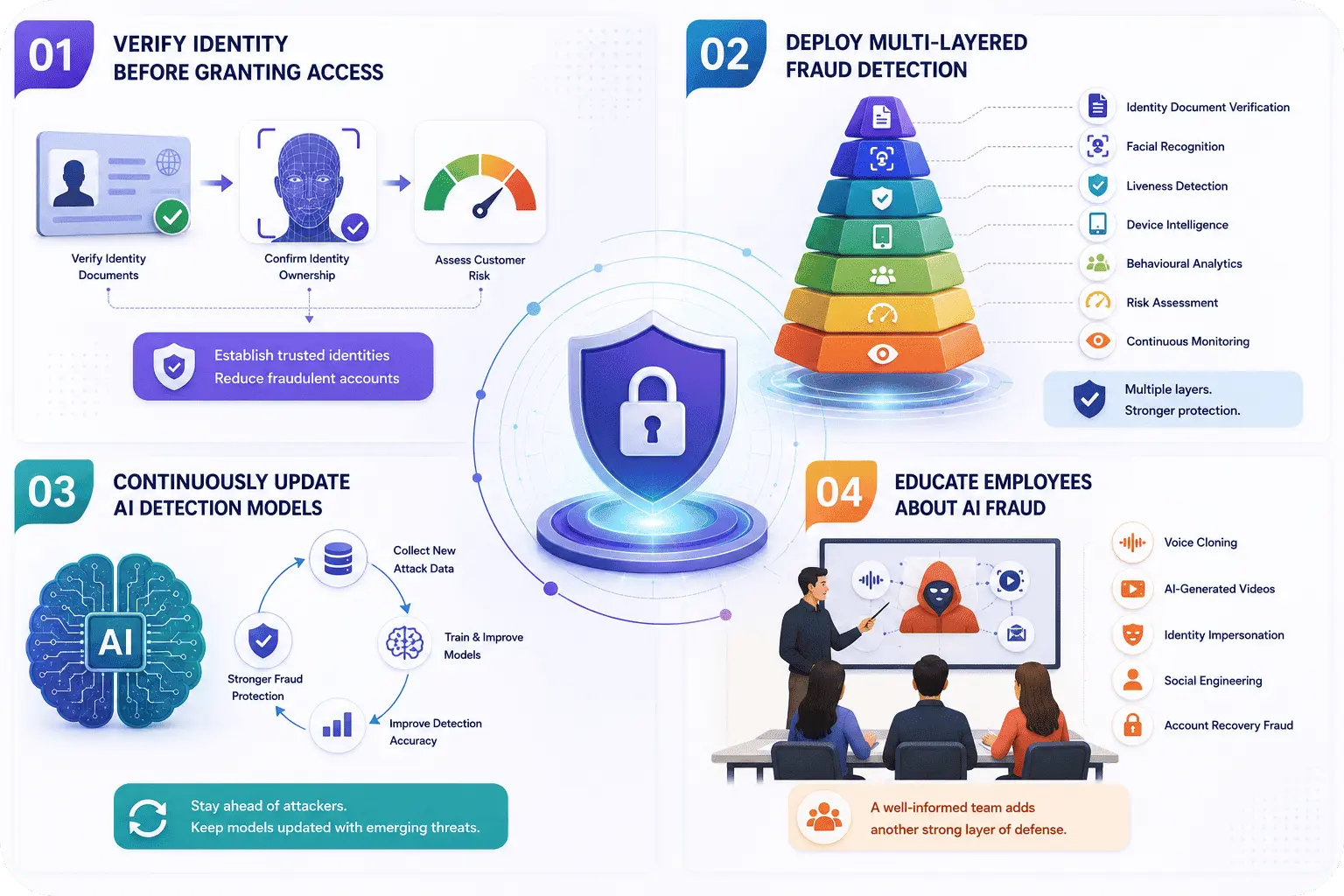
1. Verify Identity Before Granting Access
Strong fraud prevention starts during customer onboarding.
Organizations should establish trusted identities before allowing customers to access financial products or services. This includes verifying government-issued identity documents, confirming identity ownership through biometrics, and assessing customer risk.
Combining these verification steps creates a much stronger foundation for future authentication while reducing the likelihood of fraudulent accounts entering the system.
2. Deploy Multi-Layered Fraud Detection
No single technology can stop every deepfake attack.
The most effective fraud prevention strategies combine multiple verification layers that evaluate different aspects of customer identity.
A comprehensive verification framework should include:
- Identity document verification
- Facial recognition
- Liveness detection
- Device intelligence
- Behavioural analytics
- Risk assessment
- Continuous monitoring
Layered verification significantly improves fraud detection while minimizing disruption for genuine customers.
3. Continuously Update AI Detection Models
Generative AI continues improving at an extraordinary pace.
Fraud detection models that remain unchanged quickly become less effective as attackers develop more convincing deepfake techniques.
Organizations should regularly update their fraud detection systems using new attack data, emerging threat intelligence, and continuous model training to maintain high detection accuracy.
4. Educate Employees About AI Fraud
Technology alone cannot prevent every fraud attempt.
Employees working in customer support, fraud operations, and compliance should understand how deepfake attacks are performed and recognize warning signs during customer interactions.
Regular awareness training helps staff identify suspicious activity involving:
- Voice cloning
- AI-generated videos
- Identity impersonation
- Social engineering
- Account recovery fraud
A well-informed workforce provides an additional layer of defense against increasingly sophisticated attacks.
The Future of Deepfake Fraud Prevention
Artificial intelligence will continue reshaping both fraud and fraud prevention.
As attackers adopt increasingly realistic synthetic media, financial institutions must move toward intelligent verification systems capable of adapting to rapidly changing threats.
Several innovations are expected to influence the next generation of identity fraud prevention.
Continuous Identity Verification
Identity verification is gradually evolving beyond the onboarding stage.
Instead of verifying customers only once, organizations increasingly monitor identity throughout the customer relationship.
Additional verification may be triggered when:
- High-value transactions occur
- Login behaviour changes
- New devices are detected
- Sensitive account information is updated
- Suspicious activity is identified
Continuous verification enables organizations to detect compromised accounts much earlier than traditional authentication models.
AI-Powered Fraud Intelligence
Machine learning will continue improving fraud detection by analysing enormous volumes of behavioural, biometric, and transactional data in real time.
Rather than relying solely on predefined fraud rules, intelligent systems will continuously adapt to new attack techniques while reducing false positives for legitimate customers.
This enables organizations to respond more quickly as fraud patterns evolve.
Behavioural Biometrics
Behavioural biometrics are expected to play an increasingly important role in fraud prevention.
Instead of focusing only on physical biometric traits, behavioural analysis evaluates how customers naturally interact with applications.
Examples include:
- Typing rhythm
- Mouse movements
- Touchscreen interactions
- Navigation behaviour
- Device usage patterns
These additional signals help identify suspicious behaviour even after authentication has been completed.
Choosing the Right Deepfake Fraud Prevention Solution
Selecting a fraud prevention platform requires more than comparing facial recognition accuracy.
Organizations should evaluate whether the solution can adapt to evolving AI-generated threats while supporting long-term operational growth.
Important considerations include:
- Liveness detection accuracy
- Deepfake detection capabilities
- Biometric verification performance
- AI-powered fraud detection
- Global identity document coverage
- Integration flexibility
- Scalability
- Compliance support
- Developer documentation
Solutions that combine identity verification, biometric authentication, liveness detection, fraud detection, and continuous risk monitoring within a single platform typically provide stronger protection while simplifying implementation.
Development teams interested in implementation resources can also explore the official Recognito GitHub repository for SDK documentation, sample projects, and integration guides.
Conclusion
Deepfake fraud has rapidly become one of the most significant threats facing financial institutions. Advances in generative AI have enabled criminals to create increasingly convincing synthetic videos, cloned voices, and fabricated identities capable of bypassing traditional verification methods.
Protecting against these attacks requires more than stronger passwords or manual document reviews. Financial institutions must adopt a layered fraud prevention strategy that combines identity verification, biometric authentication, liveness detection, behavioural analytics, artificial intelligence, and continuous monitoring.
Organizations that invest in advanced fraud prevention technologies today will be better equipped to reduce financial losses, strengthen regulatory compliance, improve customer trust, and stay ahead of the rapidly evolving landscape of AI-driven fraud.
Frequently Asked Questions
What is deepfake fraud?
Deepfake fraud is the use of artificial intelligence to create realistic fake videos, images, or audio recordings that impersonate real individuals for fraudulent purposes, such as bypassing identity verification or gaining unauthorized account access.
Why are financial institutions targeted by deepfake attacks?
Financial institutions manage sensitive customer data and financial assets, making them attractive targets for cybercriminals seeking to commit identity fraud, account takeover, money laundering, and other financial crimes.
How can financial institutions detect deepfake fraud?
Organizations can detect deepfake fraud by combining biometric verification, face liveness detection, behavioural analytics, device intelligence, artificial intelligence, and continuous risk assessment to identify suspicious authentication attempts.
What is the relationship between deepfake fraud and synthetic identity fraud?
Deepfake fraud often complements synthetic identity fraud by providing realistic AI-generated biometric content that makes fabricated identities appear more convincing during digital onboarding and authentication.
Can liveness detection stop deepfake attacks?
Advanced liveness detection significantly improves protection against many deepfake and presentation attacks by verifying that a real person is physically present during biometric verification. When combined with facial recognition and identity verification, it provides much stronger fraud resistance.
What should organizations consider when selecting a deepfake fraud prevention solution?
Organizations should evaluate biometric accuracy, deepfake detection capabilities, liveness detection performance, AI-powered fraud detection, scalability, compliance support, integration flexibility, and developer resources when choosing a fraud prevention platform.
