
Account takeover fraud has become one of the most costly and persistent threats facing banks, fintech companies, digital lenders, payment providers, and financial institutions worldwide. As consumers increasingly manage their finances online, cybercriminals continue to develop new ways to gain unauthorized access to customer accounts.
Once an account is compromised, fraudsters can transfer funds, change account information, open new financial products, steal personal data, and conduct fraudulent transactions that damage both customers and financial institutions.
Historically, banks relied on passwords, PINs, security questions, and one-time passcodes to protect customer accounts. While these measures still play an important role, they are no longer sufficient on their own. Modern attackers frequently bypass traditional authentication methods using stolen credentials, phishing campaigns, malware, social engineering, and AI-powered fraud techniques.
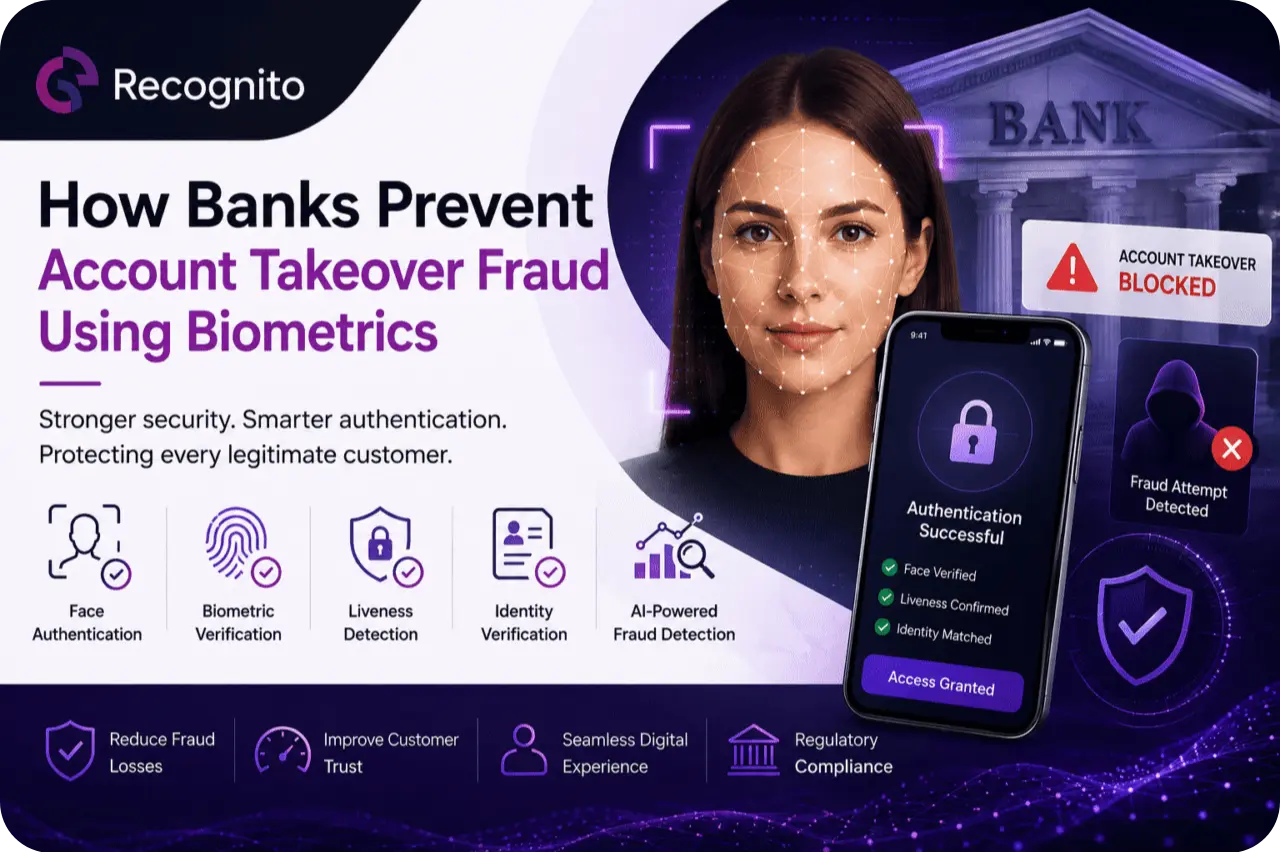
To combat these threats, banks increasingly rely on biometric authentication, face authentication, identity verification, and liveness detection technologies that confirm a user is genuinely who they claim to be.
What Is Account Takeover Fraud?
Account takeover fraud occurs when a criminal gains unauthorized access to a legitimate customer’s account and assumes control of it.
Unlike synthetic identity fraud, where criminals create entirely new identities, account takeover attacks target existing accounts belonging to real customers.
Once access is obtained, fraudsters may:
- Transfer money
- Make unauthorized purchases
- Change passwords and recovery details
- Apply for loans or credit products
- Access sensitive personal information
- Commit further identity fraud
Many account takeover attacks begin long before the actual compromise occurs.
Criminals often gather credentials through:
- Phishing emails
- Data breaches
- Credential stuffing attacks
- Malware infections
- Social engineering schemes
- SIM swap attacks
Organizations looking to understand how identity-based fraud evolves should also review our guide on detecting synthetic identities, which explores another rapidly growing threat affecting financial institutions.
Why Account Takeover Fraud Continues to Grow
Several factors have contributed to the rapid increase in account takeover fraud across the banking industry.
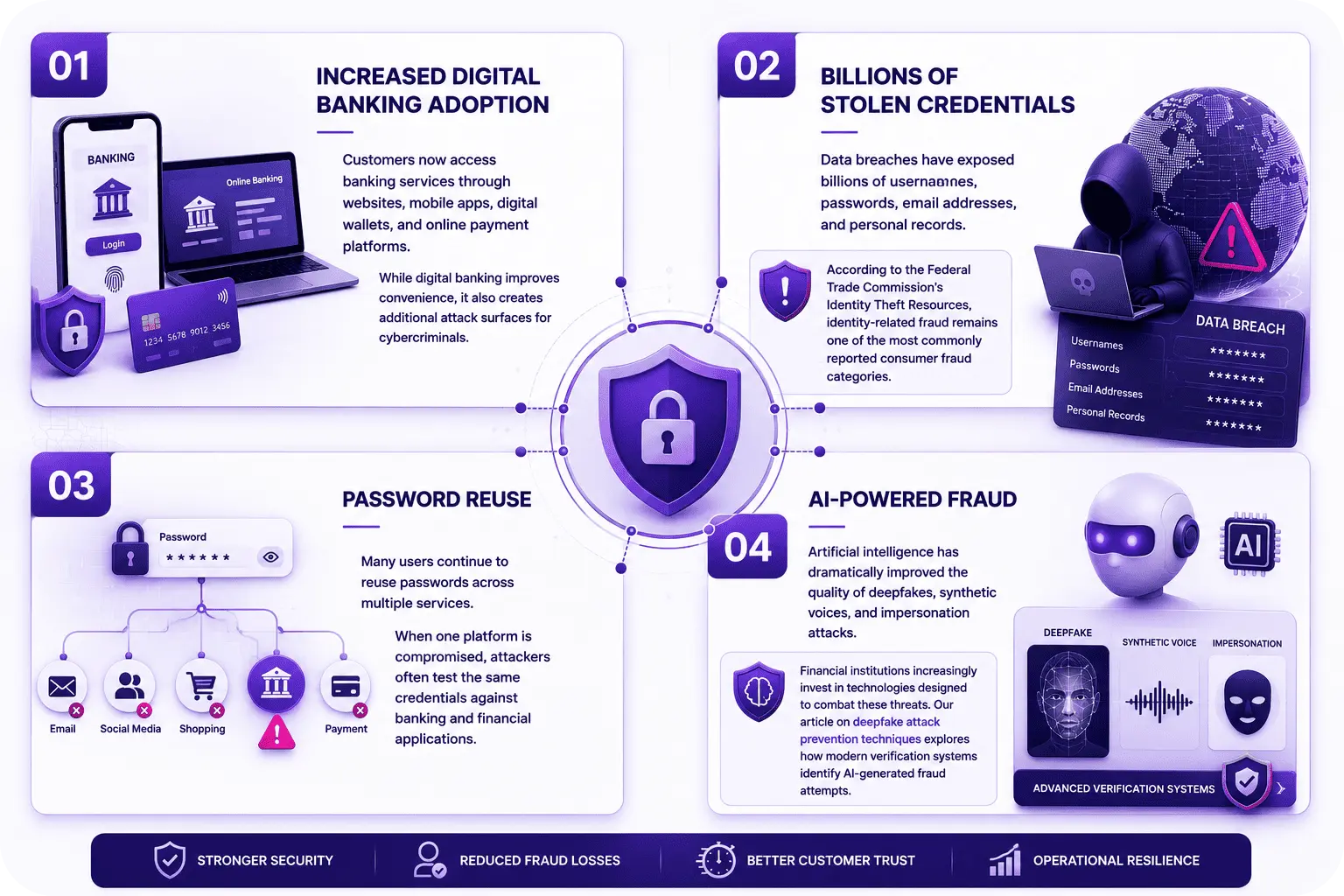
1. Increased Digital Banking Adoption
Customers now access banking services through websites, mobile apps, digital wallets, and online payment platforms.
While digital banking improves convenience, it also creates additional attack surfaces for cybercriminals.
2. Billions of Stolen Credentials
Data breaches have exposed billions of usernames, passwords, email addresses, and personal records.
According to the Federal Trade Commission’s Identity Theft Resources, identity-related fraud remains one of the most commonly reported consumer fraud categories.
3. Password Reuse
Many users continue to reuse passwords across multiple services.
When one platform is compromised, attackers often test the same credentials against banking and financial applications.
4. AI-Powered Fraud
Artificial intelligence has dramatically improved the quality of deepfakes, synthetic voices, and impersonation attacks.
Financial institutions increasingly invest in technologies designed to combat these threats. Our article on deepfake attack prevention techniques explores how modern verification systems identify AI-generated fraud attempts.
Why Traditional Authentication Is No Longer Enough
Traditional authentication methods rely heavily on information that can be stolen, guessed, shared, or purchased.
Examples include:
- Passwords
- PIN codes
- Security questions
- SMS verification codes
- Email-based authentication
The challenge is simple.
Knowing a password does not prove identity.
A criminal who obtains login credentials may successfully access an account without ever demonstrating that they are the legitimate account owner.
This limitation has led banks toward stronger forms of authentication based on biometrics.
Unlike passwords, biometric characteristics are tied directly to the individual and are significantly more difficult to replicate.
The OWASP Authentication Cheat Sheet highlights the importance of stronger identity assurance mechanisms for protecting sensitive systems and customer accounts.
How Biometric Authentication Helps Prevent Account Takeover Fraud
Biometric authentication verifies users using unique biological characteristics.
Common methods include:
- Facial recognition
- Fingerprint recognition
- Voice authentication
- Behavioral biometrics
Financial institutions increasingly combine multiple biometric technologies to create layered fraud prevention frameworks.
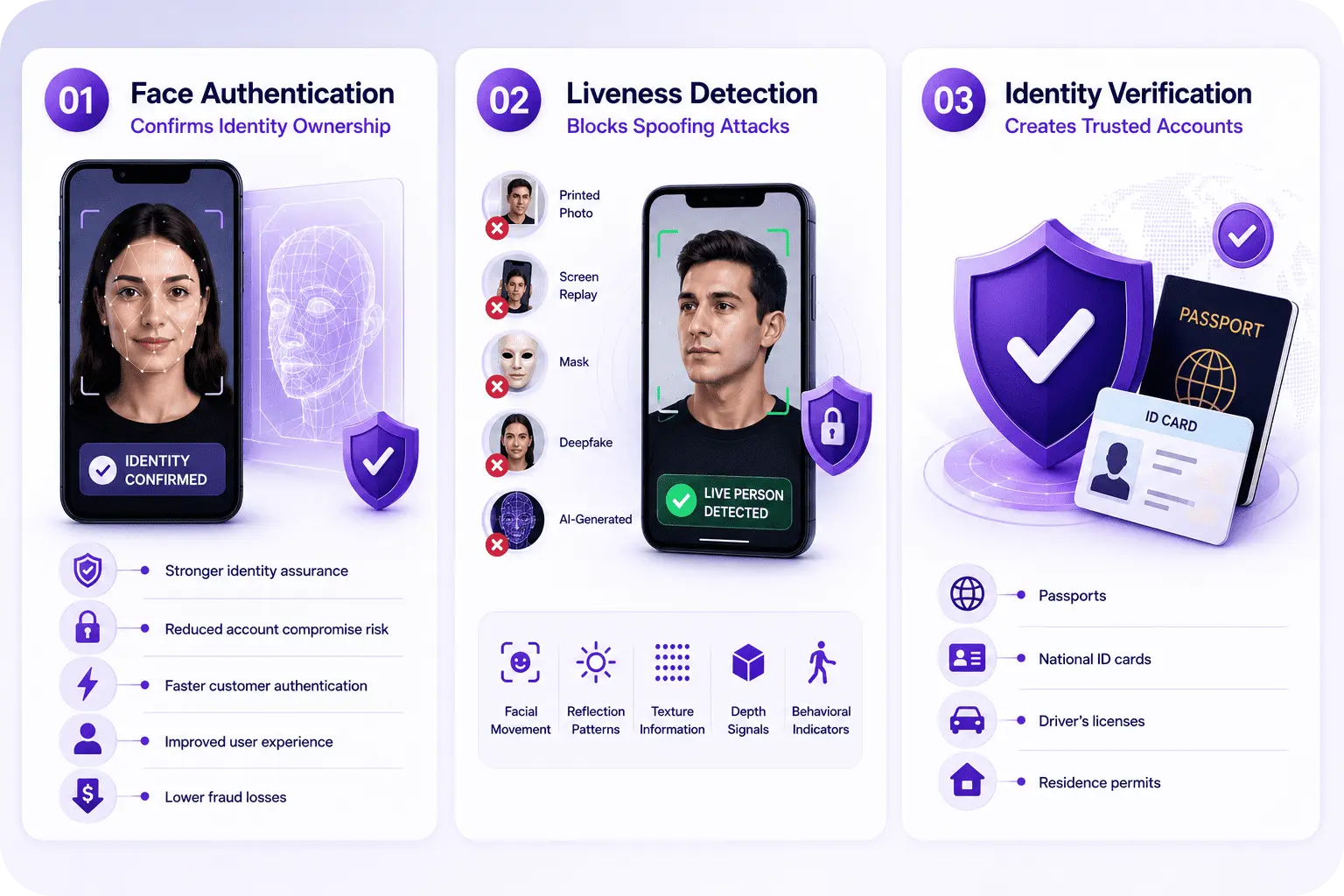
1. Face Authentication Confirms Identity Ownership
Face authentication compares a live facial image against a previously enrolled biometric template.
The goal is to ensure that the person requesting account access is the same person who originally verified their identity.
Banks increasingly deploy enterprise-grade facial recognition technology to strengthen authentication while maintaining a seamless customer experience.
The benefits include:
- Stronger identity assurance
- Reduced account compromise risk
- Faster customer authentication
- Improved user experience
- Lower fraud losses
Organizations evaluating biometric technologies can also explore our comparison of facial recognition and fingerprint authentication to understand how different verification methods perform across various use cases.
Independent evaluations such as the NIST Face Recognition Vendor Test (FRVT) continue to demonstrate significant improvements in facial recognition accuracy across the industry.
2. Liveness Detection Blocks Spoofing Attacks
Face matching alone is not enough.
Fraudsters frequently attempt to bypass biometric systems using:
- Printed photographs
- Mobile phone screens
- Video replay attacks
- Deepfake videos
- Silicone masks
- AI-generated facial imagery
Liveness detection helps determine whether a real person is physically present during authentication.
Banks increasingly implement advanced liveness verification technology to prevent spoofing attacks before account access is granted.
Modern systems analyze:
- Facial movement
- Reflection patterns
- Texture information
- Depth signals
- Behavioral indicators
For organizations comparing implementation approaches, our article on active versus passive liveness detection explains how each method contributes to fraud prevention.
Research published under the ISO/IEC 30107 biometric presentation attack detection standard continues to shape how liveness detection systems are evaluated across the industry.
3. Identity Verification Creates Trusted Accounts
The strongest account takeover prevention strategies begin long before a login attempt occurs.
Security starts during customer onboarding.
Banks must establish trusted identities from the beginning by validating customer information and identity documents.
Modern onboarding systems typically verify:
- Passports
- National ID cards
- Driver’s licenses
- Residence permits
Organizations increasingly rely on automated identity document verification solutions to improve onboarding security and reduce manual review requirements.
Understanding the distinction between establishing identity and confirming identity ownership is critical. Our guide on identity proofing and identity verification explains how these processes work together to strengthen digital onboarding.
The Role of Document Verification in Fraud Prevention
Account takeover attacks often succeed because fraudsters gain access to accounts that were weakly verified during onboarding.
Strong document verification helps establish higher trust levels before accounts become active.
Modern verification platforms evaluate:
- Document authenticity
- Security features
- Machine-readable zones
- Tampering indicators
- Data consistency
- Issuing authority standards
Banks increasingly combine document verification with document liveness detection technology to identify screenshots, photocopies, and manipulated identity documents.
Organizations interested in this topic can also review why document liveness verification matters for KYC programs.
Continuous Authentication and Behavioral Analytics
Modern fraud prevention extends beyond the login screen.
Banks increasingly implement continuous authentication strategies that monitor user behavior throughout an active session.
Behavioral analytics may evaluate:
- Device interactions
- Navigation patterns
- Typing behavior
- Transaction behavior
- Geolocation consistency
- Session activity
When unusual behavior is detected, systems can trigger additional authentication steps before allowing sensitive actions.
This layered approach improves security while minimizing friction for legitimate customers.
How Artificial Intelligence Improves Account Takeover Prevention
Modern account takeover prevention systems generate enormous volumes of data.
Every login attempt, authentication request, device interaction, transaction, and customer action creates signals that can help identify fraud.
The challenge is that human analysts cannot realistically evaluate thousands of data points in real time.
This is where artificial intelligence has become one of the most valuable tools in modern fraud prevention programs.
AI-powered fraud detection platforms analyze:
- Login behavior
- Device fingerprints
- Authentication patterns
- Biometric confidence scores
- Transaction history
- Location consistency
- Customer behavior patterns
Instead of relying on a single fraud indicator, machine learning systems evaluate hundreds of signals simultaneously to determine risk.
For example, a login attempt may initially appear legitimate because the correct username and password were entered. However, an AI-powered system may detect that:
- The device has never been used before
- The login originates from a high-risk location
- The behavioral pattern differs from the customer’s normal activity
- The biometric confidence score is unusually low
The system can then automatically trigger additional verification before granting access.
This approach allows banks to improve fraud prevention without introducing unnecessary friction for legitimate users.
Building a Layered Account Takeover Prevention Strategy
The most successful financial institutions do not rely on a single technology to prevent fraud.
Instead, they combine multiple security layers that work together throughout the customer lifecycle.
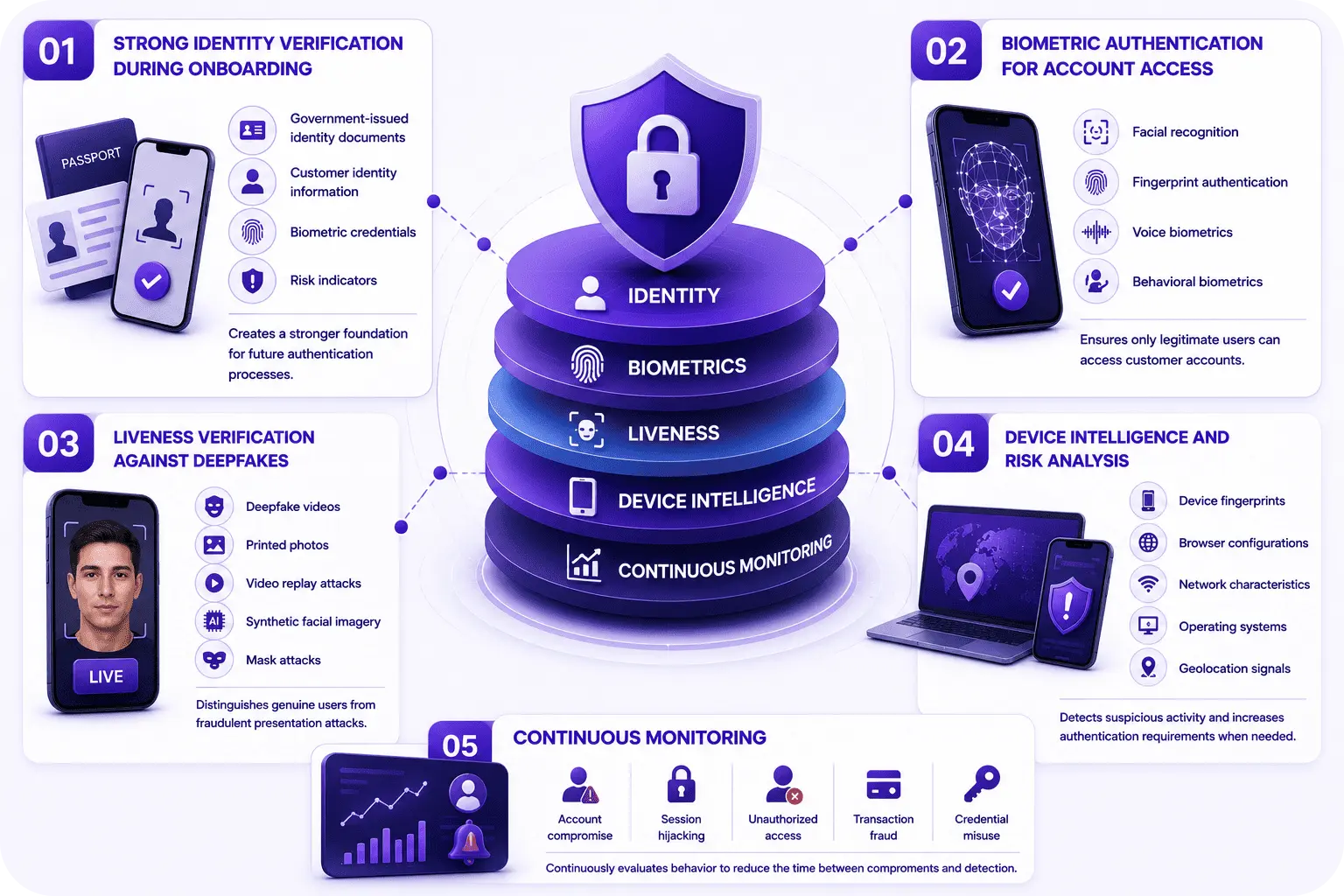
1. Strong Identity Verification During Onboarding
Account security begins before a customer ever logs into an account.
Organizations that establish trusted identities during onboarding are significantly better positioned to prevent future account compromise.
Modern banks increasingly adopt AI-powered identity verification platforms for digital onboarding to verify customers quickly while maintaining regulatory compliance.
Banks should verify:
- Government-issued identity documents
- Customer identity information
- Biometric credentials
- Risk indicators
This creates a stronger foundation for future authentication processes.
2. Biometric Authentication for Account Access
Biometric authentication helps ensure that only legitimate users can access customer accounts.
Unlike passwords, biometric traits cannot easily be shared, stolen, or reused.
Banks increasingly use:
- Facial recognition
- Fingerprint authentication
- Voice biometrics
- Behavioral biometrics
Advanced face authentication technologies provide stronger protection against account takeover attempts while reducing customer friction.
3. Liveness Verification Against Deepfakes
Deepfake technology continues to evolve rapidly.
Financial institutions must ensure that biometric verification systems can distinguish between genuine users and fraudulent presentation attacks.
Organizations increasingly deploy biometric liveness verification solutions capable of identifying:
- Deepfake videos
- Printed photos
- Video replay attacks
- Synthetic facial imagery
- Mask attacks
Additional insights into emerging AI fraud threats can be found in our guide on deepfake detection for fraud prevention.
4. Device Intelligence and Risk Analysis
Device intelligence helps identify suspicious infrastructure used by fraudsters.
Banks commonly evaluate:
- Device fingerprints
- Browser configurations
- Network characteristics
- Operating systems
- Geolocation signals
When suspicious activity is detected, systems can automatically increase authentication requirements before sensitive transactions are approved.
5. Continuous Monitoring
Authentication should not end after login.
Modern banking security programs continuously evaluate customer behavior throughout active sessions.
Continuous monitoring helps identify:
- Account compromise
- Session hijacking
- Unauthorized access
- Transaction fraud
- Credential misuse
This approach significantly reduces the time between compromise and detection.
Common Warning Signs of Account Takeover Fraud
Financial institutions continuously monitor for indicators that may suggest an account has been compromised.
Some of the most common warning signs include:
Unusual Login Locations
Login attempts originating from unfamiliar countries, regions, or devices may indicate fraud.
Multiple Failed Authentication Attempts
Repeated authentication failures often signal credential stuffing or brute-force attacks.
Sudden Changes to Account Information
Unexpected modifications to:
- Phone numbers
- Email addresses
- Passwords
- Recovery settings
can indicate unauthorized access.
Unusual Transaction Patterns
Large transfers, unexpected withdrawals, or unusual payment activity frequently indicate account takeover attempts.
Biometric Verification Failures
Repeated failures during facial authentication or liveness verification may indicate impersonation attempts.
Organizations looking to strengthen fraud prevention controls should also review our guide on using facial recognition to prevent online account fraud.
Regulatory Considerations for Biometric Authentication
Banks implementing biometric authentication must also comply with evolving privacy and security requirements.
Important regulatory considerations include:
Data Protection
Biometric information must be collected, stored, and processed securely.
Organizations operating internationally should align biometric programs with the General Data Protection Regulation (GDPR).
Identity Assurance Standards
Many financial institutions use frameworks such as the NIST Digital Identity Guidelines when designing authentication and identity verification systems.
Anti-Money Laundering Requirements
Strong customer authentication supports broader AML compliance efforts by helping organizations maintain confidence in customer identities.
The Financial Action Task Force (FATF) continues to provide guidance on customer identification, identity verification, and financial crime prevention.
Future Trends in Account Takeover Prevention
Several technologies are expected to shape the future of banking security.
Passive Authentication
Authentication processes will increasingly operate in the background without disrupting users.
Continuous Identity Verification
Identity verification will become an ongoing process rather than a single onboarding event.
Behavioral Biometrics
Behavioral patterns will play a larger role in identifying compromised accounts.
AI-Powered Fraud Intelligence
Machine learning systems will continue improving fraud detection accuracy while reducing false positives.
Passwordless Banking
Many financial institutions are moving toward passwordless authentication models centered around biometrics and trusted devices.
Development teams interested in implementing advanced biometric solutions can explore resources available through the official Recognito GitHub repository.
Conclusion
Account takeover fraud remains one of the most significant threats facing modern financial institutions. As cybercriminals continue adopting increasingly sophisticated techniques, traditional authentication methods alone can no longer provide adequate protection.
By combining biometric authentication, face authentication, identity verification, liveness detection, behavioral analytics, device intelligence, and AI-powered fraud prevention, banks can significantly reduce the risk of unauthorized account access while maintaining a seamless customer experience.
Modern technologies such as Recognito facial recognition, liveness detection, and document verification solutions provide financial institutions with the tools needed to strengthen account takeover prevention strategies, improve customer trust, and stay ahead of evolving fraud threats.
Frequently Asked Questions
What is account takeover fraud?
Account takeover fraud occurs when a criminal gains unauthorized access to a legitimate user’s account and uses it to conduct fraudulent activities.
How do banks prevent account takeover fraud?
Banks use biometric authentication, identity verification, liveness detection, behavioral analytics, device intelligence, and AI-powered fraud detection systems to prevent unauthorized account access.
Why is biometric authentication effective against account takeover fraud?
Biometric authentication verifies unique biological characteristics that are significantly more difficult to steal or replicate than passwords or security questions.
What role does face authentication play in fraud prevention?
Face authentication confirms that the person attempting to access an account matches the verified account owner, helping prevent impersonation and unauthorized access.
How does liveness detection prevent spoofing attacks?
Liveness detection verifies that a real person is physically present and helps block attacks involving photographs, videos, masks, and deepfakes.
Can biometric authentication replace passwords?
Many financial institutions are moving toward passwordless authentication models, although biometrics are often combined with additional security controls to provide maximum protection.