

Cryptocurrency has transformed the global financial landscape by enabling faster, borderless, and decentralized transactions. From centralized exchanges and digital wallets to decentralized finance (DeFi) platforms and crypto payment providers, millions of users now access digital assets without relying on traditional banking infrastructure.
As the industry continues to grow, so does the sophistication of financial crime. Cryptocurrency platforms face increasing threats from synthetic identities, account takeover attacks, stolen credentials, money laundering, document fraud, and AI-generated deepfake attacks. At the same time, regulators worldwide are introducing stricter Know Your Customer (KYC) and Anti-Money Laundering (AML) requirements to improve transparency and combat illicit financial activity.
Balancing regulatory compliance with a fast and seamless user experience has become one of the biggest challenges for cryptocurrency businesses.
To address these risks, exchanges are increasingly adopting crypto identity verification solutions that combine document verification, biometric authentication, liveness detection, and automated risk assessment to verify customers before they gain access to trading platforms.
This guide explains why identity verification has become essential for cryptocurrency platforms, the technologies supporting modern crypto onboarding, and the best practices for building secure and compliant verification processes.
What Is Crypto Identity Verification?
Crypto identity verification is the process of confirming a customer’s identity before allowing access to cryptocurrency services such as trading, investing, transferring digital assets, or opening exchange accounts.
Unlike traditional registration processes that rely only on email verification, crypto identity verification uses multiple technologies to establish trust in a customer’s identity while helping organizations comply with financial regulations.
A modern verification workflow commonly includes:
- Identity document verification
- Biometric verification
- Face liveness detection
- Customer Due Diligence (CDD)
- AML screening
- Risk assessment
- Ongoing monitoring
Together, these verification steps help cryptocurrency platforms reduce fraud, prevent money laundering, and create a safer trading environment for legitimate users.
Organizations implementing secure onboarding often strengthen identity validation by integrating an identity verification API, allowing customer verification to be embedded directly into mobile applications and web platforms without building complex verification infrastructure from scratch.
Businesses looking to better understand how identity establishment differs from authentication can also explore our guide on identity proofing vs identity verification explained.
Why Identity Verification Is Critical for Cryptocurrency Exchanges
The cryptocurrency industry has become a frequent target for organized financial crime.
The speed and global accessibility of digital assets make cryptocurrency platforms attractive to criminals seeking to conceal illicit funds, create fraudulent accounts, or exploit weak onboarding controls.
Without effective identity verification, exchanges become increasingly vulnerable to:
- Identity fraud
- Synthetic identities
- Money laundering
- Account takeover attacks
- Sanctions violations
- Financial fraud
Strong customer verification reduces these risks by ensuring every account is linked to a verified individual before trading begins.
At the same time, identity verification helps exchanges satisfy evolving regulatory requirements while improving customer trust and platform security.
KYC and AML Requirements for Crypto Platforms
Regulatory expectations for cryptocurrency businesses have changed significantly over the past few years.
Many jurisdictions now require exchanges and virtual asset service providers (VASPs) to implement customer identification procedures similar to those used by traditional financial institutions.
These compliance programs typically include:
- Customer identity verification
- Customer Due Diligence (CDD)
- AML screening
- Sanctions screening
- Risk assessment
- Transaction monitoring
- Record keeping
International guidance published by the Financial Action Task Force (FATF) continues to shape global expectations for cryptocurrency compliance by encouraging a risk-based approach to customer verification and ongoing monitoring.
Organizations designing compliant onboarding workflows can also read our guide on AML verification and identity verification in customer onboarding, which explains how identity verification and AML controls work together to strengthen digital onboarding.
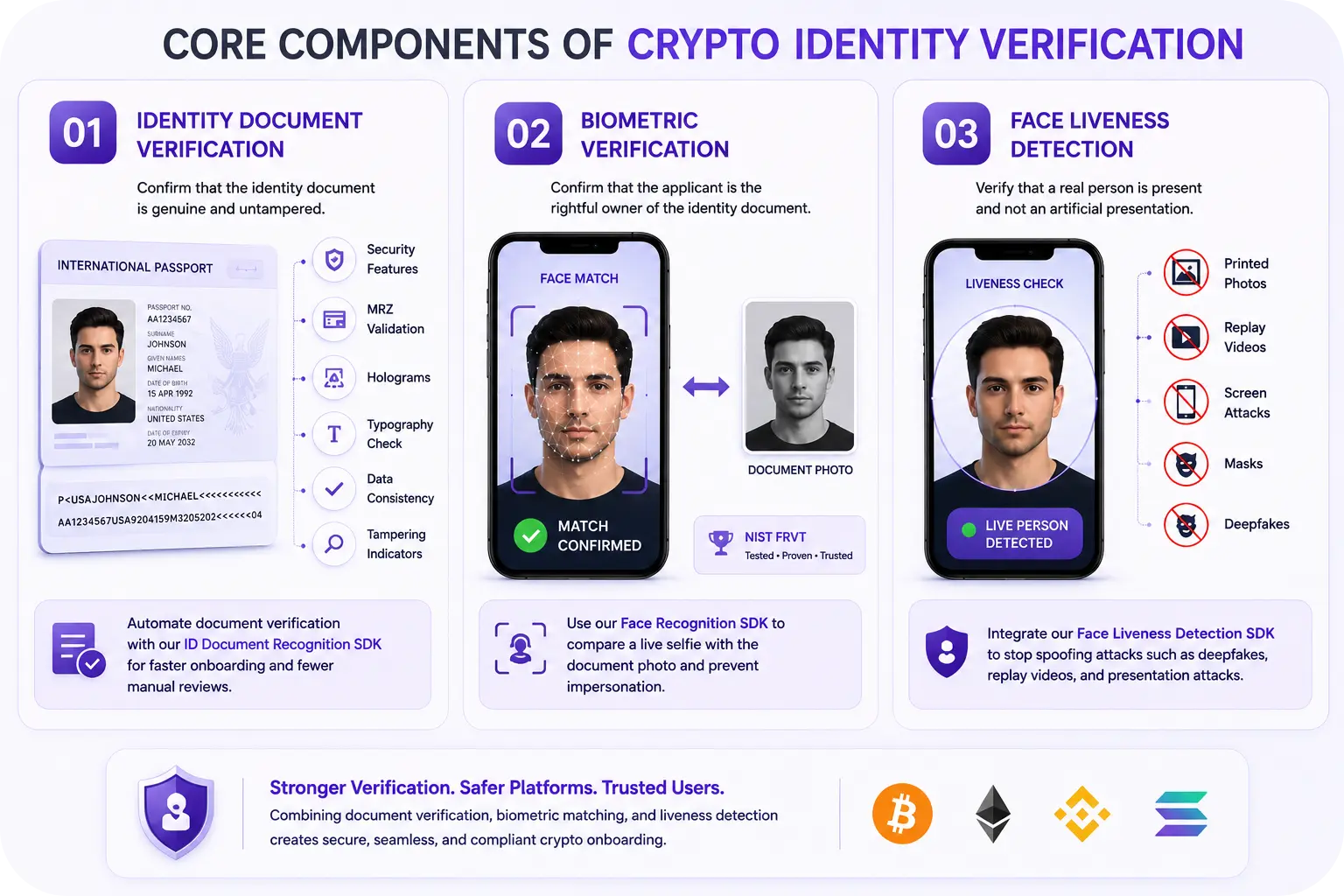
Core Components of Crypto Identity Verification
Secure customer onboarding depends on multiple verification technologies working together rather than a single identity check.
1. Identity Document Verification
Every verification process begins by confirming that a customer’s identity document is genuine.
Modern verification platforms automatically examine government-issued documents for:
- Security features
- Machine-readable zones (MRZ)
- Holograms
- Typography
- Tampering indicators
- Data consistency
Many cryptocurrency exchanges automate this process using the id document recognition SDK, allowing identity documents to be validated within seconds while reducing manual review and improving onboarding efficiency.
2. Biometric Verification
Authenticating an identity document alone does not confirm that the applicant is its rightful owner.
Biometric verification addresses this challenge by comparing a live facial image with the photograph stored within the submitted identity document.
Cryptocurrency platforms increasingly strengthen onboarding security using a face recognition SDK to reduce impersonation attempts while maintaining a fast and convenient user experience.
Independent evaluations conducted through the NIST Face Recognition Vendor Test (FRVT) continue to demonstrate the significant improvements achieved by modern facial recognition algorithms across diverse real-world conditions.
3. Face Liveness Detection
As biometric verification has become more common, attackers have adopted increasingly sophisticated spoofing techniques.
Criminals may attempt to deceive verification systems using:
- Printed photographs
- Replay videos
- Mobile phone screens
- Silicone masks
- AI-generated deepfakes
Face liveness detection verifies that a genuine person is physically present during the verification process rather than an artificial presentation.
Organizations implementing advanced anti-spoofing controls often deploy the face liveness detection SDK to improve fraud prevention while maintaining a frictionless onboarding experience.
Businesses interested in understanding how anti-spoofing technologies strengthen biometric security can also read our guide on presentation attack detection and its role in biometric security.
Benefits of Crypto Identity Verification
Implementing modern identity verification provides measurable benefits for cryptocurrency exchanges and digital asset platforms.
These include:
- Faster customer onboarding
- Stronger KYC compliance
- Improved AML compliance
- Reduced identity fraud
- Better account security
- Lower manual review costs
- Increased customer trust
- Scalable verification workflows
As cryptocurrency adoption continues to expand globally, robust identity verification has become an essential component of secure, compliant, and sustainable digital asset platforms.
How Crypto Identity Verification Strengthens Exchange Security
As cryptocurrency adoption continues to grow, exchanges must balance customer convenience with increasingly complex regulatory and security requirements. Modern identity verification solutions help achieve this balance by automating compliance while reducing fraud throughout the customer lifecycle.
Rather than relying on manual document reviews or basic account registration, leading cryptocurrency platforms use multiple verification technologies that work together to establish trusted customer identities.
1. Preventing Identity Fraud
Identity fraud remains one of the most significant risks facing cryptocurrency exchanges.
Fraudsters frequently attempt to create accounts using stolen personal information, forged documents, or fabricated identities. Once these accounts are approved, they can be used for money laundering, fraudulent transactions, or other financial crimes.
Modern identity verification systems help detect fraudulent applicants before they gain access to the platform by validating both identity documents and the individual presenting them.
Organizations looking to better understand how modern verification technologies identify fraudulent applicants can also read our guide on document fraud detection techniques used in modern identity verification.
2. Stopping Deepfake and Biometric Spoofing Attacks
Artificial intelligence has dramatically increased the sophistication of identity fraud.
Cybercriminals now use AI-generated deepfake videos, replay attacks, printed photographs, and realistic facial images to deceive weak biometric verification systems.
For this reason, cryptocurrency exchanges increasingly combine facial recognition with advanced liveness detection.
Instead of simply comparing two facial images, modern liveness technology confirms that a genuine person is physically present during verification by analysing behavioural and biometric signals.
Businesses interested in emerging AI threats can also explore our guide on deepfake fraud trends financial institutions should watch, which explains how financial organizations defend against AI-generated impersonation attacks.
3. Supporting AML Compliance
Identity verification forms the foundation of every effective AML program.
Before allowing customers to trade digital assets, cryptocurrency exchanges must identify high-risk applicants and comply with regulatory obligations designed to combat financial crime.
Modern verification platforms support AML programs by enabling organizations to:
- Verify customer identities
- Perform Customer Due Diligence (CDD)
- Screen sanctions lists
- Identify Politically Exposed Persons (PEPs)
- Assess customer risk
- Maintain compliance records
Automating these processes helps exchanges strengthen compliance while reducing operational costs and manual review workloads.
4. Improving Customer Experience
Security should not create unnecessary barriers for legitimate customers.
Lengthy verification procedures often increase application abandonment and reduce customer satisfaction.
Identity verification technology enables exchanges to automate onboarding while maintaining a fast and intuitive user experience.
Modern verification platforms can complete document validation, biometric verification, and fraud analysis within minutes, allowing legitimate users to begin trading much sooner.
Organizations seeking to improve digital onboarding can also read our guide on how identity verification APIs improve digital customer onboarding, which explains how API-based verification simplifies customer onboarding across web and mobile applications.
5. Supporting Global Growth
Cryptocurrency exchanges often serve customers across multiple countries and jurisdictions.
As businesses expand internationally, onboarding systems must support a wide range of identity documents, regulatory requirements, and verification standards.
Modern identity verification platforms provide:
- Global document coverage
- Multi-language support
- Cross-platform compatibility
- Scalable cloud infrastructure
- Flexible API integration
These capabilities allow exchanges to grow internationally without redesigning their verification workflows for each new market.

Common Challenges for Cryptocurrency Exchanges
Despite advances in verification technology, crypto platforms continue facing several operational and security challenges.
Evolving Financial Crime
Fraud techniques continue becoming more sophisticated.
Today’s cryptocurrency platforms regularly encounter:
- Synthetic identities
- Forged identity documents
- Deepfake attacks
- Account takeover fraud
- Credential theft
- Money laundering schemes
Organizations should continuously update fraud detection capabilities to stay ahead of emerging threats rather than relying on static verification controls.
Balancing Compliance With User Experience
Customers expect onboarding to be completed quickly.
However, cryptocurrency exchanges must also satisfy increasingly demanding regulatory requirements.
Successful onboarding platforms balance these competing priorities by automating low-risk applications while applying enhanced verification only where elevated risk indicators exist.
This risk-based approach improves both compliance and customer experience.
Operating Across Multiple Jurisdictions
Cryptocurrency regulations continue evolving around the world.
Exchanges operating internationally often need to comply with multiple legal and regulatory frameworks simultaneously.
Organizations should design flexible onboarding processes capable of adapting to changing compliance requirements while maintaining consistent verification standards across all markets.
Businesses processing personal and biometric data should also ensure their verification programs align with internationally recognised privacy regulations such as the General Data Protection Regulation (GDPR).
Best Practices for Crypto Identity Verification
Implementing crypto identity verification involves more than meeting regulatory requirements. Cryptocurrency exchanges should build onboarding processes that strengthen security, improve compliance, and provide a seamless experience for legitimate users.
The following best practices can help organizations build a secure and scalable verification framework.
1. Verify Every Customer Before Trading
Identity verification should take place before customers are allowed to deposit funds, buy cryptocurrencies, or access trading features.
Verifying customer identities at the beginning of the relationship helps prevent fraudulent accounts from entering the platform while supporting long-term compliance.
A strong onboarding process should include:
- Identity document verification
- Biometric verification
- Face liveness detection
- Customer risk assessment
- AML screening
Establishing trusted identities early significantly reduces fraud throughout the customer lifecycle.
2. Automate Verification Workflows
Manual verification is difficult to scale as customer volumes increase.
Automation enables exchanges to verify thousands of applications consistently while reducing operational costs and onboarding delays.
Modern verification platforms can automatically:
- Validate identity documents
- Perform biometric matching
- Detect presentation attacks
- Screen sanctions and watchlists
- Generate audit records
Automation allows compliance teams to focus their attention on genuinely high-risk applications instead of manually reviewing every customer.
3. Continuously Monitor Customer Risk
Identity verification should not end after onboarding.
Customer risk levels may change due to transaction activity, geographic movement, or newly identified financial crime indicators.
Organizations should continuously monitor:
- Transaction behaviour
- Login activity
- Device changes
- Sanctions updates
- Suspicious account activity
Ongoing monitoring helps exchanges detect emerging risks while supporting long-term AML compliance.
4. Protect Against AI-Powered Fraud
Artificial intelligence is changing both financial services and financial crime.
Fraudsters increasingly use AI-generated identities, deepfake videos, document manipulation, and biometric spoofing to bypass weak verification systems.
Organizations should regularly update fraud detection models and implement multiple verification technologies capable of identifying emerging AI-driven threats before fraudulent accounts are approved.

The Future of Crypto Identity Verification
Identity verification will continue evolving alongside cryptocurrency adoption and regulatory expectations.
Rather than focusing solely on customer onboarding, exchanges are moving toward continuous identity assurance throughout the customer relationship.
Several technologies are expected to shape the future of crypto verification.
AI-Powered Risk Analysis
Artificial intelligence is becoming central to modern compliance programs.
Machine learning models analyse hundreds of customer signals simultaneously, including biometric confidence scores, transaction behaviour, device intelligence, geolocation consistency, and historical fraud indicators.
This enables exchanges to identify suspicious behaviour earlier while reducing unnecessary reviews for legitimate customers.
Continuous Authentication
Many exchanges are moving beyond one-time authentication.
Instead of verifying users only during login, continuous authentication evaluates identity throughout an active session.
Additional verification may be triggered when:
- High-value withdrawals are requested
- Login patterns change
- New devices are detected
- Sensitive account information is updated
- Suspicious transactions occur
This adaptive approach improves security without disrupting normal customer activity.
Passwordless Access
Traditional passwords remain vulnerable to phishing, credential stuffing, and data breaches.
Many cryptocurrency platforms are adopting passwordless authentication supported by biometrics and trusted devices to strengthen account security while simplifying the login experience.
As biometric technologies continue improving, passwordless authentication is expected to become increasingly common across digital asset platforms.
Choosing the Right Crypto Identity Verification Solution
Selecting an identity verification platform involves more than satisfying compliance requirements.
Organizations should evaluate whether a solution can scale with customer growth while adapting to evolving fraud techniques and regulatory changes.
Important evaluation criteria include:
- Identity verification accuracy
- Global document coverage
- Biometric matching performance
- Face liveness detection
- AML and KYC compliance capabilities
- API and SDK integration
- Scalability
- Developer documentation
- Reporting and audit support
Solutions that combine identity verification, biometric authentication, document verification, liveness detection, and AML screening within a single platform typically reduce implementation complexity while improving operational efficiency.
Development teams interested in implementation resources can also explore the official Recognito GitHub repository for SDK documentation, sample integrations, and developer guides.
Conclusion
As cryptocurrency adoption continues to accelerate, secure identity verification has become a fundamental requirement for exchanges and digital asset platforms. Growing regulatory expectations, increasingly sophisticated fraud techniques, and rising customer expectations mean that simple registration processes are no longer sufficient.
By combining identity document verification, biometric authentication, face liveness detection, AML screening, and continuous risk monitoring, cryptocurrency platforms can strengthen security while delivering fast and frictionless onboarding experiences.
Organizations that invest in advanced crypto identity verification solutions today will be better positioned to reduce fraud, maintain regulatory compliance, protect customer assets, and build long-term trust in an increasingly competitive digital asset ecosystem.
Frequently Asked Questions
What is crypto identity verification?
Crypto identity verification is the process of confirming a customer’s identity before granting access to cryptocurrency services. It typically includes document verification, biometric verification, liveness detection, and AML screening.
Why do cryptocurrency exchanges require KYC verification?
KYC verification helps exchanges confirm customer identities, comply with financial regulations, reduce money laundering risks, and prevent fraudulent accounts from accessing cryptocurrency services.
How does identity verification prevent crypto fraud?
Identity verification reduces fraud by validating identity documents, confirming the applicant’s identity through biometrics, detecting spoofing attempts, and identifying high-risk customers before accounts are approved.
What is the role of AML in cryptocurrency exchanges?
AML programs help cryptocurrency exchanges identify suspicious activity, perform customer risk assessments, comply with regulatory obligations, and reduce the risk of money laundering and terrorist financing.
How does face liveness detection improve crypto identity verification?
Face liveness detection confirms that a real person is physically present during biometric verification, helping prevent spoofing attacks involving printed photographs, replay videos, masks, and AI-generated deepfakes.
What should cryptocurrency platforms consider when choosing an identity verification solution?
Organizations should evaluate verification accuracy, biometric performance, global document support, liveness detection capabilities, AML compliance features, scalability, integration flexibility, developer resources, and reporting capabilities before selecting an identity verification platform.
