
Digital customer onboarding has become a competitive advantage for organizations across banking, fintech, healthcare, telecommunications, insurance, e-commerce, and cryptocurrency platforms. Today’s customers expect to create accounts, verify their identities, and access services within minutes, regardless of where they are.
Meeting these expectations while preventing fraud is a growing challenge. Organizations must verify customer identities accurately without introducing lengthy manual reviews or complicated onboarding processes. At the same time, fraudsters continue exploiting digital channels through synthetic identities, forged documents, deepfake attacks, and account impersonation.
To address these challenges, businesses are increasingly adopting identity verification APIs that automate identity checks while integrating seamlessly into existing applications and onboarding workflows.
Instead of building complex verification systems from scratch, developers can integrate identity verification software directly into websites, mobile applications, and enterprise platforms through APIs. This approach enables organizations to strengthen security, accelerate customer onboarding, and maintain compliance with Know Your Customer (KYC) and Anti-Money Laundering (AML) regulations.
This guide explains how identity verification APIs work, the benefits they provide, and why they have become a critical component of modern digital onboarding.
What Is an Identity Verification API?
An identity verification API is a set of programming interfaces that allows developers to integrate identity verification capabilities into their applications without building the underlying verification infrastructure themselves.
These APIs enable organizations to automate customer verification by connecting their onboarding platforms with advanced identity verification technologies.
Depending on the provider, an identity verification API may support:
- Identity document verification
- Facial recognition
- Biometric verification
- Face liveness detection
- Document liveness detection
- Risk assessment
- Customer identity validation
Many organizations accelerate implementation by integrating an identity verification SDK into their existing onboarding systems, allowing customers to verify their identities quickly while reducing manual review workloads.
Organizations new to digital identity often confuse verifying an identity with proving ownership of that identity. Businesses looking to understand this distinction can also read identity proofing vs identity verification explained, which explores how both processes contribute to secure customer onboarding.
Why Identity Verification APIs Matter
Customer onboarding has become one of the most important stages for preventing fraud.
If an organization fails to verify a customer’s identity accurately during account creation, fraudsters may gain access to financial services, healthcare platforms, digital wallets, government services, or online marketplaces using false or stolen identities.
Manual verification processes often struggle to keep pace with growing customer demand.
Common challenges include:
- Slow onboarding
- Human error
- High operational costs
- Inconsistent verification decisions
- Poor customer experience
- Limited scalability
Identity verification APIs address these challenges by automating verification while maintaining high levels of accuracy and compliance.
Instead of manually reviewing every application, organizations can automatically verify customer identities within seconds, allowing compliance teams to focus on applications that genuinely require additional investigation.
This combination of speed and security enables businesses to improve customer satisfaction while reducing fraud exposure.
How Identity Verification APIs Work
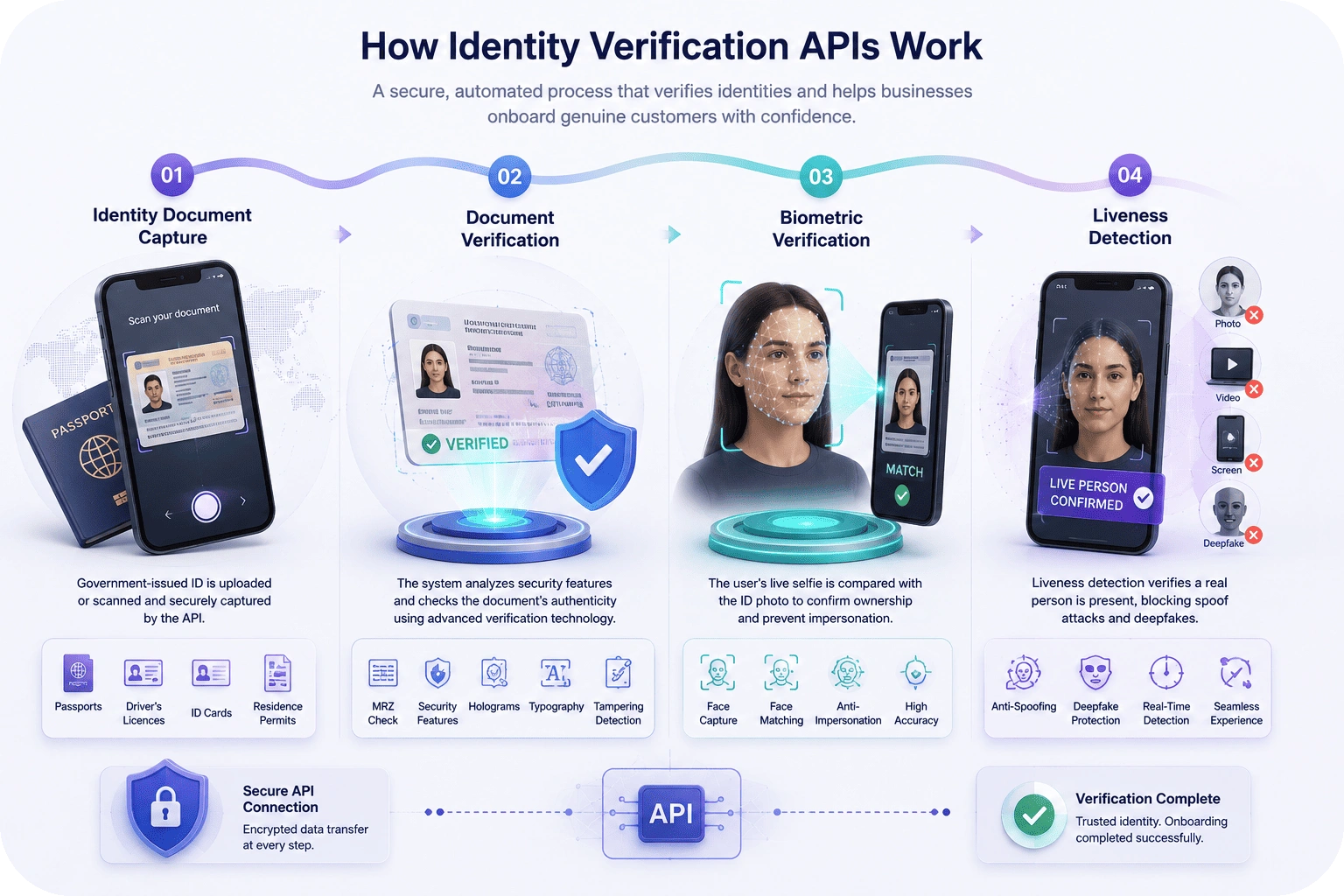
Although implementations differ between providers, most identity verification APIs follow a similar workflow.
1. Identity Document Capture
The onboarding process begins by collecting a government-issued identity document.
Customers typically upload or scan documents such as:
- Passports
- Driver’s licences
- National identity cards
- Residence permits
The API securely receives the document and prepares it for automated analysis.
2. Document Verification
Once the document is submitted, the verification system evaluates whether it is genuine.
Modern identity verification software examines numerous security elements, including:
- Machine-readable zones (MRZ)
- Security features
- Holograms
- Typography
- Image quality
- Signs of tampering
Many organizations automate this stage using the id document recognition SDK, helping reduce manual review while improving both verification speed and accuracy.
3. Biometric Verification
Verifying the authenticity of an identity document alone is not enough.
Organizations must also confirm that the individual submitting the document is its legitimate owner.
To achieve this, the onboarding system captures a live facial image and compares it with the photograph contained within the identity document.
Businesses increasingly implement biometric matching through a face recognition SDK to strengthen customer identity verification while reducing impersonation attempts.
Independent evaluations conducted through the NIST Face Recognition Vendor Test (FRVT) continue to demonstrate the significant improvements achieved by modern facial recognition technology across diverse environments.
4. Liveness Detection
Sophisticated fraudsters frequently attempt to bypass biometric verification using printed photographs, replay videos, mobile phone screens, and AI-generated deepfakes.
To prevent these attacks, identity verification APIs increasingly incorporate liveness detection before completing authentication.
Rather than simply comparing two facial images, liveness detection verifies that a genuine person is physically present during the verification process.
Organizations implementing stronger anti-spoofing controls often integrate the face liveness detection SDK to improve fraud prevention while maintaining a smooth customer experience.
For organizations evaluating different implementation strategies, our guide on presentation attack detection and its role in biometric security explains how modern anti-spoofing technologies defend against increasingly sophisticated biometric attacks.
Benefits of Using Identity Verification APIs
Organizations across multiple industries are adopting identity verification APIs because they deliver measurable improvements in both operational efficiency and security.
Some of the most significant benefits include:
- Faster customer onboarding
- Improved identity verification accuracy
- Reduced manual reviews
- Better fraud prevention
- Easier regulatory compliance
- Scalable onboarding processes
- Improved customer experience
- Faster integration for development teams
Instead of building complex identity verification systems internally, organizations can deploy proven verification capabilities through well-documented APIs, reducing both implementation time and ongoing maintenance costs.
How Identity Verification APIs Strengthen Customer Onboarding
An identity verification API does far more than automate identity checks. It enables organizations to build onboarding experiences that are faster, more secure, and easier to scale while meeting increasingly complex compliance requirements.
By integrating verification directly into digital workflows, businesses can reduce fraud without introducing unnecessary friction for legitimate customers.
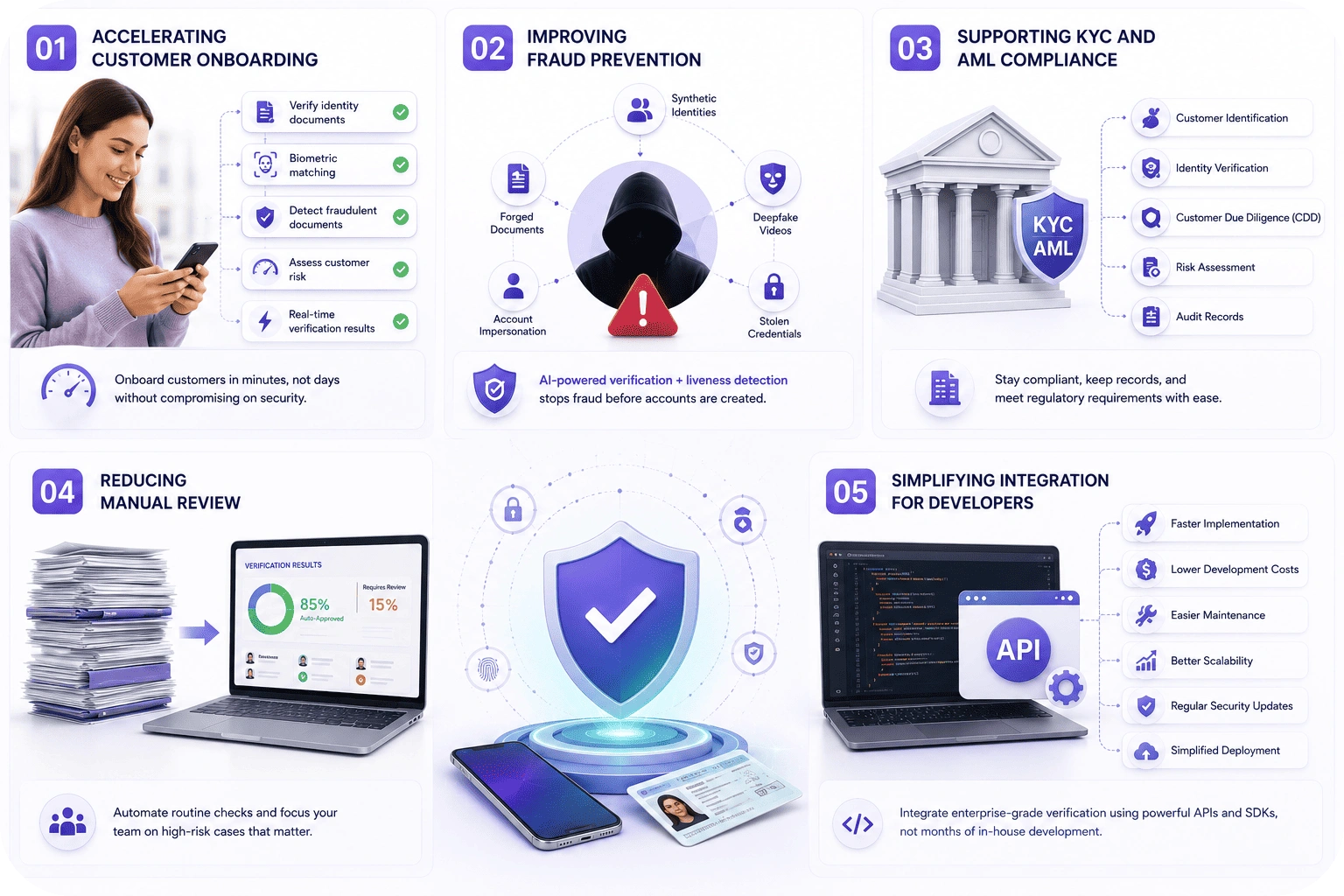
1. Accelerating Customer Onboarding
Speed plays a major role in customer acquisition.
Today’s users expect to create an account within minutes, not hours or days. Lengthy verification processes often result in abandoned applications and lost business opportunities.
Identity verification APIs automate multiple onboarding tasks simultaneously, allowing organizations to:
- Verify identity documents instantly
- Perform biometric matching
- Detect fraudulent documents
- Assess customer risk
- Generate verification results in real time
This automation significantly reduces onboarding times while maintaining a high level of identity assurance.
Organizations building modern onboarding experiences can also explore our guide on remote customer onboarding best practices, which explains how verification technologies improve both security and customer experience.
2. Improving Fraud Prevention
Identity fraud continues to evolve alongside digital services.
Fraudsters increasingly use:
- Synthetic identities
- Forged identity documents
- Deepfake videos
- Account impersonation
- Stolen credentials
Traditional manual verification often struggles to identify these increasingly sophisticated attacks.
Modern identity verification APIs combine document verification, biometric authentication, artificial intelligence, and liveness detection to identify suspicious applications before customer accounts are approved.
Businesses looking to understand one of the fastest-growing fraud threats can also read how financial institutions detect synthetic identity fraud, which explains how AI-powered verification helps identify fabricated identities during onboarding.
3. Supporting KYC and AML Compliance
For regulated industries, identity verification is not only about preventing fraud, it is also essential for regulatory compliance.
Financial institutions, fintech companies, payment providers, and cryptocurrency exchanges must verify customer identities before establishing a business relationship.
Identity verification APIs help organizations support compliance activities including:
- Customer identification
- Identity verification
- Customer Due Diligence (CDD)
- Risk assessment
- Audit records
By automating these processes, businesses can improve consistency while reducing operational workloads for compliance teams.
Organizations designing compliant onboarding programs may also benefit from reading our guide on AML verification and identity verification in customer onboarding, which explains how these processes work together within modern compliance frameworks.
4. Reducing Manual Review
Manual identity verification can be expensive, time-consuming, and difficult to scale.
As customer volumes increase, compliance teams often spend significant time reviewing low-risk applications that could be processed automatically.
Identity verification APIs help reduce manual intervention by automatically validating identity documents, comparing biometric information, and identifying applications that require additional investigation.
This enables compliance teams to focus on genuinely high-risk customers rather than reviewing every application individually.
The result is improved operational efficiency without compromising security.
5. Simplifying Integration for Developers
Building an identity verification platform from the ground up requires significant development resources.
Organizations must develop document recognition capabilities, biometric matching, fraud detection, security infrastructure, compliance controls, and ongoing maintenance.
Identity verification APIs eliminate much of this complexity.
Developers can integrate advanced verification capabilities into existing applications using well-documented APIs and SDKs instead of creating proprietary verification systems.
This approach offers several advantages:
- Faster implementation
- Lower development costs
- Easier maintenance
- Better scalability
- Regular security updates
- Simplified deployment
As digital services continue expanding, API-based verification allows organizations to deliver enterprise-grade identity verification without building every component internally.
Common Use Cases for Identity Verification APIs
Identity verification APIs are now used across a wide range of industries where establishing trust is essential.
Financial Services
Banks and fintech companies use identity verification APIs for:
- Digital account opening
- Loan applications
- Customer onboarding
- Account recovery
- Fraud prevention
Cryptocurrency Platforms
Crypto exchanges rely on identity verification to satisfy regulatory requirements while reducing financial crime.
Common applications include:
- KYC verification
- AML compliance
- Wallet creation
- Transaction monitoring
Healthcare
Healthcare providers use identity verification APIs to confirm patient identities before granting access to sensitive medical information and digital healthcare services.
Telecommunications
Telecommunications providers verify customer identities during:
- SIM registration
- New account creation
- Number portability
- Remote customer onboarding
Online Marketplaces
Digital platforms use identity verification APIs to establish trust between buyers and sellers while reducing identity fraud and fake account creation.
Challenges Organizations Should Consider
Although identity verification APIs offer significant advantages, successful implementation requires careful planning.
Privacy and Data Protection
Identity verification involves processing highly sensitive personal information.
Organizations should ensure that identity data is securely collected, transmitted, processed, and stored while complying with applicable privacy regulations.
Businesses operating internationally should also align their verification programs with the General Data Protection Regulation (GDPR) and other relevant data protection laws.
Choosing the Right Verification Provider
Not every identity verification API provides the same level of accuracy, fraud detection, or global document coverage.
When evaluating providers, organizations should consider factors such as:
- Identity verification accuracy
- Supported identity documents
- Biometric performance
- Liveness detection capabilities
- API reliability
- Integration flexibility
- Compliance support
- Developer documentation
Selecting a scalable solution today helps organizations avoid costly migrations as customer volumes continue to grow.
Best Practices for Implementing Identity Verification APIs
Integrating an identity verification API is not simply a technical project. Organizations should design onboarding workflows that balance security, compliance, scalability, and customer experience from the outset.
The following best practices can help businesses maximize the value of their identity verification solution.
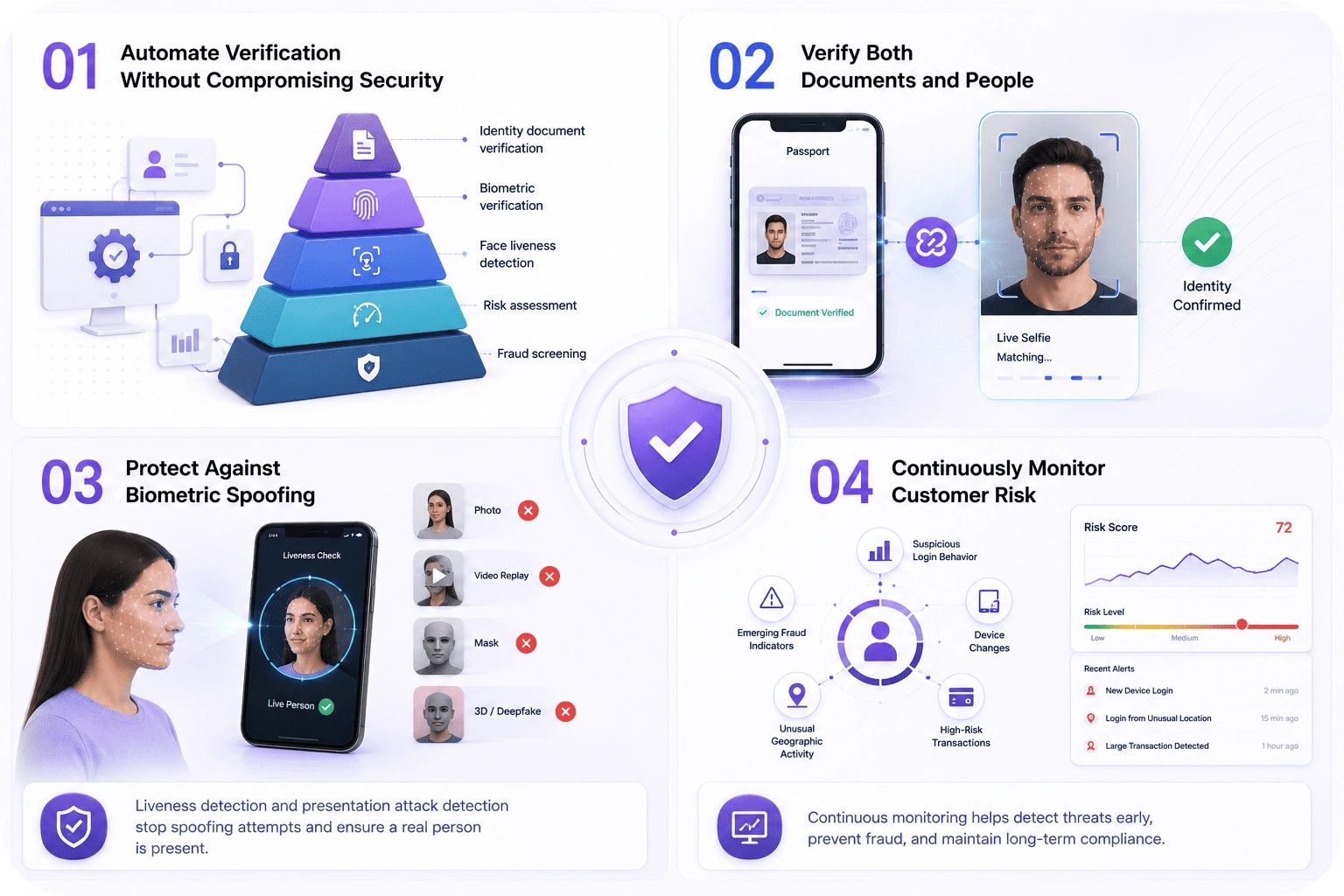
1. Automate Verification Without Compromising Security
One of the biggest advantages of identity verification APIs is automation.
However, automation should not come at the expense of security. Organizations should ensure every verification request is supported by multiple validation layers rather than relying on document verification alone.
A modern onboarding workflow should include:
- Identity document verification
- Biometric verification
- Face liveness detection
- Risk assessment
- Fraud screening
Layering these controls significantly improves identity assurance while maintaining a fast onboarding experience.
2. Verify Both Documents and People
Authenticating an identity document does not automatically confirm that the individual presenting it is the legitimate owner.
To establish a trusted digital identity, organizations should combine document validation with biometric verification.
Many businesses strengthen this process using a biometric verification solution, allowing the onboarding system to compare a live facial image with the photograph contained within the submitted identity document.
This additional verification layer helps reduce impersonation attempts while improving overall onboarding security.
3. Protect Against Biometric Spoofing
As biometric authentication becomes more common, attackers continue developing increasingly sophisticated presentation attacks.
Deepfake videos, replay attacks, printed photographs, and AI-generated facial imagery can all be used to deceive authentication systems that rely solely on face matching.
Organizations should integrate presentation attack detection and liveness verification into every biometric workflow.
Businesses looking to strengthen their anti-spoofing strategy can also explore our guide on presentation attack detection and its role in biometric security, which explains how modern PAD technologies defend against evolving biometric attacks.
4. Continuously Monitor Customer Risk
Identity verification should not end once an account has been approved.
Customer behavior, transaction activity, and fraud risks change over time.
Organizations should implement continuous monitoring capable of identifying:
- Suspicious login behavior
- Device changes
- High-risk transactions
- Unusual geographic activity
- Emerging fraud indicators
This ongoing approach helps organizations detect compromised accounts much earlier while supporting long-term regulatory compliance.
The Future of Identity Verification APIs
Identity verification technology continues to evolve as organizations seek faster, more intelligent, and more secure onboarding experiences.
Artificial intelligence, machine learning, and cloud-native infrastructure are transforming how identity verification APIs operate.
Several trends are expected to shape the future of digital onboarding.
AI-Driven Identity Verification
Artificial intelligence is becoming central to modern identity verification.
Instead of evaluating only document authenticity, AI-powered systems analyze hundreds of signals simultaneously, including biometric confidence, document integrity, behavioral patterns, device intelligence, and fraud indicators.
This enables organizations to identify suspicious applications more accurately while reducing false positives for legitimate customers.
Continuous Identity Verification
Rather than verifying identities only during onboarding, organizations are increasingly adopting continuous identity verification throughout the customer lifecycle.
Additional verification may be triggered when:
- Sensitive account information changes
- Large transactions occur
- New devices are detected
- Suspicious account activity is identified
- Password recovery is requested
This adaptive approach improves security while minimizing unnecessary disruption for genuine customers.
Passwordless Digital Experiences
As organizations continue reducing their reliance on passwords, identity verification APIs are becoming an important part of passwordless authentication strategies.
By combining trusted devices, biometric authentication, and intelligent risk analysis, businesses can provide stronger security while simplifying the customer experience.
This shift is expected to accelerate across banking, healthcare, government services, telecommunications, and enterprise applications over the coming years.
Choosing the Right Identity Verification API
Selecting an identity verification API involves much more than comparing technical documentation.
Organizations should evaluate whether a platform can support future growth while adapting to changing fraud techniques and regulatory expectations.
Important considerations include:
- Identity verification accuracy
- Global document coverage
- Biometric matching performance
- Liveness detection capabilities
- API reliability
- Scalability
- Compliance support
- Developer experience
- Integration flexibility
Platforms that combine document verification, biometric authentication, fraud detection, and onboarding capabilities within a single solution often reduce implementation complexity while improving operational efficiency.
Development teams interested in implementation resources can also explore the official Recognito GitHub repository, which provides SDK documentation, integration examples, and developer resources.
Conclusion
Identity verification APIs have become an essential component of modern digital customer onboarding. By automating document verification, biometric authentication, liveness detection, and fraud prevention, these APIs enable organizations to onboard customers faster while maintaining high levels of security and regulatory compliance.
As fraud techniques continue evolving, businesses can no longer rely on manual verification processes alone. A well-designed identity verification API allows organizations to improve operational efficiency, reduce onboarding friction, strengthen customer trust, and protect against increasingly sophisticated identity fraud.
Organizations that invest in intelligent identity verification technologies today will be better positioned to deliver secure, scalable, and future-ready digital onboarding experiences while meeting the growing expectations of both customers and regulators.
Frequently Asked Questions
What is an identity verification API?
An identity verification API allows developers to integrate identity verification capabilities, such as document verification, biometric authentication, and liveness detection, directly into websites, mobile applications, and digital onboarding platforms.
How do identity verification APIs improve customer onboarding?
They automate identity verification, reduce manual reviews, accelerate account creation, improve fraud prevention, and help organizations maintain compliance with KYC and AML requirements.
Which industries use identity verification APIs?
Identity verification APIs are widely used across banking, fintech, healthcare, insurance, telecommunications, government services, cryptocurrency platforms, travel, and online marketplaces.
Can an identity verification API help prevent fraud?
Yes. Modern identity verification APIs combine document verification, biometric authentication, liveness detection, artificial intelligence, and risk assessment to identify fraudulent applications before accounts are approved.
Are identity verification APIs suitable for mobile applications?
Yes. Most modern APIs are designed to integrate seamlessly with web, Android, and iOS applications, enabling secure identity verification across multiple digital channels.
What should organizations consider when choosing an identity verification API?
Organizations should evaluate verification accuracy, biometric performance, document coverage, liveness detection capabilities, scalability, compliance support, integration flexibility, and developer documentation before selecting an identity verification solution.