
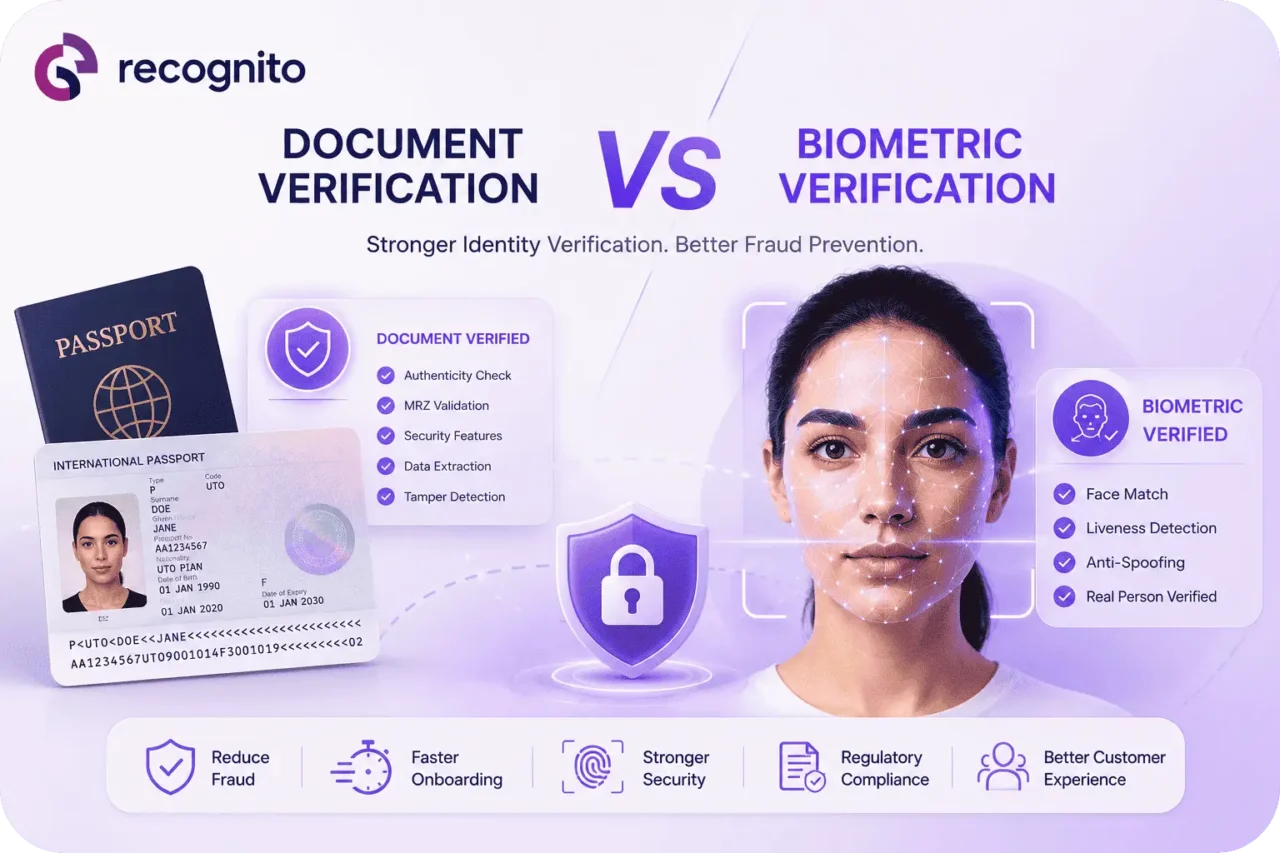
Digital identity verification has become a critical part of customer onboarding across banking, fintech, healthcare, insurance, telecommunications, cryptocurrency platforms, and other regulated industries. As organizations continue moving their services online, verifying customer identities quickly and securely has become essential for preventing fraud while delivering a seamless user experience.
However, identity fraud has become increasingly sophisticated. Criminals now use forged identity documents, synthetic identities, stolen credentials, AI-generated deepfakes, and account takeover techniques to exploit weaknesses in digital onboarding systems. Relying on a single verification method is no longer sufficient to protect organizations against these evolving threats.
Two of the most widely adopted verification technologies are document verification and biometric verification. While they are often discussed together, they solve different problems within the identity verification process.
Document verification confirms that an identity document is genuine, while biometric verification confirms that the individual presenting the document is its legitimate owner. Together, these technologies create a stronger defense against identity fraud than either method could provide on its own.
This guide explains the differences between document verification and biometric verification, their individual strengths, and why combining both technologies has become the industry standard for modern fraud prevention.
What Is Document Verification?
Document verification is the process of validating the authenticity of government-issued identity documents before establishing a customer’s identity.
Modern verification systems use artificial intelligence, computer vision, and optical character recognition (OCR) to analyse identity documents for signs of forgery, manipulation, or tampering.
Documents commonly verified include:
- Passports
- National identity cards
- Driver’s licences
- Residence permits
Modern document verification platforms examine multiple security features, including:
- Machine-readable zones (MRZ)
- Holograms
- Typography
- Security patterns
- Data consistency
- Tampering indicators
Organizations increasingly automate these checks using the id document recognition SDK, allowing identity documents to be verified within seconds while reducing manual review and improving onboarding efficiency.
What Is Biometric Verification?
Biometric verification confirms that the person presenting an identity document is the legitimate owner of that document.
Instead of examining documents, biometric systems analyse unique physical characteristics that are difficult to copy or steal.
Common biometric verification methods include:
- Facial recognition
- Fingerprint recognition
- Voice recognition
- Iris recognition
Facial recognition has become the most widely adopted biometric technology for digital onboarding because it combines high security with a convenient user experience.
Organizations increasingly strengthen customer verification using a face recognition SDK, which compares a live facial image against the photograph stored within the submitted identity document.
To protect against spoofing attacks involving printed photographs, replay videos, or AI-generated deepfakes, many organizations also integrate advanced liveness detection before completing biometric verification.
Businesses interested in learning more about biometric anti-spoofing can explore our guide on presentation attack detection and its role in biometric security.
Document Verification vs Biometric Verification
Although both technologies support identity verification, they answer two different questions during customer onboarding.
Document verification asks:
“Is this identity document genuine?”
Biometric verification asks:
“Is this person the legitimate owner of the verified identity document?”
Neither technology replaces the other.
A genuine identity document may still be presented by someone using a stolen identity.
Likewise, accurately matching a face provides little value if the underlying document itself has been forged or manipulated.
For this reason, organizations increasingly combine both verification methods into a single onboarding workflow that establishes trust in both the identity document and the individual presenting it.
Understanding this distinction is essential when designing secure digital onboarding. Organizations looking to strengthen their verification strategy can also read our guide on identity proofing vs identity verification explained, which explores how identity establishment and identity confirmation work together.
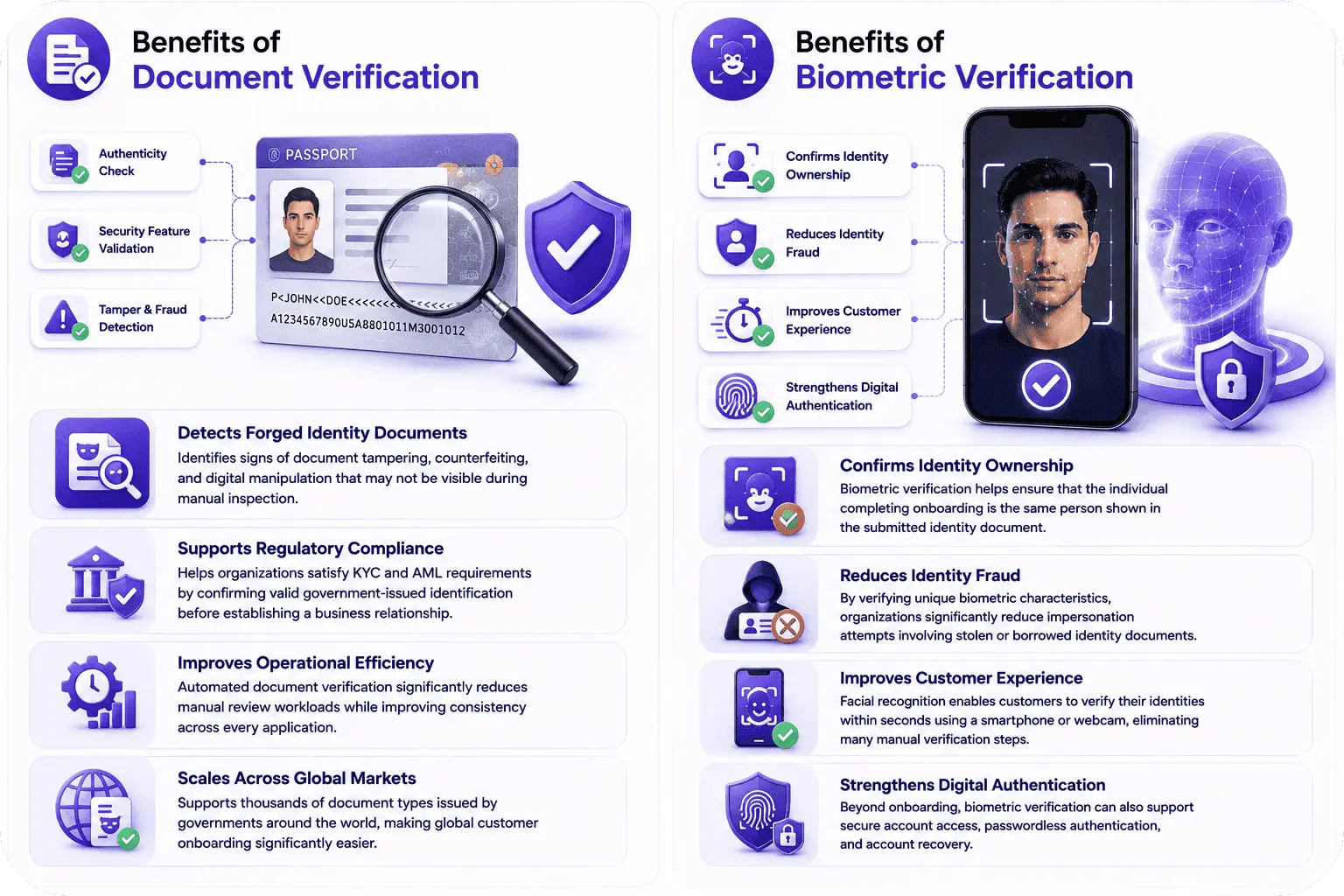
Benefits of Document Verification
Document verification provides several important advantages during customer onboarding.
Detects Forged Identity Documents
Modern verification systems identify signs of document tampering, counterfeiting, and digital manipulation that may not be visible during manual inspection.
Supports Regulatory Compliance
Document verification helps organizations satisfy KYC and AML requirements by confirming that customers provide valid government-issued identification before establishing a business relationship.
Improves Operational Efficiency
Automated document verification significantly reduces manual review workloads while improving consistency across every application.
Scales Across Global Markets
Modern verification platforms support thousands of document types issued by governments around the world, making global customer onboarding significantly easier.
Benefits of Biometric Verification
Biometric verification provides an additional layer of identity assurance beyond document validation.
Confirms Identity Ownership
Biometric verification helps ensure that the individual completing onboarding is the same person shown in the submitted identity document.
Reduces Identity Fraud
By verifying unique biometric characteristics, organizations significantly reduce impersonation attempts involving stolen or borrowed identity documents.
Improves Customer Experience
Facial recognition enables customers to verify their identities within seconds using a smartphone or webcam, eliminating many manual verification steps.
Strengthens Digital Authentication
Beyond onboarding, biometric verification can also support secure account access, passwordless authentication, and account recovery.
Organizations implementing biometric authentication across the customer lifecycle can also explore our guide on face recognition accuracy factors every business should understand, which explains the factors influencing real-world biometric performance.
Why Modern Fraud Prevention Requires Both Technologies
One of the biggest misconceptions about identity verification is that organizations must choose between document verification and biometric verification.
In reality, the strongest fraud prevention strategies combine both technologies because each addresses a different stage of the identity verification process.
Document verification establishes confidence in the authenticity of an identity document, while biometric verification confirms that the individual presenting that document is its rightful owner.
Together, they create a layered verification process that significantly reduces fraud while improving customer trust.
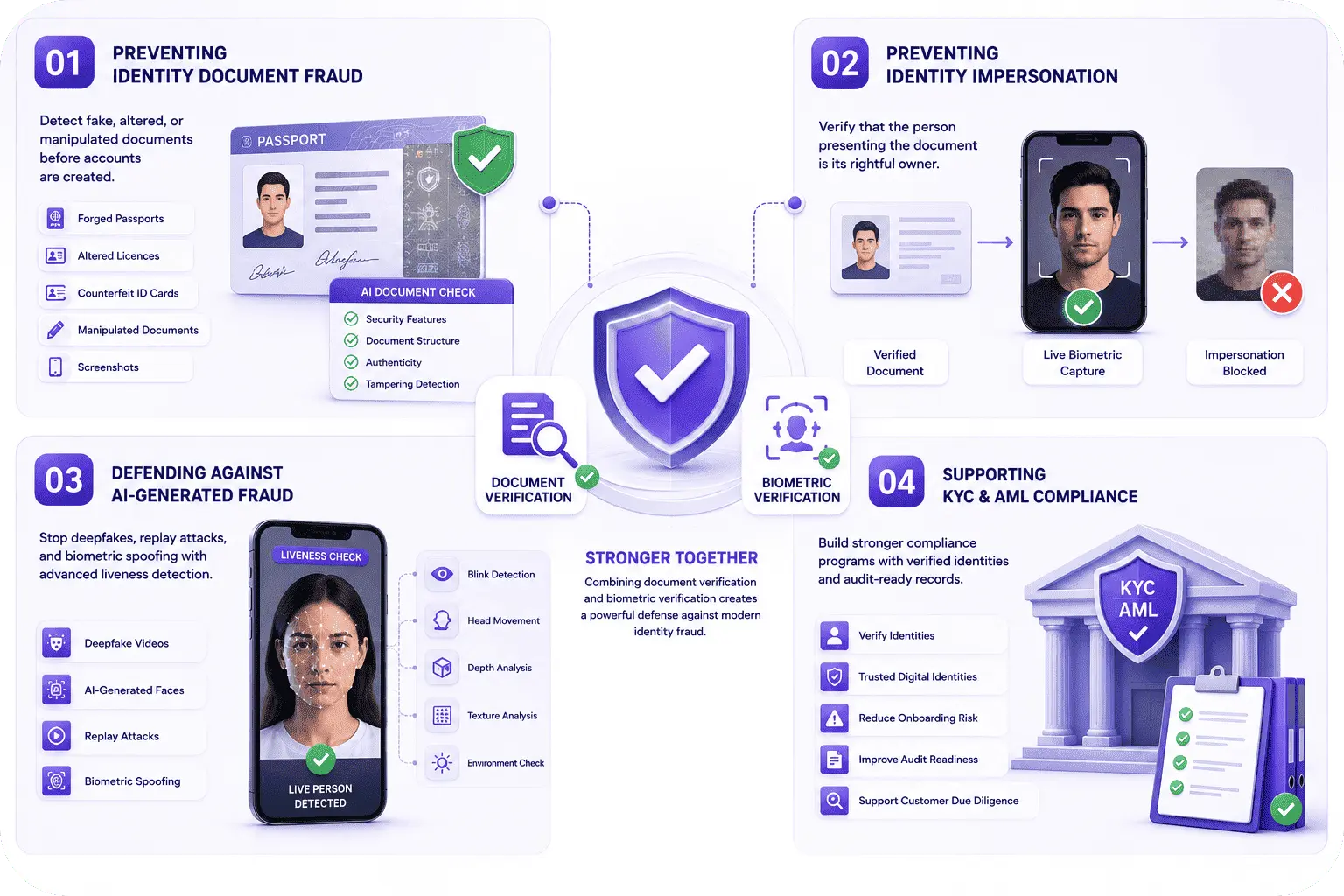
1. Preventing Identity Document Fraud
Identity document fraud continues to be one of the most common methods used by cybercriminals to bypass digital onboarding systems.
Fraudsters may attempt to use:
- Forged passports
- Altered driver’s licences
- Counterfeit national ID cards
- Digitally manipulated documents
- Screenshots of identity documents
Without document verification, organizations may unknowingly approve fraudulent identities during onboarding.
Modern verification systems automatically analyse security features, document structure, and signs of tampering to identify fraudulent documents before accounts are created.
Businesses looking to strengthen this process can also explore our guide on document fraud detection techniques used in modern identity verification, which explains how AI-powered document verification helps detect increasingly sophisticated document fraud.
2. Preventing Identity Impersonation
A genuine identity document does not necessarily mean the applicant is the legitimate owner.
Criminals frequently obtain stolen or borrowed identity documents and attempt to use them during remote onboarding.
Biometric verification helps prevent this type of fraud by comparing a live biometric sample with the photograph stored within the verified identity document.
This additional verification layer makes impersonation significantly more difficult while reducing unauthorized account creation.
3. Defending Against AI-Generated Fraud
Artificial intelligence has transformed identity fraud.
Attackers increasingly use deepfake videos, AI-generated facial imagery, replay attacks, and other biometric spoofing techniques to bypass weak verification systems.
Organizations should combine biometric verification with advanced liveness detection to verify that a genuine person is physically present during authentication.
Instead of relying solely on facial similarity, liveness detection analyses behavioural and environmental signals that help identify presentation attacks before verification is approved.
Businesses interested in understanding how financial organizations are responding to AI-generated threats can also read our guide on deepfake fraud trends financial institutions should watch.
4. Supporting KYC and AML Compliance
Identity verification is not only about fraud prevention.
Financial institutions and other regulated organizations must also comply with Know Your Customer (KYC) and Anti-Money Laundering (AML) regulations before establishing customer relationships.
Document verification and biometric verification support these requirements by helping organizations:
- Verify customer identities
- Establish trusted digital identities
- Reduce onboarding risk
- Improve audit readiness
- Support Customer Due Diligence (CDD)
Combining both technologies creates stronger compliance programs while reducing operational complexity.
Common Challenges Organizations Face
Although document verification and biometric verification are highly effective, organizations still face several implementation challenges.
Balancing Security and User Experience
Customers expect digital onboarding to be completed within minutes.
Verification processes that require excessive manual reviews or repeated document uploads often increase abandonment rates.
Modern verification platforms automate identity verification while requesting additional verification only when elevated risk is detected.
This adaptive approach improves both security and customer satisfaction.
Evolving Fraud Techniques
Identity fraud continues to evolve rapidly.
Organizations increasingly encounter:
- Synthetic identities
- Forged documents
- Deepfake attacks
- Account takeover fraud
- Presentation attacks
Static verification processes quickly become outdated.
Organizations should regularly update verification technologies and fraud detection capabilities to remain effective against emerging threats.
Global Identity Document Support
Organizations operating internationally often verify customers using identity documents issued by different countries.
Supporting multiple document formats, languages, and security standards requires verification platforms capable of recognizing thousands of document types while maintaining consistent accuracy.
Selecting a provider with broad global document coverage simplifies international customer onboarding while reducing manual intervention.
Industries That Benefit From Layered Verification
Combining document verification with biometric verification has become standard practice across many industries where secure identity verification is essential.
Financial Services
Banks and fintech companies use layered verification for:
- Customer onboarding
- Loan applications
- Account recovery
- Fraud prevention
- Regulatory compliance
Cryptocurrency Exchanges
Digital asset platforms use document verification and biometrics to satisfy KYC requirements while reducing identity fraud and account abuse.
Businesses interested in cryptocurrency compliance can also explore our guide on identity verification for cryptocurrency platforms and exchanges.
Healthcare
Healthcare providers verify patient identities before granting access to sensitive medical records, telehealth services, and digital healthcare platforms.
Government Services
Government agencies rely on layered identity verification to support citizen services, border control, digital identity programs, and secure online transactions.
Best Practices for Combining Document Verification and Biometric Verification
Organizations achieve the highest levels of fraud prevention when document verification and biometric verification work together as part of a unified identity verification strategy.
Instead of treating them as separate technologies, businesses should integrate both into every stage of the customer onboarding journey.
The following best practices can help organizations maximize security while maintaining a seamless user experience.
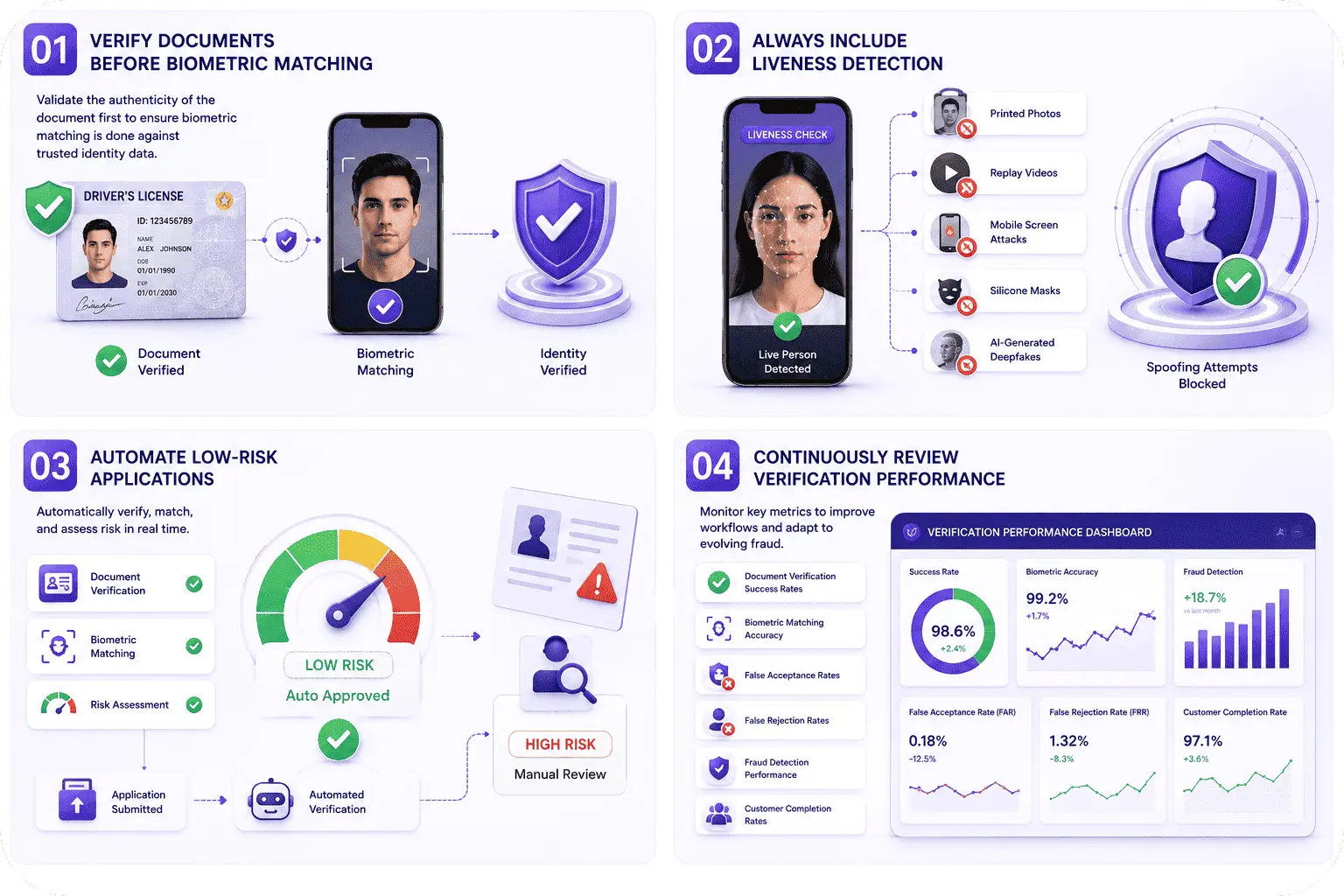
1. Verify Documents Before Performing Biometric Matching
Biometric verification should always begin with a trusted identity document.
Verifying the authenticity of a government-issued document before comparing biometric information ensures the system is matching against legitimate identity data rather than forged or manipulated documents.
This sequence creates a stronger foundation for identity verification while reducing fraud during onboarding.
2. Always Include Liveness Detection
Biometric verification alone cannot reliably detect every spoofing attempt.
Organizations should verify that a real person is physically present before completing face matching.
Advanced liveness detection helps identify:
- Printed photographs
- Replay videos
- Mobile screen attacks
- Silicone masks
- AI-generated deepfakes
Adding liveness verification significantly strengthens biometric security without creating unnecessary friction for genuine users.
3. Automate Low-Risk Applications
Manual identity verification increases operational costs and slows customer onboarding.
Modern verification platforms automatically validate identity documents, perform biometric matching, and assess fraud risk in real time.
Applications with low-risk profiles can be approved automatically, while higher-risk cases are escalated for manual review.
This approach improves operational efficiency while maintaining strong fraud controls.
4. Continuously Review Verification Performance
Identity verification should be continuously monitored and optimized.
Organizations should regularly evaluate:
- Document verification success rates
- Biometric matching accuracy
- False acceptance rates
- False rejection rates
- Fraud detection performance
- Customer completion rates
Monitoring these metrics helps improve verification workflows while adapting to evolving fraud techniques.
The Future of Identity Verification
Identity verification continues evolving alongside advances in artificial intelligence, biometrics, and digital identity technologies.
Rather than relying on isolated verification methods, organizations are moving toward intelligent identity ecosystems capable of continuously evaluating customer trust throughout the entire relationship.
Several trends are expected to shape the future of fraud prevention.
AI-Powered Verification
Artificial intelligence is transforming both document verification and biometric verification.
Machine learning models now analyse document authenticity, biometric confidence, behavioural signals, device intelligence, and fraud indicators simultaneously.
This enables organizations to identify suspicious activity more accurately while reducing unnecessary manual reviews.
Continuous Identity Verification
Traditional onboarding verifies identity only once.
Future verification systems will continuously evaluate customer identity throughout the account lifecycle.
Additional verification may be triggered when:
- High-value transactions occur
- Login behaviour changes
- Sensitive account information is updated
- New devices are detected
- Suspicious activity is identified
Continuous verification helps organizations detect fraud much earlier while improving overall account security.
Passwordless Authentication
As organizations reduce their reliance on passwords, biometric verification is becoming a key component of passwordless authentication.
Facial recognition combined with trusted devices and intelligent risk analysis enables customers to access services securely without remembering complex passwords.
This approach improves both security and user experience across digital platforms.
Choosing the Right Identity Verification Solution
Selecting an identity verification platform involves much more than comparing individual features.
Organizations should evaluate whether the solution provides comprehensive identity assurance while remaining flexible enough to adapt to changing fraud techniques and regulatory requirements.
Key evaluation criteria include:
- Identity document coverage
- Document verification accuracy
- Biometric matching performance
- Face liveness detection
- AI-powered fraud detection
- Integration flexibility
- Scalability
- Compliance support
- Developer documentation
Platforms that combine document verification, biometric authentication, liveness detection, fraud detection, and identity verification within a single ecosystem often simplify implementation while delivering stronger fraud prevention.
Development teams interested in implementation resources can also explore the official Recognito GitHub repository for SDK documentation, sample integrations, and developer guides.
Conclusion
Document verification and biometric verification are not competing technologies. They address different aspects of identity verification and are most effective when used together. Document verification confirms that a government-issued identity document is authentic, while biometric verification confirms that the individual presenting the document is its legitimate owner.
By combining these technologies with liveness detection, AI-powered fraud analysis, and continuous monitoring, organizations can significantly reduce identity fraud while improving customer onboarding and regulatory compliance.
As fraud techniques continue evolving, businesses that adopt a layered identity verification strategy will be better positioned to protect customers, strengthen trust, and deliver secure digital experiences across every stage of the customer journey.
Frequently Asked Questions
What is the difference between document verification and biometric verification?
Document verification confirms that an identity document is genuine by analysing its security features and authenticity. Biometric verification confirms that the person presenting the document is its legitimate owner by comparing unique biological characteristics such as facial features.
Which is better for fraud prevention: document verification or biometric verification?
Neither technology is sufficient on its own. Document verification detects forged or altered identity documents, while biometric verification prevents impersonation. Combining both provides much stronger protection against identity fraud.
Why should businesses combine document verification with biometric verification?
Using both technologies creates a layered identity verification process that validates the authenticity of the identity document and confirms the customer’s identity, significantly improving fraud prevention and compliance.
Can biometric verification prevent document fraud?
No. Biometric verification confirms identity ownership but does not determine whether an identity document is genuine. Document verification is required to identify forged, altered, or counterfeit documents.
How does liveness detection improve biometric verification?
Liveness detection confirms that a real person is physically present during verification, helping prevent spoofing attacks involving printed photographs, replay videos, masks, and AI-generated deepfakes.
Which industries benefit most from combining document and biometric verification?
Financial services, fintech, cryptocurrency exchanges, healthcare providers, insurance companies, government agencies, telecommunications providers, and online marketplaces all benefit from combining document verification and biometric verification to strengthen fraud prevention, customer onboarding, and regulatory compliance.
