
Face recognition has become one of the most widely adopted biometric technologies for digital identity verification, customer authentication, and fraud prevention. Banks, fintech companies, healthcare providers, government agencies, telecommunications operators, travel companies, and online marketplaces increasingly rely on facial recognition to verify customer identities while delivering fast and secure digital experiences.
As adoption continues to grow, businesses often ask a critical question:
How accurate is face recognition?
The answer depends on far more than the recognition algorithm itself.
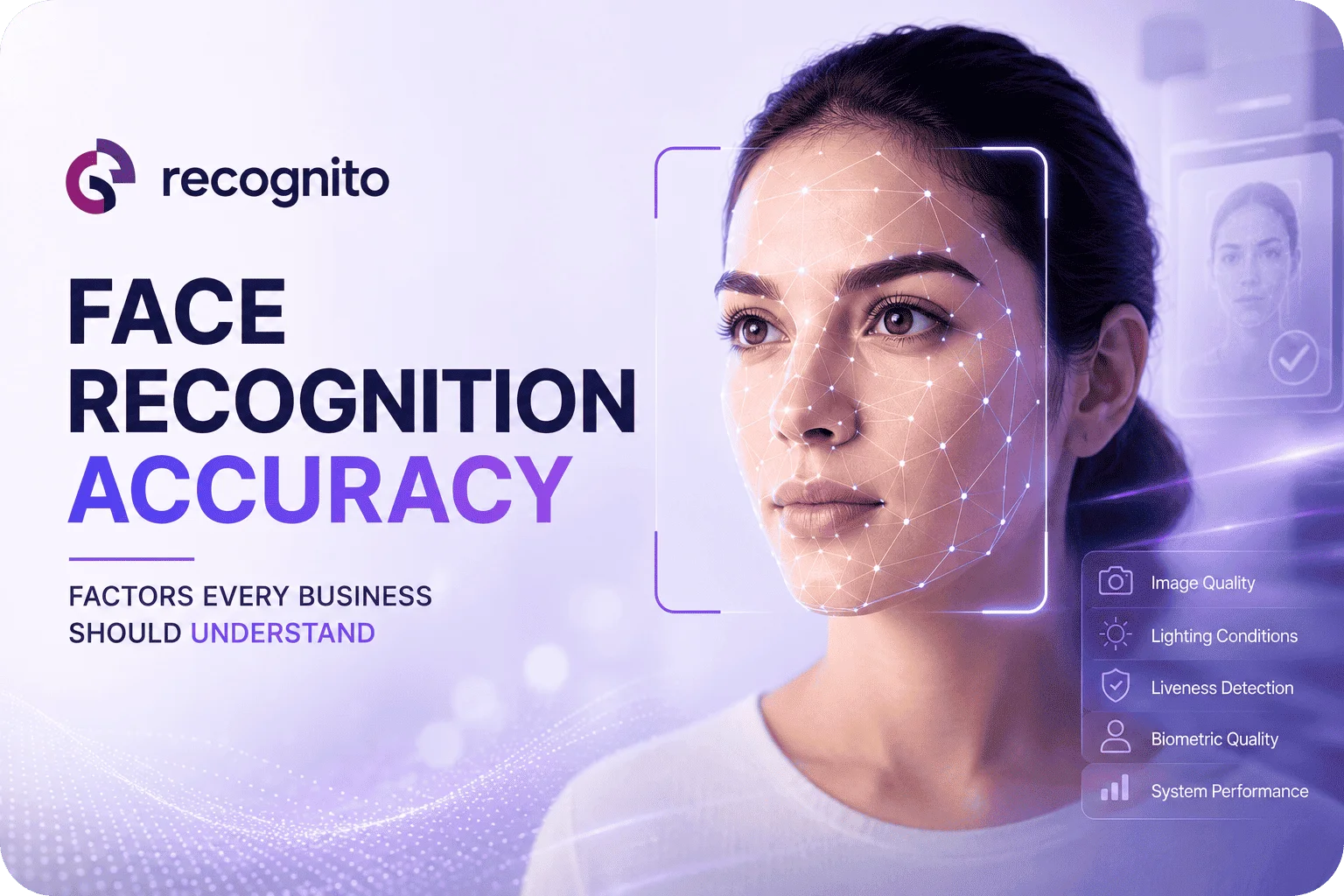
Modern facial recognition systems operate in a wide range of real-world environments where lighting, camera quality, facial expressions, aging, presentation attacks, image quality, and biometric enrollment all influence performance. Selecting the right technology requires understanding the factors that affect face recognition accuracy and how they impact authentication reliability.
Organizations evaluating biometric solutions should look beyond marketing claims and assess how recognition systems perform under realistic operating conditions, supported by independent testing and robust anti-spoofing capabilities.
This guide explains the key factors that influence facial recognition accuracy, how businesses should evaluate biometric performance, and the best practices for deploying reliable face recognition systems.
What Is Face Recognition Accuracy?
Face recognition accuracy refers to how effectively a biometric system identifies or verifies an individual by comparing facial characteristics.
A highly accurate system consistently recognizes legitimate users while preventing unauthorized individuals from being incorrectly accepted.
When evaluating biometric accuracy, organizations generally consider two outcomes:
- Correctly verifying genuine users.
- Correctly rejecting unauthorized users.
The objective is to minimize both false acceptances and false rejections while maintaining a seamless customer experience.
Modern organizations improve verification reliability by combining facial recognition with the face liveness detection SDK, ensuring that authentication confirms both facial similarity and the presence of a genuine live person.
Businesses interested in understanding how liveness detection strengthens biometric security can also read our guide on presentation attack detection and its role in biometric security.
Why Face Recognition Accuracy Matters
For many organizations, facial recognition has become the foundation of digital identity verification.
Poor recognition accuracy can lead to security vulnerabilities, operational inefficiencies, and frustrated customers.
If a system incorrectly approves fraudulent users, organizations may experience:
- Account takeover fraud
- Identity theft
- Financial losses
- Regulatory violations
- Reputational damage
Conversely, if legitimate customers are repeatedly rejected, organizations may encounter:
- Increased onboarding abandonment
- Higher customer support costs
- Reduced customer satisfaction
- Lower conversion rates
Finding the right balance between security and usability is essential for every biometric deployment.
Organizations implementing digital onboarding often combine facial recognition with an identity verification API to automate customer verification while maintaining high levels of biometric accuracy across web and mobile applications.
Key Factors That Affect Face Recognition Accuracy
Although modern algorithms have achieved remarkable performance improvements, several real-world factors continue influencing recognition accuracy.
Understanding these variables helps organizations select technologies that perform reliably under different operating conditions.
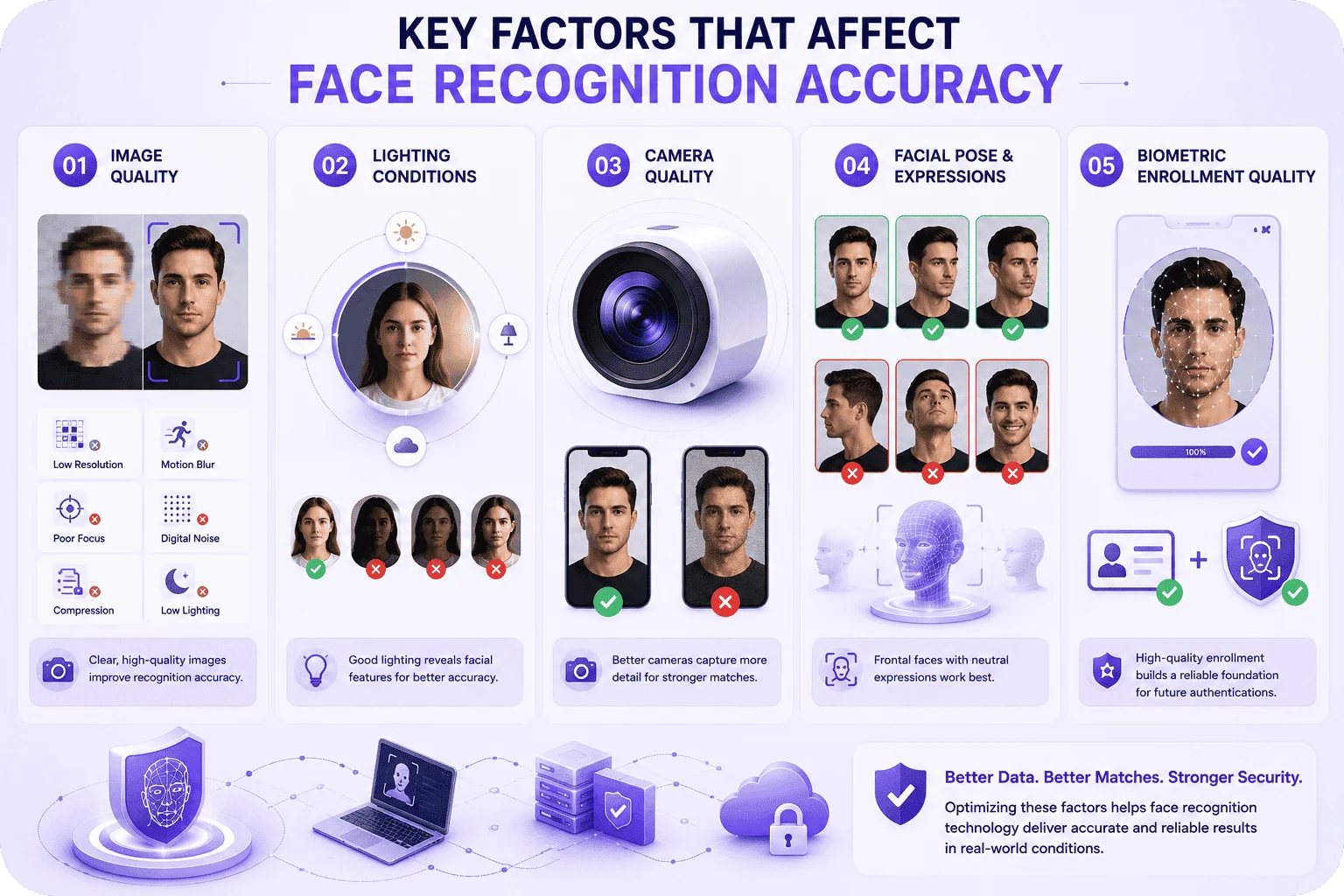
1. Image Quality
Image quality remains one of the most important factors affecting facial recognition performance.
Poor-quality images often reduce the system’s ability to extract reliable biometric features.
Common issues include:
- Low resolution
- Motion blur
- Poor focus
- Digital noise
- Image compression
- Low lighting
Organizations should encourage customers to capture clear, well-lit facial images during onboarding to improve verification outcomes.
2. Lighting Conditions
Lighting significantly influences facial recognition accuracy.
Strong shadows, backlighting, excessive brightness, or uneven illumination can obscure important facial features and reduce matching performance.
Modern facial recognition systems are increasingly designed to operate across varying lighting environments, but consistent image quality remains essential for achieving optimal results.
3. Camera Quality
The quality of the camera used during enrollment and authentication also affects recognition performance.
Higher-resolution cameras generally capture more detailed biometric information, allowing algorithms to generate stronger facial templates.
However, software optimization is equally important, particularly for mobile devices where camera capabilities vary significantly.
Organizations deploying digital onboarding across smartphones should ensure their biometric solution performs consistently across different hardware configurations.
4. Facial Pose and Expressions
Face recognition systems perform best when the subject is looking directly toward the camera with minimal obstruction.
Large head rotations, partially visible faces, or exaggerated facial expressions may reduce matching accuracy.
Modern AI-powered recognition algorithms have become increasingly robust against moderate pose variations, but frontal facial images still provide the most reliable verification results.
5. Biometric Enrollment Quality
Recognition accuracy begins with high-quality enrollment.
If poor biometric samples are captured during account creation, future authentication attempts become significantly less reliable.
Organizations should establish trusted identities by combining biometric enrollment with document verification.
Many businesses automate this process using the id document recognition SDK to verify government-issued identity documents before creating biometric templates.
Businesses looking to strengthen customer onboarding can also explore our guide on remote customer onboarding best practices, which explains how layered verification improves both security and user experience.
The Role of NIST Face Recognition Testing
When evaluating facial recognition technologies, organizations should look beyond vendor claims and consider independent performance evaluations.
One of the most respected benchmarking programs is the NIST Face Recognition Vendor Test (FRVT).
The National Institute of Standards and Technology (NIST) evaluates facial recognition algorithms under a wide range of real-world conditions, allowing organizations to compare biometric performance using standardized testing methodologies.
Rather than focusing solely on overall accuracy scores, businesses should review how algorithms perform across different operating environments, demographic groups, image qualities, and verification scenarios.
Independent benchmarking provides valuable insight into how facial recognition solutions are likely to perform in production environments.
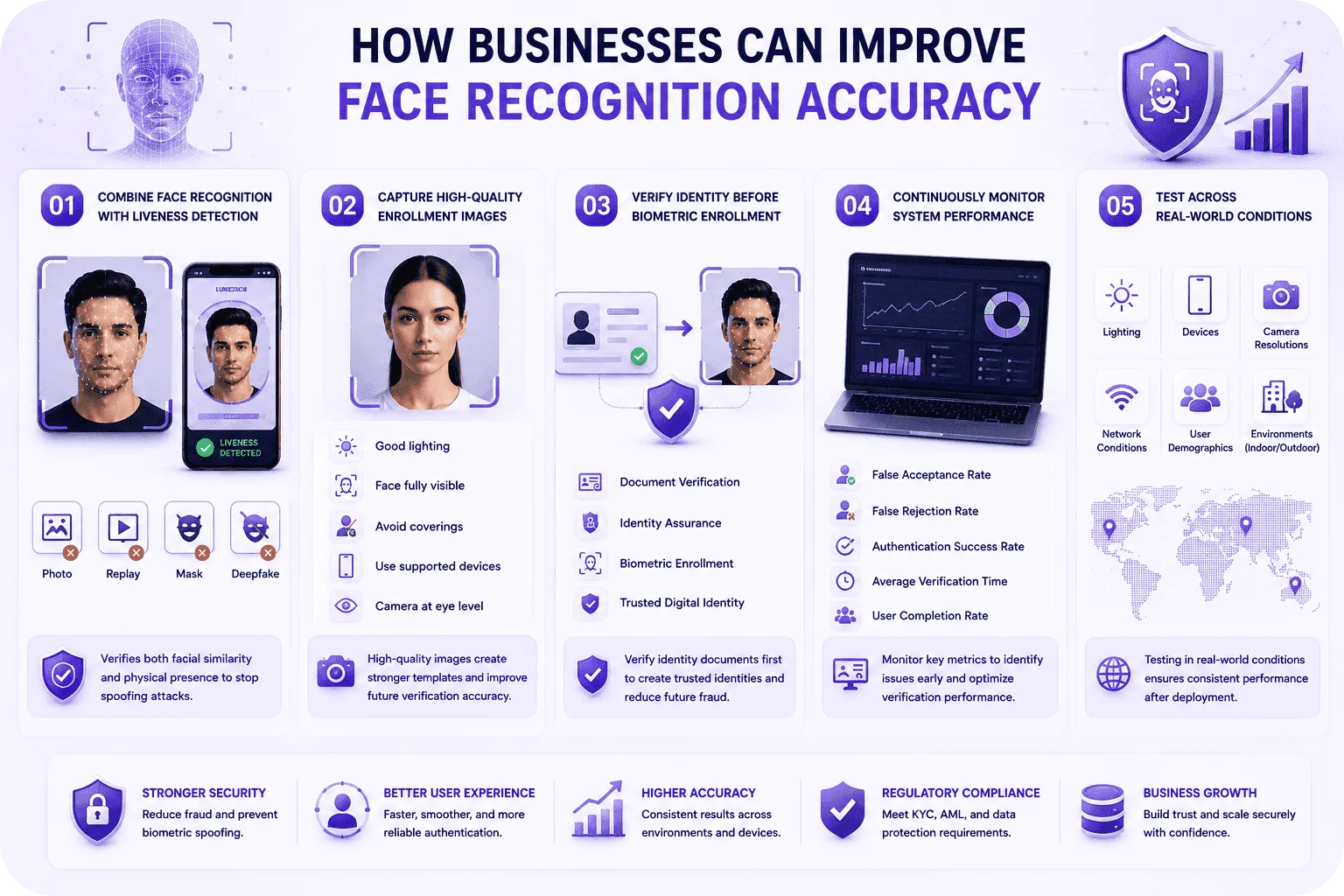
How Businesses Can Improve Face Recognition Accuracy
Although modern facial recognition systems are highly advanced, achieving consistently accurate results depends on how they are implemented. Organizations that follow proven deployment practices can significantly improve biometric performance while reducing both fraud and customer friction.
Below are some of the most effective ways to improve face recognition accuracy.
1. Combine Face Recognition With Liveness Detection
Facial matching alone cannot determine whether the biometric sample comes from a real person.
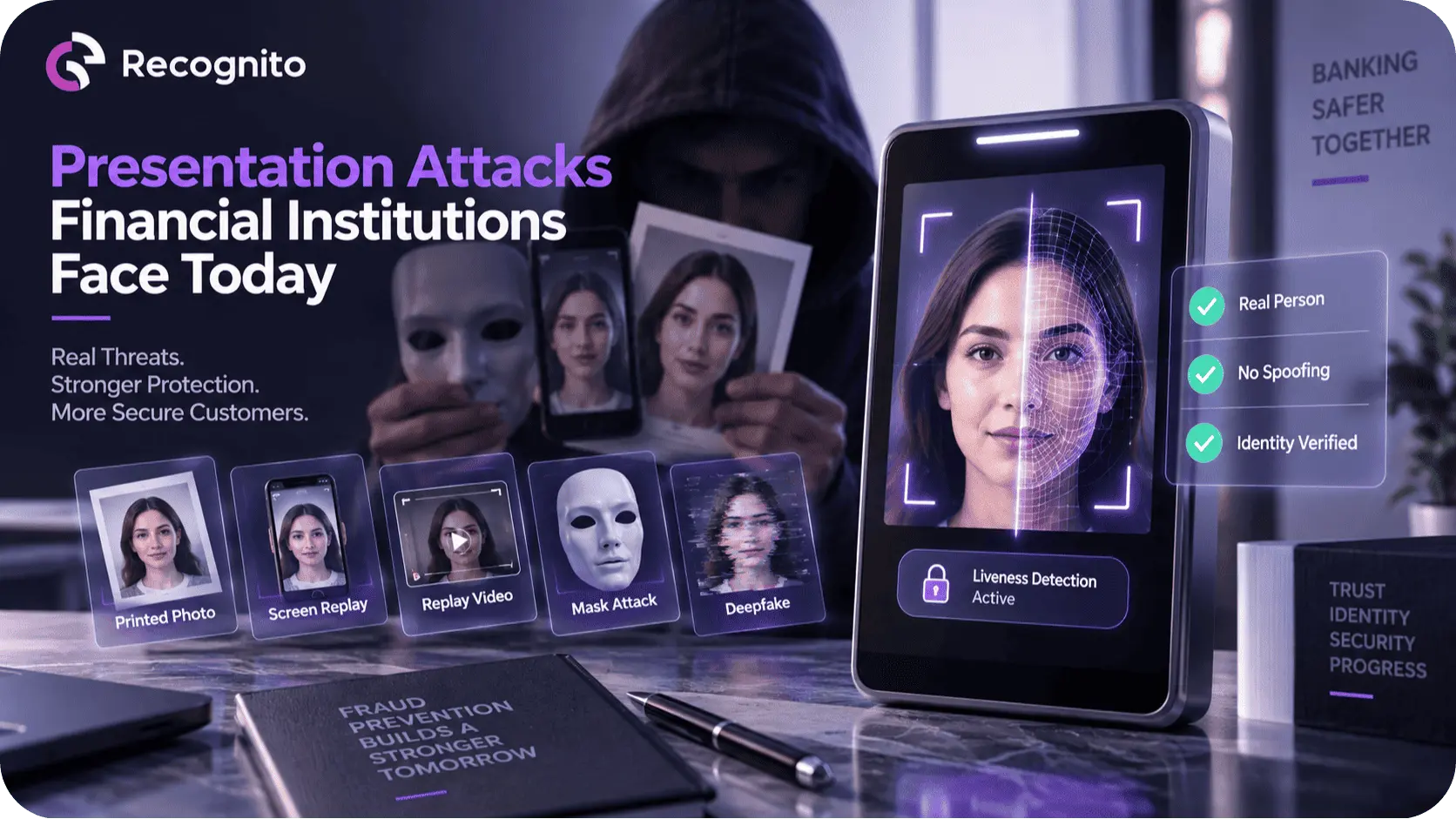
Fraudsters increasingly use printed photographs, replay videos, silicone masks, and AI-generated deepfakes to deceive authentication systems.
By combining face recognition with liveness detection, organizations can verify both facial similarity and physical presence before approving authentication.
This additional verification layer significantly reduces the risk of biometric spoofing while maintaining a smooth user experience.
Organizations interested in learning more about anti-spoofing technologies can also explore our guide on deepfake fraud trends financial institutions should watch, which explains how AI-generated attacks are changing the fraud landscape.
2. Capture High-Quality Enrollment Images
Recognition accuracy begins during customer enrollment.
If the original biometric template is created from a poor-quality image, future authentication attempts become less reliable regardless of how advanced the recognition algorithm may be.
Organizations should encourage users to:
- Capture images in good lighting.
- Keep their face fully visible.
- Avoid excessive facial coverings.
- Use supported camera devices.
- Position the camera directly in front of the face.
A high-quality enrollment image creates a stronger biometric template that improves future verification performance.
3. Verify Identity Before Biometric Enrollment
Facial recognition confirms that two biometric samples belong to the same individual, but it does not establish whether that individual is using a genuine identity.
Organizations should verify identity documents before enrolling biometric data to create trusted digital identities from the start.
Businesses implementing secure onboarding often combine document verification with biometric enrollment to improve identity assurance and reduce future fraud risks.
Understanding this distinction is essential for secure onboarding. Our guide on AML verification and identity verification in customer onboarding explains how identity verification and compliance controls work together before biometric authentication begins.
4. Continuously Monitor System Performance
Biometric systems should not be treated as static technologies.
Organizations should continuously evaluate authentication performance by monitoring key indicators such as:
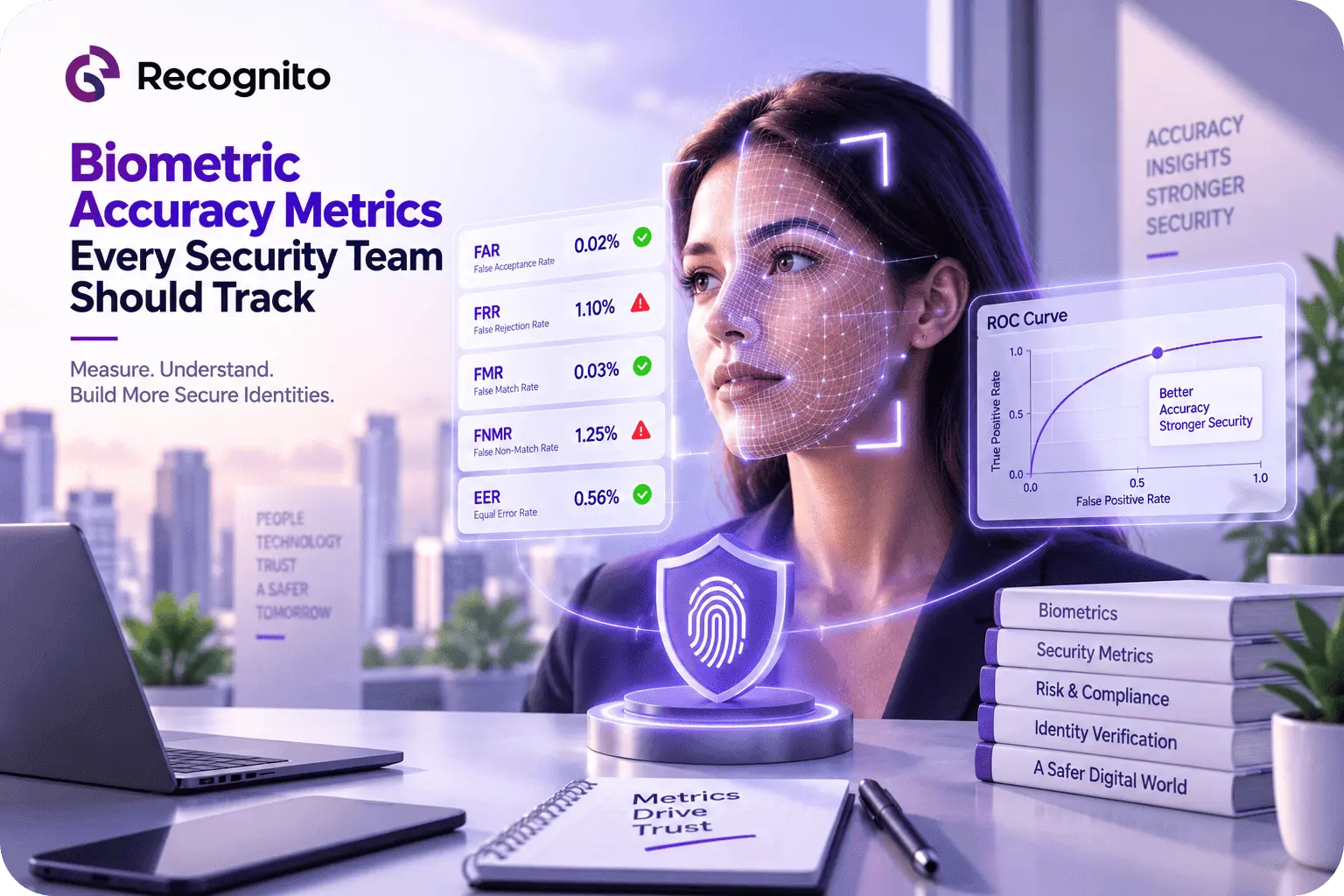
- False acceptance rates
- False rejection rates
- Authentication success rates
- Average verification time
- User completion rates
Regular monitoring allows organizations to identify performance issues early and optimize verification workflows as customer behaviour and fraud techniques evolve.
5. Test Across Real-World Conditions
Laboratory testing provides useful benchmarks, but real-world environments introduce additional variables.
Organizations should evaluate biometric performance across different:
- Lighting conditions
- Mobile devices
- Camera resolutions
- Network environments
- User demographics
- Indoor and outdoor settings
Testing across realistic operating conditions helps ensure consistent authentication performance after deployment.
Common Challenges Affecting Biometric Accuracy
Even advanced facial recognition systems encounter practical challenges that organizations should understand before deployment.
Aging and Appearance Changes
People naturally change over time.
Factors such as aging, facial hair, hairstyles, makeup, glasses, medical conditions, and cosmetic procedures may slightly affect facial appearance.
Modern AI-powered recognition algorithms are increasingly capable of handling these variations, but organizations should periodically refresh biometric templates where appropriate.
Presentation Attacks
Presentation attacks remain one of the biggest threats to biometric systems.
Rather than attempting to defeat facial matching algorithms directly, attackers try to present fake biometric samples during authentication.
Examples include:
- Printed photographs
- Mobile device displays
- Video replay attacks
- Silicone masks
- AI-generated facial imagery
Organizations should deploy presentation attack detection and liveness verification alongside facial recognition to improve overall biometric security.
Environmental Conditions
Environmental factors often influence authentication quality.
Examples include:
- Poor lighting
- Strong backlighting
- Camera movement
- Network latency
- Low-quality webcams
- Mobile camera limitations
Organizations should design onboarding experiences that help users capture high-quality biometric samples regardless of device type.
Face Recognition Accuracy Across Industries
Face recognition is now widely used across industries where accurate identity verification is essential.
Financial Services
Banks and fintech companies use facial recognition to support:
- Digital onboarding
- Customer authentication
- Account recovery
- Fraud prevention
- Regulatory compliance
Healthcare
Healthcare providers use biometric verification to confirm patient identities before granting access to sensitive medical records and digital healthcare platforms.
Government Services
Government agencies use facial recognition for:
- Digital identity programs
- Border control
- Citizen services
- Passport verification
Cryptocurrency Platforms
Crypto exchanges rely on facial recognition to strengthen customer onboarding, support KYC compliance, reduce account fraud, and improve platform security.
Organizations building secure digital asset platforms can also read our guide on identity verification for cryptocurrency platforms and exchanges, which explains how biometric verification supports regulatory compliance while reducing financial crime.
Best Practices for Maximizing Face Recognition Accuracy
Achieving high face recognition accuracy requires more than selecting a high-performing algorithm. Organizations should design biometric systems that combine accurate recognition with strong fraud prevention, regulatory compliance, and a seamless user experience.
The following best practices can help businesses improve both biometric performance and long-term reliability.
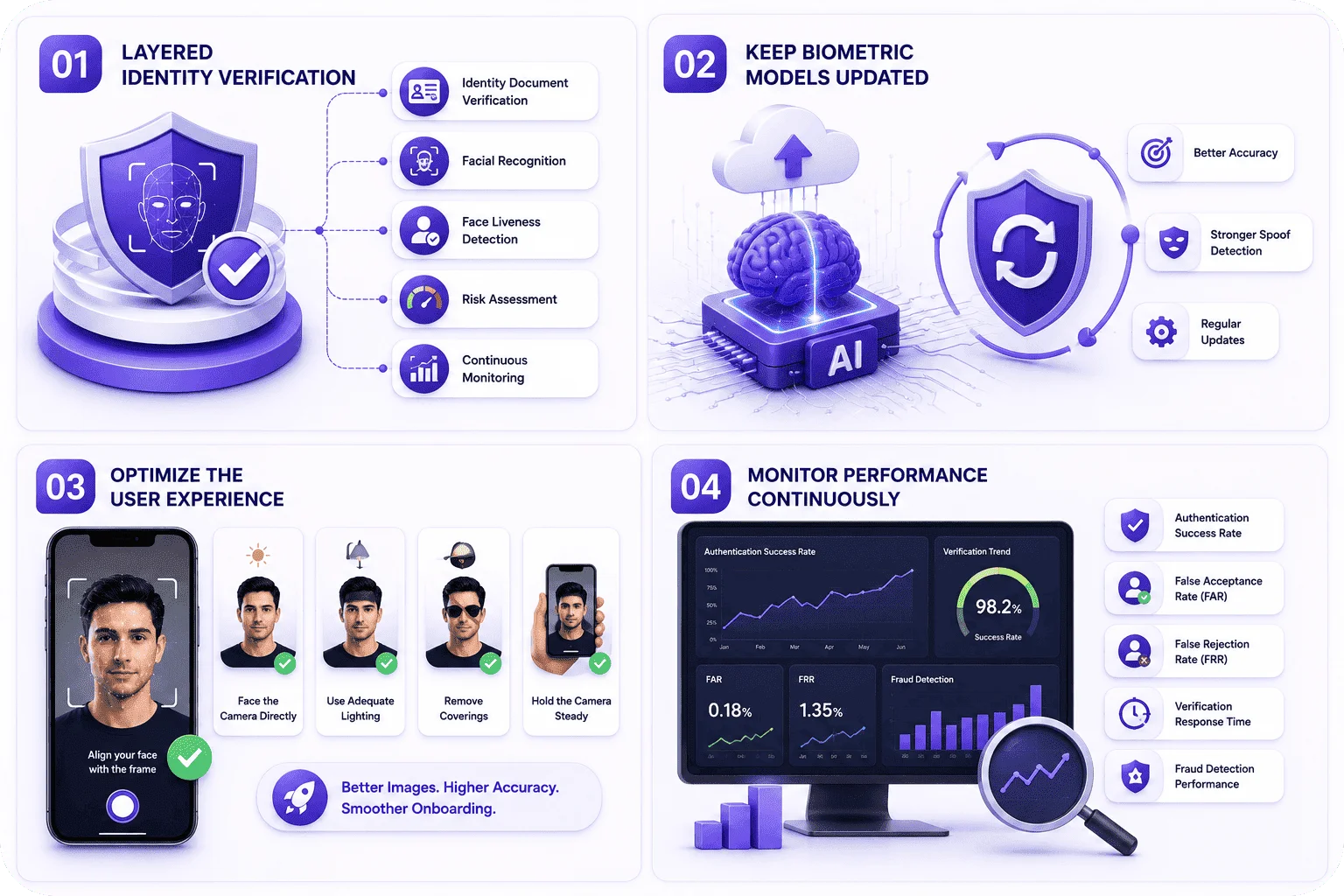
1. Use Layered Identity Verification
Face recognition should be one component of a broader identity verification strategy rather than the only authentication mechanism.
A secure verification workflow combines multiple technologies that validate both the customer’s identity and their physical presence.
An effective framework typically includes:
- Identity document verification
- Facial recognition
- Face liveness detection
- Risk assessment
- Continuous monitoring
Layered verification improves security while reducing both false acceptances and false rejections.
2. Keep Biometric Models Updated
Facial recognition technology continues to evolve rapidly.
Modern AI models regularly improve recognition performance across different age groups, lighting conditions, camera types, and demographic populations.
Organizations should ensure their biometric systems receive regular software updates to benefit from improved algorithms, stronger spoof detection, and ongoing security enhancements.
3. Optimize the User Experience
Even highly accurate biometric systems can perform poorly if users struggle during enrollment or authentication.
Organizations should provide clear guidance that helps users capture high-quality facial images.
Simple recommendations include:
- Face the camera directly.
- Use adequate lighting.
- Remove objects covering the face.
- Hold the camera steady.
- Avoid excessive motion during capture.
Reducing user error improves biometric quality while creating a smoother onboarding experience.
4. Monitor Performance Continuously
Biometric accuracy should be measured continuously rather than only during deployment.
Organizations should regularly review:
- Authentication success rates
- False acceptance rates
- False rejection rates
- User completion rates
- Verification response times
- Fraud detection performance
Monitoring these metrics helps identify opportunities to improve both security and customer experience over time.
The Future of Face Recognition Accuracy
Facial recognition continues improving as artificial intelligence becomes more sophisticated.
Future systems will focus not only on recognizing identities more accurately but also on adapting automatically to changing environments and emerging fraud techniques.
Several innovations are expected to shape the future of biometric accuracy.
AI-Enhanced Recognition
Artificial intelligence is enabling recognition systems to analyse facial characteristics with greater precision than ever before.
Future algorithms will become increasingly resilient to variations in lighting, facial pose, aging, camera quality, and environmental conditions while maintaining high verification accuracy.
Smarter Anti-Spoofing
Presentation attacks continue evolving through AI-generated deepfakes and increasingly realistic synthetic media.
Next-generation face recognition systems will rely on advanced anti-spoofing models that evaluate behavioural, environmental, and biometric signals simultaneously.
This will allow organizations to identify sophisticated spoofing attempts with greater confidence while reducing unnecessary friction for legitimate users.
Continuous Biometric Authentication
Authentication is gradually shifting from a single verification event to continuous identity assurance.
Instead of verifying users only during login, future biometric systems will monitor identity throughout active sessions using facial recognition, behavioural analytics, device intelligence, and contextual risk signals.
This approach enables organizations to detect suspicious behaviour much earlier while improving overall account security.
Choosing the Right Face Recognition Solution
Selecting a facial recognition platform involves much more than comparing overall accuracy percentages.
Organizations should evaluate whether the solution performs consistently across real-world operating conditions while supporting future business growth.
Important evaluation criteria include:
- Independent benchmark performance
- Recognition accuracy across diverse populations
- Liveness detection capabilities
- Presentation attack detection
- Integration flexibility
- Cross-platform compatibility
- Scalability
- Compliance support
- Developer documentation
Solutions that combine facial recognition, document verification, liveness detection, and identity verification within a unified platform often reduce implementation complexity while delivering stronger biometric security.
Development teams interested in implementation resources can also explore the official Recognito GitHub repository for SDK documentation, sample integrations, and developer guides.
Conclusion
Face recognition has become one of the most reliable biometric technologies for digital identity verification, customer authentication, and fraud prevention. However, achieving high face recognition accuracy depends on much more than the algorithm itself. Image quality, lighting conditions, biometric enrollment, camera performance, presentation attack detection, and system design all play an important role in real-world results.
Organizations should evaluate facial recognition solutions using independent benchmarks such as the NIST Face Recognition Vendor Test while implementing layered verification strategies that combine facial recognition with document verification, liveness detection, and continuous monitoring.
Businesses that invest in accurate, secure, and scalable biometric technologies will be better positioned to reduce fraud, improve customer trust, streamline digital onboarding, and deliver secure authentication experiences as digital identity continues to evolve.
Frequently Asked Questions
What is face recognition accuracy?
Face recognition accuracy measures how effectively a facial recognition system correctly verifies or identifies individuals while minimizing false acceptances and false rejections.
What factors affect facial recognition accuracy?
Several factors influence facial recognition accuracy, including image quality, lighting conditions, camera resolution, facial pose, biometric enrollment quality, environmental conditions, and presentation attack detection capabilities.
Why is NIST face recognition testing important?
The NIST Face Recognition Vendor Test (FRVT) provides independent evaluations of facial recognition algorithms, helping organizations compare performance under standardized testing conditions and make informed technology decisions.
How can businesses improve face recognition accuracy?
Businesses can improve accuracy by capturing high-quality enrollment images, verifying identities before biometric enrollment, implementing liveness detection, monitoring system performance, and deploying facial recognition across realistic operating environments.
Does face recognition work in poor lighting?
Modern facial recognition systems perform well across many lighting conditions, but poor lighting can still reduce image quality and biometric accuracy. Proper illumination helps produce more reliable verification results.
Can face recognition prevent identity fraud?
Face recognition significantly improves identity verification when combined with document verification, liveness detection, presentation attack detection, and continuous risk assessment. Together, these technologies help reduce impersonation, account takeover, and other forms of identity fraud.