
Identity verification is one of the foundations of a strong compliance program. Banks, fintech companies, insurers, marketplaces, cryptocurrency platforms, and other digital businesses need reliable ways to establish who their customers are and determine whether the identity evidence they provide can be trusted.
The challenge is that compliance failures do not always come from deliberately ignoring regulations. They can result from seemingly reasonable verification practices that are incomplete, poorly implemented, or no longer appropriate for the organization’s risk environment.
A business may verify an identity document but fail to establish that the applicant is its rightful holder. Another may collect large amounts of personal data without clearly defining why it is needed. A third may deploy a remote verification tool without adequately testing whether it remains reliable under real-world conditions.
The European Banking Authority’s guidance on remote customer onboarding emphasizes that financial institutions need risk-sensitive customer due diligence processes and should assess whether their chosen onboarding solutions are adequate and reliable. (European Banking Authority)
Avoiding these problems requires more than buying identity verification software. Organizations need a verification process that is accurate, proportionate, secure, auditable, and aligned with applicable requirements.
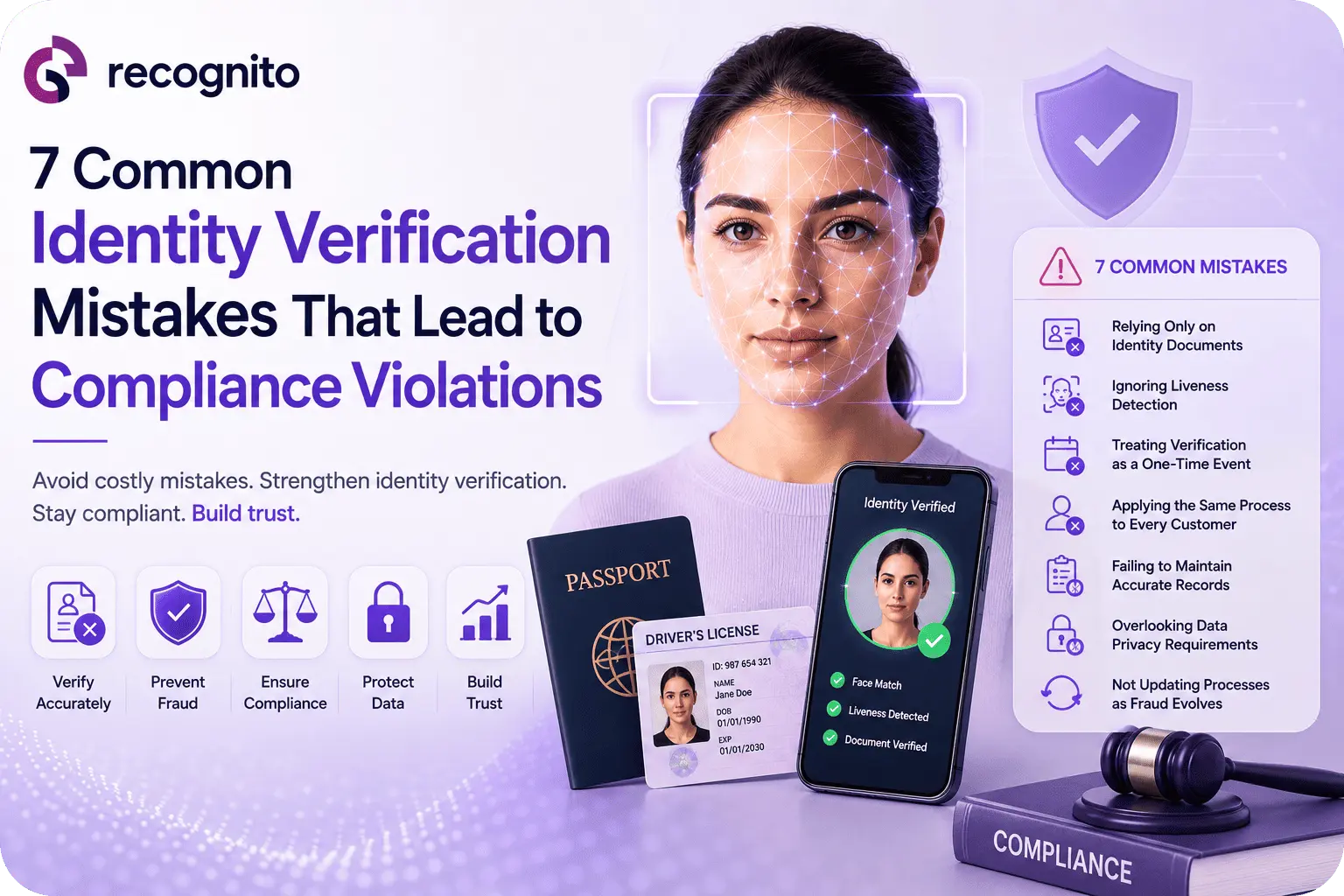
Here are seven common mistakes that can create compliance risk.
1. Treating Identity Document Checks as Complete Verification
One of the most common mistakes is assuming that checking an identity document automatically verifies the person.
Document verification and identity verification are related, but they answer different questions.
A document check may determine whether a passport, identity card, or driver’s license appears genuine and whether its information is internally consistent.
It does not necessarily prove that the person presenting it is the legitimate document holder.
Consider a stolen genuine passport.
The document can be authentic.
The information can be correct.
The passport can pass document checks.
Yet the person using it may still be an impersonator.
That is why higher-assurance workflows often combine document verification with a person-to-identity check, such as facial verification.
Businesses should define what each verification step establishes and avoid treating one successful check as proof of everything.
Recognito’s guide on document verification versus biometric verification explains why these technologies provide complementary forms of identity evidence.
2. Failing to Match the Person With the Identity Evidence
The opposite mistake is focusing on the document while underestimating the importance of the person behind it.
Remote onboarding removes much of the context available during face-to-face verification. The organization must establish a relationship between the applicant and the identity evidence digitally.
A biometric comparison can help address this.
For example:
Validated identity document → document photograph → live facial capture → biometric comparison
The purpose is not to replace document verification.
It is to answer another question:
Does the person completing the verification correspond with the identity represented by the document?
This becomes especially important for financial onboarding, regulated services, account recovery, and other high-impact identity events.
NIST’s current Digital Identity Guidelines separate identity-evidence validation from identity verification and describe identity proofing as a process for establishing confidence in an applicant’s claimed identity. (NIST Pages)
Organizations should therefore design the workflow around the full identity relationship rather than treating documents as the endpoint.
3. Ignoring Presentation Attacks and Liveness
A biometric match can create another false sense of confidence.
Suppose a customer provides a face that closely resembles the trusted reference. A matching system may return a strong result.
But was the presentation genuine?
An attacker may attempt to use:
- A photograph
- A screen image
- Replayed video
- A physical replica
- Synthetic facial media
This is where presentation attack detection and liveness become relevant.
ISO/IEC 30107-3:2023 establishes principles and methods for evaluating presentation attack detection mechanisms and reporting their results. It also makes clear that PAD testing does not represent a complete assessment of overall system security. (ISO)
For organizations using remote facial biometrics, the important lesson is that matching and presentation authenticity are separate security questions.
A face liveness SDK can be incorporated into an application when liveness protection is appropriate to its threat model.
However, businesses should evaluate which attacks the solution addresses, how it was tested, and how the liveness layer integrates with the rest of the verification workflow.
4. Choosing Verification Technology Without Testing Its Reliability
Another compliance risk comes from treating a vendor’s technology as a black box.
A solution may work well in a product demonstration but perform differently across real devices, users, lighting conditions, or document types.
This matters because a poorly performing verification system can produce two kinds of problems.
False acceptance can allow an identity risk to pass.
False rejection can prevent legitimate customers from completing onboarding.
Neither should be ignored.
The EBA’s remote onboarding guidance specifically expects financial institutions to assess the adequacy and reliability of the tools they choose and to ensure those tools remain adequate and reliable over time. (European Banking Authority)
Organizations should therefore test:
Accuracy
Measure relevant false-match and false-rejection behavior.
Device Performance
Test the smartphones, browsers, cameras, and operating systems customers actually use.
Document Coverage
Test the document types and conditions expected in production.
Difficult Conditions
Evaluate low light, glare, blur, movement, and other realistic situations.
Ongoing Performance
Continue monitoring after deployment rather than assuming the initial evaluation remains representative.
Compliance is not strengthened simply because a business selected a recognized vendor. The organization still needs evidence that the implementation works appropriately for its own use case.
5. Collecting Too Much Personal and Biometric Data
More data does not automatically mean better verification.
Organizations sometimes retain every document image, facial capture, video frame, biometric template, and verification record indefinitely because the information might be useful later.
That approach can create unnecessary privacy and security exposure.
The GDPR’s principles include purpose limitation and data minimization, requiring personal data to be collected for specified purposes and limited to what is necessary for those purposes. Its framework also provides specific protections for biometric data used to uniquely identify individuals. EU General Data Protection Regulation
A better approach is to define the information lifecycle before deployment.
Ask:
- What data is actually necessary?
- Why is it being collected?
- Does the business need the raw image after verification?
- Are biometric templates required?
- How long should information be retained?
- Who needs access?
- When should information be deleted?
These questions should be answered consistently rather than on a case-by-case basis.
Privacy controls also need to match the actual verification architecture.
A system that performs verification without retaining raw biometric media may have different data-governance considerations from one that stores facial video indefinitely.
6. Using the Same Verification Process for Every Customer
Compliance programs can fail when organizations treat every customer and every identity event as identical.
Risk varies.
A routine low-risk customer interaction may not require the same controls as a new financial account, high-value transaction, or suspicious account-recovery event.
Risk-based verification allows the organization to adjust the level of scrutiny to the situation.
For example:
Normal risk → standard verification
Elevated risk → stronger biometric or identity checks
High risk → additional evidence, liveness, enhanced review, or restrictions
The FATF’s guidance on digital identity recognizes the value of reliable digital identity technology within a risk-based customer-identification and due-diligence framework. (Federal Trade Commission)
The mistake is not simply using too little verification.
Using unnecessarily intensive verification everywhere can also create operational problems, customer friction, and poor exception handling.
The goal is proportionate identity assurance.
7. Failing to Detect and Act on Verification Red Flags
Verification does not end when an automated check returns a result.
Organizations also need procedures for what happens when something does not make sense.
Potential red flags can include:
- Altered or suspicious identity documents
- Conflicting customer information
- Repeated failed verification attempts
- Unexpected changes to account information
- Reuse of identity details across suspicious accounts
- Unusual account behavior
- Mismatches between identity evidence and customer information
The important issue is having a defined response.
The FTC’s guidance on the Red Flags Rule explains that organizations covered by the rule need programs designed to identify, detect, prevent, and mitigate warning signs of identity theft. It also stresses that programs should be kept current as threats change. (Federal Trade Commission)
This illustrates a broader compliance principle:
A red flag that nobody acts on is not an effective control.
Verification results need to feed into operational processes.
One Table: Identity Verification Mistakes and Better Practices
| Common Mistake | Compliance or Security Risk | Better Practice |
| Treating document checks as complete verification | Genuine document may belong to another person | Combine document and person-to-identity checks |
| Ignoring biometric presentation attacks | Photos, replay, or artificial presentations may bypass face checks | Evaluate liveness and PAD where appropriate |
| Trusting vendor claims without testing | Production performance may differ from demonstrations | Conduct realistic testing and ongoing monitoring |
| Retaining unnecessary biometric data | Increases privacy and security exposure | Apply purpose limitation and data minimization |
| Using one verification level for everyone | May under-check high-risk cases or overburden low-risk users | Use risk-based verification |
| Ignoring inconsistent identity signals | Suspicious activity can pass without escalation | Define red flags and response procedures |
| Failing to update verification controls | New fraud techniques can outpace the program | Review technology, threats, and policies regularly |
How Internal Verification Controls Should Work Together
The seven mistakes above often overlap.
For example, an organization might collect an identity document, perform facial matching, and store every biometric record permanently.
Technically, several controls are present.
Operationally, the process may still have weaknesses.
A stronger architecture connects each control to a defined purpose:
Identity evidence establishes the claimed identity.
Document verification evaluates the credential.
Facial verification connects the person with the identity.
Liveness helps protect the biometric presentation.
Risk intelligence identifies unusual behavior.
Human review handles ambiguous cases.
Governance determines how the information can be collected, used, stored, and deleted.
This structure makes it easier to demonstrate why each control exists and how it contributes to the organization’s overall risk-management approach.
Build Verification Around the Customer Journey
Another useful way to prevent compliance failures is to design verification around actual identity events.
A business might need different workflows for:
New Customer Onboarding
Establish identity before an account is created.
Existing Customer Authentication
Confirm the person before granting access.
Account Recovery
Increase assurance when normal credentials are unavailable.
High-Risk Transactions
Apply stronger verification before sensitive actions.
Profile Changes
Reverify identity before changing important customer information.
This prevents the common mistake of treating verification as a single event that happens only during signup.
Identity risk can change throughout the customer lifecycle.
Use Clear Escalation Paths
Automation should not be expected to resolve every case.
Verification systems will encounter ambiguous results.
A document may be legitimate but difficult to read.
A facial match may fall near a decision threshold.
A customer may repeatedly fail liveness because of poor capture conditions.
The organization needs a defined escalation process.
A practical model can be:
Clear result → automated decision
Uncertain result → additional verification
Suspicious result → investigation
High-risk case → enhanced review
This reduces pressure on automated systems to make binary decisions when the evidence is genuinely uncertain.
It also creates a clearer audit trail.
Keep Verification Controls Current
Identity fraud evolves.
A verification process that was effective when implemented may become weaker as attack methods, customer behavior, devices, and technologies change.
Regular reviews should consider:
- New fraud patterns
- Biometric attack techniques
- Document-fraud trends
- New device environments
- Verification performance
- False-rejection trends
- Privacy requirements
- Regulatory changes
The FTC’s Red Flags guidance emphasizes keeping identity-theft prevention programs current as threats evolve. (Federal Trade Commission)
The same principle applies more broadly to identity verification.
Compliance is not a one-time implementation exercise.
Where SDK-Based Verification Fits
Businesses building custom digital onboarding experiences may use SDKs to integrate identity technologies into their existing applications.
A facial biometric SDK can provide person-to-identity matching.
A liveness SDK can strengthen presentation protection.
Document recognition can support identity-evidence processing.
The advantage is greater control over the verification journey.
Developers can determine when checks occur, how results are handled, and when additional verification is triggered.
For technical teams, the Recognito GitHub repository can provide an additional development resource when evaluating integration approaches.
The technology should still be tested as part of the complete application rather than evaluated in isolation.
How to Avoid These Compliance Mistakes
A strong identity-verification program can be built around a straightforward checklist.
Define the identity assurance required for each use case.
Establish trustworthy identity evidence.
Validate documents where required.
Connect the person to the claimed identity.
Protect remote biometric capture against relevant attacks.
Test technology under realistic production conditions.
Apply proportionate verification based on risk.
Define responses to verification red flags.
Minimize unnecessary data collection and retention.
Review performance and threats regularly.
This approach makes compliance part of the verification architecture instead of something added after implementation.
How Recognito Can Support Better Identity Verification
Organizations building digital identity workflows can combine document, biometric, and liveness capabilities according to their requirements.
A biometric verification SDK can support person-to-identity matching, while an identity verification API can help connect verification capabilities with a wider customer-onboarding workflow.
The important objective is not to add as many verification technologies as possible.
It is to create a workflow where each layer addresses a defined risk and produces evidence that can be acted upon.
Conclusion
The most serious identity verification mistakes are often not caused by a complete absence of technology.
They happen when organizations use the right technologies in the wrong way.
A genuine identity document does not automatically prove that the applicant is its rightful owner.
A successful facial match does not automatically prove that the presentation was genuine.
A powerful verification vendor does not remove the need for production testing.
Collecting more biometric data does not automatically improve compliance.
And an automated red flag does not help if nobody knows what action should follow it.
A stronger approach combines trusted identity evidence, document verification, biometric matching, presentation-attack protection, risk-based decisioning, clear escalation, and responsible data governance.
NIST’s digital identity guidance, EBA’s remote-onboarding framework, FATF’s digital identity guidance, ISO’s PAD standard, and privacy requirements such as GDPR all point toward the same broader principle: organizations need verification processes that are appropriate to the risks they face and supported by reliable controls. (NIST Pages)
Businesses should therefore evaluate identity verification as an ongoing system rather than a single compliance checkbox.
When every verification step has a clear purpose, every exception has a response, and every identity decision is supported by appropriate evidence, organizations can reduce both fraud exposure and the likelihood of compliance failures.
Frequently Asked Questions
What is the biggest identity verification mistake businesses make?
One of the most important mistakes is treating a successful document check as complete identity verification. A genuine document can belong to another person, so organizations often need additional person-to-identity controls.
Can poor identity verification cause compliance problems?
Yes. Inadequate identity controls can contribute to failures in customer due diligence, fraud prevention, privacy governance, record management, and other applicable obligations. The specific requirements depend on the organization’s jurisdiction and regulated activities.
Is facial recognition enough for identity verification?
Not necessarily. Facial recognition can help establish person-to-identity correspondence, but it may need to be combined with trusted identity evidence, document verification, liveness, and other risk controls.
How often should identity verification controls be reviewed?
Organizations should review them regularly and whenever there are significant changes to regulations, technology, customer behavior, fraud patterns, or the verification environment.
How can businesses improve identity verification compliance?
Define clear identity-assurance requirements, use risk-based verification, test technologies under realistic conditions, protect biometric and personal data, establish escalation procedures, and continuously monitor whether verification controls remain effective.