
A face recognition vendor can claim extremely high accuracy and still leave a business with important questions: what was tested, at what error rate, on which images, and across which groups and conditions?
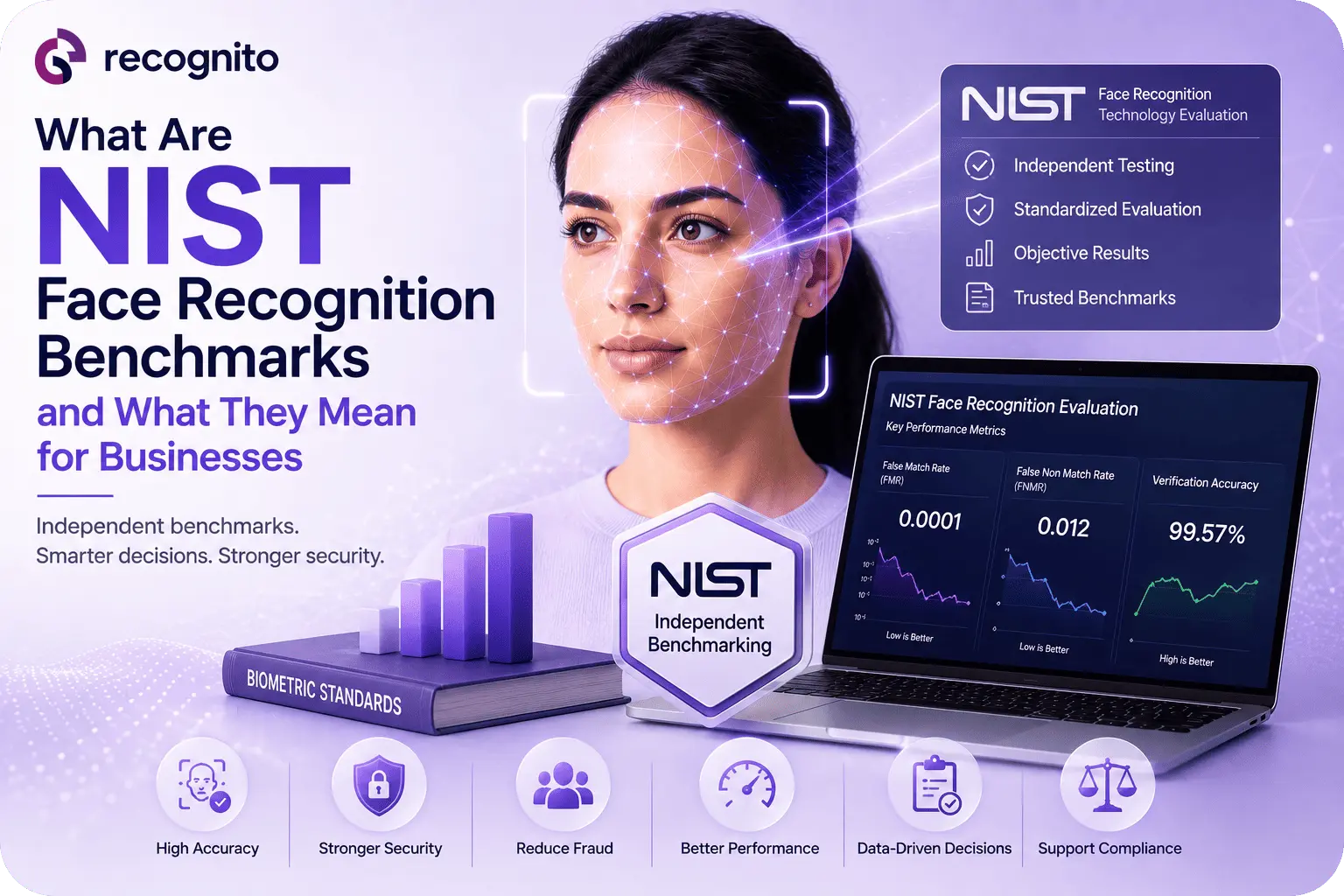
The National Institute of Standards and Technology (NIST) runs independent evaluations that give organizations a structured way to compare face recognition algorithms under defined conditions. The program formerly known as the Face Recognition Vendor Test, or FRVT, is now organized under the Face Recognition Technology Evaluation (FRTE) name, while face-analysis testing operates under FATE. NIST describes the program as an ongoing evaluation rather than a one-time ranking exercise.
For businesses, the value is understanding what the benchmark measures, what its error rates mean for risk, and how the results fit into a broader technology evaluation.
What NIST Face Recognition Benchmarks Actually Measure
NIST evaluates submitted face recognition algorithms using standardized datasets, tasks, thresholds, and performance metrics. That structure makes results more comparable than vendor claims that may use different definitions of “accuracy.”
The current FRTE program includes several evaluation tracks, but two are especially important for commercial identity applications:
1:1 verification compares two facial samples to determine whether they represent the same person.
1:N identification searches one facial sample against a gallery to determine whether a corresponding identity can be found.
Those are fundamentally different problems. A digital onboarding system may use 1:1 matching between a customer’s selfie and a document portrait. An identity search system may use 1:N matching across thousands or millions of enrolled identities.
NIST’s current Face Technology Evaluations overview explains the distinction between FRTE recognition evaluations and FATE face-analysis evaluations, as well as the ongoing nature of the program.
Do not compare 1:1 and 1:N results as though they represent the same capability.
The Error Rates Matter More Than a Headline Accuracy Score
“99.9% accurate” sounds impressive, but it does not tell a security team where that number came from. Biometric systems operate around thresholds, and changing the threshold changes the balance between incorrect acceptance and legitimate-user rejection.
1:1 Verification: FMR and FNMR
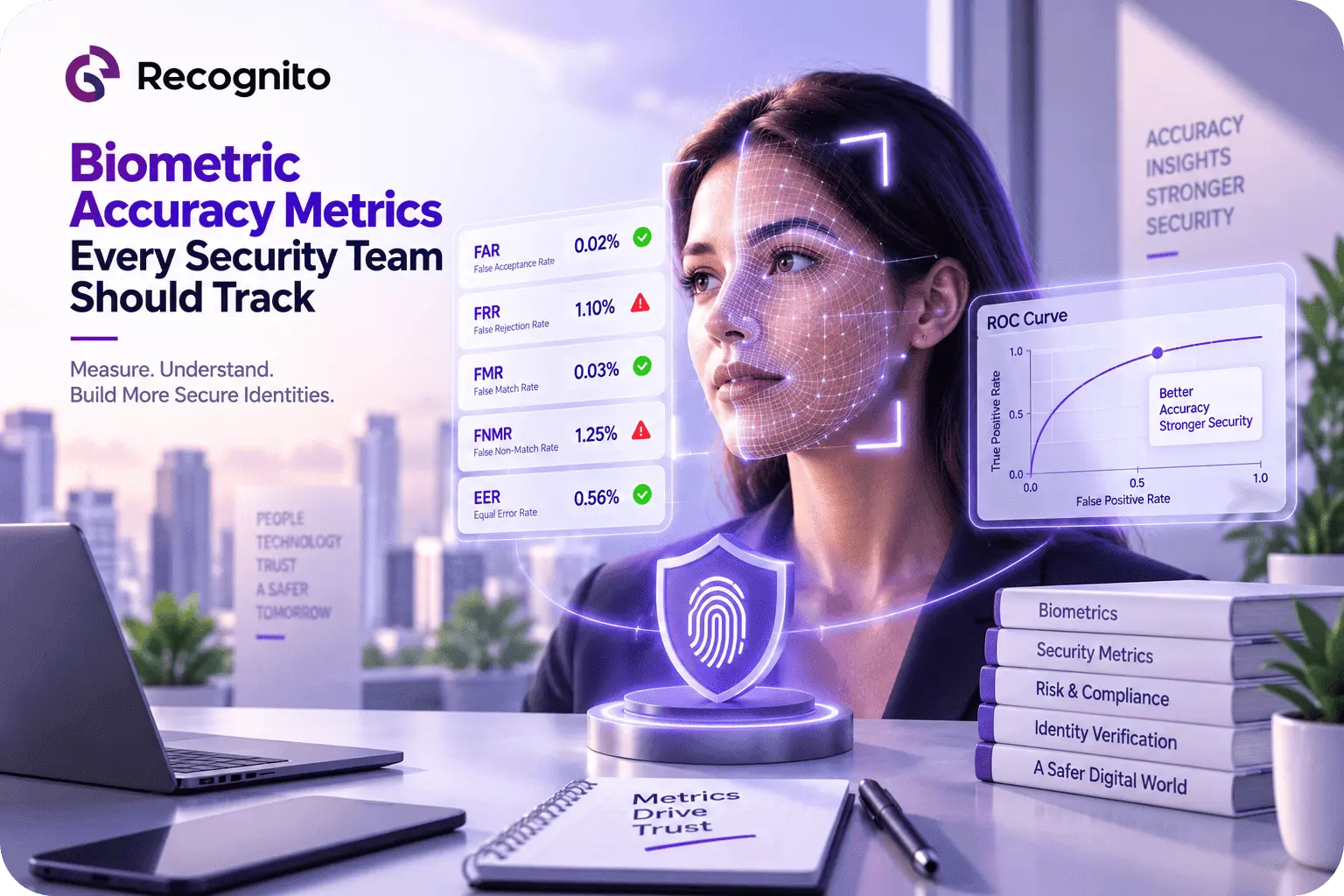
For 1:1 verification, two important measures are False Match Rate (FMR) and False Non-Match Rate (FNMR).
FMR represents the proportion of comparisons involving different people that are incorrectly accepted as matches. FNMR represents genuine comparisons that fail to match.
NIST reports FNMR at specified FMR operating points. In other words, the result can be read as: how often does the system reject a genuine match when configured to keep false matches at a particular level?
The current NIST FRTE 1:1 evaluation publishes ongoing results and shows why benchmark numbers should always be interpreted together with their operating point.
For a financial application, reducing FMR may be worth some increase in customer friction. A lower-risk application may make a different trade-off. There is no universally correct threshold.
1:N Identification: FNIR and FPIR
Identification introduces a different pair of measures: False Negative Identification Rate (FNIR) and False Positive Identification Rate (FPIR).
FNIR captures searches where the correct identity is not returned above the required threshold. FPIR captures cases where the system returns a candidate incorrectly.
The current NIST FRTE 1:N identification evaluation reports results in ways that show the relationship between identification performance and false-positive risk.
That relationship becomes increasingly important as the gallery grows. A system used for a small internal population and one used to search a very large identity database may create very different operational risks, even when the underlying algorithm is the same.
Why NIST Results Are Useful for Business Procurement
Instead of asking a vendor, “How accurate is your facial recognition?”, a procurement or security team can ask:
- Which NIST track applies to our workflow?
- Which algorithm version produced the reported result?
- At what FMR or FPIR was performance measured?
- How does the result compare across relevant datasets?
- What demographic differences were observed?
- Is the benchmarked implementation the same technology used in production?
- What additional controls sit around the matcher?
The benchmark should also be combined with practical criteria such as mobile performance, API or SDK integration, latency, supported platforms, deployment model, and developer experience. A useful internal resource on face recognition SDK evaluation criteria highlights why algorithm performance is only one part of selecting a production-ready biometric component.
Demographic Performance Cannot Be Ignored
An aggregate score can conceal meaningful differences between groups.
NIST’s ongoing 1:1 evaluation includes demographic variation reporting. The results are intended to show how error rates vary across demographic categories and test conditions. NIST also notes that image quality can strongly affect false-negative outcomes.
This matters operationally because a production capture flow is rarely identical to a laboratory-style test. Customers may use different phones, lighting, camera angles, distances, and environments. If image quality degrades, failures can increase before an organization ever reaches a problem in the underlying matching model.
The second question is often overlooked. Capture guidance, image-quality checks, framing, lighting instructions, and retry logic can materially influence real-world verification outcomes.
Organizations evaluating deployment should also understand the practical variables covered by face recognition accuracy factors, rather than assuming that a benchmark percentage will transfer unchanged into production.
NIST Benchmark Results Are Not the Same as Product Performance
A benchmark measures a defined algorithm under a defined evaluation setup. A commercial identity system contains an entire chain of components.
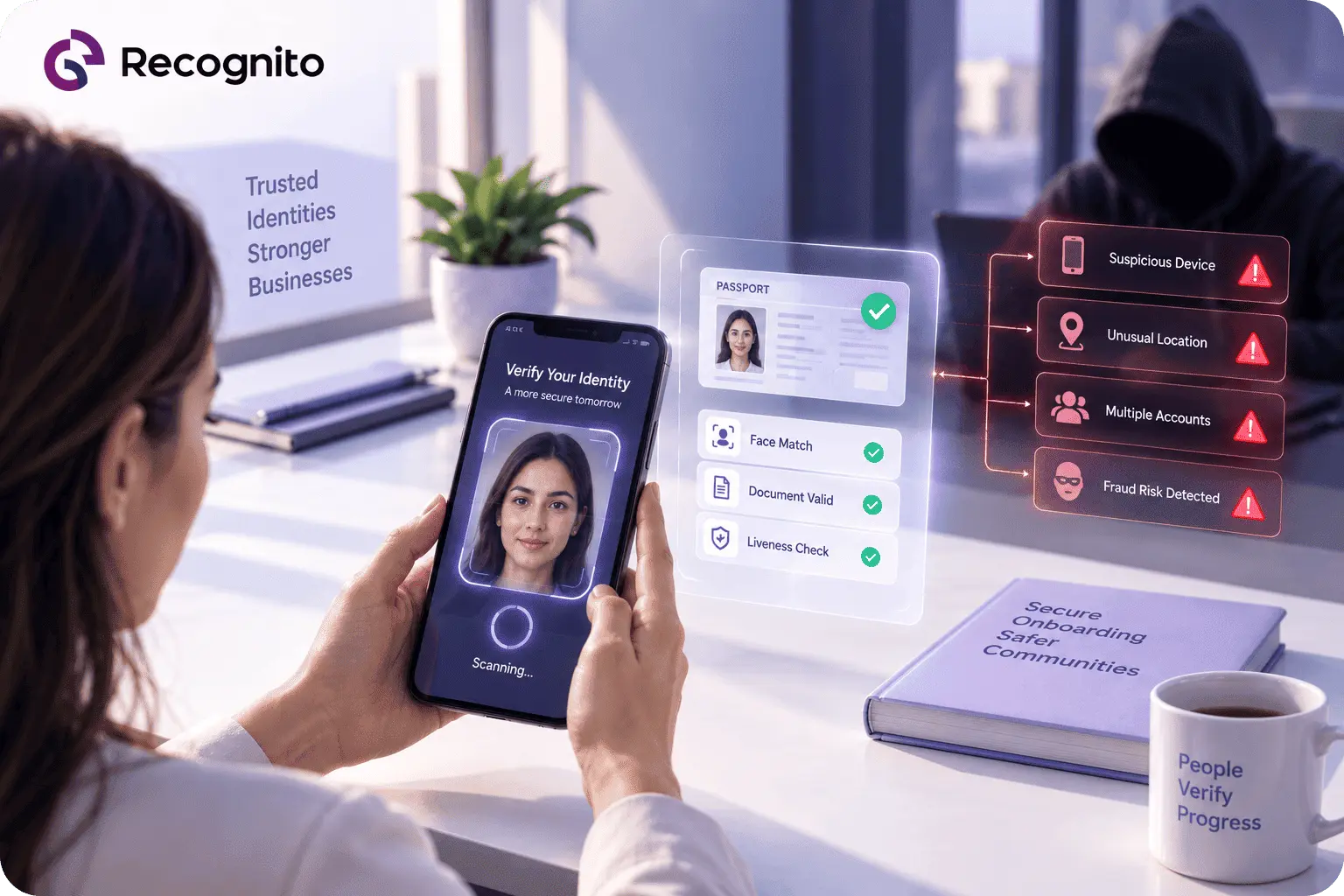
Consider a remote onboarding process. The face matcher may perform extremely well, but if the customer submits a poor-quality image, the capture layer fails to detect the face correctly, or the workflow accepts a spoofed input, the business still has a security or conversion problem.
This is why NIST should be treated as one evidence layer rather than a complete product scorecard.
Recognition Accuracy Does Not Equal Liveness Security
A face matcher answers a matching question. It does not automatically answer whether the captured input comes from a live person.
An attacker may attempt to exploit the capture process using a photograph, replayed media, manipulated content, a mask, or other presentation attack. Separating recognition from presentation-attack detection is therefore essential in security-sensitive workflows.
NIST’s face-technology evaluation ecosystem includes separate work around presentation attack detection, reflecting the fact that these capabilities address different technical problems.
That distinction is also important when evaluating commercial components. A business may need both strong face matching and strong anti-spoofing controls. The relevant security architecture depends on the threat model, the value being protected, and how much control an attacker has over the device and capture environment.
The related presentation attack detection and biometric security discussion provides useful context on this separate security layer.
How Businesses Should Read a NIST Result
The benchmark should be read through the business use case rather than treated as an overall product ranking.
| Benchmark factor | What to examine | Business question |
| Evaluation type | 1:1 or 1:N | Does the test match the workflow we are building? |
| Error metric | FMR/FNMR or FPIR/FNIR | Which failure matters most to our risk model? |
| Operating point | Threshold and associated error rate | What security-versus-friction trade-off are we accepting? |
| Demographics | Differences across groups | Are results suitable for our customer population? |
| Image conditions | Dataset and capture characteristics | How closely do the tests resemble our real environment? |
| Algorithm version | Submission and implementation details | Are we evaluating the same version we will deploy? |
| Efficiency | Processing and resource behavior | Can the technology meet our latency and scale requirements? |
This framework turns benchmark data into a procurement tool.
Test the Whole Workflow, Not Just the Algorithm
Once NIST results have narrowed the shortlist, organizations should conduct their own validation.
A practical pilot should use representative devices, users, network conditions, image quality, and expected edge cases. Measure not only match accuracy but also:
- first-attempt success rate
- average retries
- latency
- failure reasons
- false acceptance and false rejection behavior
- user drop-off
- support burden
- performance under degraded image conditions
For technical teams, a face recognition SDK can help evaluate the recognition engine inside the intended application. A face biometric playground can help teams explore capabilities before a larger integration.
This answers a different question from NIST: Does the technology work reliably in our environment?
NIST, ISO, and Other Independent Evaluation
NIST is one important reference point, but businesses should not assume that one benchmark covers every evaluation requirement.
ISO/IEC 19795-1:2021 establishes general principles for biometric performance testing and reporting, including error rates, throughput, test-data recording, and test protocols intended to reduce inappropriate bias and clarify how test results should be interpreted.
The standard is also being revised, which reinforces an important point: biometric performance evaluation is an engineering discipline, not simply a matter of quoting one accuracy figure.
Independent certification can address additional dimensions. For example, the FIDO Alliance publishes active requirements and test documentation for face verification certification, covering biometric certification procedures beyond the narrow question of whether two faces match.
What NIST Benchmarks Do Not Tell You
NIST results do not automatically answer several questions that are critical to a production deployment.
They do not by themselves establish:
- whether your customer journey is usable
- whether your SDK integrates cleanly into the application
- whether liveness controls resist your specific attacks
- whether the service performs well during network degradation
- whether biometric data is handled according to your privacy requirements
- whether the vendor provides adequate monitoring and incident response
- whether the complete workflow meets your regulatory obligations
This is particularly important for regulated identity workflows. An accurate algorithm can still be unsuitable if data retention, access controls, auditability, or recovery processes are poorly designed.
A Better Way to Use NIST in Vendor Selection
NIST benchmarks work best when they become part of a structured evaluation process.
1. Define the risk first.
Identify whether the main concern is fraudulent acceptance, legitimate-user rejection, unauthorized access, duplicate identities, or search errors.
2. Select the correct evaluation track.
Use 1:1 evidence for verification and 1:N evidence for identification. Avoid mixing the two.
3. Establish the operating point.
Decide what level of false acceptance and false rejection the business can tolerate before comparing vendors.
4. Review demographic and image-quality results.
Look for performance differences that could matter to your user population or capture environment.
5. Test production conditions.
Validate the shortlisted system with the devices, users, workflows, and attack scenarios the business actually expects.
6. Evaluate the security stack.
Include liveness, fraud detection, document checks where applicable, monitoring, privacy, and fallback mechanisms.
7. Verify the implementation.
For development teams, the Recognito GitHub repository provides developer-oriented resources that can complement formal benchmark review and application testing.
This approach prevents a common procurement mistake: choosing the algorithm with the best headline number rather than the system that best fits the business risk.
Privacy and Compliance Remain Separate Questions
Benchmark performance does not establish legal compliance.
Biometric deployments may involve requirements covering data minimization, retention, transparency, access, security, consent or lawful basis, and jurisdiction-specific rules. Before deployment, organizations should document what data is collected, why it is needed, where it is processed, who can access it, and how long it is retained.
Performance testing answers how well the biometric system matches. Governance determines whether and how the business should use it.
Conclusion
NIST face recognition benchmarks give businesses a stronger basis for evaluating biometric technology than generic accuracy claims. Their real value comes from the detail behind the numbers: whether the task is 1:1 or 1:N, which error rates are being measured, what operating point is used, how demographic performance varies, and how closely the test conditions resemble the intended deployment.
Use those results to narrow the technology shortlist, then validate the complete workflow against realistic users, devices, fraud scenarios, and operational requirements. The best choice is not necessarily the algorithm with the lowest published error rate. It is the technology that delivers the right security and usability balance for the business.
For organizations building practical biometric identity workflows, Recognito can be evaluated as part of that broader technology strategy.
Frequently Asked Questions
Are NIST face recognition benchmarks certifications?
No. NIST evaluations measure the performance of submitted algorithms under defined conditions. A benchmark result does not constitute blanket certification of an entire commercial product, deployment, or security architecture.
Is a lower FNMR always better?
Not in isolation. FNMR should be considered alongside the FMR operating point because lowering one type of error can affect the other. The right balance depends on the application’s security and usability requirements.
Do NIST benchmarks test liveness?
Face recognition benchmarking and presentation-attack detection address different problems. Businesses should evaluate liveness or anti-spoofing capabilities separately when the workflow is exposed to presentation attacks.
Should businesses rely on NIST results alone?
No. NIST results are valuable independent evidence, but they should be combined with production testing, security assessment, privacy review, integration testing, and business-specific risk requirements.