
Identity verification has moved far beyond checking a name, date of birth, and document number against a form. As more banking, fintech, travel, healthcare, and public-service interactions move online, organizations increasingly need to establish that the person behind a digital transaction is the legitimate holder of the claimed identity.
That is where facial ID recognition is becoming increasingly important.
Instead of relying entirely on information that can be copied or stolen, facial recognition adds a biometric layer to the verification process. A user can capture a face through a smartphone camera, compare it with a trusted identity reference, and potentially complete verification without visiting a branch or using specialized hardware.
The technology is not a standalone answer to identity fraud. Its real value comes from combining facial matching with document verification, liveness detection, fraud controls, and risk-based decisioning. That combination is shaping what digital identity verification looks like next.
Why Identity Verification Is Becoming More Difficult
Digital onboarding has removed many of the physical safeguards that once surrounded identity checks.
In a branch, an employee could examine the customer, inspect the physical document, ask questions, and identify obvious inconsistencies. A remote application replaces that interaction with digital evidence.
The problem is that digital evidence is easier to copy and manipulate.
Stolen identity documents can be photographed. Personal information can be harvested from previous breaches. Fraudsters can manipulate images or attempt to impersonate legitimate customers. Artificial intelligence has also lowered the barrier to creating convincing synthetic or manipulated media.
At the same time, legitimate customers expect fast onboarding. Requiring multiple manual reviews or complicated verification steps can increase abandonment.
Facial ID recognition addresses part of this tension by connecting a digital identity claim to something difficult to share in the same way as a password or demographic information: the customer’s biometric characteristics.
A broader look at this shift appears in why facial ID recognition is becoming the future of ID checks, particularly as identity systems move toward remote and contactless verification.
What Facial ID Recognition Adds to Verification
Facial ID recognition typically compares one facial sample with another trusted reference.
During onboarding, for example, a customer might submit a passport and then capture a selfie. The system extracts facial characteristics from both sources and calculates a similarity score.
If the match meets the appropriate threshold, the face becomes another piece of evidence connecting the person to the claimed identity.
That is different from simply recognizing a person in an image. Identity verification generally uses a 1:1 comparison, where one face is compared against one trusted identity reference.
NIST’s current Face Recognition Technology Evaluation program evaluates 1:1 face verification performance and reports results at defined operating points, allowing organizations to examine error trade-offs instead of relying on a single generic accuracy figure.
This distinction is important because biometric systems are probabilistic. A business needs to determine how much confidence is sufficient for its specific use case, what happens when confidence is insufficient, and how additional evidence should be handled.
Facial Verification Works Best as Part of a Larger Identity Stack
The future of identity verification is unlikely to be based on facial recognition alone.
Consider a remote onboarding session. The customer presents an identity document, captures a selfie, and receives a verification decision.
Several questions need to be answered:
- Is the document a legitimate identity credential?
- Is the information on it consistent?
- Is the document physically present during capture?
- Does the customer’s face correspond to the document portrait?
- Is the person actually present?
- Does anything else about the transaction indicate elevated risk?
Facial ID recognition primarily answers one of those questions: whether the biometric samples correspond closely enough.
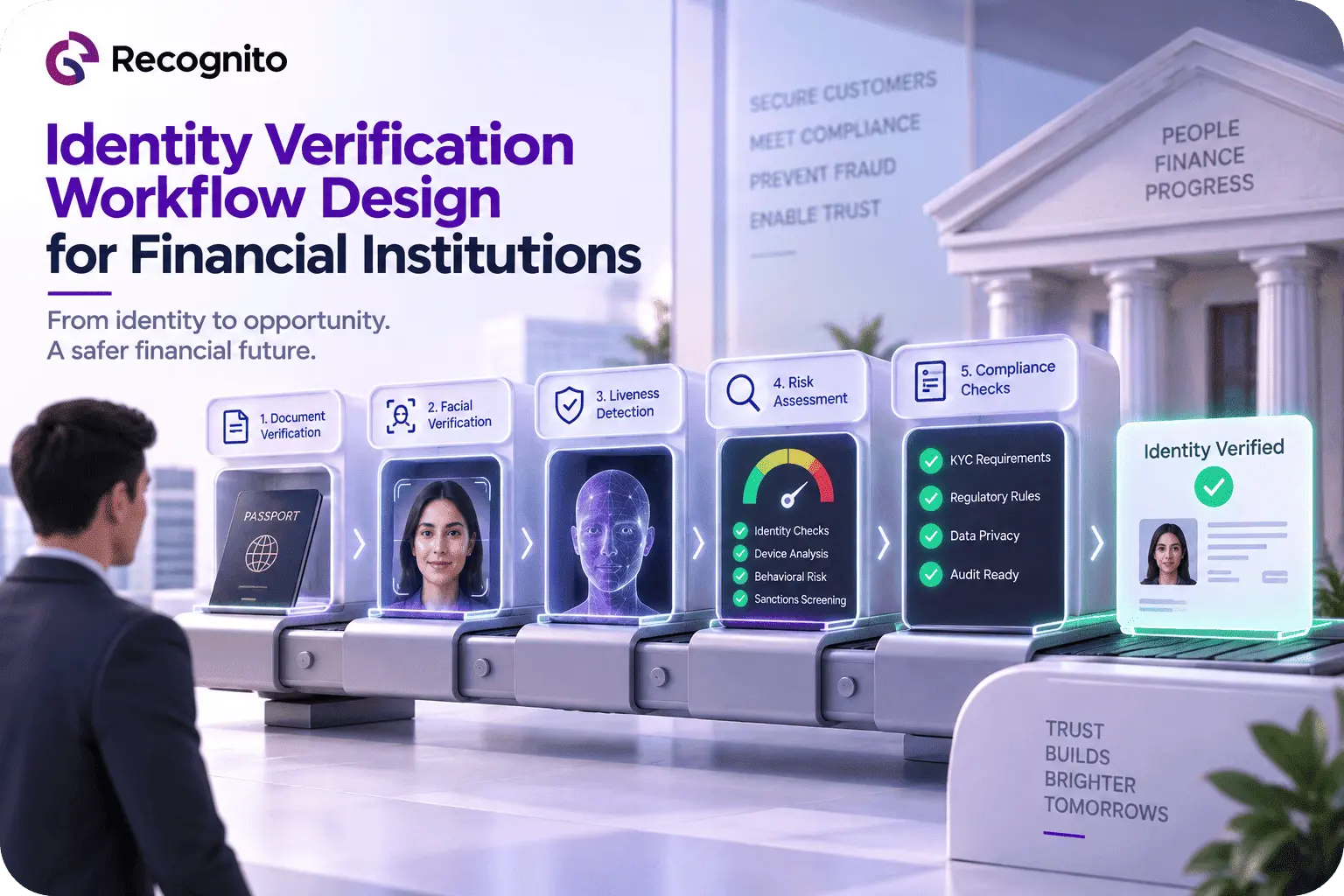
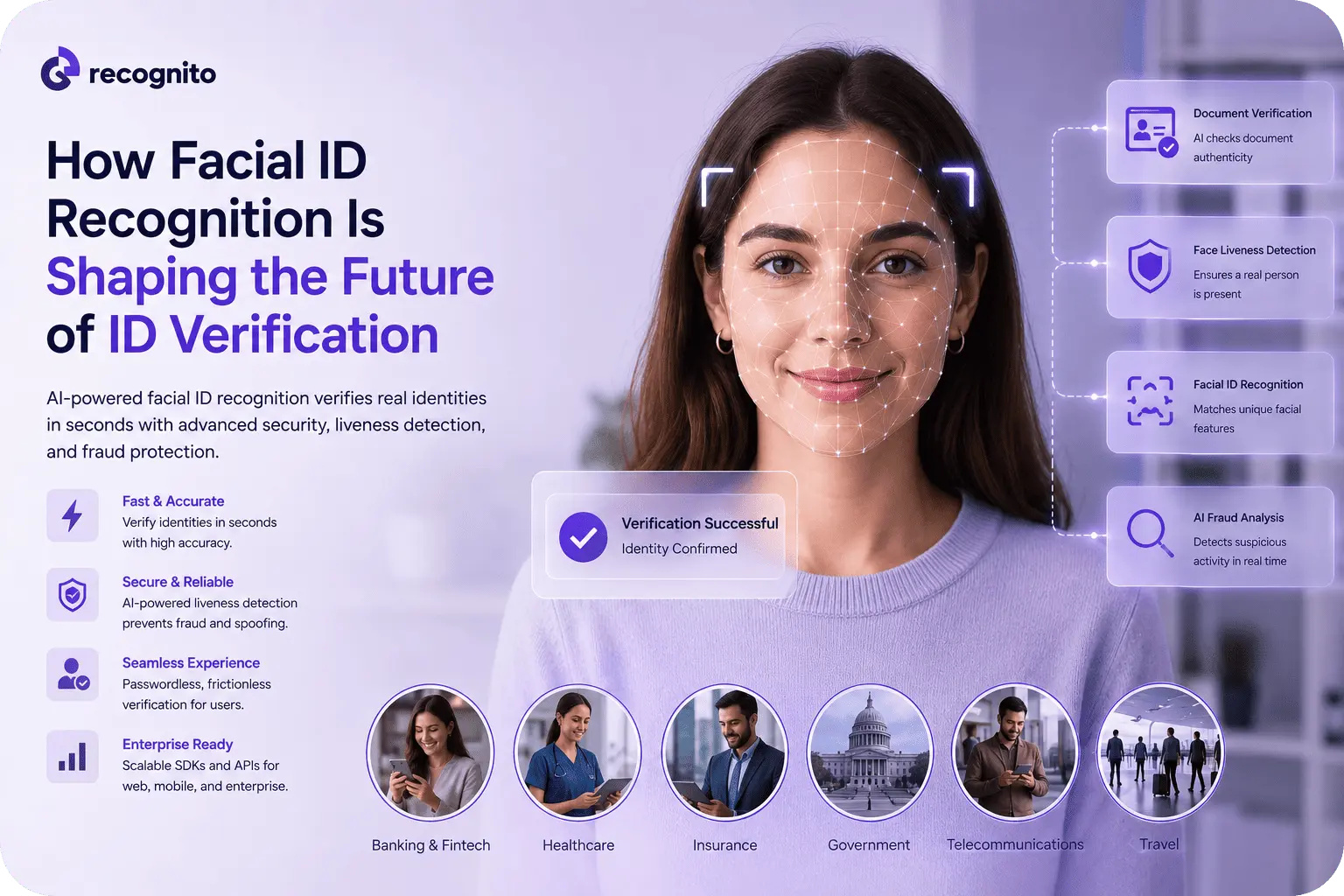
Document verification handles another. Liveness introduces another defense against presentation attacks. Risk engines can combine these results with contextual information.
This layered architecture makes the overall decision stronger because an attacker must overcome multiple controls rather than one.
That is why the distinction between identity evidence types matters. The comparison of face recognition and ID document verification shows how the two technologies can complement rather than replace one another.
The Role of Liveness in Facial ID Recognition
A face match does not automatically prove that a real person is standing in front of the camera.
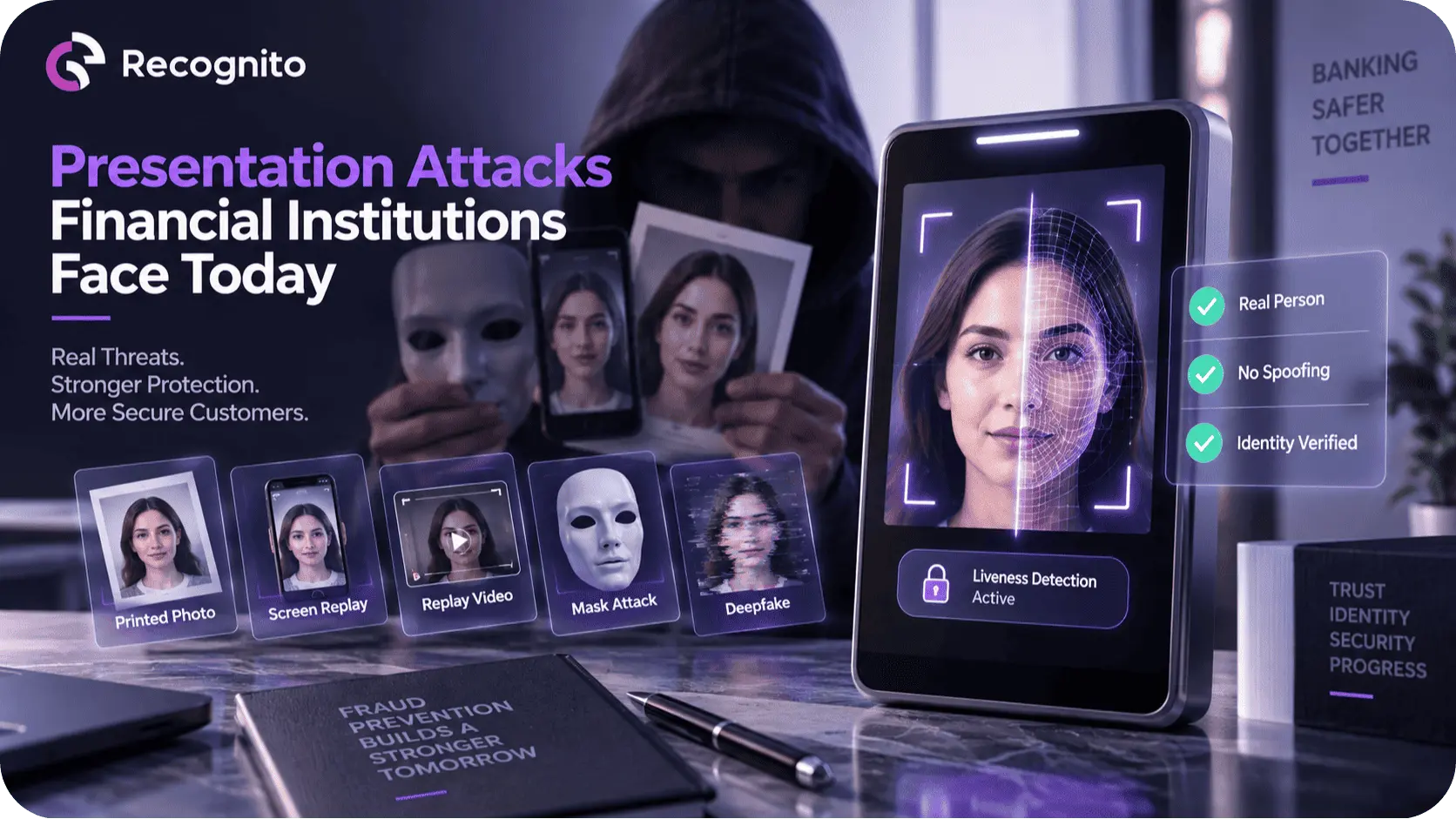
An attacker could attempt to present a photograph, replay a video, use manipulated media, or exploit another presentation method. The recognition algorithm may still determine that the face resembles the reference.
Liveness detection addresses this different question: Does the submitted biometric input appear to come from a live subject?
This separation is increasingly important because remote identity verification is exposed to threats that did not exist in the same form in traditional in-person processes.
FIDO’s Face Verification Certification specifically evaluates face-verification solutions in remote identity environments, including matching, liveness, demographic considerations, and security against relevant attack methods.
For organizations deploying facial ID recognition, the lesson is straightforward: matching performance and presentation-attack resistance should be evaluated as separate capabilities within the same security architecture.
Why AI Is Making Facial Verification More Practical
Modern facial ID systems depend heavily on machine learning.
AI models can identify facial landmarks, create numerical representations of faces, compare those representations, and estimate whether two samples are sufficiently similar. More advanced systems can also evaluate image quality and detect patterns associated with manipulation or presentation attacks.
The practical benefit is not simply higher accuracy. AI also allows verification to happen quickly enough to fit within a consumer-facing workflow.
A customer can often complete a face check within seconds rather than waiting for a human reviewer to inspect a photograph manually.
That shift creates operational advantages. Straightforward applications can move through the workflow automatically, while uncertain cases can be routed for additional verification.
For developers implementing biometric capabilities directly inside their applications, a facial recognition SDK can provide the recognition layer without requiring the entire experience to be built from scratch.
The Security Challenge Is Changing
Facial ID recognition improves identity assurance, but it also changes the threat landscape.
Attackers are no longer limited to stolen credentials. They may attempt to combine real identity information with manipulated biometric media, exploit weak capture environments, or target gaps between different verification components.
The response should be layered security rather than a race toward a single “perfect” recognition model.
A stronger architecture can include:
- Trusted identity evidence from government-issued documents or other accepted sources.
- Facial comparison to connect the applicant with that evidence.
- Liveness detection to reduce presentation-attack risk.
- Media and device controls to reduce the opportunity for manipulated input.
- Risk-based decisioning to identify unusual or inconsistent applications.
- Manual escalation when automated evidence is insufficient.
This approach also changes how businesses should think about biometric fraud prevention. The goal is not to make one model impossible to defeat. It is to ensure that defeating one layer does not automatically produce a successful identity decision.
Research and practical considerations around biometric verification and fraud reduction provide useful context for designing that layered approach.
Facial ID Recognition Is Changing the Customer Experience
One of the strongest arguments for facial verification is convenience.
Customers already carry smartphones with capable cameras. That means a remote identity process can often use existing hardware rather than requiring a fingerprint reader or specialized biometric terminal.
The interaction can also be contactless. A customer can look at the camera, follow simple positioning guidance, and complete the facial step without touching another device.
But convenience depends on implementation quality.
Poor lighting, glare, camera movement, low-resolution imagery, incorrect framing, and inconsistent capture instructions can create unnecessary failures.
That makes the user interface part of biometric security. A technically strong model can still produce a poor business outcome when customers repeatedly fail to capture acceptable images.
Effective implementations provide immediate feedback, sensible retry handling, clear instructions, and a secure fallback when automated verification cannot reach sufficient confidence.
The Accuracy Question Is More Complicated Than a Percentage
Vendors often advertise facial recognition using a single accuracy figure. That is rarely enough for a serious procurement decision.
Performance depends on the data, threshold, demographic population, image quality, capture conditions, and type of comparison being performed.
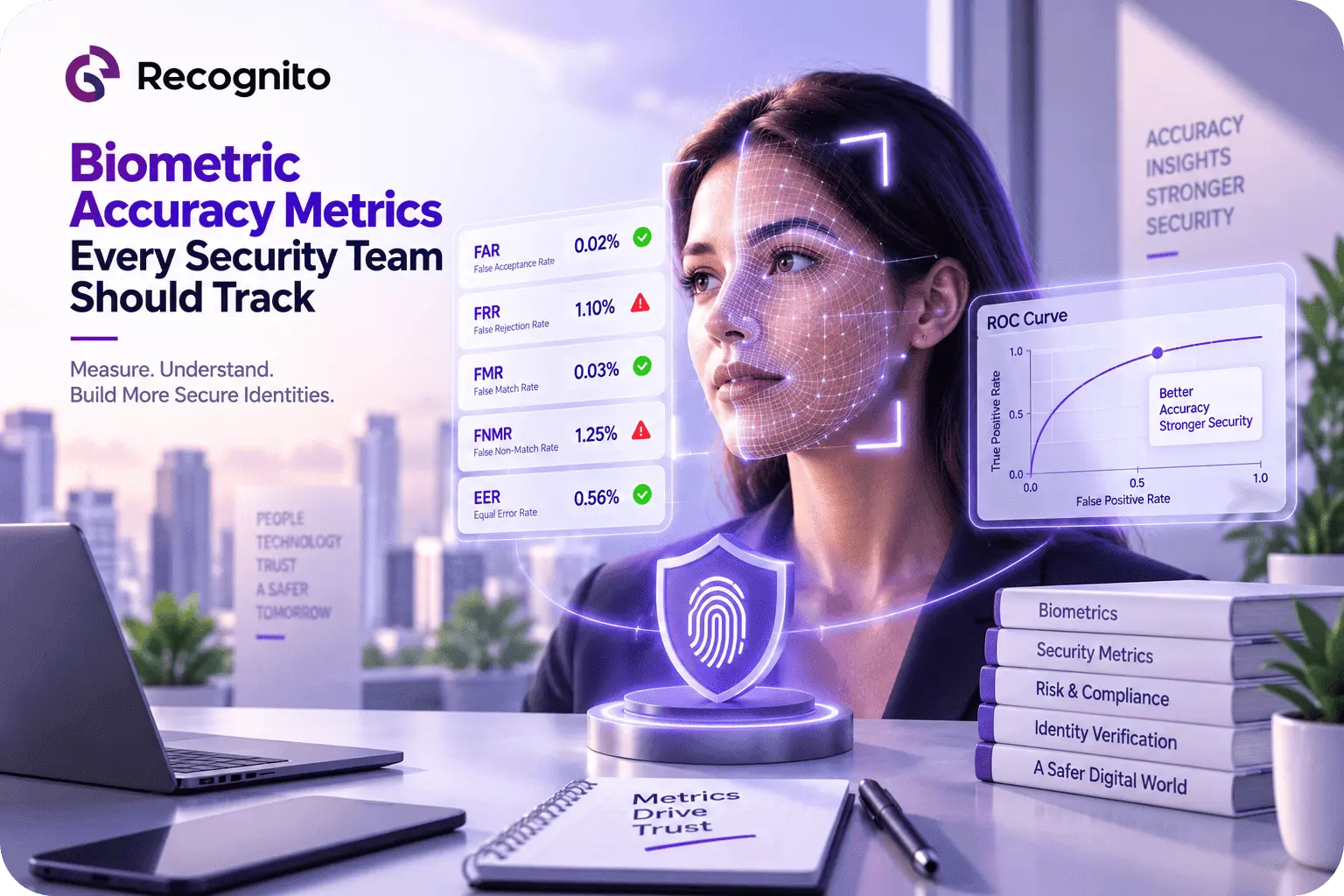
NIST’s ongoing evaluation work exists partly to make these differences visible. Rather than asking whether an algorithm is simply “accurate,” organizations can examine how its error rates behave at defined operating points.
A business should therefore ask:
- What type of comparison was tested?
- What false-match rate corresponds to the reported result?
- What happens to legitimate users at that threshold?
- Which populations were represented?
- How does performance change when image quality deteriorates?
- Was the exact production implementation evaluated?
ISO/IEC 19795-10:2024 provides a dedicated framework for reporting biometric performance variation across demographic groups, including recognition errors, acquisition failures, and processing characteristics. The standard is especially relevant when organizations need to understand whether aggregate results hide meaningful differences between groups.
The right benchmark is therefore not the largest percentage. It is the performance profile that fits the application’s actual risk and customer environment.
Privacy Becomes More Important as Biometrics Expand
The convenience of face-based verification comes with an important governance question: what happens to the biometric data?
Organizations should understand the complete lifecycle.
That means defining:
- what information is captured
- whether raw images are retained
- how biometric templates are generated
- where data is processed
- who can access it
- how long it is retained
- when it is deleted
- how customers are informed
The system should collect and retain only what is justified by the identity process and applicable requirements.
NIST’s SP 800-63A-4 identity proofing guidance focuses on identity proofing and enrollment and provides technical requirements around establishing identity assurance for digital interactions.
Although developed for government information systems, its identity-proofing principles are useful when organizations design remote identity workflows more broadly.
Facial ID Recognition and Digital Identity Are Converging
Facial recognition is increasingly moving beyond one-time onboarding.
Once an identity has been established, facial verification can potentially support account recovery, high-risk transactions, re-verification, and other moments when an organization needs confidence that the current user is the legitimate account holder.
This creates a broader concept of identity continuity.
Instead of verifying someone once and then relying indefinitely on passwords or static profile information, a service can introduce biometric verification at selected points where risk increases.
The challenge is deciding when that additional verification is justified. Requiring biometric checks for every low-risk action could introduce unnecessary friction. Using them only after suspicious activity or during sensitive events can provide a more proportional security model.
This is where risk-based identity architecture becomes more important than simply adding more biometric checks.
What Businesses Should Evaluate Before Deployment
Choosing a facial ID recognition platform requires more than comparing recognition scores.
Recognition performance
Review benchmark results, operating points, and testing conditions. Understand the difference between verification and identification.
Liveness and attack resistance
Determine how the system addresses photographs, replayed media, deepfakes, injection attempts, and other threats relevant to the deployment.
Capture quality
Test the system with real customer devices, different lighting conditions, and realistic capture behavior.
Demographic performance
Evaluate whether recognition and acquisition performance varies across the populations the service will support.
Integration
Assess SDKs, APIs, latency, platform support, error handling, and how easily results can be incorporated into the existing identity workflow.
Privacy and governance
Understand how biometric data is processed, secured, retained, and deleted.
Operational outcomes
Measure completion rates, false rejections, manual reviews, verification times, and fraud outcomes after deployment.
For teams that want to examine biometric capabilities before implementing them, the face biometric playground can provide a practical evaluation environment.
What the Future of ID Verification Looks Like
The future is unlikely to be “face recognition everywhere.”
A more realistic direction is adaptive identity verification, where different evidence is requested according to the risk of the transaction.
A new customer completing a routine low-risk process may need document verification and facial matching. A customer recovering a high-value account after suspicious activity may require facial verification with stronger liveness controls and additional evidence.
This model allows security to become proportional to risk.
It also shifts the role of facial ID recognition. Rather than being a standalone product feature, it becomes one component in an identity decision engine that continuously combines evidence.
Developers building those systems also need clear implementation and testing resources. The Recognito GitHub repository provides developer-oriented resources that can complement SDK and integration work.
The Business Impact of Facial ID Recognition
When implemented properly, facial ID recognition can affect several parts of the identity lifecycle at once.
Customer acquisition: Remote verification can reduce the need for branch visits and specialized hardware.
Fraud prevention: Biometric evidence adds another barrier against identity impersonation.
Operational efficiency: Automated verification can reduce the number of straightforward cases requiring manual intervention.
Account security: Facial checks can support sensitive recovery and authentication events.
Global accessibility: Camera-based verification can work across geographically distributed customer populations without distributing dedicated biometric readers.
Those benefits are not automatic. Poor thresholds, inadequate liveness, weak privacy practices, unreliable capture, or excessive customer friction can undermine the entire system.
The technology should therefore be evaluated as part of a complete business process, not as an isolated AI capability.
Conclusion
Facial ID recognition is shaping the future of identity verification because it provides a practical way to connect a digital identity claim with biometric evidence that is difficult to reproduce through ordinary credential theft.
Its greatest potential appears when it works alongside document verification, liveness detection, fraud analytics, risk-based decisioning, and secure data governance.
For businesses, the objective should not be to replace every identity check with a face scan. It should be to introduce facial verification where it meaningfully improves assurance, reduces unnecessary friction, and strengthens the overall identity architecture.
For organizations building that architecture, Recognito provides biometric technologies that can support modern facial verification and identity workflows.
Frequently Asked Questions
Is facial ID recognition the same as facial identification?
Not always. Facial verification generally performs a 1:1 comparison between a person and a claimed identity. Facial identification can involve searching a larger gallery to determine which identity best corresponds to a facial sample.
Can facial ID recognition prevent identity fraud by itself?
No. Facial matching should be combined with document checks, liveness, fraud controls, and appropriate risk decisioning. A biometric match alone does not establish that every part of an identity claim is legitimate.
Is facial verification suitable for remote onboarding?
Yes. It is particularly useful when customers need to verify their identity through smartphones or other camera-equipped devices without visiting a physical location.
Does facial ID recognition create privacy risks?
Yes. Facial data is sensitive and needs appropriate governance. Organizations should define collection, processing, access, retention, security, and deletion practices before deployment.
What should businesses look for in a facial ID recognition solution?
Look beyond headline accuracy. Evaluate recognition performance, liveness, attack resistance, demographic behavior, capture quality, integration, latency, privacy controls, customer experience, and real-world fraud outcomes.