
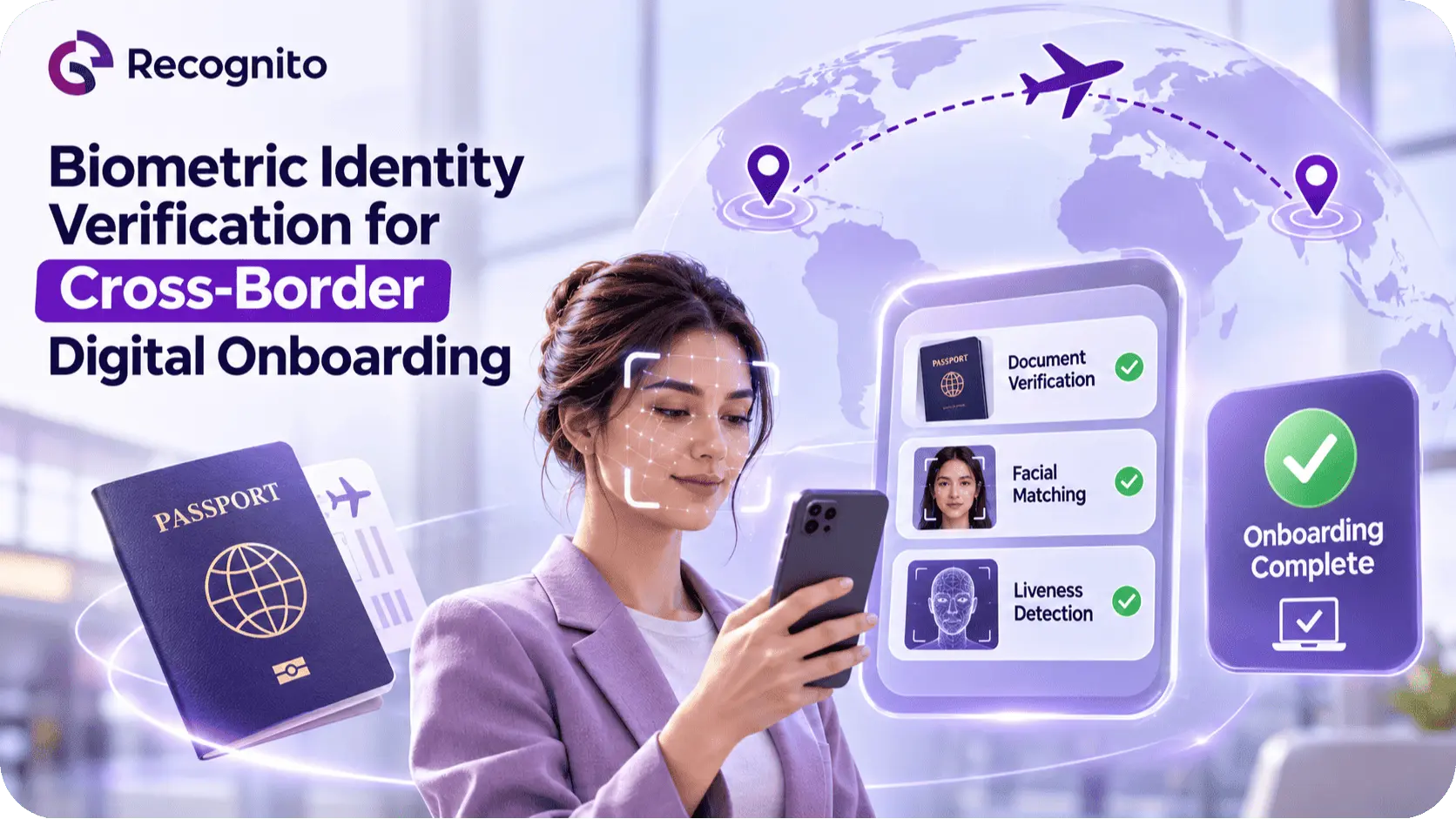
A customer applying for a financial service from another country may hold a valid passport, have an address format unfamiliar to the provider, and rely on identity records unavailable through domestic databases. The application is digital, but the evidence and rules behind it are not uniform.
That is the central challenge of cross-border onboarding. A provider must establish that the applicant is who they claim to be, validate identity evidence issued under another country’s system, meet the rules applying to the service, and protect personal and biometric data across jurisdictions.
Biometric identity verification helps connect a person to identity evidence remotely. It is not, by itself, a cross-border identity framework. Reliable onboarding combines document intelligence, facial comparison, liveness, trusted data sources, jurisdiction-aware compliance, and controlled decision-making.
Why Cross-Border Onboarding Is More Complex
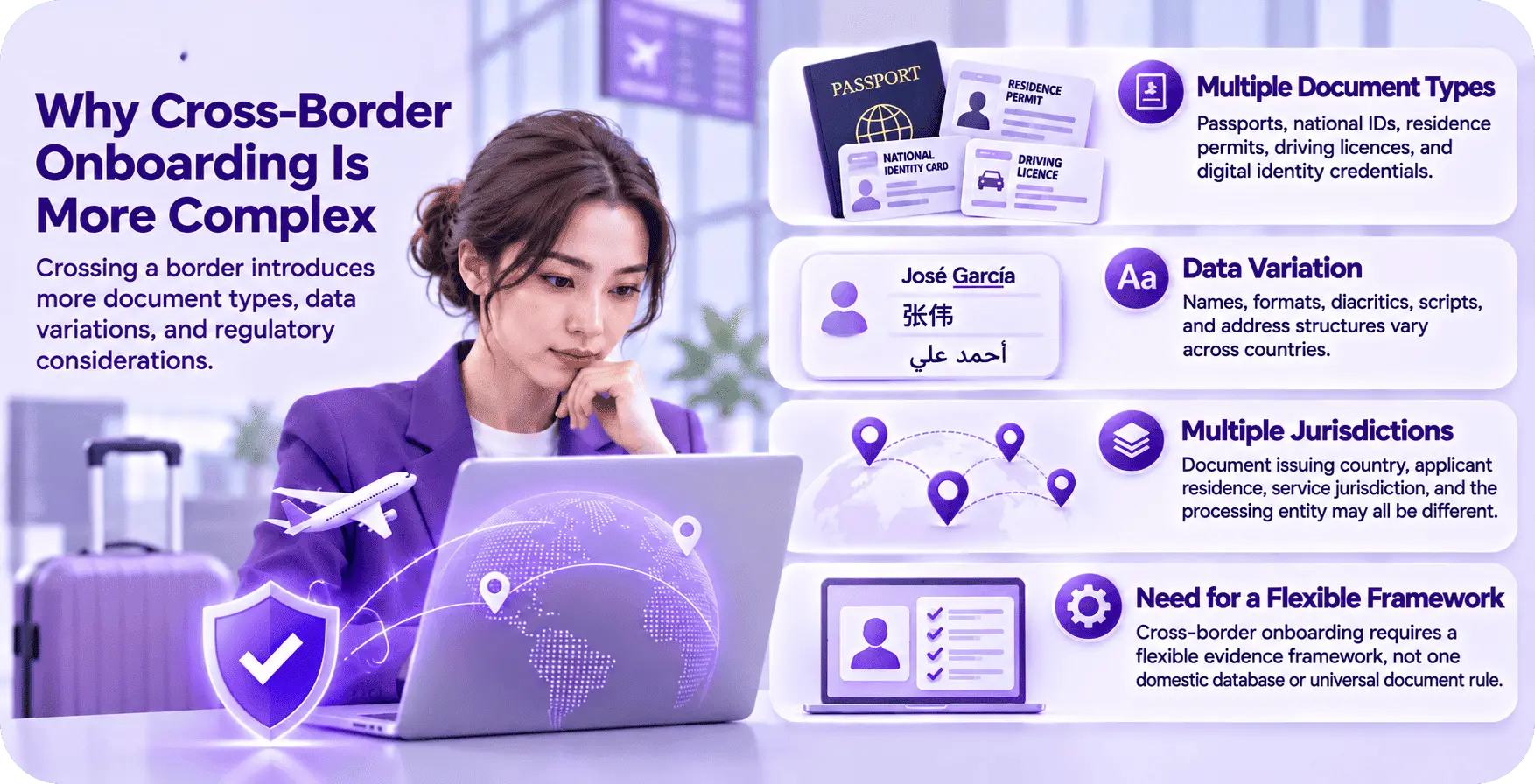
Domestic onboarding often relies on familiar documents, local data sources, and established regulatory processes. Crossing a border changes those assumptions.
A provider may encounter passports, national identity cards, residence permits, driving licences, and digital identity credentials. They differ in layout, security features, language, validity rules, and electronic-verification options.
Even basic data matching can be difficult. Names may contain diacritics, multiple family names, patronymics, or transliterations from non-Latin scripts. Name order, date formats, and address structures also vary. A rigid form built around one country’s conventions can reject legitimate applicants.
The provider must also distinguish the document’s issuing country, the applicant’s residence, the service jurisdiction, and the legal entity responsible for processing the application. These may all differ.
Cross-border onboarding therefore needs a flexible evidence framework, not one domestic database or universal document rule. The challenges of digital identity verification provide useful context for this problem.
What Biometrics Contribute to Remote Identity Proofing
Biometrics help connect an applicant to the identity evidence they submit. A typical flow captures an identity document and a selfie or short video, then checks whether the evidence and person are consistent.
Each component answers a different question:
- Document recognition: What document was submitted, and what information does it contain?
- Document authenticity: Does it appear genuine and unaltered?
- Document presence: Is the physical document being presented during capture rather than supplied as a static file?
- Face matching: Does the applicant resemble the document portrait?
- Face liveness: Does the biometric input appear to come from a live person rather than a photograph, replay, mask, or manipulated media?
These controls are not interchangeable. A genuine document may not be physically present. A face may match a passport portrait while the camera input is a replay. A liveness check may establish a live subject without proving that the document belongs to them.
The value comes from combining evidence and interpreting results together.
Start With the Document, Not Just the Face
A cross-border platform needs to recognize supported document types and apply suitable parsing and validation logic. It must account for national layouts, machine-readable zones, portrait placement, field labels, scripts, and document versions.
For passports and other machine-readable travel documents, ICAO Doc 9303 provides internationally used specifications for machine-readable travel documents. It offers a common technical foundation, but does not mean every national identity document follows the same format.
Where supported, reading an ePassport chip can provide additional evidence, including digitally signed data. Chip reading should be evaluated alongside document checks and issuer trust; it does not replace verifying the applicant.
An ID document recognition SDK can support document capture, classification, and information extraction. The implementation still needs a country-specific policy for accepted documents, expiry, and unsupported cases.
Establish That the Document and Applicant Are Present
A static image does not establish that a customer is presenting a physical document during a live session. Attackers may use scans, screenshots, edited images, or injected media.
Document-presence checks assess whether evidence appears to originate from a physical document at capture time. Depending on the system, they may use passive image analysis, capture sequences, or guided movements.
Facial liveness addresses a different point. It attempts to distinguish a live person from presentation attacks such as printed photographs, replayed videos, or masks. A face liveness detection SDK can provide this capability within a remote biometric flow, complementing document validation and face matching.
For a related document workflow, passport recognition for identity checks explains how document capture and identity matching fit together.
Cross-Border Interoperability: The Data Is Often the Hard Part
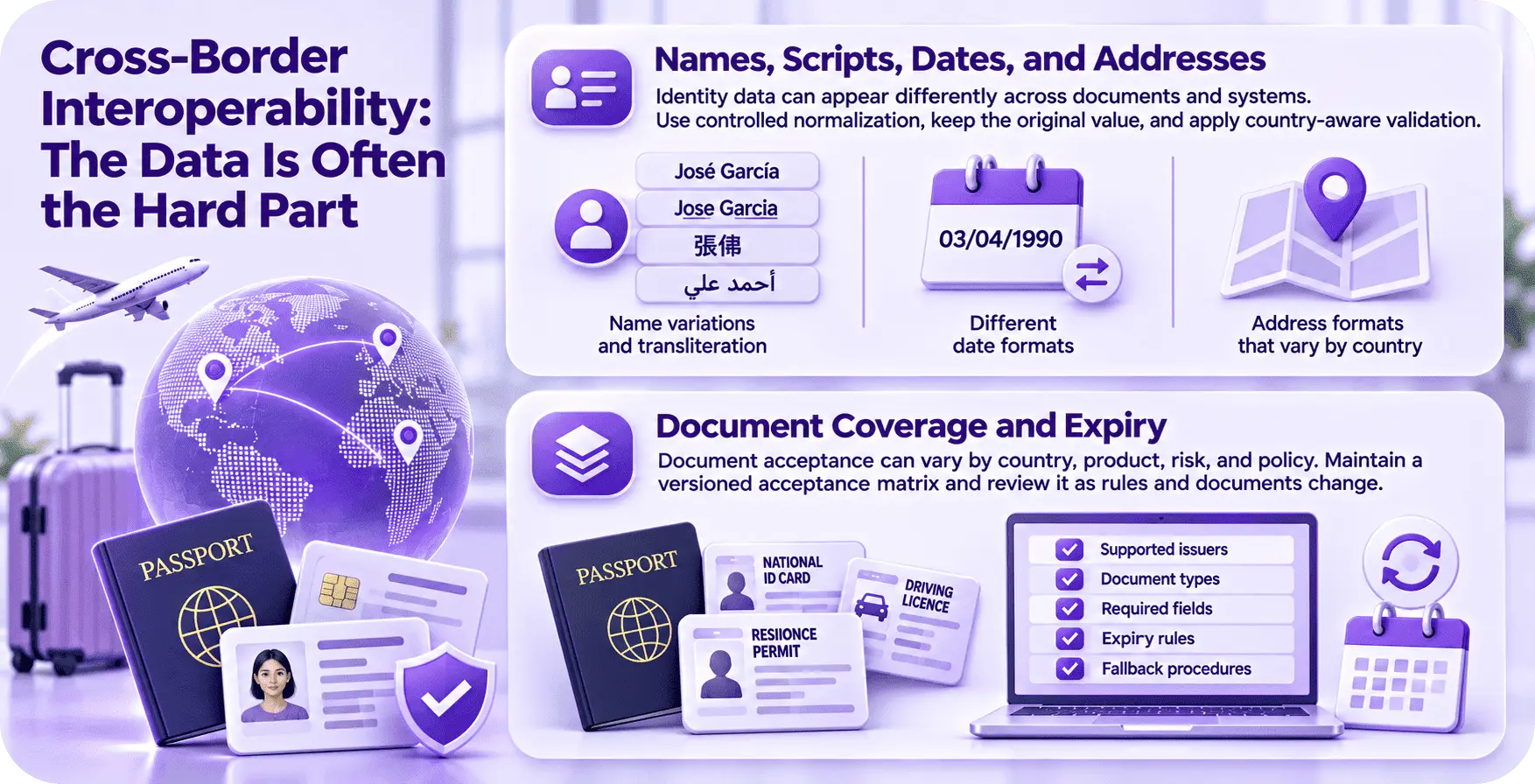
Names, scripts, dates, and addresses
A person’s name may appear differently across a passport, local registry, bank account, and application form. Transliteration can produce several acceptable Latin spellings; some cultures use multiple surnames or patronymics.
Preserve the original document value while applying controlled normalization for matching. Do not silently rewrite source identity data or reject someone solely because two systems represent the same name differently.
Dates can be ambiguous, and addresses may not fit a domestic postcode or street-number model. Store structured components where possible, retain the original representation, and apply country-aware validation.
Document coverage and expiry
A document accepted for one purpose in its issuing country may not be accepted for a particular service elsewhere. Rules can depend on residency, product type, risk, local law, and provider policy.
Maintain a versioned acceptance matrix showing supported issuers, document types, required fields, expiry rules, and fallback procedures. Review it as documents and regulations change.
A Risk-Based Cross-Border Verification Workflow
A robust flow adapts to the applicant, market, and service.
- Determine the relevant jurisdictions. Identify residence, document issuer, service market, and responsible legal entity.
- Select acceptable evidence. Apply the document and credential rules for that market and product.
- Capture securely. Guide document image or chip capture where supported; assess quality before proceeding.
- Validate presence and authenticity. Check physical presence and relevant document features.
- Extract and normalize attributes. Preserve original values and apply careful country-aware matching.
- Compare the face. Where appropriate, compare a live facial sample with the document portrait.
- Assess liveness and fraud signals. Check presentation attacks without assuming any one signal proves identity.
- Complete customer due diligence. Apply sanctions, PEP, adverse-media, and other checks required for the relationship and jurisdiction.
- Record the decision. Approve, request more evidence, or route the case to trained review, recording the reasons and evidence.
Biometric assurance and financial-crime screening remain separate. A successful face match does not establish that a customer is low-risk, and a screening result does not prove that an identity document is genuine.
How International Frameworks Fit In
Cross-border onboarding needs a policy framework as well as technology.
The FATF’s Guidance on Digital Identity explains how regulated entities can assess whether digital identity systems are sufficiently reliable and independent for customer due diligence. It supports a risk-based approach rather than requiring one biometric method.
For financial institutions within its scope, the European Banking Authority’s remote customer onboarding guidelines set expectations for assessing remote onboarding tools under applicable EU AML/CFT and data-protection requirements. They are EU supervisory guidelines, not a universal rule.
The European Commission’s European Digital Identity framework describes wallets intended to let people share identity information and attributes across public and private services, with common specifications supporting interoperability among Member States. Wallet-based evidence may simplify some journeys, but providers must still determine whether a credential is suitable for the transaction.
NIST’s SP 800-63A-4 identity proofing guidance is another technical reference for evidence validation and identity assurance. It addresses U.S. government digital identity systems; it is not a global legal standard.
Privacy and Biometric Data Across Borders
A cross-border process may involve several processors, cloud regions, document vendors, biometric providers, and regulated entities. The customer, controller, processor, and infrastructure may be in different countries.
Under the GDPR, biometric data processed to uniquely identify a person is a special category of personal data. International transfers from the EEA are subject to Chapter V conditions. Organizations should assess the applicable legal basis, special-category condition, transparency, minimization, retention, security, processor arrangements, and transfer mechanism.
The GDPR text on EUR-Lex sets out the relevant rules, including biometric data and international transfers. Other countries have their own privacy, biometric, localization, and transfer requirements; GDPR analysis alone is not enough for a global service.
Practical safeguards include:
- Collect only evidence needed for the defined purpose.
- Separate raw images, extracted attributes, and biometric templates where feasible.
- Define retention and deletion periods for each data category.
- Restrict access and encrypt data in transit and at rest.
- Document subprocessors, storage regions, and international transfers.
Common Mistakes in Cross-Border Onboarding
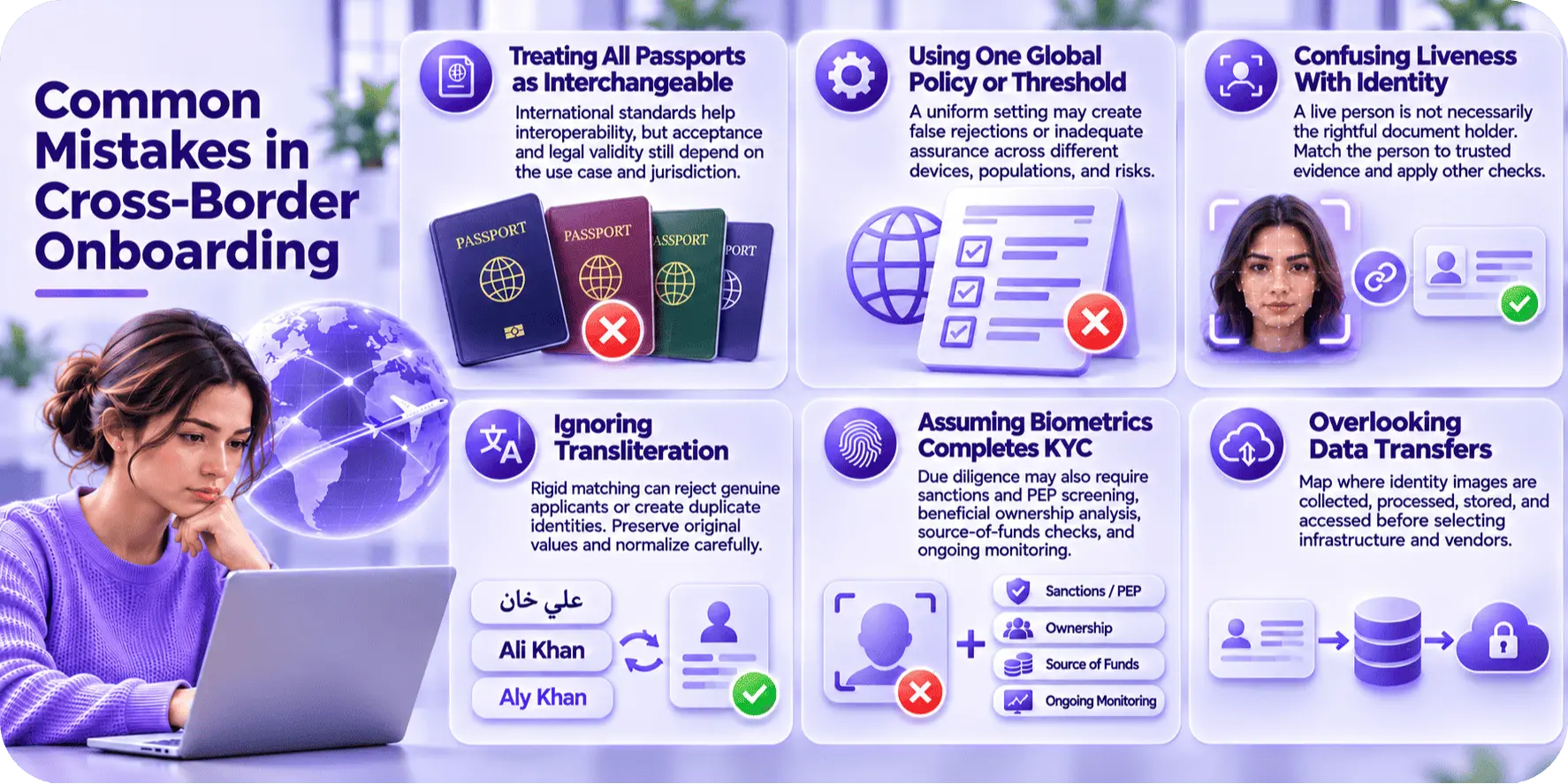
Treating all passports as interchangeable. International standards improve interoperability, but acceptance and legal validity still depend on the use case and jurisdiction.
Using one global policy or threshold. A uniform setting may create false rejections or inadequate assurance across different devices, populations, and risks.
Confusing liveness with identity. A live person is not necessarily the rightful document holder. Match the person to trusted evidence and apply other checks.
Ignoring transliteration. Rigid matching can reject genuine applicants or create duplicate identities. Preserve original values and normalize carefully.
Assuming biometrics completes KYC. Due diligence may also require sanctions and PEP screening, beneficial ownership analysis, source-of-funds checks, and ongoing monitoring.
Overlooking data transfers. Map where identity images are collected, processed, stored, and accessed before selecting infrastructure and vendors.
Choosing Technology for a Global Rollout
Evaluate providers against the markets and user groups the service will actually support.
| Evaluation area | Questions to ask | Why it matters |
| Document coverage | Which issuers and versions are supported? | Prevents country-coverage gaps |
| Capture and liveness | Are static media and relevant attacks detected? | Strengthens remote evidence |
| Face comparison | How is performance tested across devices and populations? | Helps manage false matches and rejections |
| Data handling | Where are images and templates processed and stored? | Supports privacy assessments |
| Integration | Are APIs, SDKs, and error states documented? | Reduces implementation risk |
| Operations | Can uncertain cases be reviewed and audited? | Supports defensible decisions |
Do not rely on a global coverage claim without testing actual documents and capture environments. Pilot across representative countries, devices, network conditions, languages, and user groups. Measure completion, retry, false-rejection, manual-review, and confirmed-fraud rates by market.
For teams designing the financial-services process, eKYC requirements for fintech platforms provides related context on digital verification and onboarding controls.
Build for Interoperability Without Losing Local Control
The most practical architecture separates reusable technology from country-specific policy.
Document recognition, facial comparison, and liveness components may be shared across markets. Document acceptance, data matching, retention, due-diligence rules, and escalation thresholds often require local configuration.
A central policy service can select rules based on the applicant’s jurisdiction and product. Each decision should record the policy version, evidence evaluated, failures, and reason for approval or escalation.
For engineering teams integrating biometric capabilities, the Recognito GitHub repository can be reviewed alongside product documentation and integration requirements.
Conclusion
Biometric identity verification can make cross-border onboarding more practical by connecting a remote applicant to identity evidence without an in-person visit. But biometrics alone cannot resolve differences in national documents, naming systems, regulatory obligations, data-transfer rules, or financial-crime risk.
A resilient approach combines document recognition, presence and authenticity checks, face matching, liveness, country-aware data handling, risk-based due diligence, and human review for uncertain cases. It also keeps identity proofing, authentication, and customer-risk decisions distinct.
For organizations developing these workflows, Recognito offers biometric and document-verification technologies that can form part of a broader cross-border identity architecture.
Frequently Asked Questions
What is biometric identity verification for cross-border onboarding?
It uses biometric evidence, commonly facial comparison and liveness, alongside identity documents and other data to help establish that a remote applicant is associated with the identity they claim.
Can one biometric verification system work in every country?
A common technical platform can support multiple markets, but document coverage, legal requirements, data formats, and due-diligence rules need jurisdiction-aware configuration.
Is passport recognition enough to verify an international customer?
No. Passport recognition extracts and assesses document information, but a workflow may also need authenticity and presence checks, face comparison, liveness, customer due diligence, and local validation.
How should companies handle biometric data across borders?
Map where data is collected, processed, stored, and accessed. Establish applicable legal bases, transfer mechanisms, retention limits, safeguards, and processor responsibilities for each jurisdiction.
Does biometric verification replace KYC?
No. It supports identity proofing and verification. KYC is broader and may include customer due diligence, sanctions and PEP screening, risk assessment, beneficial ownership checks, and ongoing monitoring.