
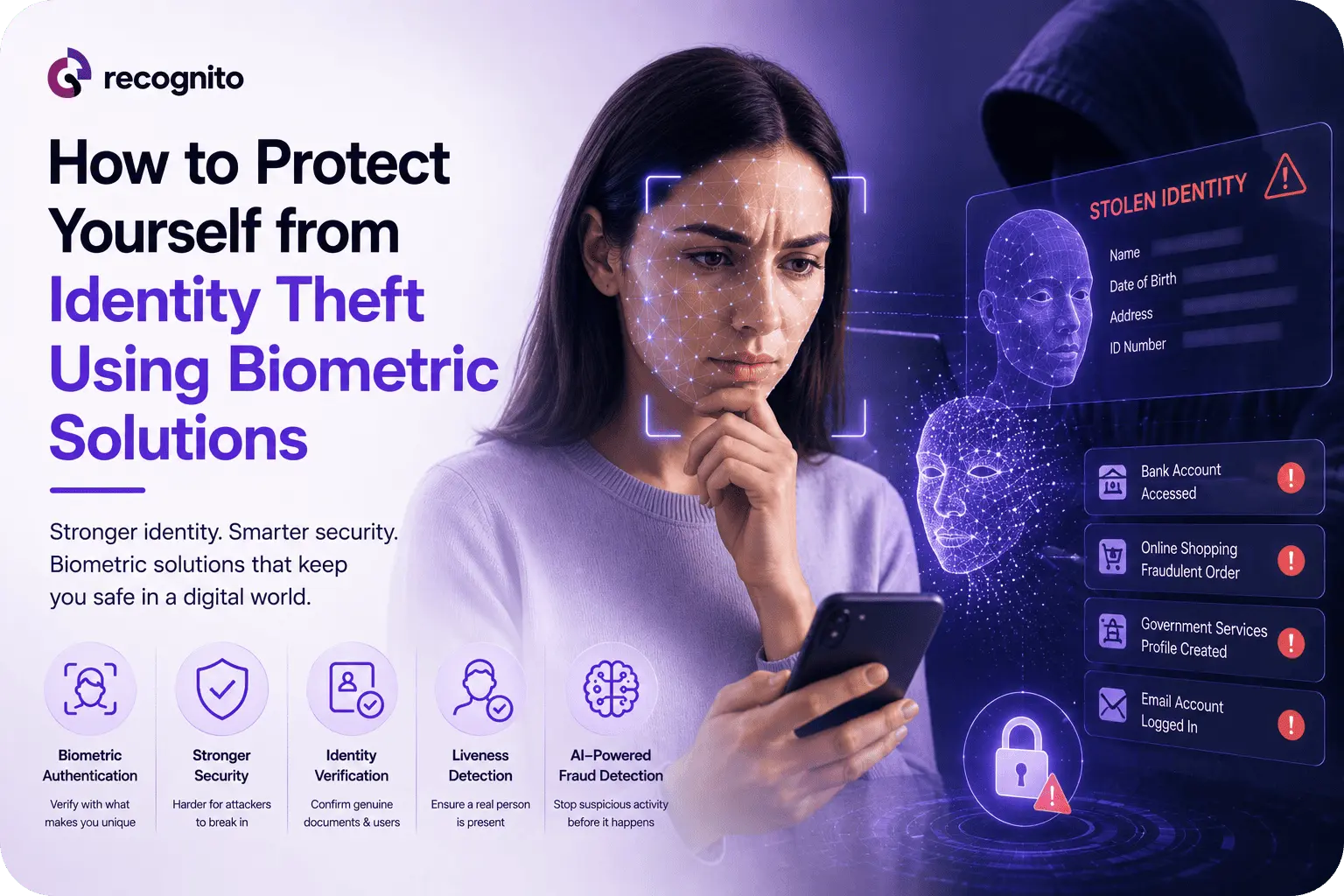
Identity theft rarely begins with someone physically stealing an identity card. More often, criminals obtain pieces of personal information and use them to impersonate the victim online.
Passwords can be guessed or stolen. Personal details can be exposed in data breaches. Identity documents can be copied. Phishing can trick people into surrendering credentials. Once attackers have enough information, they may attempt to open accounts, access existing services, or impersonate the victim during verification.
Biometric technology adds another layer by tying an identity decision to a person’s physical characteristics. Facial recognition, fingerprints, voice, and other biometric signals can make impersonation more difficult because an attacker needs more than copied credentials.
But biometrics are not a magic shield. A face can be photographed. A fingerprint can be lifted from a surface. Biometric systems can also be attacked through spoofing, manipulated media, weak recovery processes, or compromised devices.
The safest strategy is therefore to use biometrics as part of a layered identity-security architecture.
Why Biometrics Can Make Identity Theft Harder
Traditional authentication depends heavily on information that can be transferred from one person to another.
A password can be copied. A one-time code can be intercepted. Personal information can be purchased or obtained through social engineering.
Biometrics introduce a different category of evidence: something connected to the person.
A facial verification system can compare a customer’s face with an enrolled reference. A fingerprint system can compare captured ridge patterns with a stored template. The biometric itself does not establish that every request is legitimate, but it adds an identity signal that is harder to reproduce than a password alone.
NIST’s current digital identity guidance recognizes biometrics as a useful factor while also emphasizing their limitations. Its Digital Identity Guidelines explain how identity proofing and authentication should be designed across a broader digital identity process.
That distinction matters. Biometrics improve identity assurance when they are properly implemented, but they should not replace secure authentication architecture.
Where Identity Theft Happens
Identity theft can occur at several points in the identity lifecycle.
An attacker may first acquire personal information through phishing or a breached service. They may then use it to create a fraudulent account, reset an existing account, or pass a remote identity-verification process.
Account takeover presents another route. A criminal does not need to create a new identity if they can gain access to an existing account through stolen credentials or a weak recovery process.
This is why biometric protection should be used at more than one stage where appropriate.
Biometrics can help establish identity during onboarding, verify the user during sensitive actions, and provide additional assurance during account recovery.
The broader relationship between biometrics and fraud prevention is covered in how biometric verification reduces fraud.
Facial Recognition for Identity Protection
Facial recognition is particularly useful for digital services because modern smartphones already contain cameras.
During verification, a system captures a user’s face and converts the image into biometric features. A matcher then compares those features with an appropriate reference to determine whether the samples are sufficiently similar.
For consumers, the major advantage is convenience. A person can verify identity remotely without visiting a branch or using specialized biometric hardware.
For service providers, the advantage is the ability to connect a digital action with a physical person.
Facial recognition is especially useful for:
- new account verification
- account recovery
- high-risk transactions
- password-reset protection
- remote customer verification
- access to sensitive personal information
Organizations implementing this capability can use a facial recognition SDK to integrate biometric verification into applications and digital workflows.
However, facial matching alone is not enough.
Why Liveness Detection Is Essential
An attacker may have access to a photograph or video of the victim. If a system only checks whether a submitted face resembles a known person, a convincing presentation could potentially produce an incorrect match.
Liveness detection adds another question:
Is the biometric input coming from a live person during the verification event?
Depending on the implementation, liveness systems analyze facial movement, texture, depth-related information, lighting behavior, capture patterns, or other signals to distinguish a live subject from an attempted presentation attack.
This is especially important for remote identity verification, where the service cannot physically inspect the person.
A dedicated face liveness SDK can provide this layer alongside facial matching rather than treating recognition as the only defense.
NIST’s authentication guidance highlights the same underlying issue: biometric characteristics are not secrets. Facial images can be obtained without the user’s cooperation, while fingerprints may be recovered from objects a person touches. Presentation attack detection can reduce these risks, but the complete sensor and authentication architecture still matters.
Fingerprints Still Have an Important Role
Fingerprint recognition remains valuable where a compatible sensor is available.
Modern devices can use fingerprint authentication for local access, while enterprise systems can use fingerprint readers for controlled physical or logical access.
Its main strength is the maturity of the technology and the relatively controlled capture environment created by a dedicated sensor.
However, fingerprints have the same fundamental limitation as other biometrics: they are not secret.
An exposed fingerprint template cannot simply be replaced in the same way as a password. This makes biometric template protection, secure device architecture, and strong recovery mechanisms especially important.
For many consumer applications, facial recognition is easier to deploy because a camera is widely available. In controlled environments, fingerprint authentication may remain highly practical.
Biometrics Should Protect More Than the Login Screen
One of the biggest mistakes is using biometrics only for initial login.
Identity theft often becomes dangerous after an attacker gains access to an account. A criminal who compromises credentials may attempt to change contact information, reset security settings, add a new payment method, or initiate a high-value transaction.
Risk-sensitive systems can use biometric verification again when an action has significant consequences.
For example, a financial service might require biometric verification before:
- changing an account recovery method
- approving a large transfer
- accessing particularly sensitive information
- recovering an account after suspicious activity
- changing identity-related account details
This approach turns biometrics into a continuous identity-assurance mechanism rather than a one-time onboarding feature.
The role of biometrics within broader authentication architecture is discussed in biometric authentication versus traditional authentication methods.
The Biggest Biometric Threats to Understand
Biometric security becomes much easier to manage when the main attack paths are clear.
Stolen biometric information
A person’s face and fingerprints can be captured without permission. That is fundamentally different from a secret password.
Organizations should therefore avoid treating raw biometric data as ordinary application data. Strong access controls, encryption, template protection, and appropriate retention policies are necessary.
Presentation attacks
An attacker may present a photograph, replayed video, artificial fingerprint, mask, or other artifact to imitate the legitimate user.
Liveness and presentation-attack detection are designed to address this class of threat.
Deepfake and manipulated media
Generative tools can make fraudulent visual content more convincing. Remote systems should assume that attackers may attempt to submit manipulated images or video.
Device compromise
A secure biometric algorithm cannot compensate for a compromised capture environment. Malware, application tampering, sensor substitution, or insecure device-to-server communication can undermine the trustworthiness of biometric evidence.
Weak account recovery
Strong biometric authentication becomes less useful when an attacker can simply bypass it through a poorly protected recovery process.
Identity security must therefore extend beyond the primary login mechanism.
How to Build a Strong Biometric Protection Strategy
For individuals, the safest approach is usually to enable biometric authentication on trusted devices while keeping strong account protections around it.
For organizations, implementation should be more deliberate.
| Security layer | Main purpose | Example control |
| Identity proofing | Establish who the user is | Document and biometric verification |
| Biometric matching | Compare identity evidence | Face or fingerprint matching |
| Liveness | Detect presentation attacks | Passive or active liveness checks |
| Authentication | Protect ongoing access | Biometric plus device-bound credentials |
| Risk detection | Identify suspicious behavior | Device, session, and transaction signals |
| Account recovery | Prevent biometric bypass | Strong recovery verification |
| Data protection | Protect biometric information | Encryption, access controls, limited retention |
The strongest architecture does not expect one biometric check to solve every identity problem.
Protect the Biometric Data Itself
Biometric protection creates a paradox: the same information that strengthens identity assurance becomes highly sensitive data once collected.
NIST explains that biometric characteristics do not constitute secrets. That means organizations need to think carefully about what happens if biometric information is exposed.
A well-designed system should minimize unnecessary storage and avoid retaining raw biometric material when the workflow does not require it.
Organizations should establish:
- clear collection purposes
- strict access controls
- encryption in transit and at rest
- retention and deletion policies
- secure template handling
- vendor and processor controls
- incident-response procedures
Privacy requirements vary by jurisdiction. The UK’s Information Commissioner’s Office states that biometric information used for uniquely identifying people receives special protection under UK data-protection rules, and its biometric data guidance explains relevant governance considerations.
The important principle is to protect biometric information according to its sensitivity rather than assuming that brief processing makes it irrelevant from a privacy perspective.
Do Not Rely on Biometrics Alone
Biometric authentication is strongest when combined with another trusted factor or secure device.
NIST’s authentication and authenticator management guidance treats biometrics as subject to important limitations and requires specific architectural controls when they are used for authentication.
For consumers, that means a fingerprint or face should ideally unlock a protected device credential rather than act as the sole protection for every security decision.
For organizations, it means combining biometric evidence with factors such as trusted devices, cryptographic credentials, transaction monitoring, risk assessment, and secure recovery.
This also reduces the impact of a single failed biometric decision.
Why User Experience Still Matters
Security systems fail when users cannot complete them reliably.
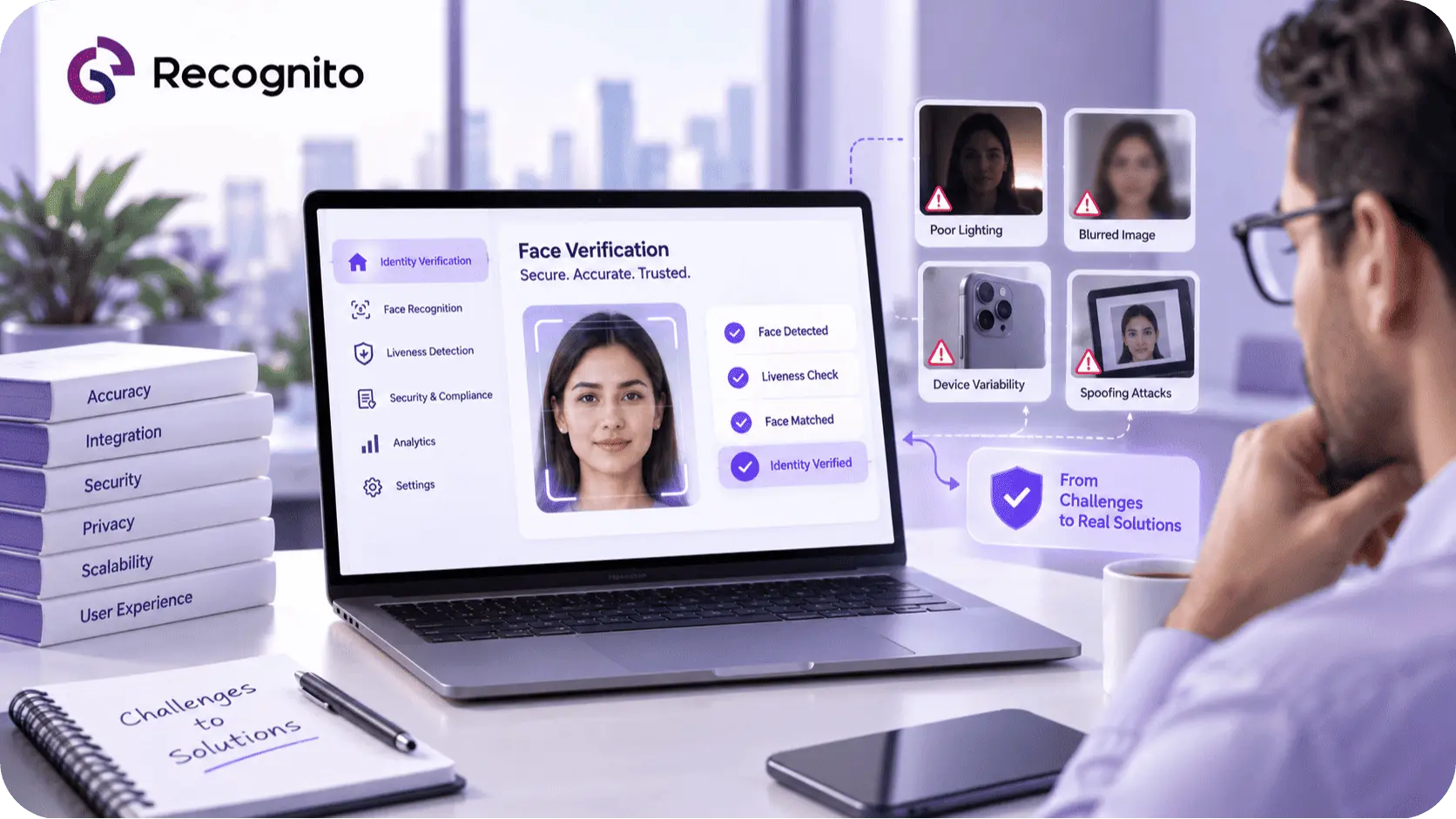
Poor camera conditions, glare, low light, motion blur, damaged fingerprints, sensor problems, or confusing instructions can cause legitimate verification failures.
That creates a difficult trade-off. Increasing security controls without considering usability can push legitimate users toward weaker workarounds or repeated support requests.
A good biometric system should therefore provide:
- clear capture instructions
- real-time quality feedback
- sensible retry limits
- accessible fallback methods
- transparent failure handling
- stronger checks when risk increases
The objective is not to make every interaction difficult. It is to reserve additional friction for situations where stronger assurance is justified.
How Individuals Can Reduce Their Exposure
Biometric technology works best when it complements basic security hygiene.
The Federal Trade Commission recommends monitoring accounts and credit reports, recognizing unfamiliar transactions, and taking steps such as placing a credit freeze when identity theft occurs. Its consumer guidance on how to protect yourself from identity theft provides practical steps for detecting and responding to misuse of personal information.
Biometrics should be viewed as one additional barrier, not a replacement for careful account management.
Individuals should also use unique passwords where passwords remain necessary, enable multi-factor authentication, avoid suspicious links, keep devices updated, and pay attention to unexpected account-recovery messages.
How Organizations Can Evaluate Biometric Solutions
A biometric security product should be evaluated under realistic conditions rather than through a polished demonstration.
Test the system against:
Normal use: Can legitimate users authenticate consistently?
Poor conditions: What happens in low light, with camera movement, or with poor sensor quality?
Presentation attacks: Can common spoofing methods be detected?
Adversarial input: How does the system respond to manipulated images, replay attempts, or unusual capture conditions?
Operational failures: What happens when the biometric service is unavailable?
Recovery: Can an attacker bypass the biometric through account recovery?
Privacy: Is collected biometric information minimized and appropriately protected?
A hands-on biometric face scanner evaluation environment can also help technical teams understand capture behavior and verification workflows before production deployment.
The Role of Biometrics in Account Takeover Prevention
Identity theft and account takeover increasingly overlap.
A criminal may begin with stolen personal information, but the ultimate goal is often access to an account or service. Once credentials are compromised, the attacker needs another way to impersonate the victim.
Biometric verification provides an additional identity signal at precisely that point.
A service can require biometric confirmation when a user attempts to recover an account, change sensitive security information, or perform a transaction that materially increases risk.
The result is a security architecture where possession of stolen information is not necessarily enough to complete the attack.
That makes biometrics particularly useful as a step-up control. Instead of requiring biometric checks for every low-risk action, the system can introduce them when the consequences of identity error become greater.
Practical Rules for Safer Biometric Deployment
Whether you are protecting a personal account or designing a biometric service, several principles remain consistent:
- Treat biometrics as one security layer, not a complete identity solution.
- Use liveness or presentation-attack detection where remote biometric capture is exposed to spoofing.
- Protect biometric templates and minimize unnecessary retention.
- Use secure devices and communications between biometric sensors and verifiers.
- Protect account recovery as carefully as the primary authentication path.
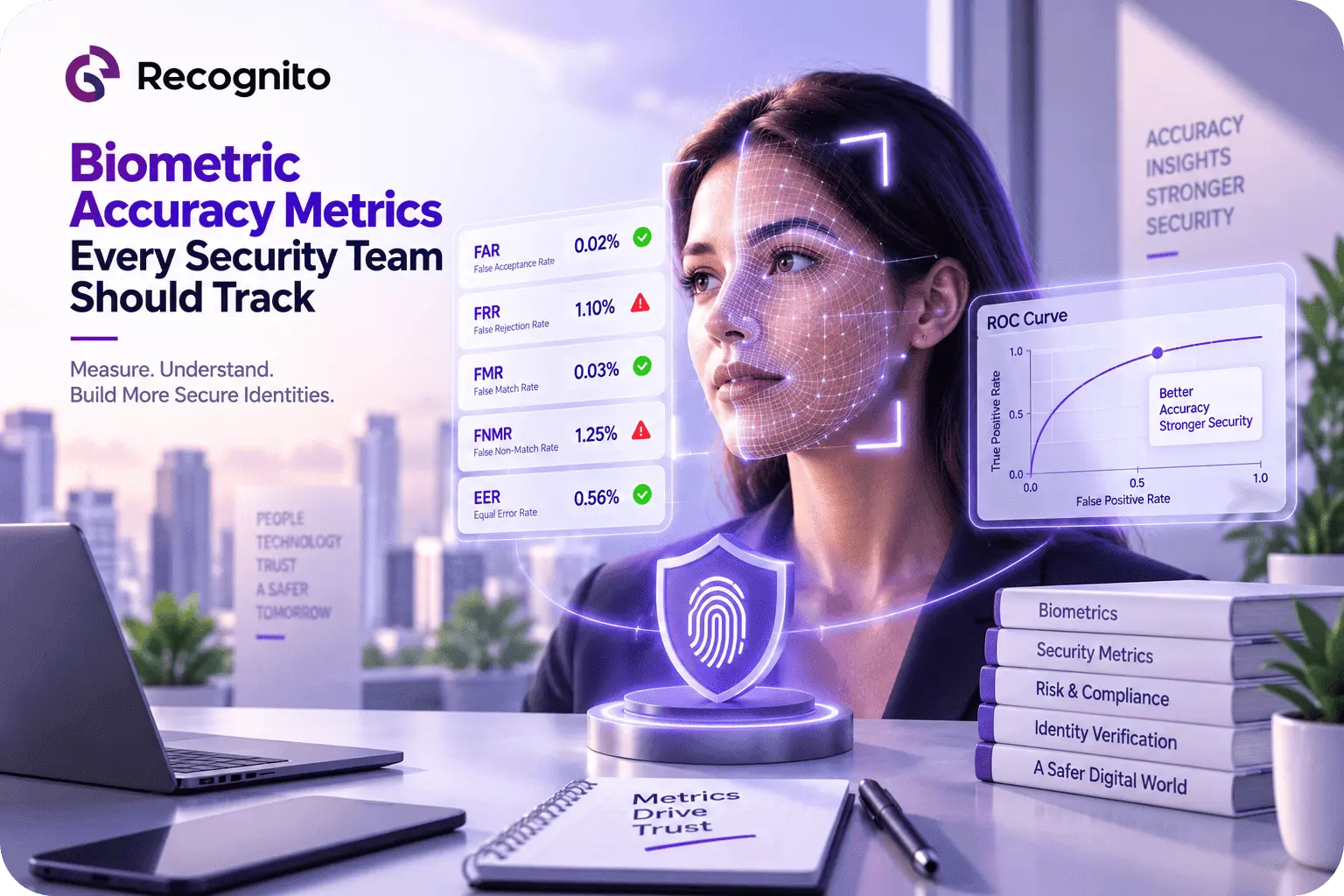
- Monitor false accepts, false rejects, unusual failures, and suspicious account activity.
- Test with realistic users, devices, environments, and attack scenarios.
- Provide secure alternatives for legitimate users who cannot complete biometric verification.
For developers working with biometric implementations, the Recognito GitHub repository provides additional technical resources for exploring biometric development and integration.
Conclusion
Biometric solutions can make identity theft substantially harder by adding evidence that an attacker cannot obtain simply by stealing a password or personal detail. Facial recognition, fingerprint authentication, and liveness detection each address different parts of the identity-security problem.
But the strongest protection comes from layers. Biometrics should work alongside secure devices, strong authentication, fraud detection, protected recovery processes, privacy controls, and continuous monitoring.
For individuals, that means using trusted biometric authentication where appropriate while maintaining strong account-security habits. For organizations, it means designing biometrics as part of a complete identity architecture rather than treating them as a standalone feature.
For businesses building that architecture, Recognito provides biometric technologies that can support identity verification, facial recognition, and liveness-enabled security workflows.
Frequently Asked Questions
Can biometrics completely prevent identity theft?
No. Biometrics add a strong identity signal but cannot prevent every form of identity theft. Attackers can target credentials, recovery processes, devices, biometric capture, or other parts of the security architecture.
Is facial recognition safe to use?
It can be, when implemented with appropriate security and privacy controls. Facial recognition should be combined with liveness, secure processing, access controls, and a carefully designed authentication workflow.
What happens if biometric data is stolen?
Biometric characteristics are difficult to replace, so exposure can have long-term implications. Organizations should minimize retention, protect templates, restrict access, and design systems so biometric data is not unnecessarily exposed.
Is biometric authentication better than passwords?
Biometrics can improve convenience and identity assurance, but they are not universally better in isolation. Strong security usually comes from combining biometrics with secure devices or other authentication factors.
What is the most important biometric protection measure?
There is no single control that solves every risk. For remote facial verification, strong liveness or presentation-attack detection, secure capture, protected biometric data, and a secure recovery process are especially important.