
As businesses continue to expand their digital services, securing user accounts has become more challenging than ever. Financial institutions, fintech companies, healthcare providers, government agencies, e-commerce platforms, and enterprise organizations all need authentication systems that can protect sensitive data without creating unnecessary friction for users.
For decades, passwords, PINs, and security questions formed the foundation of digital security. While these traditional authentication methods are still widely used, they are increasingly vulnerable to phishing attacks, credential theft, brute-force attacks, password reuse, and social engineering. At the same time, users expect faster and more convenient access to online services without sacrificing security.
These evolving expectations have accelerated the adoption of biometric authentication, which verifies a user’s identity using unique biological characteristics rather than information that can be forgotten, guessed, or stolen.
This article compares biometric authentication with traditional authentication methods, explores their strengths and limitations, and explains why many organizations are adopting passwordless authentication to improve both security and user experience.
What Is Biometric Authentication?
Biometric authentication is the process of verifying an individual’s identity using unique physical or behavioural characteristics.
Unlike traditional authentication methods that rely on something a user knows, such as a password or PIN, biometric authentication verifies something the user is, making it significantly more difficult for attackers to replicate.
Common biometric authentication methods include:
- Facial recognition
- Fingerprint recognition
- Voice recognition
- Iris recognition
- Behavioural biometrics
Among these technologies, facial recognition has become one of the most widely adopted because it offers a balance of security, speed, and convenience across mobile devices, desktops, and web applications.
Many organizations integrate biometric verification using a face recognition SDK to authenticate users securely while reducing reliance on passwords.
It’s also important to distinguish authentication from identity verification. Authentication confirms that a returning user is the legitimate account owner, while identity verification establishes trust during customer onboarding. If you’d like to explore this distinction further, our guide on identity proofing vs identity verification explained provides a detailed comparison.
What Are Traditional Authentication Methods?
Traditional authentication methods rely on information or credentials that users possess or remember.
For many years, these methods have been the primary way organizations protected online accounts and digital services.
The most common traditional authentication methods include:
- Passwords
- PIN codes
- Security questions
- One-time passwords (OTP)
- SMS verification codes
- Email verification links
Although these approaches remain widely used, they present several security challenges.
Passwords can be reused across multiple accounts, security questions often rely on publicly available information, and SMS-based authentication has become increasingly vulnerable to SIM swap attacks.
As cyber threats continue evolving, organizations are recognizing that knowledge-based authentication alone is no longer sufficient for protecting sensitive accounts.
The latest guidance published in the NIST Digital Identity Guidelines (SP 800-63B) recommends moving away from weak authentication mechanisms and adopting stronger, phishing-resistant authentication methods wherever possible.
Why Authentication Matters More Than Ever
Digital transformation has dramatically increased the number of online services people use every day.
Customers now access:
- Online banking
- Digital wallets
- Healthcare portals
- Government services
- Investment platforms
- Enterprise applications
- E-commerce accounts
Every login represents a potential target for cybercriminals.
Modern attacks commonly involve:
- Credential stuffing
- Password spraying
- Phishing campaigns
- Account takeover fraud
- Malware
- Social engineering
A single compromised account can expose sensitive personal information, financial assets, or confidential business data.
Organizations therefore need authentication systems that not only verify users accurately but also resist increasingly sophisticated attack methods.
Businesses looking to strengthen authentication security should also understand how compromised credentials contribute to financial crime. Our article on how banks stop account takeover fraud with biometric authentication explains how modern financial institutions use biometrics to defend against unauthorized account access.
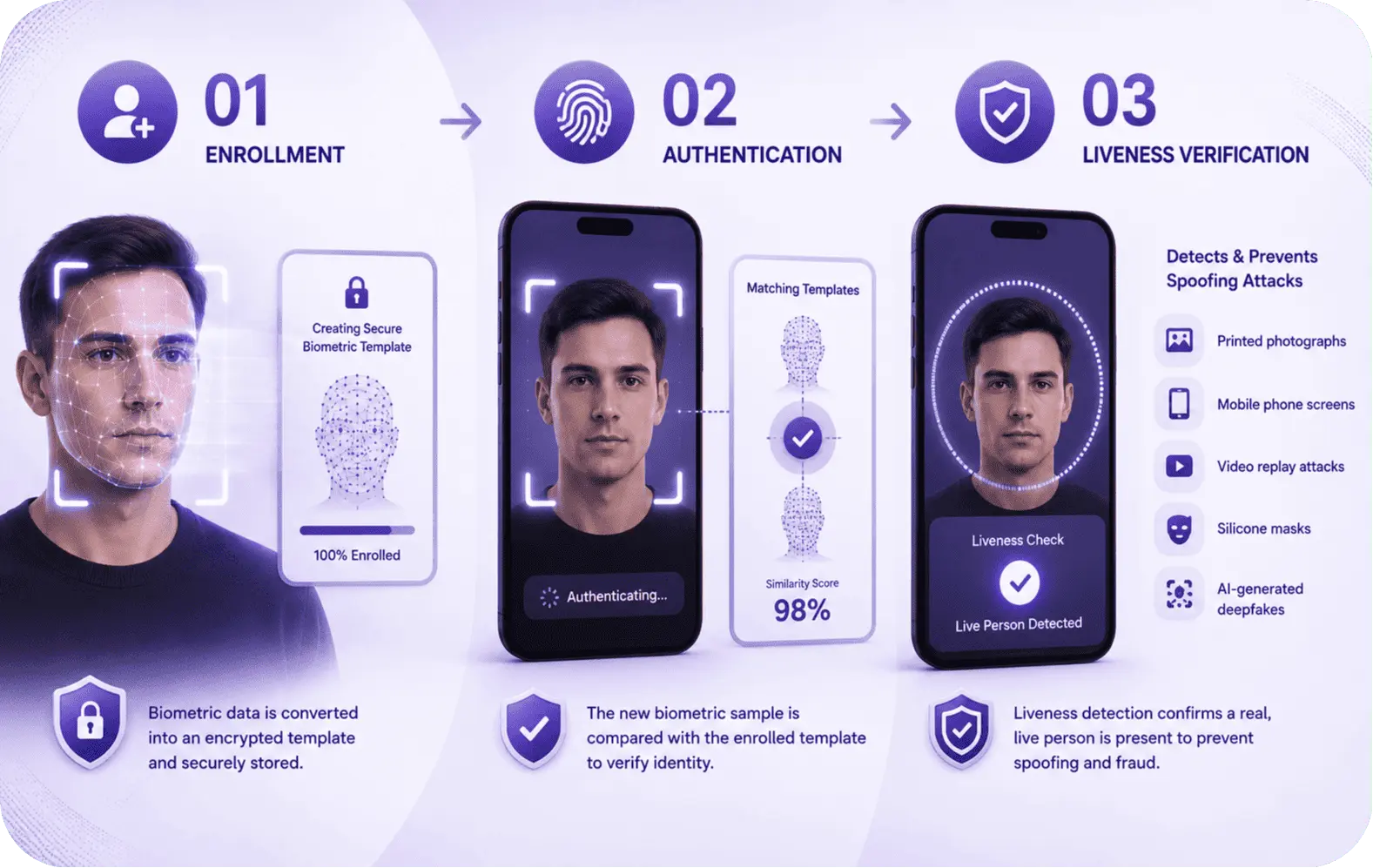
How Biometric Authentication Works
Although different biometric technologies use different algorithms, most follow a similar authentication process.
1. Enrollment
The user first registers a biometric characteristic, such as their face or fingerprint.
Instead of storing an actual photograph or fingerprint image, modern biometric systems create an encrypted mathematical template representing unique characteristics.
This template becomes the trusted reference used during future authentication attempts.
2. Authentication
When the user attempts to log in, a new biometric sample is captured.
The system compares the newly captured biometric template against the enrolled template to determine whether they belong to the same individual.
If the similarity score meets the required threshold, authentication is approved.
3. Liveness Verification
Modern biometric authentication does not rely solely on facial similarity.
Fraudsters increasingly attempt to bypass authentication systems using:
- Printed photographs
- Mobile phone screens
- Video replay attacks
- Silicone masks
- AI-generated deepfakes
To defend against these attacks, organizations increasingly combine facial recognition with the face liveness detection SDK, which helps confirm that a genuine person is physically present during authentication.
If you’re evaluating different implementation approaches, our comparison of active vs passive liveness detection explains how each method contributes to stronger biometric security.
Advantages of Biometric Authentication
The growing adoption of biometric authentication is driven by its ability to improve both security and user experience.
Some of its most significant advantages include:
- Stronger identity assurance
- Reduced reliance on passwords
- Faster login experiences
- Improved fraud prevention
- Lower risk of credential theft
- Better customer convenience
- Support for passwordless authentication
Unlike passwords, biometric characteristics cannot be easily guessed, shared, or reused across multiple services.
When combined with risk-based authentication and device intelligence, biometrics provide organizations with a significantly higher level of confidence that the individual accessing an account is its legitimate owner.
Comparing Biometric and Traditional Authentication
Both biometric authentication and traditional authentication methods are designed to answer the same question:
“Is this person authorized to access the account?”
The difference lies in how they establish that trust.
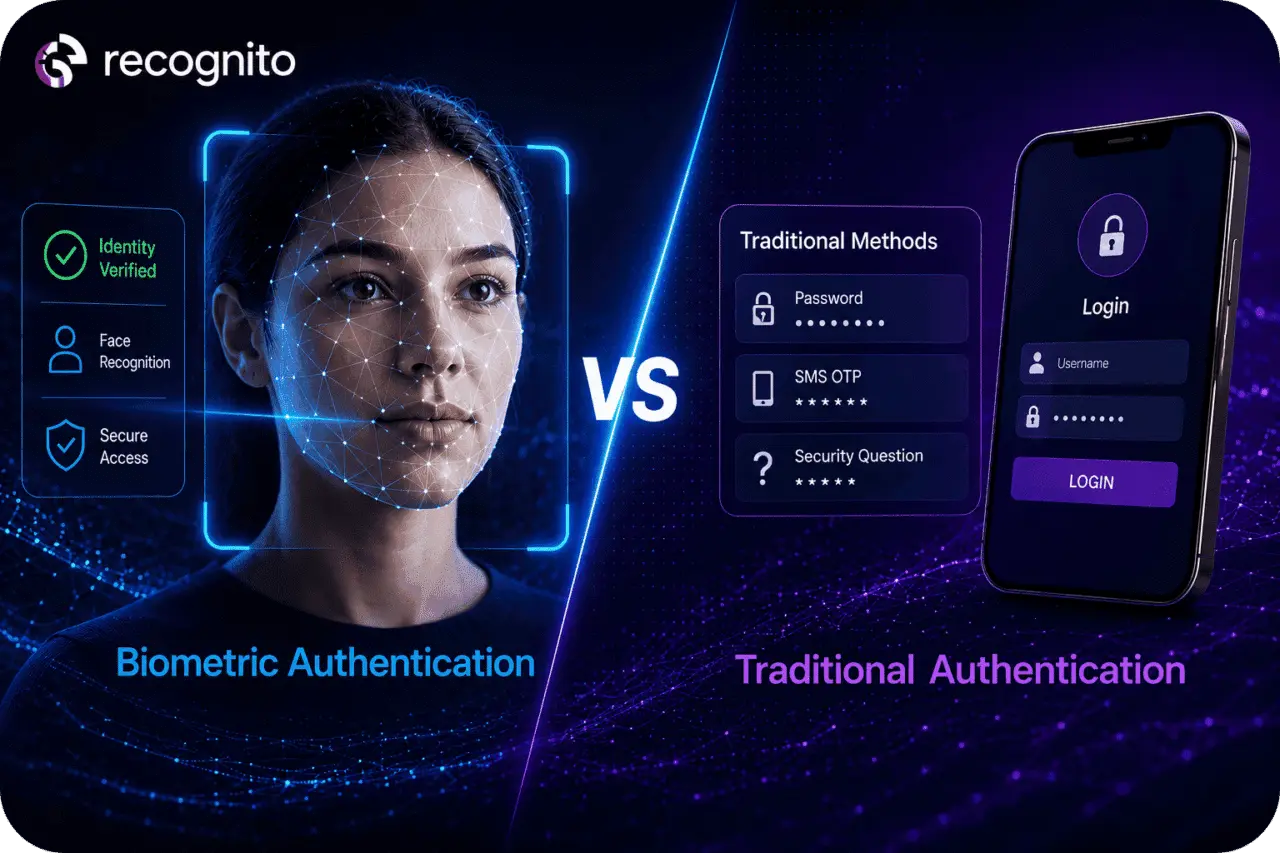
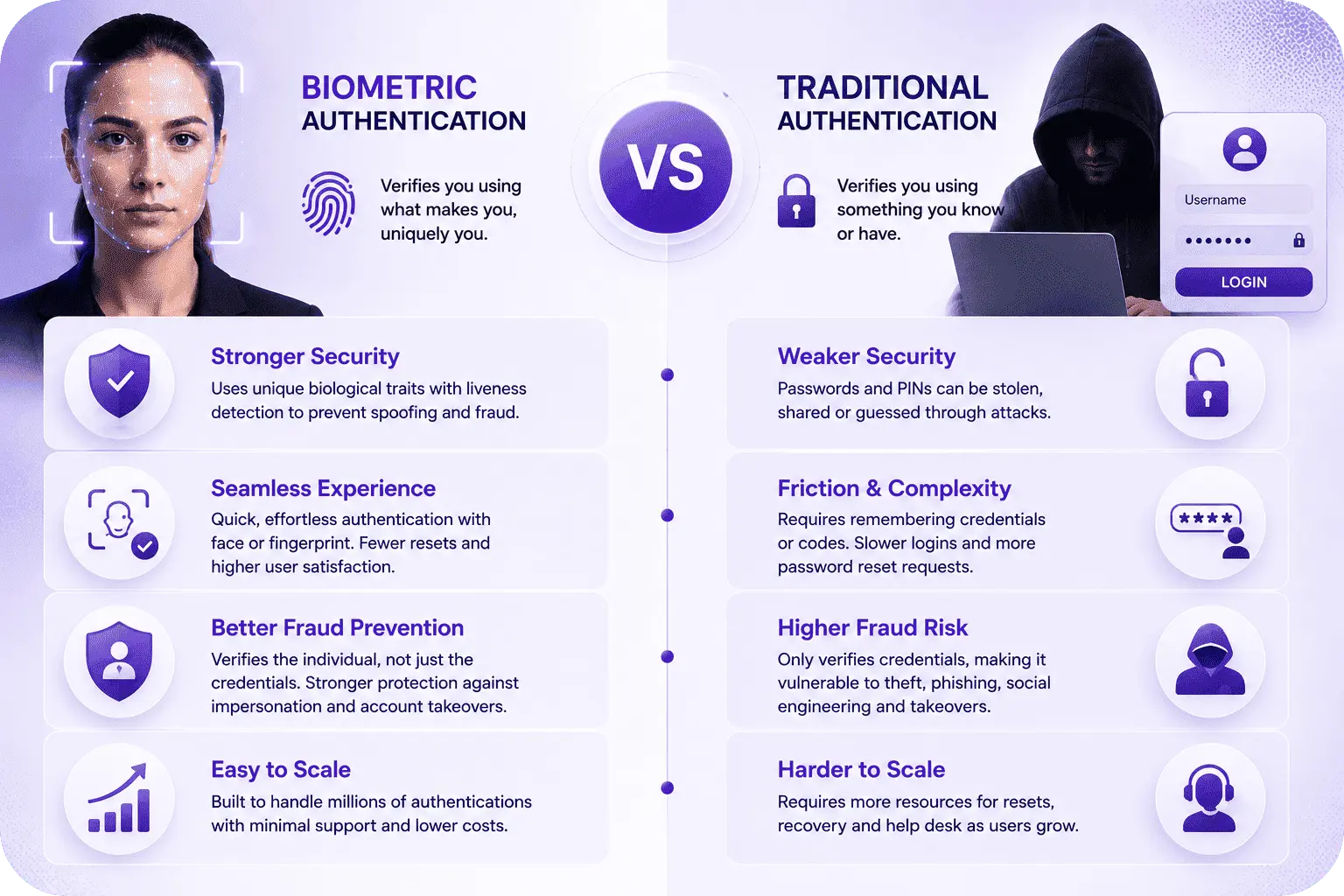
Traditional authentication relies on credentials that users know or possess, whereas biometric authentication verifies characteristics that are unique to the individual. This distinction has significant implications for security, usability, and fraud prevention.
Let’s compare the two approaches across the factors that matter most.
Security
Security is one of the biggest reasons organizations are moving toward biometric authentication.
Passwords and PINs can be stolen through phishing attacks, data breaches, malware, or credential stuffing. Even when users create strong passwords, many still reuse them across multiple accounts, increasing the impact of a single breach.
Biometric authentication significantly reduces these risks because biometric characteristics cannot simply be guessed or copied like passwords.
However, biometric authentication is most effective when combined with additional safeguards such as liveness detection. Without these protections, attackers may attempt to use printed photographs, replay videos, or AI-generated deepfakes to impersonate legitimate users.
Organizations implementing biometric security often combine facial recognition with the face liveness detection SDK to prevent spoofing attacks and strengthen authentication.
Businesses interested in emerging biometric threats can also explore our guide on deepfake attack prevention strategies, which explains how modern verification systems defend against AI-generated fraud.
User Experience
Customers increasingly expect authentication to be both secure and effortless.
Typing complex passwords, remembering security questions, or entering one-time verification codes can slow down the login process and frustrate users.
Biometric authentication simplifies this experience by allowing users to verify their identity using a quick facial scan or fingerprint.
Instead of remembering credentials, users authenticate with characteristics they naturally possess.
The benefits include:
- Faster logins
- Fewer password reset requests
- Reduced user frustration
- Improved accessibility
- Better customer satisfaction
For organizations with digital onboarding workflows, this seamless experience often leads to higher completion rates and improved customer retention.
Businesses designing secure onboarding experiences can also read our guide on remote customer onboarding best practices, which explores how authentication and identity verification work together to improve customer journeys.
Fraud Prevention
Traditional authentication methods primarily verify that a user knows the correct credentials.
They do not verify whether the individual entering those credentials is actually the legitimate account owner.
This limitation makes traditional authentication vulnerable to:
- Credential theft
- Phishing
- Social engineering
- Password reuse
- Account takeover attacks
Biometric authentication provides an additional layer of identity assurance by verifying the individual rather than the credentials.
When combined with document verification, behavioural analytics, and liveness detection, biometrics significantly improve fraud prevention.
Organizations looking to strengthen digital security can also learn how document fraud detection techniques help identify forged identity documents before fraudulent accounts are approved.
Scalability
As organizations grow, authentication systems must support increasing numbers of users without sacrificing performance or security.
Traditional authentication often requires ongoing operational resources for:
- Password resets
- Account recovery
- Credential management
- Help desk support
These administrative costs increase alongside the user base.
Biometric authentication reduces many of these challenges by minimizing reliance on passwords and simplifying account access.
Modern biometric platforms are designed to support millions of authentication requests while maintaining high levels of accuracy and performance.
The Role of Multi-Factor Authentication (MFA)
Although biometric authentication provides strong identity assurance, many organizations choose to combine it with additional security measures through Multi-Factor Authentication (MFA).
MFA requires users to verify their identity using two or more authentication factors.
These factors generally fall into three categories:
- Something you know (password or PIN)
- Something you have (mobile device or security token)
- Something you are (biometric authentication)
For example, a banking application may require:
- A trusted mobile device
- Facial recognition
- A one-time verification code for high-risk transactions
This layered approach significantly reduces the likelihood of unauthorized account access.
Organizations following the authentication guidance published by the FIDO Alliance increasingly combine biometrics with cryptographic authentication to create phishing-resistant login experiences.
Passwordless Authentication
One of the biggest trends shaping modern cybersecurity is the move toward passwordless authentication.
Rather than requiring users to remember complex passwords, passwordless authentication relies on trusted devices, biometrics, and cryptographic credentials to verify identity.
This approach addresses many of the weaknesses associated with traditional passwords.
Key benefits include:
- Reduced phishing risk
- Elimination of password reuse
- Faster authentication
- Lower IT support costs
- Improved customer experience
Financial institutions, healthcare organizations, and enterprise businesses are increasingly adopting passwordless authentication to improve both security and usability.
As organizations transition toward passwordless environments, biometric authentication is expected to play an increasingly central role in everyday account access.
Common Challenges of Biometric Authentication
Despite its advantages, biometric authentication is not without challenges.
Organizations should carefully evaluate implementation requirements before deploying biometric systems at scale.
Privacy and Data Protection
Biometric information is highly sensitive.
Organizations must ensure biometric data is securely processed, encrypted, and stored in accordance with applicable privacy regulations.
Businesses operating internationally should ensure their authentication programs comply with the General Data Protection Regulation (GDPR) and other relevant privacy laws when handling biometric information.
Presentation Attacks
Cybercriminals continue developing increasingly sophisticated spoofing techniques using:
- Deepfake videos
- Printed photographs
- Replay attacks
- Silicone masks
- AI-generated facial imagery
Organizations relying solely on facial matching may remain vulnerable to these attacks.
Combining facial recognition with advanced liveness detection significantly reduces these risks while maintaining a seamless user experience.
User Acceptance
Although biometric authentication adoption continues to grow, some users remain hesitant to share biometric information due to privacy concerns.
Organizations can build trust by being transparent about how biometric data is collected, processed, protected, and used while following recognised industry standards and privacy best practices.
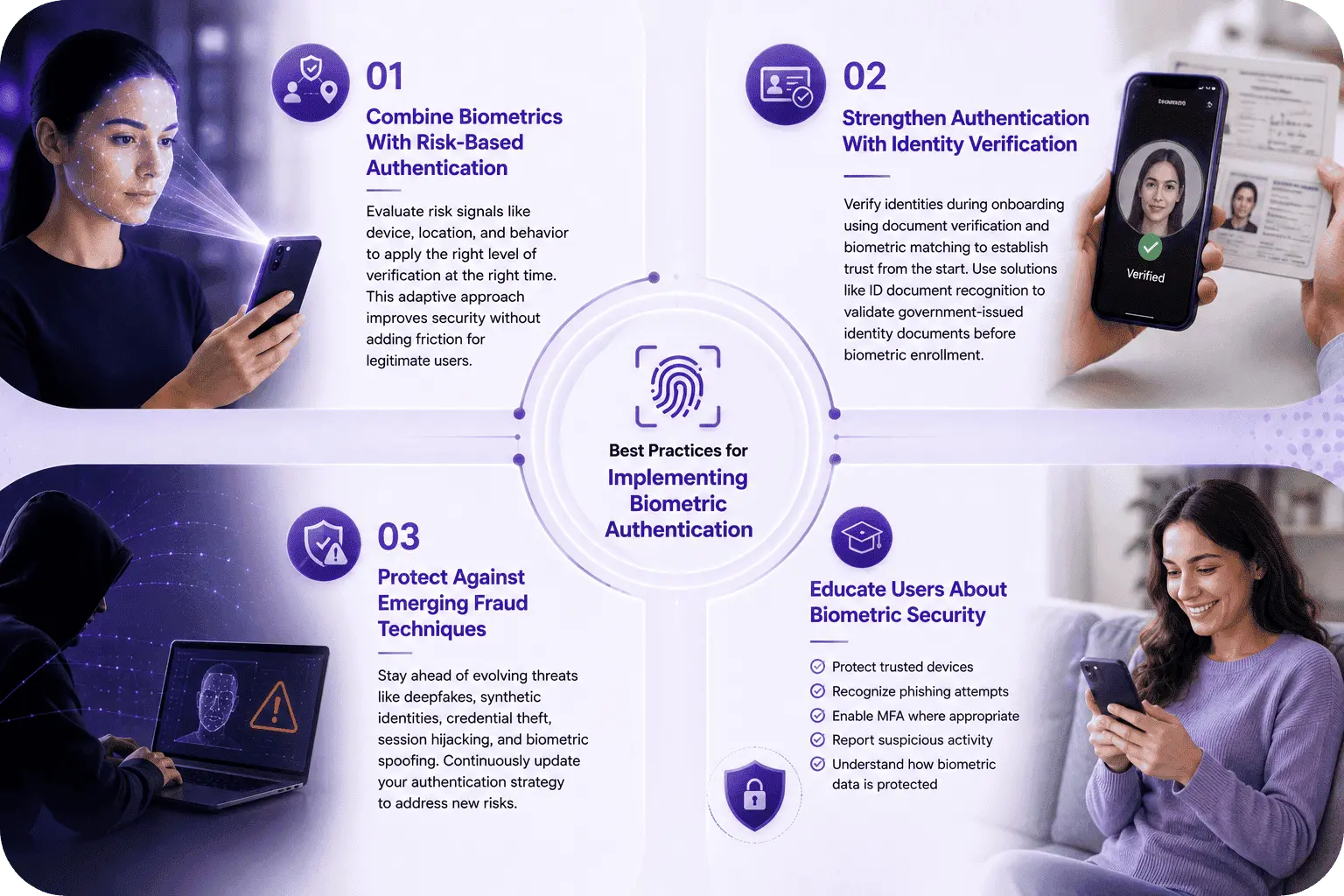
Best Practices for Implementing Biometric Authentication
Adopting biometric authentication involves more than replacing passwords with facial recognition or fingerprints. Organizations should implement a layered authentication strategy that balances security, privacy, compliance, and user experience.
The following best practices can help businesses maximize the effectiveness of biometric authentication.
1. Combine Biometrics With Risk-Based Authentication
Biometric authentication is highly secure, but it should not operate in isolation.
The strongest authentication frameworks evaluate additional risk signals before granting access. These signals may include device reputation, login location, behavioral patterns, and transaction risk.
For example, a user logging in from a trusted device may only require facial authentication, while an attempt from an unfamiliar location could trigger additional verification.
This adaptive approach improves security without creating unnecessary friction for legitimate users.
2. Strengthen Authentication With Identity Verification
Authentication confirms that a returning user is the legitimate account owner, but it does not establish trust during the initial onboarding process.
Organizations should first verify customer identities before relying on biometric authentication for future logins.
Modern onboarding platforms often combine document verification with biometric matching to establish a trusted identity from the beginning. Businesses implementing digital onboarding can strengthen this process using the id document recognition SDK to validate government-issued identity documents before biometric enrollment.
Understanding the difference between onboarding and authentication is essential for building secure identity ecosystems. Businesses looking to strengthen their onboarding strategy can also explore our guide on AML verification and identity verification in customer onboarding.
3. Protect Against Emerging Fraud Techniques
Cybercriminals continue to develop increasingly sophisticated methods for bypassing authentication systems.
Modern threats include:
- AI-generated deepfakes
- Synthetic identities
- Credential theft
- Session hijacking
- Biometric spoofing
Organizations should continuously update their authentication strategies to address these evolving risks rather than relying on static security controls.
For financial institutions in particular, understanding how fraud evolves is critical. Our article on how financial institutions detect synthetic identity fraud explains how advanced identity verification technologies help identify fraudulent applicants before accounts are approved.
4. Educate Users About Biometric Security
Even the most advanced authentication system benefits from informed users.
Organizations should educate customers about:
- Protecting trusted devices
- Recognizing phishing attempts
- Enabling multi-factor authentication where appropriate
- Reporting suspicious account activity
- Understanding how biometric data is protected
Building user confidence encourages greater adoption while reducing security risks caused by human error.
The Future of Authentication
Authentication is evolving rapidly as organizations move away from password-dependent security models.
Rather than relying on credentials that can be stolen or forgotten, businesses are adopting intelligent authentication systems that continuously evaluate user identity throughout the customer journey.
Several trends are expected to shape the future of authentication.
Continuous Authentication
Authentication is no longer limited to the login screen.
Modern systems continuously evaluate user behavior after access has been granted.
Signals such as typing patterns, device usage, geolocation, transaction behavior, and biometric confidence can help identify suspicious activity during an active session.
If unusual behavior is detected, organizations can request additional verification before allowing sensitive actions.
AI-Powered Authentication
Artificial intelligence is transforming authentication by analyzing large volumes of behavioral and contextual data in real time.
Instead of relying solely on predefined rules, AI-driven authentication platforms evaluate:
- Login history
- Device intelligence
- Behavioral biometrics
- Network reputation
- Biometric confidence
- Risk indicators
This allows organizations to make more accurate authentication decisions while minimizing false positives.
Passwordless Digital Experiences
Passwords continue to be one of the weakest components of digital security.
As authentication technologies mature, organizations are increasingly replacing passwords with biometrics, trusted devices, and cryptographic authentication.
Industry initiatives led by the FIDO Alliance continue accelerating the adoption of passwordless authentication across financial services, healthcare, government, and enterprise environments.
Organizations investing in these technologies today will be better positioned to improve both security and customer experience.
Choosing the Right Biometric Authentication Solution
Not every biometric authentication platform offers the same level of security, scalability, or fraud resistance.
When evaluating providers, organizations should consider factors such as:
- Authentication accuracy
- Liveness detection performance
- Cross-platform compatibility
- Scalability
- Privacy and compliance support
- Integration flexibility
- Developer documentation
- Independent benchmark performance
Solutions that combine facial recognition, liveness detection, document verification, and identity verification within a single platform often reduce implementation complexity while strengthening overall security.
Development teams interested in implementation resources can explore the official Recognito GitHub repository for SDK documentation, sample projects, and integration guides.
Conclusion
As digital services continue to expand, organizations need authentication methods that provide stronger security without compromising user experience. Traditional authentication methods such as passwords and PINs remain widely used, but they are increasingly vulnerable to phishing, credential theft, and account takeover attacks.
Biometric authentication addresses many of these challenges by verifying unique physical characteristics that are significantly more difficult to steal or replicate. When combined with liveness detection, identity verification, and risk-based authentication, biometrics provide a more secure and seamless alternative to traditional authentication methods.
While passwords are unlikely to disappear overnight, the industry is steadily moving toward passwordless authentication powered by biometrics and intelligent risk analysis. Organizations that adopt these technologies today will be better equipped to reduce fraud, strengthen customer trust, and meet the growing security expectations of the digital economy.
Frequently Asked Questions
What is biometric authentication?
Biometric authentication is the process of verifying a user’s identity using unique biological or behavioral characteristics, such as facial recognition, fingerprints, voice recognition, or iris scans.
Is biometric authentication more secure than passwords?
In most cases, yes. Biometric authentication is generally more secure because biometric characteristics are significantly harder to steal, guess, or reuse than traditional passwords. When combined with liveness detection and risk-based authentication, it provides even stronger protection against fraud.
What is passwordless authentication?
Passwordless authentication allows users to access accounts without entering a password. Instead, it relies on trusted devices, biometrics, security keys, or cryptographic credentials to verify identity.
Can biometric authentication be used with MFA?
Yes. Biometric authentication is commonly integrated into Multi-Factor Authentication (MFA) solutions alongside other authentication factors such as trusted devices or one-time verification codes to provide additional security.
What are the most common biometric authentication methods?
The most widely used biometric authentication methods include facial recognition, fingerprint recognition, voice recognition, iris recognition, and behavioral biometrics.
Which industries benefit from biometric authentication?
Biometric authentication is widely used across banking, fintech, healthcare, government services, insurance, telecommunications, e-commerce, travel, and enterprise security to strengthen authentication, reduce fraud, and improve user experience.