
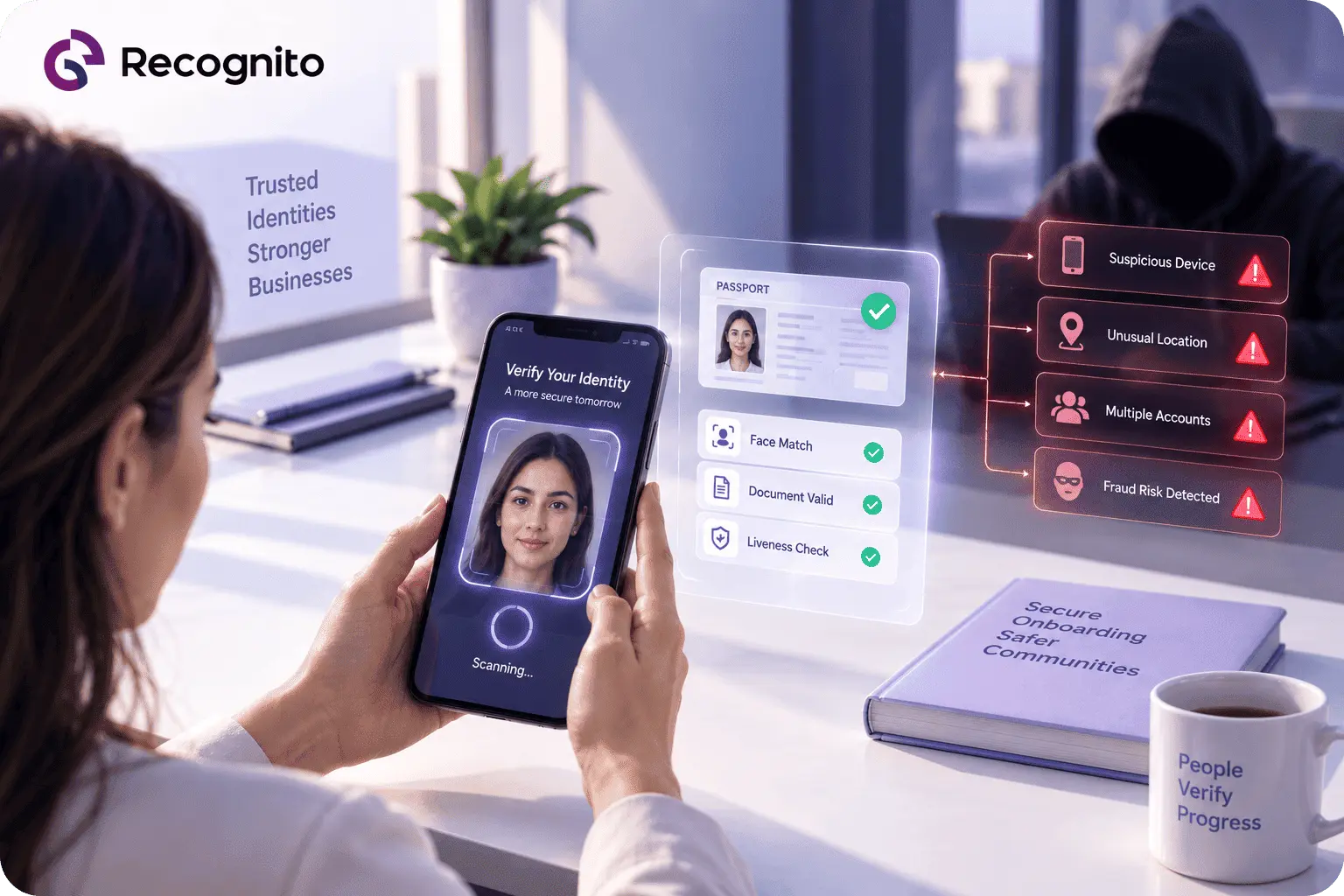
Digital customer onboarding has made financial services, fintech platforms, payment products, marketplaces, and other online services significantly easier to access.
A customer can often open an account without visiting a branch, submitting physical paperwork, or speaking with an employee. But the same convenience creates opportunities for fraudsters who can operate remotely, automate applications, use stolen information, and combine multiple techniques to make fraudulent identities appear legitimate.
This makes identifying fraud risk indicators during onboarding increasingly important.
A suspicious application rarely announces itself through one obvious signal. More often, risk becomes visible when several pieces of information do not make sense together. A document may appear authentic while the device is associated with unusual activity. A facial match may be weak while the applicant is attempting repeated verification. An identity may look legitimate but have behavioral characteristics associated with a coordinated fraud operation.
For this reason, modern digital onboarding should evaluate multiple signals rather than relying on a single verification check.
This article explains the most important fraud risk indicators organizations should monitor during customer onboarding and how identity verification, biometrics, device intelligence, and risk-based decisioning can work together.
Why Fraud Risk Detection Starts During Onboarding
Customer onboarding is one of the first major opportunities for a business to establish trust.
Before opening an account, issuing a financial product, or providing access to a service, an organization usually needs to determine whether the applicant is genuine and whether the identity being presented is credible.
If weaknesses are missed at this stage, the fraudulent account can become much more difficult to manage later.
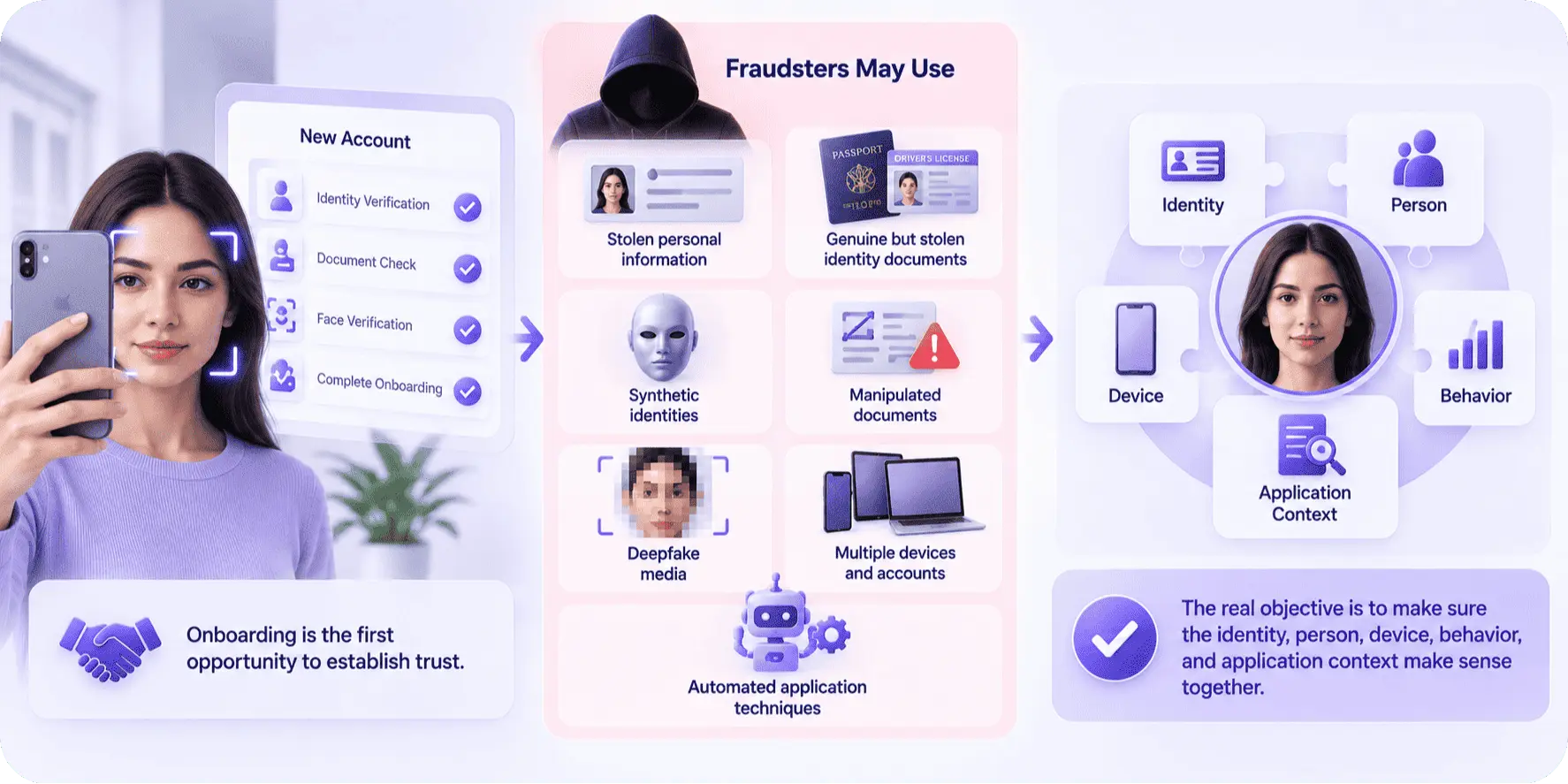
Fraudsters may use:
- Stolen personal information
- Genuine but stolen identity documents
- Synthetic identities
- Manipulated documents
- Deepfake media
- Multiple devices and accounts
- Automated application techniques
The challenge is therefore not simply verifying the customer’s name or document.
The real objective is to determine whether the identity, person, device, behavior, and application context make sense together.
What Are Fraud Risk Indicators?
Fraud risk indicators are signals or patterns that may suggest an onboarding application deserves additional scrutiny.
They do not necessarily prove that an applicant is fraudulent.
A single unusual signal could have a legitimate explanation. A customer may be traveling, using a new device, entering information incorrectly, or experiencing poor network conditions.
The value comes from combining multiple signals and understanding their context.
For example, a new device by itself may not be suspicious. A new device combined with repeated identity verification failures, inconsistent location information, multiple accounts, and unusual application behavior creates a much stronger risk signal.
This is why modern fraud systems increasingly use risk-based decisioning instead of simple rules that automatically reject applicants.
1. Inconsistent Identity Information
One of the most basic fraud indicators is inconsistency between the information provided during onboarding and the information contained in supporting evidence.
Examples can include differences between:
- Name and document information
- Date of birth and identity records
- Address information
- Phone number and country
- Document information and application data
Some inconsistencies are caused by legitimate errors.
The goal is therefore not to reject every mismatch automatically, but to determine whether the discrepancy should trigger another verification step.
Strong identity verification software should be capable of identifying inconsistencies while allowing the organization to apply context and risk thresholds.
2. Suspicious Identity Document Signals
Identity documents remain an important source of evidence during digital onboarding, but they can also become a major attack surface.
Fraudsters may use:
- Altered documents
- Forged documents
- Expired credentials
- Reproductions
- Manipulated digital images
- Documents belonging to another person
Document verification can examine the document structure and available authenticity indicators, but the result should be considered alongside other signals.
An ID document recognition SDK can support automated analysis as part of a wider customer verification workflow.
The important consideration is that a document appearing authentic does not automatically establish that the person presenting it is the legitimate owner.
That distinction is critical for fraud prevention.
3. Face-to-Document Mismatch
A genuine document can be used by the wrong person.
This creates one of the clearest reasons to combine document verification with biometrics during higher-risk onboarding.
Facial verification can compare the applicant’s facial sample with the trusted photograph associated with the submitted identity.
A significant mismatch may indicate:
- Identity impersonation
- Stolen identity documents
- Incorrect document ownership
- Poor-quality facial capture
- An unsuccessful verification attempt
Organizations using an enterprise face verification SDK can add this biometric comparison to the onboarding process.
The result should not be interpreted without considering image quality and other factors, but a consistent mismatch can be an important fraud risk indicator.
4. Repeated Verification Attempts
Repeated attempts are another useful signal.
A legitimate customer may need to retry because of poor lighting or an unsuitable document image. However, a large number of attempts within a short period can also indicate that someone is repeatedly trying to bypass the verification process.
Organizations should monitor:
- Number of attempts
- Time between attempts
- Changes in identity information
- Changes in devices
- Changes in document images
- Changes in facial samples
Repeated failures become more meaningful when the underlying information changes between attempts.
For example, multiple failed attempts using different identity documents and different personal details may present a considerably higher risk than two failed captures caused by poor lighting.
5. Suspicious Device Characteristics
The device being used for onboarding can reveal valuable context.
A customer may normally use one device, while a fraudster may operate from infrastructure associated with:
- Multiple accounts
- Emulators
- Automated activity
- Proxy or VPN networks
- Suspicious device configurations
- Unusual browser characteristics
Device intelligence can therefore provide a useful layer around identity verification.
A suspicious device does not necessarily mean the customer is fraudulent. Privacy-conscious customers may use VPNs, travelers may access services from unusual locations, and shared devices can produce legitimate anomalies.
The key is to combine device signals with identity, biometric, behavioral, and application information.
6. Multiple Identities Connected to the Same Environment
A coordinated fraud operation may involve many identities rather than one fraudulent application.
This creates an opportunity for organizations to detect patterns across applications.
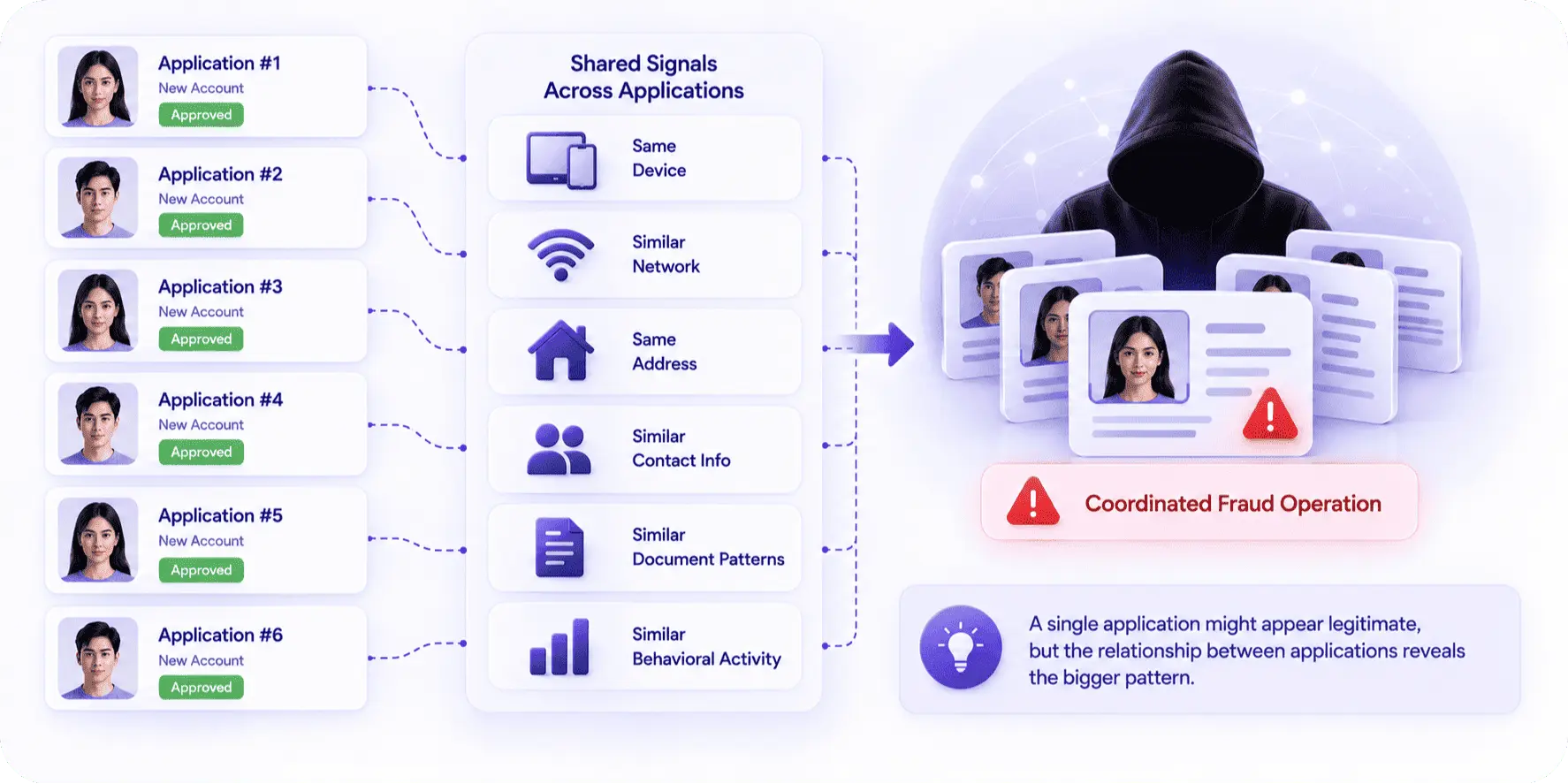
For example, several new accounts may share:
- The same device
- Similar network characteristics
- The same address
- Similar contact information
- Similar document patterns
- Similar behavioral activity
A single application might not appear suspicious in isolation.
The relationship between applications can reveal the broader fraud pattern.
This is particularly relevant to synthetic identity fraud and organized onboarding attacks, where fraudsters may create multiple apparently unrelated identities.
7. Unusual Geographic Signals
Geographic inconsistencies can provide another risk signal.
For example, an application may contain one location while the device, IP address, or other network signals indicate a significantly different environment.
However, location should never be treated as definitive proof of fraud.
Customers travel. VPNs exist. Mobile networks can route traffic through unexpected locations.
Geographic information is therefore more useful as a contextual risk signal.
A location mismatch combined with other anomalies may justify additional verification, while a location mismatch by itself may not.
8. Abnormal Customer Behavior
Behavioral signals can help identify patterns that are difficult to detect from identity information alone.
During digital onboarding, organizations can examine factors such as:
- Unusually rapid form completion
- Repeated navigation patterns
- Multiple failed attempts
- Unusual interaction timing
- Automated behavior
- Repeated account creation attempts
The objective is not to profile customers unnecessarily.
It is to identify interactions that differ materially from the expected onboarding pattern.
Behavioral analysis becomes particularly useful when combined with device and identity signals.
9. Biometric Verification Failures
Biometric verification failures can be another important indicator.
A failed facial match does not automatically mean fraud.
There are many legitimate reasons for failure, including poor image quality, an unsuitable camera angle, insufficient lighting, or changes in appearance.
However, repeated biometric failures combined with other anomalies can significantly increase risk.
Organizations should therefore track both the outcome and the context.
A sensible system distinguishes between:
Low-quality capture
and
Repeated suspicious biometric mismatch
The response to each may be very different.
10. Failed Liveness Verification
Liveness detection provides another important signal during remote onboarding.
A customer may pass facial similarity checks while still presenting a photograph, replay, or other artificial biometric sample.
A liveness detection SDK can help assess whether the biometric presentation appears to come from a genuine live subject.
Liveness failures can result from legitimate capture problems, so they should not automatically trigger rejection.
However, repeated liveness failures, especially when combined with suspicious device activity or repeated identity attempts, can become a meaningful fraud indicator.
For organizations assessing this security layer, understanding presentation attack detection can help clarify why biometric matching and capture security should be evaluated separately.
11. Synthetic Identity Patterns
Synthetic identity fraud is particularly difficult because the applicant’s information can look legitimate.
Fraudsters may combine real and fabricated data to build identities that can pass basic checks.
Potential indicators include:
- Newly created identity profiles
- Unusual combinations of real and fabricated information
- Rapid account creation
- Multiple related applications
- Limited historical identity information
- Repeated activity across connected devices
The right response is not necessarily to reject every new identity.
Instead, organizations should combine identity, behavioral, device, biometric, and historical signals to determine whether the overall profile presents elevated risk.
Recognito’s guide on how financial institutions detect synthetic identity fraud explores this specific fraud pattern in greater depth.
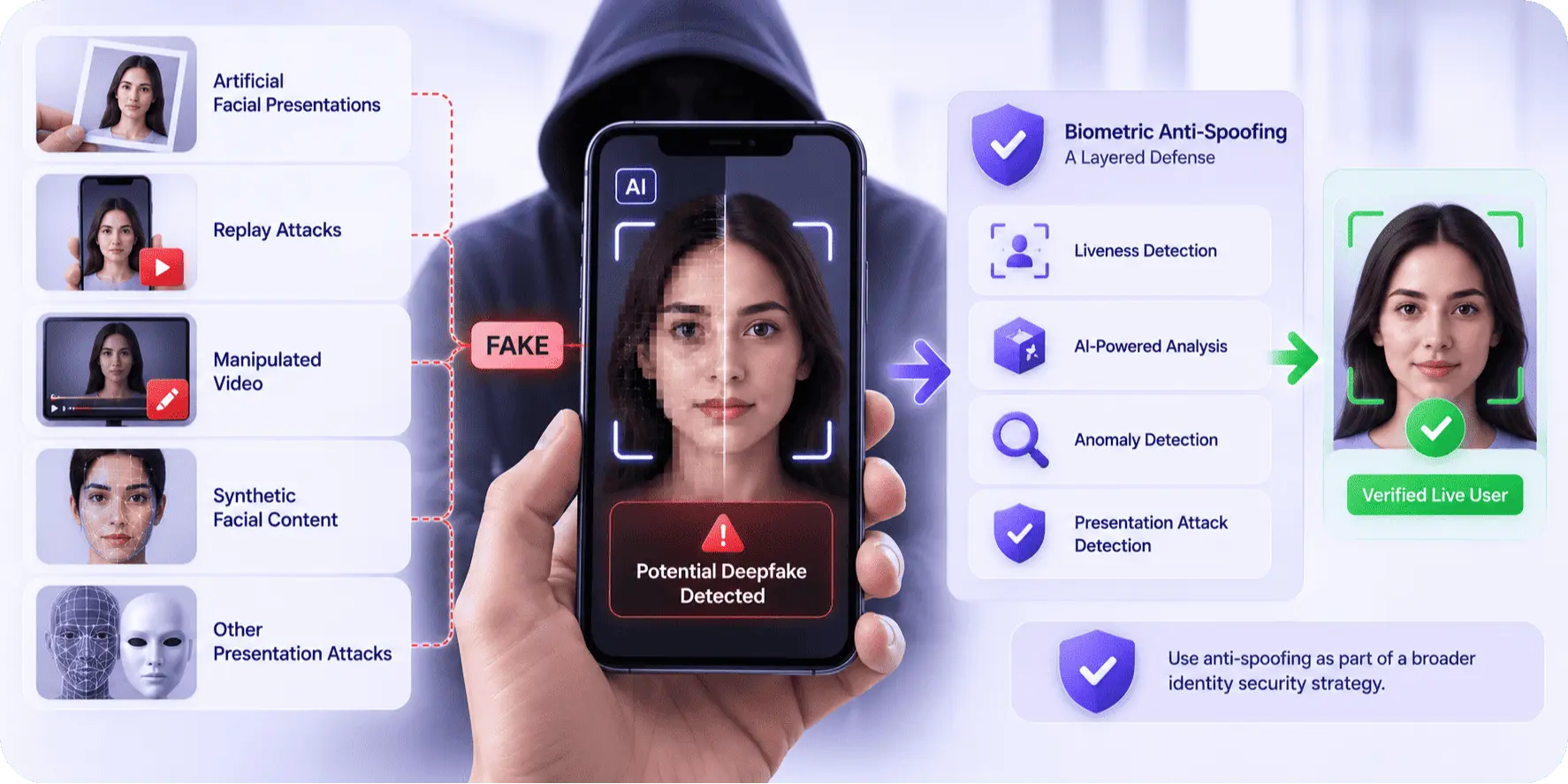
12. Deepfake and Synthetic Media Indicators
Generative AI has created new challenges for biometric onboarding.
Fraudsters can use manipulated images, synthetic faces, altered video, and other forms of generated media to attempt to deceive remote verification systems.
This makes biometric presentation security increasingly important.
Organizations should consider whether their onboarding workflow can address:
- Artificial facial presentations
- Replay attacks
- Manipulated video
- Synthetic facial content
- Other presentation attacks
A biometric anti-spoofing SDK can form part of a layered defense, but it should be evaluated alongside the rest of the identity architecture rather than treated as a complete deepfake solution.
How Multiple Risk Indicators Should Be Combined
The most important principle in fraud risk detection is that signals should not be viewed independently.
A single warning sign may be harmless.
Multiple signals pointing in the same direction are more meaningful.
| Risk Indicator | Possible Legitimate Explanation | When It Becomes More Concerning |
| New device | Customer replaced their phone | Device is linked to many new accounts |
| Location mismatch | Travel or VPN use | Combined with identity and device anomalies |
| Failed face match | Poor image quality | Repeated failures with changing identity details |
| Liveness failure | Capture problem | Repeated failures with other suspicious signals |
| Document mismatch | Data-entry mistake | Multiple inconsistent documents |
| Multiple applications | Family or business activity | Similar identities sharing suspicious infrastructure |
| Rapid onboarding | Experienced user | Automated or repeated account creation |
| New identity | Genuine new customer | Combined with several other unusual indicators |
This model is more effective than treating every anomaly as evidence of fraud.
Risk-Based Customer Verification
The final onboarding decision should ideally depend on the combined risk rather than a single indicator.
A low-risk application may be able to complete standard verification automatically.
An application with several risk indicators could trigger stronger controls, such as another biometric check, additional document evidence, manual review, or enhanced due diligence.
A risk engine might consider:
- Identity verification results
- Document authenticity
- Facial similarity
- Liveness outcome
- Device intelligence
- Behavioral signals
- Geographic consistency
- Historical information
- Transaction or account context
This makes the onboarding process more flexible.
Legitimate customers are not automatically treated as suspicious because of one unusual event, while high-risk applications can receive additional scrutiny.
Why False Positives Matter
Fraud prevention systems can create their own business risk when they generate too many false positives.
If legitimate customers are constantly flagged for investigation, onboarding completion may fall and customer support costs can rise.
Excessive friction can also encourage users to abandon the application.
Organizations should therefore monitor both fraud outcomes and customer outcomes.
Important measures include:
- Fraud detection rate
- False positive rate
- False acceptance rate
- Verification completion
- Manual review volume
- Customer abandonment
- Average onboarding time
The best fraud prevention strategy is not the one that flags the most customers.
It is the one that identifies meaningful risk while allowing legitimate customers to proceed efficiently.
How Digital Onboarding Teams Should Respond to High-Risk Signals
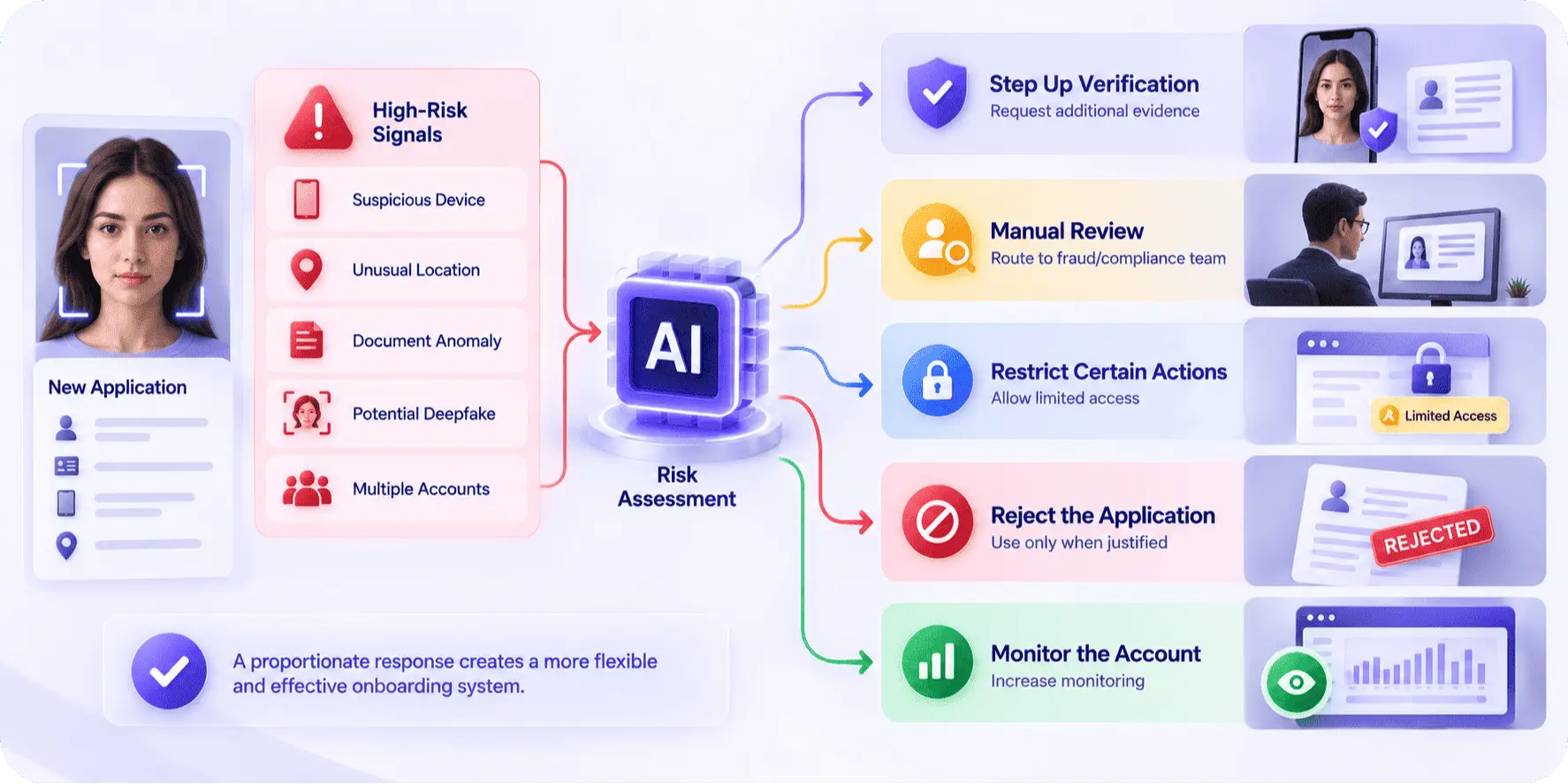
When multiple risk indicators appear, the response should be proportionate.
A business might:
Step Up Verification
Request stronger identity evidence or another biometric interaction.
Trigger Manual Review
Route the application to a trained fraud or compliance team.
Restrict Certain Actions
Allow limited access while additional verification is completed.
Reject the Application
Use rejection only when the evidence and risk level justify it.
Monitor the Account
Where the account is already active, increased monitoring can help identify further suspicious behavior.
This creates a more flexible system than simply accepting or rejecting everything automatically.
Building a Fraud Monitoring Layer Around Customer Verification
Identity verification should not necessarily end when the customer is approved.
Some fraud indicators only become visible when customer behavior is observed over time.
Organizations can connect onboarding information with later signals such as:
- Account activity
- Login behavior
- Device changes
- Transaction behavior
- Authentication events
- New contact details
This creates a more complete picture of identity risk.
The original onboarding decision can then become one data point in a broader fraud monitoring system.
SDK-Based Technology for Fraud Risk Detection
Many organizations prefer integrating verification capabilities into their own applications rather than sending customers through disconnected verification experiences.
SDK-based biometric technology can support this approach.
A face recognition SDK can provide facial matching within the organization’s own application, while liveness and document technologies can contribute additional signals.
For organizations evaluating implementation resources, the Recognito GitHub repository provides another technical resource for development teams.
A broader identity verification architecture can then combine these biometric signals with the organization’s own fraud engine, device intelligence, behavioral analytics, and customer data.
The key benefit is control over how the individual signals are combined and how the final risk decision fits the business workflow.
How to Build a Fraud Risk Indicator Framework
Organizations should avoid creating hundreds of disconnected fraud rules.
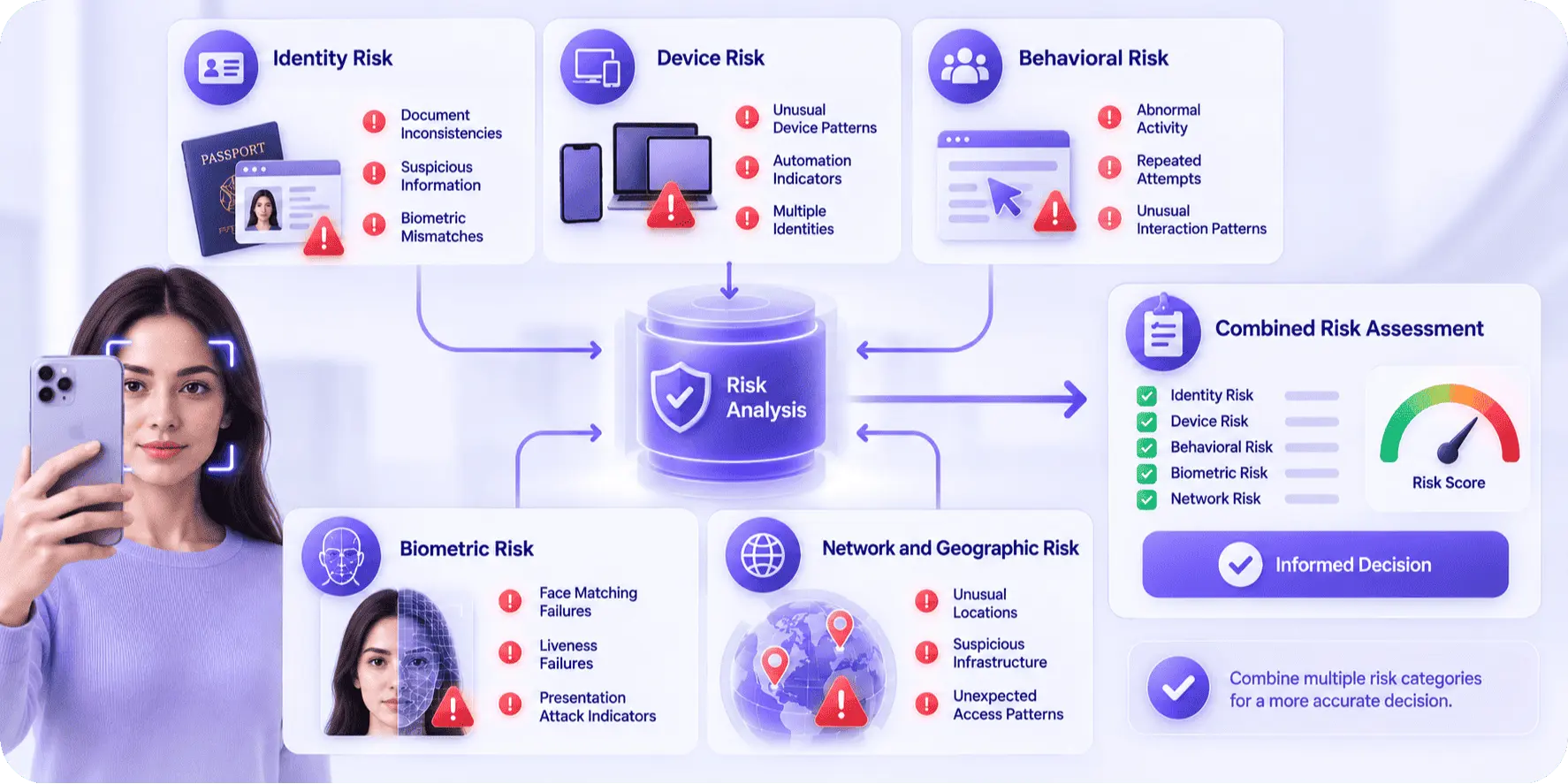
Instead, start by identifying the most important risk categories and map relevant signals to each one.
Identity Risk
Look for document inconsistencies, suspicious personal information, and biometric mismatches.
Device Risk
Look for unusual device patterns, automation indicators, and connections to multiple identities.
Behavioral Risk
Look for abnormal onboarding activity, repeated attempts, and unusual interaction patterns.
Biometric Risk
Look for repeated face matching failures, liveness failures, and presentation attack indicators.
Network and Geographic Risk
Look for unusual locations, suspicious infrastructure, or unexpected access patterns.
The final decision should combine these categories rather than rely on one rule.
How Recognito’s Biometric Technologies Fit Into the Workflow
A fraud prevention architecture can use biometric components at several points in customer onboarding.
For organizations that need facial matching, a facial verification SDK can help connect an applicant to a trusted identity reference.
Where identity documents are part of the workflow, an ID document recognition SDK can provide document-level evidence before biometric matching occurs.
A liveness component can then add protection against presentation attacks.
Technical teams can also explore the Face Biometric Playground when evaluating the practical biometric experience before production integration.
The correct implementation depends on the organization’s risk model and should be tested using realistic users, devices, documents, and fraud scenarios.
Practical Fraud Risk Monitoring Checklist
Before production, onboarding teams should be able to explain:
- Which fraud indicators they monitor
- Which signals trigger additional verification
- How multiple indicators are combined
- How false positives are handled
- When manual review is required
- How biometric failures are investigated
- How risk rules are updated
- Which metrics determine whether the system is working
If a fraud system cannot explain why an application was considered risky, it becomes much harder to improve, audit, or govern.
Conclusion
Fraud risk indicators are most useful when they are treated as pieces of a larger identity and behavioral picture.
An inconsistent identity detail, new device, failed biometric check, unusual location, or liveness failure may have a legitimate explanation when viewed alone. When several independent signals point toward the same risk, however, the organization has a stronger basis for additional verification or review.
The most effective digital onboarding systems therefore combine document verification, biometric verification, liveness, device intelligence, behavioral analysis, and risk-based decisioning.
This approach allows organizations to increase fraud protection without forcing every legitimate customer through the highest level of verification.
Businesses building stronger digital onboarding and biometric verification workflows can explore the broader capabilities available from Recognito as part of their fraud prevention architecture.
Frequently Asked Questions
What are common fraud risk indicators during digital onboarding?
Common indicators include inconsistent identity information, suspicious documents, repeated verification failures, unusual device activity, multiple identities connected to the same environment, location anomalies, abnormal behavior, biometric mismatches, and liveness failures.
Does one fraud indicator mean an applicant is fraudulent?
No. Individual signals can have legitimate explanations. Fraud decisions are generally stronger when multiple independent indicators point toward the same risk pattern.
How does biometric verification help identify onboarding fraud?
Facial verification can help determine whether the applicant corresponds to a trusted identity reference. Liveness detection can add protection against attempts to present an artificial biometric sample.
How should businesses handle high-risk onboarding applications?
Depending on the risk level, organizations can require additional verification, route the application to manual review, restrict certain actions, reject the application, or apply enhanced monitoring.
How can companies reduce false positives in fraud detection?
Organizations should combine multiple signals, use risk-based thresholds, test rules against legitimate customer behavior, monitor false-positive rates, and regularly adjust their fraud decisioning based on production outcomes.