
An enterprise must establish whether employees and contractors are who they claim to be, protect customer accounts from impersonation, and prevent compromised credentials from opening pathways into critical systems.
These responsibilities often sit across HR, identity and access management, fraud operations, and application teams. When their systems do not share reliable signals, gaps appear between proving an identity, authenticating it, and deciding what it may access.
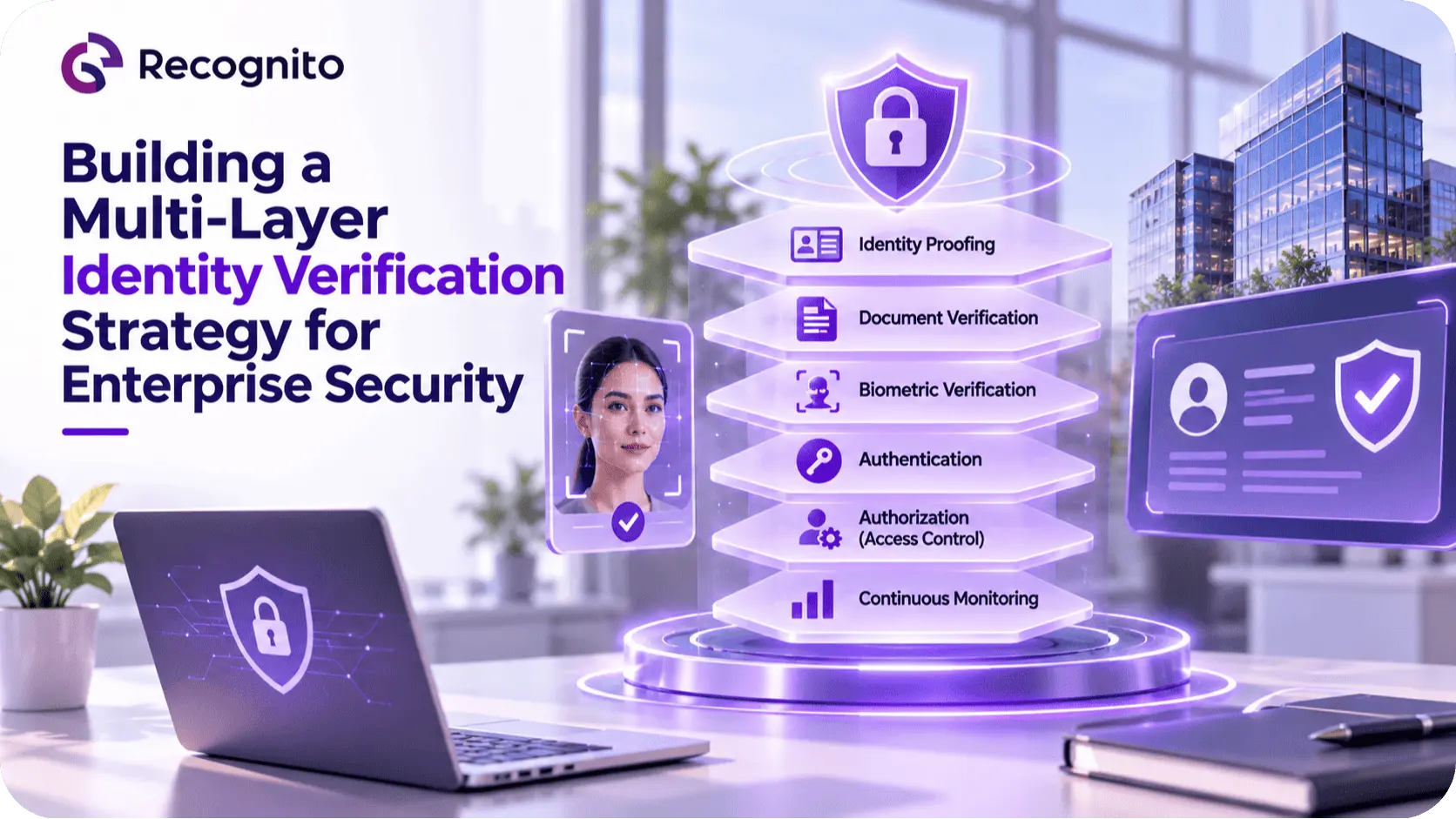
A multi-layer strategy connects those decisions across the identity lifecycle: proofing, strong authentication, contextual risk assessment, least-privilege authorization, and continuous monitoring. The goal is not to add checks indiscriminately, but to place the right control where identity risk arises.
Identity Proofing, Authentication, and Authorization Are Different
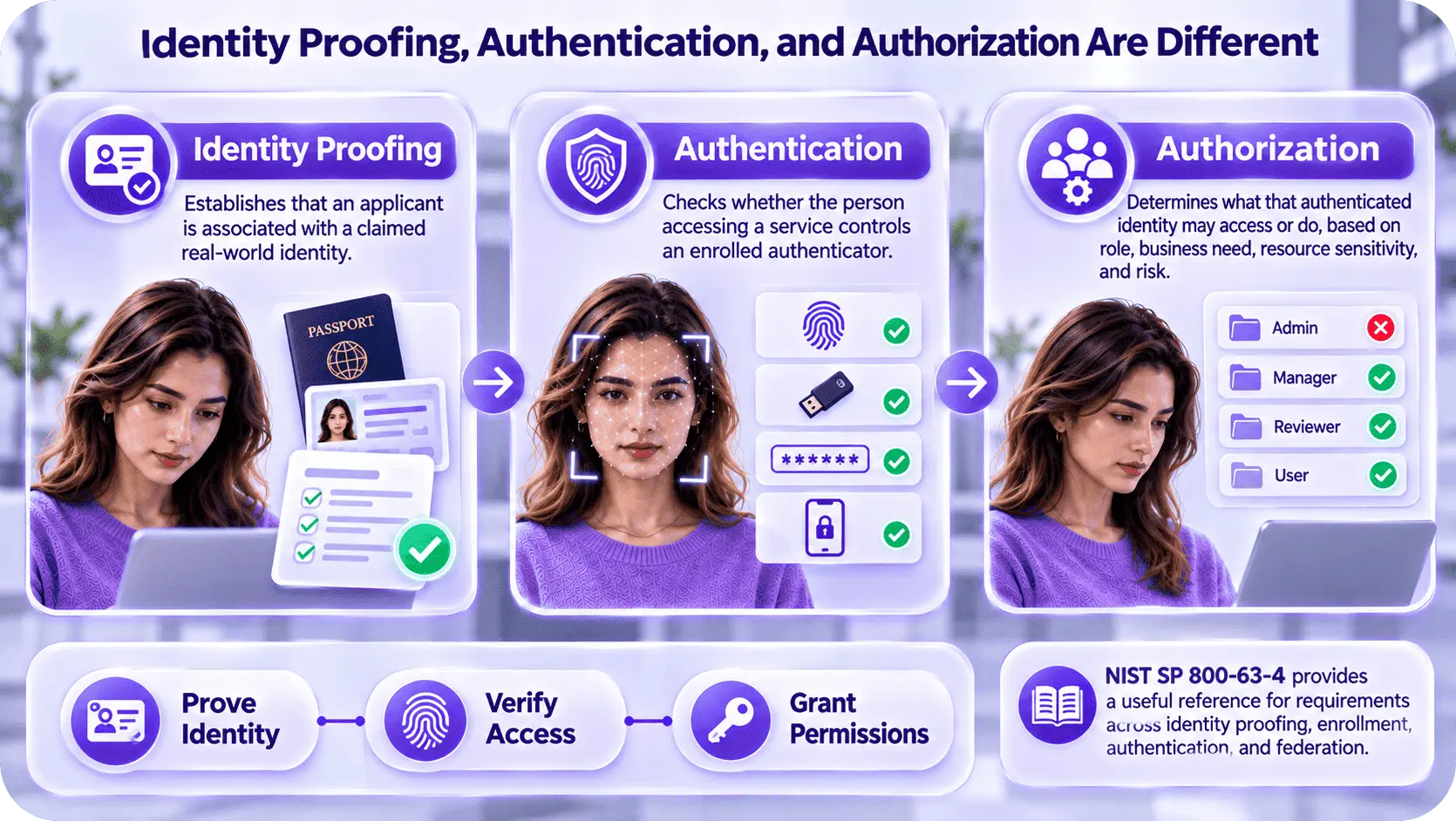
These functions are related but not interchangeable.
Identity proofing establishes that an applicant is associated with a claimed real-world identity, using evidence such as documents, trusted data, employment records, or validated digital credentials.
Authentication checks whether the person accessing a service controls an enrolled authenticator, such as a passkey, security key, certificate, or password.
Authorization determines what that authenticated identity may access or do, based on role, business need, resource sensitivity, and risk.
A successful check at hiring does not make every later login safe, and a successful login does not justify administrator privileges. Keep the decisions connected but distinct.
NIST’s Digital Identity Guidelines, SP 800-63-4 organize requirements across identity proofing, enrollment, authentication, and federation. They are written for users interacting with government information systems, but provide a useful reference for enterprise identity architecture.
The Layers of an Enterprise Identity Strategy
The right combination depends on the threat model, user groups, regulatory environment, and sensitivity of the systems being protected.
1. Establish identity before issuing access
Use reliable proofing for employees, contractors, partners, and customers, with strength matched to the consequences of an identity error. Employee enrollment may combine HR checks and trusted identity evidence; remote customer onboarding may require document verification and face comparison. Supplier and machine identities need ownership or contractual validation rather than human biometrics.
Decide what evidence is sufficient for each use case, and avoid repeating checks when an approved source can be securely reused. The challenges of digital identity verification provide useful context for designing this layer.
For regulated customer due diligence, FATF’s Guidance on Digital Identity explains how organizations should assess the reliability and independence of digital identity systems within a risk-based approach.
2. Validate identity documents and capture evidence safely
Document checks should go beyond OCR. Extracting fields does not prove that an ID is genuine, unaltered, or physically present during remote capture. A stronger workflow combines document classification, field consistency, available security-feature checks, image-quality assessment, presence checks, and escalation for uncertain cases.
An ID document recognition SDK can provide capture and extraction capabilities for applications integrating document processing.
3. Bind the person to the identity evidence
Where justified, biometric comparison can help confirm that the person presenting a document corresponds to its portrait or an enrolled reference. Facial matching suits remote workflows because it uses a camera, but matching and liveness are distinct: matching compares face samples, while liveness and presentation-attack detection assess whether the input comes from a genuine live subject rather than a photograph, replay, mask, or manipulated media.
A face liveness detection SDK may support remote capture, but should complement document validation and fraud controls. The presentation-attack detection layer addresses a separate risk.
Biometrics are not necessary for every enterprise identity. Use them only when their assurance benefit justifies privacy, accessibility, and operational implications.
4. Enroll strong authenticators
After proofing, bind the verified identity to strong authenticators. A rigorous onboarding check can be undermined if the account is later protected only by a reusable password or a weak reset process.
Prefer phishing-resistant methods for high-value accounts. Passkeys and security keys use public-key cryptography to bind authentication to the legitimate service. The FIDO Alliance’s passkey guidance explains how these credentials replace passwords; in common designs, biometric verification remains on the device rather than sending a face or fingerprint to the service.
Use step-up authentication for sensitive actions such as changing payment details, exporting data, accessing production systems, or enrolling a new authenticator. Apply it when risk warrants it, not indiscriminately.
5. Make authorization least-privilege and context-aware
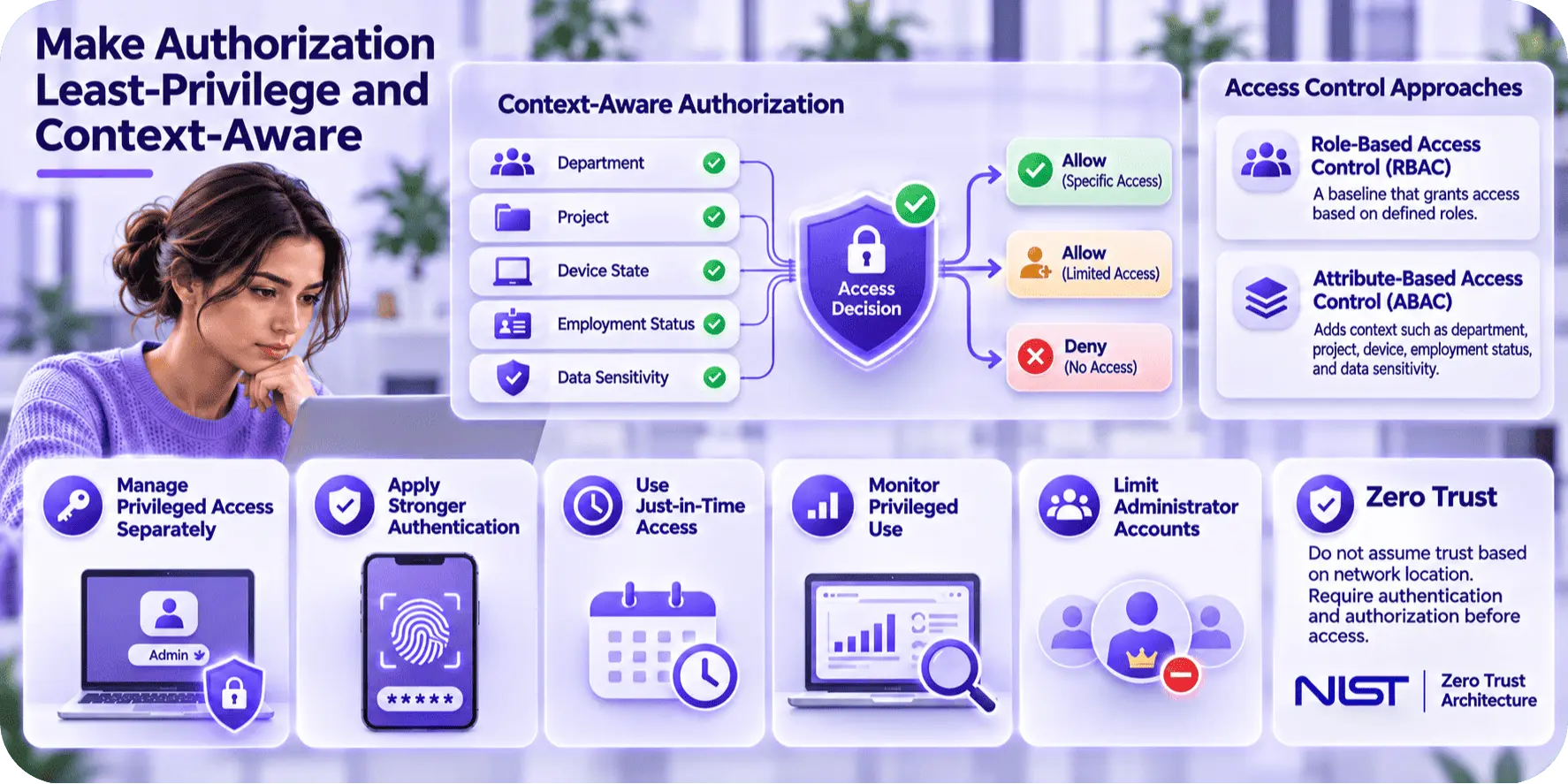
Grant access according to task and resource, not merely organizational membership. Role-based access control provides a baseline; attribute-based policies can incorporate reliable context such as department, project, device state, employment status, and data sensitivity.
Treat privileged access separately. Limit administrator accounts, apply stronger authentication, monitor use, and grant elevated rights just in time where possible. This supports zero trust, where network location does not create implicit trust. NIST’s Zero Trust Architecture focuses on protecting resources and requiring authentication and authorization before access.
6. Monitor identity and session risk continuously
Identity confidence changes after onboarding: devices are compromised, credentials exposed, roles change, contracts end, and accounts behave unexpectedly.
Connect identity events to monitoring. Signals may include repeated failures, unfamiliar devices, unusual access times, unexpected privilege use, suspicious authenticator enrollment, or abnormal transfers. None proves compromise alone; interpret signals in context.
Responses may include stronger authentication, session limits, blocking a sensitive action, token revocation, or investigation. Log each decision for review.
How the Layers Work Together
Consider a contractor requesting access to an engineering environment. The organization validates the person’s identity and business relationship, creates an account tied to the workforce record, enrolls a phishing-resistant authenticator, and grants access only to project systems.
A documentation request may be allowed after normal authentication. Access to production secrets may require fresh authentication and an approved privileged-access workflow. When the contract ends, the workforce system triggers account disablement, session revocation, and group removal.
The original proofing check does not keep the identity trusted forever. These separate operations need consistent records and timely lifecycle signals.
A Practical Control Map
| Layer | Main purpose | Example controls | Risk it helps reduce |
| Identity proofing | Establish claimed identity | Trusted evidence, document checks, HR validation | Impersonation at enrollment |
| Evidence validation | Assess submitted evidence | Authenticity and presence checks, biometrics where justified | Forged or manipulated evidence |
| Authentication | Verify account control | Passkeys, security keys, certificates, MFA | Credential theft and account takeover |
| Authorization | Limit permitted actions | Least privilege, role and attribute policies | Excessive access |
| Continuous monitoring | Detect changing risk | Session analytics, device signals, audit logs | Undetected compromise |
| Lifecycle management | Align access with status | Joiner-mover-leaver workflows, reviews, revocation | Orphaned and excessive accounts |
No single control in this map is sufficient. Strong authentication cannot correct a fraudulent identity created during enrollment, while accurate proofing cannot prevent an attacker from taking over an account months later.
Common Design Mistakes That Undermine the Strategy
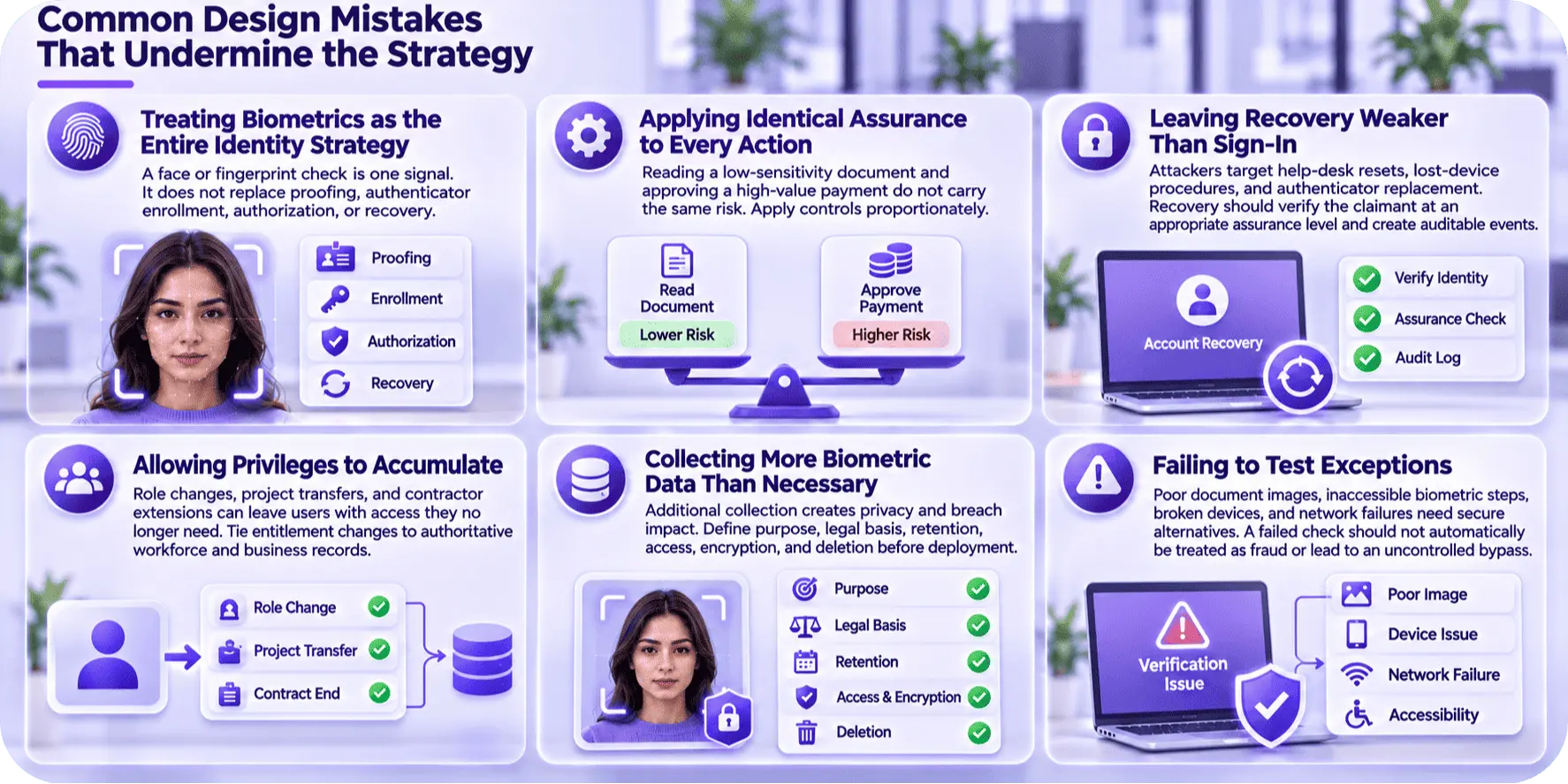
Treating biometrics as the entire identity strategy. A face or fingerprint check is one signal. It does not replace proofing, secure authenticator enrollment, authorization, or account recovery.
Applying identical assurance to every action. Reading a low-sensitivity document and approving a high-value payment do not carry the same risk. Apply controls proportionately.
Leaving recovery weaker than sign-in. Attackers target help-desk resets, lost-device procedures, and authenticator replacement. Recovery should verify the claimant at an appropriate assurance level and generate auditable events.
Allowing privileges to accumulate. Role changes, project transfers, and contractor extensions can leave users with access they no longer need. Tie entitlement changes to authoritative workforce and business records.
Collecting more biometric data than necessary. Additional collection creates privacy and breach impact. Define purpose, legal basis, retention, access, encryption, and deletion before deployment.
Failing to test exceptions. Poor document images, inaccessible biometric steps, broken devices, and network failures need secure alternatives. A failed check should not automatically be treated as fraud or lead to an uncontrolled bypass.
Governance, Privacy, and Standards
Govern the identity strategy as part of the enterprise security program. ISO/IEC 27001:2022 sets requirements for an information security management system and provides a risk-management basis for assigning control owners, documenting decisions, and reviewing effectiveness.
Biometric information needs particular care. Assess necessity and legal basis, provide transparency, restrict access, protect templates and images, and define retention and deletion. Centralized biometric storage should not be the default simply because it is convenient.
Assign clear ownership for proofing, authenticators, authorization, privileged access, exceptions, and incident response. The biometric compliance considerations for identity verification can help frame this governance work.
How to Implement the Strategy Without Replacing Everything
Roll out the strategy in phases rather than replacing every identity platform at once.
- Inventory identities and access. Include workforce, customers, contractors, partners, services, and machines.
- Map high-impact risks. Prioritize privileged accounts, remote access, sensitive data, financial operations, and weak recovery.
- Set assurance requirements. Define the evidence and authentication strength needed for each user group and action.
- Connect authoritative sources. Link HR, contractor records, customer systems, identity providers, and access management.
- Strengthen access controls. Introduce phishing-resistant methods, remove excessive privileges, and add step-up policies to sensitive actions.
- Integrate monitoring. Make identity events visible to security operations and define response actions.
- Measure and refine. Review failures, exceptions, access findings, and incident data before expanding.
Track time to revoke access, standing privileged accounts, proofing failures, phishing-resistant authentication coverage, unresolved access reviews, recovery incidents, and time to contain suspected compromise.
For engineering teams integrating these components, the Recognito GitHub repository can be reviewed alongside product documentation and integration requirements.
Conclusion
Enterprise identity security is strongest when designed as a connected lifecycle. Identity proofing establishes who a person is; secure authenticators help verify that person during access; authorization limits what they can do; and continuous monitoring responds when risk changes.
The objective is not to stack every available verification method onto every user. Select complementary controls based on resource sensitivity, the threat model, and the consequences of an identity failure. When identity records, access policies, and security monitoring work together, enterprises gain a more resilient foundation for protecting people, applications, and data.
For organizations evaluating biometric components within that broader architecture, Recognito provides face and ID document verification technologies that can form part of a layered identity workflow.
Frequently Asked Questions
What is a multi-layer identity verification strategy?
It combines identity proofing, evidence validation, authentication, authorization, monitoring, and lifecycle management so that no single check is expected to protect every stage of an identity’s use.
Is multi-factor authentication the same as multi-layer identity verification?
No. Multi-factor authentication strengthens login by requiring different factor types. A multi-layer identity strategy also covers how an identity is established, what evidence supports it, what access it receives, and how changes or compromise are handled.
Does every enterprise need biometric verification?
No. Biometrics can be useful for remote identity proofing or high-assurance workflows, but they are not a universal requirement. Consider risk, accessibility, privacy, legal obligations, and alternatives.
Where should enterprises start?
Begin with an inventory of identities, privileged access, and critical resources. Identify weak proofing, authentication, recovery, and deprovisioning paths, then prioritize controls by business impact.
How often should identity permissions be reviewed?
Review frequency should reflect access sensitivity, role changes, regulatory obligations, and organizational risk. Privileged and sensitive access generally warrants more frequent review, with immediate changes when employment or contract status changes.