
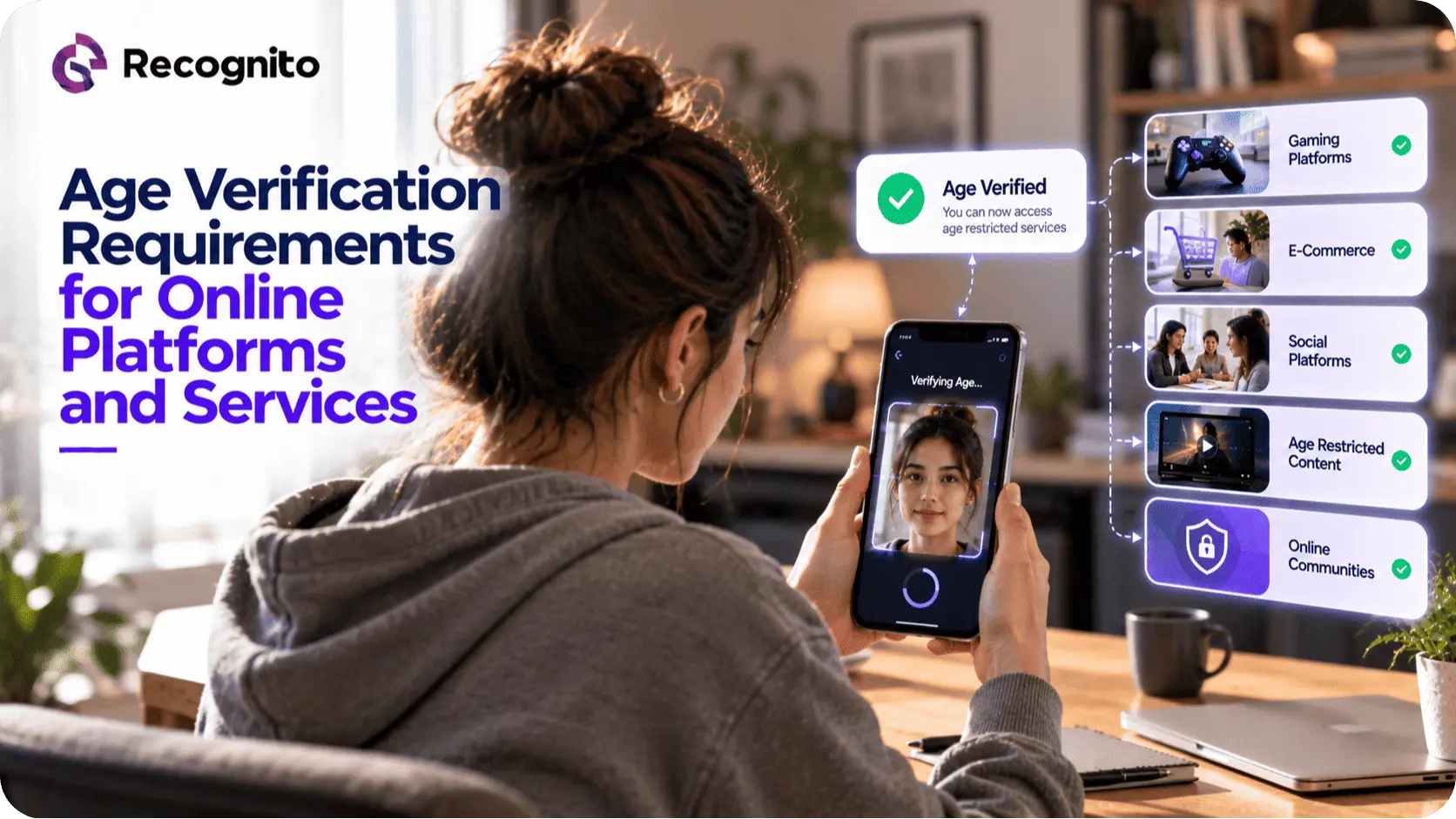
Age verification is becoming an increasingly important part of operating online platforms and digital services.
Platforms may need to establish whether a user is old enough to access particular content, purchase certain products, use specific features, or participate in services subject to age restrictions. The challenge is doing this accurately without collecting unnecessary personal information or creating excessive friction for legitimate users.
This makes age verification requirements a combination of legal, technical, privacy, and user-experience considerations.
The exact requirements depend on the country, service, type of content, and applicable regulatory framework. A platform serving children and adults may face different obligations from a service where age-restricted access is only one small part of the customer journey.
Modern digital age verification can involve identity documents, facial age estimation, biometric verification, age credentials, or other assurance methods. The appropriate approach depends on what the platform needs to establish and how much certainty is legally and operationally required.
A strong implementation should therefore begin with the requirement itself rather than simply choosing an age verification technology.
Why Age Verification Is Becoming More Important
Online services increasingly need to distinguish between users of different ages.
This can be relevant to:
- Age-restricted content
- Online communities
- Gaming platforms
- Social and video services
- Financial services
- E-commerce
- Gambling and other regulated activities
- Services involving children or teenagers
The regulatory environment is also evolving.
For example, the UK’s Online Safety Act places duties on certain regulated services relating to children’s safety online, and Ofcom has published guidance concerning highly effective age assurance methods. (ofcom.org.uk)
The European Union has also been developing approaches to age verification within its broader digital identity and online safety initiatives.
This means age verification should be treated as an evolving compliance requirement rather than a static checkbox.
What Are Age Verification Requirements?
Age verification requirements are the legal, operational, and technical conditions a platform needs to satisfy when it must determine whether a user meets an age threshold.
The actual requirement can differ substantially.
A service may need to establish:
“Is this user above a specific age?”
Another may need to establish:
“Is this person old enough to legally access this particular service?”
The distinction matters because the second question may require more identity assurance.
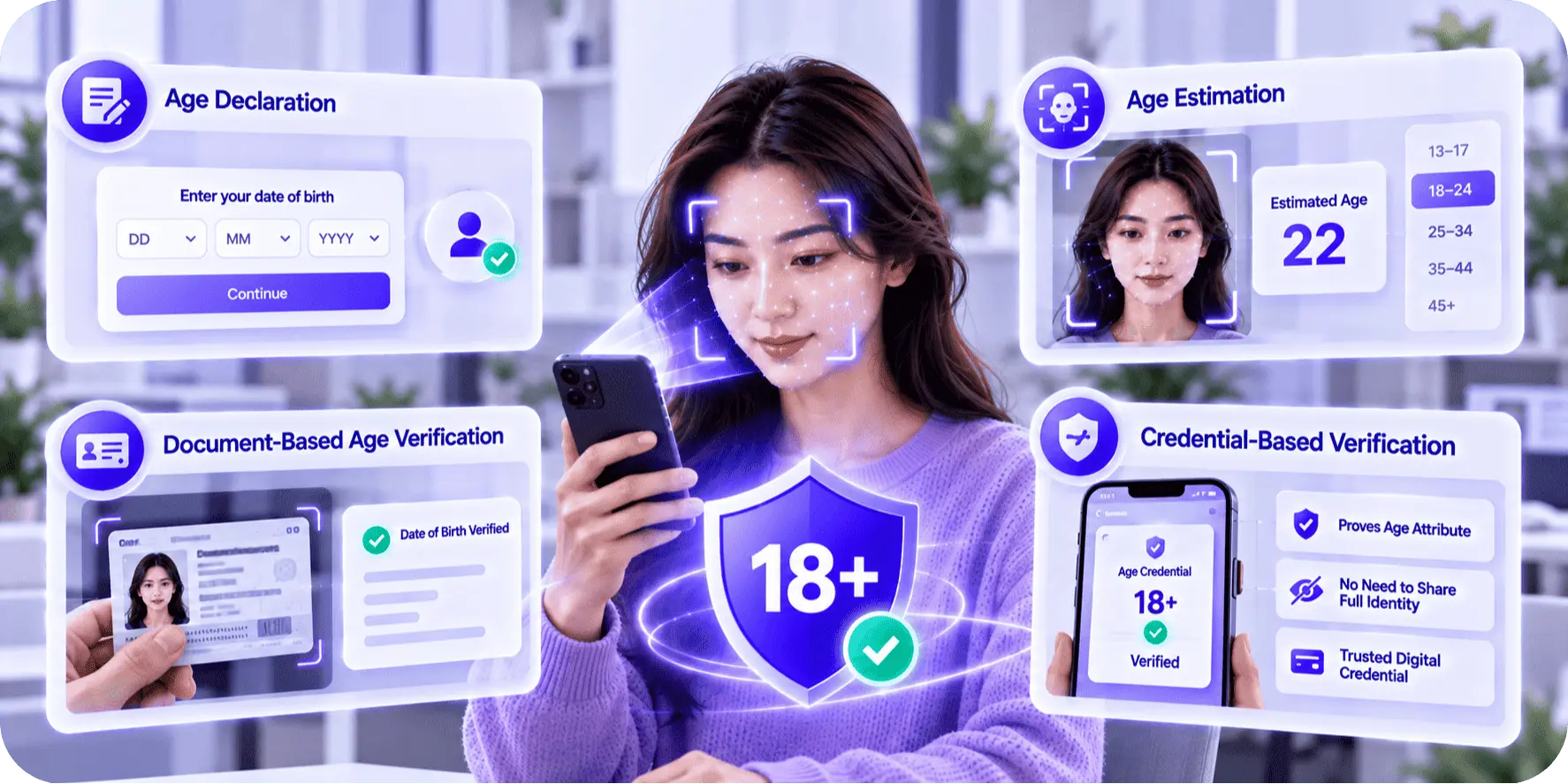
Age verification can be implemented using different methods depending on the risk.
Age Declaration
The user provides their age or date of birth.
This is easy to implement but provides relatively weak assurance because the information may not be independently verified.
Age Estimation
A system estimates a user’s age from a biometric characteristic such as their face.
This can reduce the need to collect identity documents but introduces its own accuracy and privacy considerations.
Document-Based Age Verification
The user provides an identity document and the platform verifies the date of birth or another age-related attribute.
This can provide stronger evidence but generally requires processing more personal information.
Credential-Based Verification
A trusted digital credential can establish a particular age attribute without necessarily requiring the user to disclose their complete identity information.
The appropriate approach depends on the actual risk and legal requirement.
Age Verification vs Age Estimation
These terms should not be treated as interchangeable.
Age verification generally seeks evidence that a person satisfies a defined age requirement.
Age estimation attempts to estimate the person’s age without necessarily establishing their exact date of birth.
This distinction is important for compliance teams.
If a service only needs to determine whether someone is above a threshold, an age-estimation approach may potentially provide sufficient assurance in some contexts.
If the service needs stronger identity evidence, document-based or credential-based verification may be more appropriate.
The platform should therefore identify the precise age-assurance question before selecting its technology.
Why Identity Verification Can Support Age Assurance
Age verification often overlaps with broader identity verification.
An identity document may contain a customer’s date of birth, while biometric verification can help connect the person presenting the document to that identity.
For example, a platform could verify an identity document, extract the date of birth, and then use facial verification to establish that the person presenting the document corresponds to the identity on it.
An ID document recognition SDK can support the document analysis stage of such a workflow.
This can provide stronger evidence than simply asking the user to enter their date of birth.
However, not every age-verification scenario requires full identity verification.
That is why data minimization should remain an important design principle.
When Biometrics Can Be Used for Age Verification
Biometric technology can play different roles in an age-assurance workflow.
Facial analysis can potentially estimate age, while facial verification can connect a person to an identity document containing age information.
These are different biometric use cases.
Facial Age Estimation
The system analyzes facial characteristics to estimate an approximate age.
Face-to-Document Verification
The system compares the person’s face with the identity image associated with a verified document and uses the document’s date of birth as the age evidence.
Credential-Based Age Assurance
A digital credential can potentially establish that the user satisfies an age threshold without exposing unnecessary identity information.
The appropriate technology should be selected according to the platform’s actual legal and operational requirements.
Online Safety and Age Assurance
Age assurance is increasingly connected to broader online safety obligations.
Platforms may need to take additional measures when minors are able to access services involving potentially harmful or age-inappropriate content.
The UK’s Ofcom guidance explains that age assurance can involve methods designed to establish or estimate whether users are children or adults and discusses characteristics of highly effective age assurance. (ofcom.org.uk)
This is important because compliance is not simply about placing an age gate on a webpage.
A platform needs to assess whether its method provides enough assurance for the particular risk it is trying to address.
Age Verification Compliance Is Jurisdiction-Specific
One of the biggest challenges is that age verification laws and expectations differ between markets.
A platform operating internationally may need to consider:
- User location
- Service type
- Age threshold
- Content category
- Legal obligations
- Privacy requirements
- Applicable regulator guidance
A method that may be considered sufficient in one jurisdiction may not be adequate in another.
Organizations should therefore avoid designing a global age-verification process around one country’s rules without reviewing the markets in which the service is offered.
Legal and compliance teams should map the requirements first and then determine which technical controls are appropriate.
Privacy Is Central to Digital Age Verification
Age verification can create a privacy problem of its own if platforms collect more information than they genuinely need.
For example, if a service only needs to establish that a user is above a particular age, storing a full identity document indefinitely may create unnecessary privacy and security risk.
A privacy-conscious approach asks:
What is the minimum information necessary to establish the required age assurance?
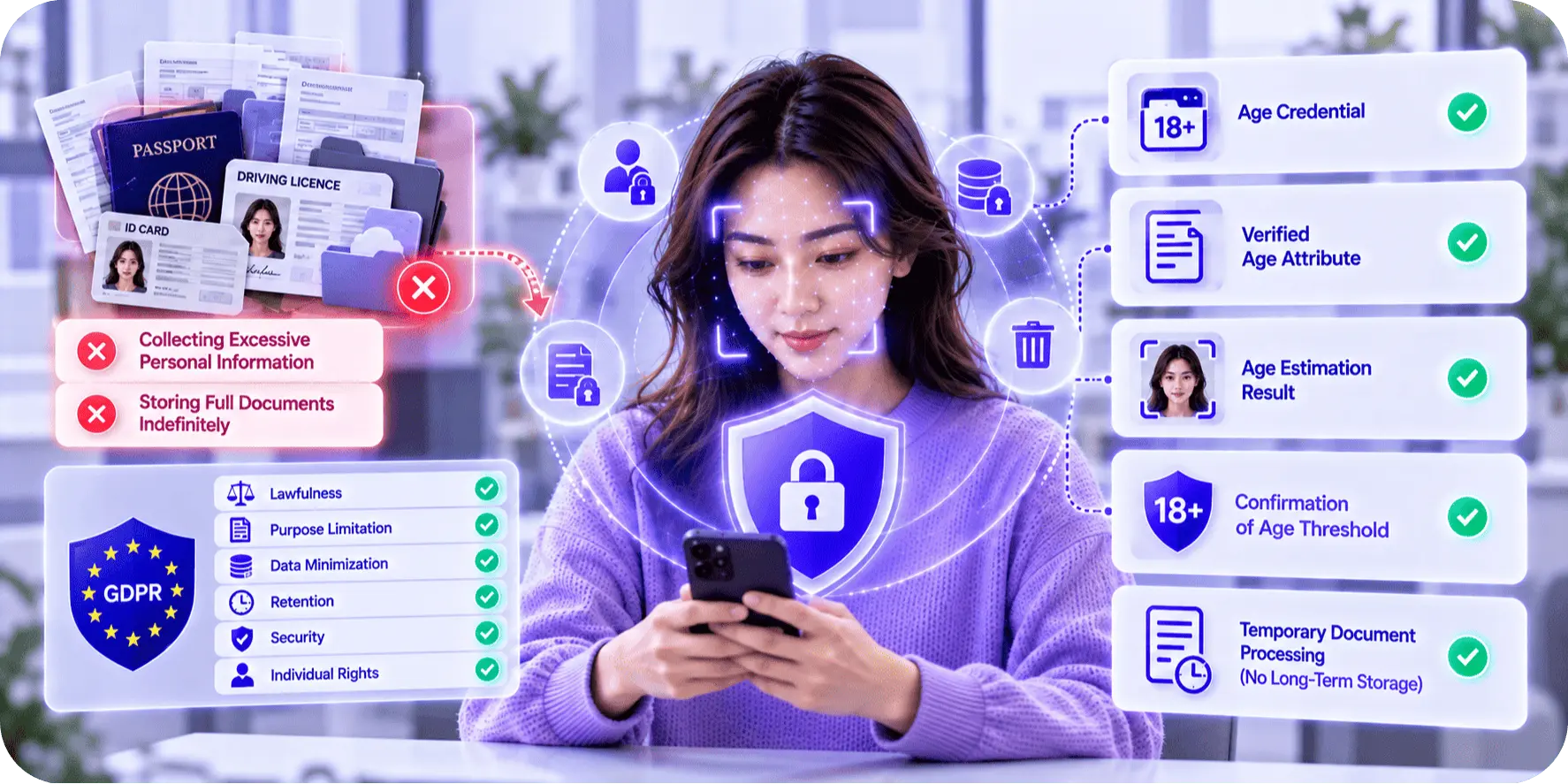
Depending on the use case, that could potentially mean:
- A simple age credential
- A verified age attribute
- An age estimation result
- Confirmation that an age threshold was met
- Temporary document processing without long-term storage
The correct choice depends on the legal and security requirements.
For organizations processing European personal data, the GDPR framework provides an important foundation for considering lawfulness, purpose limitation, data minimization, retention, security, and individual rights.
Why Data Minimization Matters
The strongest age verification system is not necessarily the one that collects the most information.
Suppose a platform only needs to determine whether a user is over 18.
It may not need:
- Full residential address
- Document number
- Complete identity profile
- Raw facial image retained indefinitely
A system that can establish the required age attribute without unnecessarily exposing additional personal information may reduce the platform’s privacy and security burden.
This is particularly relevant when children and young people are involved.
The architecture should therefore be designed so that the age assurance result is separated from unnecessary personal information wherever practical.
Liveness Detection in High-Assurance Age Verification
Where age verification relies on facial biometrics, the platform may also need to protect the biometric capture process.
A person could potentially attempt to use a photograph, replayed video, or other artificial facial presentation.
Liveness detection can add another security layer by assessing whether the biometric presentation appears to come from a genuine live subject.
A liveness detection SDK can support this capability where the platform’s risk model requires stronger biometric presentation protection.
The distinction is important:
Age estimation asks approximately how old the person appears.
Facial verification asks whether the person corresponds to a trusted identity.
Liveness detection asks whether the biometric presentation appears genuine.
These controls should not be treated as interchangeable.
Building a Risk-Based Age Verification Workflow
Not every platform needs maximum identity assurance for every user.
A practical workflow can apply different methods according to risk.
1. Determine the Legal Age Threshold
Establish the specific requirement the platform needs to enforce.
2. Identify the Assurance Level Required
Determine whether a self-declaration, estimation, credential, or verified identity is sufficient.
3. Select the Least Intrusive Suitable Method
Choose a method that provides adequate assurance without collecting unnecessary personal information.
4. Add Stronger Verification Where Needed
Higher-risk services can trigger document or biometric verification.
5. Protect Biometric Capture
Where facial verification or estimation is used remotely, consider presentation attack protection.
6. Define Failure and Escalation Paths
Determine what happens when a user cannot complete age assurance or the result is inconclusive.
This helps the platform remain both secure and usable.
Age Verification for Online Platforms
Different platforms may have very different requirements.
Social and Community Platforms
The focus may be determining whether users are children or adults and applying age-appropriate safety measures.
Gaming Platforms
Age assurance may be connected to content ratings, communication features, payments, or parental controls.
E-Commerce Platforms
Some products may have minimum-age restrictions, creating a need for stronger age checks at the point of purchase.
Financial Services
Age may form part of eligibility requirements, but financial onboarding may already involve broader identity and KYC processes.
Adult or Age-Restricted Services
These services may require a substantially stronger level of age assurance depending on applicable law.
The lesson is that there is no universal “best” age verification method.
Measuring Age Verification Performance
Platforms should monitor both compliance effectiveness and user experience.
Useful metrics include:
- Age assurance completion rate
- First-attempt success
- False rejection rate
- Inconclusive results
- Retry rate
- Average verification time
- User abandonment
- Manual review rate
- Privacy-related incidents
For biometric methods, teams can also track biometric-specific outcomes such as face verification failures and liveness failures.
The objective is to establish whether the age-verification process is providing the necessary assurance without creating unreasonable friction.
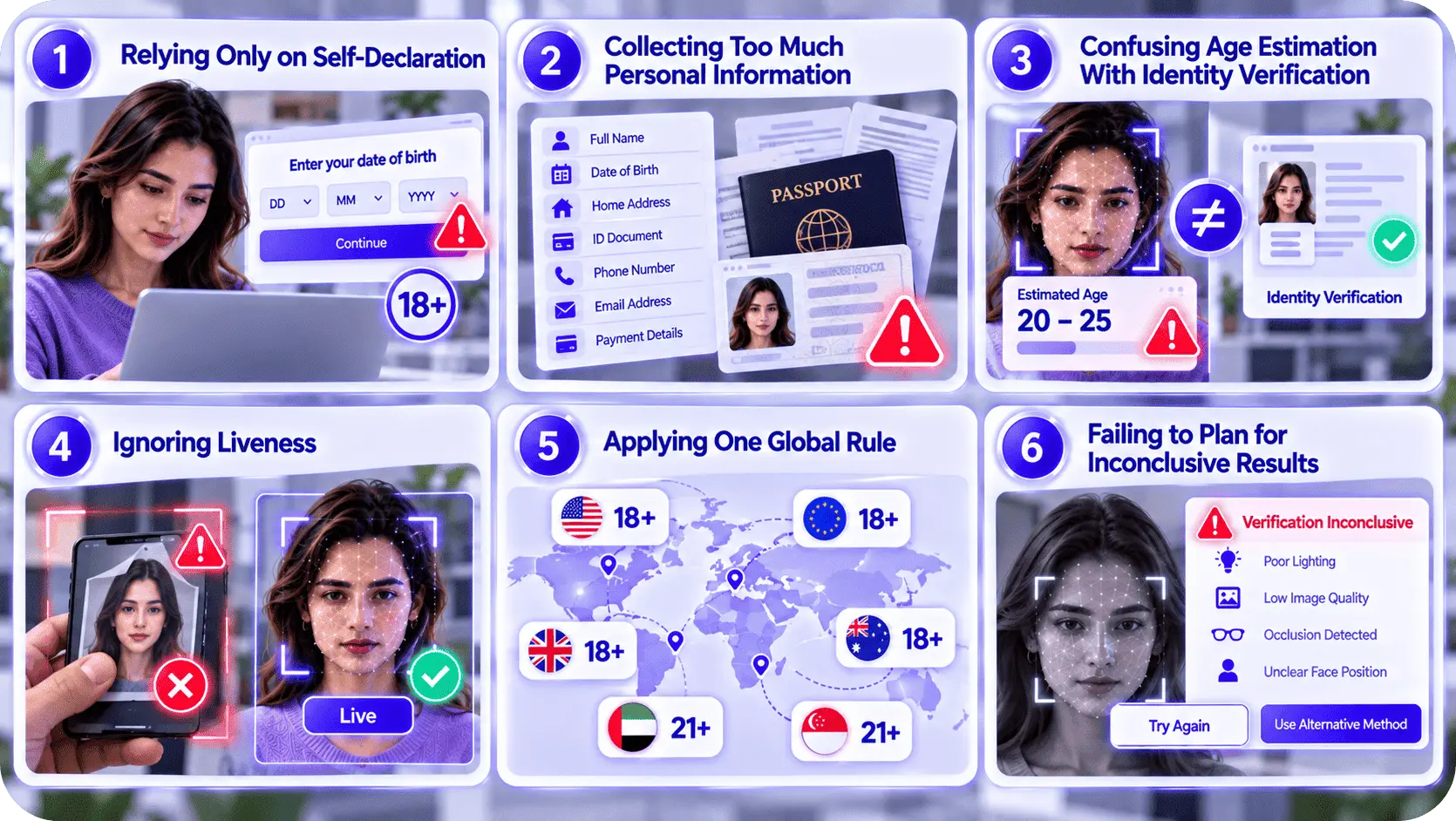
Common Age Verification Implementation Mistakes
Relying Only on Self-Declaration
A simple date-of-birth field provides limited assurance when stronger age assurance is required.
Collecting Too Much Personal Information
A platform should not collect a complete identity profile when it only needs to establish an age threshold.
Confusing Age Estimation With Identity Verification
An estimated age does not necessarily establish a person’s legal identity.
Ignoring Liveness
Remote facial workflows may require additional protection against presentation attacks.
Applying One Global Rule
Different jurisdictions can have different age-assurance obligations.
Failing to Plan for Inconclusive Results
A user should have an appropriate next step when the technology cannot confidently establish age.
Using SDK-Based Technology for Age Assurance
SDK-based biometric technology can allow online platforms to integrate age and identity controls into their existing applications.
A biometric verification SDK can support face-based identity verification where stronger assurance is required.
A document component can establish age-related information from a trusted identity credential, while liveness can protect the remote biometric capture process.
Technical teams can also explore the Face Biometric Playground when evaluating the practical biometric experience.
For developers assessing integration resources, the Recognito GitHub repository can provide additional technical material.
The platform should still determine the appropriate implementation based on its legal obligations and risk model.
Age Verification and Digital Identity
Digital identity wallets and verifiable credentials may eventually provide another option for age assurance.
Instead of presenting an entire identity document, a user could potentially present a trusted credential that establishes a relevant age attribute.
This could support greater privacy because the service may only need to know that the user meets a particular threshold.
However, this model depends on trustworthy credential issuers, interoperable systems, appropriate verification mechanisms, and regulatory acceptance.
Digital identity can therefore complement rather than replace existing age-assurance technologies.
Creating a Sustainable Age Verification Compliance Program
Age verification should be reviewed over time.
Online safety requirements evolve. Regulators publish new guidance. Technology changes. Attackers discover new ways to bypass controls.
A sustainable program should therefore:
Review Legal Requirements
Map requirements for each market and service.
Assess Technology Performance
Monitor verification results and real-world error rates.
Protect User Privacy
Review data collection, retention, access, and deletion.
Test New Attack Scenarios
Evaluate whether existing controls remain effective against evolving presentation and identity attacks.
Update the Workflow
Adjust verification methods when regulatory or operational requirements change.
This makes age assurance an ongoing compliance capability rather than a one-time feature release.
Conclusion
Age verification requirements are becoming increasingly important for online platforms and services, but there is no single technical solution that works for every organization.
Some services may need only a relatively simple age check, while higher-risk or regulated environments may require stronger identity evidence, document verification, biometric verification, or additional security controls.
The strongest approach begins with the actual legal and business requirement.
Organizations should determine what age assurance is needed, select the least intrusive method capable of meeting that requirement, minimize unnecessary personal data collection, protect biometric capture when biometrics are used, and provide appropriate paths for inconclusive results.
As digital identity wallets, verifiable credentials, biometric technology, and online safety regulation continue to develop, platforms will increasingly need age assurance systems that are both effective and privacy-conscious.
Organizations evaluating biometric and digital identity technologies can explore the broader capabilities available from Recognito as part of their age-assurance and identity verification strategy.
Frequently Asked Questions
What are age verification requirements?
Age verification requirements are the legal, technical, and operational conditions a platform must satisfy when it needs to determine whether a user meets a particular age threshold.
Is self-declared age enough for online platforms?
It depends on the service and applicable requirements. A simple age declaration provides limited assurance and may not be sufficient where stronger age assurance is legally or operationally required.
What is the difference between age verification and age estimation?
Age verification seeks evidence that a user meets a defined age requirement, while age estimation attempts to estimate a person’s age. They provide different levels and types of assurance.
Can biometrics be used for digital age verification?
Yes, depending on the use case and applicable requirements. Facial technology can be used for age estimation or to verify a person against an identity document containing their date of birth.
How can platforms protect privacy during age verification?
Platforms should collect only the information necessary for the required age assurance, minimize retention, protect biometric information appropriately, and avoid storing complete identity information when a simpler age attribute can satisfy the requirement.