
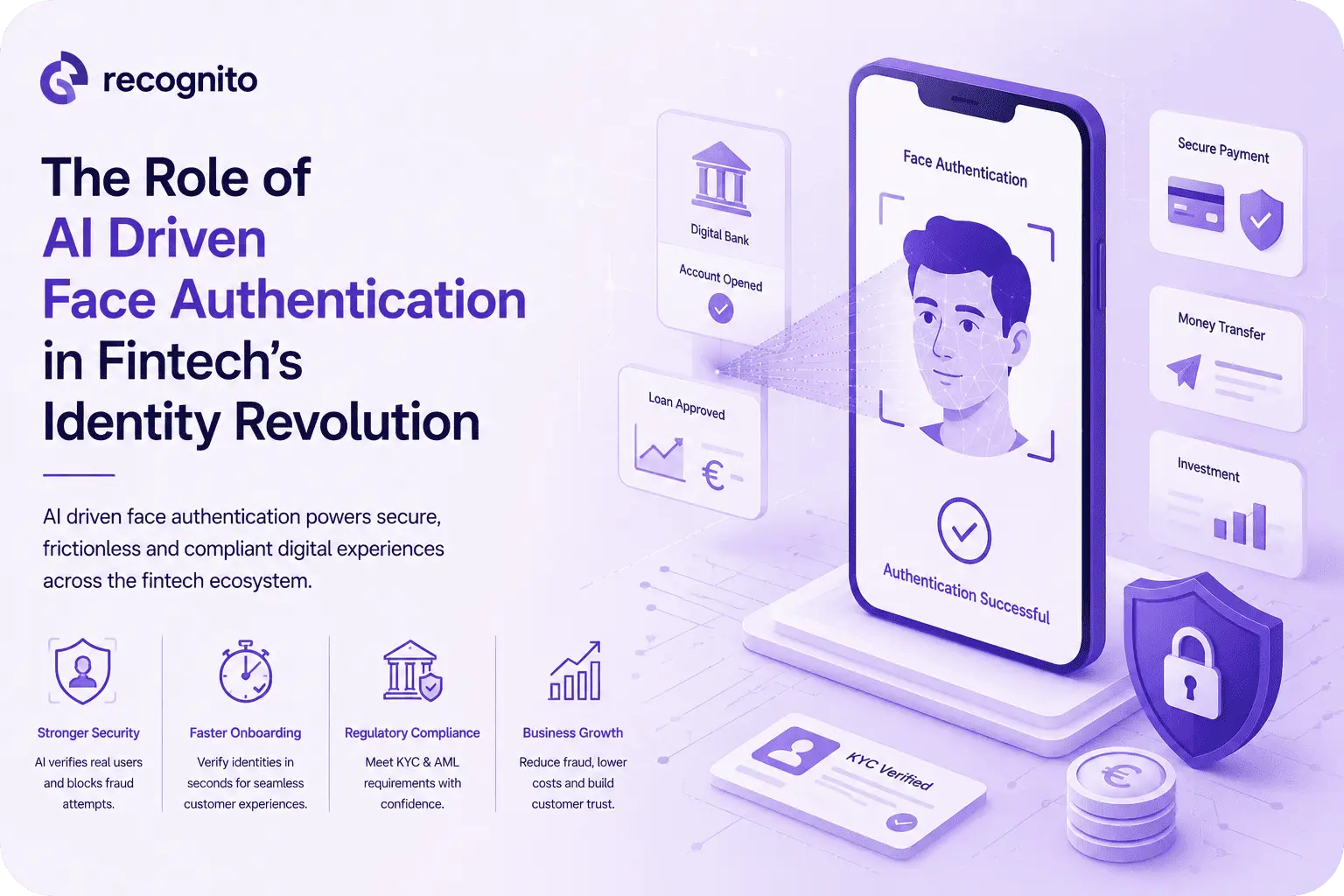
Fintech changed the relationship between financial services and physical branches. Customers can now open accounts, recover access, approve transactions, and manage financial products without visiting an office. But moving identity online created a difficult security problem: how do you establish that the person behind a screen is actually the legitimate account holder?
Passwords provide weak evidence of identity because they can be stolen. One-time codes improve protection but can still be intercepted or socially engineered. Knowledge-based questions depend on information that may already be exposed.
AI-driven face authentication introduces a different type of identity signal. Instead of asking only what a customer knows or possesses, it evaluates biometric characteristics to help establish who the customer is.
This does not mean facial authentication is a standalone answer to fintech security. Its value comes from combining facial recognition, liveness detection, device intelligence, risk controls, and other identity signals into a broader security architecture.
That shift is driving what can reasonably be called an identity revolution in fintech: identity is becoming a continuously evaluated security signal rather than a one-time onboarding event.
Why Fintech Needs Stronger Identity Signals
Digital financial services operate under an uncomfortable tension. The onboarding process must be fast enough to compete with consumer applications, while the institution must still manage impersonation, account takeover, synthetic identity fraud, and regulatory obligations.
A customer may legitimately provide the correct password, phone number, or one-time code while an attacker is controlling the account. Those credentials prove possession, not necessarily identity.
Biometrics address part of this weakness by linking an interaction to a physical characteristic. NIST’s current digital identity guidance recognizes biometrics as a method that can support identity proofing and authentication when implemented with appropriate controls, while also emphasizing the privacy and security implications of biometric processing. NIST’s biometric authenticator requirements provide the relevant technical context.
For fintechs, this creates an opportunity to make authentication more resistant to credential theft without forcing customers through increasingly complicated password processes.
What AI Adds to Face Authentication
Traditional face matching compares facial characteristics between a live capture and a reference image. AI makes that process more adaptable by learning complex facial patterns and handling variations that are difficult to express through simple rules.
A modern face authentication system may perform several tasks:
- Detect and locate a face in the camera stream
- Assess whether the captured image is usable
- Generate a biometric representation
- Compare it against an enrolled reference
- Estimate the confidence of the match
- Analyze whether the face appears genuine and present
- Identify conditions that require additional verification
The important architectural point is that face matching and face liveness are different functions.
A strong facial match does not automatically prove that the customer is physically present. An attacker could potentially present a photograph, replayed video, synthetic media, or another manipulated input. Liveness detection provides a separate layer intended to distinguish genuine biometric capture from presentation attacks.
FIDO’s Face Verification certification framework specifically addresses selfie matching alongside threats such as deepfakes, liveness failures, injection attacks, and demographic performance.
That makes AI-driven face authentication much more than a visual login. It becomes an identity-security component with multiple detection stages.
From Onboarding to Continuous Identity Protection
One of the biggest changes fintechs are making is moving away from treating identity verification as a single event.
Historically, the main identity check happened when an account was opened. After that, the customer authenticated with a password, PIN, token, or one-time code.
AI-driven biometrics enable a broader model.
During onboarding, a customer may present an identity document and complete a selfie check. During account recovery, the institution may ask for another facial verification. A high-risk transaction could trigger additional biometric authentication. A suspicious session might require stronger identity proof before access is granted.
This creates a layered identity lifecycle:
Proof identity → enroll → authenticate → monitor risk → step up when necessary
The approach is particularly relevant to high-value financial activities, where authentication strength should reflect transaction risk rather than remaining static for every session.
A deeper look at the broader role of face-based financial authentication is available in face authentication for fintechs.
How AI Face Authentication Works in a Fintech Workflow
A typical implementation can be divided into several stages.
1. Enrollment
The customer creates an identity profile. A trusted facial reference may be created from an approved identity-verification process, rather than relying on an arbitrary photograph.
2. Capture
When authentication is requested, the customer’s device camera captures a new facial sample.
3. Quality and face detection
The system checks whether a face is detectable and whether the capture is sufficiently usable for matching.
4. Biometric comparison
The new facial representation is compared with the enrolled reference. The system produces a similarity score that is evaluated against a defined decision threshold.
5. Liveness assessment
The system checks whether the input appears to represent a live person rather than a presentation attack.
6. Risk decision
The authentication result can be combined with device, session, behavioral, transaction, and account-risk information.
7. Step-up or approval
A low-risk event may proceed immediately. A high-risk or uncertain event may trigger another verification factor or manual review.
This model matters because it avoids putting the entire security decision on the facial matcher. The biometric system supplies evidence; the fintech’s risk engine determines what that evidence means in context.
Facial Authentication and Fraud Prevention
The strongest argument for AI face authentication is not convenience. It is the opportunity to strengthen defenses against identity-based fraud.
Consider account takeover. An attacker may obtain a customer’s credentials through phishing or malware. If the fintech requires biometric verification before a sensitive account-recovery action, possessing the password alone may no longer be enough.
Consider another scenario: a fraudster creates an account using stolen identity information. A selfie-to-document comparison can help establish whether the applicant resembles the person represented by the identity evidence.
The model becomes even stronger when biometric verification is combined with liveness, document analysis, and fraud intelligence.
The relationship between biometrics and broader fraud controls is explored in how biometric verification reduces fraud.
Deepfakes Change the Threat Model
AI-generated media has made facial security more complicated.
A traditional presentation attack might involve holding a photograph in front of a camera. Modern attacks can be more dynamic, including manipulated video, synthetic faces, and attempts to inject altered biometric data into a remote verification process.
That means fintechs should ask more than whether a vendor’s face matcher has high accuracy.
The critical questions include:
- How does the system detect presentation attacks?
- How does it address deepfake content?
- Can manipulated or injected media reach the matching engine?
- How are suspicious captures escalated?
- What happens when liveness and face similarity produce conflicting results?
ISO/IEC 30107-1:2023 establishes a framework for biometric presentation attack detection and clarifies that presentation attacks occur during the capture and presentation of biometric characteristics. It also makes clear that PAD is not the same as an overall system security assessment. The ISO presentation-attack detection framework is therefore useful when structuring biometric threat models.
For fintechs, the lesson is straightforward: authentication security depends on more than the recognition algorithm.
The Customer Experience Advantage
Security controls are often designed as obstacles. Face authentication can turn part of that friction into a familiar interaction.
Customers already use facial biometrics to unlock phones and authorize digital services. In a well-designed fintech application, the interaction can be reduced to a brief camera-based verification rather than another password or recovery questionnaire.
But convenience depends heavily on implementation quality.
Poor lighting, camera limitations, head pose, motion, glare, and unclear instructions can increase failed attempts. Excessive retries can frustrate legitimate customers and increase support costs.
The objective should therefore be low-friction assurance, not simply the fewest screens.
A good system tells the customer what to do, provides useful capture feedback, and escalates only when confidence is insufficient.
For teams evaluating how facial technology behaves before committing to an implementation, a face biometric playground can provide a practical environment for exploring biometric interactions.
Accuracy Is Not the Same as Security
Fintech decision-makers often ask for an accuracy percentage. That is only part of the picture.
Face authentication involves at least two competing error types. An overly permissive threshold may make fraudulent acceptance more likely. An overly restrictive threshold may reject legitimate customers.
Performance can also vary according to image quality, demographic characteristics, elapsed time between reference and authentication images, and operating conditions.
NIST’s current FRTE demographic evaluation documents how false-positive and false-negative effects can vary across demographic groups and notes the strong influence of image quality on false negatives.
That makes production testing essential. A vendor’s laboratory result may demonstrate algorithm capability, but a fintech still needs to test its own users, devices, capture journey, thresholds, and fraud scenarios.
The practical goal is not the highest published percentage. It is an operating point that produces acceptable security and customer outcomes.
Privacy Becomes More Important, Not Less
Biometric authentication creates a different privacy responsibility from password storage.
A compromised password can be changed. A person’s facial characteristics cannot simply be replaced.
That makes biometric lifecycle management critical. Fintechs should establish what information is captured, whether raw images are retained, how templates or representations are protected, who can access them, where processing occurs, and when data is deleted.
NIST’s identity-proofing requirements also address biometric privacy, including obligations to provide information about biometric use, storage, protection, and removal consistent with applicable laws and regulations. The current identity-proofing requirements are useful when designing these processes.
Privacy should therefore be part of the architecture from the beginning rather than a legal review added after deployment.
AI Governance and Explainability
Introducing AI into authentication also creates governance requirements.
A model can change over time. Thresholds can be recalibrated. New attack patterns can emerge. A vendor can release an updated model or change how the capture experience works.
Fintechs therefore need mechanisms to understand whether performance is improving or deteriorating.
NIST’s AI Risk Management Framework provides a voluntary framework for incorporating trustworthiness considerations into AI design, deployment, use, and evaluation.
For identity systems, practical governance includes:
- Monitoring authentication failures
- Tracking false rejections and suspicious acceptances
- Testing model updates before production
- Reviewing demographic performance
- Documenting significant threshold changes
- Maintaining an escalation process
- Auditing abnormal changes in fraud outcomes
This turns facial authentication from an isolated software component into a managed security capability.
Where an SDK Fits Into the Architecture
For fintech engineering teams, implementation quality can determine whether the biometric technology actually delivers its expected value.
An AI model may be technically strong, but the surrounding application still needs camera permissions, secure data transmission, error handling, retries, timeout management, platform compatibility, and integration with the existing identity system.
A facial recognition SDK can provide the biometric capability inside a larger application workflow.
Teams should test the SDK under real conditions rather than relying solely on documentation. That includes different smartphones, varying network quality, low-light capture, interrupted sessions, authentication failures, and recovery paths.
The Recognito GitHub repository can also provide technical resources for development teams evaluating implementation approaches.
The Business Case for AI-Driven Authentication
The value of facial authentication is ultimately measured through business outcomes.
A fintech should look at several dimensions rather than treating biometric adoption as a technology checkbox.
| Business objective | What to measure | Potential impact |
| Fraud reduction | Fraudulent attempts detected or blocked | Lower financial losses |
| Account security | High-risk authentication success | Stronger protection against takeover |
| Conversion | Successful onboarding completion | Fewer abandoned applications |
| Customer experience | Verification time and retry rate | Lower friction |
| Operations | Manual-review volume | Lower support and review costs |
| Resilience | Performance under attack scenarios | Stronger security posture |
| Governance | Auditability and monitoring coverage | Better risk management |
The most useful measurement is often comparative. What changed after biometric authentication was introduced? Did account takeover decrease? Did recovery fraud fall? Did legitimate customers experience fewer or more failures? Did manual-review demand change?
Those questions connect the biometric investment to actual business performance.
Why Face Authentication Is Becoming Part of the Identity Layer
The fintech identity model is moving from static credentials toward combinations of evidence.
A customer may begin with verified identity information, authenticate with a device-bound factor, use facial biometrics for step-up verification, and trigger stronger controls when transaction risk increases.
Face authentication fits this model because it can be used at multiple points without requiring a dedicated physical reader.
That flexibility is particularly important in mobile-first financial services, where the customer’s smartphone is already the primary interface.
It also makes the technology complementary to other security mechanisms rather than a direct replacement for all of them.
For transaction-focused applications, face authentication for secure online transactions provides another perspective on how facial biometrics can fit into financial workflows beyond initial account creation.
What Fintechs Should Evaluate Before Deployment
Before introducing AI-driven face authentication into a production identity architecture, decision-makers should evaluate five areas.
Security
Assess biometric matching, liveness, presentation attacks, deepfakes, injection risks, account recovery abuse, and fallback mechanisms.
Accuracy
Measure both acceptance and rejection behavior at the operating threshold that matches the business’s security requirements.
User experience
Test real customers across supported devices, environments, and network conditions.
Privacy
Understand the complete biometric data lifecycle and applicable legal requirements before deployment.
Operations
Define monitoring, escalation, manual review, incident response, vendor-change management, and rollback procedures.
These considerations prevent a common mistake: choosing a biometric model first and designing the security architecture around it later.
The Future of Fintech Identity Is Layered
AI-driven face authentication is not replacing identity verification, passwords, devices, or risk engines. It is becoming one of the mechanisms that connects them.
The strongest fintech architectures will use facial biometrics where they provide meaningful assurance, then combine that signal with document evidence, liveness, device trust, transaction risk, behavioral indicators, and other controls.
That approach makes identity adaptive.
A routine login can remain simple. A suspicious account-recovery attempt can require stronger evidence. A high-risk payment can trigger biometric step-up authentication. The same identity layer can support all three without applying identical friction to every customer.
The result is a more flexible security model that aligns verification strength with actual risk.
Conclusion
AI-driven face authentication is changing fintech identity by making biometric evidence a practical part of onboarding, authentication, account recovery, and fraud prevention.
Its real strength does not come from facial matching alone. It comes from combining AI-based recognition with liveness, secure capture, risk orchestration, privacy controls, monitoring, and appropriate fallback mechanisms.
For fintechs, the strategic opportunity is to replace fragmented identity checks with a layered identity architecture that can increase assurance without making every interaction cumbersome.
For organizations building that infrastructure, Recognito provides biometric technologies that can support secure facial authentication and identity-verification workflows.
Frequently Asked Questions
Is AI-driven face authentication secure enough for fintech?
It can provide strong identity assurance when implemented as part of a layered security architecture. Matching alone is insufficient; liveness, presentation-attack defenses, secure integration, risk controls, and monitoring are also important.
Can face authentication prevent account takeover?
It can make credential-only attacks harder by adding a biometric factor, particularly during sensitive actions such as account recovery or high-risk authentication. It does not eliminate every account-takeover pathway.
Does facial authentication replace passwords?
Not necessarily. Many fintechs use biometrics alongside other authentication factors. The appropriate combination depends on the threat model, user experience, and risk of the action being authorized.
What is the biggest challenge with AI face authentication?
A major challenge is balancing security and usability. High security thresholds may increase false rejections, while permissive thresholds can increase acceptance risk. Capture quality and presentation attacks also need attention.
Should fintechs use facial authentication during onboarding and login?
The answer depends on the workflow. Using facial verification during onboarding can help connect the applicant to identity evidence, while later authentication can provide stronger assurance for account recovery or high-risk actions.