
Online transactions are increasingly being approved without a customer ever entering a password or visiting a branch. That convenience creates a difficult security problem: how can a payment provider determine that the person initiating a high-value transaction is actually the legitimate account holder?
Passwords can be stolen. One-time codes can be intercepted or socially engineered. Payment credentials can be compromised. Even a familiar device does not necessarily prove that the correct person is operating it.
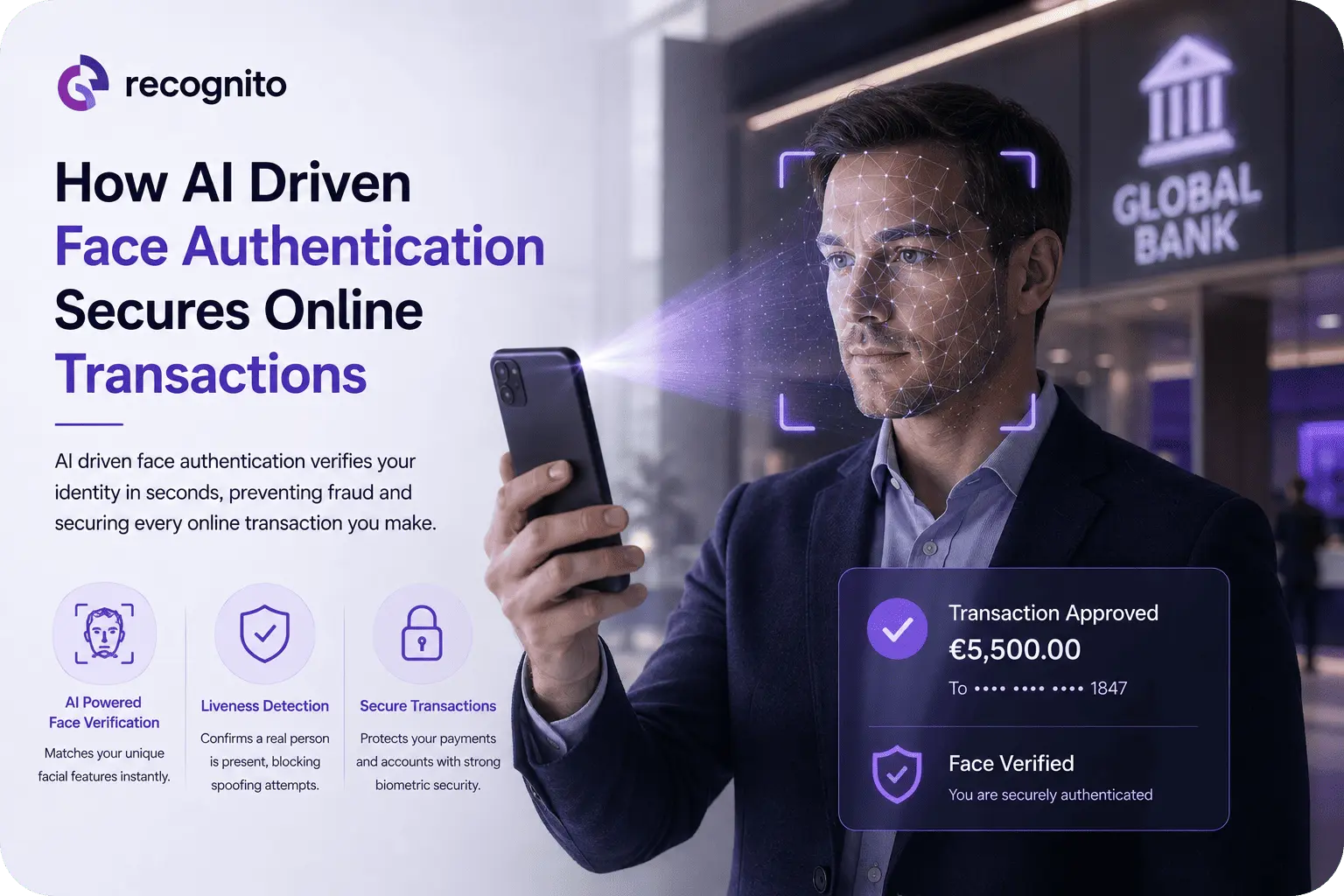
AI-driven face authentication introduces a biometric signal into that decision. A camera captures the user’s face, an AI model analyzes its characteristics, and the system compares the result against a trusted biometric reference. Additional liveness and anti-spoofing controls can help determine whether the interaction comes from a genuine, present user.
The result is not simply a more convenient login. Properly designed, face authentication can become another security layer between stolen credentials and an unauthorized transaction.
Why Online Transactions Need More Than Passwords
Transaction fraud often exploits the gap between having credentials and being the legitimate person behind them.
A criminal who obtains a username, password, or payment credential may attempt to access an account or authorize a purchase. Traditional controls can stop some attacks, but each additional authentication step can also introduce customer friction.
Strong customer authentication frameworks recognize the value of combining different authentication factors. The European Banking Authority explains that PSD2 strong customer authentication applies when users access payment accounts, initiate electronic payment transactions, or perform certain remote actions carrying fraud risk.
Biometrics provide an inherence factor because they are tied to characteristics of the user. NIST’s current authentication and authenticator guidance covers biometric use within broader digital authentication requirements.
The practical opportunity is to make transaction authorization harder to hijack without forcing every legitimate customer through cumbersome verification.
How AI-Driven Face Authentication Works
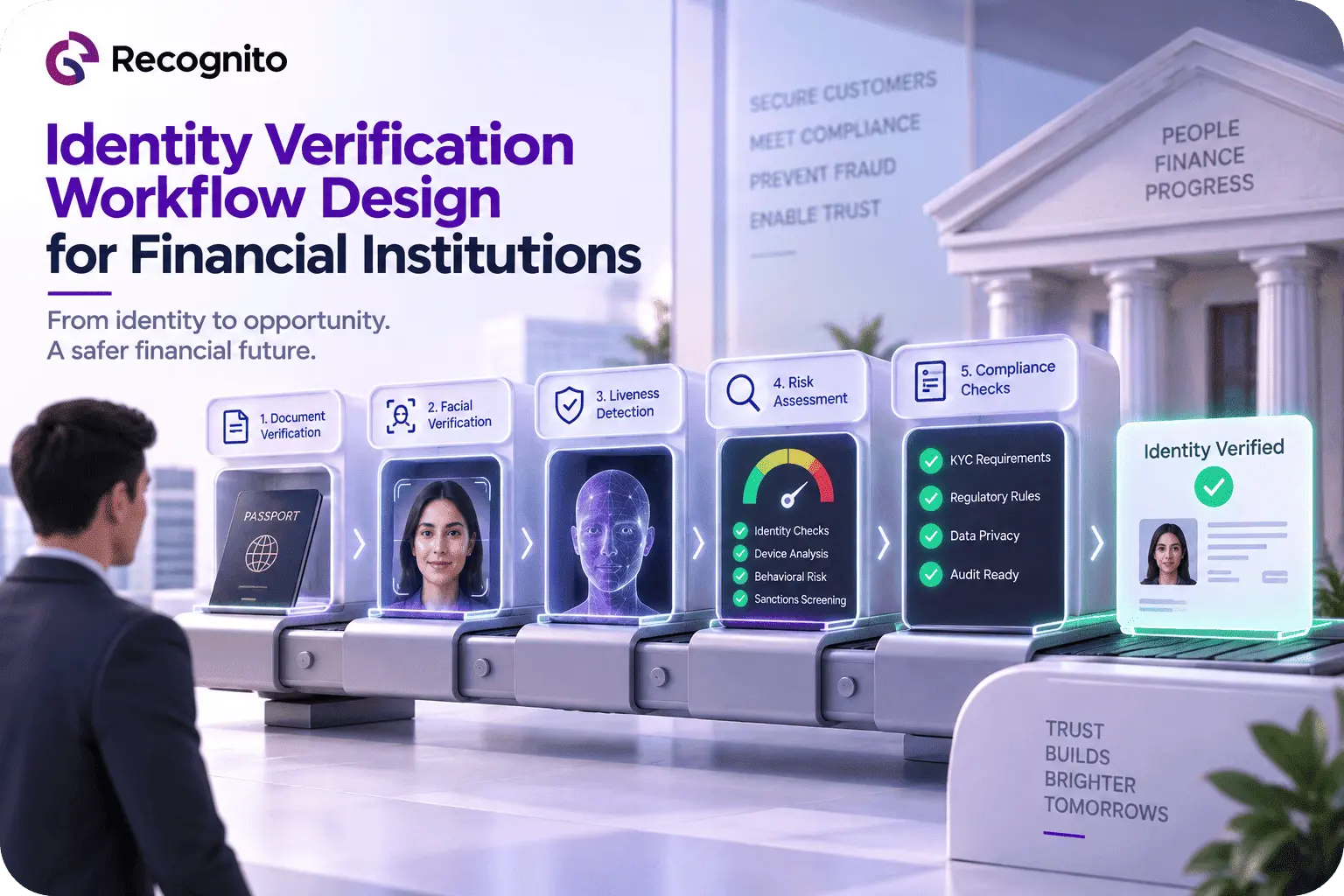
A typical face authentication flow has several stages.
First, the application activates the camera and captures the user’s face. Computer vision identifies the facial region and evaluates whether the image is suitable for processing.
An AI model then converts facial characteristics into a mathematical representation. The system compares that representation with a trusted reference associated with the account.
A similarity score is produced, and the application applies a predefined threshold. A high enough score may satisfy the biometric requirement, while an uncertain score can trigger a retry, another authentication factor, or manual intervention depending on the transaction risk.
The crucial point is that modern face authentication is not just image comparison. Security-sensitive implementations also need to consider whether the facial input comes from a genuine user.
That is where liveness detection and presentation-attack controls become important.
Liveness Prevents a Face Match From Becoming a Weak Point
Imagine a fraudster obtains a photograph of the account holder. A facial recognition model might correctly determine that the image resembles the enrolled customer.
That is not enough to authorize a sensitive transaction.
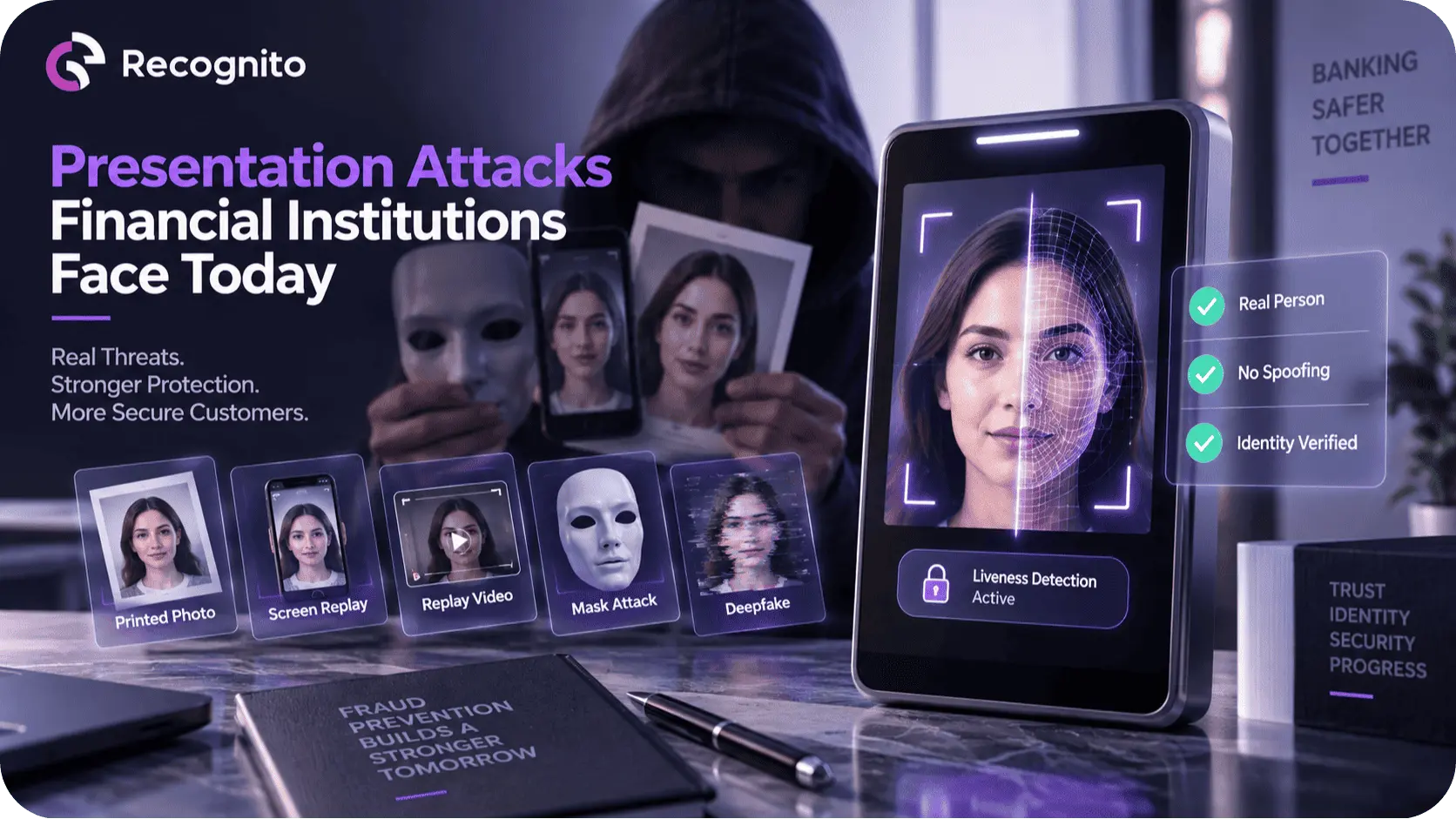
Liveness detection attempts to determine whether the face being presented belongs to a live subject rather than a photograph, replayed video, mask, or another presentation attack. For remote authentication, this creates a second security question:
Is this the right face, and is the person actually present?
FIDO’s Face Verification certification framework evaluates remote facial verification solutions against threats including deepfakes, liveness attacks, biometric matching failures, and injection attacks.
For an online transaction system, this distinction is fundamental. Face matching establishes biometric similarity; liveness helps establish the legitimacy of the capture event.
AI Helps Adapt Authentication to Transaction Risk
Not every transaction deserves the same authentication experience.
A low-value purchase from a familiar environment may require little friction. A large transfer, new beneficiary, unusual location, or account-recovery event may warrant stronger verification.
AI-driven systems can support this risk-based model by combining facial authentication with contextual signals.
For example, a transaction engine may consider:
- transaction value
- customer history
- device characteristics
- unusual account behavior
- location or session anomalies
- biometric confidence
- liveness results
- previous authentication events
The biometric result does not have to make the entire decision by itself.
Instead, it becomes one high-value signal within a broader risk engine.
This approach can reduce the temptation to make every customer complete the most restrictive authentication journey.
Where Face Authentication Adds the Most Security
The strongest applications are those where an attacker who controls credentials could cause significant damage.
High-value payments
A financial institution may require additional facial verification before approving a large transfer or unusual payment.
Account recovery
Password-reset flows are attractive targets because successful recovery can hand an attacker control of the account. Face authentication can help reconnect the recovery event with the legitimate account holder.
New-device authentication
When a user attempts to access an account from a new device, biometric verification can provide another way to establish that the person behind the session is legitimate.
Sensitive account changes
Changing a phone number, adding a beneficiary, changing security settings, or modifying payment details can justify stronger authentication.
Recognito’s secure online transaction face authentication content explores this use case in greater detail, particularly where biometric verification is integrated into payment security.
Face Authentication vs Traditional Authentication
Biometric authentication does not necessarily need to replace passwords, passkeys, or possession factors.
Instead, it can complement them.
| Authentication approach | Main strength | Key weakness | Best use |
| Password | Familiar and inexpensive | Can be stolen or reused | Basic account access |
| OTP | Adds an additional verification step | Vulnerable to phishing and interception | Step-up authentication |
| Device-based authentication | Ties access to a registered device | Device compromise remains possible | Routine authentication |
| Face authentication | Links authentication to the user’s biometric characteristics | Requires camera and anti-spoofing controls | High-value or remote authentication |
| Layered authentication | Combines multiple independent signals | More implementation complexity | High-risk transactions |
The right architecture depends on the threat model.
The goal should not be to replace every existing control with facial recognition. It should be to create a stronger authentication chain where biometric evidence provides meaningful additional assurance.
A broader comparison of biometric approaches is available in biometric authentication versus traditional authentication.
Deepfakes Change the Authentication Threat Model
AI-generated media makes facial authentication harder to design correctly.
An attacker may attempt to generate or manipulate facial video that resembles a legitimate customer. They may also attempt to interfere with the media pipeline before it reaches the biometric engine.
This is why modern face authentication needs protection at multiple levels.
The camera capture layer should detect suspicious presentation conditions. Liveness should help distinguish genuine users from spoofing attempts. The application should protect communication between the client and authentication service. Risk engines should examine transaction context instead of blindly trusting one biometric result.
The authentication process also needs appropriate controls against injection attacks, where manipulated input attempts to bypass the expected camera-to-analysis pipeline.
A biometric model can be highly accurate and still sit inside an insecure application architecture. Security has to extend beyond the recognition algorithm.
Accuracy Is Not the Same as Security
A vendor may advertise a very high face recognition accuracy rate, but that number needs context.
Performance depends on factors such as:
- camera quality
- lighting
- image resolution
- face angle
- capture distance
- threshold configuration
- demographic characteristics
- reference-image quality
- presentation attacks
- operating environment
A system optimized for very low false acceptance may reject more legitimate users. A system optimized for convenience may accept more uncertain matches.
For online payments, that trade-off should be linked to transaction risk.
A financial institution may tolerate a slightly more demanding authentication experience for a high-value transfer than for a low-value purchase.
This is why organizations should evaluate both security and customer-experience metrics rather than treating one accuracy percentage as the final measure.
The Role of an AI Face Authentication SDK
For a product team, the implementation challenge is larger than selecting a recognition model.
The application has to manage camera permissions, capture states, image quality, user guidance, retries, network failures, biometric results, liveness outcomes, and transaction authorization logic.
A face recognition SDK can provide the biometric processing layer while allowing developers to integrate the authentication experience into their own application.
The SDK should still be evaluated carefully. Important questions include:
- Which platforms are supported?
- How much processing happens on the device?
- What information is transmitted?
- How are failures reported?
- How does the SDK handle poor image quality?
- What liveness capabilities are available?
- Can thresholds and risk rules be integrated into the application’s architecture?
- How is performance monitored after deployment?
Development teams can also examine the Recognito GitHub repository as part of their technical evaluation and implementation planning.
Usability Determines Whether Security Works
An authentication method that users consistently fail to complete creates its own operational problems.
People may be in low light, using an older phone, holding the device at an unusual angle, or moving while capturing their face. A system that simply responds with “verification failed” creates confusion and repeated attempts.
Better implementations provide immediate guidance.
The application can indicate that the user’s face is outside the capture area, that lighting is insufficient, or that the image is unclear. The customer can correct the problem before the transaction is rejected.
This is especially important when biometric authentication is used as a step-up control. The customer should understand why another verification step appeared and how to complete it without unnecessary complexity.
Privacy Must Be Designed Alongside Security
Face authentication involves sensitive biometric information, so transaction security cannot be separated from data governance.
The organization should determine:
- what biometric information is collected
- whether raw images are retained
- where processing takes place
- how biometric templates are protected
- who can access authentication records
- how long information is retained
- how deletion requests are handled
- which third parties process the data
Data minimization is particularly important. Storing more biometric information than the authentication process actually requires increases the potential impact of a compromise.
Technical architecture also matters. Some implementations can perform significant processing on the user’s device, while others rely on remote biometric services. Each model creates different security, privacy, and operational considerations.
Testing the Complete Transaction Flow
Facial authentication should never be evaluated only with successful demonstrations.
A serious test program should include legitimate and adversarial scenarios.
Test users should attempt authentication under different lighting conditions, devices, camera qualities, and capture angles. Security teams should also test photographs, replay attacks, manipulated media, and other realistic presentation threats.
The transaction layer should be tested at the same time.
For example, the team should determine what happens when facial authentication fails after a payment has been submitted. Does the payment remain blocked? Can the customer safely retry? Does the transaction engine distinguish a failed biometric check from a detected fraud signal?
EMVCo’s guidance on 3-D Secure transactions and payment-token data describes how additional authentication challenges, including biometrics, can be used for higher-risk e-commerce transactions while considering the effect of authentication friction on consumers.
The transaction itself should therefore remain tightly connected to the authentication event.
Avoid Making the Biometric the Only Trust Signal
One of the most important architectural decisions is knowing what face authentication should not do.
A successful facial match should not automatically override every other risk signal.
Suppose the biometric result is strong, but the transaction suddenly involves a new recipient, an unfamiliar device, abnormal account behavior, and an unusually large amount. The system should still be able to increase scrutiny.
Conversely, a customer might fail a biometric capture because of poor lighting even though every other risk signal looks normal. Automatically classifying that customer as fraudulent would create unnecessary friction.
Risk engines should therefore distinguish between:
authentication failure,
capture failure, and
fraud suspicion.
Those are not interchangeable outcomes.
Measuring Business Impact
Once face authentication is deployed, the organization needs more than login statistics.
Useful metrics include:
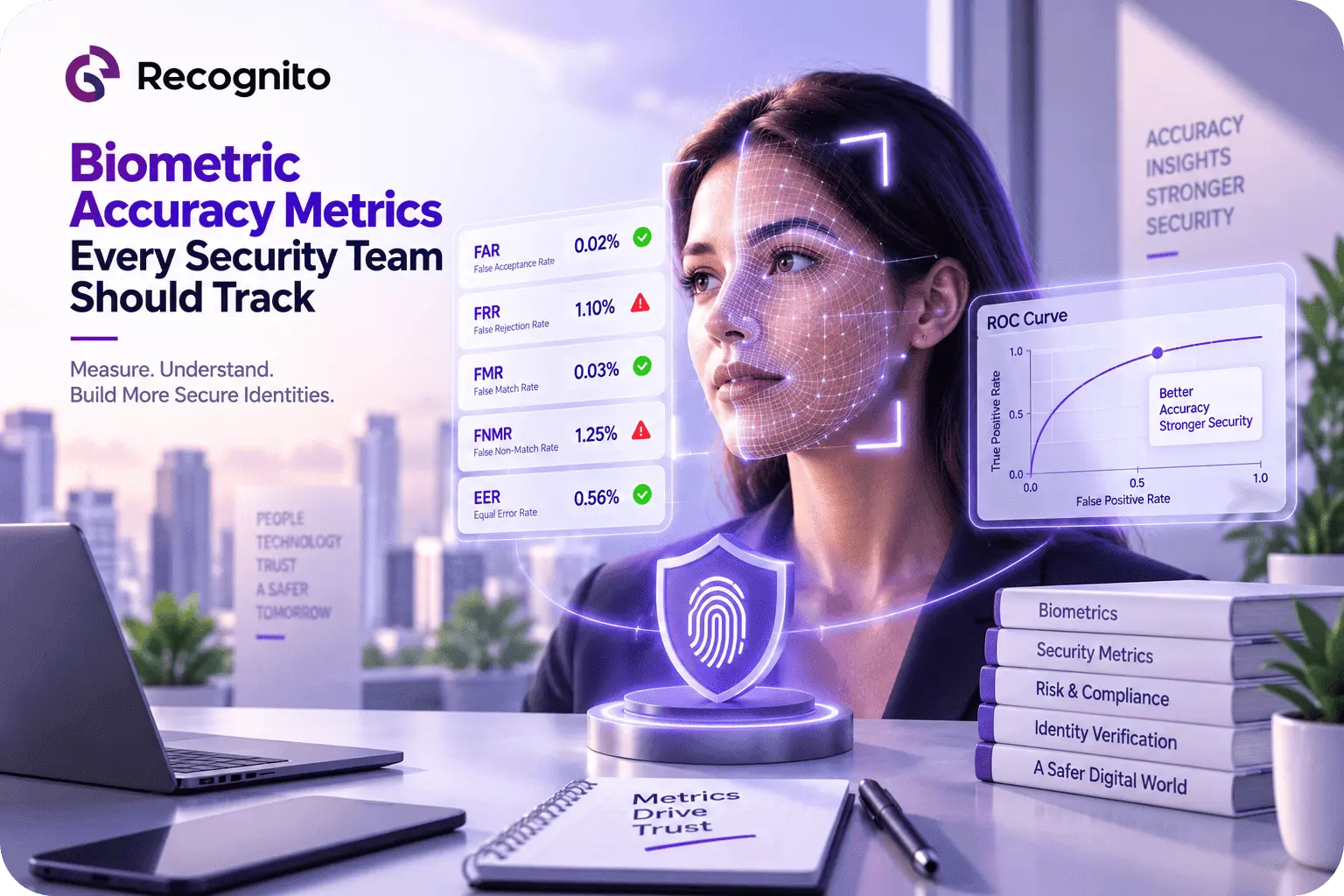
False acceptance rate: How often could an unauthorized user pass?
False rejection rate: How often are legitimate users incorrectly blocked?
Authentication completion rate: How many customers successfully finish the process?
Retry rate: How frequently do users need another capture?
Step-up success rate: How often do customers successfully complete stronger verification?
Transaction fraud rate: Does biometric authentication reduce fraudulent transaction outcomes?
Abandonment rate: How much customer friction does the added security create?
These measurements reveal whether the technology is actually improving the security-to-friction balance.
Where AI-Driven Face Authentication Is Heading
The most effective transaction security architectures are moving toward adaptive authentication rather than one fixed verification requirement.
A routine transaction may pass with a familiar device and established authentication context. A higher-risk event can trigger facial verification, liveness assessment, and additional controls without applying the same friction to every customer.
This creates a more proportional security model.
Face authentication can also connect account enrollment, authentication, account recovery, and sensitive transaction authorization into a more consistent identity architecture. FIDO’s remote face verification certification resources illustrate the industry’s growing focus on biometric accuracy, liveness, bias, and structured testing for remote identity workflows.
The direction is not simply toward “more biometrics.” It is toward better coordination between biometric evidence, transaction context, device trust, and risk decisioning.
Conclusion
AI-driven face authentication can strengthen online transaction security by adding a biometric layer that is much harder to use remotely than a stolen password alone.
Its effectiveness depends on more than facial matching. Liveness, anti-spoofing controls, secure application architecture, risk-based decisions, privacy safeguards, and realistic testing all determine whether biometric authentication provides meaningful protection.
The strongest approach treats face authentication as one component of a layered transaction-security strategy. Use it where transaction risk justifies stronger assurance, calibrate the experience carefully, and measure both fraud reduction and customer friction after deployment.
For organizations building biometric authentication into digital products and payment workflows, Recognito provides technology designed to support practical face-based identity and authentication experiences.
Frequently Asked Questions
Can face authentication prevent online transaction fraud?
It can reduce certain forms of unauthorized access and impersonation by adding biometric verification, but it cannot eliminate every fraud technique. Strong transaction security still requires layered controls.
Is facial recognition enough without liveness detection?
For security-sensitive remote authentication, relying only on facial similarity creates unnecessary exposure to presentation attacks. Liveness provides an additional check that the user is genuinely present.
Can face authentication replace passwords?
It can replace passwords in some architectures, but many systems use biometrics alongside other authentication mechanisms. The appropriate design depends on the application’s threat model and assurance requirements.
Does face authentication create privacy risks?
Yes. Biometric data requires careful governance. Organizations should minimize collection, protect biometric information, restrict access, define retention periods, and understand where processing occurs.
What should businesses evaluate before deploying face authentication for transactions?
Evaluate biometric accuracy, liveness, spoof resistance, device coverage, usability, privacy, integration, transaction orchestration, fallback controls, and real-world performance under both legitimate and adversarial conditions.