
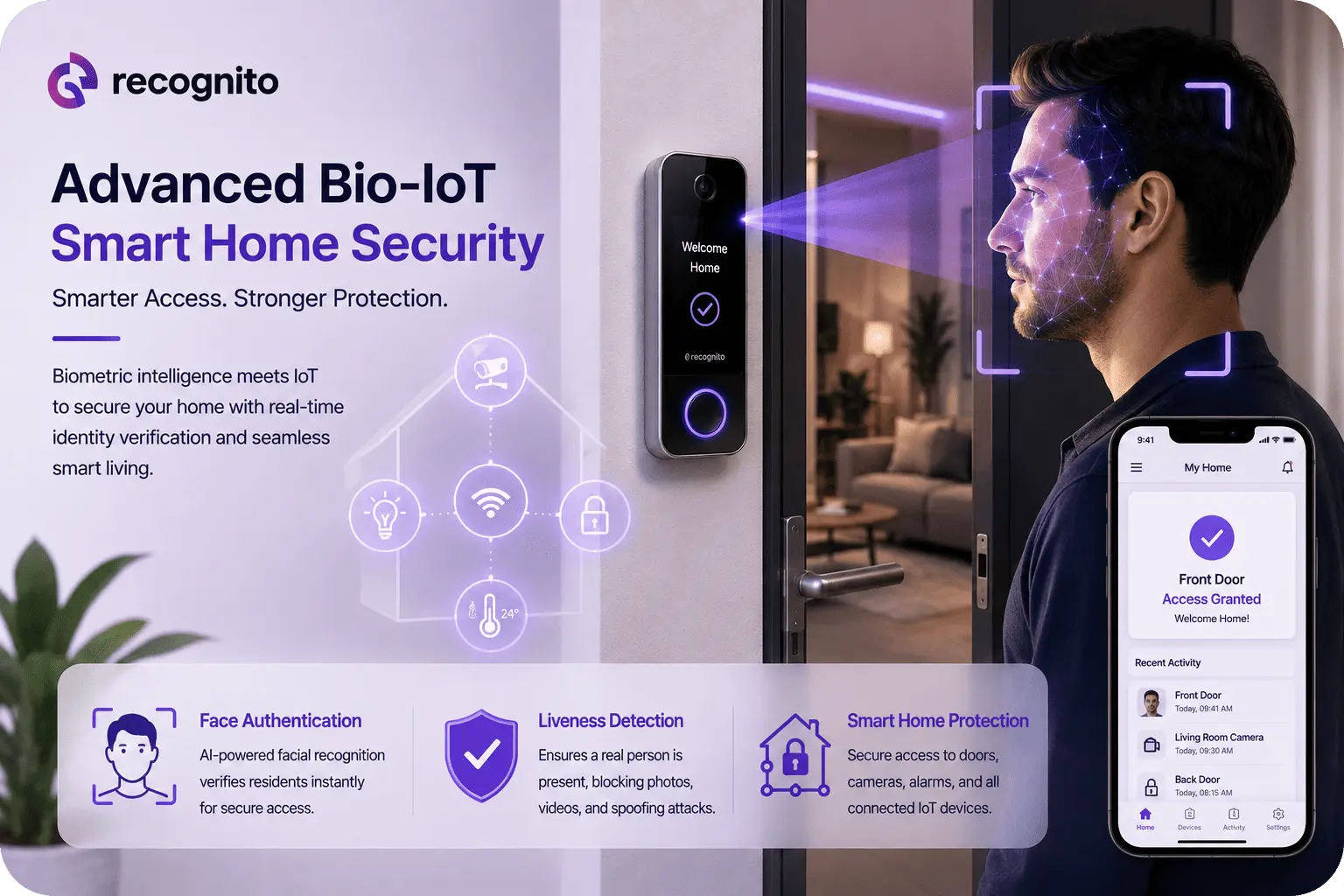
Smart homes are becoming less like collections of connected appliances and more like interconnected security environments. Cameras watch entrances, locks control access, sensors detect movement, voice assistants respond to commands, and connected devices continuously exchange information.
That connectivity creates a major opportunity for stronger security, but it also creates a larger attack surface. A compromised camera, weak device credential, exposed hub, or poorly protected smart appliance can become an entry point into the wider home network.
Advanced Bio-IoT is addressing part of this problem by bringing biometric intelligence into the Internet of Things. Instead of relying only on passwords, PINs, or device ownership, smart-home systems can use facial recognition, liveness detection, behavioral patterns, and other biometric signals to determine who is interacting with the environment.
The result is a shift from device-centric security to identity-aware security. The smart home does not simply know that a command came from a connected device; it can increasingly determine who is making the request and whether the interaction appears legitimate.
Why Smart Homes Need More Than Device Authentication
Traditional IoT security often treats the device as the primary identity.
A smart lock trusts a mobile application. A camera trusts an account. A smart speaker responds to a recognized voice or authenticated service. Once an attacker obtains a password, session token, or compromised device, the system may have limited ability to distinguish the legitimate owner from the attacker.
That weakness becomes more serious as more devices share the same ecosystem.
NIST’s IoT Core Baseline for Consumer IoT Products identifies cybersecurity capabilities intended for consumer IoT products and emphasizes that security requirements should apply to the entire IoT product rather than being treated as an isolated feature.
Biometric intelligence adds another dimension: identity.
A smart-home platform equipped with biometric verification can potentially recognize an authorized resident before unlocking a door, changing a security setting, viewing sensitive camera feeds, or executing a high-impact command.
This does not eliminate conventional authentication. Instead, it gives the system another signal that is tied to the person rather than simply the device.
What Bio-IoT Adds to the Smart Home
Bio-IoT combines connected physical devices with biometric or human-behavior signals.
A home security ecosystem might combine:
- facial recognition cameras
- fingerprint-enabled devices
- voice recognition
- movement or gait analysis
- behavioral patterns
- smart locks
- connected alarms
- environmental sensors
- edge AI processors
- cloud-based management systems
The important development is the ability to make these components cooperate.
Imagine a resident approaching the front door. A camera identifies a face, liveness technology checks that the input is not simply a photograph or replay, the smart lock evaluates authorization, and the home automation platform determines which connected actions should follow.
The security system is no longer reacting only to motion. It is evaluating identity plus context.
Research published in 2026 on multimodal biometric authentication for IoT-enabled smart homes similarly explored combining facial recognition with behavioral information rather than relying on a single biometric modality. The study reported stronger performance from the combined approach than from either modality individually.
Facial Recognition Is Becoming a Key Identity Layer
Facial recognition is particularly suited to smart-home environments because cameras are already common in doorbells, indoor security systems, phones, and access-control devices.
Instead of requiring residents to enter a PIN or physically interact with a reader, a system can potentially recognize an authorized person when they approach a protected area.
Applications include:
Smart door access
A camera can identify approved household members before an electronic lock is opened.
Room-level access
Sensitive areas such as offices, server rooms, medication storage, or equipment areas can require additional biometric verification.
Personalized automation
Recognition can be used to associate a person with predefined preferences. Lighting, temperature, entertainment, or access settings can respond differently depending on the identified resident.
Security event verification
When a camera detects activity, identity-aware analysis can help distinguish known residents from unknown individuals.
However, recognition alone is not enough for a security-sensitive workflow. A photograph of an authorized resident should not necessarily be treated as equivalent to the real person standing in front of the system.
That is where liveness becomes important.
Liveness Detection Closes a Major Security Gap
A facial recognition system answers one question:
Does this captured face resemble the enrolled identity?
Liveness detection addresses another:
Does the biometric input appear to come from a real, present person?
That distinction matters because attackers can use photographs, recorded video, masks, manipulated media, or other presentation methods against poorly protected biometric systems.
For smart-home applications, this matters most when a biometric decision can trigger a physical action. Opening a door is fundamentally different from simply identifying someone in a non-security application.
A practical implementation may therefore combine recognition and liveness before allowing high-risk actions.
For teams exploring the underlying biometric technology, deep learning for face anti-spoofing provides additional context on protecting facial systems against presentation attacks.
From Single Biometrics to Multimodal Bio-IoT
One of the most interesting developments is the move toward multimodal authentication.
A single biometric can fail under certain conditions.
A camera may struggle in poor lighting. A fingerprint sensor may perform poorly with a wet or damaged finger. Voice recognition can encounter environmental noise. Behavioral patterns can change over time.
Combining signals can make the overall system more resilient.
Consider a smart-home entrance that combines:
Face recognition: establishes probable identity.
Liveness detection: checks whether the captured face appears genuine.
Behavioral context: considers whether the interaction resembles normal household activity.
Device authentication: verifies that the connected system belongs to the trusted home environment.
Physical sensors: confirm door position and surrounding conditions.
The system can then assign confidence to the overall event instead of relying entirely on a single measurement.
For another perspective on identity-aware biometric capture, biometric face scanner technology illustrates how facial biometric systems can be used for user verification.
Edge AI Is Important for Smart-Home Security
A major challenge in Bio-IoT is deciding where biometric processing should occur.
Sending every camera frame to the cloud may increase latency, bandwidth usage, and privacy exposure. Processing selected biometric information locally at the edge can reduce the amount of raw data transmitted outside the home.
Edge processing can also make some security decisions faster.
For example, a camera attached to a smart lock could perform an initial face analysis locally and only request additional services when the situation requires them.
The architecture can therefore divide responsibilities:
Edge device: capture, detection, quality checks, and potentially initial matching.
Home hub: correlation of multiple sensor events and local policy enforcement.
Cloud platform: fleet management, longer-term analytics, device administration, or other functions where cloud processing is justified.
The right balance depends on hardware capability, security requirements, privacy constraints, and the complexity of the biometric models involved.
Bio-IoT Can Make Smart Homes Context-Aware
The real promise is not simply better authentication. It is more intelligent contextual decision-making.
A conventional motion sensor may report that someone entered a room.
An identity-aware system could potentially determine that:
- an authorized resident entered
- the resident entered during normal hours
- the door was opened through an approved method
- the person’s behavior is consistent with normal activity
- no other suspicious signals are present
The same event could produce a very different response if the system detects an unknown individual, an unusual access pattern, or conflicting biometric signals.
This creates a foundation for adaptive home security.
For example, an authorized resident might unlock the front door without additional interaction, while an unknown individual triggers stronger camera recording, notifications, and access restrictions.
That concept connects closely with face recognition system architecture and real-world use cases, where facial recognition is considered as part of broader operational workflows rather than as an isolated matching feature.
Smart-Home Cameras Become More Intelligent Security Sensors
Traditional security cameras primarily record video.
AI-powered Bio-IoT systems can treat video as a stream of structured security events.
A camera may detect a person, recognize an authorized individual, identify repeated access behavior, or trigger an action based on the combination of visual and contextual signals.
This turns video surveillance into a more active security layer.
For smart-home deployments, the same architecture can support perimeter protection, access management, visitor verification, and automated alerts.
The challenge is avoiding excessive surveillance. A system that captures and analyzes every person in every room may create privacy risks that outweigh the convenience.
The best architecture therefore needs clear boundaries around where biometric recognition is permitted, what data is processed, and what events require retention.
The New Attack Surface: Connected Biometric Devices
Adding biometrics to IoT does not remove the attack surface. It expands it.
A Bio-IoT system may now have to defend:
- cameras and microphones
- edge processors
- smart hubs
- mobile applications
- APIs
- cloud services
- device credentials
- biometric templates
- firmware
- wireless communications
- automation rules
An attacker does not necessarily need to fool the biometric model. They may instead attempt to compromise another component in the chain.
For example, an attacker could target the mobile application, steal credentials, compromise a hub, manipulate communications, or interfere with an IoT device that is trusted by the biometric system.
This is why biometric security must be integrated with broader IoT security rather than treated as a substitute for it.
NIST’s Cybersecurity for IoT Program emphasizes risk-based security and recognizes that IoT products must be considered within the environment in which they operate.
Device Onboarding Is Another Critical Security Layer
A smart home may contain dozens of connected devices from different manufacturers.
Adding a new camera, smart lock, sensor, or hub introduces an identity and trust problem: How does the home know the device is legitimate, and how are its credentials established securely?
FIDO Device Onboard addresses this type of problem with an automated mechanism for securely provisioning credentials and configuration to IoT devices. Its current resources describe zero-touch onboarding, device ownership, and late binding to management platforms.
The FIDO Device Onboard specification is relevant because a sophisticated biometric system is only as trustworthy as the connected devices participating in it.
A compromised or falsely onboarded device could undermine otherwise strong biometric controls.
Privacy Becomes More Important With Bio-IoT
A smart home already contains sensitive information about occupants.
Add facial recognition, behavioral analysis, voice processing, and continuous sensing, and the privacy implications become much larger.
The system may learn:
- who lives in the home
- when residents arrive
- which rooms they use
- when they are away
- who visits
- which devices they access
- how they behave over time
NIST’s research into smart-home privacy and security practices highlights that connected homes create risks involving network security, information privacy, and even physical safety.
Privacy should therefore influence architecture from the start.
Useful controls include data minimization, local processing where practical, encryption, access restrictions, configurable retention, and clear rules governing which household members or third parties can access biometric information.
Not every sensor needs to collect continuously. Not every event needs to be retained indefinitely.
Security Architecture Should Use Risk-Based Automation
Not every smart-home action deserves the same level of authentication.
Turning on a light is very different from unlocking the front door, disabling an alarm, or opening a garage.
That suggests a risk-based model.
| Smart-home action | Possible authentication level | Why it matters |
| Lighting adjustment | Basic device or app authorization | Low physical risk |
| Entertainment controls | Lightweight user recognition | Convenience-focused |
| Smart thermostat changes | User or device authorization | Moderate impact |
| Camera-feed access | Strong authentication | Sensitive household information |
| Door unlocking | Face recognition plus liveness or another strong factor | Direct physical security |
| Alarm disarming | Strong biometric or multi-factor authentication | High security impact |
| New-device enrollment | Strong owner authentication and secure provisioning | Establishes trust for future actions |
This approach helps avoid a common mistake: applying the same authentication requirements to every IoT interaction.
Testing Bio-IoT in the Real Home
Laboratory accuracy is not enough.
A smart-home biometric system has to operate through real cameras, changing light, different room layouts, network interruptions, household members moving naturally, and unexpected environmental conditions.
Testing should include:
- Different lighting conditions: daylight, nighttime, backlighting, and low-light environments.
- Different user positions: close, distant, side-facing, partially occluded, and moving subjects.
- Known and unknown people: including visitors and attempted unauthorized access.
- Presentation attacks: photographs, video replay, masks, and other relevant attack methods.
- Device failures: disconnected cameras, unavailable sensors, and hub outages.
- Network failures: determine which security decisions still function locally.
- False matches and false rejects: measure both security and usability impact.
- Privacy behavior: verify that data collection and retention match policy.
For developers integrating biometric capabilities, the face biometric playground can also be useful for exploring facial-processing behavior before moving into a full smart-home integration.
Why Open Developer Resources Matter
Bio-IoT ecosystems often combine hardware, mobile applications, cloud services, APIs, and biometric components.
Developers need visibility into how these pieces interact.
The Recognito GitHub repository can provide technical resources for teams evaluating biometric integration and experimenting with related development workflows.
The goal should be interoperability without sacrificing security. Every API, device connection, and data exchange becomes part of the system’s trust boundary.
Where Advanced Bio-IoT Is Heading
The most important change will likely be the transition from isolated biometric features to coordinated identity intelligence.
A smart-home platform could increasingly combine:
Who is this?
Facial, fingerprint, voice, or behavioral recognition.
Is the evidence genuine?
Liveness and anti-spoofing controls.
Is this device trustworthy?
Secure device identity and onboarding.
Is the behavior expected?
Contextual and behavioral analytics.
What should happen next?
Risk-based automation.
That creates a more adaptive security architecture. Instead of relying on a single password, sensor, or biometric, the home can evaluate multiple signals and select an appropriate response.
The challenge will be keeping that intelligence understandable and controllable. Security systems should not become so complex that residents cannot understand why access was granted or denied.
Conclusion
Advanced Bio-IoT is changing smart-home security by connecting biometric identity with the devices that control the physical environment.
Facial recognition can help identify residents. Liveness detection can add protection against presentation attacks. Behavioral and contextual signals can provide additional confidence, while secure IoT onboarding and device protection help establish trust between the connected components.
But stronger biometrics do not compensate for weak IoT security. Cameras, hubs, applications, APIs, firmware, credentials, and biometric data all need protection.
The most resilient smart homes will therefore combine identity, device trust, intelligent sensing, adaptive authorization, and privacy-aware architecture rather than relying on one security mechanism.
For organizations developing biometric capabilities for connected environments, Recognito provides technologies that can support facial recognition, liveness, and identity-oriented security workflows.
Frequently Asked Questions
What does Bio-IoT mean in smart-home security?
Bio-IoT refers to combining biometric or human-related identity signals with connected IoT systems. In a smart home, this can include facial recognition, fingerprint authentication, voice recognition, behavioral analysis, and connected security devices.
Can facial recognition replace passwords in a smart home?
It can reduce reliance on passwords in suitable workflows, but it should not automatically replace every authentication mechanism. High-risk actions may require liveness, another authentication factor, or additional contextual signals.
Why is liveness detection important for smart locks?
A facial recognition system may recognize an enrolled person from an image. Liveness detection adds a separate check intended to determine whether the captured biometric input comes from a live person, helping defend against presentation attacks.
Is processing biometrics locally better for smart homes?
Local processing can reduce latency and the amount of sensitive biometric information sent to cloud systems, but the best architecture depends on device capabilities, security requirements, privacy needs, and the specific workflow.
What is the biggest challenge with Bio-IoT?
The biggest challenge is securing the entire ecosystem. Biometric models, cameras, sensors, applications, hubs, APIs, device credentials, communications, and cloud infrastructure all contribute to the overall security of the smart-home environment.