

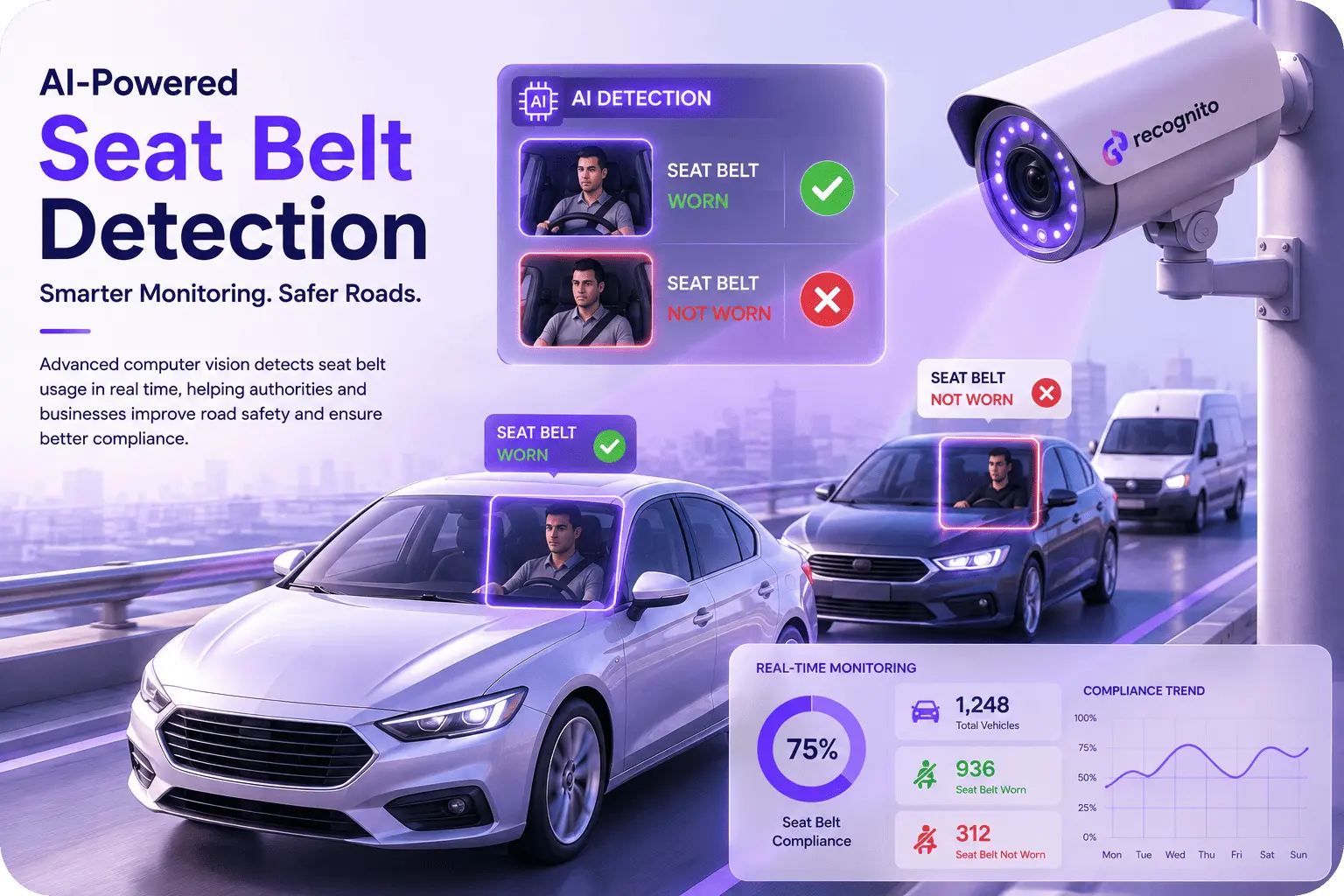
A seat belt detection model may appear simple: look at a driver and determine whether the belt is fastened. In practice, the computer-vision problem is far more complicated.
The belt may blend into dark clothing. A driver may be partially obscured by the steering wheel. Lighting can change dramatically between daytime and nighttime. Different vehicle interiors create different backgrounds, while camera position determines how much of the belt is visible. A model trained on a small collection of clear images can therefore perform impressively in testing and still fail when deployed inside real vehicles.
This is why the dataset behind a seat belt detection system matters so much.
A dataset is not simply a collection of images for training an object-detection model. It defines what the model sees, which situations it learns, which failures are represented, and how well its performance can generalize beyond the training environment.
For automotive companies, fleet operators, safety technology providers, and computer-vision developers, understanding seat belt detection datasets is therefore an important part of building reliable in-vehicle monitoring systems.
Why Seat Belt Detection Is Harder Than It Looks
A human can often recognize a seat belt immediately because the brain understands context. A computer-vision model must learn visual patterns from examples.
That creates several challenges.
The belt itself can be a narrow object crossing the torso diagonally. Its appearance changes with clothing, reflections, shadows, camera angle, and passenger posture. In some vehicles, the belt may be almost indistinguishable from the driver’s shirt.
Research has demonstrated this problem directly. The NADS-Net seat belt detection study developed a dataset using video clips from 100 drivers across 50 driving sessions and evaluated detection under different demographic, appearance, and illumination conditions.
The lesson is important: a useful dataset must represent the conditions that can make detection difficult, not just the conditions in which detection is easy.
What Is a Seat Belt Detection Dataset?
A seat belt detection dataset contains images or video frames showing vehicle occupants, with annotations identifying seat belt states or the visual regions associated with seat belt usage.
Depending on the project’s objective, annotations may represent:
- seat belt present or absent
- fastened or unfastened state
- belt position
- driver or passenger location
- occupant bounding boxes
- belt segmentation masks
- fastening or unfastening actions
- additional behaviors such as phone use or smoking
The annotation strategy should reflect the model’s intended task.
For example, a binary classification dataset may label an entire image as “seatbelt” or “no seatbelt.” An object-detection dataset may draw bounding boxes around the belt or driver. A segmentation dataset can identify the precise pixels belonging to the belt.
These are not interchangeable.
A model trained to classify an entire image may perform well when the camera position is fixed but provide little information about where the belt is located. Detection and segmentation approaches can provide more spatial information, but they typically require more detailed annotation.
This distinction is explored further in Recognito’s seat belt detection dataset analysis, which connects dataset structure with model-development considerations.
The Main Types of Data Used
There is no single ideal dataset format for every driver-monitoring application.
Images
Still images are relatively easy to annotate and can provide large numbers of training examples. They are useful for object detection and classification.
However, images do not naturally represent temporal behavior. They cannot show how a driver transitions from unbuckled to buckled, or whether a temporary visual obstruction persists over time.
Video
Video provides temporal information and can help models understand changes in driver behavior.
It is particularly useful when a system must distinguish between momentary occlusion and a persistent seat belt state. The trade-off is significantly greater storage, annotation effort, and computational processing.
Synthetic data
Synthetic data can help create difficult or rare scenarios that are expensive to capture in real vehicles.
The neuromorphic seatbelt state detection research dataset, for example, used simulated event-camera data alongside real event data to investigate seat belt state detection with an unusual sensing modality.
Synthetic data can expand coverage, but it should not automatically be treated as equivalent to real-world imagery. Models can learn characteristics of the simulator rather than characteristics of actual vehicles and occupants.
What Makes a Good Dataset?
Dataset size matters, but it is not the only consideration.
A smaller dataset containing diverse, realistic examples can be more valuable than a much larger collection dominated by nearly identical images.
The most important characteristics include diversity, annotation quality, representative conditions, class balance, and independence between training and testing data.
Diversity
A dataset should capture variation in:
- clothing colors and textures
- body sizes and seating positions
- vehicle types and interiors
- driver and passenger demographics
- camera locations
- lighting conditions
- weather and time of day
- seat belt colors and designs
- occlusions
- image quality
The objective is not to make the dataset complicated for its own sake. Each variation represents a condition under which a deployed system may need to operate.
Annotation Quality
A model cannot learn reliably from inconsistent labels.
Suppose one annotator marks a partially visible belt as “fastened” while another marks the same visual condition as uncertain. The model receives conflicting training signals.
Annotation guidelines should therefore define difficult cases explicitly. Teams should establish how to label partially obscured belts, loose belts, unusual belt positions, passengers leaning across seats, and frames in which the belt cannot be determined confidently.
Class Balance
A dataset dominated by “seatbelt on” examples can produce misleading performance.
A model may learn that predicting the majority class is often safe during training, while failing to recognize less frequent but operationally important cases.
Balance does not necessarily mean creating exactly equal numbers of every class. It means ensuring that minority states are represented sufficiently for the model to learn them.
Real-World Conditions Are the Real Test
One of the strongest indicators of dataset quality is whether its conditions resemble deployment.
A commercial vehicle-monitoring system may encounter:
- bright sunlight entering through the windshield
- shadows across the driver’s torso
- nighttime illumination
- sunglasses
- heavy winter clothing
- low-resolution cameras
- unusual seating positions
- partial occlusion
- reflective surfaces
- different vehicle dashboards and interiors
The SHRP2 Naturalistic Driving Study data access resources illustrate the scale and complexity possible in naturalistic driving research. The study includes extensive driving and vehicle-related data, and its broader ecosystem provides researchers with access procedures, de-identified data, and information about real driving conditions.
That kind of real-world context is valuable because controlled images rarely capture every condition encountered on the road.
Dataset Splits Matter More Than Many Teams Realize
A model should be tested on data it has not effectively memorized.
A common mistake is randomly splitting images from the same driver or video into training and testing sets. Frames from a single recording can look extremely similar, allowing the model to learn the driver’s clothing, vehicle interior, camera position, or lighting rather than the underlying seat belt pattern.
A better approach is to separate data by meaningful units such as driver, trip, vehicle, or recording session.
This is especially important with video datasets. If adjacent frames from one sequence appear in both training and testing, reported performance can become artificially high.
A genuinely independent test set provides a much stronger indication of how the model will behave on new drivers and environments.
Detection, Classification, or Segmentation?
The model architecture should follow the dataset and intended application.
| Approach | What the model learns | Strength | Main limitation |
| Image classification | Whether a seat belt state is present in the image | Simple and efficient | Provides limited spatial information |
| Object detection | Where relevant belt or occupant regions are located | Useful for real-time monitoring | Small or partially visible belts can be difficult |
| Semantic segmentation | Which pixels belong to the belt | Precise visual understanding | Requires detailed annotation and more computation |
| Video-based detection | Seat belt state across frames | Uses temporal context | More data, processing, and annotation complexity |
| Action recognition | Whether fastening or unfastening occurs | Captures behavior over time | Requires temporal training examples |
Research has explored multiple approaches. The NADS-Net study used a convolutional architecture with a feature pyramid and multiple detection heads for driver and seat belt detection, while earlier work explored object detection combined with semantic segmentation.
The appropriate choice depends on whether the system needs a simple warning, precise belt localization, behavioral monitoring, or broader occupant analysis.
Why Dataset Bias Can Break Deployment
Dataset bias occurs when the training data overrepresents certain conditions and underrepresents others.
Imagine a dataset containing mostly daytime photographs of drivers wearing dark shirts in the same vehicle model. A model may perform very well on validation images drawn from that environment.
Move it to a fleet with bright uniforms, different interiors, nighttime operation, and another camera position, and performance may fall sharply.
This is why data diversity should be considered a security and reliability requirement rather than simply a machine-learning best practice.
NIST’s AI Risk Management Framework emphasizes testing, evaluation, measurement, and management of AI risks across the system lifecycle. Its approach is useful for computer-vision projects because dataset limitations can translate directly into deployment risks.
Common Dataset Problems
Many seat belt detection projects encounter similar weaknesses.
Too few vehicles
A model trained on one or two vehicle interiors may accidentally learn background patterns rather than seat belt characteristics.
Limited lighting variation
Daytime-only images provide weak coverage for systems operating around the clock.
Repeated drivers
Large image counts do not automatically mean large visual diversity if most frames come from a small group of people.
Simplified clothing
If training data rarely includes coats, patterned clothing, or colors similar to the seat belt, real-world performance may suffer.
Ambiguous labels
Unclear annotation rules produce inconsistent training targets.
Data leakage
Near-duplicate images or frames from the same recording can inflate evaluation results.
Overreliance on augmentation
Synthetic rotations, brightness adjustments, and crops are useful, but augmentation cannot fully reproduce real-world variation.
Building a Dataset for Production
A production-oriented dataset should begin with the deployment environment.
Before collecting images, define where cameras will be positioned, which vehicles will be monitored, what seat belt states matter, and which conditions are operationally important.
Then design the collection strategy around those requirements.
A sensible process is:
- Define the target classes. Decide whether the system detects belt presence, fastening state, occupant position, or a broader set of driver behaviors.
- Collect diverse environments. Include different vehicles, camera positions, occupants, lighting conditions, and clothing.
- Create precise annotation guidelines. Make uncertain cases explicit.
- Separate participants and sessions. Prevent training and test leakage.
- Reserve a genuinely unseen test set. Avoid tuning the system against the final evaluation data.
- Measure failure cases. Record where and why detection fails.
- Iterate the dataset. Add representative examples of real production failures rather than randomly collecting more images.
The seventh step is often overlooked. A deployed model effectively generates information about where its dataset is weak. Those cases can become the most valuable new training examples.
What Should You Measure?
Accuracy alone does not adequately describe a seat belt detection system.
Depending on the task, teams should consider precision, recall, F1 score, false-positive rate, false-negative rate, and latency.
A false negative may mean the system fails to identify an unbelted driver. A false positive may cause unnecessary warnings.
The business consequence of each error should therefore influence the model threshold.
Real-time deployment adds another dimension. A model may produce excellent detection metrics but operate too slowly for an in-vehicle monitoring system.
The 2026 study on seatbelt violation detection using edge AI is a useful example of current research evaluating multiple YOLO architectures and considering different vehicle types, clothing variations, and environmental conditions. Its focus illustrates an increasingly important requirement: detection performance must be evaluated together with deployment constraints.
From Dataset to Real-Time Safety System
A dataset is only the beginning of the engineering process.
The final system may include an in-cabin camera, image-processing pipeline, detection model, tracking logic, decision rules, alert mechanism, and logging infrastructure.
That means the model must be evaluated within the conditions of the complete system.
A camera mounted farther from the driver may produce smaller belt regions. A low-power edge processor may require a lighter model. A warning system may need multiple consecutive frames before triggering an alert to avoid reacting to temporary occlusion.
The connection between dataset design and operational monitoring becomes critical here. A useful broader perspective comes from real-time seat belt monitoring, particularly when considering how detection models translate into continuous in-vehicle safety applications.
For teams building broader camera-based monitoring platforms, video analytics for real-time security also provides context on the transition from visual detection models to operational monitoring systems.
Privacy and Data Governance
Driver-monitoring datasets may contain identifiable people, vehicle interiors, timestamps, or other sensitive contextual information.
That makes data governance important from the collection stage.
Organizations should establish appropriate consent and data-use procedures, access controls, retention periods, de-identification practices where appropriate, and secure storage.
Research datasets may also have restrictions that affect what can be downloaded, shared, or redistributed. The SHRP2 program, for example, uses different access mechanisms and licensing arrangements depending on the type of data and research use.
Dataset governance should therefore be treated as part of system engineering rather than an administrative step added later.
Why Dataset Quality Determines AI Quality
A sophisticated model cannot compensate indefinitely for weak training data.
If a dataset does not contain enough diversity, the model has limited opportunity to learn the patterns that matter in deployment. If labels are inconsistent, the model receives contradictory supervision. If evaluation data leaks information from training, the final metrics may look better than actual performance.
For seat belt detection, these problems become especially visible because the object is relatively small, frequently occluded, and sensitive to environmental conditions.
The most useful dataset is therefore not simply the largest one. It is the dataset that represents the real problem with enough variation, reliable annotations, and genuinely independent evaluation data.
Conclusion
Seat belt detection datasets form the foundation of reliable AI-based driver monitoring. The quality of the model depends heavily on whether the underlying data represents real vehicles, real occupants, real lighting, real camera positions, and the difficult cases that occur during everyday driving.
For organizations developing these systems, dataset design should be treated as a core engineering decision. Define the detection task carefully, collect diverse data, control annotation quality, prevent train-test leakage, measure meaningful error types, and continuously improve the dataset using real deployment failures.
The goal is not simply to build a model that recognizes a seat belt in a clean image. It is to build a system that can make dependable decisions when the visual conditions are far less predictable.
For teams exploring computer-vision technologies for practical monitoring and safety applications, Recognito provides AI-based vision capabilities that can fit into broader real-time detection workflows.
Frequently Asked Questions
What is a seat belt detection dataset?
It is a collection of images or video frames annotated to help machine-learning systems recognize seat belt presence, absence, fastening state, location, or related driver behavior.
How large should a seat belt detection dataset be?
There is no universal number. Diversity, annotation quality, independent evaluation, and coverage of real deployment conditions are often more important than raw image count.
Why is lighting important for seat belt detection?
Lighting can change contrast, create shadows, obscure the belt, and alter the appearance of clothing and vehicle interiors. A model trained mainly in controlled conditions may therefore perform poorly in darker or highly variable environments.
Should training and testing data come from different drivers?
Yes, whenever possible. Separating drivers, vehicles, trips, and recording sessions helps reduce data leakage and provides a more realistic measure of generalization.
Can synthetic data replace real driving images?
Synthetic data can expand coverage and help create difficult or rare scenarios, but it should generally complement rather than automatically replace representative real-world data.