
Online account fraud continues to be one of the biggest cybersecurity challenges facing businesses in 2026. From account takeovers and identity theft to synthetic identity fraud, cybercriminals are using increasingly sophisticated techniques to gain unauthorized access to digital accounts. Traditional security methods such as passwords and one-time passcodes are no longer enough to stop modern fraud attacks.
As a result, organizations are adopting biometric technologies to strengthen account security. Among these technologies, face recognition has emerged as one of the most effective tools for identity verification and fraud prevention. By combining artificial intelligence, biometric authentication, and liveness detection, face recognition helps businesses verify users with greater accuracy while providing a seamless customer experience.
Understanding Online Account Fraud
Online account fraud occurs when unauthorized individuals gain access to digital accounts using stolen credentials, fake identities, or social engineering techniques.
Common forms of account fraud include:
- Account takeover attacks
- Identity theft
- Credential stuffing
- Synthetic identity fraud
- Unauthorized account creation
These attacks can lead to financial losses, data breaches, and reputational damage for businesses and consumers alike.
According to the Federal Trade Commission (FTC), identity theft and account fraud remain among the most frequently reported cybercrime issues affecting consumers worldwide.
Why Traditional Authentication Methods Are Struggling
For many years, passwords served as the primary defense against unauthorized access. However, today’s threat landscape has exposed the weaknesses of password-based security.
Password Reuse
Many users continue to reuse passwords across multiple services. If one account is compromised, attackers can often gain access to others.
Phishing Attacks
Cybercriminals frequently use phishing campaigns to steal login credentials and bypass traditional authentication systems.
Credential Stuffing
Attackers use automated tools to test stolen usernames and passwords across multiple platforms.
These risks have driven organizations to seek stronger authentication methods that rely on user identity rather than knowledge-based credentials.
How Face Recognition Works
Face recognition is a biometric technology that verifies or identifies individuals using unique facial characteristics.
The process typically involves:
- Capturing a facial image or selfie
- Detecting facial landmarks
- Creating a biometric template
- Comparing the template against a stored reference
- Confirming identity based on similarity scores
Modern facial recognition systems use artificial intelligence and deep learning algorithms to improve accuracy and reliability.
Organizations can integrate advanced biometric authentication using technologies such as Face Recognition SDK solutions that support secure identity verification across web and mobile platforms.
How Face Recognition Prevents Online Account Fraud
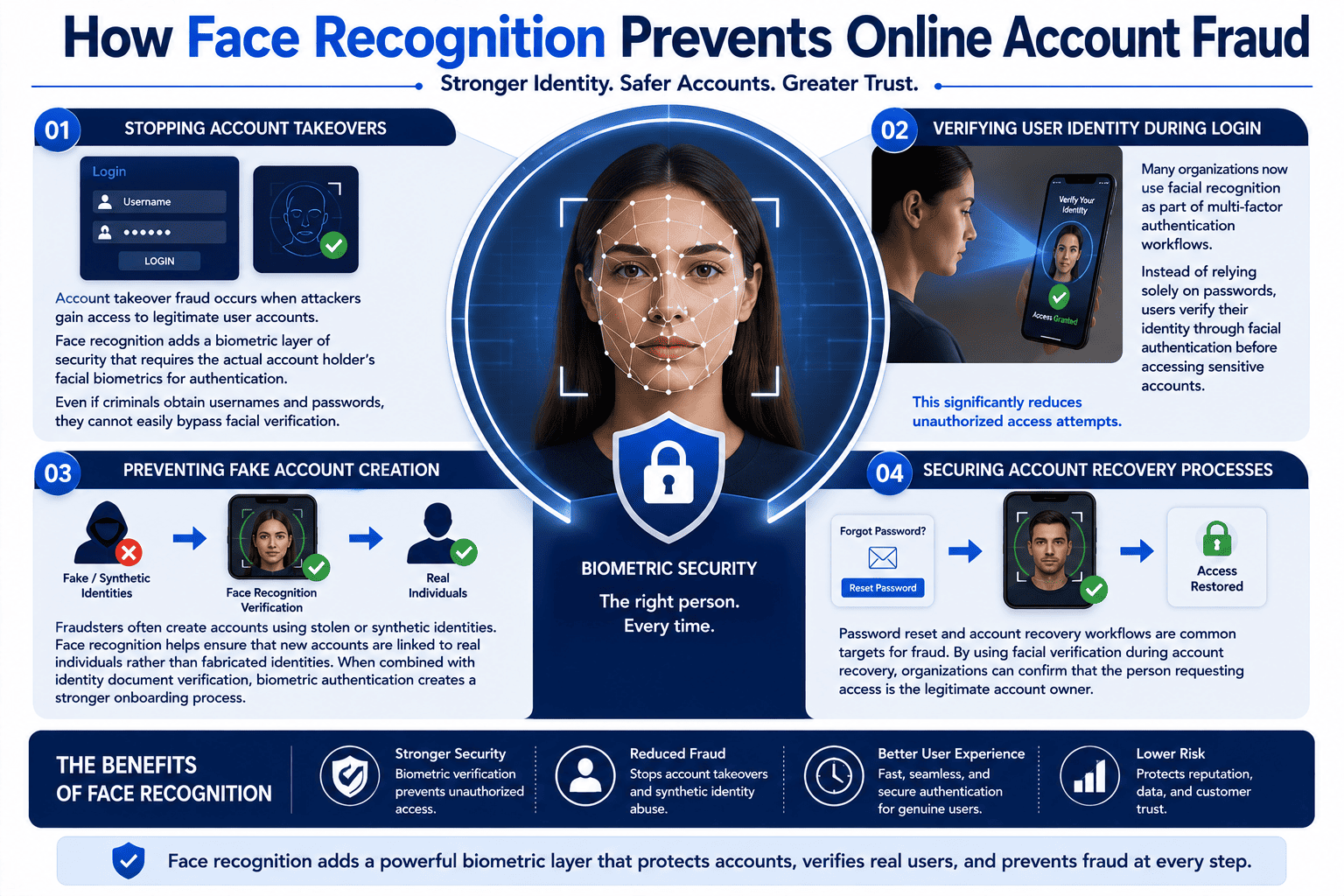
Stopping Account Takeovers
Account takeover fraud occurs when attackers gain access to legitimate user accounts.
Face recognition adds a biometric layer of security that requires the actual account holder’s facial biometrics for authentication. Even if criminals obtain usernames and passwords, they cannot easily bypass facial verification.
Verifying User Identity During Login
Many organizations now use facial recognition as part of multi-factor authentication workflows.
Instead of relying solely on passwords, users verify their identity through facial authentication before accessing sensitive accounts.
This significantly reduces unauthorized access attempts.
Preventing Fake Account Creation
Fraudsters often create accounts using stolen or synthetic identities.
Face recognition helps ensure that new accounts are linked to real individuals rather than fabricated identities. When combined with identity document verification, biometric authentication creates a stronger onboarding process.
Securing Account Recovery Processes
Password reset and account recovery workflows are common targets for fraud.
By using facial verification during account recovery, organizations can confirm that the person requesting access is the legitimate account owner.
The Importance of Liveness Detection
While facial recognition is highly effective, fraudsters may attempt to bypass systems using photos, videos, or deepfake content.
This is where liveness detection becomes critical.
Detecting Presentation Attacks
Liveness detection verifies that a real person is physically present during authentication.
The technology analyzes facial movements, lighting reflections, depth information, and behavioral signals to detect spoofing attempts.
Combating Deepfake Fraud
As AI-generated content becomes more sophisticated, deepfake attacks present a growing risk.
Advanced Face Liveness Detection SDK technologies help organizations identify manipulated media and prevent attackers from using synthetic facial content to gain account access.
Combining face recognition with liveness detection creates a much stronger fraud prevention framework.
AI and Modern Fraud Prevention
Artificial intelligence has become a key component of modern identity verification systems.
Behavioral Analysis
AI systems analyze user behavior patterns to identify suspicious login activity.
Examples include:
- Unusual login locations
- Abnormal device usage
- Rapid authentication attempts
- Suspicious account activity
Risk-Based Authentication
Many organizations now use adaptive authentication systems that adjust security requirements based on risk levels.
High-risk activities may trigger additional facial verification checks before access is granted.
Continuous Learning
AI models continuously learn from new fraud attempts, helping organizations stay ahead of emerging threats.
Research from the National Institute of Standards and Technology (NIST) continues to demonstrate the growing accuracy and effectiveness of modern facial recognition technologies.
Industries Benefiting From Face Recognition in 2026
Face recognition is helping organizations across multiple industries strengthen account security.
Financial Services
Banks and fintech companies use biometric authentication to secure customer accounts and reduce account takeover fraud.
E-Commerce Platforms
Online retailers use facial verification to protect user accounts and prevent fraudulent transactions.
Cryptocurrency Exchanges
Crypto platforms rely on identity verification and facial recognition to secure accounts and meet regulatory requirements.
Digital Marketplaces
Marketplaces use biometric verification to reduce fake accounts and improve trust between users.
Healthcare Platforms
Healthcare providers use facial authentication to protect access to sensitive patient records.
Across these industries, face recognition is becoming a key component of digital security strategies.
How Recognito Supports Fraud Prevention
As fraud threats continue to evolve, businesses need identity verification solutions that can provide both security and convenience.
Platforms such as Recognito help organizations strengthen fraud prevention through AI-powered facial recognition, biometric authentication, and liveness detection technologies. These tools enable businesses to verify user identities quickly while reducing account takeover risks and fraudulent account activity.
By combining advanced biometrics with modern fraud detection capabilities, organizations can create safer digital experiences for their users.
Conclusion
As online fraud becomes more sophisticated in 2026, organizations can no longer rely solely on passwords and traditional authentication methods. Face recognition is playing a critical role in preventing account takeovers, identity fraud, and unauthorized access by providing secure biometric verification.
When combined with AI-driven fraud detection and liveness detection technologies, face recognition helps businesses protect user accounts while delivering a fast and convenient authentication experience. As digital services continue to expand, biometric security will remain a cornerstone of effective fraud prevention strategies.
Frequently Asked Questions
What is online account fraud?
Online account fraud occurs when unauthorized individuals gain access to user accounts through stolen credentials, identity theft, or other fraudulent methods.
How does face recognition prevent account takeover attacks?
Face recognition verifies the user’s biometric identity, making it much more difficult for attackers to access accounts even if they obtain login credentials.
Is face recognition more secure than passwords?
Face recognition provides a stronger layer of authentication because facial biometrics are significantly harder to steal or replicate than passwords.
What is liveness detection?
Liveness detection verifies that a real person is physically present during authentication and helps prevent spoofing attacks using photos, videos, or deepfakes.
Can face recognition stop identity fraud?
While no security technology is perfect, face recognition significantly reduces identity fraud by verifying that users are who they claim to be.
Why are businesses adopting face recognition in 2026?
Businesses are adopting face recognition because it improves security, reduces fraud, supports compliance, and provides a more seamless user experience than traditional authentication methods.
