

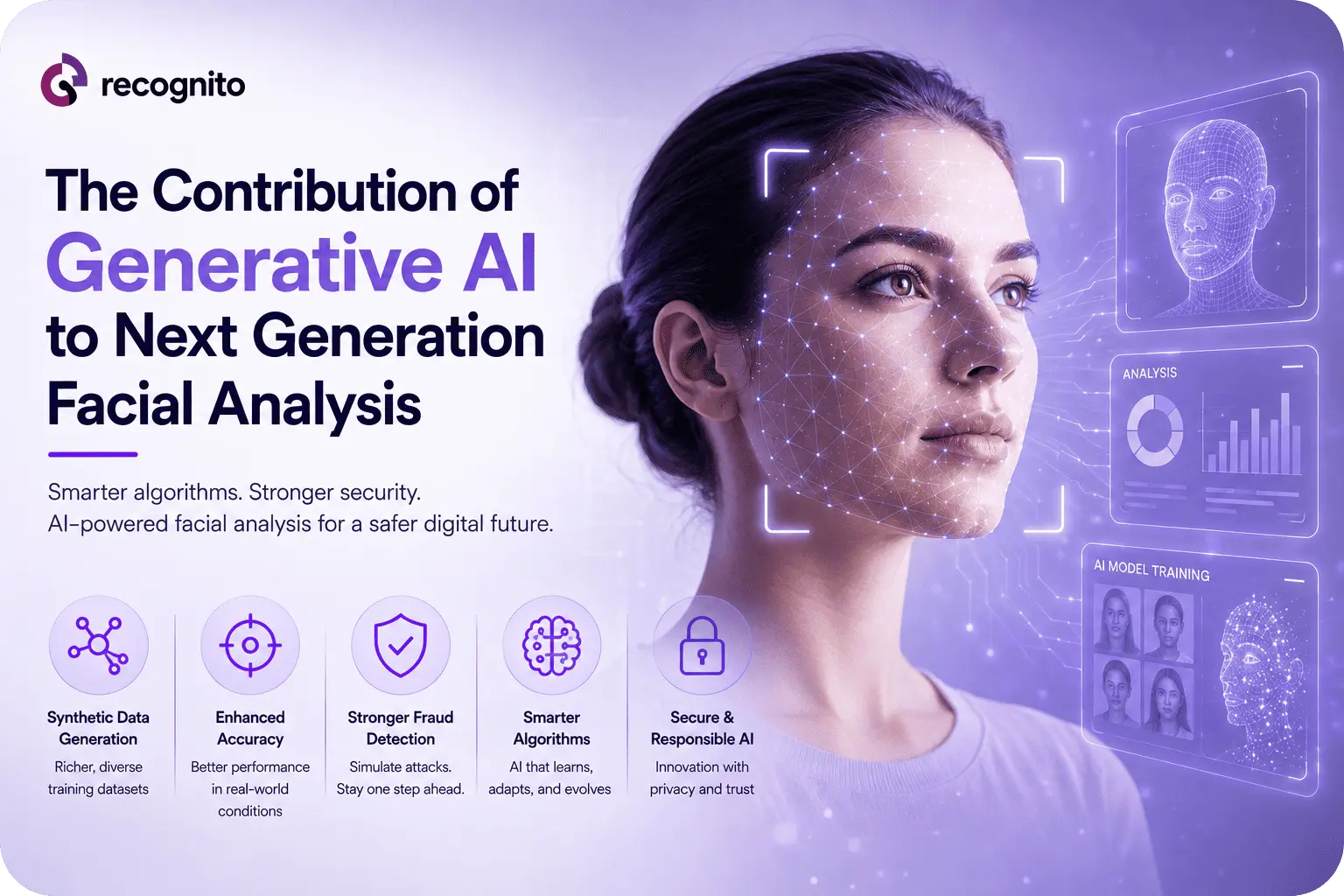
Facial analysis is moving beyond simply recognizing who appears in an image. Modern systems increasingly need to understand age-related characteristics, image quality, pose, expression, presentation risks, and whether visual content has been manipulated.
Generative AI is becoming part of that evolution.
Unlike conventional computer-vision pipelines that primarily classify or compare existing images, generative models can create, reconstruct, transform, and augment visual data. That gives developers new ways to train facial-analysis systems, simulate difficult conditions, improve testing, and investigate attacks that would otherwise require large amounts of real-world data.
But the same capability creates new problems. Generative models can produce highly convincing synthetic faces, alter identity characteristics, create deepfakes, and introduce artifacts that challenge traditional analysis systems.
The next generation of facial analysis therefore depends on using generative AI in two roles: as an enabling technology for better models and as a threat that those models must learn to detect.
Why Generative AI Matters for Facial Analysis
Traditional facial-analysis models rely heavily on large collections of labeled images. The quality, diversity, and coverage of that training data directly influence how a system behaves in production.
Real-world facial data has obvious limitations. Some conditions are difficult to collect at scale:
- unusual lighting
- extreme head poses
- uncommon camera angles
- age transitions
- occlusions
- rare facial characteristics
- manipulated or synthetic imagery
Generative AI provides another way to create controlled training examples.
A model can potentially generate variations of existing samples or create synthetic scenarios that expose weaknesses before those weaknesses appear in deployment.
That does not make synthetic data a replacement for real data. Generated samples can inherit model biases, reproduce artifacts, and fail to represent the complexity of real people.
The strongest approach is therefore to use synthetic data as a complement to carefully curated real-world datasets.
Generative AI as a Synthetic Data Engine
One of the most important contributions of generative AI is the ability to produce large quantities of synthetic facial imagery under controlled conditions.
A development team could generate examples involving changes in:
- illumination
- pose
- facial expression
- image resolution
- background
- age appearance
- occlusion
- camera characteristics
This can expand the variety of situations available during training and testing without requiring every condition to be captured manually.
For instance, a facial-analysis model intended for mobile applications may need to handle both ideal indoor images and difficult captures taken outdoors in uneven lighting. Synthetic generation can help create controlled variations around those conditions.
The key challenge is validation. Synthetic images should not automatically be considered equivalent to real observations. Their usefulness depends on how faithfully they represent the target environment.
This is particularly important for systems expected to perform consistently across different populations and capture conditions.
For a broader look at the variables that influence facial-system performance, face recognition accuracy factors provides useful context.
Improving Facial Image Quality Assessment
Generative AI also has potential in image enhancement and quality assessment.
A facial-analysis system may receive an image that is blurred, compressed, poorly illuminated, partially occluded, or captured at an unfavorable angle. Before attempting downstream analysis, the system needs to determine whether the input contains enough usable information.
Modern quality models can evaluate characteristics such as focus, illumination, distortion, noise, pose, and facial expression.
NIST’s FATE Quality evaluation examines automated approaches to detecting image defects and summarizing facial-image quality. The broader goal is to produce actionable information about whether an image is suitable for a particular biometric task.
Generative AI adds another possibility: intelligently reconstructing or enhancing degraded imagery.
But enhancement creates an important boundary. If a model generates missing facial details, the resulting image may look better while becoming less faithful to the original observation.
For security-sensitive applications, improving visual quality must never silently become inventing biometric evidence.
That means enhanced images may be useful for visualization or certain analysis tasks, while the original capture should remain available for verification and audit.
Better Age Estimation and Facial Attribute Analysis
Facial analysis increasingly includes attributes beyond identity matching.
Age estimation is one example. A model may estimate a person’s age or determine whether they are likely to fall above or below a particular threshold.
NIST’s FATE Age Estimation and Verification evaluation measures age-estimation performance across different datasets, image conditions, geographic groupings, and verification scenarios.
Generative AI can contribute by creating training examples representing changes in apparent age, pose, image quality, and environmental conditions.
That can help models become more robust, but it also introduces a major question: Does the generated appearance correspond to realistic human variation?
Age transformation is especially sensitive because generated faces can exaggerate visual characteristics that are not reliably associated with chronological age.
For business use cases such as age assurance, synthetic data should therefore be validated against real-world performance rather than treated as proof that a model understands biological age.
Generative AI and Deepfake Detection
Perhaps the most important relationship between generative AI and facial analysis is adversarial.
Generative models can produce realistic faces and manipulate existing facial imagery. That changes the threat environment for identity systems.
A fraudster may attempt to use generated or altered imagery to impersonate another person. Facial-analysis systems therefore need to distinguish between genuine biometric evidence and synthetic content.
This is a different task from conventional face recognition.
A recognition system asks whether two facial samples correspond to the same identity. A manipulation-detection system asks whether the visual evidence itself has been altered or generated.
NIST’s FATE MORPH evaluation illustrates how serious this distinction has become. The evaluation examines vulnerability to face morphing and now includes diffusion-based morphing datasets, reflecting the changing nature of synthetic-image attacks.
The result is a technological arms race: better generation drives better detection, while improved detection forces attackers toward more sophisticated generation techniques.
That makes deepfake attack prevention strategies increasingly relevant to facial-analysis architectures.
Using Generative Models to Test Facial Systems
Generative AI is valuable not only for training but also for adversarial testing.
A security team can use synthetic manipulation techniques to ask how a facial-analysis model responds when its input is altered.
For example, testing may evaluate:
- manipulated facial features
- identity-preserving transformations
- synthetic backgrounds
- generated faces
- altered age characteristics
- morphing between identities
- compression and quality degradation
This creates a more proactive testing methodology.
Instead of waiting for real attackers to discover a vulnerability, teams can deliberately generate difficult inputs and measure system behavior.
The important control is to separate testing data from trusted identity evidence. Generated samples should be clearly labeled and handled as adversarial or synthetic material throughout the evaluation process.
Generative AI Can Improve Data Diversity Without Solving Bias
Synthetic data is sometimes presented as a quick answer to demographic imbalance.
It can help expand underrepresented scenarios, but it does not automatically remove bias.
A generative model learns patterns from its training data. If those patterns are incomplete or distorted, synthetic generation may simply reproduce the problem at a larger scale.
This creates a risk of artificial diversity that looks convincing but does not correspond to genuine human variation.
For facial-analysis developers, evaluation should therefore compare model behavior using real and synthetic datasets separately. Improvements observed only on generated samples should not be assumed to represent real-world gains.
The same principle applies to fairness testing: synthetic demographic variation can support experiments, but real-world measurements remain necessary.
The Risk of Hallucinated Facial Information
Generative AI introduces a fundamental issue that traditional enhancement systems do not always face: hallucination.
A generative model can produce details that were not actually present in the original image.
For ordinary photography, this might be acceptable. For biometric analysis, it can be dangerous.
Consider a low-resolution image where part of the face is obscured. A generative model may create a visually plausible reconstruction, but the generated structure is an inference, not direct evidence.
Using that reconstruction as if it were an authentic observation could affect identity matching, attribute analysis, or fraud investigations.
For high-assurance systems, the original image should remain the authoritative source. Generated versions should be treated as derived representations with clear provenance.
Combining Generative AI With Conventional Computer Vision
The strongest next-generation systems are unlikely to be purely generative.
Instead, generative models can operate alongside established computer-vision components.
A production pipeline might combine:
- Face detection to locate the subject.
- Quality assessment to determine whether the capture is usable.
- Feature extraction to generate biometric representations.
- Recognition or analysis to perform the required task.
- Generative augmentation to expand testing or training scenarios.
- Manipulation detection to identify synthetic or altered content.
- Risk orchestration to determine how the combined evidence should influence a decision.
This layered architecture reduces the risk of making one generative model responsible for every task.
It also makes system failures easier to diagnose because individual stages can be measured separately.
Generative AI and Facial Biometric Development
For engineering teams, the contribution of generative AI extends beyond model training.
It can accelerate experimentation by producing controlled datasets, simulating edge cases, generating test variations, and helping researchers investigate model vulnerabilities.
However, developers still need disciplined dataset governance.
Every synthetic sample should ideally have traceable metadata identifying how it was produced, what transformation was applied, and where it can legitimately be used.
This becomes especially important when synthetic and real images enter the same development pipeline.
Teams exploring biometric components can use a face biometric playground to investigate facial technologies in a practical environment before integrating them into production workflows.
For technical teams building or experimenting with biometric applications, the Recognito GitHub repository can provide additional developer-oriented resources.
The Emerging Role of Multimodal and Hybrid Analysis
Generative AI also makes it easier to combine facial imagery with other forms of contextual information.
A future analysis pipeline may consider facial appearance alongside video motion, image provenance, device information, capture metadata, or other signals.
The advantage of multimodal analysis is that an attacker may be able to manipulate one signal without successfully manipulating all of them.
However, more signals also create more complexity. Each input introduces its own uncertainty, privacy implications, and failure modes.
The system should therefore be designed so that additional data improves decision quality rather than simply increasing the volume of information being processed.
Security and Governance Become More Important
Generative AI changes the risk profile of facial-analysis systems because it affects both sides of the problem.
It can strengthen models through better training and testing while simultaneously giving attackers more powerful manipulation tools.
NIST’s Generative AI Profile for the AI Risk Management Framework identifies risks that are novel to or amplified by generative AI and provides suggested actions for managing those risks across the AI lifecycle.
For organizations deploying facial analysis, governance should address:
- synthetic-data provenance
- dataset contamination
- model validation
- adversarial testing
- deepfake resilience
- human review
- privacy
- monitoring after deployment
- controlled model updates
The goal is not to avoid generative AI. It is to ensure that its capabilities do not become an uncontrolled source of biometric risk.
What Businesses Should Evaluate Before Adopting Generative AI
The business case should be tied to a specific problem.
| Use of generative AI | Potential value | Main risk to control |
| Synthetic training data | Expands difficult scenarios | Unrealistic or biased samples |
| Image enhancement | Improves usable visual inputs | Invented biometric details |
| Adversarial testing | Exposes model weaknesses | Poorly controlled test data |
| Deepfake research | Improves manipulation detection | Rapid attacker adaptation |
| Age-analysis augmentation | Broadens training variation | Unrealistic age representations |
| Edge-case simulation | Reduces dependence on rare captures | Synthetic conditions may not generalize |
A practical evaluation should ask whether generative AI delivers measurable improvement over conventional methods.
Does it reduce failure rates? Improve robustness? Increase attack detection? Reduce data-collection costs? Speed up testing?
Without measurable outcomes, generative AI risks becoming an impressive research feature rather than a valuable production capability.
What the Next Generation of Facial Analysis Will Look Like
The future of facial analysis is likely to involve increasingly specialized models working together rather than one system trying to solve every visual problem.
Generative AI can help create training data, simulate attacks, enhance research, and identify weaknesses. Conventional recognition models can handle biometric matching. Quality models can assess whether an input is usable. Dedicated detection systems can identify manipulation.
That division of responsibility matters.
A generated image can be useful as a test artifact without being acceptable as identity evidence. A deepfake detector can flag suspicious media without being responsible for deciding whether an applicant is legitimate. A facial matcher can establish similarity without determining whether the source material is trustworthy.
The strongest architecture keeps those responsibilities distinct while bringing their outputs together at the decision layer.
Conclusion
Generative AI is becoming an important force in next-generation facial analysis because it changes both how facial systems are developed and how they must defend themselves.
Synthetic data can expand difficult training scenarios. Generative techniques can support image-quality research, age-analysis development, and adversarial testing. At the same time, synthetic faces and manipulated imagery create new threats that conventional facial-analysis pipelines were not designed to handle.
The most effective strategy is therefore not to replace traditional computer vision with generative AI. It is to combine the strengths of different models, preserve trusted source data, test aggressively against synthetic attacks, and maintain clear boundaries between generated content and genuine biometric evidence.
For organizations developing secure facial-analysis and biometric systems, Recognito can support the broader technology stack needed to turn these capabilities into practical identity and security workflows.
Frequently Asked Questions
How does generative AI improve facial analysis?
It can generate synthetic training data, simulate difficult capture conditions, support image-quality research, create adversarial test cases, and help developers investigate system weaknesses.
Can generative AI make facial recognition more accurate?
It can potentially improve robustness by increasing training and testing diversity, but synthetic data does not automatically improve real-world accuracy. Models still need validation against representative real data.
Can generative AI be used to detect deepfakes?
Yes. Generative techniques can help create realistic synthetic attacks for testing and training detection systems. The detection model itself should still be evaluated against real and synthetic manipulation methods.
Is AI-generated facial imagery safe to use for biometric verification?
Generated imagery should generally be treated differently from trusted biometric evidence. For high-assurance verification, organizations should preserve the original capture and clearly distinguish derived or synthetic content.
What is the biggest business risk?
The biggest risk is assuming that realistic generated imagery is equivalent to authentic biometric evidence. Generative AI should strengthen analysis and testing while remaining subject to validation, provenance controls, security testing, and governance.