

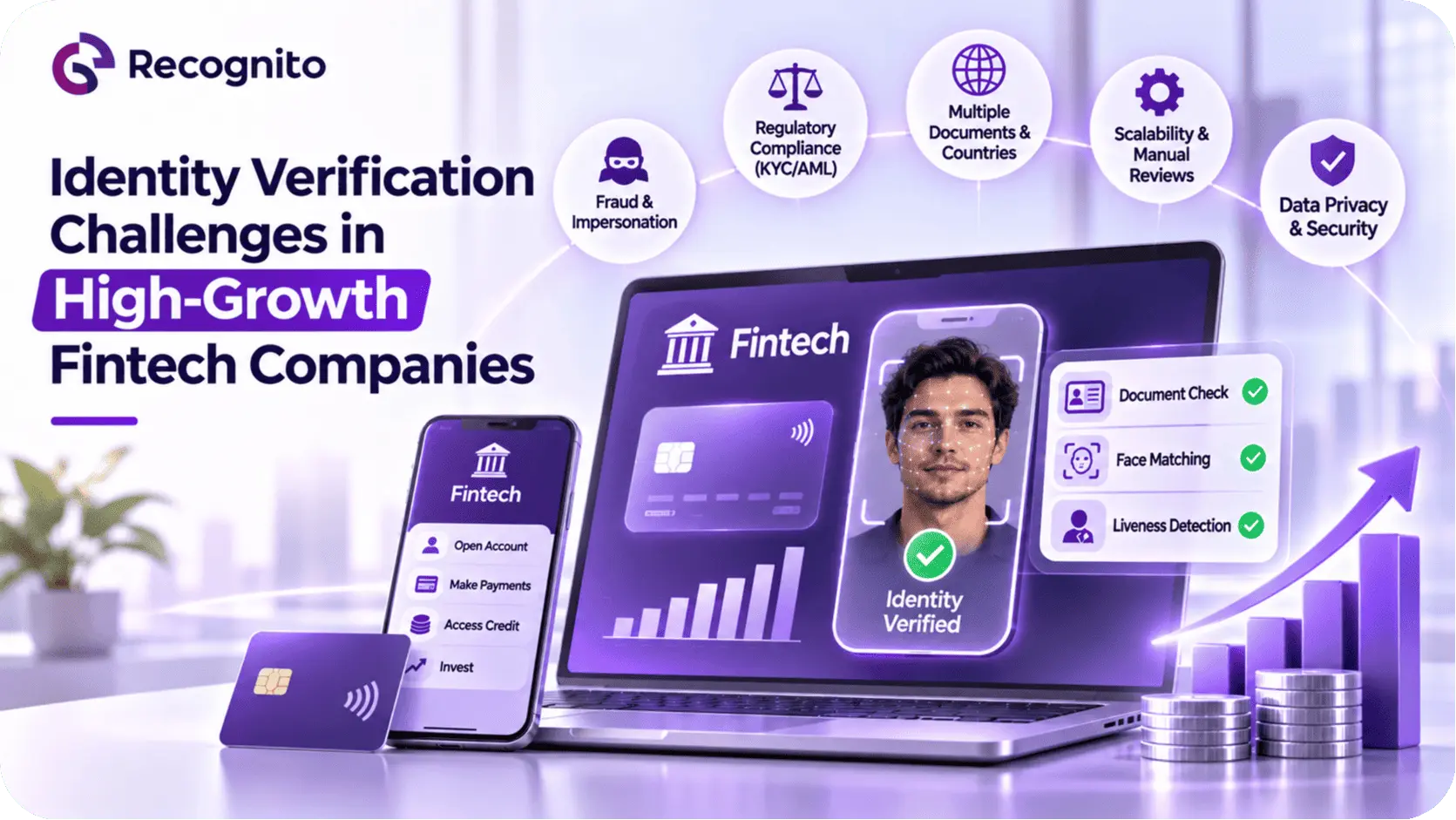
Growth exposes weaknesses in identity verification. A fintech that can manage a few hundred applications through a small operations team may struggle when customer volumes, fraud attempts, and market coverage expand.
Verification must deter impersonation, synthetic identities, document manipulation, and account abuse without driving legitimate customers away. Compliance teams need defensible decisions, and engineering teams need systems that scale reliably.
For high-growth fintechs, identity verification is not simply a KYC feature. It is core infrastructure connecting customer experience, fraud prevention, compliance, and product scalability.
Why Growth Exposes Weaknesses in Identity Verification
Early-stage fintechs may collect customer details, request an ID, run checks, and send exceptions to a small review team. At scale, more channels, devices, products, markets, and fraud attempts increase complexity while review queues grow.
A process that once seemed efficient can produce abandonment, inconsistent decisions, delays, and rising costs. Under pressure, teams may loosen controls or create workarounds. Identity processes must therefore be designed for changing volume and risk, not just the initial product launch.
Challenge 1: Balancing Fraud Prevention With Conversion
The central tension is preventing fraudulent applications without rejecting genuine customers.
Strict workflows may block legitimate users because of poor image quality, name mismatches, or unsupported documents. Permissive workflows may improve completion while letting stolen identities or manipulated evidence through.
The answer is risk-based friction. Consistent, low-risk applications should not automatically face the same checks as cases with conflicting evidence. Measure completion, retries, false rejections, referrals, confirmed fraud, and time to decision together. A higher approval rate is not success if post-onboarding fraud rises.
The practical principles in remote customer onboarding best practices are useful when redesigning the journey around both assurance and customer experience. Segment these measures by acquisition channel, device, country, document type, and customer cohort. An average completion rate can hide a camera-specific failure or an unusually high rejection rate for one document group. Review changes after each major campaign or product release, not only in monthly aggregate reports.
Challenge 2: Detecting More Sophisticated Identity Fraud
A successful identity compromise can open access to accounts, payments, credit, and other financial products. Attackers may use stolen or altered documents, synthetic identities, impersonation, replayed video, or manipulated biometric media.
No single check detects every attack. Document validation does not prove the applicant is the rightful holder. Face matching does not prove the camera input is live. Liveness does not establish a customer’s financial history. A face liveness SDK can add a dedicated presentation-attack check, but it should remain one signal in the decision.
Combine document authenticity and presence, face matching, liveness, device and session signals, customer data, and risk rules. Each control should address a defined threat. Feed confirmed fraud, false positives, and new attack patterns back into policy and vendor testing.
Challenge 3: Meeting KYC and AML Requirements Across Markets
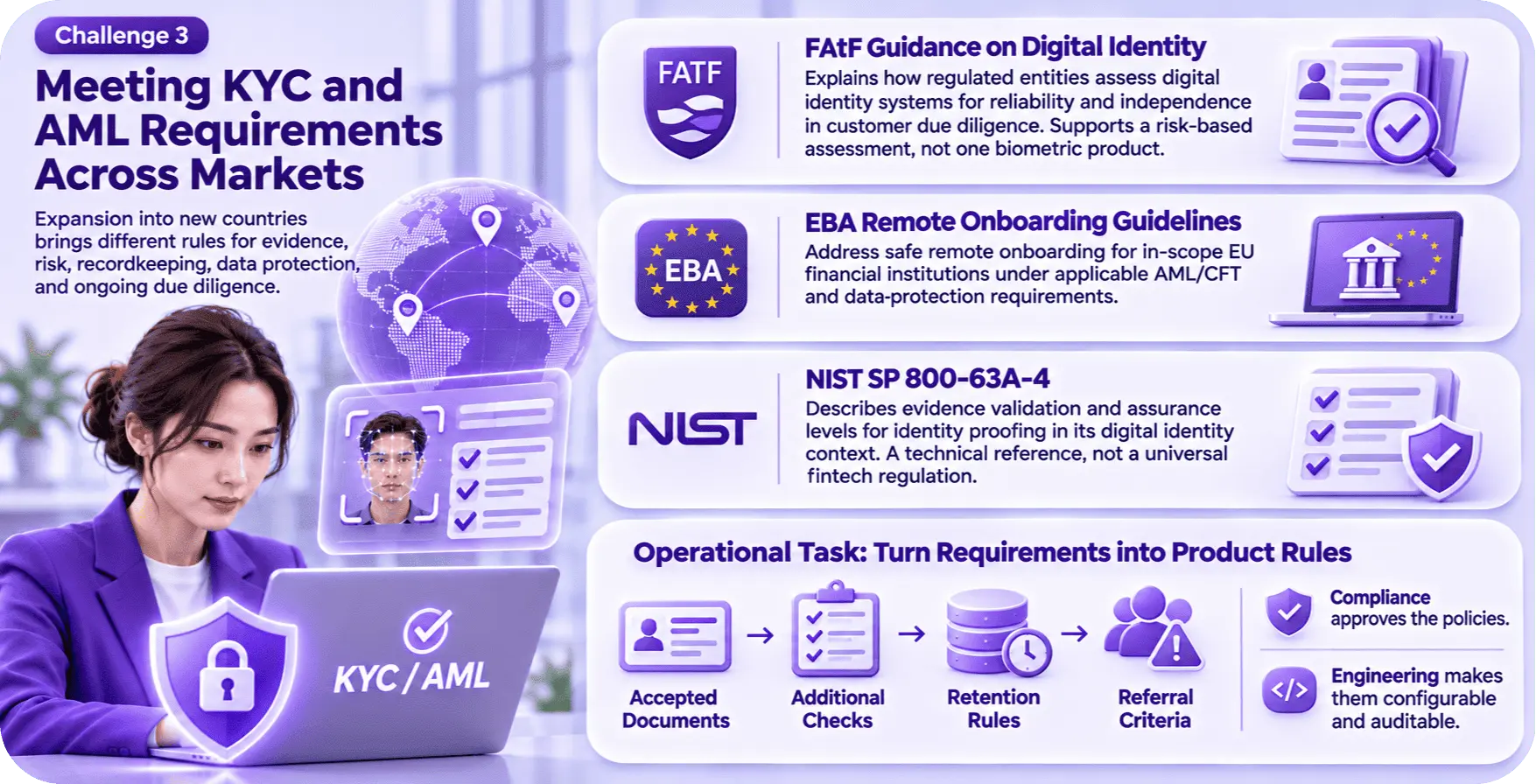
Expansion into new countries introduces different rules for acceptable evidence, risk classification, recordkeeping, data protection, and ongoing due diligence. A global product cannot assume that one document, database check, or threshold is suitable everywhere.
The FATF’s Guidance on Digital Identity explains how regulated entities assess digital identity systems for reliability and independence in customer due diligence. It supports risk-based assessment rather than prescribing one biometric product.
For in-scope EU financial institutions, the EBA’s remote customer onboarding guidelines address safe remote onboarding under applicable AML/CFT and data-protection requirements.
The operational task is translating obligations into product rules: accepted documents, additional checks, retention, and referral criteria by market and product. Compliance should approve the policies; engineering should make them configurable and auditable. NIST’s SP 800-63A-4 identity proofing guidance describes evidence validation and assurance levels for its digital identity context. It is a technical reference, not a universal fintech regulation. The eKYC requirements for fintech platforms provide related onboarding context.
Challenge 4: Supporting Different Documents, Languages, and Customer Profiles
Document formats, security features, languages, scripts, portrait placement, and machine-readable fields vary. Names may contain multiple surnames, patronymics, diacritics, or transliterations; address and date formats also differ. A system built around a narrow domestic document set can reject legitimate applicants as the customer base expands.
Maintain a coverage matrix of supported issuers, document types, versions, and limitations. Preserve original values while applying governed normalization. Do not silently rewrite identity attributes or reject valid naming conventions.
Document recognition can automate classification and extraction, but policies are still needed for unsupported IDs, conflicting evidence, expiry, and exceptions. An ID document recognition SDK may support capture and extraction within the application.
Challenge 5: Scaling Manual Reviews Without Creating a New Bottleneck
Automation changes which cases need human review; it does not eliminate it.
At scale, informal review practices create inconsistent decisions and queues without clear priorities. A sustainable model separates poor image quality from suspected tampering, identity mismatch, liveness failure, screening concerns, and unresolved data discrepancies. Each needs an appropriate action and service target.
Useful controls include risk-based queue priorities, standard decision codes, escalation paths, reviewer calibration, documented overrides, and feedback from confirmed outcomes. Give reviewers the evidence and reason that triggered referral, not just a red or amber score. This makes decisions more consistent and helps identify whether the problem is a poor capture, a model limitation, a policy rule, or a genuine fraud concern. Reserve specialist attention for cases where judgment adds value.
Challenge 6: Integrating Verification Into a Fast-Moving Technology Stack
Product teams need to launch features and enter markets quickly. Integration becomes fragile when vendors expose different APIs, response formats, and error states. Point-to-point connections may be fast initially, but business rules can become scattered across mobile apps, backend services, and operations.
A central orchestration layer can manage document capture, biometric checks, data sources, risk rules, retries, and referrals. Normalize provider responses while preserving detail needed for audit and investigation. Keep policy decisions separate from vendor-specific response codes so a provider change does not require rewriting the entire onboarding journey.
Assess API reliability, latency, platform support, versioning, rate limits, error handling, data residency, and vendor incident procedures. Test timeouts, duplicate requests, partial outages, and provider failover as carefully as successful checks. Define what the customer sees when a service is unavailable and how pending applications are safely resumed.
Challenge 7: Protecting Sensitive Identity and Biometric Data
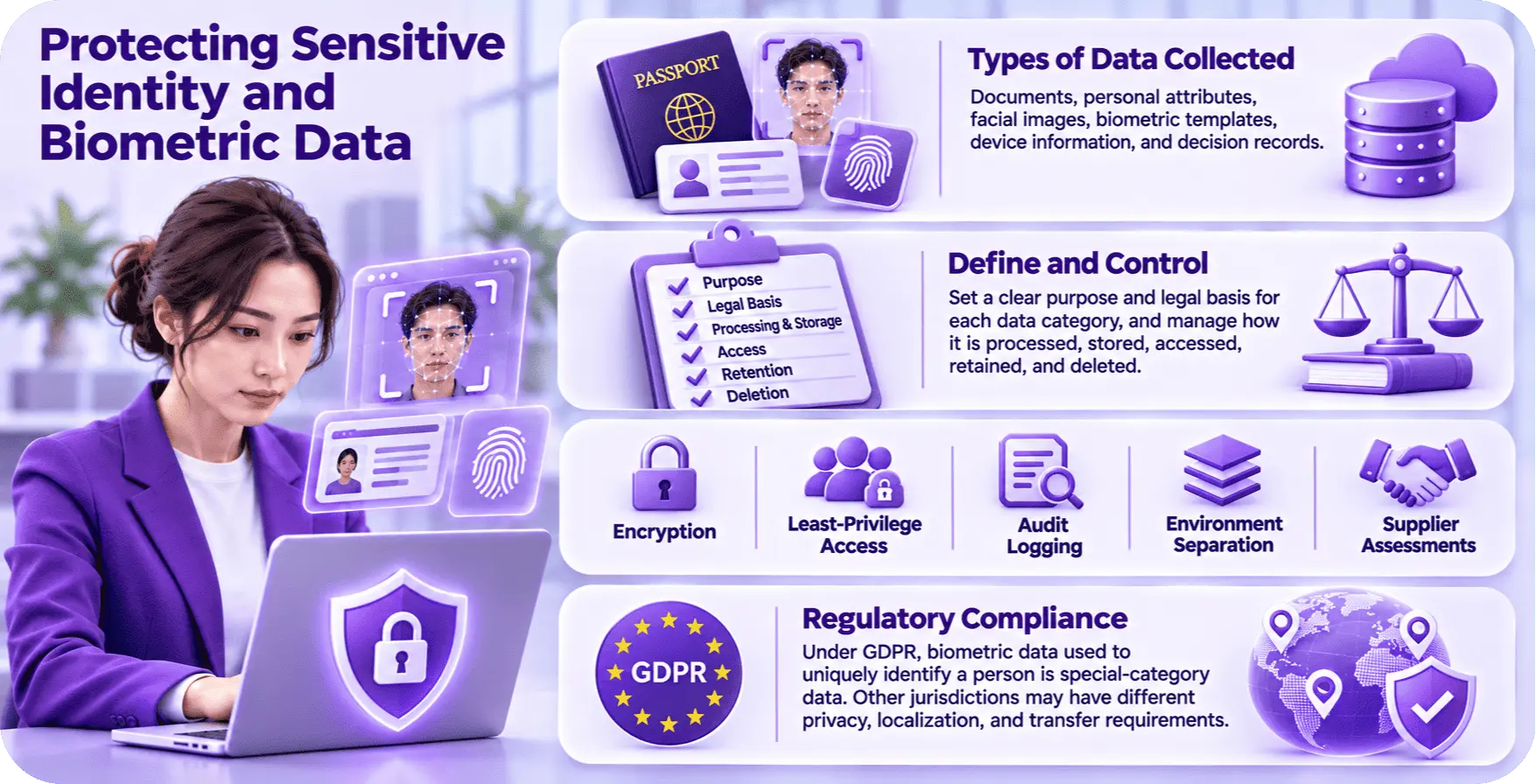
Verification may collect document images, personal attributes, facial images, biometric templates, device information, and decision records. Multiple processors and cloud services increase the number of systems handling sensitive data.
Collecting more is not automatically safer. Define the purpose and legal basis for each data category, processing and storage locations, access, retention, and deletion. Apply encryption, least-privilege access, audit logging, environment separation, and supplier assessments.
Under the GDPR, biometric data processed to uniquely identify a person is special-category personal data. Other jurisdictions may impose different privacy, localization, and transfer requirements. Map obligations by market rather than assuming one policy covers every deployment. The GDPR text provides the EU legal framework.
Challenge 8: Preventing Account Takeover After Onboarding
Treating identity verification as complete once an account is approved creates a gap. A legitimate customer can later lose control through phishing, credential theft, malware, SIM-swap attacks, social engineering, or compromised recovery channels.
Connect onboarding to strong authentication, step-up checks for sensitive actions, session monitoring, and secure recovery. Changes to contact details, payout destinations, credentials, or trusted devices may warrant additional checks. The common identity verification mistakes article explores gaps between initial proofing and ongoing controls.
Choosing the Right Verification Architecture
Choose technology based on product, customer base, fraud exposure, and regulatory footprint, not the longest feature list. Assess document coverage, matching and liveness performance, attack testing, integration, and privacy.
| Capability | What to assess | Why it matters as the fintech scales |
| Document verification | Issuer and document coverage, authenticity signals, data extraction | Supports new markets and reduces manual data entry |
| Face matching | Accuracy, image-quality tolerance, demographic performance | Connects applicants to identity evidence |
| Liveness detection | Presentation and injection attack coverage | Helps resist remote biometric spoofing |
| Risk orchestration | Configurable rules, referrals, and decision records | Adapts checks to risk and product |
| Integration | APIs, SDKs, latency, resilience, and versioning | Reduces engineering and operational debt |
| Privacy controls | Retention, access, encryption, processing locations | Limits data exposure and supports compliance |
| Operations | Review queues, audit trails, reporting, and support | Keeps exceptions manageable at higher volume |
Do not rely on a headline accuracy figure. Ask for operating conditions, false-accept and false-reject behavior, supported documents, and production evidence. Pilot with representative devices, customer profiles, and network conditions.
Building a Scalable Identity Verification Strategy
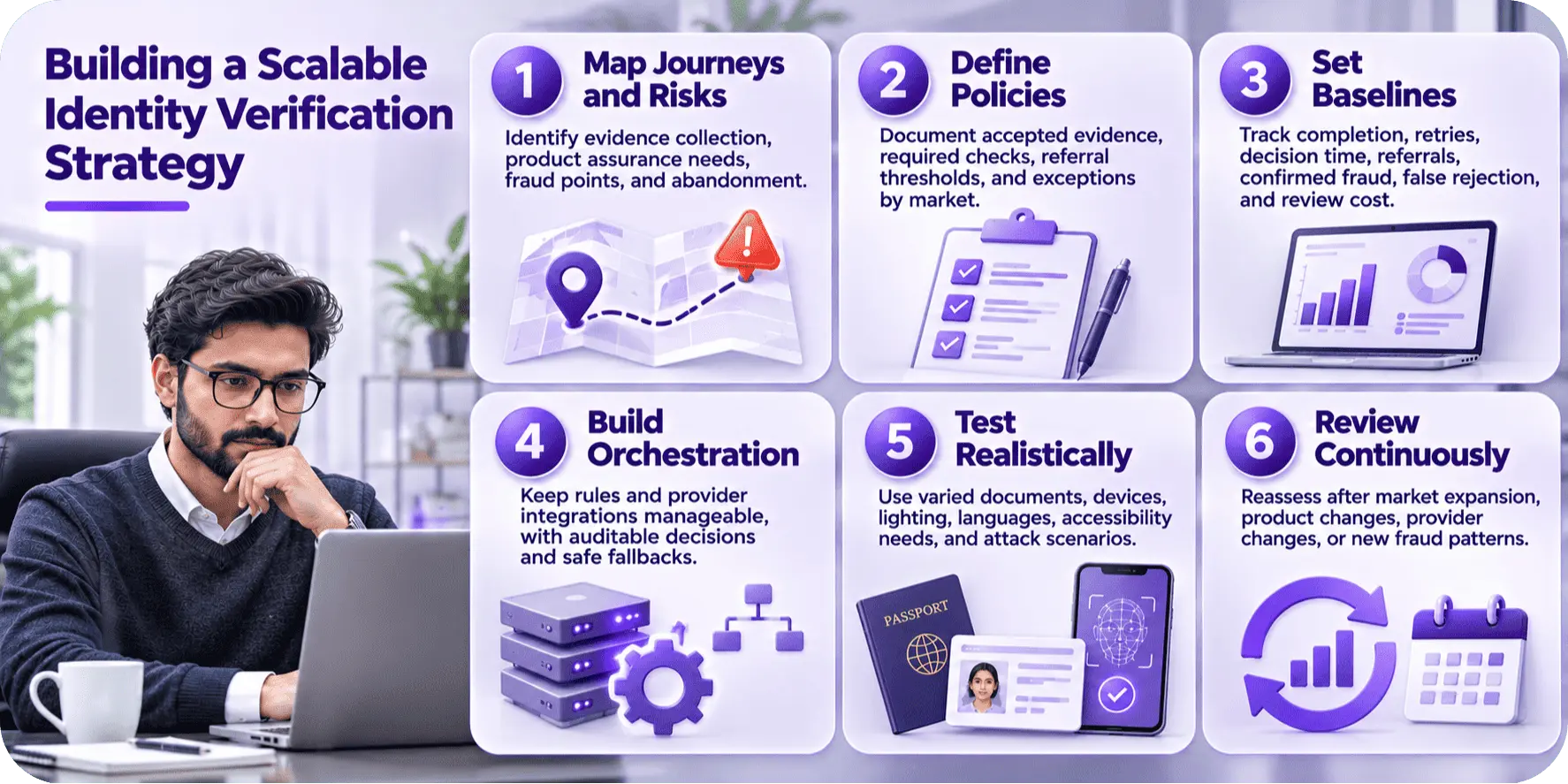
A practical rollout can follow six steps:
- Map journeys and risks. Identify evidence collection, product assurance needs, fraud points, and abandonment.
- Define policies. Document accepted evidence, required checks, referral thresholds, and exceptions by market.
- Set baselines. Track completion, retries, decision time, referrals, confirmed fraud, false rejection, and review cost.
- Build orchestration. Keep rules and provider integrations manageable, with auditable decisions and safe fallbacks.
- Test realistically. Use varied documents, devices, lighting, languages, accessibility needs, and attack scenarios.
- Review continuously. Reassess after market expansion, product changes, provider changes, or new fraud patterns.
For implementation teams, the Recognito GitHub repository can be reviewed alongside product documentation and integration requirements.
Conclusion
Identity verification becomes a strategic challenge when a fintech grows faster than its controls, review operations, and technology architecture. The answer is not to add friction to every application or depend on one biometric check. It is to build a configurable, risk-based process that connects trustworthy identity evidence with fraud controls, regulatory policy, secure authentication, and ongoing monitoring.
High-growth fintechs should measure the entire journey: how reliably customers are verified, how often genuine applicants are delayed, how effectively fraud is detected, and how much operational effort is required to resolve exceptions.
For companies evaluating biometric and document-verification components as part of that architecture, Recognito offers technologies that can support digital identity workflows.
Frequently Asked Questions
Why is identity verification difficult for high-growth fintech companies?
Growth increases application volume, fraud exposure, document diversity, review demand, and regulatory complexity at the same time. Processes that work at low volume may become slow, inconsistent, or expensive.
How can fintechs reduce onboarding friction without weakening KYC?
Use risk-based workflows, clear capture guidance, reliable document and biometric checks, and targeted manual review. Measure completion and fraud outcomes together rather than optimizing approval rate alone.
Is facial recognition enough for fintech identity verification?
No. Face matching connects a person’s face with a reference image, but it does not independently establish document authenticity, liveness, financial-crime risk, or ongoing account control.
Should a fintech use one identity verification provider in every country?
A common platform can simplify operations, but document coverage, legal requirements, data handling, and risk policies must be configured for each market. Provider capability should be tested against the actual customer base.
Which metrics should a fintech monitor?
Track verification completion, retry rate, time to decision, manual-review rate, false rejection, confirmed fraud, post-onboarding account abuse, and review cost. Segment results by product, market, document type, and capture environment where appropriate.