
A passport is one of the strongest identity documents used in remote customer onboarding, but simply asking a customer to upload a passport image does not make the identity trustworthy.
The image still needs to be captured correctly, the document needs to be recognized, its information needs to be extracted and validated, and the institution needs confidence that the passport itself is genuine. In higher-risk onboarding, the passport also has to be connected to the person presenting it.
That is where passport recognition becomes valuable. Instead of treating a passport as an image file, AI-powered document recognition turns it into structured, machine-readable identity evidence that can be analyzed as part of a broader KYC process.
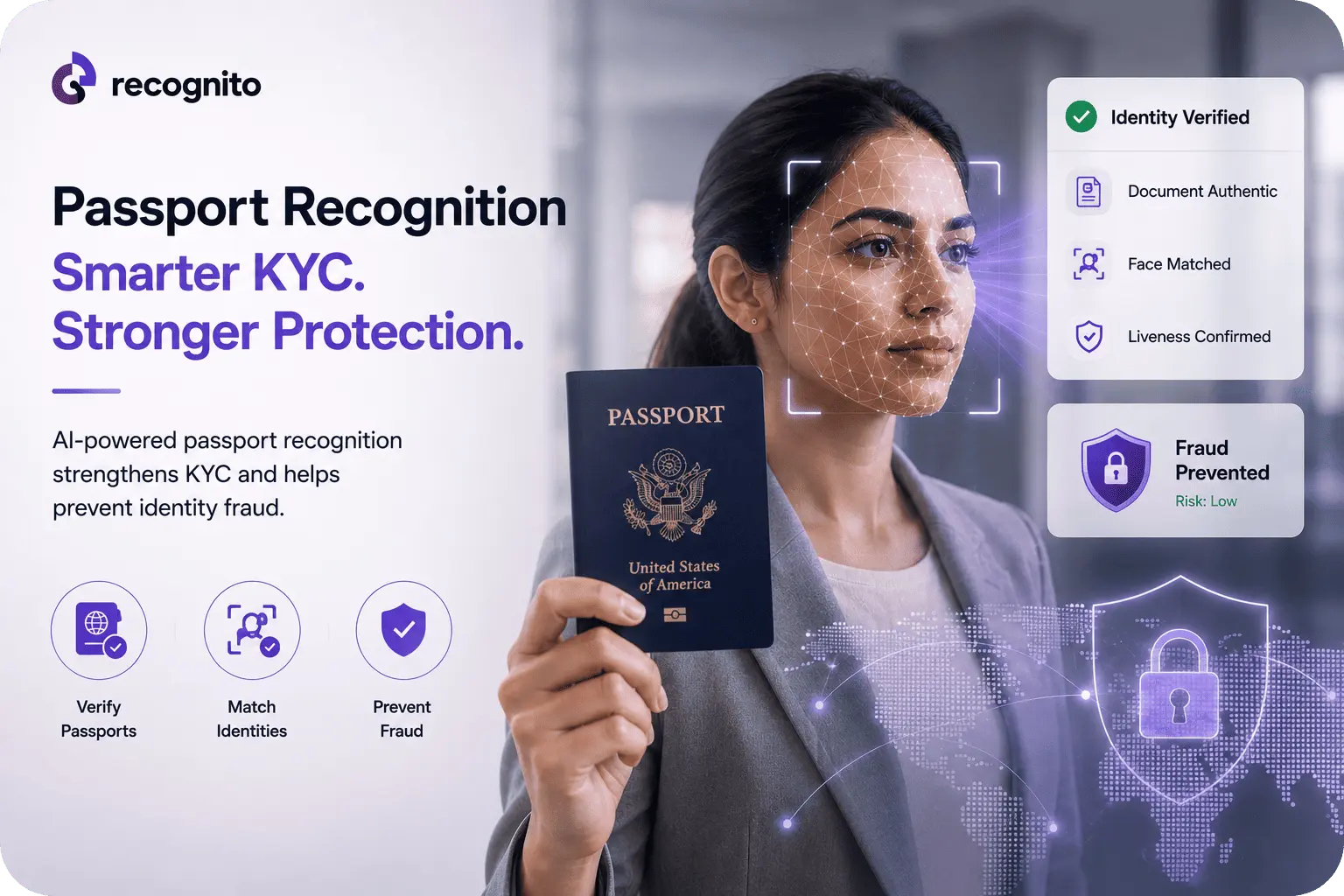
The technology can extract passport information, identify document characteristics, validate machine-readable zones, detect inconsistencies, and connect the passport to biometric verification. When combined with document authenticity and liveness controls, it creates a much stronger foundation for remote identity verification.
Why Passport Recognition Matters in Digital KYC
Traditional KYC was designed around physical documents and face-to-face interaction. An employee could inspect a passport, compare the customer with the photograph, and manually record relevant information.
Remote onboarding removes much of that physical assurance.
The customer may photograph a passport with a smartphone and submit the image from anywhere. That creates several questions:
- Is the document actually a passport?
- Is the image readable?
- Has information been altered?
- Is the passport expired or otherwise invalid?
- Does the captured data match the document?
- Does the applicant match the passport holder?
Modern passport recognition addresses the first stages automatically and helps connect them to the remaining identity checks.
The broader passport recognition workflow illustrates how automated passport processing can reduce manual work while supporting faster digital identity checks.
This is particularly relevant as financial institutions increasingly conduct onboarding through mobile applications and web interfaces rather than branches.
How AI Passport Recognition Works
Passport recognition combines computer vision, OCR, document classification, and structured data extraction.
A typical workflow begins when the customer points a smartphone camera at the passport. The system identifies the document and determines whether the captured image contains sufficient information for processing.
It then locates relevant regions such as:
- document number
- name
- nationality
- date of birth
- expiration date
- issuing country
- portrait
- machine-readable zone
OCR converts visual information into structured fields. The system can also use document-specific rules to interpret the extracted data.
For machine-readable passports, the machine-readable zone provides another source of structured information. ICAO’s Doc 9303 specifications for machine-readable travel documents define technical requirements for machine-readable passports, including the standardized data structure used in the machine-readable zone.
That structure gives verification systems a valuable consistency check. Information visible elsewhere on the passport can be compared with machine-readable data rather than treated as independent text.
Passport Recognition Is More Than OCR
OCR alone answers a narrow question: What text appears in this image?
Passport recognition goes further.
A dedicated document-recognition system can determine the document type, identify the issuing country or document format, locate fields according to that format, and extract information consistently.
That matters because passport layouts differ across issuing authorities and document generations. A production KYC system needs to understand the structure of the evidence rather than simply reading arbitrary text.
This becomes even more important when the extracted information feeds other systems.
For example, the passport number may enter a customer profile, the expiration date may affect eligibility, and the portrait may become the reference image for facial verification.
A document-recognition capability therefore acts as a bridge between the customer’s physical identity document and the digital identity workflow.
Teams implementing this capability can use an identity document recognition SDK to integrate document processing directly into the onboarding journey.
Passport Recognition and Fraud Detection
The biggest security mistake is treating document recognition as proof that a passport is genuine.
Recognizing a passport correctly does not mean the document itself is authentic.
An attacker may use a stolen genuine passport, a counterfeit document, a physically altered passport, a digitally manipulated image, or a presentation designed to fool a remote capture workflow.
FIDO’s Document Authenticity certification program specifically addresses remote verification risks involving forged, tampered, invalid, and presentation-attacked government documents, including passports.
This distinction creates a layered security model:
Document recognition identifies and extracts the passport.
Authenticity checks assess whether the passport appears legitimate.
Document liveness or presence checks establish that the physical document is being presented rather than an arbitrary image.
Face verification checks whether the customer resembles the passport portrait.
Face liveness helps determine whether the biometric input comes from a live person.
The layers address different failure modes. Combining them is considerably stronger than relying on any single document check.
The Growing Importance of Document Presence
A common remote KYC weakness is assuming that every uploaded image came directly from a physical passport.
A fraudster could submit a screenshot of a passport image, a scan, a photograph displayed on another screen, or an altered digital representation.
Document presence checks are intended to reduce this attack surface by analyzing the passport during live capture.
NIST’s current SP 800-63A-4 identity-proofing guidance addresses evidence collection and validation for identity proofing and includes requirements related to using appropriate mechanisms to establish confidence in identity evidence.
The practical principle is straightforward: a KYC platform should not assume that a digital image is equivalent to physical identity evidence.
Matching the Passport to the Customer
Passport recognition becomes significantly more useful when it connects document evidence with biometric evidence.
The passport contains a photograph of the identity holder. During remote onboarding, the applicant can provide a live selfie or video capture.
A facial verification system can compare the live biometric sample with the passport portrait. If the images are sufficiently consistent, the biometric layer provides another piece of evidence supporting the identity claim.
This creates a chain of evidence:
Passport → extracted identity data → document checks → passport portrait → live customer → biometric comparison
The stronger the consistency across those stages, the more confidence the organization can place in the overall identity decision.
However, a face match still does not prove that the customer is physically present. A photograph or replayed media could potentially be used in a presentation attack.
That is why facial matching should be paired with liveness and other fraud controls.
Why Passport Recognition Helps Reduce Manual KYC Work
Manual passport processing is expensive because much of the work is repetitive.
A reviewer may have to identify the document, read fields, enter information into another system, inspect the portrait, check dates, and determine whether anything appears unusual.
Automation can handle the predictable portion of that workload.
Straightforward documents can be processed quickly, while exceptions can be routed to an analyst.
This is particularly valuable for fintechs, banks, payment providers, travel platforms, and other businesses that process high onboarding volumes.
The objective should not be to remove human reviewers entirely. It should be to ensure that human attention is concentrated on applications where automated evidence is incomplete, contradictory, or suspicious.
That approach is consistent with the wider direction of digital identity systems: automate routine evidence processing while maintaining stronger controls around exceptional cases.
Common Passport Fraud Scenarios
Passport recognition and verification systems need to account for several different attack paths.
Stolen genuine passport
The document may be authentic, but the person presenting it is not the legitimate owner.
Facial comparison and liveness become important here because document authenticity alone cannot establish who is using the passport.
Counterfeit passport
An attacker may produce a document designed to resemble a genuine passport. Document classification, visual checks, security-feature analysis, and other authenticity controls may help identify inconsistencies.
Digitally manipulated passport image
A fraudster may alter information in a digital copy before submitting it. An image can look convincing while containing information that does not correspond to the original document.
Presentation attack
The attacker may show a passport image or reproduction to the camera rather than presenting the genuine physical document.
This is where document-presence techniques become particularly relevant.
Identity manipulation
A fraudster may use genuine identity evidence belonging to another person and attempt to establish an account under that identity.
Connecting passport verification with facial biometrics and other risk signals helps address this problem more effectively than document processing alone.
A deeper look at document fraud detection techniques can help security teams think beyond simple OCR and field validation.
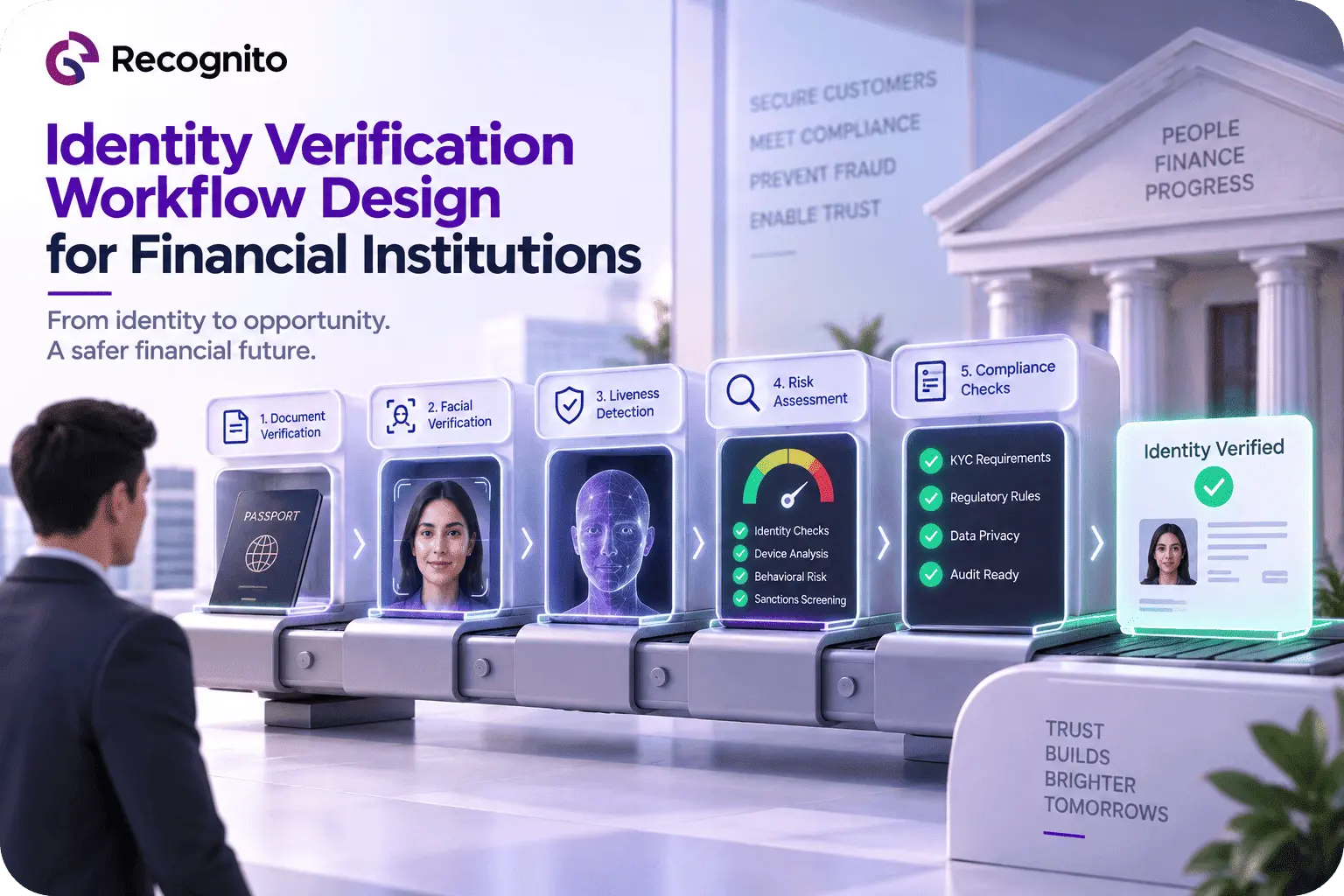
Passport Recognition in a Modern KYC Workflow
A practical onboarding architecture can be structured into several layers.
| KYC stage | Passport-recognition role | Security objective |
| Capture | Guides and evaluates passport image quality | Obtain usable identity evidence |
| Recognition | Identifies passport type and issuing context | Establish document structure |
| Data extraction | Reads identity fields and MRZ information | Create structured customer data |
| Consistency checks | Compares visible and machine-readable information | Detect discrepancies |
| Authenticity | Evaluates document integrity and validity signals | Reduce counterfeit and tampering risk |
| Biometric comparison | Compares passport portrait with live face | Connect document to applicant |
| Liveness | Assesses whether captured biometric evidence is genuine | Reduce presentation attacks |
| Risk decision | Combines verification outputs with other signals | Determine approval, escalation, or rejection |
This layered design is important because no single stage should carry the entire security burden.
A failed recognition result may simply indicate poor image quality. An authenticity anomaly may indicate potential fraud. A face mismatch could indicate impersonation. These cases should not necessarily produce the same response.
What Businesses Should Evaluate Before Deploying Passport Recognition
Choosing a passport-recognition solution requires more than testing whether a sample passport can be read successfully.
Document coverage
Determine which countries, passport formats, document generations, and edge cases the system supports.
Capture performance
Test real smartphones and realistic lighting conditions. A model that works perfectly in controlled demonstrations may produce more failures with glare, motion, poor focus, or low-end cameras.
Recognition accuracy
Measure whether fields are extracted correctly and whether the system consistently identifies document types.
Fraud resistance
Evaluate counterfeit, tampered, digitally altered, stolen, and presentation scenarios relevant to the organization’s threat model.
Integration
Review SDKs, APIs, latency, error handling, supported platforms, and how verification outputs enter the existing KYC decision engine.
Independent testing
Vendor claims should be supported with meaningful evaluation evidence. Independent assurance can be especially valuable when passport authentication is a critical control.
For technical teams, a face biometric playground can also be useful when evaluating how biometric components behave before they are incorporated into a broader verification flow.
Data Quality Is a Hidden KYC Risk
Even a sophisticated recognition model can struggle when the input is poor.
Passport photographs may contain glare from protective pages. Curved pages can distort text. Cameras can introduce blur or compression. Customers may capture the document at an angle or outside the recommended frame.
These conditions can lead to false rejections, unnecessary retries, and manual-review volume.
A good KYC implementation therefore treats capture quality as part of the verification system.
The customer should receive practical guidance while capturing the passport. The system should explain when the document is outside the frame, too dark, too reflective, or otherwise unsuitable.
This improves both usability and the quality of evidence entering the fraud-detection pipeline.
Privacy and Passport Data Governance
Passport recognition processes highly sensitive personal information.
The risk is not limited to the passport image itself. Extracted names, document numbers, dates of birth, nationality, passport portraits, and biometric information may all become part of the customer’s digital identity record.
A responsible architecture should determine:
- what information is collected
- which data is necessary
- what is stored
- how long it is retained
- who can access it
- how it is protected
- when it is deleted
Data minimization is particularly important because better KYC does not necessarily mean retaining more information.
Security teams should also consider how third-party providers process identity evidence, whether data crosses jurisdictions, and how access is audited.
The Role of Passport Recognition in Risk-Based KYC
Passport recognition should support a broader risk-based decision instead of acting as an isolated approval mechanism.
A straightforward application may present a clear passport, consistent extracted information, a strong biometric match, and convincing liveness evidence. That case may be suitable for automated processing.
Another applicant may produce a low-quality passport capture combined with inconsistent information and an uncertain facial comparison. That case deserves more scrutiny.
The distinction allows fintechs to reserve friction for situations where it is justified.
FATF’s Guidance on Digital Identity emphasizes that digital identity systems can support customer due diligence when they provide appropriate confidence in the reliability and independence of identity information and are used with suitable risk mitigation.
The technology therefore becomes most valuable when it strengthens the evidence behind a risk-based decision rather than simply producing another automated score.
How Passport Recognition Improves the Customer Experience
Security and usability do not have to be opposing goals.
Automated passport recognition can shorten onboarding by removing repetitive data entry. Customers photograph their passports instead of manually typing document details.
Structured capture guidance can further reduce mistakes. Once the system has extracted the necessary information, the applicant may only need to confirm details and complete the remaining verification steps.
The result can be a shorter and more consistent onboarding process without reducing the depth of identity checks.
However, friction should not disappear at the expense of security. Fast onboarding is valuable only when the evidence behind the resulting account is trustworthy.
Preparing for More Sophisticated Identity Fraud
Passport verification is becoming part of a larger battle over digital identity evidence.
Fraudsters no longer need to physically reproduce every component of a document. Digital manipulation, synthetic identities, stolen identity information, and increasingly convincing generated media can all be incorporated into remote attacks.
That is why future-ready KYC systems need to evaluate the entire evidence chain.
The passport must be recognized correctly. Its information must be consistent. The document must appear legitimate. The applicant should correspond to the document. The biometric capture should come from a live person. And the final decision should incorporate risk signals beyond the document itself.
This layered approach makes it harder for an attacker to defeat the entire workflow by compromising one control.
For organizations developing these systems, the Recognito GitHub repository provides technical resources that can complement product and integration evaluation.
Conclusion
Passport recognition gives digital KYC systems a structured way to turn a physical identity document into usable digital evidence.
Its real value appears when recognition is combined with document authenticity, presence checks, biometric verification, liveness detection, risk analysis, and appropriate human review. Together, those controls can reduce manual processing while making remote identity fraud more difficult.
The most effective passport-verification strategy is therefore not simply to read the passport faster. It is to build a reliable chain of evidence from document capture to final customer decision.
For organizations building secure digital identity workflows, Recognito provides technologies that can support passport recognition, biometric verification, and broader identity-security requirements.
Frequently Asked Questions
What is passport recognition in KYC?
Passport recognition uses technologies such as computer vision and OCR to identify a passport, locate relevant fields, and convert information from the document into structured digital data for identity verification.
Can passport recognition detect fake passports?
Passport recognition by itself should not be considered a complete counterfeit-detection system. Stronger KYC workflows combine document recognition with authenticity checks, presence detection, biometric verification, and other fraud controls.
Why compare a passport with a selfie?
The passport establishes identity evidence, while facial comparison helps determine whether the person completing the remote verification corresponds to the passport portrait.
Is passport recognition useful for fintech onboarding?
Yes. It can reduce manual data entry, accelerate document processing, improve consistency, and provide structured evidence for automated or risk-based onboarding decisions.
What should businesses prioritize when choosing passport-recognition technology?
Look at document coverage, extraction accuracy, image-quality handling, fraud resistance, biometric integration, liveness support, privacy controls, SDK or API capabilities, independent testing, and performance under realistic customer conditions.