
Financial institutions need to verify customers accurately without making the onboarding process unnecessarily complicated.
A bank, fintech company, payment provider, digital lender, or financial platform may need to establish who a customer is, confirm that the submitted identity information is legitimate, prevent impersonation, satisfy KYC requirements, and decide whether the application should be approved or reviewed.
The challenge is that these objectives are connected but not identical.
An identity document can be genuine while being presented by the wrong person. A facial match can be strong while the biometric presentation is fraudulent. A customer can pass initial verification while later exhibiting behavior that creates a new fraud risk.
This is why an effective identity verification workflow should be designed as a sequence of related controls rather than a single verification step.
A well-designed workflow combines document verification, biometric verification, liveness detection, risk assessment, compliance controls, and appropriate manual intervention. It should also be flexible enough to apply stronger verification when risk increases without forcing every legitimate customer through the most complex possible process.
This guide explains how financial institutions can design a practical onboarding workflow, what each stage should accomplish, and how to connect the individual technologies into a reliable customer verification process.
What Is an Identity Verification Workflow?
An identity verification workflow is the sequence of checks an organization uses to establish and verify a customer’s identity.
The workflow can vary depending on the institution, product, geography, regulatory environment, and level of risk.
A low-risk service may require relatively few checks. A financial institution opening a regulated account may need document verification, biometric verification, liveness, screening, risk assessment, and additional review.
The important point is that the workflow should be designed around the identity assurance required by the business.
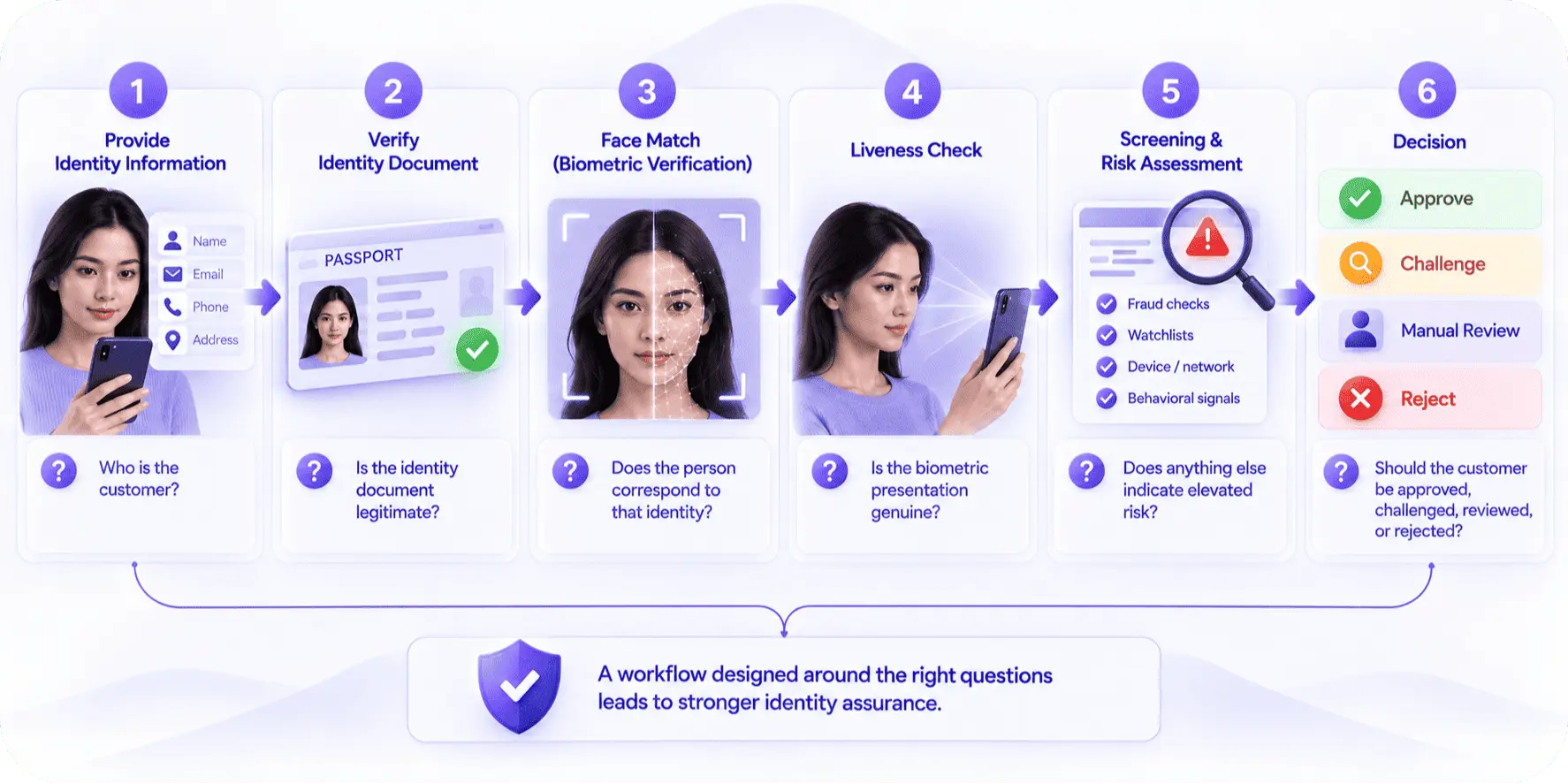
A useful workflow should answer several questions:
- Who is the customer?
- Is the identity document legitimate?
- Does the person presenting it correspond to that identity?
- Is the biometric presentation genuine?
- Does anything else about the application indicate elevated risk?
- Should the customer be approved, challenged, reviewed, or rejected?
These questions should guide the architecture before individual technologies are selected.
Why Workflow Design Matters as Much as the Technology
A financial institution can purchase high-quality verification technology and still create a poor onboarding process.
For example, if document verification is performed after biometric checks, the system may be asking the wrong question at the wrong time. If liveness is applied to every customer interaction regardless of risk, unnecessary friction can increase. If failed verification has no recovery path, legitimate customers can become trapped.
The workflow determines how individual controls interact.
Consider the difference between:
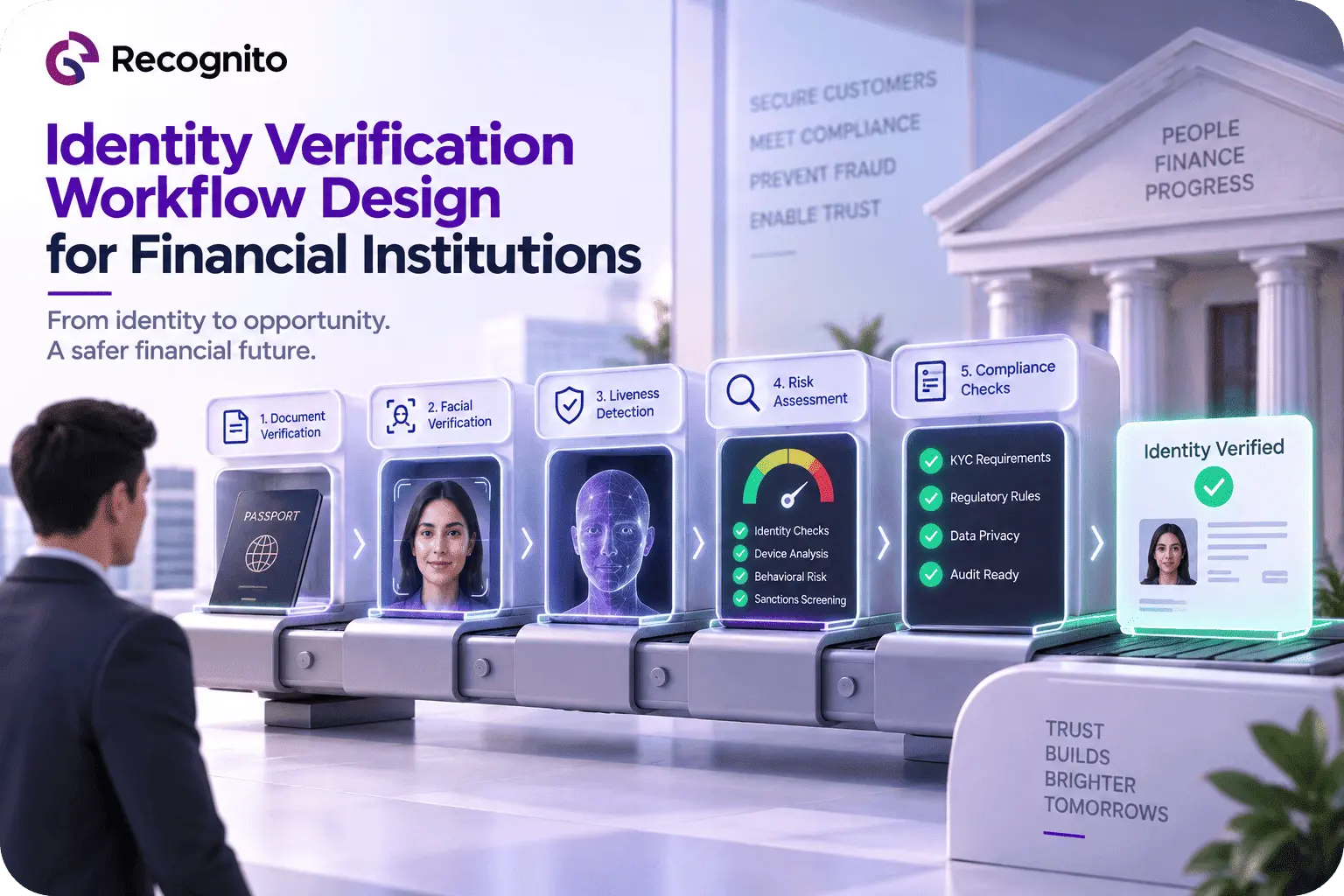
Document verification → facial verification → liveness → risk decision
and:
Face capture → automatic rejection → manual document review
Both may use biometric technology, but the first architecture creates a much clearer chain of identity evidence.
The goal is therefore not simply to add more verification.
It is to use each control where it provides the most value.
The Core Stages of a Financial Identity Verification Workflow
A typical digital onboarding process can be structured into several stages.
1. Customer and Identity Data Collection
The workflow begins by collecting the information required to establish the applicant’s identity.
This may include personal information, contact details, country of residence, and an identity document.
The amount of information requested should be driven by the actual business and compliance requirements.
Collecting unnecessary information increases privacy exposure without necessarily improving verification.
A good onboarding workflow should therefore establish the minimum information required for the initial identity decision and request additional information only when the use case requires it.
2. Identity Document Capture and Verification
For many financial institutions, the identity document is a major source of trusted identity information.
The customer may submit a passport, national identity card, driver’s license, or another accepted credential.
The verification system can then examine the document and extract relevant information.
A document-focused ID document recognition SDK can form this part of the workflow by supporting automated document analysis.
The exact checks depend on the document and technology, but the workflow should establish whether the document appears genuine and whether its information is consistent with the application.
Financial institutions should also consider what happens when the document cannot be verified.
A failed document check should not automatically mean the customer is fraudulent. Poor image quality, unsupported document versions, or expired credentials may all produce legitimate failures.
The workflow should distinguish between technical failure, verification failure, and genuine risk.
3. Identity Information Consistency
After document processing, the institution should compare the extracted identity information with the information provided during onboarding.
This can help identify inconsistencies such as differences in:
- Name
- Date of birth
- Document number
- Country
- Address
- Other required identity attributes
A mismatch may be caused by a simple data-entry mistake.
However, multiple inconsistencies can become a meaningful risk signal when combined with other anomalies.
The identity verification workflow should therefore feed these results into the broader risk decision rather than treating each mismatch as an automatic rejection.
4. Facial Verification
Once the identity document has established a trusted facial reference, the institution can introduce biometric verification.
The customer provides a facial sample, and the system compares it with the appropriate reference image.
A face recognition SDK can support the biometric matching stage within the institution’s own onboarding application.
This provides an important connection between the identity credential and the person presenting it.
For example, a fraudster may possess a genuine passport belonging to another individual. The document itself may appear legitimate, but the facial comparison can identify that the person presenting the passport does not correspond to the photograph.
This is why document verification and facial verification are generally complementary rather than competing technologies.
5. Liveness Verification
Facial similarity alone does not establish that a real person is present.
An attacker may try to present a photograph, replayed video, screen image, mask, or other artificial representation.
Liveness detection addresses this additional security question.
A biometric liveness SDK can provide a dedicated layer for assessing whether the facial presentation appears to come from a genuine live subject.
The workflow should determine when liveness is necessary based on risk.
For high-risk customer onboarding, it may be appropriate to use liveness as part of the standard process. In other scenarios, the institution may apply stronger biometric checks only when risk signals require them.
The important principle is that facial matching and liveness solve different problems.
6. Risk Assessment and Decisioning
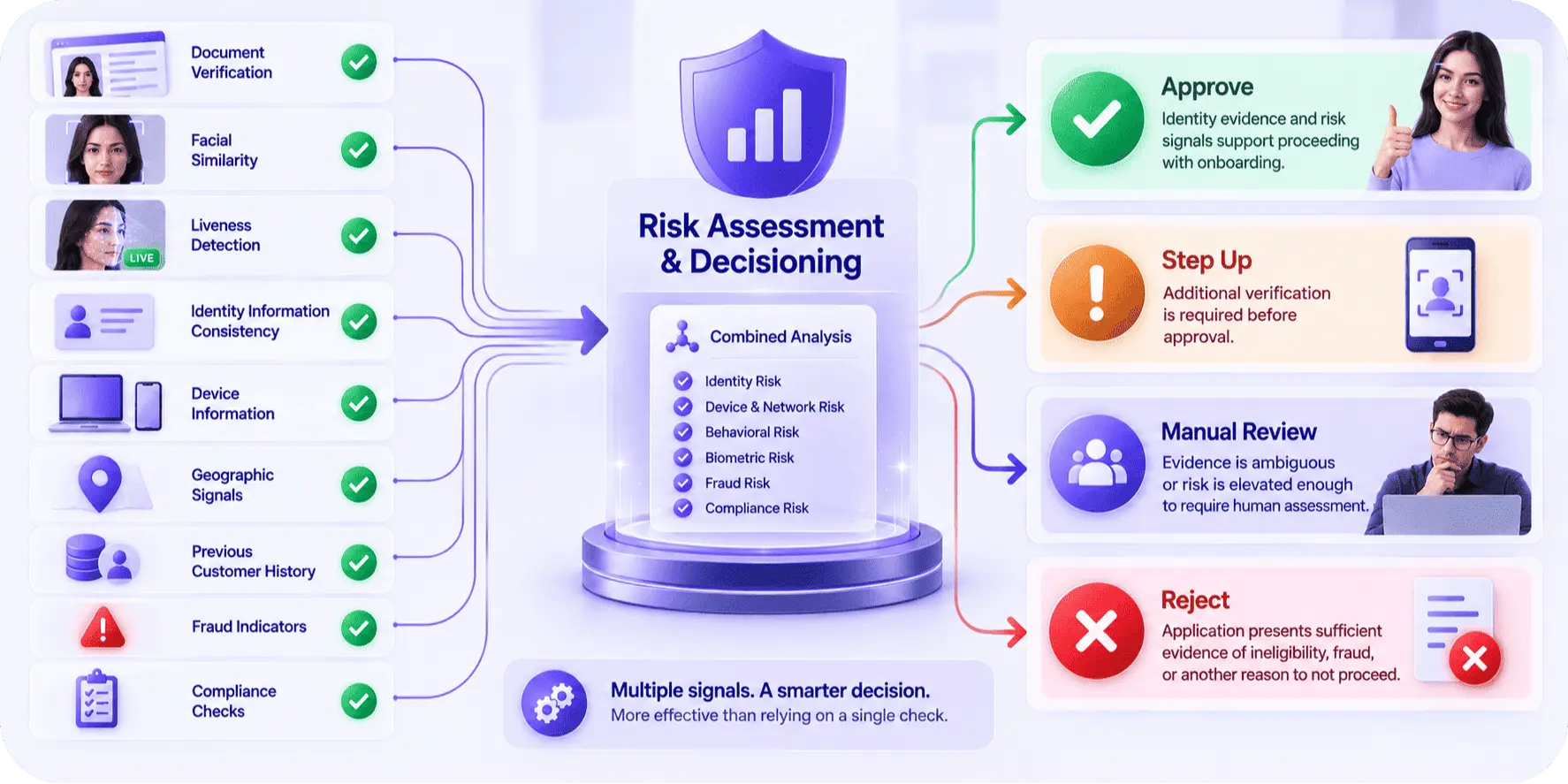
After the identity, document, biometric, and liveness checks are completed, the workflow should combine the results.
This is where the verification process becomes a risk decision rather than a collection of individual pass/fail checks.
A financial institution may consider:
- Document verification result
- Facial similarity
- Liveness result
- Identity information consistency
- Device information
- Geographic signals
- Previous customer history
- Fraud indicators
- Required compliance checks
The output can then determine the next action.
Approve
The identity evidence and risk signals support proceeding with onboarding.
Step Up
Additional verification is required before approval.
Manual Review
The evidence is ambiguous or the risk is elevated enough to require human assessment.
Reject
The application presents sufficient evidence of ineligibility, fraud, or another reason the institution cannot proceed.
This approach is generally more effective than allowing one biometric or document check to make the entire decision.
Designing Risk-Based Verification Instead of One-Size-Fits-All Verification
Not every customer represents the same level of risk.
A long-established customer updating basic information is different from a new customer opening an account using a new device from an unusual environment.
A strong workflow should therefore support different levels of verification.
For example:
Standard risk: document and identity verification.
Elevated risk: document + biometric verification.
High risk: document + biometric verification + liveness + additional review.
This model can improve customer experience because stronger controls are applied when they are actually justified.
It can also improve fraud prevention by preventing high-risk applications from receiving the same treatment as ordinary applications.
How KYC and Compliance Fit Into the Workflow
Identity verification is only one component of a financial institution’s broader compliance responsibilities.
KYC and customer due diligence requirements can involve identity information, risk assessment, screening, monitoring, recordkeeping, and other controls.
The FATF digital identity guidance provides useful context on digital identity within customer identification and verification processes.
This means an identity verification workflow should be designed so its results can feed into the institution’s wider compliance architecture.
For example, the workflow might produce structured outputs indicating:
- Identity document verified
- Biometric verification completed
- Liveness passed
- Additional review required
- Customer risk level
- Verification timestamp
These outputs can then support downstream KYC and risk processes.
The identity verification step should therefore be treated as part of a broader customer lifecycle rather than an isolated onboarding event.
Privacy and Data Handling Within the Workflow
Biometric and identity information require careful handling.
The workflow should establish what information is collected, where it is processed, what needs to be retained, and who has access.
Organizations serving European customers should consider the GDPR framework when designing identity and biometric processing.
The architecture should also consider whether raw images are stored or deleted after verification, how biometric templates are protected, and how retention periods are enforced.
Data minimization should influence the workflow from the beginning.
A financial institution should not collect and retain every possible data point simply because the technology allows it.
The better approach is to identify which information supports the business and compliance decision and limit processing to what is necessary.
What Happens When Verification Fails?
A good workflow is not designed only for successful customers.
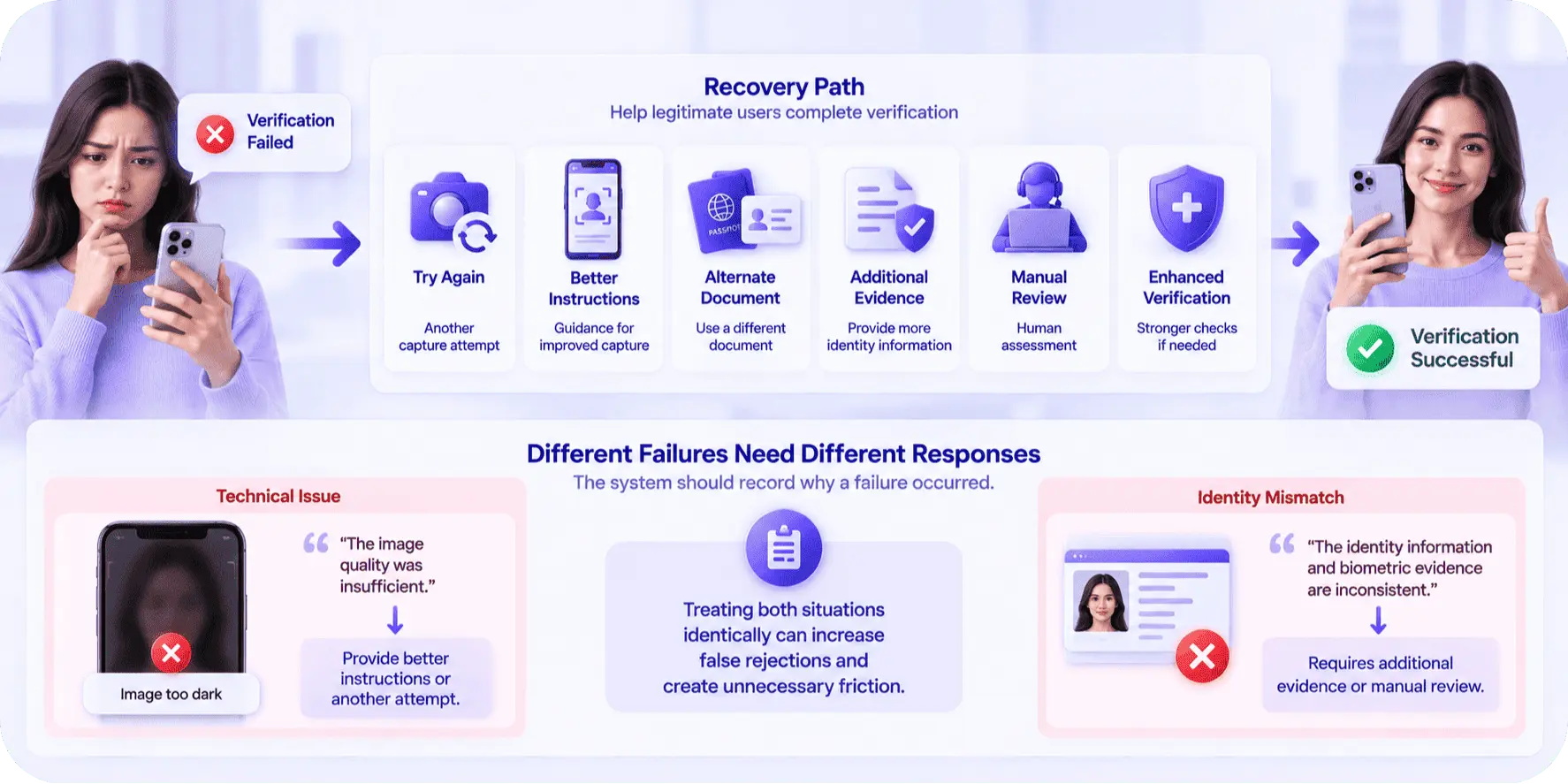
Some legitimate users will fail verification because of poor lighting, unsupported documents, changed appearance, device limitations, or other technical conditions.
The workflow needs a recovery path.
A failed verification may lead to:
- Another capture attempt
- Better capture instructions
- An alternate document
- Additional identity evidence
- Manual review
- Enhanced verification
The system should also record why a failure occurred.
There is a significant difference between:
“The image quality was insufficient.”
and:
“The identity information and biometric evidence are inconsistent.”
Treating both situations identically can increase false rejections and create unnecessary friction.
Designing the Customer Experience
Security and customer experience should be designed together.
Customers do not care how many verification APIs are running in the background. They care whether the process is understandable, fast, and successful.
A good customer verification experience should explain:
- What the customer needs to do
- Why a document or face capture is required
- How to capture it correctly
- What happens after submission
- What to do if verification fails
Clear instructions can reduce technical failures before they become fraud or support issues.
The organization should also monitor completion and abandonment rates after launch.
A workflow with excellent fraud controls but poor customer completion may not be successful commercially.
Choosing the Right Identity Verification Architecture
Financial institutions can implement identity verification in different ways.
Some may prefer an end-to-end verification platform that manages most of the workflow.
Others may prefer SDK-based components so their engineering team can control the user journey and integrate verification directly into their own applications.
SDK-based architecture can be particularly useful when the institution needs deeper control over:
- Customer experience
- Application logic
- Data flow
- Risk decisioning
- Integration with internal systems
A biometric platform should therefore be evaluated according to how it fits the institution’s overall architecture.
How Individual Technologies Fit Together
The different technologies should have clearly defined jobs.
| Workflow Stage | Primary Purpose | Typical Technology |
| Identity capture | Collect required identity evidence | Application and document capture |
| Document verification | Assess identity credential | Document recognition |
| Identity consistency | Compare application and document information | Verification and data validation |
| Facial verification | Connect person to trusted identity | Face matching |
| Liveness | Protect biometric capture | Presentation attack detection |
| Risk decision | Combine evidence and determine next action | Risk engine and workflow rules |
| Compliance | Support KYC and customer due diligence | Compliance systems and review |
| Monitoring | Detect changing risk after onboarding | Fraud and account monitoring |
The important point is that no single component needs to solve every problem.
A well-designed workflow connects the outputs so that one stage strengthens the next.
How to Test an Identity Verification Workflow Before Launch
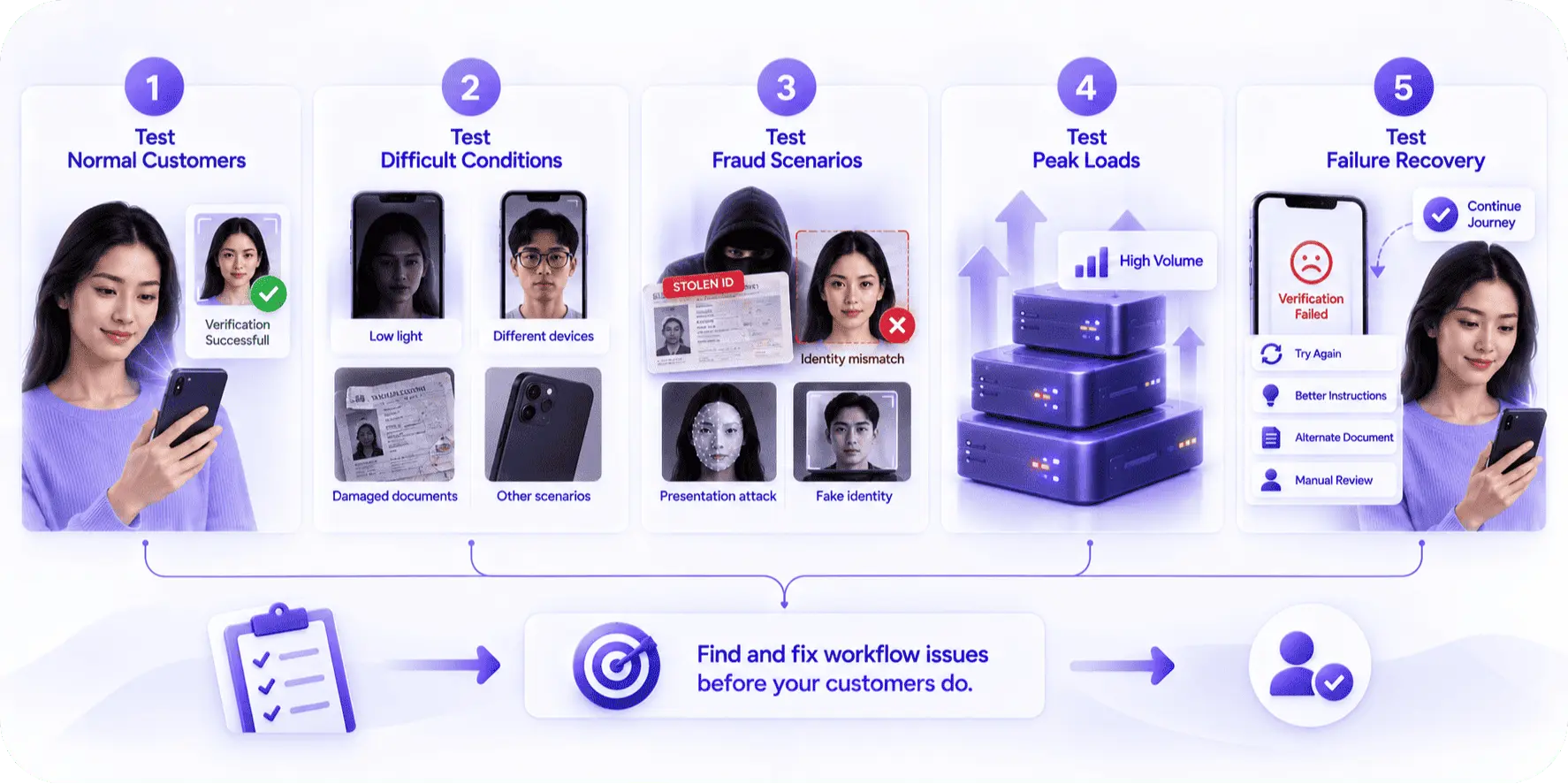
A proof of concept should test the complete customer journey, not just individual APIs.
Test Normal Customers
Make sure legitimate users can complete verification without unnecessary friction.
Test Difficult Conditions
Use poor lighting, different devices, damaged documents, and other realistic scenarios.
Test Fraud Scenarios
Evaluate stolen documents, identity mismatches, presentation attacks, and other relevant threats.
Test Peak Loads
Measure how the workflow behaves when verification volumes increase.
Test Failure Recovery
Confirm that legitimate users have a clear path when a check fails.
The goal is to discover workflow problems before customers encounter them.
Where SDK-Based Biometrics Fit Into the Workflow
SDKs can allow financial institutions to embed biometric capabilities directly into their onboarding experience.
For example, a facial verification SDK can provide the face matching stage, while document analysis and liveness can be integrated as complementary controls.
Technical teams can also explore the Face Biometric Playground during evaluation to understand the practical biometric experience before connecting it to a production workflow.
For development teams, the Recognito GitHub repository can provide additional technical resources during implementation planning.
The goal should be to build a workflow where the SDK components fit naturally into the institution’s existing application and risk architecture rather than forcing the business to rebuild its entire onboarding process around the technology.
Common Identity Verification Workflow Mistakes
Financial institutions can weaken a good verification architecture through poor workflow design.
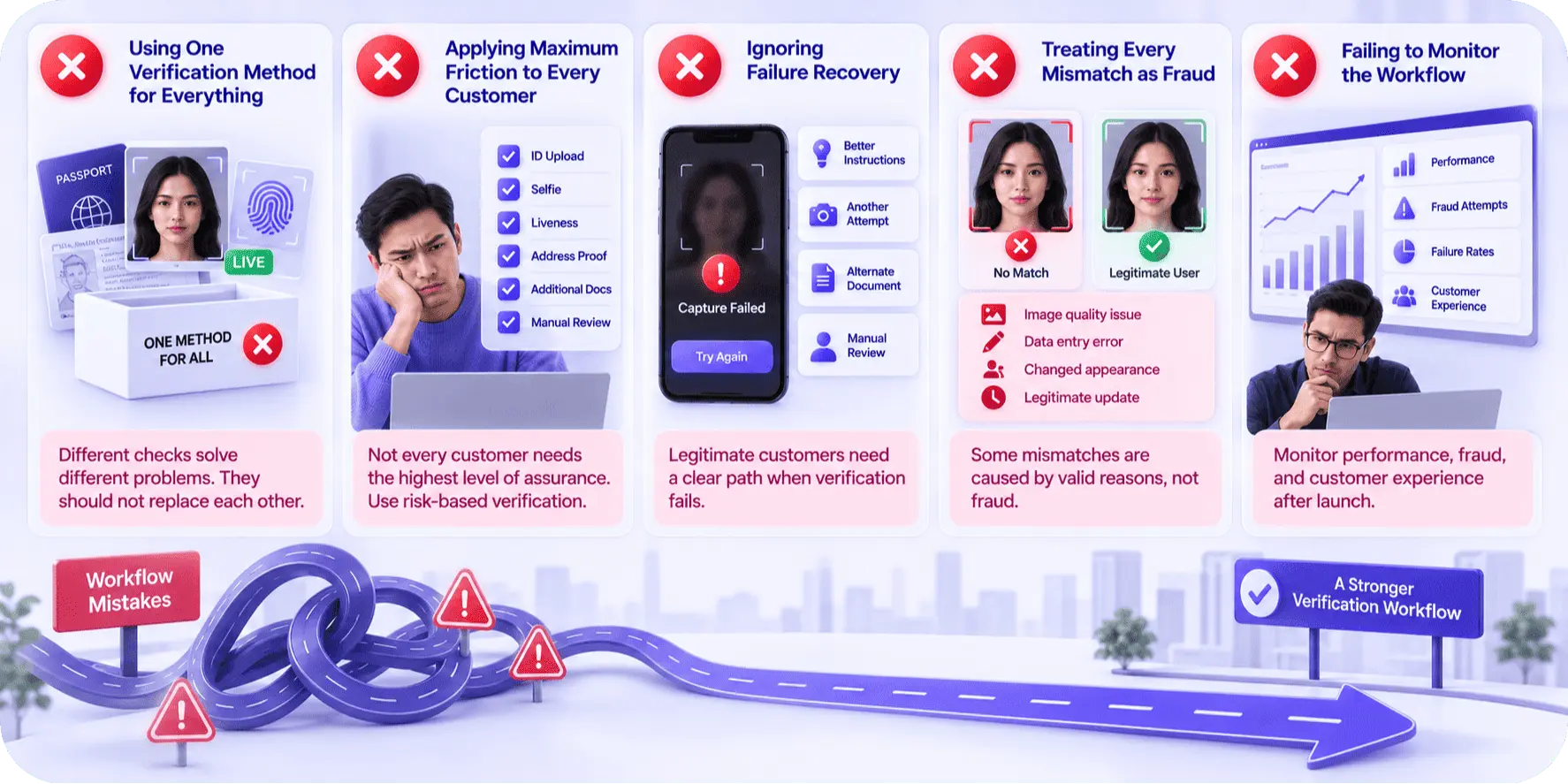
Using One Verification Method for Everything
Document verification, biometric matching, and liveness solve different problems. They should not be expected to replace one another.
Applying Maximum Friction to Every Customer
Not every customer requires the highest level of assurance. Risk-based verification can reduce unnecessary steps.
Ignoring Failure Recovery
Legitimate customers need a clear path when image capture or verification fails.
Treating Every Mismatch as Fraud
Some mismatches result from data-entry errors, image quality, or legitimate changes.
Failing to Monitor the Workflow
A verification process needs ongoing performance, fraud, and customer-experience monitoring after launch.
What Should Financial Institutions Measure?
A workflow should be monitored using both security and operational metrics.
Useful measures include:
- Verification completion rate
- False rejection rate
- Fraud detection rate
- Manual review rate
- Average verification time
- Retry rate
- Customer abandonment
- Liveness failure rate
- Document verification failure rate
These measurements can reveal where the workflow needs improvement.
For example, a high document failure rate may indicate an image capture problem rather than a fraud problem. A high manual review rate may indicate that risk thresholds are too strict or poorly calibrated.
Building an Identity Verification Workflow That Can Evolve
Identity verification technology continues to change.
Financial institutions are increasingly evaluating digital identity wallets, verifiable credentials, biometric authentication, AI-powered fraud detection, and risk-based decisioning alongside traditional verification technologies.
That means the best workflow is not necessarily the one with the most components today.
It is the one that can incorporate new capabilities without requiring a complete redesign.
A modular architecture can allow institutions to update biometric components, document verification, risk models, and fraud controls while keeping the broader onboarding experience stable.
This can reduce long-term technical debt and make the identity verification process easier to maintain.
Conclusion
A successful identity verification workflow is not simply a series of checks placed one after another.
It is a carefully designed process that connects identity documents, biometric verification, liveness, risk assessment, compliance, customer experience, and ongoing monitoring.
For financial institutions, the strongest architecture is usually risk-based. Straightforward applications should be able to move through verification efficiently, while higher-risk cases can trigger stronger biometric or manual controls.
The workflow should also be designed around privacy, clear failure recovery, realistic testing, scalability, and long-term maintainability.
The objective is to create enough confidence in the customer’s identity without introducing unnecessary friction or collecting more information than the institution genuinely needs.
Financial institutions evaluating SDK-based identity and biometric technologies can explore the broader capabilities available from Recognito as part of their onboarding architecture.
Frequently Asked Questions
What is an identity verification workflow?
An identity verification workflow is the sequence of processes an organization uses to establish and verify a customer’s identity. It can include document checks, biometric verification, liveness, risk assessment, compliance checks, and manual review.
What should a financial institution include in its verification process?
Depending on the risk and regulatory environment, the process may include identity document verification, biometric verification, liveness detection, data consistency checks, risk assessment, KYC controls, and manual review.
Should every customer complete the same verification steps?
Not necessarily. Risk-based verification allows financial institutions to apply stronger controls when risk increases while keeping lower-risk onboarding more efficient.
What happens when a customer fails identity verification?
The workflow should distinguish between technical failure and genuine identity risk. Depending on the reason, the customer may receive better capture guidance, another verification attempt, additional evidence requirements, or manual review.
How should financial institutions test an onboarding workflow before launch?
They should test the complete customer journey with normal and difficult scenarios, different documents and devices, realistic fraud attempts, expected peak workloads, failure recovery, privacy controls, and customer-experience metrics.