
Face recognition has moved from a specialized computer-vision capability to a practical identity technology used in banking, digital onboarding, access control, authentication, travel, fraud prevention, and customer verification.
That shift is being driven by artificial intelligence. Modern systems do more than compare two photographs. They detect faces, extract biometric features, assess image quality, calculate similarity, and increasingly work alongside liveness detection and other fraud controls.
For businesses, however, the important question is not whether AI face recognition works in general. It is whether a particular system works reliably for the intended users, under the intended conditions, with acceptable security, privacy, and operational risk.
That requires looking beyond an accuracy percentage.
How AI Face Recognition Works
AI face recognition typically begins with face detection. The system identifies a face within an image or video frame and determines which portion should be analyzed.
It then generates a mathematical representation of the facial characteristics using a trained machine-learning model. This representation, often called an embedding or template, can be compared with another representation to estimate similarity.
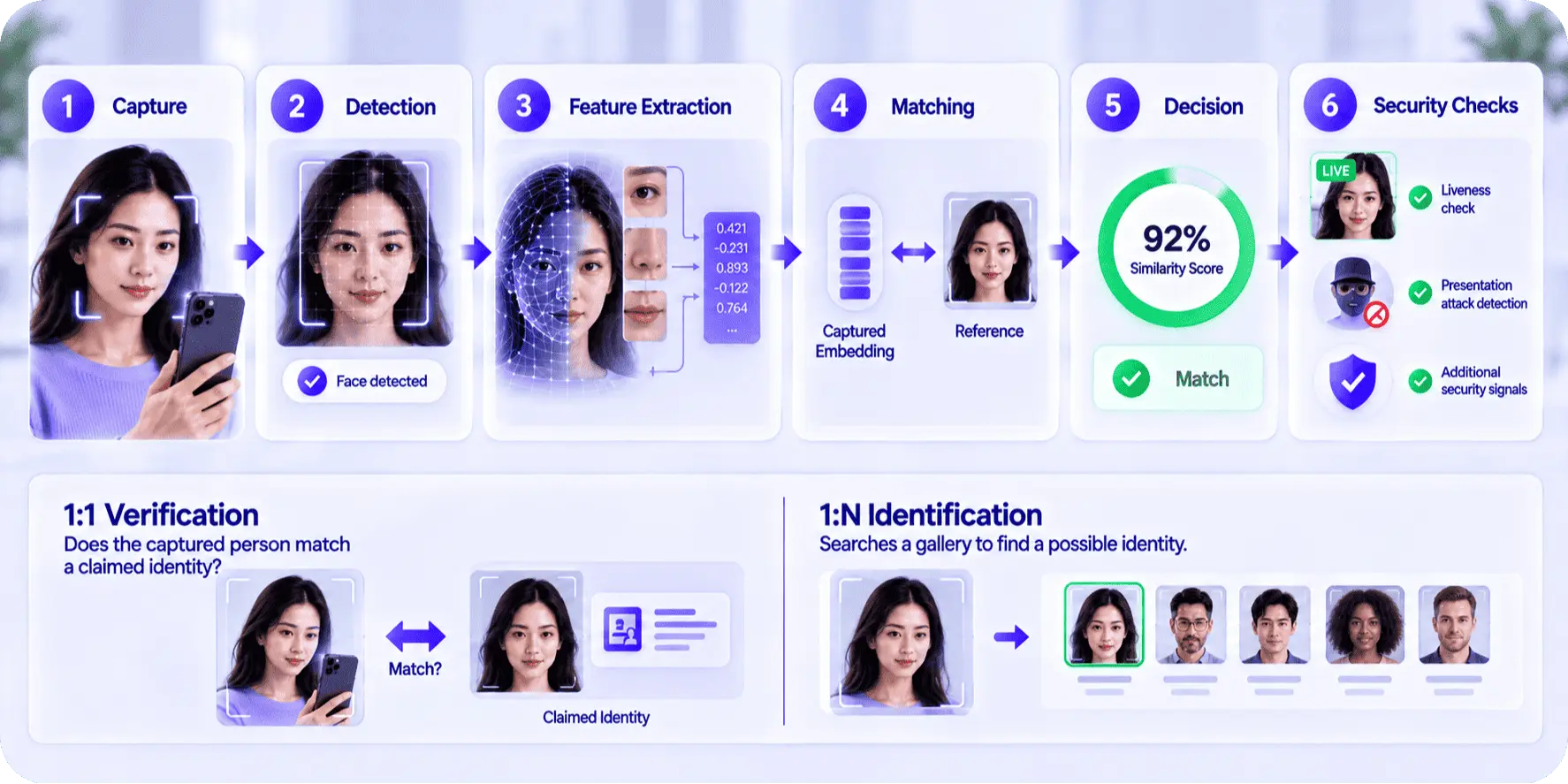
A typical workflow looks like this:
- Capture: A camera collects a facial image or video.
- Detection: The system locates the face and checks whether it is suitable for analysis.
- Feature extraction: An AI model converts facial characteristics into a machine-readable representation.
- Matching: The representation is compared with a reference.
- Decision: A similarity score is evaluated against a threshold.
- Security checks: Liveness, presentation-attack detection, or other signals may be applied before the final decision.
The process differs depending on whether the application performs 1:1 verification or 1:N identification.
In 1:1 verification, the system asks whether the captured person matches a claimed identity. In 1:N identification, it searches a gallery to find a possible identity.
NIST’s ongoing Face Recognition Technology Evaluation program evaluates these recognition scenarios separately, reflecting the different performance and risk characteristics of each.
Why Businesses Use AI Face Recognition
The technology becomes valuable when identity has to be established without relying exclusively on passwords, physical cards, or manual inspection.
Remote identity verification
A smartphone camera allows customers to complete facial verification without specialized biometric hardware. That makes the technology particularly useful for remote onboarding and digital account access.
A fintech, for example, can compare a customer’s selfie with the portrait on an identity document and use the outcome as one part of an identity decision.
This approach is increasingly relevant as organizations move from branch-based verification toward remote customer journeys. A useful related overview is how face recognition systems work in real applications.
Authentication
Face recognition can also support repeat authentication after an identity has already been established.
Instead of entering a password or PIN, the user may present their face to the application. Depending on the architecture, this can create a faster authentication experience while adding a biometric factor to the security model.
The design matters, though. A biometric match should not automatically be treated as proof that every request is trustworthy. Device security, session protection, account recovery, and transaction risk still matter.
Fraud prevention
Biometric comparison can make certain forms of impersonation harder because an attacker needs to reproduce a matching biometric signal rather than simply obtain credentials.
That does not eliminate identity fraud. Modern fraud attempts may involve stolen identities, manipulated documents, deepfakes, synthetic identities, or presentation attacks.
Facial recognition therefore works best as one component in a layered fraud-prevention system.
The Business Benefits Go Beyond Convenience
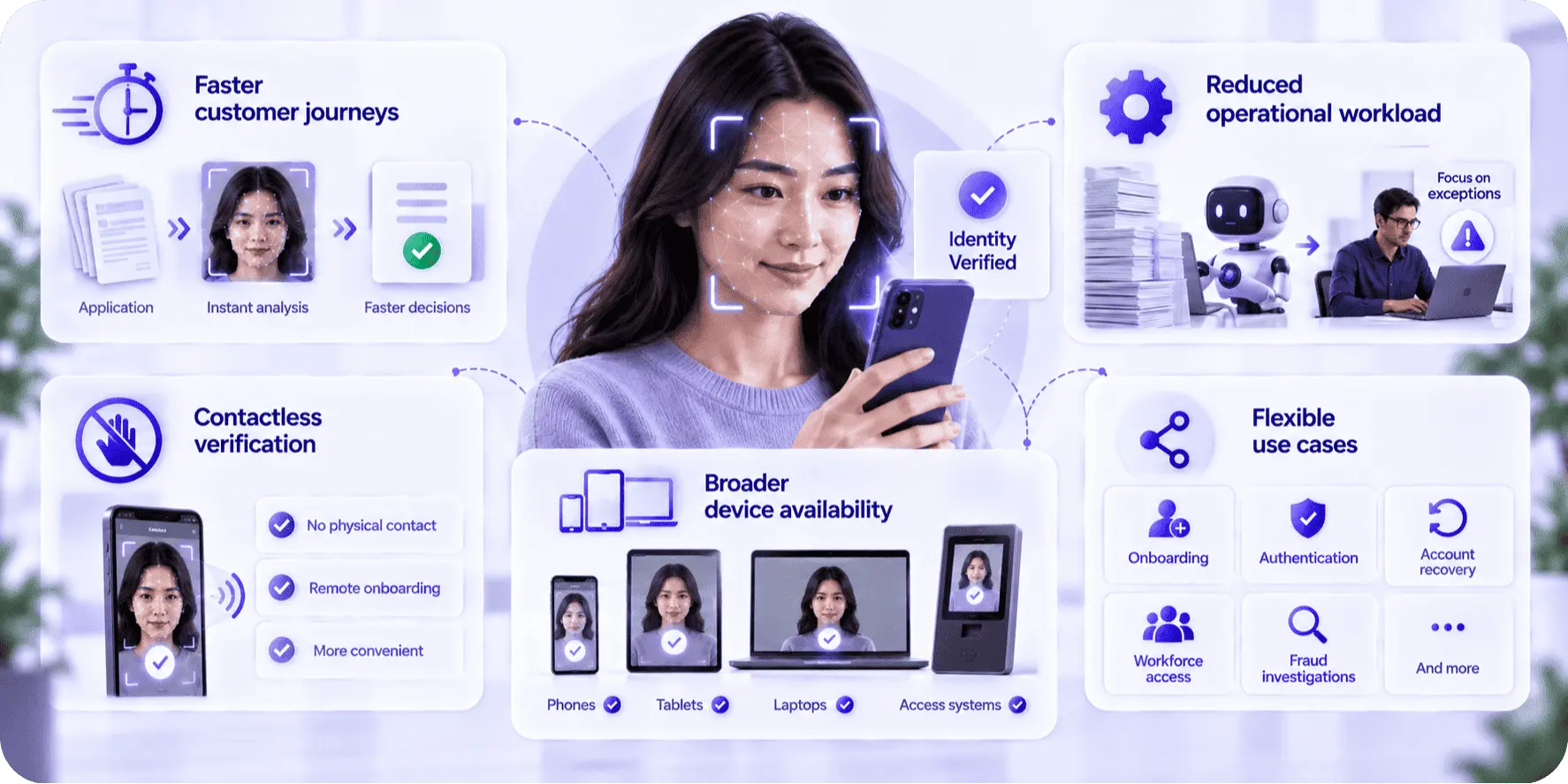
Faster customer journeys
Manual identity checks create queues, especially when application volumes grow. Automated facial analysis can process straightforward cases quickly and route uncertain cases to additional checks.
That can shorten decision times without requiring every applicant to go through the same level of manual review.
Reduced operational workload
Human reviewers are expensive and difficult to scale linearly with application volume.
AI can take on repetitive comparison and screening tasks while analysts focus on exceptions, high-risk applications, and cases where automated evidence is inconsistent.
Contactless verification
Unlike fingerprint readers, facial recognition generally requires only a camera. This is useful for remote onboarding and touch-free experiences.
Broader device availability
Because cameras are already built into phones, tablets, laptops, and many access systems, organizations may be able to deploy facial verification without distributing dedicated biometric readers.
Flexible use cases
The same underlying technology can support onboarding, authentication, account recovery, workforce access, fraud investigations, and other identity workflows, although each use case requires its own threshold and security design.
Accuracy Is More Complicated Than a Percentage
One of the easiest mistakes is to evaluate face recognition through a single headline figure.
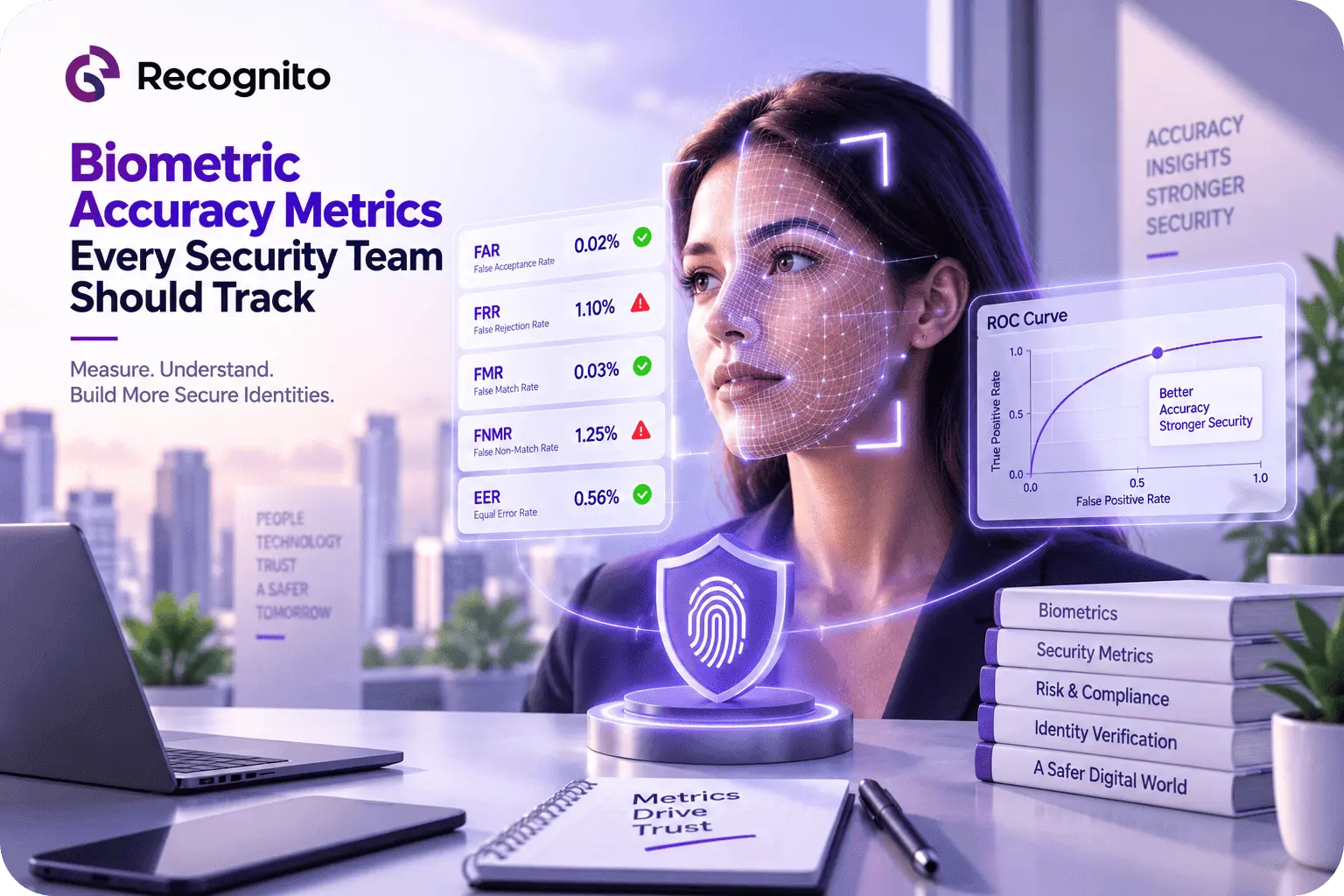
A claim such as “99.9% accurate” does not explain the operating conditions, dataset, demographic distribution, threshold, or trade-off between false matches and false non-matches.
NIST’s current FRTE 1:1 evaluation results report FNMR at specified FMR operating points. This is far more informative because it shows how the algorithm behaves at a defined security threshold.
Two error types are especially important:
False match: the system incorrectly decides that two different people are the same person.
False non-match: the system fails to recognize that two samples belong to the same person.
A stricter threshold may reduce false matches while increasing false non-matches. A more permissive threshold can improve legitimate-user acceptance but increase the chance of an incorrect match.
The appropriate balance depends on the consequences of each error.
A high-value financial transaction, for instance, may justify a stricter threshold than a low-risk convenience feature.
Image Quality Can Change the Outcome
AI models do not receive an abstract “face.” They receive a captured image.
Lighting, camera quality, motion blur, pose, focus, exposure, occlusion, and background conditions can all influence the quality of that input.
NIST’s FRTE demographic analysis specifically notes that false negatives are strongly affected by image quality and gives examples involving lighting and camera positioning.
That creates an important implementation lesson: improving performance may require more than changing the AI model.
A better capture experience can also help. Real-time framing guidance, image-quality checks, suitable retry handling, and clear instructions can reduce failures before matching even takes place.
Businesses evaluating deployments should therefore test the environment in which people will actually use the system rather than relying exclusively on laboratory results.
Demographic Performance and Fairness
Face recognition must also be evaluated across different demographic groups.
Performance can vary across age, sex, race, and other population characteristics, and environmental conditions can interact with those differences. The issue is therefore not just whether an average error rate is acceptable.
A responsible evaluation should examine:
- false-match differences
- false-non-match differences
- failure-to-capture rates
- performance under realistic lighting
- device and camera variation
- the actual population being served
Organizations should document these results and monitor them after deployment.
ISO’s biometric performance testing and reporting framework provides principles for measuring biometric performance, reporting error rates, and designing tests that reduce inappropriate bias and clarify the limits of test results.
The technology should be judged by evidence from the population and environment that matter to the actual business.
Face Recognition Is Not the Same as Liveness Detection
A facial matcher can determine that an image resembles a reference face. That does not necessarily mean the person is physically present.
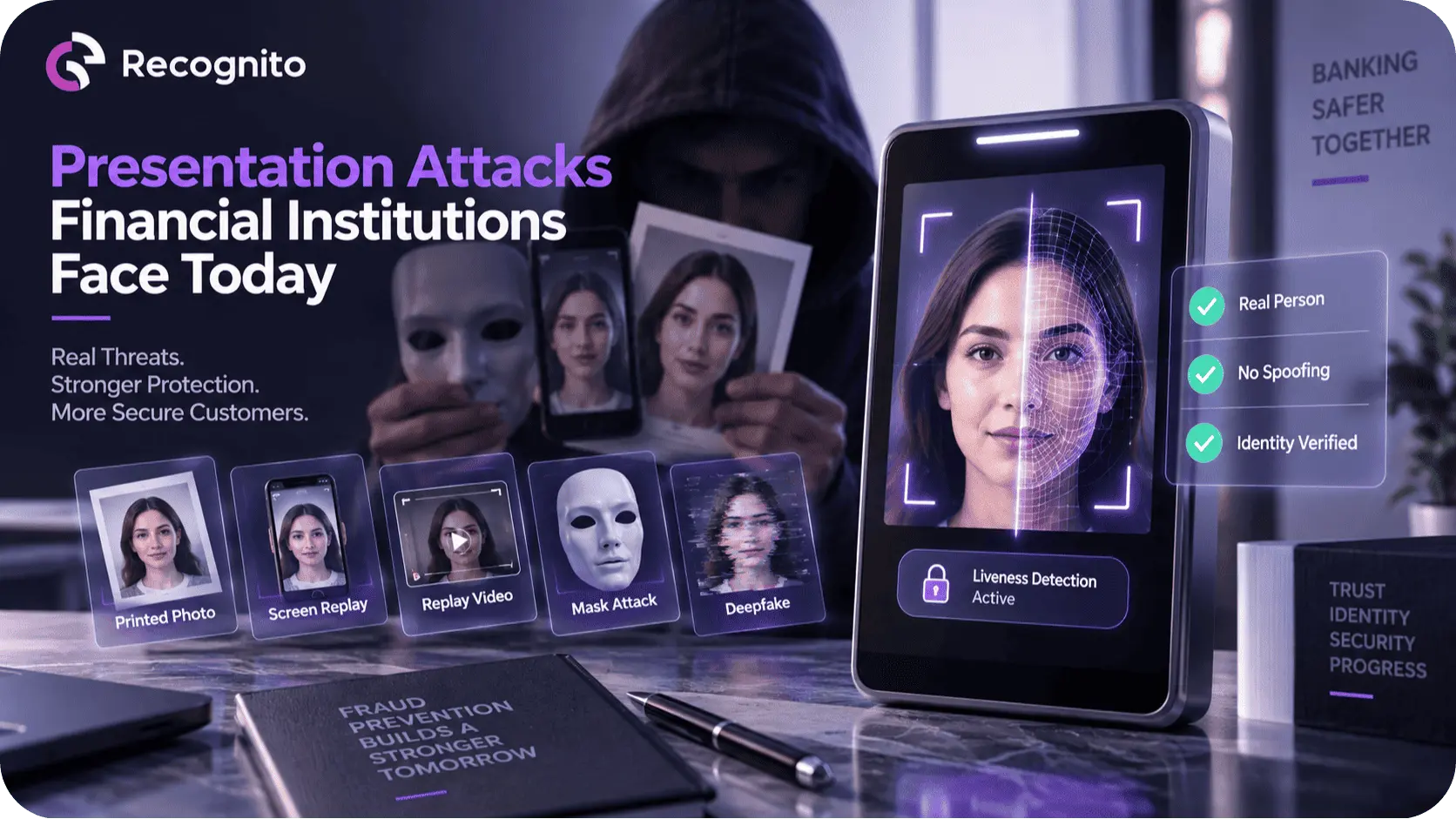
An attacker might present a photograph, replay video, use manipulated media, or attempt another presentation attack.
That is where liveness detection enters the architecture. It evaluates whether the captured biometric input is consistent with a live subject rather than a presentation artifact.
This distinction is critical for remote identity verification.
A stronger workflow may combine:
Identity document → document authenticity → face matching → face liveness → risk assessment
Each layer answers a different question.
FIDO’s Face Verification certification resources include testing requirements for biometric performance and face-verification systems, reinforcing the importance of evaluating matching, liveness, and other security characteristics together.
For organizations implementing this capability, a facial verification SDK can provide the biometric recognition component within a broader application workflow.
The Main Security Challenges
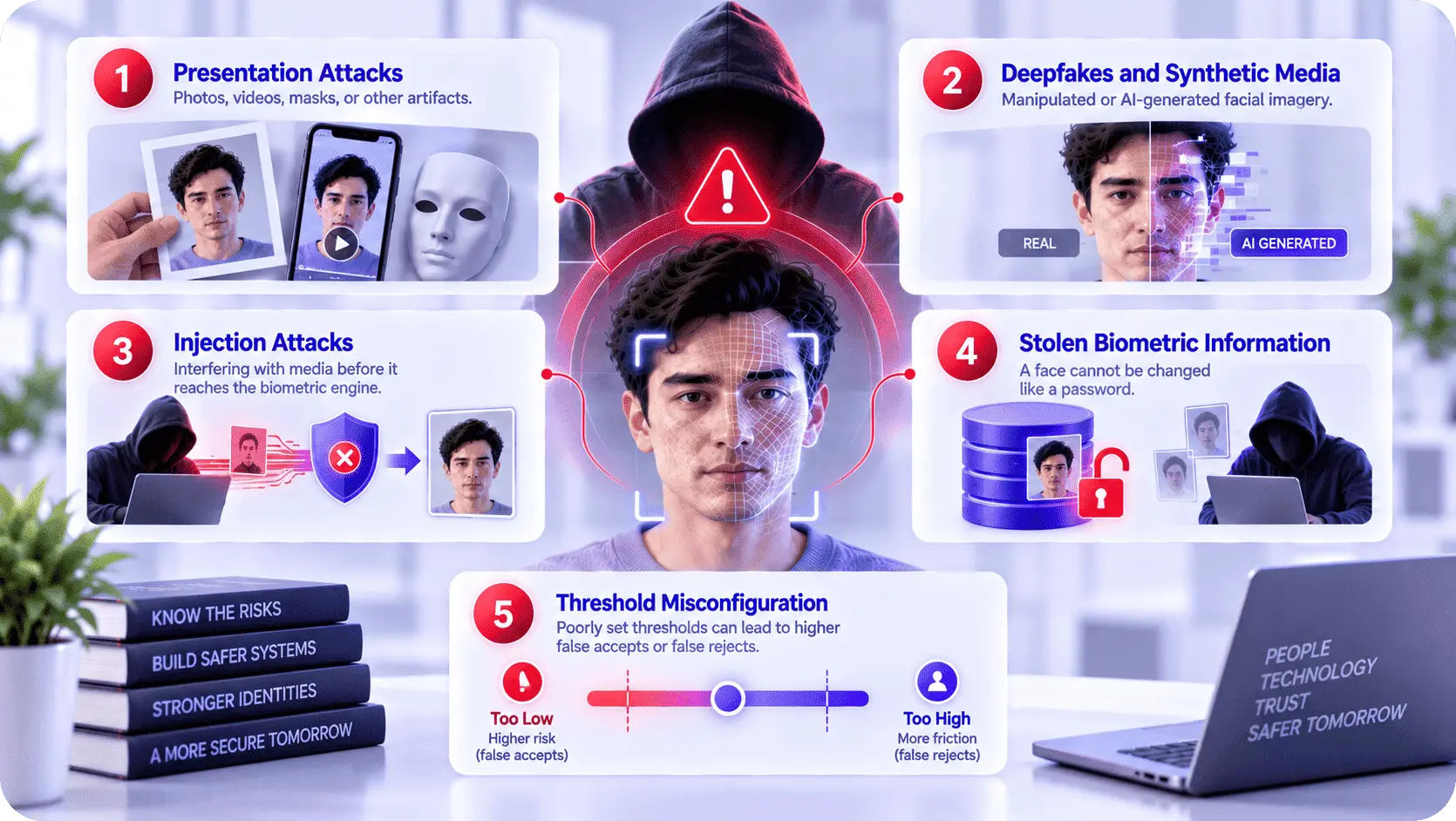
AI face recognition introduces meaningful security benefits, but it also creates attack surfaces that need to be managed.
Presentation attacks
Attackers may try to fool the camera with photographs, videos, masks, or other artifacts.
Deepfakes and synthetic media
Generative technology can make manipulated video and facial imagery more convincing. Systems need to consider whether the incoming media itself is trustworthy.
Injection attacks
In some architectures, attackers may attempt to interfere with media before it reaches the biometric engine. Protecting the capture and transmission path is therefore part of the security design.
Stolen biometric information
Unlike passwords, a person’s face cannot simply be replaced after exposure. Organizations must think carefully about how biometric templates and related data are protected.
Threshold misconfiguration
A model with excellent technical performance can still be poorly deployed if the acceptance threshold is set without understanding the business consequences of errors.
A useful broader reference for organizations examining the trade-offs is the advantages and disadvantages of facial recognition technology.
Privacy Is a Design Requirement
Face data is sensitive because it is closely connected to an identifiable individual.
Privacy risk depends on more than whether an organization stores a photograph. The full lifecycle matters:
- what data is captured
- whether raw images are retained
- whether templates are created
- where data is processed
- who can access it
- how long it is retained
- how deletion is handled
- whether data is shared with third parties
The Federal Trade Commission has highlighted privacy, security, and potential bias concerns associated with biometric information and biometric technologies in its policy statement on biometric information.
A sound implementation therefore starts with data governance, not after-the-fact compliance reviews.
Choosing an AI Face Recognition System
Businesses should evaluate the entire system rather than selecting a model based on marketing claims.
| Evaluation area | Key question | Why it matters |
| Recognition accuracy | How does performance change at relevant operating points? | Determines security and user-friction trade-offs |
| Image quality | How does the system handle poor capture conditions? | Reduces legitimate-user failures |
| Demographic performance | Are error rates consistent across relevant populations? | Supports fairness and risk management |
| Liveness | How well does it resist presentation attacks? | Helps protect remote verification |
| Integration | Can the system work reliably on target platforms? | Affects deployment cost and stability |
| Latency | How quickly does verification complete? | Influences user experience and infrastructure |
| Privacy | What biometric data is collected and retained? | Reduces governance and compliance risk |
| Monitoring | Can production performance be measured continuously? | Detects degradation and emerging problems |
For development teams, the practical evaluation should include successful captures as well as failure cases, API errors, poor connectivity, permission problems, camera differences, and recovery flows.
Where hands-on testing is useful, a face biometric playground can complement documentation-based assessment before an organization commits to an integration.
AI Governance Should Continue After Launch
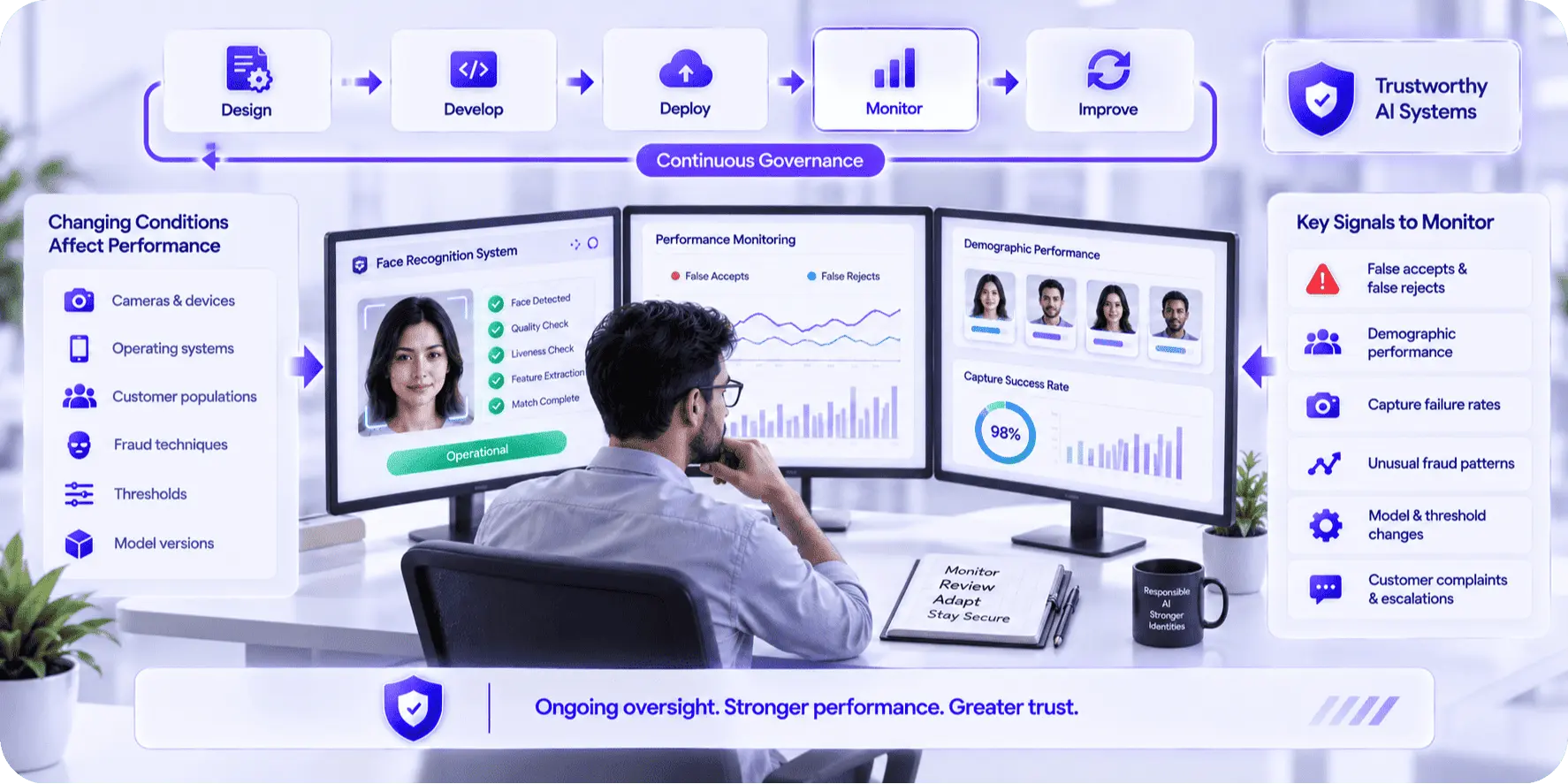
Model evaluation should not end when the product reaches production.
Changes in cameras, operating systems, customer populations, fraud techniques, thresholds, or model versions can affect performance.
NIST’s AI Risk Management Framework encourages organizations to incorporate trustworthiness considerations throughout the design, development, deployment, and evaluation of AI systems.
For a face recognition deployment, that can mean monitoring:
- false acceptance and false rejection trends
- demographic performance
- capture failure rates
- unusual fraud patterns
- model and threshold changes
- customer complaints and escalation outcomes
A system that performs well during procurement can still deteriorate operationally if these signals are ignored.
For technical teams building or evaluating implementations, the Recognito GitHub repository can provide additional developer resources alongside formal testing and product documentation.
Where AI Face Recognition Makes the Most Sense
The best applications are those where facial evidence solves a clear identity problem.
Digital onboarding: Match the customer with an identity document and add liveness to the workflow.
Account recovery: Re-establish confidence in a user’s identity when traditional credentials are unavailable.
Authentication: Provide biometric access to systems or applications where the threat model supports it.
Fraud prevention: Add a biometric signal to workflows handling impersonation and account abuse.
Workforce access: Support controlled entry or authentication where cameras and privacy controls are appropriate.
Travel and customer processing: Enable contactless identity flows where facial capture is operationally practical.
The technology should not be added simply because it is available. The business case is strongest when the biometric signal solves a measurable problem that existing controls handle poorly.
A Practical Implementation Strategy
A successful deployment should begin with a narrowly defined use case.
First, determine exactly what the system needs to establish. Then define acceptable false-match and false-non-match levels, identify relevant populations and environments, and decide what happens when confidence is insufficient.
Next, test the system against realistic devices and conditions.
Security testing should include presentation attacks and relevant media-manipulation scenarios. Privacy teams should review data flows, retention, access controls, and third-party processing.
Finally, establish production monitoring before launch. The organization should know what success looks like and have a process for investigating unexpected outcomes.
That approach turns face recognition from a standalone AI feature into a managed identity capability.
Conclusion
AI face recognition can deliver substantial value when it is used for a clearly defined identity problem and deployed with realistic expectations.
Its strengths include remote verification, contactless interaction, automation, and the ability to add biometric evidence to digital identity workflows. Its challenges include image quality, demographic variation, spoofing, deepfakes, privacy, threshold selection, and the difficulty of translating benchmark performance into real-world outcomes.
The strongest deployments treat facial recognition as one layer of a broader security architecture. Matching, liveness, document verification, fraud analysis, governance, and human escalation each have distinct roles.
For organizations building secure biometric workflows, Recognito provides technology that can support practical facial verification and identity applications.
Frequently Asked Questions
What is AI face recognition?
AI face recognition uses machine-learning models to detect faces, extract distinguishing facial characteristics, and compare them with reference identities for verification or identification.
Is AI face recognition the same as facial detection?
No. Face detection identifies where a face appears in an image or video. Face recognition goes further by generating and comparing biometric representations to determine whether the face corresponds to a particular identity.
Can facial recognition prevent deepfake attacks?
Not by itself. Deepfakes and other manipulated media require additional detection and capture-security controls. Face matching should be combined with liveness and other anti-fraud measures where the threat model requires them.
How accurate is AI face recognition?
There is no single accuracy number that applies to every system. Performance depends on the algorithm, threshold, image quality, population, camera environment, and whether the task is 1:1 verification or 1:N identification.
Is AI face recognition safe for businesses to use?
It can be, provided the deployment includes appropriate security, privacy, performance testing, governance, and access controls. The organization should evaluate the complete system and its operating environment rather than relying on a vendor’s headline accuracy claim.