
Face recognition has moved from a specialized computer-vision capability to a practical identity technology used across banking, airports, access control, smartphones, border processing, workplace systems, and digital onboarding. Yet deploying it successfully involves much more than choosing a model with a high accuracy score.
A production face recognition system has to capture usable images, detect and normalize faces, generate biometric representations, compare them under a defined threshold, handle poor conditions, resist presentation attacks, protect biometric data, and produce decisions that make sense for the business workflow.
The strongest implementation is the one that maintains appropriate security, usability, privacy, and reliability in real operating conditions.
How a Face Recognition System Works
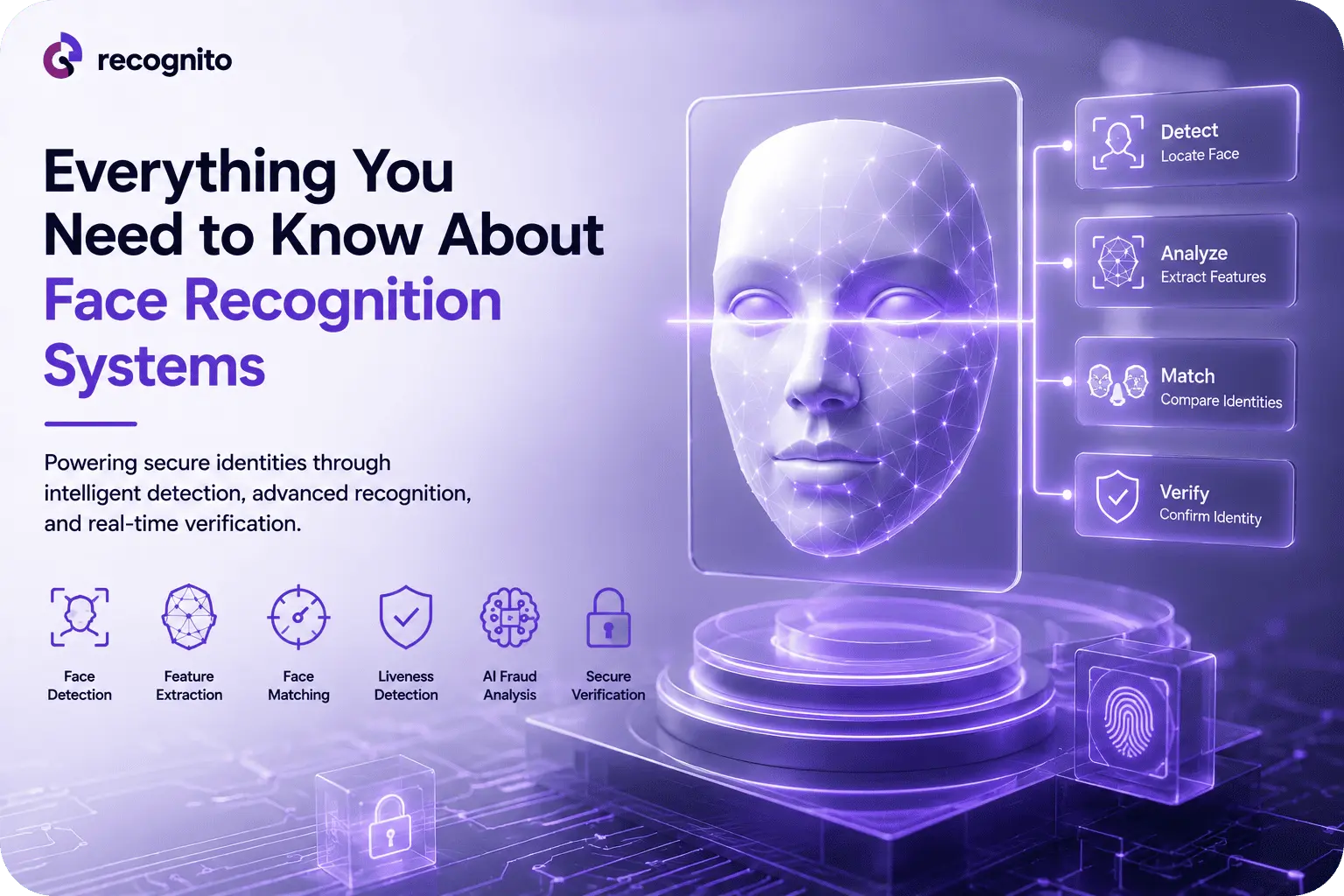
At a high level, a face recognition system turns a facial image into a representation that can be compared with another representation.
The process usually contains several stages.
Capture: A camera collects an image or video frame. Blur, poor lighting, extreme pose, occlusion, and low resolution can affect everything that follows.
Face detection: Computer vision locates the face. Detection is different from recognition: it finds the face, while recognition determines whether it corresponds to a known identity.
Preprocessing and alignment: The system may normalize orientation, crop the face, and prepare it for analysis.
Feature extraction: A neural network converts the image into a numerical representation, often called an embedding.
Matching: The system compares embeddings and produces a similarity score. A threshold determines whether the score is sufficient.
Decision: The result enters the business workflow, which may approve, reject, request another capture, or trigger additional verification.
A strong matcher cannot compensate for poor capture, weak thresholds, or insecure enrollment.
Verification and Identification Are Not the Same
One of the most important distinctions in face recognition is whether the system performs 1:1 verification or 1:N identification.
1:1 verification
The system compares a presented face against one known reference.
For example, a customer may claim an identity during account recovery, and the system checks whether the live face matches the enrolled reference associated with that account.
NIST’s current Face Recognition Technology Evaluation 1:1 results report measures such as false match and false non-match rates at specified operating points.
1:N identification
The system searches a gallery containing multiple identities.
The question changes from “Does this person match the claimed identity?” to “Which identity, if any, corresponds to this face?”
NIST’s FRTE 1:N identification evaluation uses measures such as false negative identification rate and false positive identification rate to characterize search performance.
The difference affects the security model, performance requirements, threshold selection, and consequences of errors. A business should establish which scenario it actually needs before comparing vendors.
That distinction also determines where the technology fits operationally, from remote onboarding to controlled access and identity search. Face recognition systems explained with real examples offers practical context across these environments.
What Determines Face Recognition Accuracy?
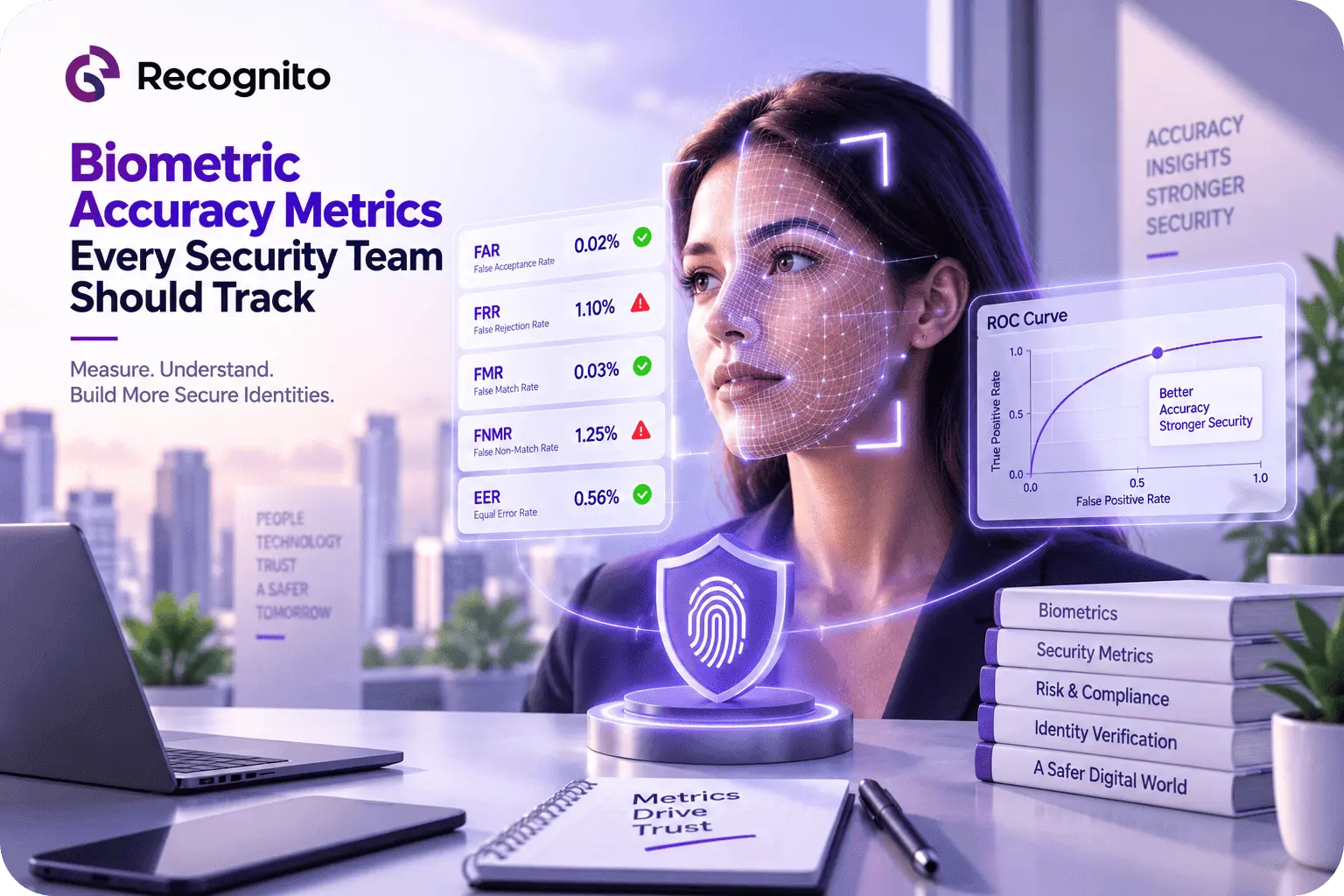
“Accuracy” is not one number.
Face recognition performance depends on the quality of the input, the population being tested, the algorithm, the matching threshold, and the conditions under which the comparison takes place.
Image quality
Lighting, exposure, blur, resolution, camera position, and compression influence biometric quality. NIST notes that false negatives are strongly dependent on image quality and that poor photography can contribute to demographic differences.
Pose and reference quality
Large pose changes and partial occlusion can reduce useful information. An excellent algorithm also needs a strong enrollment image because every later comparison depends on that reference.
Threshold selection
A stricter threshold can reduce incorrect matches but reject more legitimate users. A looser threshold can improve convenience while increasing false-match risk.
Demographic performance
Performance should be examined across relevant demographic groups rather than only as an overall average. NIST publishes face recognition demographic performance information covering demographic differentials and the role of image quality.
For a broader practical view, face recognition accuracy factors covers environmental and technical conditions that affect results.
Why Liveness Detection Matters
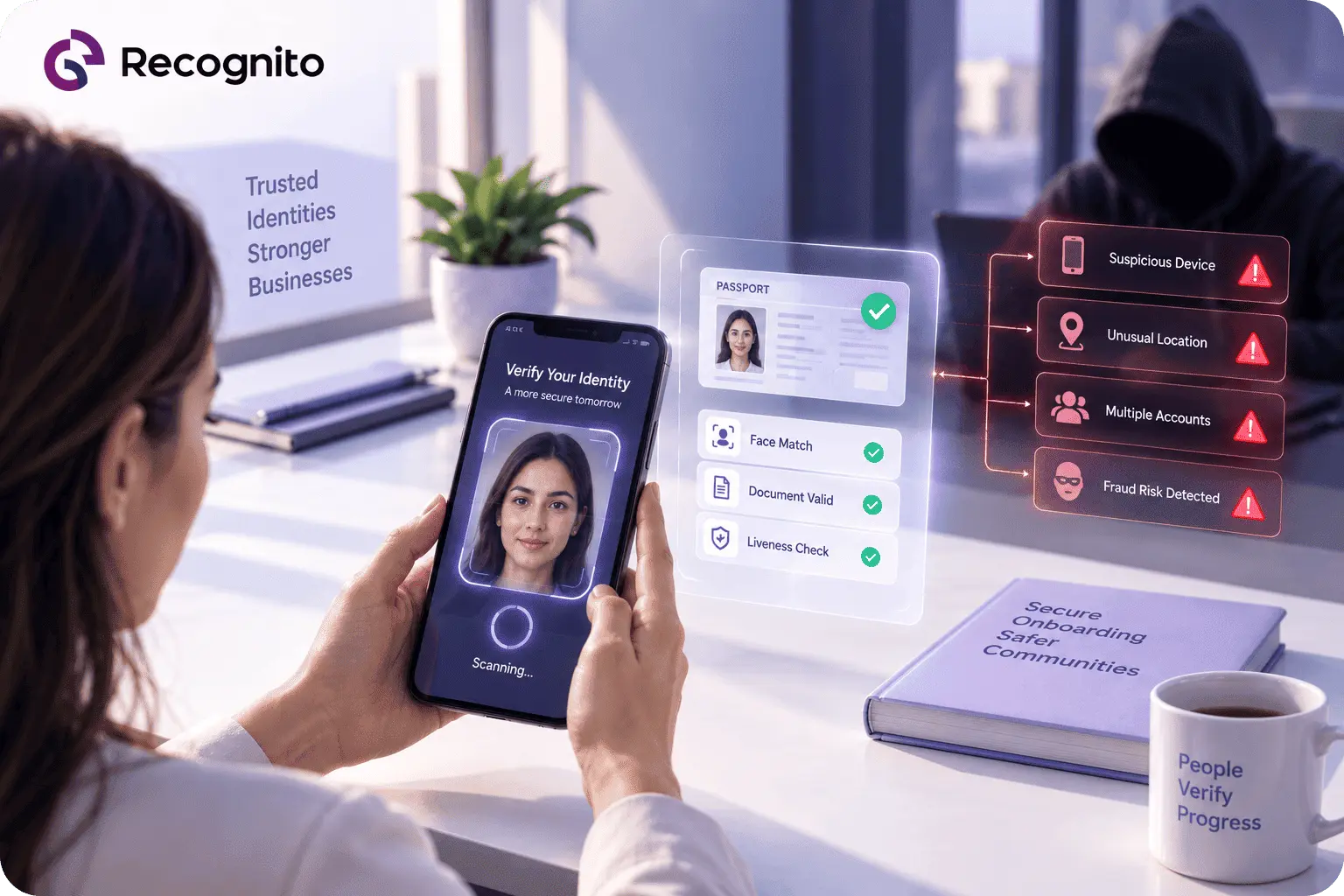
A face match shows that biometric samples are sufficiently similar; it does not automatically prove that the person is physically present.
In remote workflows, an attacker may present a photograph, replay a video, use a mask, or manipulate the media stream.
Liveness detection, also called presentation attack detection in many contexts, adds another layer by evaluating whether the biometric input appears to originate from a live person.
FIDO’s Face Verification Certification treats face matching, liveness, security, equity, and performance as related elements when evaluating remote face-verification solutions.
For implementation teams, the distinction between recognition and liveness should be reflected in the architecture rather than hidden behind one generic “face verification” result. A useful companion resource is the discussion of how face recognition liveness detection works.
Security Risks Around Face Recognition
Face recognition systems face threats at multiple stages.
Presentation attacks use photographs, displays, masks, or replayed media to fool capture.
Injection attacks attempt to alter or replace biometric data before it reaches the recognition engine.
Enrollment attacks target the creation of the biometric reference. If the wrong person is enrolled, later recognition can work perfectly while binding the wrong identity.
Account takeover becomes more serious when face recognition is used for recovery or authentication without adequate device, session, and risk controls.
Infrastructure compromise can expose templates, APIs, or decision systems.
Biometric security therefore needs defense in depth: secure enrollment, attack detection, protected communications, access controls, monitoring, rate limits, and fallback methods.
Organizations using face as an authentication factor should also consider how biometrics fit alongside passwords, device-bound credentials, and other controls; see biometric authentication vs traditional authentication for that broader comparison.
How to Evaluate a Face Recognition System
A vendor demonstration can show that a system works, but not that it will perform reliably for your users.
A strong evaluation should examine:
| Evaluation area | What to test | Why it matters |
| Recognition performance | FMR, FNMR, or relevant search metrics | Shows the security and usability trade-off |
| Capture quality | Lighting, pose, blur, cameras, distance | Reveals real-world failure conditions |
| Demographic behavior | Performance across relevant groups | Identifies potential disparities |
| Liveness | Presentation and relevant injection attacks | Tests resistance beyond face matching |
| Enrollment | Reference-image quality and enrollment controls | Prevents weak identity binding |
| Integration | SDK/API behavior, latency, failures | Determines operational reliability |
| Privacy | Storage, retention, access, deletion | Reduces data-governance risk |
| Operations | Monitoring, retries, fallback, review | Determines how the system behaves after deployment |
Independent standards can also help structure testing. ISO/IEC 19795-1:2021 establishes principles for biometric performance testing and reporting, including error rates, throughput, test-data recording, and protocols intended to improve the quality and interpretability of performance testing.
Compare systems at equivalent operating points and under conditions that resemble production.
Choosing the Right Integration Model
An API-first service may suit a centralized backend. An SDK is often more useful when camera capture, real-time processing, or user guidance must happen inside a mobile or web application.
For teams building biometric functionality into their own products, a facial biometric SDK can provide the development layer without requiring the entire computer-vision pipeline to be built internally.
Evaluate supported platforms, latency, data handling, API reliability, documentation, error handling, update procedures, and cost.
For teams wanting a hands-on look at biometric capabilities before deeper integration, the face biometric playground can be useful for exploration.
Implementation Mistakes to Avoid
Many failures are architectural rather than algorithmic. Avoid enrolling poor reference images, treating every failed match as fraud, ignoring threshold trade-offs, or testing only ideal conditions. Remote workflows also need liveness where the threat model requires it. Most importantly, secure the enrollment stage: if the wrong person is bound to a biometric reference, later recognition may work perfectly while identifying the wrong identity.
What a Production-Ready System Should Include
A robust architecture usually combines several layers:
Capture and quality control ensure usable biometric input.
Face detection and recognition establish the biometric comparison.
Liveness and attack detection address attempts to present artificial or manipulated input.
Identity binding connects the biometric to a trusted enrollment event.
Risk orchestration combines biometric results with other account or transaction signals.
Security controls protect APIs, sessions, templates, credentials, and infrastructure.
Monitoring and review detect drift, unusual failure patterns, and emerging attacks.
Fallback mechanisms provide controlled alternatives when biometric verification cannot establish sufficient confidence.
This layered structure is what turns a face recognition model into a business-grade identity system.
What NIST and Independent Evaluation Mean for Buyers
Independent evaluations are useful because they make algorithm performance easier to compare under consistent procedures.
NIST’s FRTE program evaluates submitted face recognition algorithms in defined scenarios, while ISO provides a broader framework for biometric performance testing. Neither should be interpreted as proof that a particular deployment is automatically secure, private, usable, or compliant.
Buyers should therefore combine benchmark evidence with application-specific testing.
Ask whether the evaluated algorithm is the same version used in production. Examine the operating point rather than only the headline accuracy. Test representative users and devices. Review liveness and attack defenses separately. Validate the enrollment process and understand the complete data lifecycle.
The Future of Face Recognition Systems
The direction of face recognition is less about replacing every other identity mechanism and more about making biometric verification one component of adaptive identity infrastructure.
Remote onboarding may combine document analysis, facial comparison, liveness, device intelligence, fraud signals, and risk scoring. Authentication may combine a device-bound credential with biometric unlocking. Access systems may use face recognition alongside physical credentials or other controls.
The trend favors systems that understand context.
A low-risk event may require a lightweight check. A high-risk account recovery or transaction may require stronger evidence. This adaptive model can improve security without imposing maximum friction on every user.
FIDO’s certification work reflects this direction by evaluating face-verification systems for accuracy, liveness, bias, and security characteristics.
For technical teams, the Recognito GitHub repository provides additional developer-oriented resources for exploring biometric implementation.
Conclusion
A face recognition system is not simply a camera and an AI model. It is a complete biometric pipeline that must connect high-quality capture, face detection, recognition, thresholding, liveness, identity binding, security, privacy, and operational decision-making.
The right evaluation therefore goes beyond accuracy. Businesses should measure performance under realistic conditions, understand false-match and false-non-match trade-offs, test relevant attack scenarios, examine demographic behavior, secure enrollment, and define what happens when the system is uncertain.
Used appropriately, face recognition can provide a practical way to strengthen identity verification, authentication, and access workflows. Used without careful architecture and governance, the same technology can introduce new security, privacy, and operational risks.
For organizations building secure biometric identity workflows, Recognito provides technology that can fit into a broader facial verification and identity architecture.
Frequently Asked Questions
What is the difference between face detection and face recognition?
Face detection locates a face in an image or video. Face recognition creates a biometric representation and compares it with one or more references to verify or identify an individual.
Is face recognition accurate enough for business use?
It can be, but accuracy depends on the algorithm, threshold, image quality, population, devices, and environment. Production testing is necessary because benchmark performance does not automatically predict every deployment.
Does face recognition need liveness detection?
Not every application requires the same controls. Remote identity verification and other high-risk scenarios may need liveness or presentation-attack detection because facial similarity alone does not establish that a live person is present.
Is face recognition secure?
Security depends on the full architecture. Strong recognition should be supported by secure enrollment, liveness, protected data, access controls, monitoring, attack detection, and appropriate fallback mechanisms.
What should a business evaluate before deploying face recognition?
Evaluate recognition performance, capture conditions, demographic behavior, liveness, enrollment security, integration, privacy, operational reliability, monitoring, and the consequences of false matches and false rejections.