

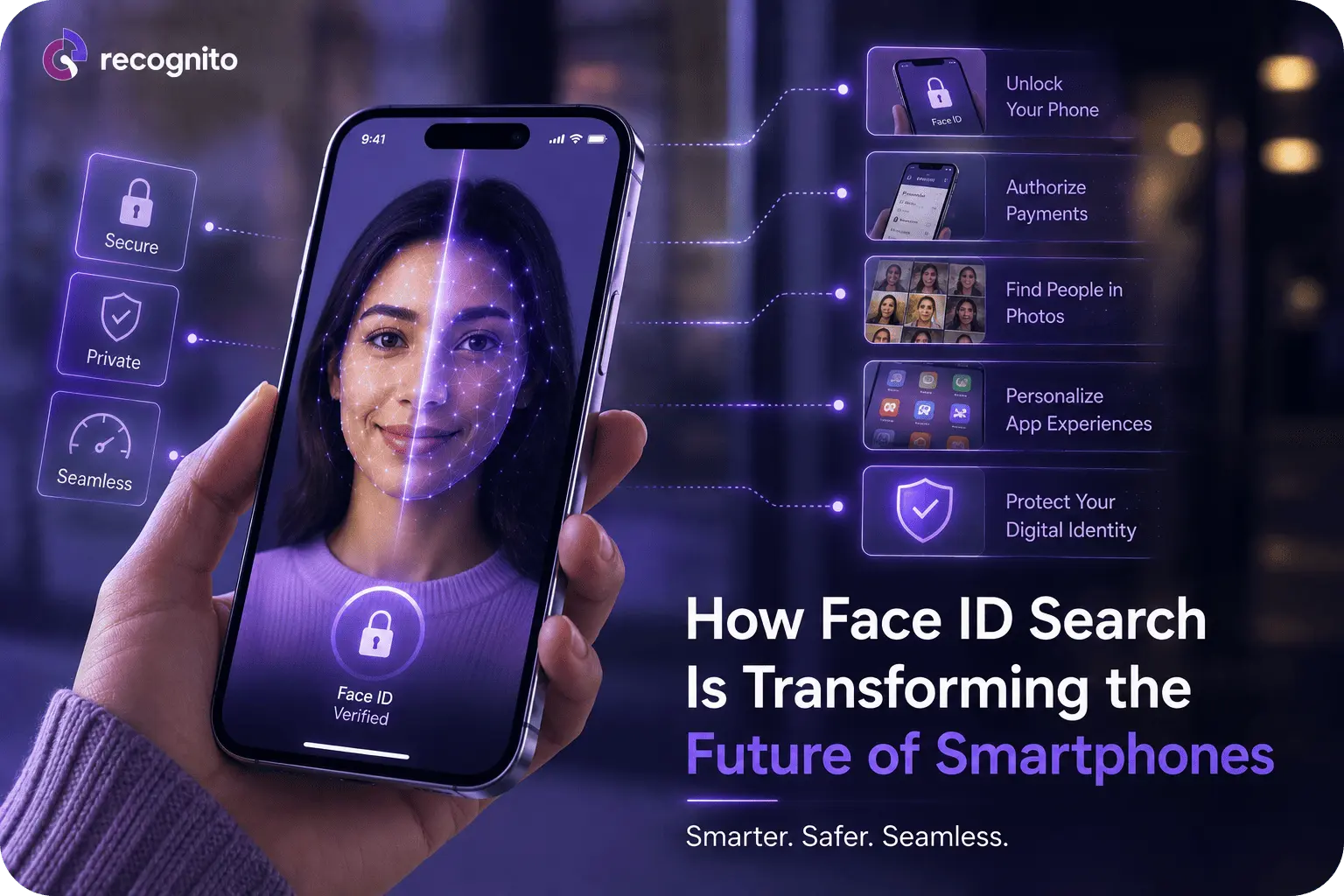
Smartphones have already moved beyond passwords and PINs for many everyday interactions. A glance can unlock a device, authorize a payment, or confirm access to an application. The next stage is broader: facial recognition is becoming a way for smartphones to understand who is using the device, what interaction is taking place, and what action should happen next.
That is where face ID search becomes more interesting.
Unlike simple face unlock, which answers whether the person holding the phone matches an enrolled user, face search can involve locating or matching a face against a collection of known identities or references. Combined with on-device AI, cameras, secure processing, and increasingly sophisticated biometric models, this capability could change how people find information, authenticate themselves, interact with applications, and perform identity-sensitive tasks.
The future is not necessarily about replacing every smartphone interaction with a face scan. It is about making facial identity one of the underlying interfaces through which smartphones understand and secure access to digital experiences.
From Face Unlock to Face-Based Search
The original smartphone value proposition for facial recognition was simple: look at the device and unlock it.
Modern systems are already more sophisticated than basic 2D image comparison. Apple’s Face ID, for example, uses a TrueDepth camera system to capture depth information and an infrared image, while facial matching is performed through processing protected by the Secure Enclave. Apple says enrolled Face ID data remains on the device rather than being backed up to iCloud. Apple’s current Face ID privacy documentation explains how that architecture is designed to protect biometric information.
Face-based search expands the concept.
Instead of asking only, “Is this the owner?”, a smartphone could potentially ask:
- Does this face correspond to someone in my trusted contacts?
- Is this the person associated with this digital identity?
- Have I encountered this person in a permitted photo collection?
- Which account, profile, or personalized experience belongs to this user?
- Should this particular application expose information to this person?
The technical difference is important. Authentication usually involves 1:1 verification, while identification or search can involve 1:N matching, where one facial input is compared against multiple enrolled identities.
NIST’s current FRTE 1:N evaluation measures identification performance using metrics including false negative identification rate and false positive identification rate. That distinction becomes increasingly relevant as smartphones move from simply authenticating owners toward more sophisticated identity-driven search experiences.
Why Smartphones Are Well Positioned for Face Search
Smartphones already contain the components needed for increasingly advanced facial experiences.
They have high-resolution cameras, dedicated processing hardware, machine-learning capabilities, secure storage, location and contextual signals, and increasingly sophisticated operating-system security.
More importantly, smartphones are always with the user.
That combination creates opportunities beyond traditional biometric authentication. A phone could use facial identity to connect a person with photos, applications, services, accounts, or context without requiring the user to type a name or remember where information was stored.
This does not necessarily mean a smartphone should continuously identify everyone around it. Privacy, consent, computational cost, and misuse risks make unrestricted recognition inappropriate for many scenarios.
Instead, the more realistic direction is permission-based, user-controlled facial search, especially for tasks where the person has a legitimate relationship with the information being accessed.
For a broader explanation of how facial identity search works and where it can be applied, how face identity search works provides a useful foundation.
The Rise of On-Device Facial Intelligence
One of the most important trends is the movement toward processing more biometric information locally.
On-device processing can reduce the need to send sensitive facial information to remote servers. Apple states that Face ID mathematical representations are encrypted and protected by the Secure Enclave, while Google’s Pixel documentation similarly says its Face Unlock face model is stored securely on the device and does not leave it. Google’s Pixel Face Unlock documentation also notes that face models may qualify as biometric data in some jurisdictions.
This architecture matters for future face search.
A local system can potentially perform some matching without exposing a user’s facial data to a centralized database. That can reduce certain privacy risks and improve responsiveness.
It can also make facial features part of the smartphone’s operating system rather than an external cloud service.
However, local processing does not eliminate privacy concerns. A biometric model remains sensitive information, and the system still needs secure enrollment, access controls, deletion mechanisms, transparent permissions, and protection against unauthorized extraction.
Personalization Could Become Identity-Aware
Facial recognition could eventually become a personalization mechanism rather than merely a security mechanism.
Imagine a shared tablet that recognizes an authorized household member and automatically presents the correct profile. A family device could distinguish between users while preserving separate application environments. A corporate smartphone might adapt access privileges according to the authenticated employee.
The underlying principle is simple: identity becomes context.
Today, users often establish identity through passwords, app accounts, or manually selected profiles. Face recognition could reduce those explicit steps for selected experiences.
The potential benefits include smoother access, fewer forgotten credentials, and more personalized interfaces.
But the system should not silently infer identity everywhere. The value of facial personalization depends on giving users clear control over when recognition occurs and what information recognition can unlock.
Face Search Could Change Mobile Photography
One of the most visible opportunities is photo management.
Smartphones already use machine learning to organize photos by faces, objects, locations, and scenes. More sophisticated face search could make personal photo libraries easier to navigate by connecting recognized identities with contacts, events, messages, or albums.
Instead of manually searching through filenames or scrolling through thousands of images, a user could search based on a person.
That sounds simple, but large-scale facial indexing introduces difficult questions. Who was indexed? Was recognition performed locally? Can a user correct an incorrect match? What happens when a person requests that information be removed?
These questions become more significant as facial search becomes more deeply integrated into the operating system.
Payments and Sensitive Actions
Facial authentication is already used to authorize sensitive smartphone actions.
Apple documents Face ID support for device unlocking, app authentication, and Apple Pay authorization. Its security documentation explains that the biometric comparison occurs within protected device hardware and that the system uses depth and infrared information to resist certain physical and digital spoofing techniques. Apple’s Face ID security guide provides additional technical detail about that architecture.
The next evolution is likely to be less visible.
Instead of asking the user to enter credentials every time a sensitive action occurs, the smartphone could use an authenticated facial state to authorize selected actions during a session.
That could make payments, account access, password management, and identity-sensitive applications feel almost invisible to the user.
The security challenge is ensuring convenience does not weaken authorization. A face match must be treated as one part of a carefully designed authentication system, with fallback methods and appropriate controls for high-risk actions.
Face Recognition Could Become a Mobile Identity Layer
The biggest long-term shift may be the role of the smartphone itself.
Rather than thinking of a phone as a device that stores digital credentials, it may increasingly function as an identity platform.
The user enrolls a trusted biometric representation. Applications receive an authentication result rather than directly accessing the person’s biometric information. Secure hardware helps protect the underlying representation.
That model can create an important separation: applications do not necessarily need to know what the user’s face looks like. They may only need confirmation that the device has successfully authenticated the enrolled user.
This approach can reduce unnecessary biometric exposure while still enabling face-based experiences.
For developers evaluating where facial recognition fits into mobile products, face recognition system fundamentals provides broader context on recognition workflows and system components.
The Biggest Challenge: Security
The convenience of face search naturally attracts attackers.
A smartphone implementation must consider photographs, replay attacks, manipulated media, presentation attacks, compromised applications, unauthorized enrollment, and attempts to inject biometric data directly into the processing pipeline.
NIST’s current digital identity guidance treats biometrics as sensitive authentication technology and requires presentation-attack detection for facial recognition in the contexts covered by the guideline. It also emphasizes that biometric characteristics are not secrets because faces can often be observed or acquired without the user’s cooperation. NIST’s authentication and authenticator guidance explains these security considerations.
FIDO takes a similar layered approach. Its Face Verification Certification program evaluates biometric matching alongside liveness, deepfake, injection, usability, and demographic considerations.
The lesson for smartphone manufacturers and developers is straightforward: facial recognition should never be treated as simply a camera feature. The surrounding security architecture determines whether the biometric becomes a useful protection mechanism or a new attack surface.
Accuracy Will Remain a Moving Target
Face recognition systems have improved substantially, but real-world performance still depends on the conditions under which recognition occurs.
Lighting, camera position, facial pose, aging, occlusion, image quality, and population characteristics can all influence performance.
NIST’s FRTE program continuously evaluates face recognition algorithms under defined conditions, including separate 1:1 and 1:N evaluations. That makes current benchmark results useful for understanding algorithmic performance, but smartphone manufacturers still need to validate the complete system in the environments where users actually operate it.
This becomes especially important for face search because 1:N systems introduce a different error model from simple device authentication.
A false match in a photo-search application may produce an incorrect organization of images. A false match in an access-control or financial workflow could have much more serious consequences.
The acceptable error level therefore depends heavily on the use case.
Privacy Could Decide How Far Face Search Goes
Technology alone will not determine the future of facial search. User trust will matter just as much.
A face is persistent. Unlike a password, it cannot simply be replaced after exposure. That makes unnecessary centralization of facial data particularly sensitive.
Future smartphone systems will need clear answers to questions such as:
- Where is facial data processed?
- Is a template stored locally or remotely?
- Which applications can request recognition?
- Can users disable specific facial features?
- How long is biometric information retained?
- Can users delete their biometric profile?
- Is recognition performed only with explicit consent?
Privacy-by-design will be especially important if face search moves beyond device unlocking into shared environments, personal photo libraries, commerce, and digital identity.
Business Opportunities for Smartphone and App Developers
As facial identity becomes more accessible through device hardware and software, developers can build experiences around authenticated identity rather than repeated credential entry.
Potential applications include:
| Smartphone use case | Role of facial recognition | Main consideration |
| Device authentication | Confirm the enrolled owner | Spoof resistance |
| Payments | Authorize sensitive transactions | Strong authentication controls |
| Photo search | Locate images associated with a person | Privacy and user control |
| Personalization | Load an authorized profile | Consent and context |
| Account recovery | Re-establish identity | Liveness and identity proofing |
| Mobile identity verification | Match a user with trusted identity evidence | Accuracy and fraud prevention |
| Access to sensitive apps | Confirm the authorized user | Secure fallback mechanisms |
For developers integrating facial capabilities into their own applications, a facial biometric SDK can provide the underlying recognition technology without requiring teams to build the biometric engine from scratch.
The important distinction is between adding face recognition as a feature and designing a trustworthy identity workflow around it.
The Future Will Be Contextual, Not Constant
The most realistic future for face ID search is not a smartphone continuously identifying everyone around the user.
That model creates obvious privacy and surveillance concerns.
A more sustainable model is contextual recognition.
The phone recognizes the user when authentication is needed, searches a private photo library when the user requests it, verifies identity when an application requires it, or enables a personalized experience where the user has explicitly authorized the feature.
In this model, facial recognition becomes part of the smartphone’s secure interaction layer rather than an always-on identification system.
That distinction could determine whether consumers view face search as useful infrastructure or invasive surveillance technology.
What the Next Generation of Smartphones Could Look Like
The long-term transformation may happen quietly.
Users may stop thinking about facial recognition as a standalone feature and instead experience it as part of everyday interactions:
A glance authenticates an account.
A face search finds a person in a personal photo library.
A verified identity unlocks a financial action.
A trusted biometric state enables a personalized application environment.
A live facial check supports remote identity verification.
These capabilities will likely remain connected to secure hardware, machine learning, privacy controls, and risk-based authentication rather than operating as independent features.
For companies building mobile identity experiences, the opportunity is therefore broader than face unlock. It is the creation of identity-aware applications that can use biometrics without unnecessarily exposing biometric data.
Conclusion
Face ID search is evolving from a convenient way to unlock smartphones into a broader concept of mobile identity.
The technology could influence authentication, payments, personalization, photo organization, account recovery, and remote identity verification. But its future will depend on solving more than recognition accuracy. Secure hardware, liveness detection, presentation-attack resistance, privacy, consent, error management, and user control will all determine how broadly these capabilities are adopted.
The strongest smartphone experiences will make facial recognition feel simple on the surface while keeping complex security and privacy protections underneath.
For developers building facial identity experiences across mobile applications, Recognito provides biometric technology that can support practical, privacy-conscious verification and recognition workflows.
Frequently Asked Questions
Is face ID search the same as Face ID?
Not exactly. Face ID is Apple’s biometric authentication system, while face ID search is a broader concept covering facial identification and search capabilities that can match a face against stored identities or references.
Can facial recognition work without storing a face image?
Yes. Some systems store a mathematical representation or biometric template rather than the original facial image. The privacy and security implications still depend on how that representation is protected and where it is processed.
Is face search secure on smartphones?
It can be secure when supported by strong hardware, protected biometric storage, presentation-attack defenses, appropriate thresholds, and secure application architecture. No biometric system should be considered completely immune to attacks.
Will face search replace passwords?
It may reduce password use in some smartphone experiences, but passwords, PINs, device credentials, and other recovery mechanisms remain important as fallback or additional authentication factors.
What is the biggest challenge for future face search?
The hardest problem is balancing convenience with privacy and security. A useful system needs to recognize authorized users accurately without turning facial identity into an uncontrolled source of surveillance or unnecessary data collection.