
Digital identity verification has changed how businesses onboard and authenticate customers. Banks can open accounts remotely, fintech platforms can complete KYC online, marketplaces can verify sellers, and other digital services can confirm users without requiring a branch visit.
That convenience creates a security challenge. In physical verification, an employee can observe the customer and inspect identity evidence directly. In a remote workflow, the organization receives digital information through a camera and must decide whether the presentation is genuine.
Facial verification can answer one question: does the face correspond with the trusted identity?
Liveness answers another: does the biometric presentation appear to come from a genuine person?
This is why a face liveness detection SDK can be an important component of modern identity verification. ISO/IEC 30107-3 establishes principles and methods for assessing presentation attack detection mechanisms and reporting results, giving organizations a recognized basis for evaluating biometric anti-spoofing. ISO/IEC 30107-3
Liveness does not replace identity verification. It strengthens the biometric stage.
What Is a Face Liveness Detection SDK?
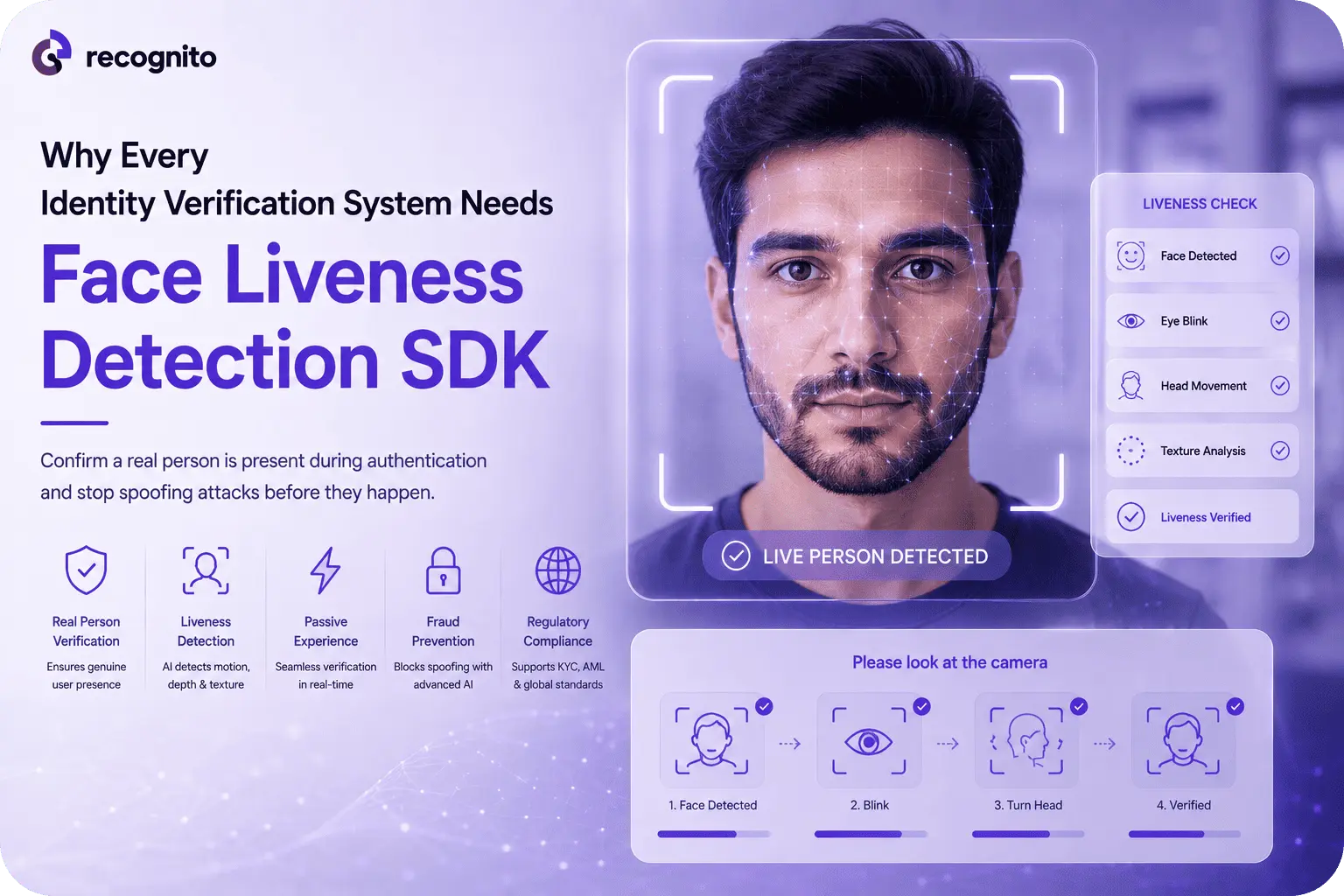
A face liveness detection SDK is software that lets developers integrate biometric liveness and presentation-attack detection into their own mobile or web applications.
Depending on the solution, the SDK can support facial capture, quality assessment, liveness analysis, and a result that can be passed to the application’s identity or fraud engine.
The purpose is specific: help determine whether the biometric presentation appears genuine.
This makes the SDK a security component within a wider identity architecture. For businesses, that can be more practical than developing an anti-spoofing capability internally and maintaining it across different devices, cameras, and application environments.
Why Facial Recognition Alone Is Not Enough
Consider a typical remote onboarding process.
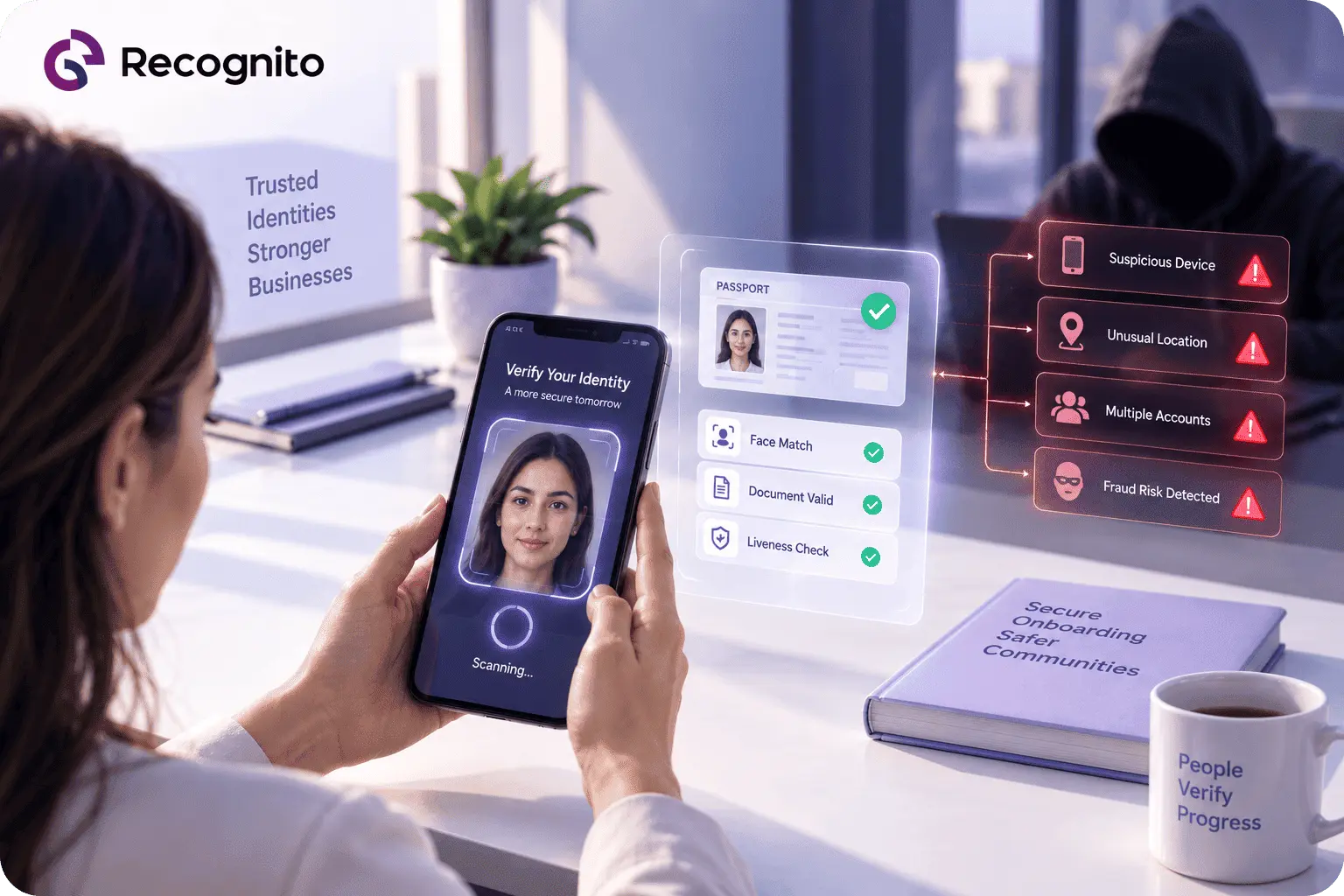
A customer submits a passport and captures a selfie. The system compares the selfie with the passport photograph.
If the faces correspond, the facial check can provide useful evidence.
Now imagine an attacker presenting a realistic photograph or replayed video of the genuine customer. The face may still look very similar to the trusted reference.
The matching system is evaluating facial similarity. It is not necessarily determining whether the capture represents a genuine live presentation.
That is the gap liveness addresses.
Face verification: Does the face correspond with the trusted identity?
Liveness detection: Does the biometric presentation appear genuine?
FIDO’s biometric requirements for remote identity verification evaluate both face matching and presentation attack detection and use measures such as false accept rate, false reject rate, and impostor attack presentation accept rate. FIDO Biometrics Requirements
What Types of Attacks Can Liveness Address?
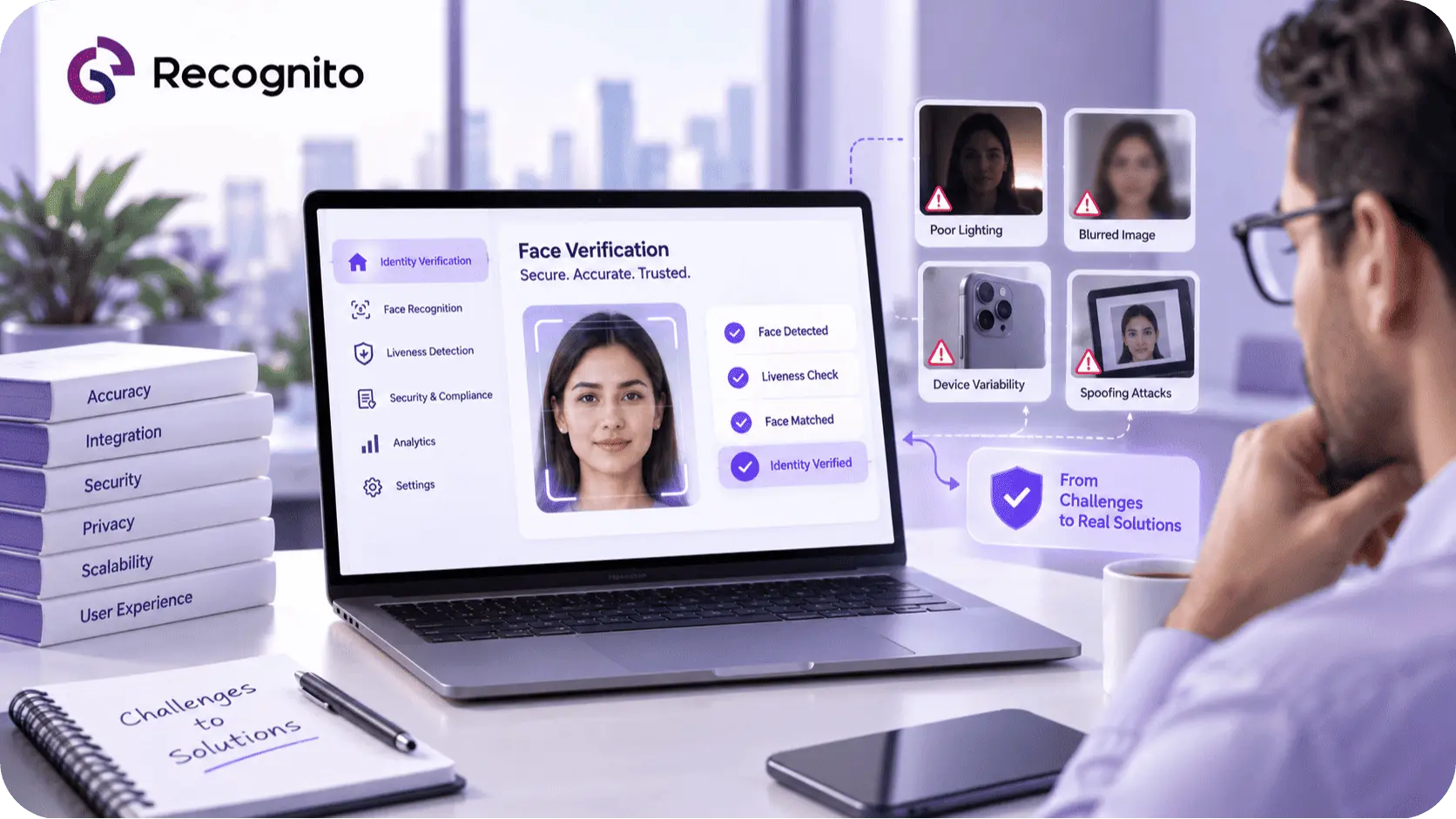
Remote facial verification can face different presentation attacks.
Photograph Attacks
A fraudster presents a printed or digital image of another person.
Screen Attacks
An image or video is displayed on another device in front of the camera.
Replay Attacks
Previously recorded facial footage is presented as if the interaction were live.
Physical Replica Attacks
A mask or other artificial representation is used to imitate a person.
Synthetic Media
AI-generated or manipulated facial content is presented during verification.
The relevant threat model depends on the application. A bank onboarding customers remotely may face different attack incentives from a low-risk application.
This is why security teams should evaluate liveness against realistic attacks instead of treating “anti-spoofing” as a single universal capability.
How Liveness Fits Into Identity Verification
Liveness becomes most valuable when it works with trusted identity evidence.
A typical workflow can look like:
Identity evidence → document verification → facial verification → liveness → risk decision
The document provides information about the claimed identity.
Document validation helps determine whether that evidence is credible.
Facial verification connects the person with the trusted reference.
Liveness helps assess whether the facial presentation appears genuine.
Risk analysis then considers the combined evidence.
NIST’s current identity-proofing guidance requires technical controls for remote biometric collection, including presentation attack detection, and also calls for controls that increase confidence that digital media is being produced by a genuine sensor. NIST notes that these controls improve protection but do not address every possible forged-media or injection scenario. NIST Identity Proofing Overview
This is why liveness should be viewed as one layer of identity assurance.
Why Liveness Matters for Remote KYC
Remote KYC removes the physical interaction that previously helped establish trust.
An attacker could obtain a genuine identity document belonging to someone else. Document validation may show that the credential appears authentic, but it does not automatically prove that the applicant is the rightful owner.
Facial verification can provide a person-to-document comparison.
Liveness adds presentation protection to that biometric step.
FATF’s digital identity guidance explains that appropriately reliable digital identity systems can support customer identification and verification during onboarding and can also support due diligence and anti-fraud efforts. FATF Digital Identity Guidance
This creates a useful layered model:
Trusted identity evidence + matching person + genuine biometric presentation
That is considerably stronger than treating document verification or facial matching as sufficient on its own.
Active vs Passive Liveness
Liveness systems can use different interaction models.
Active liveness may ask a user to perform a deliberate action during capture.
Passive liveness attempts to evaluate the presentation without the same type of explicit challenge.
Passive approaches can reduce user interaction, while active approaches can introduce a clear challenge.
Neither should automatically be considered superior. The correct choice depends on security requirements, target users, device conditions, acceptable friction, and testing evidence.
Recognito’s active vs passive liveness detection resource provides more context on the trade-offs.
Why an SDK-Based Approach Matters
An SDK allows liveness to become part of the application’s existing customer journey.
Developers can control when liveness is triggered, which users require stronger verification, how the capture experience is presented, and what happens after an unsuccessful attempt.
This is particularly useful for custom onboarding, authentication, and account-recovery experiences.
Instead of forcing every user through maximum verification, the business can apply stronger biometric checks when the risk warrants them.
A fintech platform might use liveness during account creation.
A marketplace might apply it to higher-risk seller onboarding.
An account-recovery flow might use it when the customer is accessing the service from an unfamiliar device.
The SDK becomes part of the product architecture rather than a disconnected security step.
Why Identity Documents Still Matter
Liveness cannot establish which identity a person is claiming.
For many higher-assurance workflows, the organization still needs trusted identity evidence.
A customer can submit a passport or national identity card. The document can be recognized and validated, and its photograph can provide the reference used for facial comparison.
A document recognition SDK can support that stage inside the application.
The customer’s facial sample can then be compared with the trusted reference, while liveness protects the capture.
The process becomes:
Document evidence → document validation → face comparison → liveness → decision
Each component answers a different question.
Liveness and Deepfake Threats
Generative AI has made synthetic facial content more convincing.
An attacker may attempt to use manipulated images or video during a remote verification process.
Liveness can help strengthen the biometric capture stage, but it should not be treated as a universal deepfake detector.
Deepfake analysis and liveness address related but different problems. Liveness focuses on the authenticity of the biometric presentation, while separate media-analysis techniques may look for evidence of synthetic manipulation.
The FBI has warned that criminals are using generative AI to make fraud schemes more believable and scalable, including synthetic content used for impersonation and other fraud. FBI Generative AI Fraud Warning
Recognito’s deepfake attack prevention strategies provide further context on building layered defenses.
Injection Attacks Are a Separate Concern
A presentation attack happens at the biometric capture point.
An injection attack can attempt to bypass that capture point and introduce an image or video into the biometric processing path.
FIDO treats injection attacks as a distinct concern in remote face verification, while NIST also addresses forged-media and injection risks in remote identity proofing. NIST Identity Proofing Requirements
This means a liveness SDK should not be treated as the entire security boundary.
Businesses should also consider:
Application integrity
Device security
Camera access
SDK integrity
API protection
Secure transmission
A strong biometric architecture protects the complete capture pipeline.
How Liveness Helps Reduce Identity Fraud
Suppose an attacker has a genuine passport belonging to another person.
The document may pass validation.
The attacker then needs to appear as that person.
Facial verification creates another barrier.
If the attacker presents an artificial facial representation, liveness introduces another.
The resulting controls can be summarized as:
Document evidence → face matching → liveness → risk analysis
Each stage adds information to the final decision.
This is defense in depth. It does not make fraud impossible, but it prevents an attacker from relying on one weak identity signal.
For businesses, this is especially important because modern identity fraud is often coordinated across documents, devices, accounts, and digital media rather than relying on one isolated attack.
One Table: Why Liveness Belongs in the Identity Stack
| Layer | Main Question | Security Role |
| Identity evidence | Who is the user claiming to be? | Establishes the claimed identity |
| Document verification | Does the credential provide credible evidence? | Helps detect invalid or altered documents |
| Facial verification | Does the person correspond with the identity? | Helps reduce impersonation |
| Liveness detection | Does the biometric presentation appear genuine? | Helps reduce presentation attacks |
| Capture security | Did the biometric input reach the system through the expected path? | Helps address injection and manipulation |
| Risk decisioning | Do the signals support the requested action? | Determines the final outcome |
The important takeaway is that liveness fills a specific gap between facial matching and broader identity assurance.
How Businesses Should Evaluate a Liveness Detection SDK
Vendor evaluation should begin with the organization’s actual threat model.
Define the Attack Scenarios
Identify which presentation attacks are realistic for the application.
Review the Testing Method
ISO/IEC 30107-3 provides a framework for assessing and reporting PAD performance. ISO/IEC 30107-1 also provides the broader PAD framework.
Examine Independent Evidence
FIDO’s biometric certification program provides requirements and testing procedures for remote face-verification solutions, including matching and presentation attack detection. FIDO Biometric Certification
Test Real Devices
Use the smartphones, browsers, cameras, and operating systems customers will actually use.
Test Genuine Users
Measure legitimate-user completion and false rejection alongside attack resistance.
Test the Complete Workflow
Evaluate liveness alongside document verification, facial matching, application security, and risk decisioning.
This is much more informative than judging a liveness product through a short demonstration.
When Liveness Is Most Valuable
Liveness is most important when an organization relies on remote facial biometrics for identity assurance.
A workflow that never uses facial capture has no need for face liveness.
By contrast, online onboarding, account recovery, workforce verification, regulated customer onboarding, and other higher-risk biometric events should carefully evaluate presentation-attack protection.
The control should match the threat, the consequences of fraud, and the level of identity assurance the business requires.
Privacy and Biometric Data
Liveness can involve facial images, video frames, biometric representations, or verification results.
Organizations should understand what information is collected, where it is processed, whether raw media is retained, whether biometric templates are created, how long data is stored, and who can access it.
The EU GDPR treats biometric data processed for uniquely identifying a person as a special category of personal data and establishes conditions for its processing. EU GDPR
The FTC has also warned that biometric technologies raise significant privacy and data-security concerns and that businesses should consider security, accuracy claims, and potential bias. FTC Biometric Information Guidance
The broader principle is simple: collect what is necessary, protect it appropriately, and establish clear retention and access rules.
How Recognito Fits Into the Architecture
Organizations building their own identity workflows can integrate biometric capabilities directly into their applications.
The face liveness detection SDK can provide the presentation-protection layer around facial capture.
Facial biometric matching can then connect the user with trusted identity evidence, while document recognition can support the identity-evidence stage.
For developers evaluating implementation options, the Recognito GitHub repository can provide an additional technical resource.
The appropriate combination depends on the application’s threat model, user population, privacy requirements, and required level of identity assurance.
Conclusion
A face liveness detection SDK addresses a critical gap in remote biometric identity verification.
Facial verification asks whether a face corresponds with a trusted identity.
Liveness asks whether the biometric presentation appears genuine.
That distinction matters because online verification can be targeted with photographs, screen displays, replayed video, physical replicas, synthetic facial content, and attempts to manipulate the capture path.
A strong architecture therefore combines:
Trusted identity evidence → document verification → facial verification → liveness → capture security → risk decisioning
Liveness is not a replacement for KYC, identity proofing, document verification, or facial recognition. Its role is narrower and important: strengthening the biometric presentation against relevant attacks.
Businesses should evaluate the technology using realistic attack scenarios, independent evidence, real devices, genuine-user testing, privacy reviews, and complete workflow testing. ISO/IEC 30107 provides a recognized framework for presentation-attack testing, while NIST and FIDO address the wider issues of remote identity proofing, biometric performance, capture integrity, and attack resistance.
The strongest deployment is not the one that adds the most security steps.
It is the one that applies the right controls for the risk, protects legitimate users, protects biometric information, and continues to adapt as attack techniques evolve.
For organizations building digital onboarding, KYC, authentication, account recovery, marketplace, insurance, or workforce identity workflows, SDK-based liveness can become a practical part of a modern biometric security architecture.
Organizations evaluating facial liveness and biometric verification technology can explore Recognito as part of a broader digital identity and fraud-prevention strategy.
Frequently Asked Questions
What is a face liveness detection SDK?
A face liveness detection SDK lets businesses integrate facial presentation-attack detection into their own applications and assess whether a biometric presentation appears to come from a genuine live person.
Is liveness detection the same as facial recognition?
No. Facial recognition evaluates whether facial samples correspond, while liveness evaluates whether the biometric presentation appears genuine. They address different security questions.
Can liveness detection stop deepfakes?
Liveness can provide an important layer against artificial facial presentations, but it should not be treated as a complete deepfake defense. Businesses should also consider facial verification, secure capture, trusted identity evidence, and wider risk controls.
Does every identity verification workflow need liveness?
Not literally every workflow. Liveness is most relevant when an organization relies on remote facial biometrics and needs stronger protection against presentation attacks. The appropriate control depends on the use case and threat model.
How should businesses choose a face liveness SDK?
Businesses should evaluate relevant presentation attacks, independent testing, genuine-user performance, device compatibility, privacy, application and capture security, integration, update practices, and performance within the complete identity-verification workflow.