
Customer onboarding is one of the most vulnerable stages of the digital customer lifecycle.
Before a customer can open a bank account, access a fintech platform, purchase an insurance product, or use another regulated digital service, the organization needs to establish that the applicant is a genuine person and that the identity being presented actually belongs to them.
Traditional identity verification methods can help establish basic identity information, but they may not be enough when fraudsters use stolen credentials, forged documents, synthetic identities, deepfakes, or impersonation techniques.
This is where biometric verification becomes particularly valuable.
By comparing a person’s biometric characteristics with trusted identity information, organizations can add another layer of assurance to the onboarding process. Facial verification, in particular, can help connect a remote applicant to the identity they are claiming while keeping the process fast enough for digital customer experiences.
However, biometric verification should not be viewed as a standalone fraud solution. The strongest onboarding systems combine biometrics with document verification, liveness detection, risk analysis, and other controls.
This article explains how biometric verification reduces fraud during customer onboarding, where it fits into the identity verification process, and what organizations should consider when implementing it.
Why Customer Onboarding Is a Major Fraud Risk
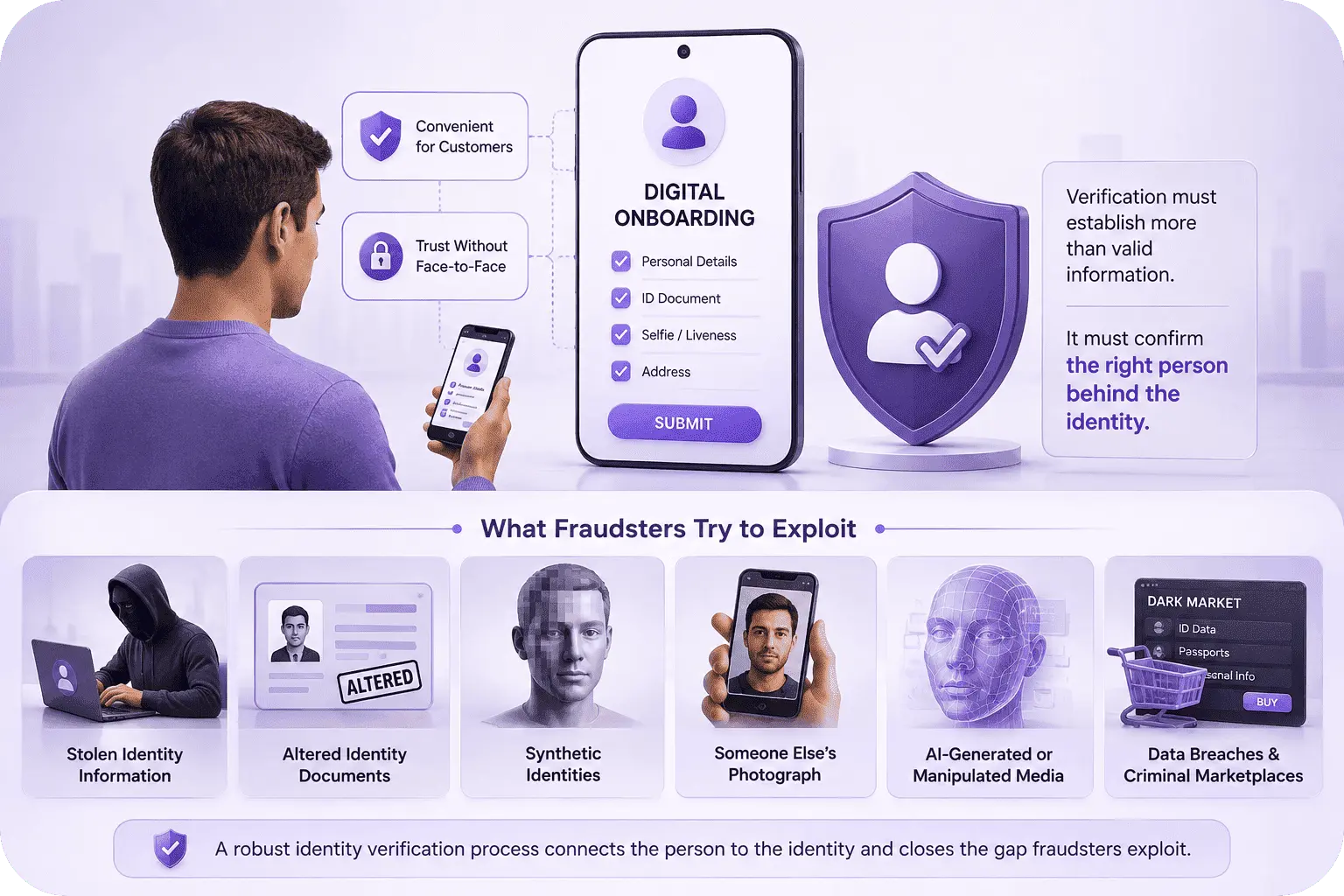
Digital onboarding removes the need for many customers to visit a physical branch or office. That makes services more convenient, but it also creates a challenge: organizations must establish trust without relying on face-to-face interactions.
A fraudster can attempt to exploit this gap by presenting:
- Stolen identity information
- Altered identity documents
- Synthetic identities
- Someone else’s photograph
- AI-generated or manipulated media
The problem becomes more difficult when traditional onboarding depends heavily on information that attackers can obtain through data breaches or criminal marketplaces.
A strong identity verification process therefore needs to establish more than whether the submitted information appears valid.
It needs to establish whether the person behind the application is consistent with the identity being presented.
What Is Biometric Verification?
Biometric verification is the process of confirming a person’s claimed identity using measurable physical or behavioral characteristics.
Common biometric modalities include:
- Facial recognition
- Fingerprint recognition
- Iris recognition
- Voice biometrics
- Behavioral biometrics
For remote customer onboarding, facial verification is particularly practical because most smartphones and computers already have cameras.
A facial verification workflow typically captures a facial image from the applicant and compares it with a trusted reference image associated with the claimed identity.
That reference may come from an identity document or another trusted identity record.
Unlike a password or security question, a biometric characteristic is connected to the individual rather than something they simply know or possess.
This makes biometric verification a useful additional layer for reducing impersonation during onboarding.
How Biometric Verification Strengthens Identity Verification
Identity verification and biometric verification perform related but different functions.
Document or identity verification helps determine whether the information and identity document provided by the applicant appear legitimate.
Biometric verification adds another question:
Is the person submitting this identity actually the person associated with it?
That distinction is important.
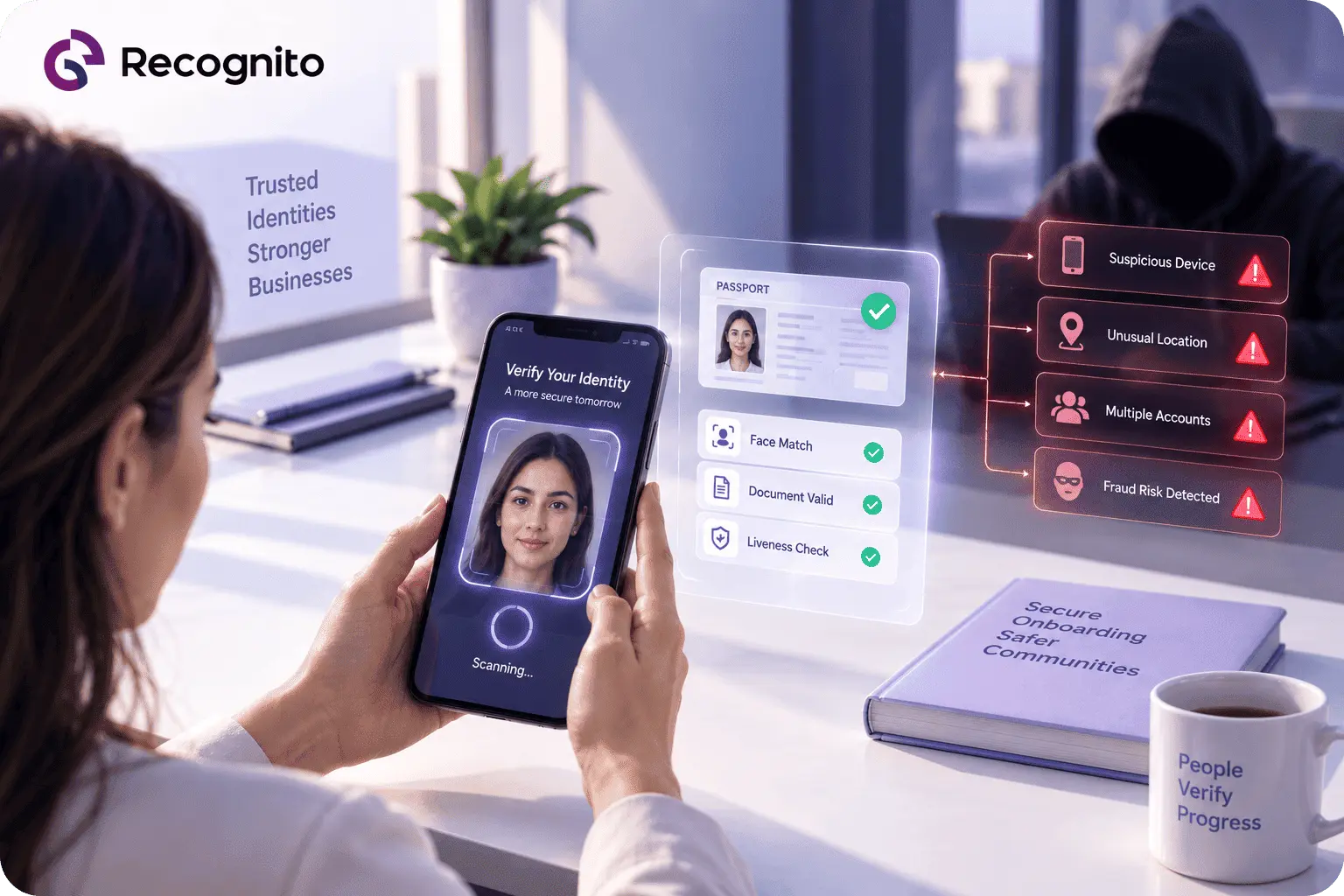
A fraudster may possess a genuine stolen passport. A document verification system could determine that the passport itself appears authentic, but that does not prove the person holding it is the legitimate owner.
Facial verification can help close that gap by comparing the applicant’s live facial image with the trusted photograph on the identity document.
This is one reason businesses increasingly combine identity verification with biometric checks rather than relying on document analysis alone.
How Biometric Verification Reduces Common Onboarding Fraud
Different fraud types create different challenges, but biometric verification can address several of the most important ones.
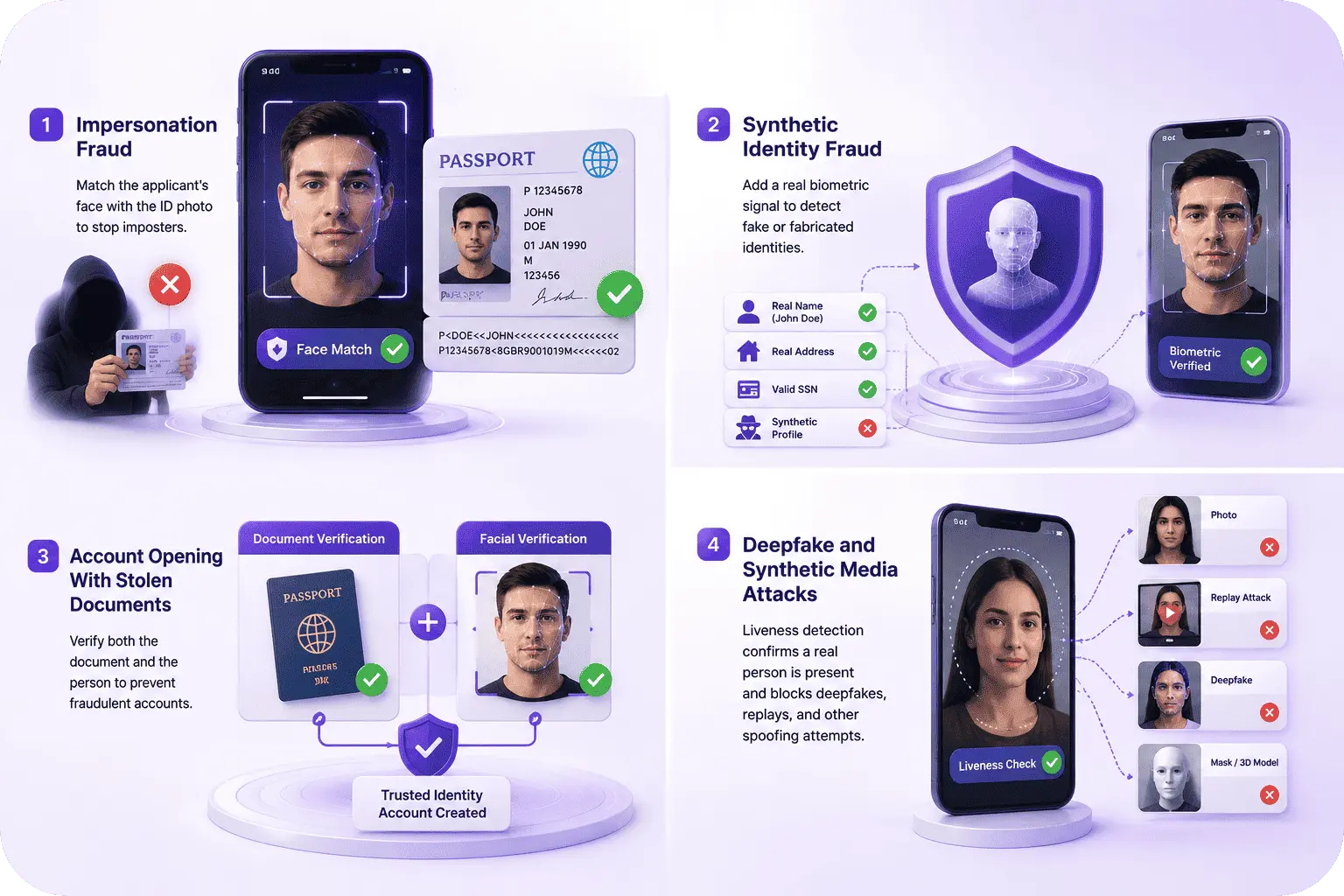
1. Impersonation Fraud
Impersonation occurs when a fraudster attempts to use another person’s legitimate identity information.
The attacker may have obtained a passport, national ID, or other personal information, but they are not the person shown on the document.
Facial verification can compare the applicant’s face against the identity image and identify a mismatch.
This provides an additional barrier against attempts to use stolen identity documents during remote onboarding.
2. Synthetic Identity Fraud
Synthetic identity fraud involves combining real and fabricated information to create a new identity.
These identities can be difficult to identify because parts of the profile may appear legitimate.
Biometric verification adds a physical identity signal to the onboarding process. Instead of relying only on names, addresses, or document information, the organization can also establish a relationship between the applicant and a facial biometric.
This becomes especially valuable when combined with the other fraud signals discussed in Recognito’s article on synthetic identity fraud detection.
3. Account Opening With Stolen Documents
A fraudster may obtain a legitimate identity document and attempt to use it to create an account.
Document verification can help establish whether the credential appears genuine, while facial verification can determine whether the applicant resembles the person shown on the document.
This creates a layered process in which the organization evaluates both the document and the person presenting it.
4. Deepfake and Synthetic Media Attacks
AI-generated faces and manipulated videos create additional risks for digital onboarding.
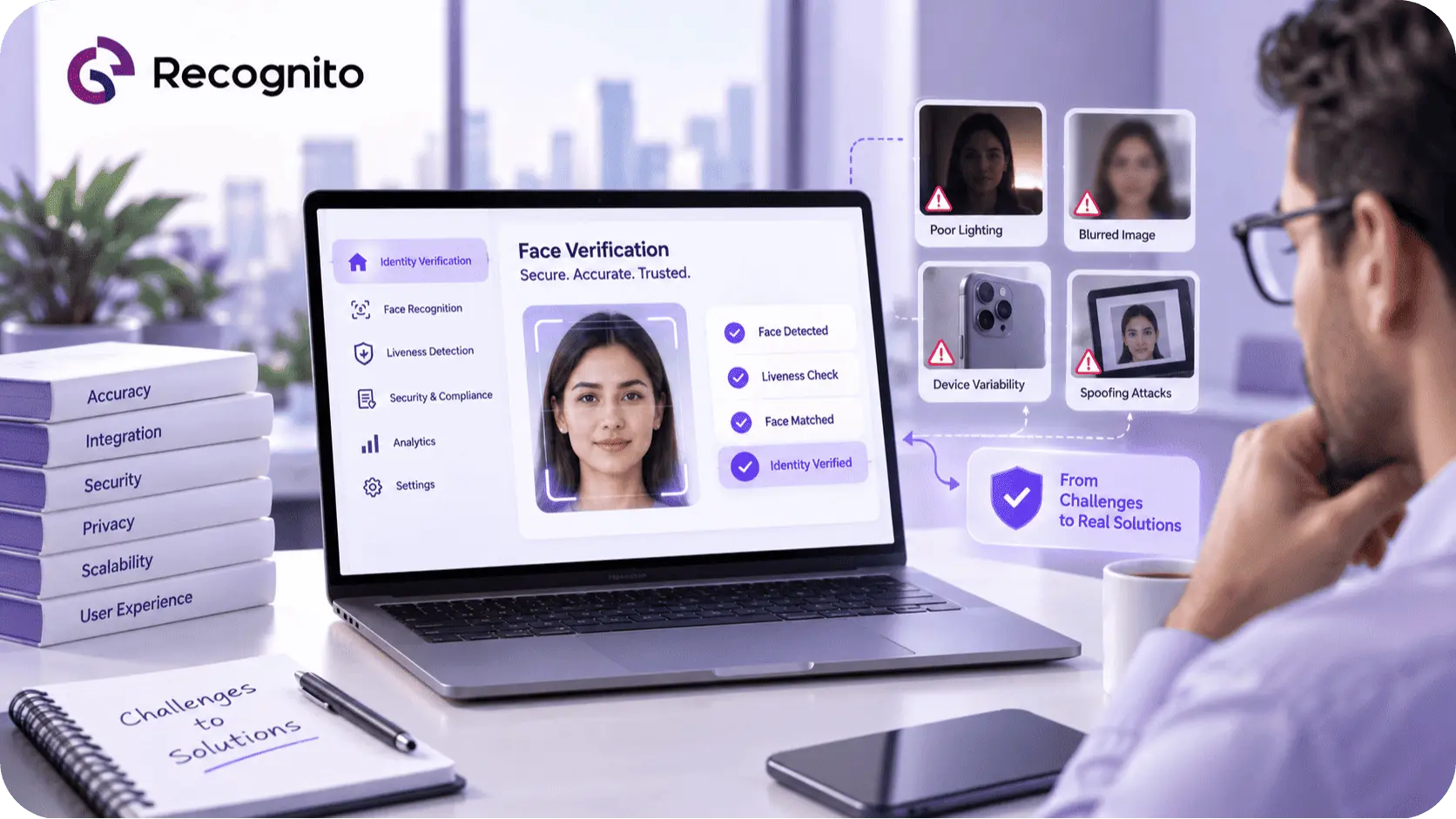
A system that performs facial matching without checking whether the biometric presentation is genuine may remain vulnerable to presentation attacks.
That is why organizations should combine facial verification with a face liveness detection SDK where the use case requires stronger protection against spoofing.
Liveness helps determine whether a real person is physically present rather than allowing the system to treat a photograph, replay, or other artificial presentation as a genuine customer.
The Role of Liveness Detection in Biometric Verification
Biometric verification and liveness detection should not be confused.
Facial verification asks whether two facial representations are sufficiently similar.
Liveness detection asks whether the biometric sample appears to originate from a live subject rather than a presentation attack.
Using both technologies together can create a stronger onboarding control.
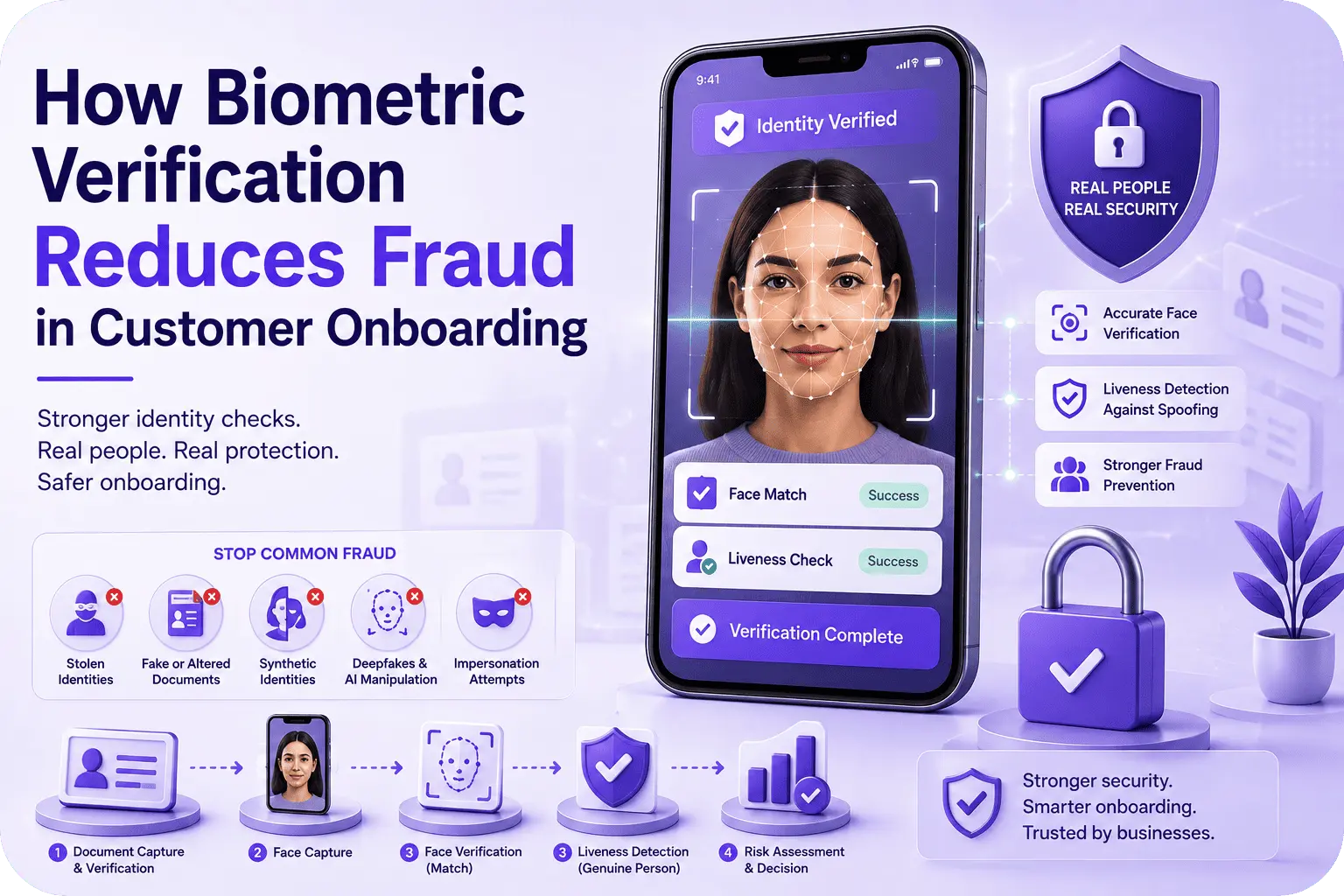
For example, a customer may first submit an identity document. The system can then capture a facial sample, verify that the face matches the document, and perform liveness checks before continuing.
This layered approach makes it considerably harder for an attacker to succeed with a stolen document alone.
Organizations can also compare different approaches through Recognito’s guide on active versus passive liveness detection, particularly when deciding how much user interaction the onboarding experience should require.
A Typical Biometric Customer Onboarding Workflow
A secure digital onboarding journey does not need to make every customer complete the same number of steps.
Instead, organizations can build a risk-based sequence.
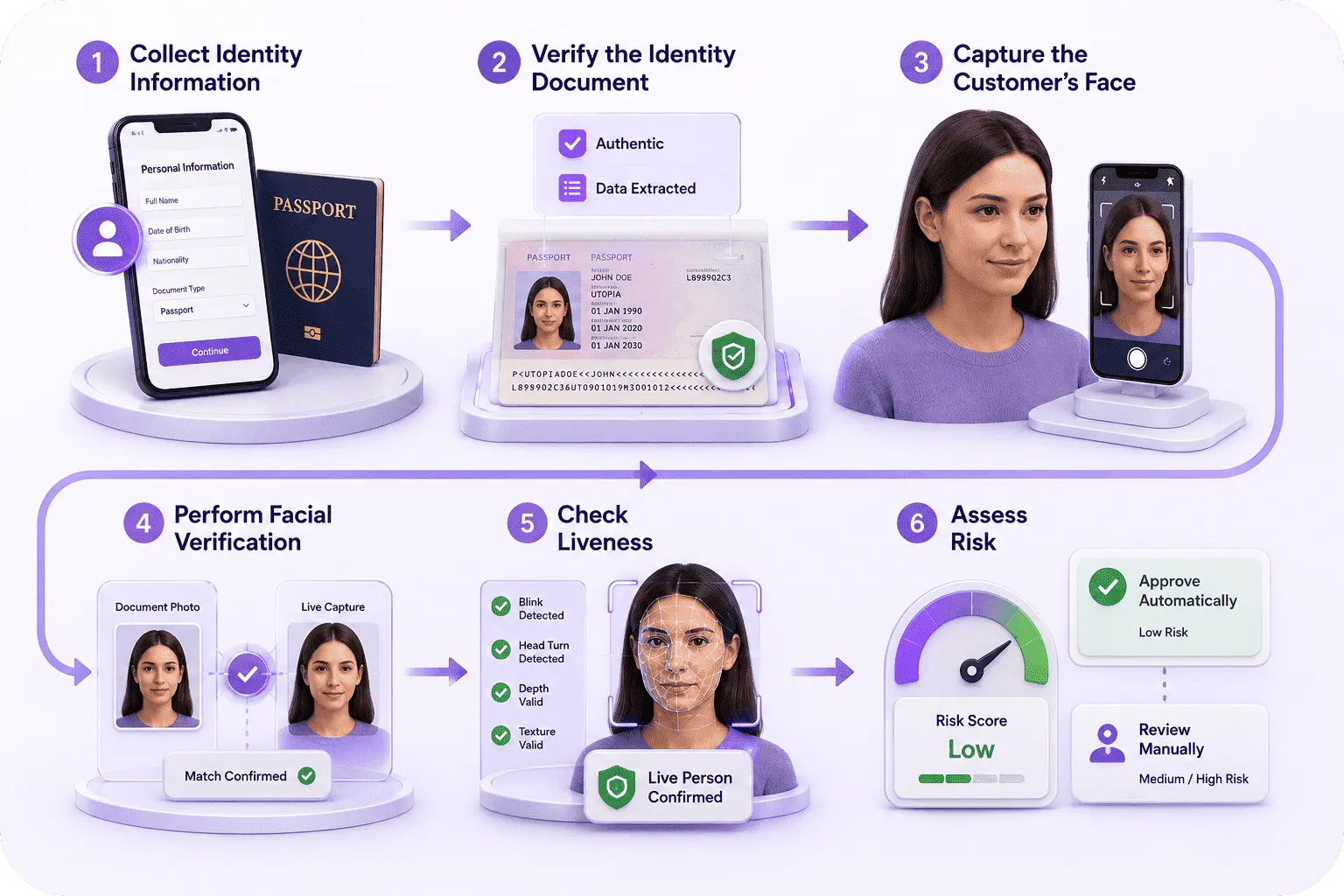
1. Collect Identity Information
The customer provides their basic information and identifies the document or credential they intend to use.
2. Verify the Identity Document
The organization checks the document for authenticity and extracts the relevant information.
3. Capture the Customer’s Face
The customer provides a facial image through a supported camera or mobile device.
4. Perform Facial Verification
The live facial sample is compared against the trusted identity image.
5. Check Liveness
The system evaluates whether the facial presentation appears to come from a genuine live person.
6. Assess Risk
Additional signals can determine whether the application should be approved automatically or sent for further review.
The number and order of these steps can change based on the organization’s risk profile, regulations, customer journey, and technical architecture.
Why Layered Verification Is More Effective
No individual verification technology eliminates every form of fraud.
A document can be genuine while being used by the wrong person. A face can match a document while the biometric presentation is fraudulent. A customer can pass onboarding and still become risky later.
That is why modern identity verification architecture increasingly uses multiple complementary signals.
A layered workflow may combine:
- Document verification
- Facial verification
- Liveness detection
- Device intelligence
- Risk scoring
- Fraud monitoring
- Ongoing verification
This approach reduces dependence on any single signal.
It also allows organizations to apply stronger controls when the risk level increases rather than forcing every customer through the most complicated possible onboarding flow.
How Biometric Verification Improves Customer Experience
Fraud prevention is not the only reason organizations adopt biometric verification.
It can also simplify onboarding.
Traditional verification may require customers to type large amounts of information, upload multiple files, wait for manual review, and repeat steps when information is missing.
A well-designed biometric workflow can reduce that friction.
A customer may simply capture an identity document and complete a short facial verification step while the system performs the necessary checks in the background.
The result can be:
- Faster onboarding
- Fewer manual reviews
- Reduced data-entry errors
- Lower customer friction
- Quicker account activation
The technology should still be implemented carefully. An overly aggressive fraud workflow can cause false rejections and frustrate legitimate customers.
False Rejections Matter Too
Fraud prevention is about more than stopping suspicious users.
If legitimate customers are repeatedly rejected because the biometric system is too strict, the business can lose conversions and increase support costs.
This creates a balance between security and usability.
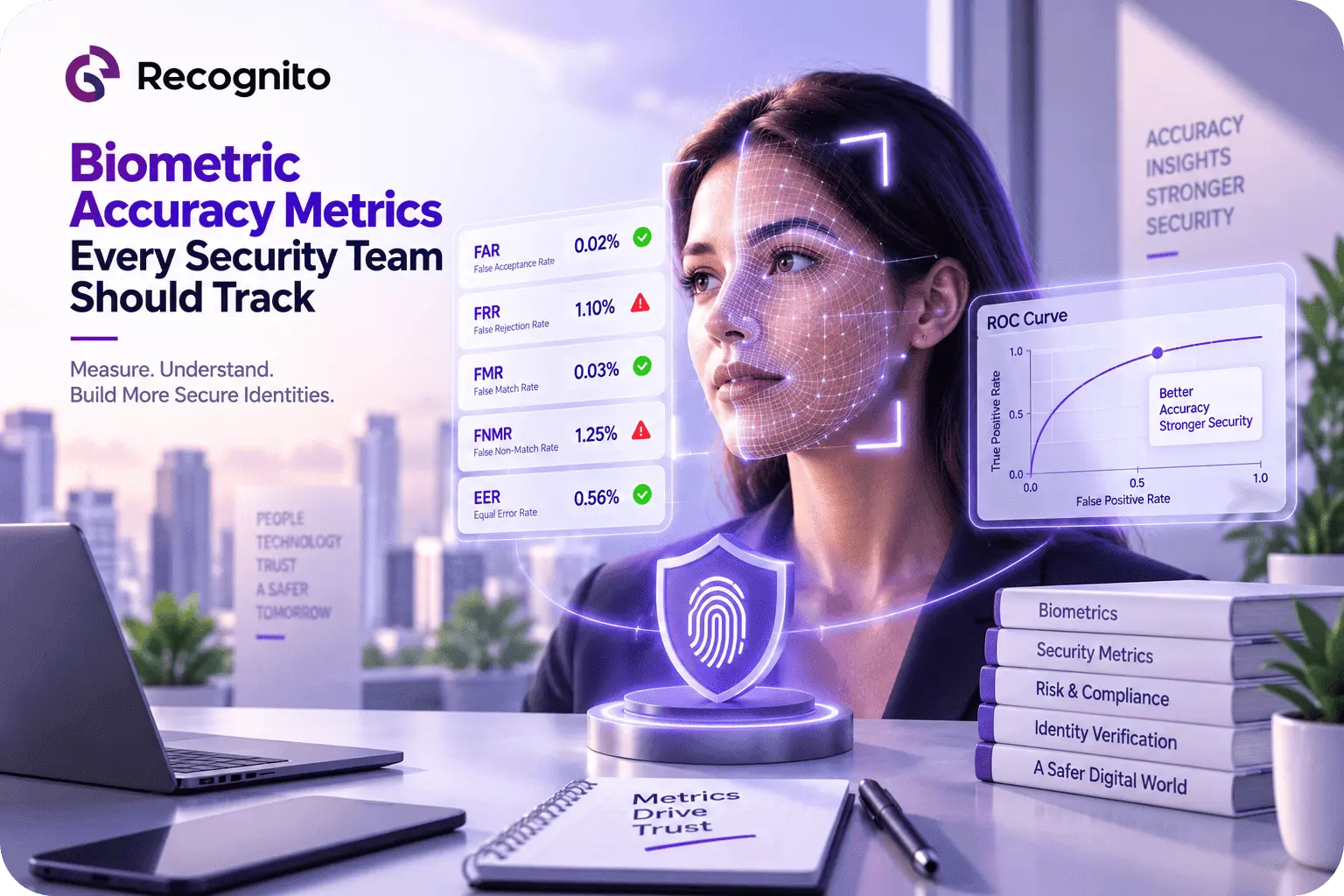
Enterprise teams should therefore evaluate biometric verification using both security and customer experience metrics.
Important measures can include:
- Successful verification rate
- False acceptance rate
- False rejection rate
- Verification completion rate
- Average verification time
- Manual review rate
- Customer abandonment
The objective is not to maximize rejection.
It is to achieve an appropriate balance between fraud prevention and legitimate customer acceptance.
How Biometric Verification Supports KYC and Compliance
Biometric verification can also strengthen regulated onboarding workflows where organizations need to establish customer identity.
Banks, fintech companies, insurance providers, and other regulated businesses may need to perform identity verification as part of KYC and customer due diligence programs.
The Financial Action Task Force digital identity guidance discusses the use of digital identification technology within customer identification and verification processes.
Biometrics can support this process by adding a stronger connection between the identity information and the individual presenting it.
However, biometric verification does not automatically satisfy every KYC or AML requirement.
Organizations still need appropriate customer risk assessment, screening, monitoring, recordkeeping, and other controls required by the applicable regulatory framework.
Privacy Considerations for Biometric Onboarding
Biometric information is sensitive and should be handled carefully.
Before deploying facial verification, organizations should understand:
- Where biometric data is processed
- Whether images are stored
- How templates are protected
- How long information is retained
- Who can access the data
- What deletion procedures exist
- Which jurisdictions apply
Privacy requirements vary by market, industry, and implementation.
Organizations handling European personal data should consider the GDPR framework and its requirements when designing biometric processing workflows.
The best implementation therefore balances strong fraud controls with data minimization, appropriate security, and transparent privacy practices.
Choosing a Biometric Verification Solution
Selecting a biometric SDK should involve more than comparing advertised accuracy.
Enterprise buyers should evaluate:
- Recognition performance
- Liveness capabilities
- Platform support
- Integration effort
- Scalability
- Privacy controls
- Developer documentation
- Security updates
- Technical support
- Total cost of ownership
A solution should also fit the complete identity verification architecture.
For example, an organization may need facial verification alongside document recognition, document liveness, fraud signals, and risk assessment.
A standalone facial capability may therefore be less useful than a technology ecosystem that integrates cleanly into the broader onboarding workflow.
How Recognito Can Fit Into a Biometric Onboarding Workflow
Recognito provides biometric technologies that can support different parts of an identity verification workflow.
Organizations can use face recognition SDK technology for facial matching and combine it with liveness capabilities when the application requires stronger presentation attack protection.
Where document-based onboarding is required, ID document recognition can support automated document analysis before the facial verification stage.
This allows an organization to build a workflow in which the document and the person presenting it are evaluated together rather than relying on either signal alone.
Technical teams can also explore the face biometric playground as part of their evaluation process and review the Recognito GitHub repository for additional implementation resources.
The appropriate combination depends on the organization’s risk model, application architecture, compliance environment, and customer journey.
How Enterprises Can Implement Biometric Verification Effectively
Technology alone does not determine the success of a biometric onboarding program.
The surrounding workflow also matters.
A practical implementation should:
Define the Risk Model
Determine which onboarding scenarios represent the highest fraud risk and where stronger verification is justified.
Test With Realistic Conditions
Evaluate the technology using representative devices, users, lighting conditions, and application flows.
Combine Multiple Signals
Use document verification, facial verification, liveness, device intelligence, and other risk signals where appropriate.
Monitor Performance
Track verification success, rejection rates, fraud outcomes, completion time, and customer abandonment after launch.
Continuously Improve
Fraud techniques evolve, and biometric systems should be reviewed and updated as the threat landscape changes.
The Future of Biometric Verification in Customer Onboarding
Biometric verification is likely to become increasingly integrated with other identity technologies rather than operating as a standalone tool.
Digital identity wallets, verifiable credentials, AI-powered fraud detection, document verification, liveness detection, and continuous risk assessment can all contribute to future identity ecosystems.
In some situations, customers may be able to reuse trusted digital credentials rather than repeating a full identity verification process for every service.
Even then, organizations may still need biometrics to establish that the person presenting the credential is its legitimate holder.
This makes biometric verification an important component of the transition toward reusable digital identity.
Conclusion
Biometric verification can significantly strengthen customer onboarding by connecting digital identity information to the person presenting it.
It helps organizations address impersonation, stolen identity documents, synthetic identities, and other forms of onboarding fraud that traditional information-based verification may not detect on its own.
The strongest approach is not to treat biometrics as a single security solution. Document verification, facial verification, liveness detection, risk analysis, device intelligence, and ongoing monitoring can work together to create a more resilient identity verification workflow.
Organizations should also balance fraud prevention with customer experience. Excessive friction and false rejections can be just as damaging to a digital onboarding program as weak security.
Businesses evaluating biometric identity technologies can explore Recognito as part of a broader strategy for secure digital verification and customer onboarding.
Frequently Asked Questions
How does biometric verification reduce fraud during customer onboarding?
It adds a biometric layer that helps confirm the person applying is the person associated with the identity being presented. This can reduce impersonation, stolen-document fraud, and certain synthetic identity attacks.
Is facial verification the same as identity verification?
No. Identity verification establishes whether identity information and supporting evidence are credible. Facial verification compares a person’s biometric characteristics against a trusted identity reference. They are often used together.
Can biometric verification prevent deepfake attacks?
Biometric matching alone cannot reliably prevent every presentation attack. Combining facial verification with liveness detection can provide additional protection against photographs, replay attacks, and certain synthetic or manipulated presentations.
Does biometric verification replace KYC?
No. Biometrics can support customer identification and verification, but KYC and AML programs generally involve additional requirements such as risk assessment, screening, monitoring, and recordkeeping.
What should businesses consider before implementing biometric verification?
Organizations should evaluate biometric performance, liveness protection, privacy, integration, scalability, developer experience, customer friction, regulatory requirements, and the total cost of operating the technology.