
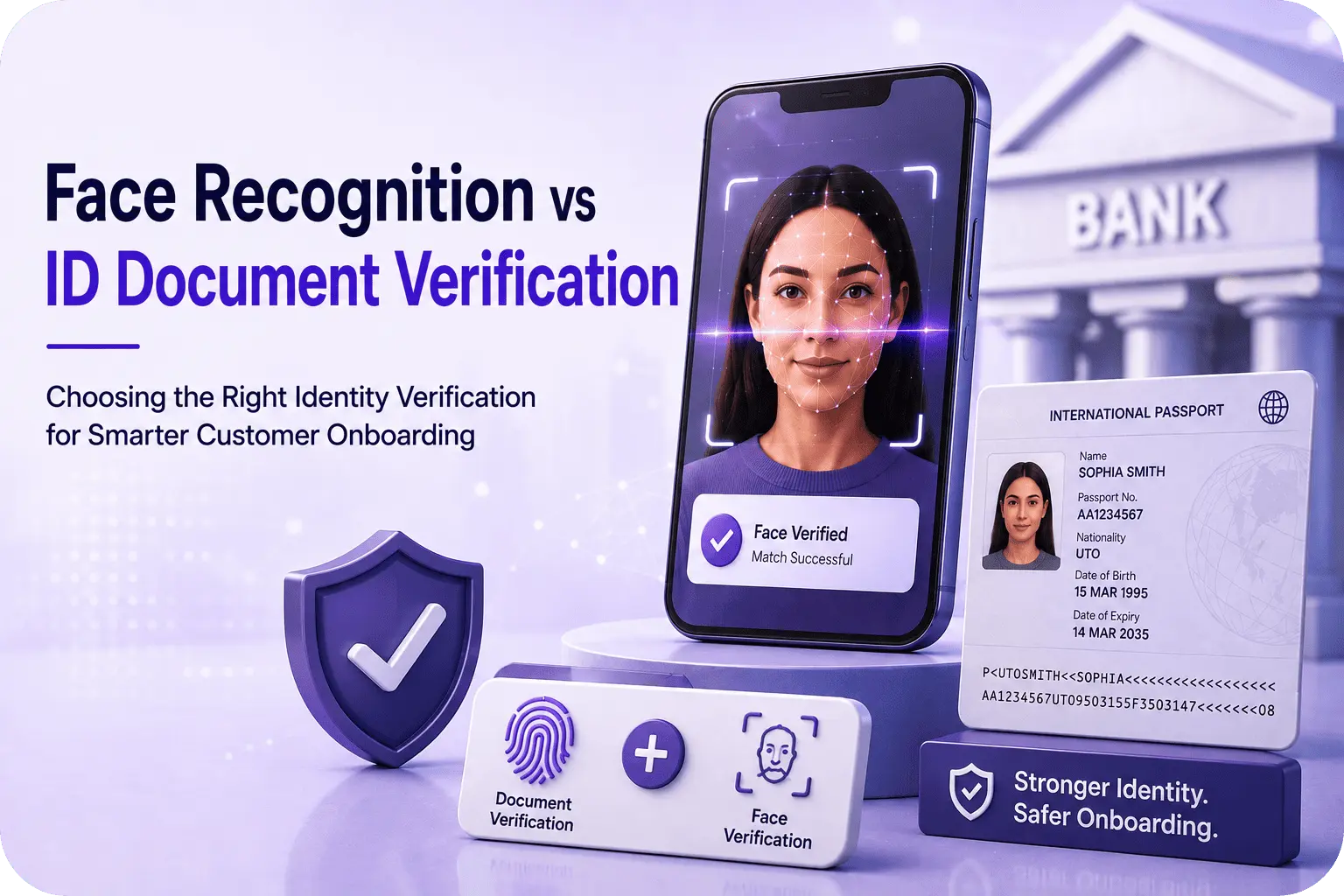
Digital customer onboarding often depends on two important identity verification methods: face recognition and ID document verification.
They are sometimes treated as competing technologies, but they actually solve different problems.
ID document verification helps determine whether the identity document submitted by an applicant appears authentic and whether the information extracted from it is consistent. Face recognition can help determine whether the person presenting that identity corresponds to the facial image associated with it.
That distinction becomes critical when a bank, fintech company, insurer, marketplace, or other digital service provider needs to decide which verification technology should be used during onboarding.
A customer could possess a genuine passport that belongs to somebody else. A document verification system may correctly identify the document as authentic, but it does not necessarily establish that the person holding it is the legitimate owner.
Likewise, a facial recognition system can compare two facial images, but without a trusted identity source, the system may not know whose identity the person is claiming.
This is why the more useful question is not:
“Should we use face recognition or document verification?”
It is:
“How should face recognition and document verification work together to establish identity with the appropriate level of assurance?”
What Does ID Document Verification Do?
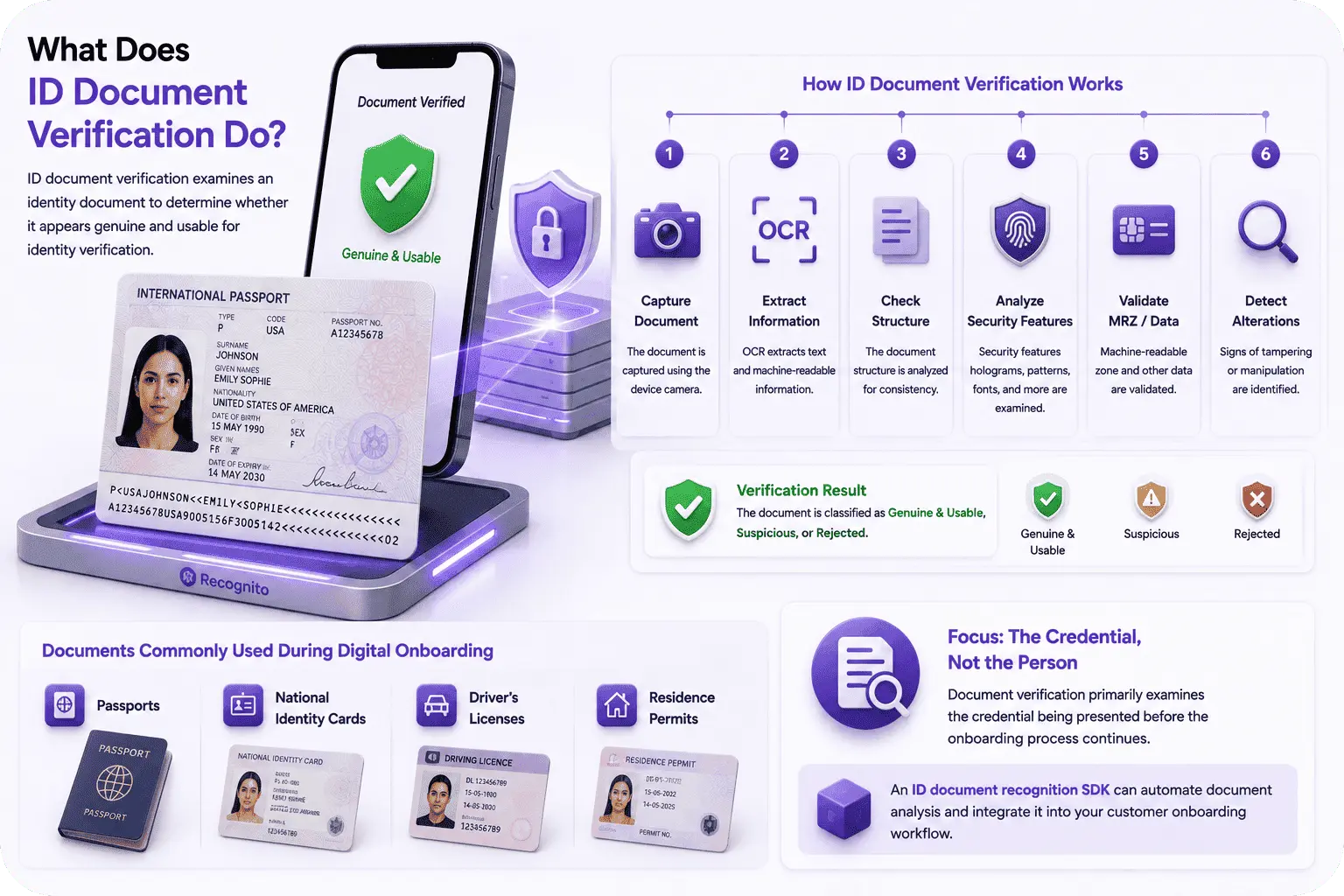
ID document verification is designed to examine an identity document and determine whether it appears genuine and usable for identity verification.
Depending on the technology and document type, the process can involve extracting information using OCR, checking document structure, analyzing security features, validating machine-readable information, and identifying signs of alteration.
Documents commonly used during digital onboarding include:
- Passports
- National identity cards
- Driver’s licenses
- Residence permits
The exact checks vary by country and document type.
The important point is that document verification primarily examines the credential being presented.
A strong document verification workflow can help identify forged, altered, expired, or otherwise suspicious documents before the onboarding process continues.
For organizations that need automated document analysis, an ID document recognition SDK can integrate document processing into a wider customer onboarding workflow.
What Does Face Recognition Do?
Face recognition performs a different job.
Instead of examining the identity document itself, a facial recognition system analyzes a facial sample and compares it against another facial representation.
During customer onboarding, this may involve comparing a live customer image with the photograph contained in an identity document.
The purpose is to establish whether the person presenting the identity appears to correspond to the person shown in the trusted identity record.
A face recognition system can therefore add a person-to-identity connection that document verification alone cannot provide.
For organizations evaluating the technology, factors such as recognition accuracy, image quality, camera conditions, and biometric thresholds all influence results. Recognito’s guide on face recognition accuracy factors provides additional context on these considerations.
Face Recognition vs Document Verification: What Is the Difference?
The easiest way to understand the distinction is to look at the question each technology is trying to answer.
| Verification Method | Primary Question | Typical Role in Onboarding |
| ID document verification | Is the submitted identity document authentic and valid? | Establishes trusted identity information |
| Face recognition | Does the person’s face correspond to the trusted identity? | Establishes person-to-identity consistency |
| Liveness detection | Is the biometric presentation coming from a genuine live person? | Helps protect against presentation attacks |
| Combined workflow | Do the document, person, and biometric presentation make sense together? | Provides stronger identity assurance |
The technologies are therefore complementary.
A document can be authentic while being presented by the wrong person. A face can match a reference image while the reference itself is not connected to a trusted identity.
Combining the controls addresses more of the identity risk.
Why Document Verification Alone May Not Be Enough
Imagine a customer applies for a bank account remotely and uploads a genuine passport.
The passport belongs to another individual, but the fraudster has obtained it.
The document itself may pass authenticity checks.
If the onboarding process stops after document verification, the institution has established that the credential appears legitimate, but it may not have established that the applicant is the legitimate owner.
This is one reason identity verification should distinguish between verifying a credential and verifying the person presenting it.
The broader difference between these stages is also relevant to identity proofing and identity verification, particularly when designing a high-assurance digital onboarding process.
Why Face Recognition Alone May Not Be Enough
The opposite scenario creates a similar problem.
Suppose an onboarding system captures a customer’s face and successfully performs facial matching.
What does that face actually prove?
A high-quality facial match can establish similarity between two biometric samples, but the system still needs a trustworthy identity reference.
Without a reliable source of identity information, facial verification does not necessarily establish who the individual is in a broader legal or regulatory sense.
For customer onboarding, that trusted reference may come from an identity document or another verified identity source.
This is why facial recognition is usually more valuable when it operates as part of an identity verification workflow instead of being treated as a standalone identity system.
How the Two Technologies Work Together
The strongest onboarding architecture often uses both technologies in sequence.
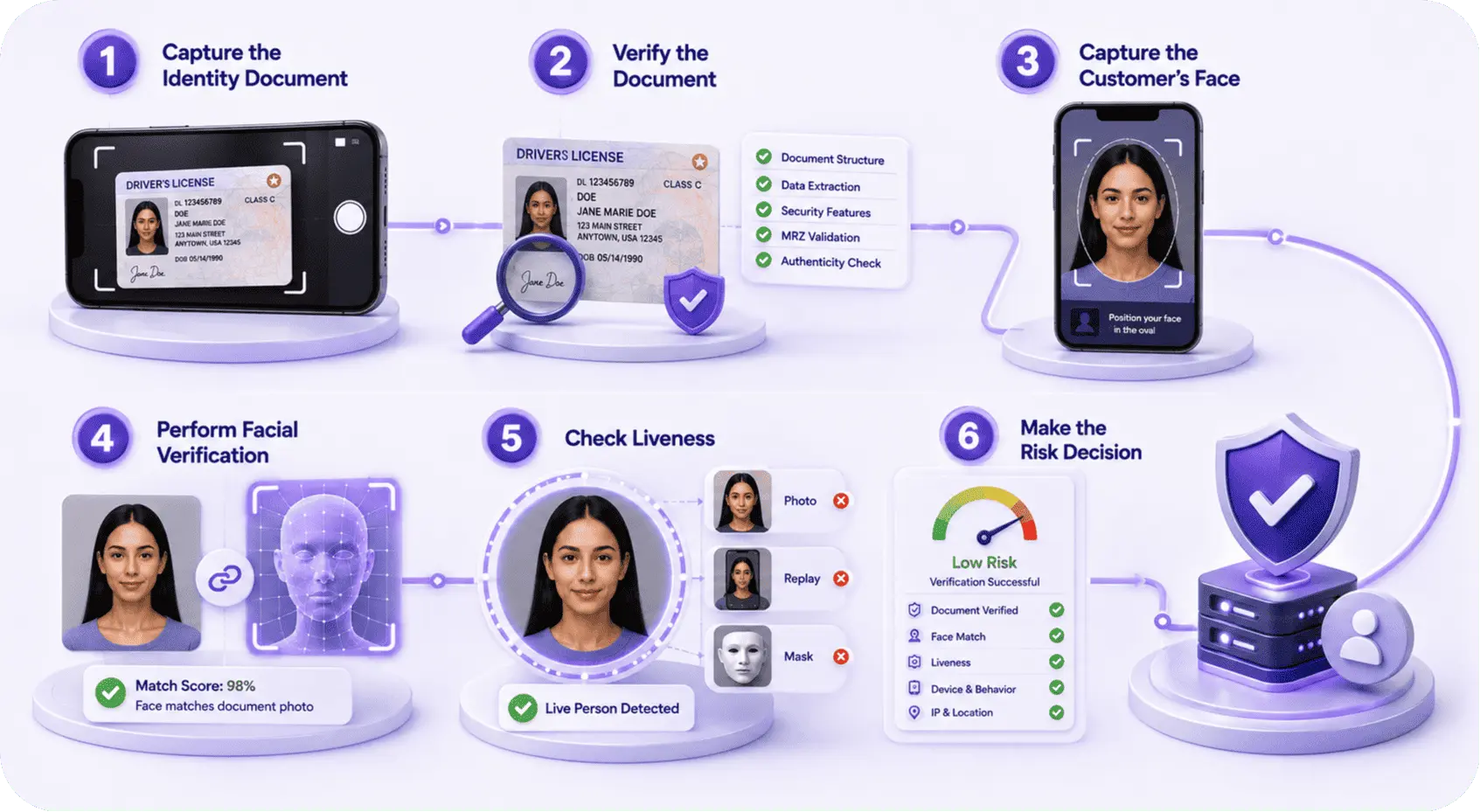
A typical workflow can look like this:
1. Capture the Identity Document
The customer photographs or scans the identity document.
2. Verify the Document
The system checks the document’s structure, information, and available authenticity indicators.
3. Capture the Customer’s Face
The customer provides a facial image through the device camera.
4. Perform Facial Verification
The facial sample is compared with the trusted photograph associated with the identity document.
5. Check Liveness
The system determines whether the biometric presentation appears to come from a live person rather than a photograph, replay, or other presentation attack.
6. Make the Risk Decision
The results can then be combined with other signals to determine whether the applicant should continue automatically or receive additional review.
This layered workflow is significantly stronger than asking either document verification or facial recognition to solve every identity problem.
Where Liveness Detection Fits
Liveness detection is an important part of this comparison because facial matching and liveness answer different questions.
Facial recognition asks:
“Does this face match the reference face?”
Liveness asks:
“Does this biometric presentation appear to come from a real person?”
Without liveness, a fraudster could attempt to use a photograph, replayed video, or another presentation attack against a facial verification system.
A face liveness detection SDK can therefore provide an additional security layer during remote onboarding.
This becomes particularly important for financial services, where attackers may combine stolen identity documents with manipulated biometric media.
The broader relationship between facial matching and presentation attack protection is also explained in Recognito’s presentation attack detection and biometric security resource.
Which Technology Is Better for Fraud Prevention?
There is no universal winner because the technologies address different attack surfaces.
Document verification is particularly useful for identifying problems with the credential itself.
Face recognition helps establish whether the applicant corresponds to the identity represented by the trusted reference image.
Liveness detection helps reduce the risk that an attacker will manipulate the biometric capture process.
A layered workflow may therefore be able to detect fraud that any single method would miss.
Consider three scenarios.
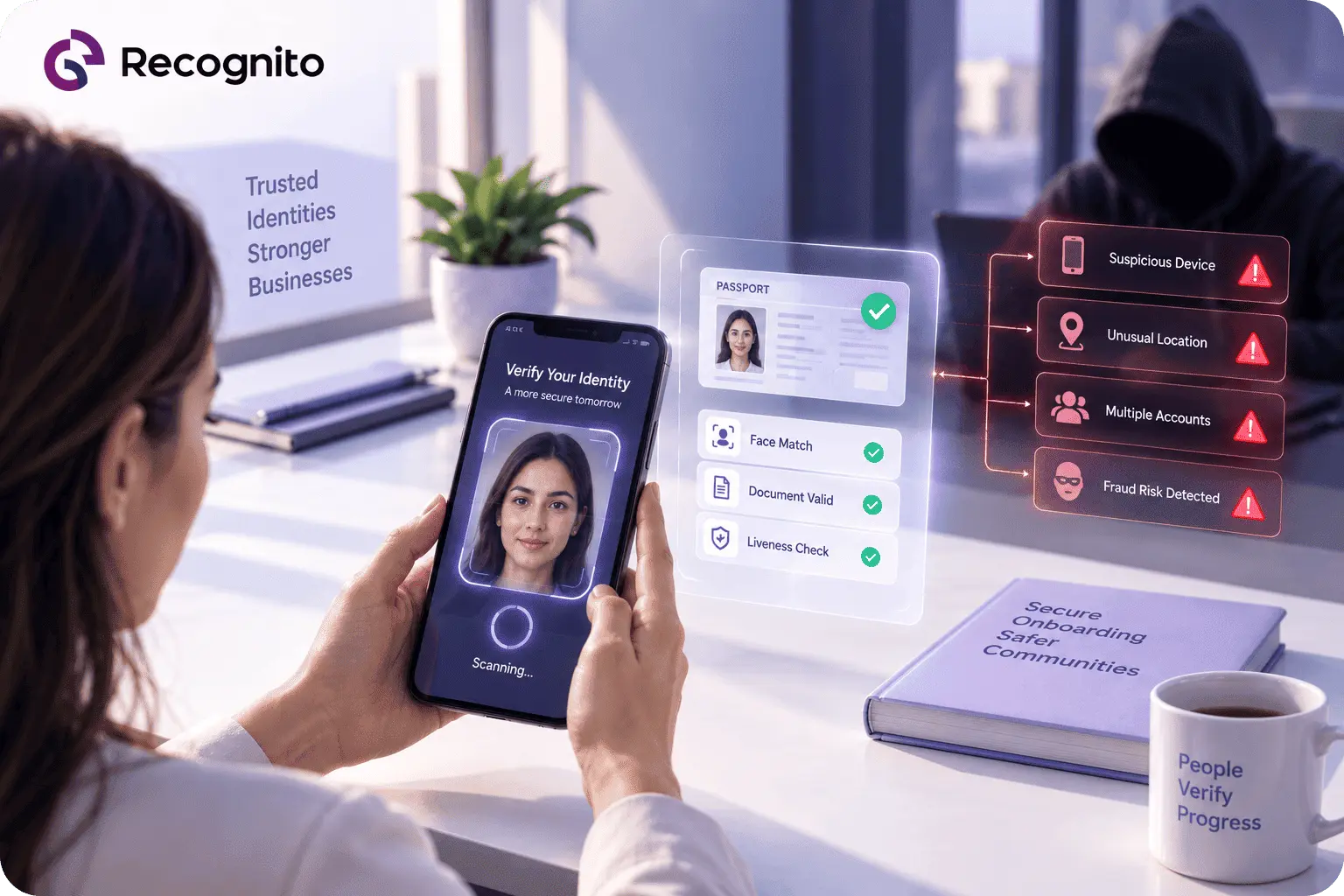
Scenario 1: Genuine Document, Wrong Person
The document is authentic, but the person presenting it is not the legitimate owner.
Document verification may pass. Facial verification can identify the mismatch.
Scenario 2: Fake Document, Genuine Person
The person is real, but the document has been manipulated.
Document verification can help detect problems with the credential.
Scenario 3: Stolen Identity Plus Biometric Spoofing
An attacker uses identity information and attempts to deceive the facial verification system with an artificial presentation.
Document verification, face matching, and liveness can work together to create multiple barriers.
This layered model is one reason modern identity verification platforms increasingly combine document and biometric technologies.
The Role of Biometric Verification in Customer Onboarding
Biometric verification provides a way to connect a claimed identity with the person participating in the onboarding process.
That connection can be valuable for banks, fintech platforms, insurance companies, payment providers, and marketplaces that need stronger assurance during remote registration.
It can also reduce reliance on information that can be stolen or recreated.
Passwords, addresses, phone numbers, and many other identity attributes can be compromised. A biometric verification step provides a different type of evidence because it is based on characteristics of the person.
That does not make biometrics immune to attack.
It means biometrics can provide another security signal that is difficult to reproduce through conventional credential theft alone.
How This Affects Customer Experience
Security is only part of the onboarding decision.
Customers expect financial and digital services to be fast and simple. A verification process that asks users to repeatedly upload documents, complete multiple checks, or wait for manual review can increase abandonment.
Combining document verification and biometrics can actually improve the experience when the workflow is well designed.
The customer may only need to:
- Capture the identity document
- Follow simple instructions for facial capture
- Complete verification
Much of the remaining analysis can happen automatically in the background.
The objective should be to reduce unnecessary friction while preserving sufficient assurance.
When Should Businesses Use Both?
For many higher-risk digital onboarding scenarios, using both technologies makes sense.
Examples include:
- Opening bank accounts remotely
- Fintech customer onboarding
- Insurance applications
- Digital wallets
- Payment services
- Cryptocurrency platforms
- High-value financial services
- Regulated marketplaces
The exact combination should depend on the business’s risk model and regulatory requirements.
A low-risk application may not need the same level of identity assurance as a financial account that can be used to move large amounts of money.
This is where risk-based verification becomes important.
How Businesses Should Evaluate the Technology
Organizations should not select a solution based only on which technology has more features.
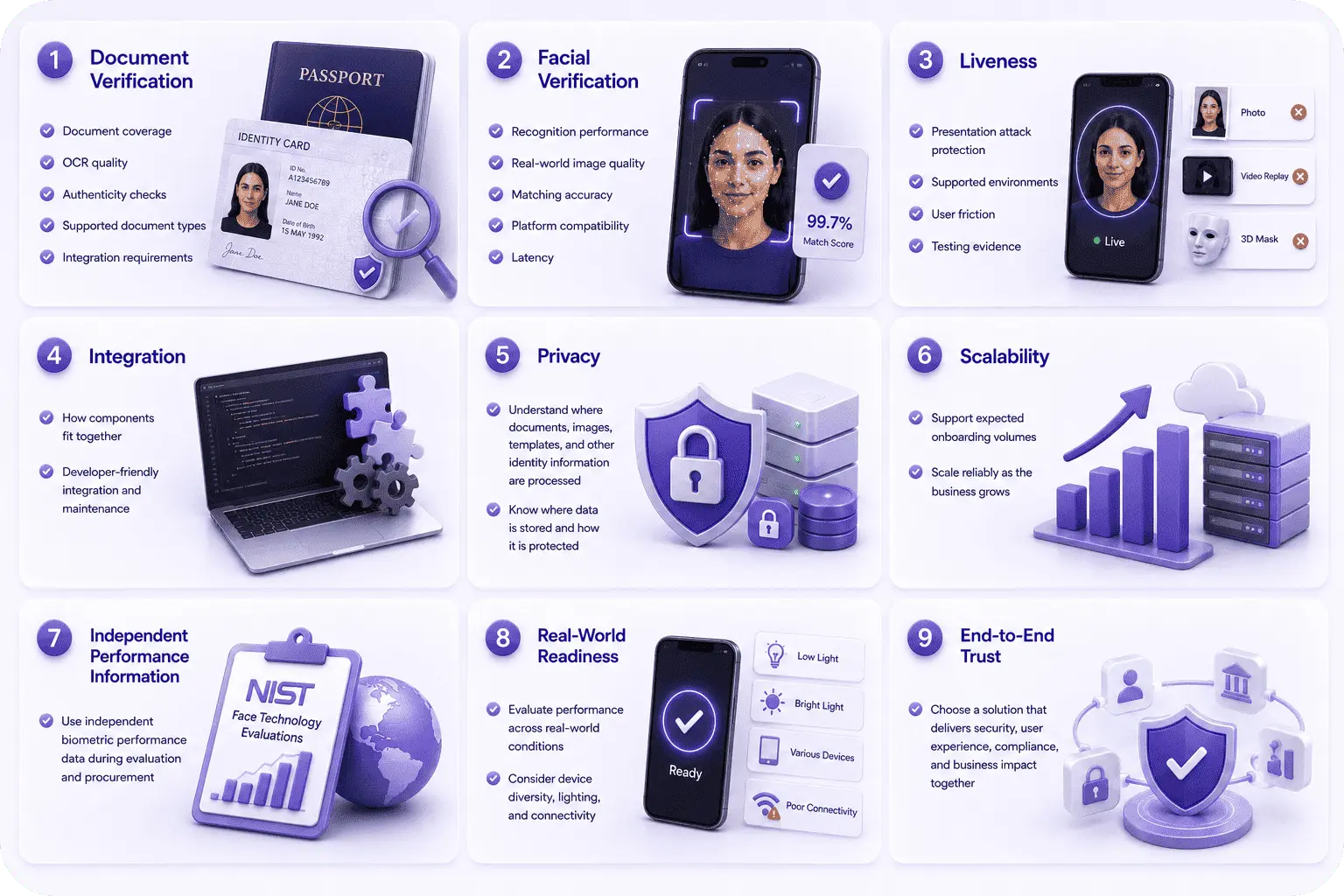
A useful evaluation should consider the complete identity journey.
Document Verification
Assess document coverage, OCR quality, authenticity checks, supported document types, and integration requirements.
Facial Verification
Evaluate recognition performance, real-world image quality, matching accuracy, platform compatibility, and latency.
Liveness
Examine presentation attack protection, supported environments, user friction, and testing evidence.
Integration
Consider how the components fit together and whether developers can maintain them efficiently.
Privacy
Understand where documents, images, templates, and other identity information are processed and stored.
Scalability
Determine whether the architecture can support expected onboarding volumes as the business grows.
Independent biometric performance information can also be useful during procurement. The NIST Face Technology Evaluations provide an additional reference point when assessing facial recognition technologies.
Document Verification vs Facial Verification for Different Use Cases
Different industries may place different weights on the two technologies.
A fintech platform performing remote KYC may require both because it needs to verify the identity document and establish that the applicant matches it.
An internal employee authentication system may rely more heavily on biometrics because the organization already has a trusted employee identity record.
A document-heavy workflow may prioritize document recognition first and use biometrics as an additional assurance layer.
The correct architecture therefore depends on the identity risk being addressed, not on choosing one technology as universally superior.
How the Technologies Support Compliance
Financial institutions need to consider more than fraud prevention during onboarding.
Identity verification can form part of KYC and customer due diligence processes, while biometric verification can provide additional confidence that the applicant corresponds to the identity being established.
Organizations should still consider applicable regulatory requirements and data protection obligations.
The FATF digital identity guidance provides useful context around digital identity systems and customer identification.
For organizations handling European personal data, the GDPR framework is also relevant when designing document and biometric processing workflows.
Compliance should therefore be considered alongside security, privacy, customer experience, and technical architecture.
How Recognito Can Support a Layered Onboarding Workflow
Recognito’s biometric technologies can fit into different stages of a digital identity workflow.
Organizations evaluating facial verification can consider an enterprise face recognition SDK for biometric matching, while document-focused onboarding can use ID document verification technology to analyze identity documents.
Where stronger protection against presentation attacks is required, liveness capabilities can add another layer between facial capture and the final risk decision.
The face biometric playground can also help technical teams gain practical exposure to facial biometric capabilities during evaluation.
For developers assessing integration options, the Recognito GitHub repository provides additional technical resources.
The important point is that the organization should design the workflow around its own requirements rather than simply deploying every available capability.
A Practical Decision Framework
For most organizations, the decision should not be framed as:
Face recognition vs document verification.
It should be framed as:
Which combination of verification methods provides the right level of assurance for our customers, risk profile, and business workflow?
A practical process is to begin by identifying the fraud risks the onboarding system needs to address.
Then determine which controls address those risks:
- Document authenticity
- Person-to-identity matching
- Presentation attack protection
- Risk assessment
- Ongoing monitoring
Finally, test the complete workflow using realistic users, devices, documents, and application conditions.
This produces a much more reliable decision than selecting a technology based on isolated feature comparisons.
Conclusion
Face recognition and ID document verification are not competing technologies that businesses must choose between.
They address different parts of the identity verification process.
Document verification helps establish whether the identity credential appears authentic. Facial verification can help establish whether the applicant corresponds to the person represented by that credential. Liveness detection adds another layer by helping determine whether the biometric presentation is genuine.
For customer onboarding, the strongest approach is therefore often a layered one that combines the technologies according to the organization’s risk, regulatory requirements, customer journey, and technical architecture.
The objective is not to introduce more verification steps than necessary. It is to use the right verification signals at the right point in the customer journey.
Organizations evaluating biometric and identity technologies can explore the broader solutions available from Recognito as part of their onboarding strategy.
Frequently Asked Questions
Is face recognition better than ID document verification?
Neither technology is universally better. Document verification evaluates the identity credential, while facial recognition helps determine whether the person presenting the identity corresponds to the trusted facial reference. They are often stronger when used together.
Can document verification alone prevent identity fraud?
No. A genuine document can still be presented by someone who is not the legitimate owner. Additional controls such as facial verification and liveness can provide stronger identity assurance.
Why is liveness detection needed with face recognition?
Facial matching alone does not necessarily determine whether the submitted biometric sample came from a real person. Liveness detection can help protect against presentation attacks involving photographs, replayed media, and similar techniques.
Should businesses use both document and biometric verification?
For many higher-risk onboarding scenarios, using both provides stronger assurance because the technologies address different parts of the identity risk. The appropriate combination should depend on the organization’s risk model.
What should businesses consider when choosing onboarding verification methods?
They should evaluate fraud risks, biometric performance, document verification capabilities, liveness protection, privacy, regulatory requirements, integration, scalability, customer friction, and the total cost of operating the verification workflow.