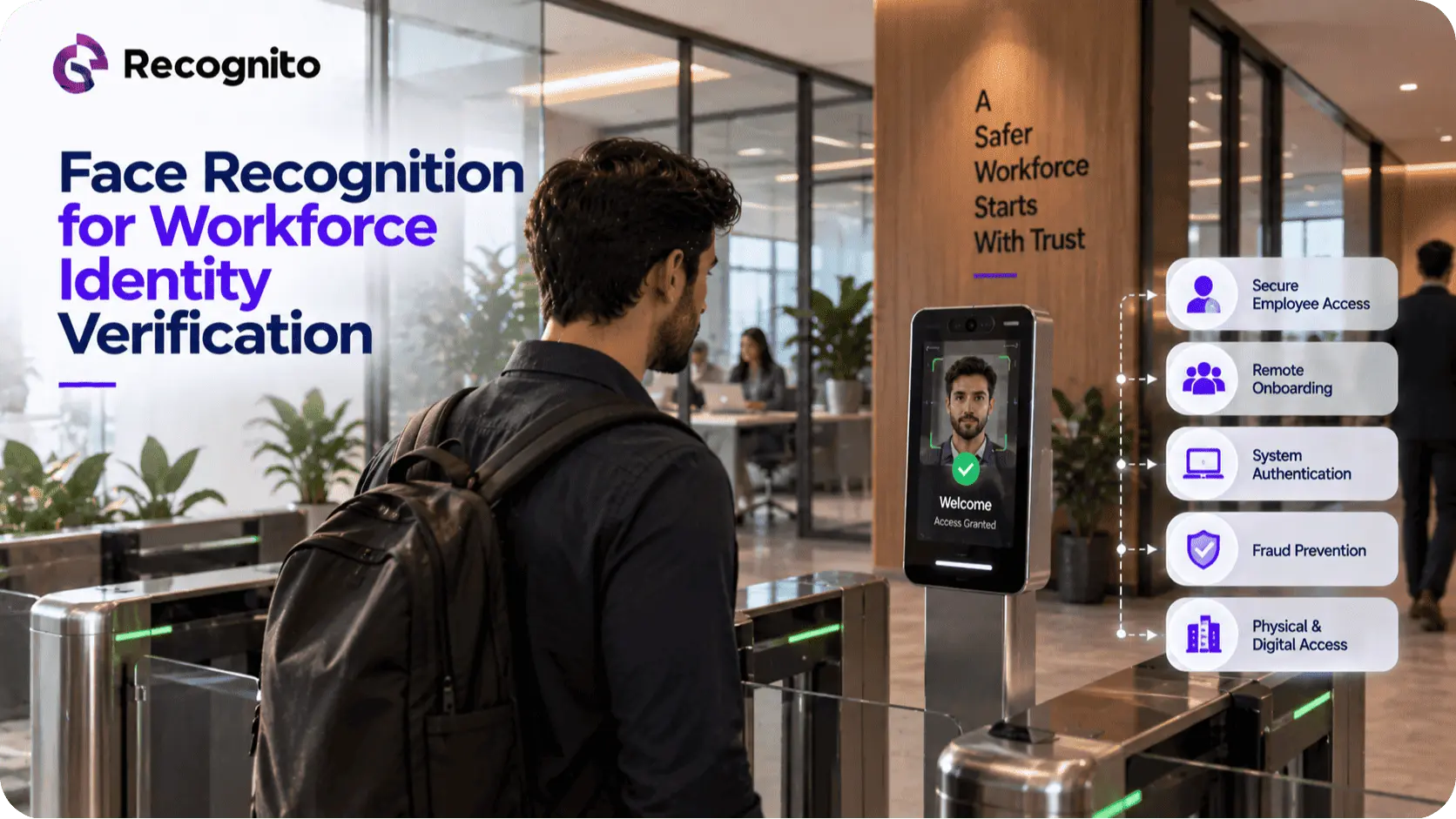


Digital customer onboarding is supposed to make financial services easier to access.
A customer should be able to open an account, apply for a financial product, or complete identity verification without visiting a branch or dealing with unnecessary paperwork. Yet many financial institutions still lose legitimate customers before onboarding is complete.
This is onboarding abandonment.
A customer may leave because the process takes too long, identity verification fails, instructions are unclear, too many checks are requested, or the experience becomes frustrating on their device.
The problem is particularly important for banks, fintech companies, payment providers, lenders, insurers, and other digital financial services. Strong security is necessary, but a verification process that creates excessive friction can directly affect conversion.
The solution is not to remove identity verification.
It is to design customer onboarding so that security controls work efficiently, failures are recoverable, and stronger verification is applied when the risk actually requires it.
This article explains the main causes of onboarding abandonment and how financial services companies can improve the experience without weakening identity verification or fraud prevention.
Why Customers Abandon Financial Onboarding
Customers rarely abandon an application for one simple reason.
The final decision may be influenced by several small sources of friction.
A customer might encounter a long form, then be asked to photograph an identity document, wait for processing, complete facial verification, retry because of poor lighting, and finally receive another request for information.
Each step may be justified individually.
Together, they can create an experience that feels unnecessarily difficult.
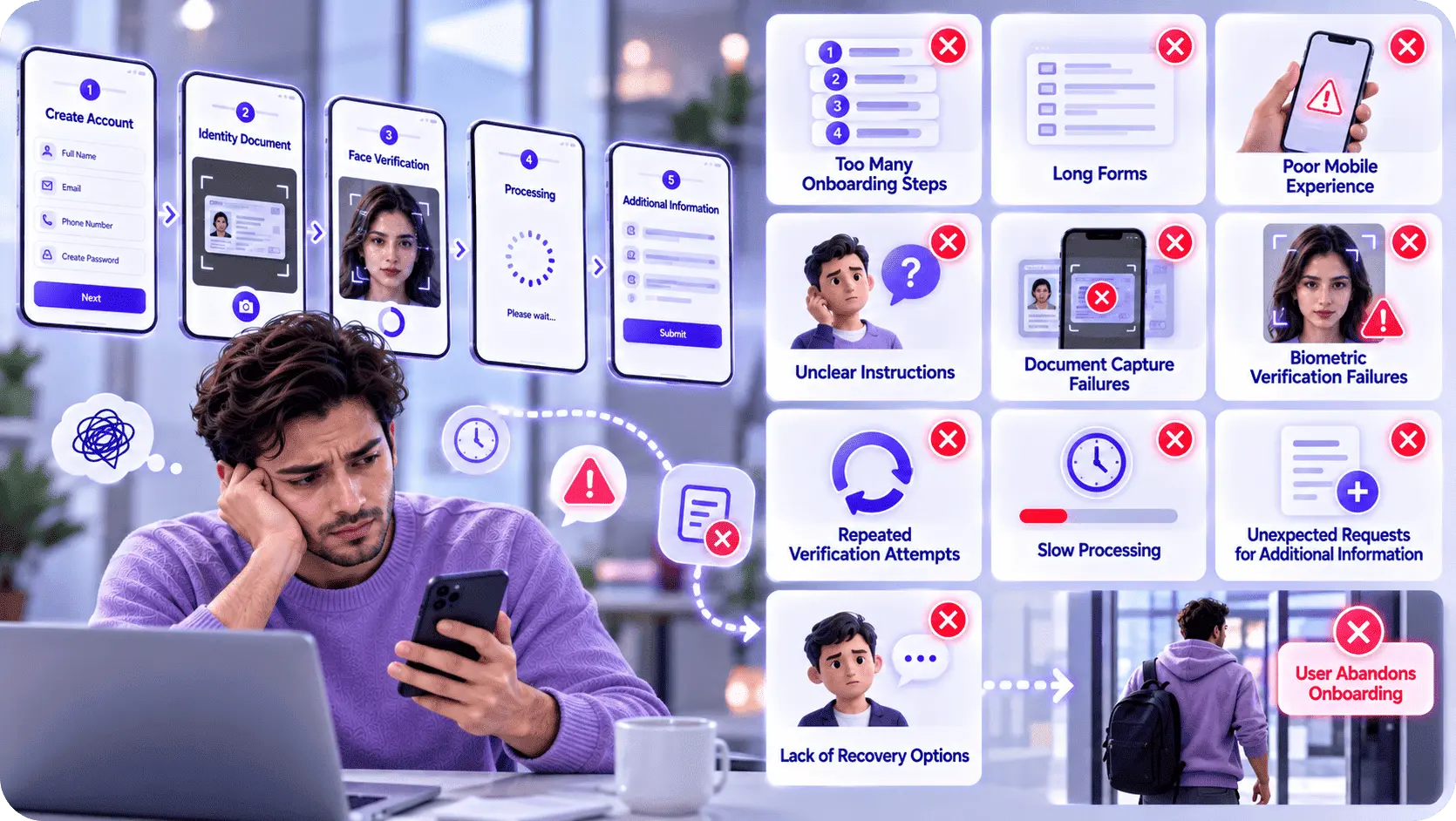
Common causes include:
- Too many onboarding steps
- Long forms
- Poor mobile experience
- Unclear instructions
- Document capture failures
- Biometric verification failures
- Repeated verification attempts
- Slow processing
- Unexpected requests for additional information
- Lack of recovery options
The first step toward reducing abandonment is therefore understanding where customers leave and why.
Identity Verification Is Often a Major Friction Point
Identity verification is essential for many financial services, particularly where businesses need to meet KYC or customer due diligence obligations.
But verification can become a major source of abandonment when the workflow is poorly designed.
Consider a customer who successfully completes the application form but then reaches an identity verification screen that asks them to photograph their passport.
The document image fails.
The customer tries again.
It fails again.
The application does not explain what went wrong or how to fix it.
At this point, the customer may simply leave.
The problem is not necessarily the document verification technology itself. It may be the capture experience, instructions, error handling, or workflow design surrounding it.
Recognito’s article on identity verification workflow design provides additional context on how individual verification stages should work together rather than operating as disconnected checks.
1. Reduce Unnecessary Form Completion
One of the simplest ways to reduce abandonment is to avoid asking customers for information the organization does not actually need at that stage.
Long forms create friction before the customer has even reached the verification process.
Financial institutions should examine every field and ask:
Does this information need to be collected now?
Some information may be necessary for regulatory or business reasons.
Other information may be available from verified documents, existing records, or another stage in the customer’s relationship.
Reducing unnecessary data entry can make the onboarding process feel significantly faster.
The objective is not to collect less information than compliance requires.
It is to avoid collecting more information than the current decision actually requires.
2. Make Identity Document Capture Easier
Document capture is one of the most visible points of friction in digital onboarding.
Customers may not know exactly how to position a passport or identity card. Glare, shadows, poor lighting, camera focus, or movement can lead to unsuccessful captures.
A well-designed workflow should guide the user before a failed submission occurs.
Useful guidance can explain:
- Place the document on a flat surface
- Avoid glare
- Use sufficient lighting
- Keep the entire document visible
- Hold the device steady
- Remove anything covering important document information
Automated quality checks can also identify unsuitable images before the customer waits for a complete verification result.
An ID document verification SDK can support the document stage while the application controls the surrounding user experience.
This distinction matters.
The SDK provides the verification capability, but the onboarding experience determines whether customers can use that capability successfully.
3. Simplify the Biometric Step
Facial verification can strengthen identity assurance, but it can also create friction when customers do not understand what they are supposed to do.
The biometric capture process should be as clear as possible.
Users should understand:
- Where to position their face
- How much of their face needs to be visible
- Whether glasses or other items should be removed
- How lighting should look
- Whether they need to move or remain still
- What happens after capture
For applications using an enterprise facial recognition SDK, the surrounding capture interface should be tested alongside the biometric technology.
A strong matching algorithm cannot compensate for a confusing capture experience.
4. Use Liveness Without Creating Excessive Friction
Liveness detection can provide important protection against presentation attacks, particularly in remote onboarding.
But the way liveness is implemented affects customer experience.
A workflow that requires multiple unfamiliar actions can increase abandonment, especially when customers do not understand why they are being asked to perform them.
The right implementation depends on the use case.
Some financial services workflows may benefit from passive approaches that reduce user interaction. Others may require more active interaction because of the level of security assurance required.
A liveness detection SDK can provide the underlying capability, while the onboarding application should explain the process clearly.
Recognito’s article comparing active and passive liveness detection provides additional context when evaluating the balance between security and user interaction.
5. Reduce Verification Retries
Repeated failures are one of the clearest warning signs for onboarding abandonment.
A customer who needs one retry may continue.
A customer who needs five retries is much more likely to leave.
Financial services companies should therefore monitor how many attempts are required at each verification stage.
For example:
Document capture: How many attempts before the document is accepted?
Facial verification: How many attempts before the face is matched?
Liveness: How many attempts before the check succeeds?
High retry rates can point to:
- Poor instructions
- Device compatibility problems
- Image-quality problems
- Overly strict thresholds
- Technical issues
- Excessive verification sensitivity
Reducing retries can improve customer experience without necessarily weakening the underlying security controls.
6. Design Better Failure and Recovery Paths
A failed verification should not automatically become a dead end.
This is one of the most important principles in reducing onboarding abandonment.
Consider two experiences.
Poor Experience
Verification failed.
The customer is sent back to the beginning.
Better Experience
We couldn’t read your document clearly. Please retake the photo in brighter lighting.
The second approach tells the customer what happened and what to do next.
Recovery options can include:
- Retry with better instructions
- Alternative supported document
- Different capture method
- Additional identity evidence
- Manual review
- Customer support escalation
The response should depend on why the verification failed.
A technical failure should not necessarily be treated the same way as a genuine identity mismatch.
7. Use Risk-Based Verification
One of the strongest ways to reduce friction is to stop treating every customer as equally risky.
A financial institution may have customers who can complete standard verification successfully with a relatively simple workflow.
Other applications may involve unusual devices, inconsistent identity information, high-value products, or other elevated-risk signals.
Instead of requiring maximum verification for everyone, organizations can use risk-based escalation.
For example:
Standard risk: identity and document verification.
Elevated risk: additional biometric verification.
Higher risk: biometric verification, liveness, enhanced checks, or manual review.
This allows the institution to direct friction toward the customers and scenarios where stronger controls are justified.
The result can be a better balance between fraud prevention and conversion.
8. Make Additional Verification Requests Understandable
Unexpected verification requests can cause customers to abandon an application simply because they do not understand why the information is required.
Financial institutions should explain the reason for additional steps in straightforward language.
For example:
“We need a quick facial verification to confirm that you are the person associated with your identity document.”
is much clearer than:
“Complete biometric authentication.”
The customer should understand:
- Why the check is required
- What they need to do
- How long it should take
- What happens afterward
Transparency can reduce uncertainty and make security requirements feel less disruptive.

9. Optimize for Mobile Customers
Financial onboarding increasingly happens on smartphones.
That makes mobile usability critical.
The verification workflow should be tested across realistic devices rather than only the newest flagship hardware.
Teams should pay attention to:
- Camera behavior
- Screen size
- Browser compatibility
- Upload performance
- Network conditions
- Permission prompts
- Capture responsiveness
- Device-specific failure rates
A customer should not have to understand the underlying technology to complete verification.
The interface should handle as much of the complexity as possible.
10. Reduce Unnecessary Manual Review
Manual review is valuable for ambiguous or higher-risk applications.
But if too many legitimate customers are routed to human review, onboarding can become slow and expensive.
A high manual-review rate may indicate:
- Poor automated verification
- Overly conservative thresholds
- Weak document capture
- Inconsistent identity data
- Poor risk rules
Financial services companies should analyze the reasons cases are escalated.
The objective is not to eliminate manual review.
It is to make sure human intervention is being used where it adds genuine value.
11. Connect Verification Results Across the Workflow
Customers should not have to repeatedly prove the same thing because different systems cannot communicate.
For example, if a customer has already completed document verification, the next stage should be able to use that verified information instead of asking them to repeat it unnecessarily.
A well-designed workflow connects:
Identity information
→
Document verification
→
Biometric verification
→
Liveness
→
Risk decision
The output of one stage should become usable evidence for the next.
This reduces redundant steps and can make the overall onboarding process feel significantly faster.
12. Measure Where Customers Actually Drop Off
Reducing onboarding abandonment requires measurement.
A financial institution should know exactly where customers stop progressing.
Useful onboarding metrics include:
- Form abandonment
- Document capture abandonment
- Verification failure
- Biometric failure
- Liveness failure
- Retry rate
- Manual-review abandonment
- Average verification time
- Final onboarding completion
The numbers become much more useful when segmented by device, market, application type, and verification stage.
For example, if abandonment suddenly increases only on one mobile operating system, the problem may be technical rather than related to customer intent.
What Financial Institutions Should Measure
A useful measurement framework should combine customer, security, and operational outcomes.
| Metric | What It Shows | Why It Matters |
| Onboarding completion rate | Percentage reaching final completion | Overall customer journey effectiveness |
| First-attempt verification | Customers passing without retry | Capture and workflow quality |
| Retry rate | Repeated verification attempts | Friction and technical problems |
| Verification abandonment | Customers leaving during identity checks | Direct onboarding loss |
| Manual review rate | Applications requiring human intervention | Operational efficiency |
| Verification time | Time from start to final result | Customer experience |
| False rejection | Legitimate customers incorrectly stopped | Security-versus-conversion balance |
| Fraud detection | Suspicious applications identified | Security effectiveness |
These metrics should be reviewed together.
For example, reducing abandonment by lowering verification thresholds may improve completion while increasing fraud exposure.
Likewise, increasing security sensitivity may reduce fraudulent approvals while increasing legitimate-user rejection.
The objective is to optimize the whole system, not one number.
Customer Onboarding vs Security: Finding the Right Balance
Financial institutions sometimes view friction as unavoidable.
Some friction is necessary.
A regulated financial service cannot simply remove identity verification because customers find it inconvenient.
But unnecessary friction is different.
A customer should not have to repeat the same step because of poor workflow design. They should not receive unexplained errors. They should not be forced through maximum verification when the risk does not justify it.
This is where good UX and security can support each other.
A more efficient workflow can actually improve security by making customers more likely to complete all required checks instead of abandoning midway and looking for alternative paths.
Personalization Can Reduce Friction
Not every customer needs the same onboarding journey.
A risk-aware system can determine which verification path is appropriate.
For example, a customer with consistent identity information, a familiar device, and a straightforward application may complete standard verification.
Another customer with conflicting information or unusual activity may be asked for additional biometric or identity checks.
This means the platform can personalize verification intensity, not necessarily personalize the security requirement itself.
The objective is to apply the amount of verification needed for the specific level of risk.
How Biometric Verification Can Improve Onboarding
Biometric verification can actually reduce friction when it replaces repetitive manual processes.
Instead of asking customers to enter large amounts of information repeatedly, the platform can use document and biometric signals to automate parts of identity verification.
A customer may capture their identity document, complete a facial check, and receive an automated result without a long manual process.
This is particularly useful when facial verification is integrated directly into the application rather than operating as a disconnected third-party flow.
The technology therefore needs to be evaluated not only on security but also on how efficiently it converts identity evidence into a final onboarding decision.
How Financial Institutions Should Test Their Onboarding Workflow
Before changing a production onboarding journey, teams should test the complete process with real users and realistic conditions.
Test Normal Customers
Make sure legitimate customers can complete the workflow without unnecessary obstacles.
Test Difficult Capture Conditions
Include poor lighting, older devices, different cameras, and realistic image-quality problems.
Test Verification Failures
Make sure customers receive meaningful instructions and recovery options.
Test High-Risk Scenarios
Evaluate how the system responds when risk signals require stronger verification.
Measure Every Stage
Track exactly where customers slow down, retry, or abandon the process.
This produces actionable information instead of relying on general feedback such as “the KYC process feels too long.”
The Role of SDK-Based Verification in Reducing Abandonment
SDK-based verification can be particularly useful for financial institutions that want to keep customers inside their existing application.
Instead of sending a customer through multiple disconnected verification experiences, an institution can integrate identity, document, facial, and liveness capabilities into its own onboarding flow.
For example, an ID document verification SDK can support the document stage while biometric capabilities handle the person-to-identity step.
Technical teams can also use the Face Biometric Playground to evaluate the practical capture experience before production integration.
For development research and implementation planning, the Recognito GitHub repository can provide additional technical resources.
The advantage of an SDK-based architecture is control.
The financial institution determines when verification happens, how the customer is guided through it, what happens after failure, and how verification results feed into the wider onboarding decision.
Common Mistakes That Increase Onboarding Abandonment
Asking for Too Much Information Too Early
Long forms can create unnecessary friction before the customer understands the value of completing the process.
Making Customers Repeat Verification
If systems do not share verification results effectively, customers may be asked to repeat steps.
Using Poor Error Messages
“Verification failed” does not tell the customer how to succeed.
Applying Maximum Verification to Everyone
Risk-based verification can reduce unnecessary steps for lower-risk customers.
Ignoring Device Differences
A workflow that works on one phone may fail on another.
Measuring Only Completion
A high completion rate does not necessarily mean the process is secure. Fraud outcomes must be considered alongside customer metrics.
Building a Lower-Abandonment Verification Strategy
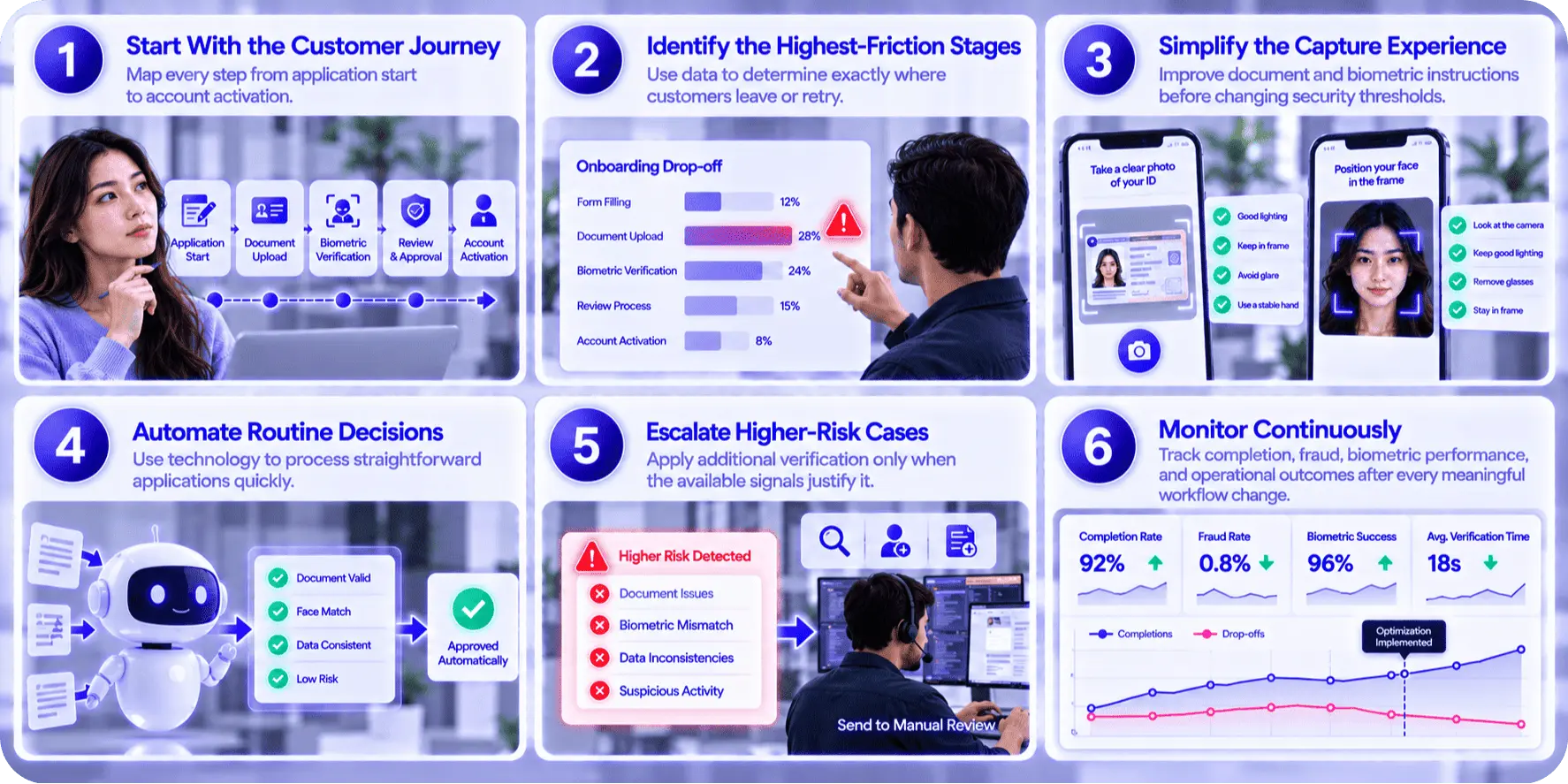
Financial institutions can improve onboarding by treating verification as a complete customer journey.
Start With the Customer Journey
Map every step from application start to account activation.
Identify the Highest-Friction Stages
Use data to determine exactly where customers leave or retry.
Simplify the Capture Experience
Improve document and biometric instructions before changing security thresholds.
Automate Routine Decisions
Use technology to process straightforward applications quickly.
Escalate Higher-Risk Cases
Apply additional verification only when the available signals justify it.
Monitor Continuously
Track completion, fraud, biometric performance, and operational outcomes after every meaningful workflow change.
This approach creates a more sustainable balance between security and conversion.
Conclusion
Onboarding abandonment is often treated as a customer-experience problem, but for financial services it is also a verification-design problem.
Customers can leave because forms are unnecessarily long, document capture is difficult, biometric checks fail repeatedly, additional verification is unexplained, or the recovery process is poor.
The answer is not to weaken identity verification.
It is to design the customer onboarding workflow so that every verification step has a clear purpose, legitimate users can recover from technical failures, and stronger controls are introduced when risk actually requires them.
Document verification, biometric verification, liveness, risk-based decisioning, and manual review can work together without forcing every customer through the same level of friction.
The most effective financial institutions measure both sides of the equation: how well they stop fraud and how efficiently legitimate customers complete onboarding.
Organizations evaluating SDK-based identity and biometric technologies can explore the broader capabilities available from Recognito as part of a lower-friction, high-assurance digital onboarding strategy.
Frequently Asked Questions
What causes onboarding abandonment in financial services?
Common causes include long forms, unclear instructions, repeated verification attempts, document or biometric failures, slow processing, unexpected information requests, poor mobile experiences, and a lack of recovery options.
Does reducing onboarding abandonment mean weakening identity verification?
No. The goal is to remove unnecessary friction while maintaining the verification controls required for the organization’s risk and compliance requirements. Risk-based verification can help achieve that balance.
How can biometric verification reduce onboarding friction?
Biometric verification can automate part of the identity process and reduce repetitive manual data entry. When integrated properly into the existing application, it can provide strong identity assurance without requiring a completely separate customer journey.
What onboarding metrics should financial institutions track?
Useful measures include completion rate, first-attempt verification, retry rate, abandonment by stage, verification time, manual review rate, false rejection, and fraud detection outcomes.
How can financial institutions improve identity verification without frustrating customers?
They should simplify capture instructions, optimize mobile workflows, provide clear failure recovery, connect verification stages, automate straightforward applications, and use stronger verification selectively when risk increases.