
A face can be copied. A photograph can be downloaded, a video can be replayed, and increasingly realistic synthetic media can be generated without the target person ever participating in a verification session.
That creates a fundamental weakness for digital identity systems: a facial match does not automatically prove that a real person is physically present in front of the camera.
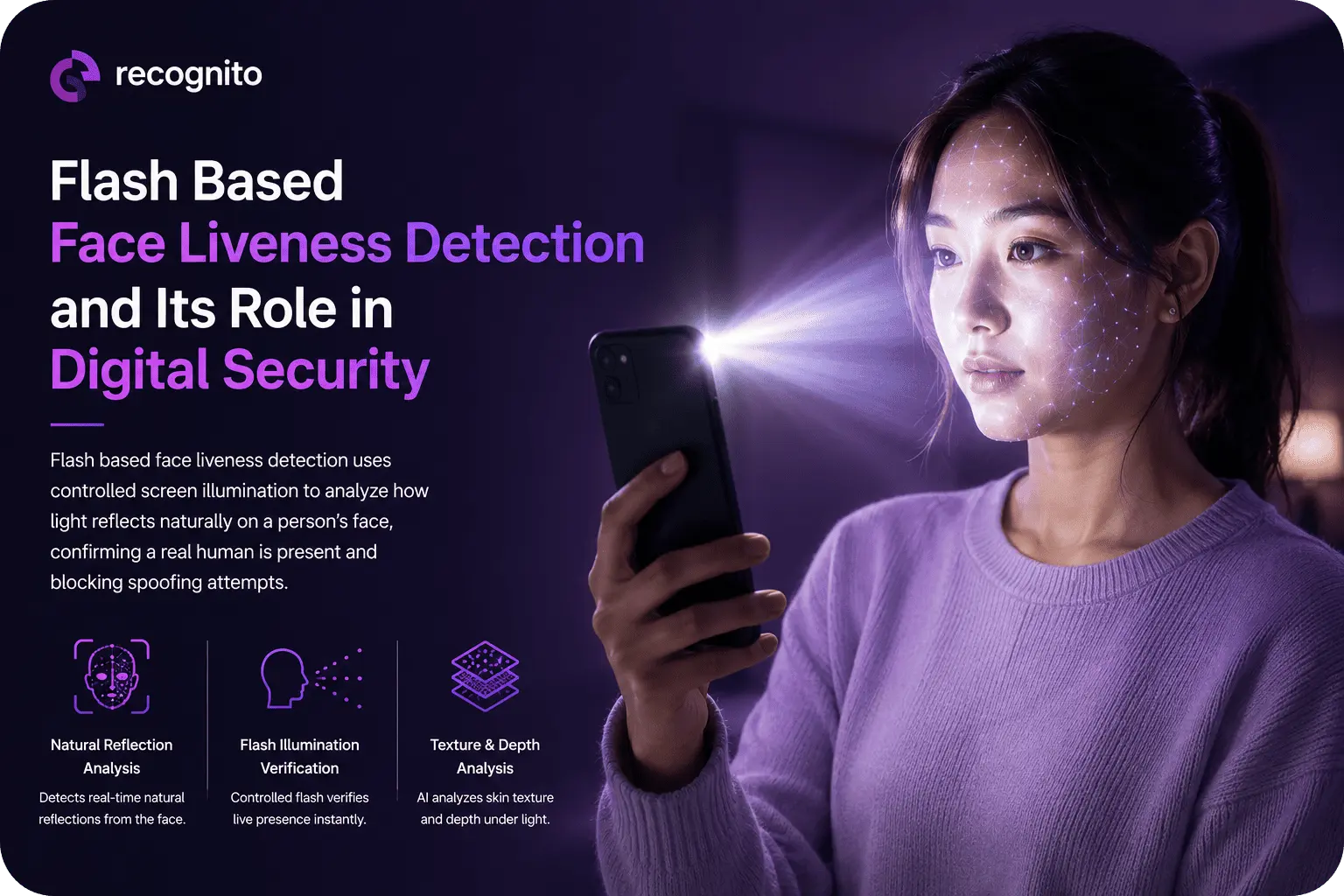
This is where face liveness detection becomes important. Among the different approaches, flash-based face liveness detection uses a short burst of controlled illumination and analyzes how the captured face responds. The goal is to obtain additional physical evidence that is difficult to reproduce with a flat photograph, screen replay, or other presentation attack.
For banks, fintechs, digital onboarding platforms, access-control providers, and other organizations using facial biometrics, flash-based detection can add another layer between a legitimate user and an attacker trying to impersonate them.
Why Facial Recognition Alone Is Not Enough
Facial recognition answers a matching question: do the biometric characteristics in the captured image resemble those of the reference identity?
That is useful, but it leaves a second question unanswered: Is the captured face actually being presented by the person it belongs to?
NIST defines presentation attack detection as the automated determination of whether a biometric presentation is an attack. Its guidance recognizes that facial images are particularly exposed because they are widely available and can often be collected without the subject’s knowledge. The NIST presentation attack detection definition describes liveness detection as one category of methods that can analyze biological characteristics or reactions to determine whether the biometric sample comes from a living subject at the capture point.
A fraudster may therefore attack the capture stage rather than the matching algorithm itself.
A printed photograph, an image displayed on another device, a replayed video, a sophisticated mask, or manipulated media can potentially be presented to a camera as though it were the legitimate user. NIST’s research on face presentation attacks specifically illustrates how photographs, digital images, and appearance-altering methods can be used to challenge facial recognition systems.
Liveness detection exists to address that gap.
What Makes Flash-Based Liveness Different?
Flash-based liveness detection introduces controlled illumination into the capture process.
A camera captures the user’s face while a flash or other controlled light source briefly illuminates it. The system then analyzes how that light interacts with the facial surface.
The underlying idea is straightforward: real human skin does not behave like a flat photograph or display screen when illuminated.
Light interacts with skin through surface reflection, subsurface scattering, texture, color variation, and three-dimensional facial structure. A liveness model can examine changes across captured frames and use these physical signals as additional evidence.
Recognito’s flash-based face liveness detection material describes this approach as using a brief illumination event and analyzing the resulting facial response to distinguish a live face from presentation artifacts.
The important point is not that flash makes a system impossible to fool. It gives the detector another observable signal beyond facial appearance itself.
How Flash-Based Face Liveness Detection Works
A typical sequence can be understood in four stages.
1. Face capture begins
The application positions the user’s face within the camera frame and establishes a usable capture condition.
Image quality matters from the beginning. Excessive motion, poor framing, glare, or insufficient illumination can make the subsequent liveness analysis less reliable.
2. Controlled illumination is introduced
A brief burst of light is generated by the camera flash, screen, or another controlled illumination source.
The light interacts with the face while the camera records the response.
3. The system analyzes the response
Machine-learning models examine changes in brightness, reflection, texture, color, and other visual characteristics across the captured frames.
The objective is not simply to detect whether a face is present. It is to determine whether the observed response is consistent with a live three-dimensional human face.
4. A liveness decision is produced
The system generates a score or classification that can be incorporated into the broader identity-verification workflow.
A verification engine may then combine that result with face matching, document verification, fraud signals, and business rules before deciding whether to approve the transaction or request additional verification.
This layered architecture is important because liveness is a security control, not the entire identity decision.
Flash-Based vs Passive and Active Liveness
Flash-based approaches sit within the larger liveness and presentation-attack-detection landscape.
Passive systems generally attempt to detect spoofing without requiring the user to perform a deliberate action. Active approaches may ask the user to move, blink, turn their head, or respond to another challenge.
Flash-based methods can also be designed around relatively passive interaction because the illumination itself provides an additional signal without requiring complex user instructions.
| Approach | User interaction | Main signal | Typical strength | Main consideration |
| Flash-based liveness | Low | Response to controlled illumination | Adds physical reflectance and depth cues | Depends on camera and lighting behavior |
| Passive liveness | Low | Facial texture, motion, image characteristics | Smooth user experience | Performance depends on available visual signals |
| Active liveness | Higher | User response to a challenge | Can add challenge-response evidence | More friction and possible accessibility issues |
| Multi-signal liveness | Low to moderate | Multiple biometric and capture signals | Broader attack coverage | Greater implementation complexity |
No single method should automatically be treated as superior in every environment. The right approach depends on the threat model, device population, user experience requirements, and the attacks the organization needs to resist.
The broader distinction between active and passive liveness detection is useful when deciding which interaction model best fits a particular application.
Why Flash Adds Useful Physical Evidence
The main security value of flash-based detection comes from the information it introduces that is difficult to obtain from an ordinary still image.
A conventional selfie captures appearance. Controlled illumination can reveal how the apparent surface responds to light.
That can help distinguish:
- a human face from a printed photograph
- a live face from an image displayed on a screen
- a real surface from some artificial materials
- a genuine capture from certain forms of replay or reproduction
The detector can also examine changes over time rather than relying on a single frame.
This is particularly useful because attackers increasingly produce higher-quality presentation artifacts. As image resolution and generative-media quality improve, simply looking for obvious visual defects becomes less dependable.
A multi-signal approach can therefore make the attacker’s task harder.
What Flash-Based Liveness Cannot Solve by Itself
It is important not to oversell any liveness method.
A sophisticated presentation attack may exploit weaknesses in the camera pipeline, capture environment, software stack, or the liveness model itself. Digital injection attacks present another challenge because an attacker may attempt to interfere with the media before the verification engine processes it.
NIST’s evaluation work on passive software-based face presentation attack detection demonstrates that presentation attack detection is its own technical problem with measurable performance characteristics. The report evaluates how software-based PAD algorithms perform against different presentation attack instruments using conventional 2D imagery.
That distinction matters for procurement. A vendor’s claim that its face recognition model is highly accurate does not automatically demonstrate strong liveness performance.
Likewise, strong liveness performance does not guarantee that a complete identity-verification system is secure against every attack.
Where Flash-Based Liveness Fits in Digital Security
Flash-based liveness is most valuable when facial verification is being performed remotely.
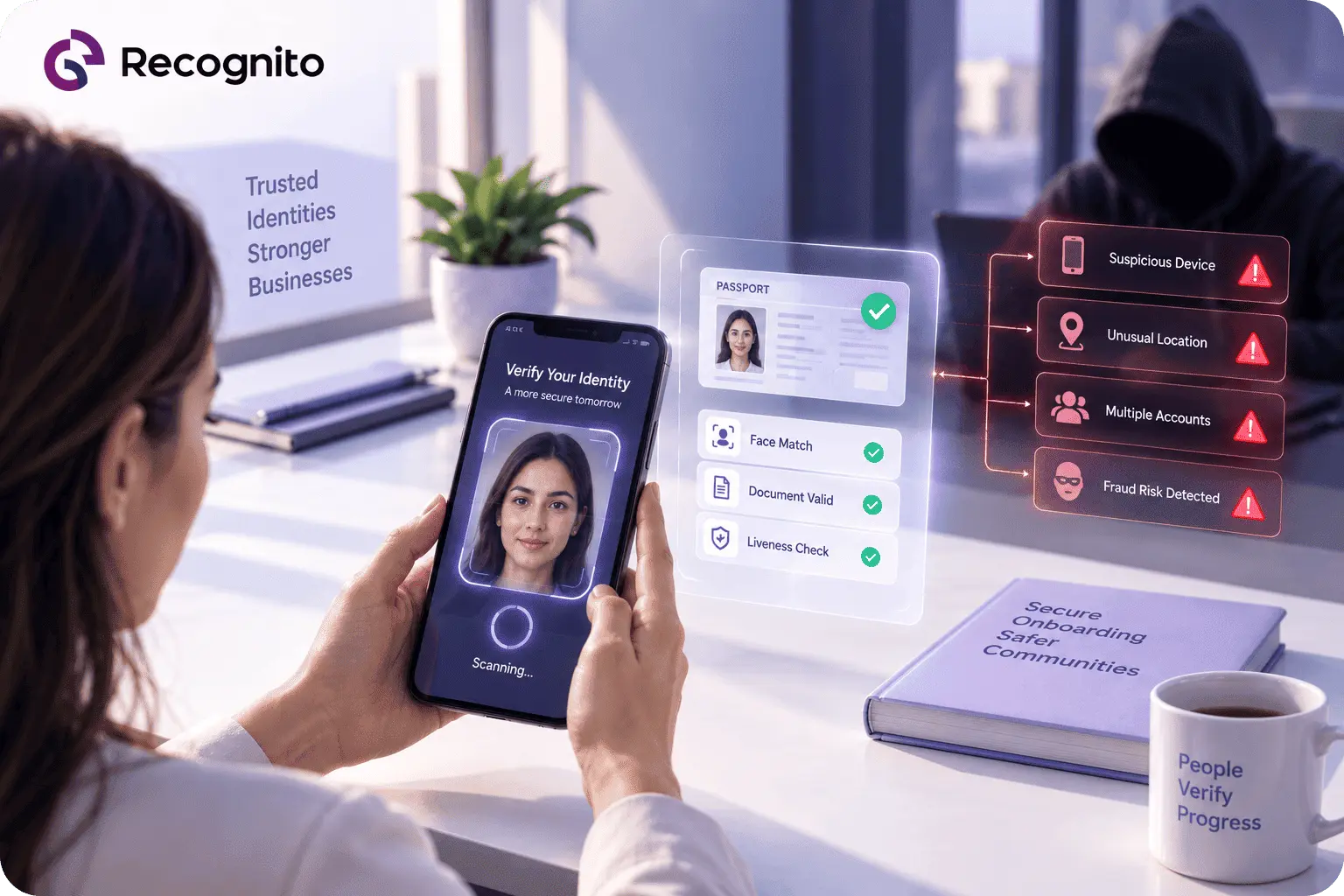
Consider a digital bank onboarding flow. A customer submits an identity document and then captures a selfie. If the system performs only facial matching, an attacker may attempt to present a photograph or replayed media belonging to the legitimate customer.
Adding liveness changes the question from:
“Does this face resemble the enrolled person?”
to:
“Does this capture appear to contain a live person whose face matches the expected identity?”
That is a much stronger security model.
The same principle applies to account recovery, high-risk authentication, remote access, age-sensitive transactions, and other workflows where there is no trusted employee physically supervising the interaction.
Organizations building broader facial-biometric defenses can also review deep learning for face anti-spoofing to understand how machine-learning approaches address increasingly sophisticated presentation attacks.
The Role of Camera and Device Quality
Flash-based liveness is still constrained by the hardware capturing the response.
A phone with a poor camera, excessive motion, inadequate flash behavior, or unusual camera processing may produce weaker evidence. Differences between device manufacturers can also affect image characteristics.
That creates an important engineering requirement: test the system across the actual device population.
A deployment team should consider:
- camera resolution
- autofocus behavior
- exposure changes
- flash intensity and timing
- front-camera limitations
- screen illumination behavior
- frame rate
- operating-system differences
- image compression
- low-light conditions
A model that performs well on controlled test hardware may require additional calibration or capture guidance when deployed across thousands of device configurations.
User Experience Still Matters
Security controls become less useful when legitimate users cannot complete them.
A liveness system that requires repeated attempts, confusing positioning, or long capture sequences can increase abandonment.
Flash-based approaches can have an advantage when they obtain additional evidence without forcing the user through an elaborate challenge. The system can often keep the experience relatively simple: position the face, capture, illuminate, analyze, and return a result.
However, organizations should still provide clear feedback when a capture fails.
A failed liveness result should not always be interpreted as proof of malicious activity. The customer may have moved, the camera may have struggled, the face may have been poorly positioned, or the lighting conditions may have reduced confidence.
Good workflows distinguish between:
- clear attack indicators
- insufficient image quality
- inconclusive liveness
- temporary capture problems
- successful verification
That allows security controls to remain strong without unnecessarily blocking legitimate users.
Flash-Based Liveness and Deepfake Threats
Deepfakes have changed the conversation around facial security.
A synthetic or manipulated video can potentially present a highly convincing face without the real person participating in the session. A liveness system therefore needs to consider more than whether facial features look realistic.
Flash provides an additional physical interaction for the system to observe. A generated face or replayed video must reproduce the expected response to the illumination event, rather than merely display a convincing facial appearance.
This does not mean flash-based detection automatically defeats every deepfake. Attackers can target the capture pipeline, create sophisticated physical artifacts, or attempt digital injection.
The stronger architectural response is therefore layered defense: liveness, face matching, protected capture, media integrity checks, device security, and risk analysis.
How to Integrate Flash-Based Liveness Into an Identity Workflow
The technology becomes much more useful when it is connected to the rest of the verification stack.
A practical architecture can follow this sequence:
Capture: guide the customer to obtain a usable facial image.
Quality assessment: reject frames that are too blurry, dark, or poorly framed.
Liveness analysis: introduce the controlled illumination event and evaluate the facial response.
Face comparison: compare the live face against the trusted reference.
Identity verification: connect the result with document and identity information where required.
Risk decisioning: combine liveness and matching results with other available fraud signals.
Escalation: send uncertain cases to additional verification or human review.
This separation makes the system easier to monitor. A failed transaction can be investigated based on the specific stage that produced the problem rather than a generic “biometric verification failed” message.
For teams integrating liveness into applications, a face liveness SDK can provide the underlying capture and detection components while leaving the organization to define its own identity and risk workflow.
How Businesses Should Evaluate a Flash-Based Liveness Solution
A successful proof of concept is not enough. Security teams should evaluate the technology against realistic attack scenarios and production conditions.
Important questions include:
Which attacks were tested?
Ask how the system performs against printed photographs, screen replays, video attacks, masks, manipulated media, and relevant injection scenarios.
What hardware was used?
Test the same types of phones, cameras, operating systems, and capture conditions expected in production.
What happens when the result is inconclusive?
A mature workflow should provide retry, fallback, or escalation paths instead of treating every failed attempt as fraud.
How is performance measured?
Ask for appropriate presentation-attack metrics and test methodology rather than a generic “liveness accuracy” percentage.
How does it affect conversion?
Measure successful first attempts, retry rates, abandonment, latency, and manual-review volume alongside security outcomes.
Can the system operate as part of a layered architecture?
Liveness should complement facial matching, identity documents, fraud detection, and authentication controls rather than becoming a single point of trust.
Privacy and Data Protection Considerations
Facial liveness processing involves biometric information and therefore deserves careful data governance.
Organizations should determine what imagery is collected, whether intermediate frames are stored, how biometric representations are protected, how long data is retained, and which components receive the information.
Privacy architecture should be designed around the minimum information required for the security objective. Organizations may also need to consider jurisdiction-specific biometric and privacy requirements, especially when operating across multiple markets.
Security and privacy should therefore be assessed together. A highly effective liveness system can still create unnecessary exposure if data is retained indefinitely or accessible to more systems than required.
The Business Case for Flash-Based Liveness
The value of flash-based liveness is not limited to blocking attacks.
A reliable liveness layer can help reduce manual verification, make remote onboarding more scalable, and increase confidence in automated identity decisions.
For high-volume workflows, even a modest reduction in successful spoof attempts or unnecessary manual cases can have significant operational value.
The business case should therefore measure multiple outcomes:
- fraudulent attempts stopped
- legitimate verification success
- first-attempt completion
- retry rate
- average verification time
- manual-review volume
- customer abandonment
- operational cost
The strongest implementation is not simply the one with the most aggressive security settings. It is the one that produces the right balance between attack resistance and legitimate-user completion.
Where the Technology Is Heading
Flash-based liveness is part of a broader shift toward multi-signal biometric security.
Instead of relying on a single visual clue, modern systems can combine facial appearance, motion, depth, illumination response, image quality, device signals, and attack-detection models.
That approach is increasingly important because attackers do not necessarily target the biometric algorithm itself. They may target the camera, software pipeline, communication channel, or decision logic around it.
The more independent evidence a system can validate, the harder it becomes to construct a convincing end-to-end fraud attempt.
Developers evaluating biometric technologies can also explore the Recognito GitHub repository for technical resources that complement implementation and integration work.
Conclusion
Flash-based face liveness detection adds an important physical signal to facial verification by observing how a face responds to controlled illumination.
Its role in digital security is not to replace facial recognition or solve every presentation attack. Its value comes from making the capture process harder to reproduce with simple photographs, screen replays, and other artificial representations.
The strongest architecture combines liveness with face matching, identity-document verification, protected capture, fraud analysis, device controls, and risk-based decisioning. Just as importantly, the system should be tested against real devices, real users, and realistic attacks.
For organizations building secure biometric workflows, Recognito provides technologies that can support face liveness and broader digital identity verification requirements.
Frequently Asked Questions
Is flash-based liveness better than passive liveness?
Not universally. Flash-based detection adds illumination-related evidence, while passive approaches may offer a smoother capture process. The better choice depends on the device environment, threat model, attack coverage, and user-experience requirements.
Can flash-based liveness stop deepfakes?
It can add a security layer against certain presentation attacks, but it should not be treated as a complete deepfake defense. Modern deployments should combine liveness with media, device, and fraud controls.
Does flash-based liveness require special hardware?
It depends on the implementation. Mobile deployments can use available camera and illumination capabilities, but performance must be validated across the devices that customers actually use.
Can liveness detection reject legitimate users?
Yes. Poor lighting, movement, camera quality, positioning, or other capture problems can produce inconclusive or failed results. Well-designed workflows should provide retries and secure fallback paths.
Where should flash-based liveness be used?
It is particularly relevant to remote identity verification, digital onboarding, authentication, account recovery, and other workflows where the organization needs evidence that a real person is physically present during facial capture.