
A face recognition system that works well on an unobstructed face can behave very differently when part of that face is hidden. Masks cover the nose, mouth, cheeks, and lower facial contours that many recognition models traditionally use as evidence. That creates a practical problem for organizations deploying biometrics in healthcare, transportation, workplace access, retail, public-facing services, and identity verification.
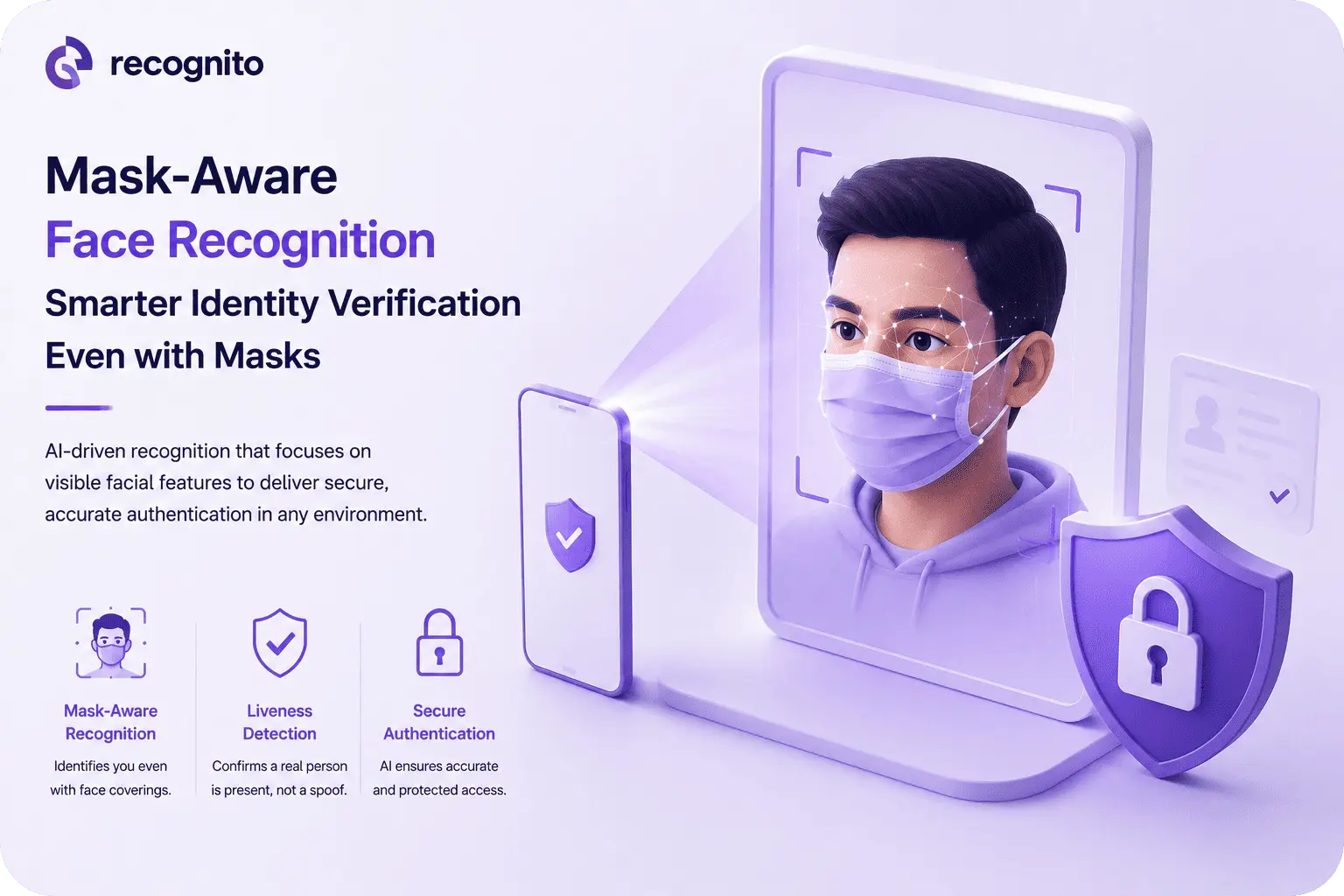
Mask-aware face recognition is the response to that problem. Instead of treating an occluded face as a badly captured version of a normal face, modern systems are designed to recognize people from the visible facial region while accounting for the missing information.
The change matters because biometric security operates beyond controlled environments. Users may wear medical masks, protective equipment, or other coverings, so systems must tolerate partial occlusion.
The goal is to balance recognition performance, security, usability, and privacy.
Why Face Masks Changed the Recognition Problem
Traditional face recognition models often benefit from access to a large portion of the face. Facial geometry around the eyes, nose, mouth, jaw, and cheeks can contribute to the biometric representation.
A mask removes some of that information before the recognition algorithm receives the image.
NIST studied this problem directly during the COVID-19 period. Its early testing found that pre-pandemic algorithms performed substantially worse on digitally masked images, with accuracy declining as mask coverage increased. Later testing showed that newer algorithms could improve substantially.
NIST’s 2020 masked-face study is useful evidence that model design can materially affect results.
The important lesson is that face recognition accuracy depends on the algorithm, data, capture conditions, and the person’s appearance at recognition.
NIST’s current FRTE face-mask evaluation documents how masked and unmasked images are compared and provides a useful benchmark for understanding the problem.
What Makes a System Mask-Aware?
Mask-aware recognition generally means the system is designed to handle partial facial occlusion rather than simply hoping the standard model remains accurate.
One approach emphasizes the periocular region around the eyes. Another uses masked and unmasked training data so the model learns how the same person appears with different levels of facial coverage.
Some systems can also detect occlusion and adapt feature extraction or matching accordingly.
NIST’s mask evaluation describes an operationally relevant approach in which systems can extract features from a full face and the periocular area on unmasked images, use the periocular region for masked images, and compare combinations of masked and unmasked samples.
That matters because real systems rarely use identical conditions. An enrollment image may be uncovered while the verification image is masked, so the algorithm must tolerate that mismatch.
How Mask-Aware Recognition Changes the Matching Process
In a conventional 1:1 comparison, a system receives two facial samples and determines how closely their biometric representations correspond.
Mask-aware processing adds another layer of interpretation.
The system may detect occlusion, rely more on visible regions, and reduce the influence of features likely to be unavailable.
This is more than simply cropping away the lower face. The system must determine which visible features remain useful and how much confidence to assign to them.
Threshold calibration also matters. Too much confidence in limited facial evidence can increase false matches; an overly strict threshold can increase false non-matches.
Why NIST Testing Is Important for Businesses
NIST’s research provides a useful reminder that algorithms do not all respond to masks in the same way.
Its early evaluation reported large performance differences among algorithms, while later testing showed that some newer systems significantly reduced masked-face error rates. NIST also noted that mask shape, coverage, and color could influence results.
That makes benchmark data useful during vendor evaluation. A buyer should ask whether the algorithm has been tested with masked faces, whether enrollment and verification conditions can differ, and what error rates look like at the intended operating point.
The broader face recognition system explained with real examples topic provides useful context for understanding how capture, feature extraction, matching, and decision thresholds work together.
A strong benchmark does not guarantee equal production performance. Businesses need to reproduce relevant conditions with their own devices, populations, lighting, masks, and workflows.
Mask-Aware Recognition Is Not Just About Accuracy
Recognition performance is only one part of a biometric security system.
A workplace access-control deployment may need to recognize employees quickly while they move through an entry point. A healthcare environment may need reliable identification when protective equipment is common. A financial application may need to compare a live customer with an identity document portrait that does not show a mask.
Each scenario creates a different tolerance for errors and friction.
Repeated rejection of legitimate masked users can create queues and workarounds, while an overly permissive threshold can increase exposure.
Deployment teams should therefore define acceptable false-match and false-non-match levels before selecting an algorithm.
Mask-Aware Recognition vs Face Detection
Face detection finds where a face is; recognition determines whose face it is or whether two samples belong to the same person.
Masks can affect both stages. A poor facial crop can undermine matching even when the recognition model is strong. That makes capture, preprocessing, and quality checks part of the security system.
Teams evaluating implementation should consider face recognition SDK evaluation criteria alongside model performance, device support, latency, integration, and production reliability.
Security Risks That Mask-Aware Systems Must Handle
Mask-aware processing improves usability, but it changes the security surface.
Reduced biometric information
Less of the face is visible, so the model has fewer features available for comparison. High-security applications need thresholds that account for this reduced evidence.
False matches
Limited facial information can make unrelated faces more difficult to distinguish. Threshold calibration is therefore critical.
Presentation attacks
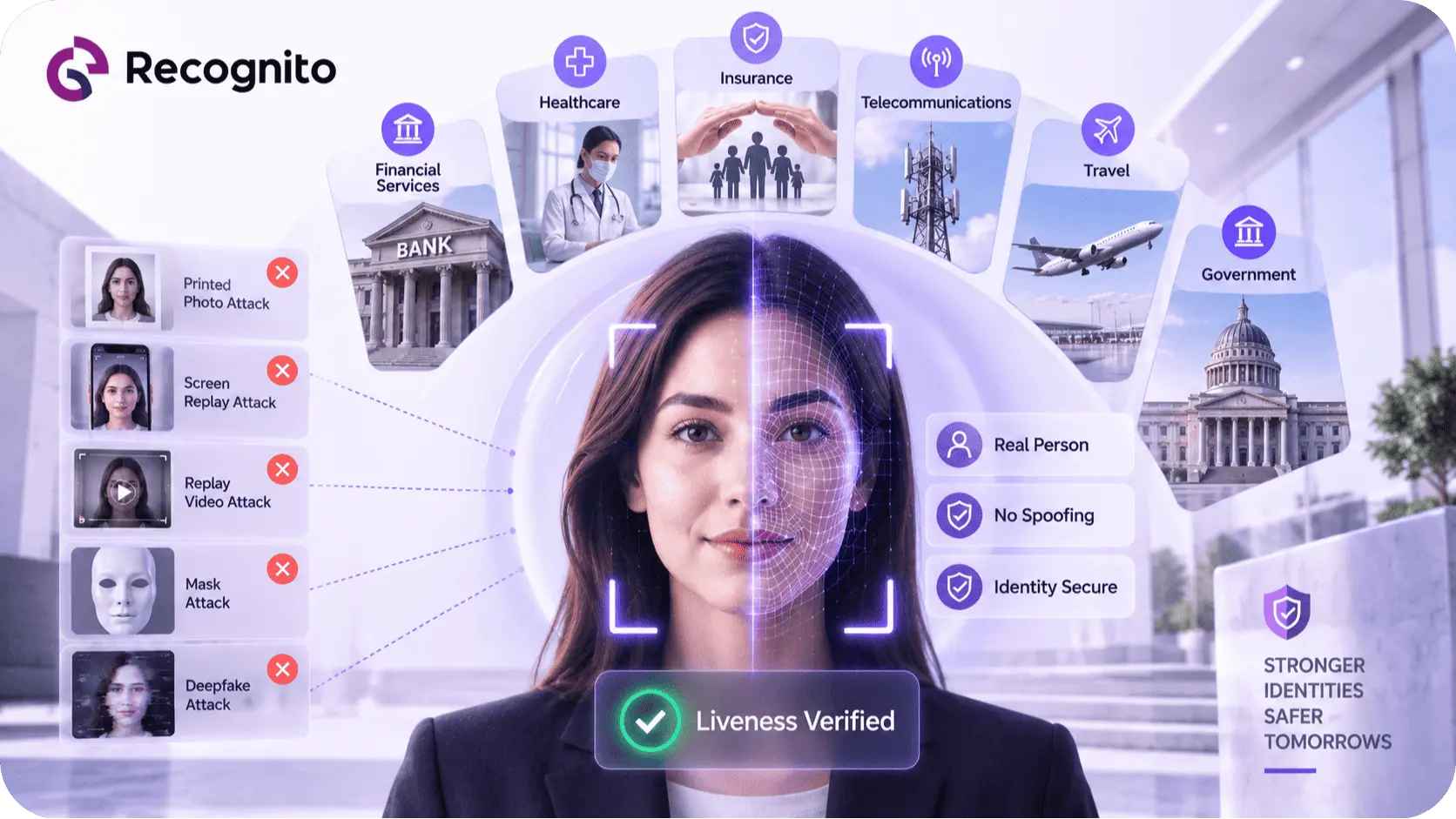
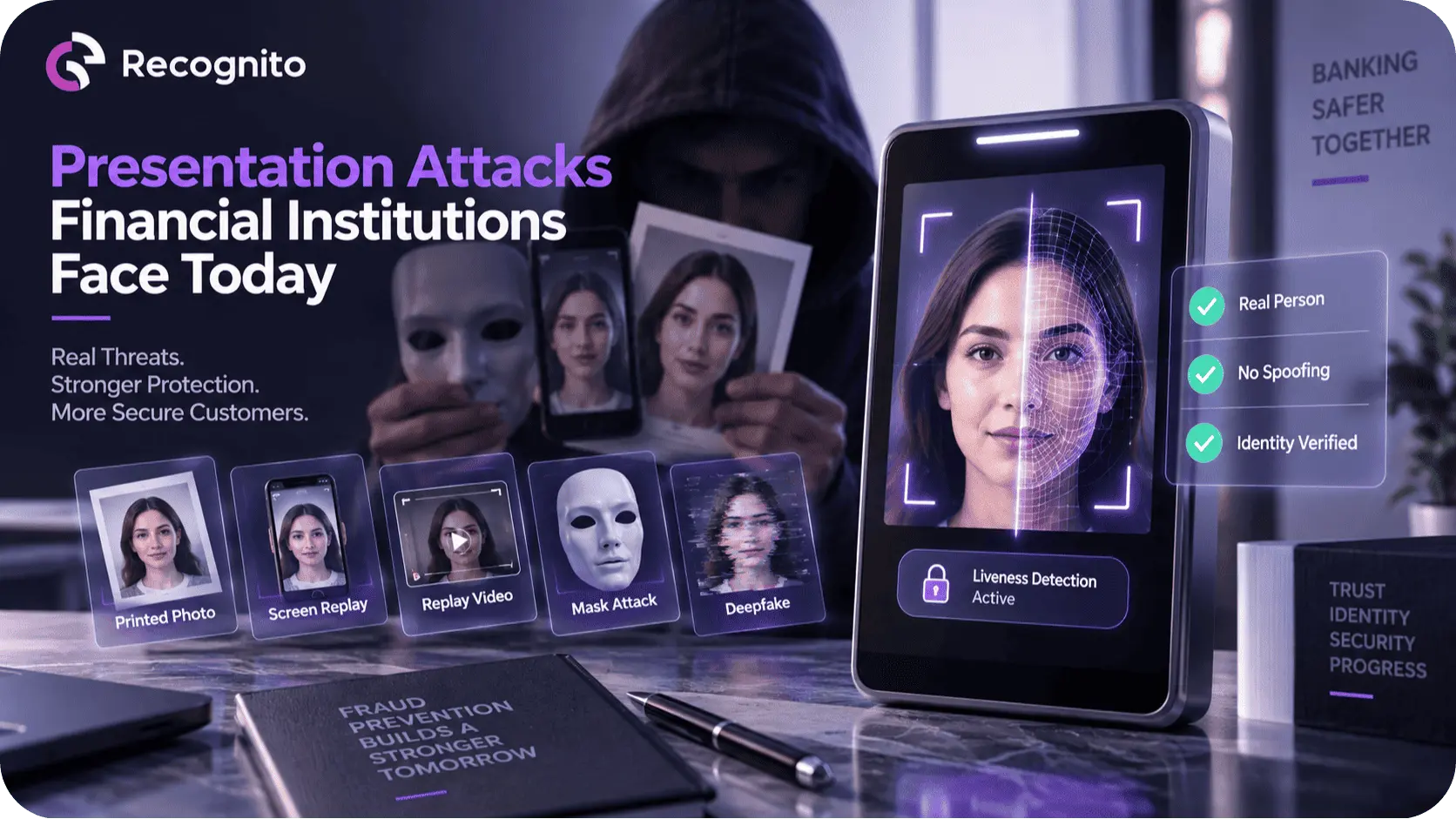
Mask-aware recognition does not replace liveness or presentation-attack detection. An attacker may still use photographs, replayed media, realistic masks, or other presentation methods.
A related discussion of active vs passive liveness detection explains why matching and liveness should remain separate controls.
Adversarial adaptation
Attackers may target assumptions built into the model, so robust deployments should combine recognition with capture controls, liveness, monitoring, and risk-based escalation.
Privacy Considerations Do Not Disappear
Mask-aware recognition can involve the same sensitive biometric information as conventional face recognition.
The privacy architecture should address what images are collected, whether biometric templates are created, where data is processed, how long information is retained, and who can access it.
This becomes particularly important when mask-aware recognition is used in public or workplace settings. A system designed for voluntary authentication has different privacy expectations from one used for persistent identification.
Choosing the Right Model for the Environment
There is no single definition of “mask-aware” that guarantees comparable performance across deployments.
A smartphone authentication system may have cooperative users and controlled framing, while entrance cameras face distance, motion, crowds, and inconsistent lighting. Testing should reflect real conditions.
| Factor | What to test | Why it matters |
| Mask coverage | Nose, mouth, cheeks, and lower-face coverage | Determines how much biometric information remains visible |
| Mask type | Medical, protective, fabric, and varied shapes | Different designs can change occlusion patterns |
| Image quality | Lighting, blur, resolution, camera angle | Poor capture can compound occlusion |
| Matching scenario | Masked-to-unmasked and masked-to-masked | Production samples may not have matching conditions |
| Demographics | Relevant user populations | Performance may vary between groups |
| Thresholds | FMR/FNMR or equivalent operating points | Balances security with legitimate-user access |
| Attack testing | Photos, replay, manipulation, and injection risks | Recognition alone does not establish liveness |
Mask-Aware Recognition and Demographic Performance
Demographic evaluation remains important when faces are partially covered.
NIST’s broader face recognition research has shown that demographic differentials can vary by algorithm and application. Partial occlusion adds another source of variation because the visible features and image quality may differ across users and environments.
Evaluate performance across the populations the system will serve and investigate meaningful differences before deployment.
Implementation: Build for Occlusion From the Start
Mask-aware performance should influence the system design before production.
Start with representative images and define the recognition task clearly. Determine whether the system performs 1:1 verification, 1:N identification, or both.
Then evaluate the complete pipeline:
- face detection
- quality assessment
- mask or occlusion detection
- feature extraction
- matching
- thresholding
- liveness
- decision rules
- logging and monitoring
Do not optimize only the matching model while ignoring capture.
Image quality is particularly important because the effects of masks can compound ordinary capture problems. Poor lighting, motion blur, unusual angles, and low resolution may make an already incomplete facial representation even less reliable.
For engineering teams implementing biometric features, a facial biometric SDK can reduce the amount of recognition infrastructure that must be built from scratch.
The development team can also use the Recognito GitHub repository while evaluating how biometric functionality fits into its application architecture.
Measuring Production Performance
After deployment, monitor operational data rather than benchmark results alone.
Track successful captures, failed matches, retries, manual escalations, false accepts, and false rejects, comparing masked and unmasked sessions.
Also watch for changes after a new camera, operating system, device, model version, or capture interface is introduced. A controlled pilot may not represent the conditions customers create in production.
Standards and Evaluation Are Evolving
The technical challenge is not limited to recognition algorithms. Capture quality and operational image acquisition also influence biometric performance.
ISO currently has work underway on face-aware capture subsystem specifications, covering automated and semi-automated capture, application-specific image quality, real-time capture feedback, and post-capture image handling.
Better recognition also depends on obtaining a usable biometric sample.
For mask-aware deployments, capture guidance should account for mask position and when image quality is insufficient.
How Businesses Should Evaluate a Mask-Aware Solution
A practical vendor assessment should answer six questions.
Does it support masked-to-unmasked matching? This is often more realistic than assuming all stored reference images will be masked.
What happens as coverage increases? Ask for results across realistic mask shapes and coverage levels.
How is the threshold calibrated? Examine security and usability together instead of reviewing accuracy in isolation.
How does the system perform on real devices? Test cameras, lighting, motion, and network conditions expected in production.
What protects against spoofing? Verify liveness and presentation-attack controls separately from recognition performance.
Can the system be monitored after launch? Teams need visibility into changing error rates, retries, demographic performance, and unusual attack patterns.
A vendor that cannot explain these points clearly is difficult to evaluate safely, regardless of how impressive its headline accuracy appears.
Conclusion
Mask-aware face recognition represents a broader shift in biometric security: systems are being designed for the way people actually appear in operational environments rather than for idealized, unobstructed images.
The technology can improve usability where face coverings are common, but it should not be reduced to a simple “mask on, accuracy up” feature. The important questions are how the algorithm handles partial information, how thresholds change the security trade-off, how liveness is enforced, and how performance behaves with real users and devices.
The strongest deployments treat mask awareness as one capability within a layered biometric architecture. Recognition, capture quality, liveness, attack detection, privacy, monitoring, and risk-based decisioning must work together.
For organizations building practical face biometric systems, Recognito can support deployments where reliable facial verification needs to work across less-than-ideal real-world conditions.
Frequently Asked Questions
Does wearing a mask make face recognition impossible?
No. Masks reduce the amount of visible facial information, but newer algorithms can be designed to recognize people using the remaining features. Performance depends heavily on the specific algorithm and capture conditions.
Can mask-aware recognition work when the reference image is unmasked?
Yes. This is an important operational scenario. A customer or employee may have an uncovered enrollment image while the verification image is captured with a mask.
Does mask-aware recognition replace liveness detection?
No. Mask-aware matching addresses partial facial occlusion. Liveness detection addresses whether the biometric input comes from a live subject rather than a presentation or manipulated representation.
Should businesses use benchmark results as proof of production performance?
No. Benchmarks are valuable for comparison, but production testing should use representative devices, users, environments, masks, and workflows.
What should businesses evaluate before selecting a mask-aware system?
Assess masked and unmasked matching, coverage tolerance, thresholds, image quality, demographic performance, liveness, attack resistance, real-device behavior, monitoring, and failure handling.