
Choosing a face recognition SDK for enterprise use is not simply about finding the provider with the highest advertised accuracy.
A biometric system can become part of a bank’s onboarding process, a fintech application’s identity verification workflow, an enterprise authentication platform, or a wider digital identity infrastructure. Once integrated into production, replacing the underlying SDK can involve development work, security testing, architectural changes, compliance reviews, and migration costs.
That makes the initial SDK evaluation extremely important.
Enterprise buyers need to determine whether a facial recognition SDK can perform reliably in real-world conditions, integrate with the existing technology stack, protect biometric information, handle production workloads, and remain maintainable as the application grows.
The right decision therefore comes from evaluating the complete technology lifecycle rather than relying on one benchmark, one feature, or one vendor claim.
What Makes an Enterprise Face Recognition SDK Different?
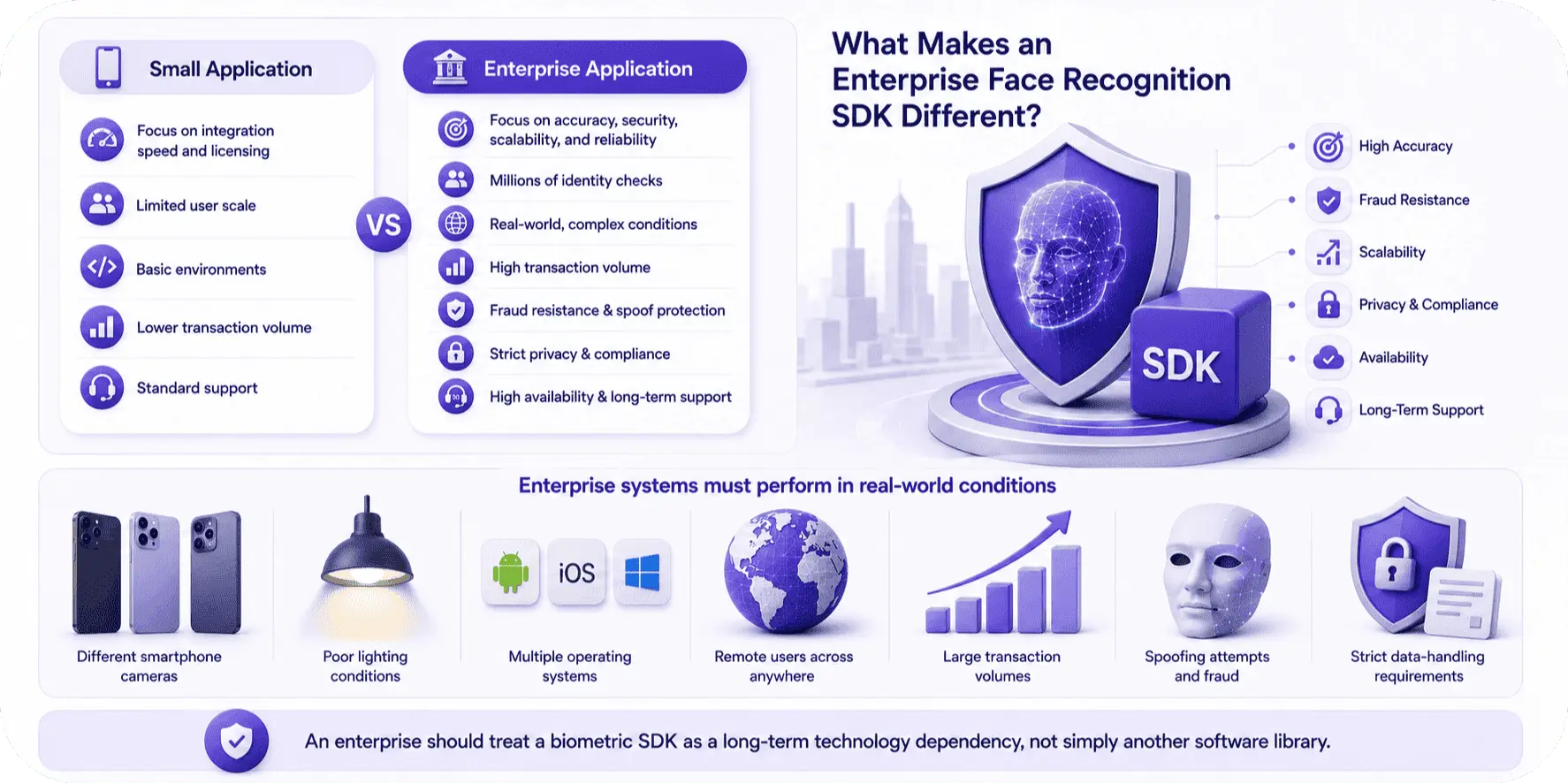
A small application and a large enterprise may both need facial recognition, but their requirements are rarely identical.
A smaller application may primarily care about integration speed and licensing. A financial institution processing millions of identity checks may place much greater importance on recognition performance, fraud resistance, scalability, privacy, availability, and long-term technical support.
The difference becomes even more important when facial biometrics are used in high-risk workflows.
Production systems may need to handle different smartphone cameras, poor lighting, multiple operating systems, remote users, large transaction volumes, spoofing attempts, and strict data-handling requirements.
This is why an enterprise should treat a biometric SDK as a long-term technology dependency, not simply another software library.
The Most Important Face Recognition SDK Evaluation Criteria
There is no single specification that determines whether an SDK is suitable for every organization. Buyers should assess several areas together and weight them according to the application’s requirements.
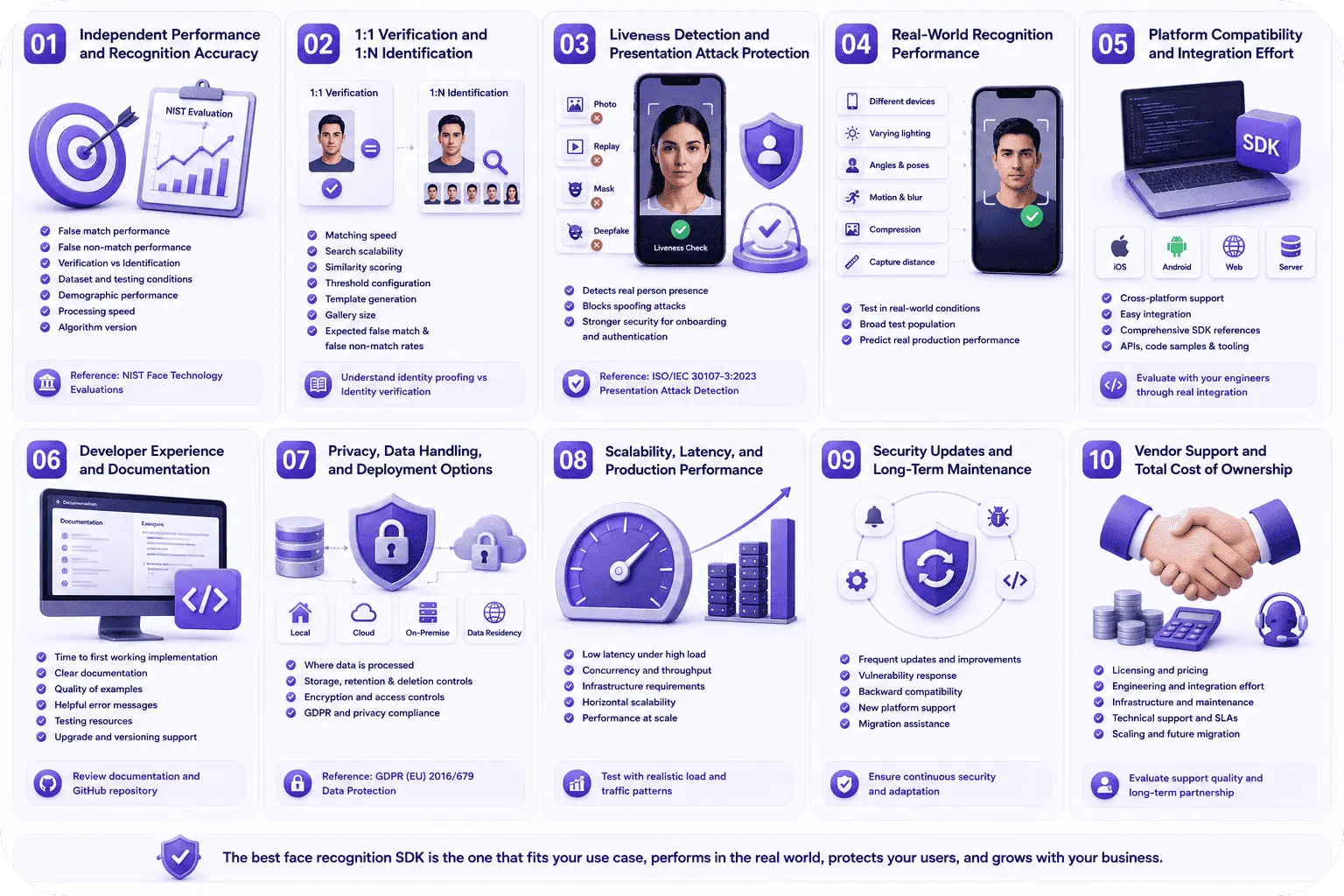
1. Independent Performance and Recognition Accuracy
Accuracy matters, but the way accuracy is measured matters just as much.
Vendor documentation can provide useful product information, but enterprise teams should also examine independent testing where credible results are available. The NIST Face Technology Evaluations provide a useful reference for understanding how facial recognition algorithms are evaluated under defined testing conditions.
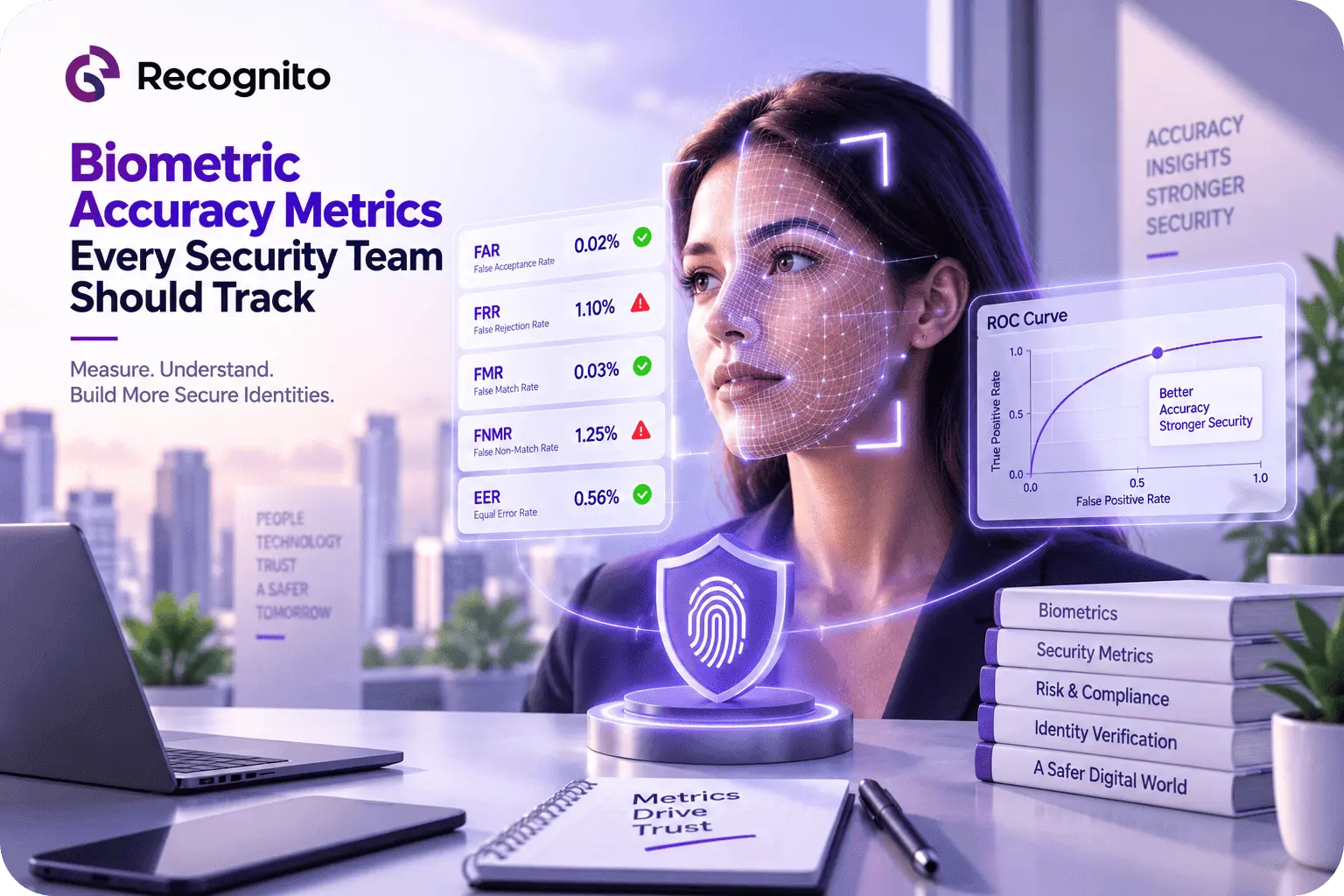
A serious assessment should distinguish between different error measures instead of reducing performance to one accuracy percentage.
Relevant factors include:
- False match performance
- False non-match performance
- Verification versus identification
- Dataset and testing conditions
- Demographic performance
- Processing speed
- Algorithm version
The relevant metric also depends on the application.
A digital onboarding platform may mainly care about correctly verifying a customer against an established identity. A search system may instead depend on identification performance across a large gallery.
That is why buyers should ask not only, “How accurate is this technology?” but also, “How accurate is it for the task we actually need?”
The NIST face recognition benchmarks resource provides additional context for understanding independent biometric evaluations.
2. 1:1 Verification and 1:N Identification
Another critical part of an SDK evaluation is determining whether the organization needs 1:1 verification, 1:N identification, or both.
In a 1:1 workflow, a facial sample is compared against one known identity. This is common in authentication and identity verification.
In a 1:N workflow, one facial sample is compared against a larger gallery to determine whether a matching identity exists. This introduces different database, performance, and scalability requirements.
Before comparing providers, technical teams should define the exact biometric workflow required.
The evaluation should consider:
- Matching speed
- Search scalability
- Similarity scoring
- Threshold configuration
- Template generation
- Gallery size
- Expected false match and false non-match rates
A system that performs well for one type of matching should not automatically be assumed to be equally suitable for another.
It is also useful to understand identity proofing versus identity verification when designing the complete process around biometric matching.
3. Liveness Detection and Presentation Attack Protection
Recognition accuracy alone does not make a biometric system secure.
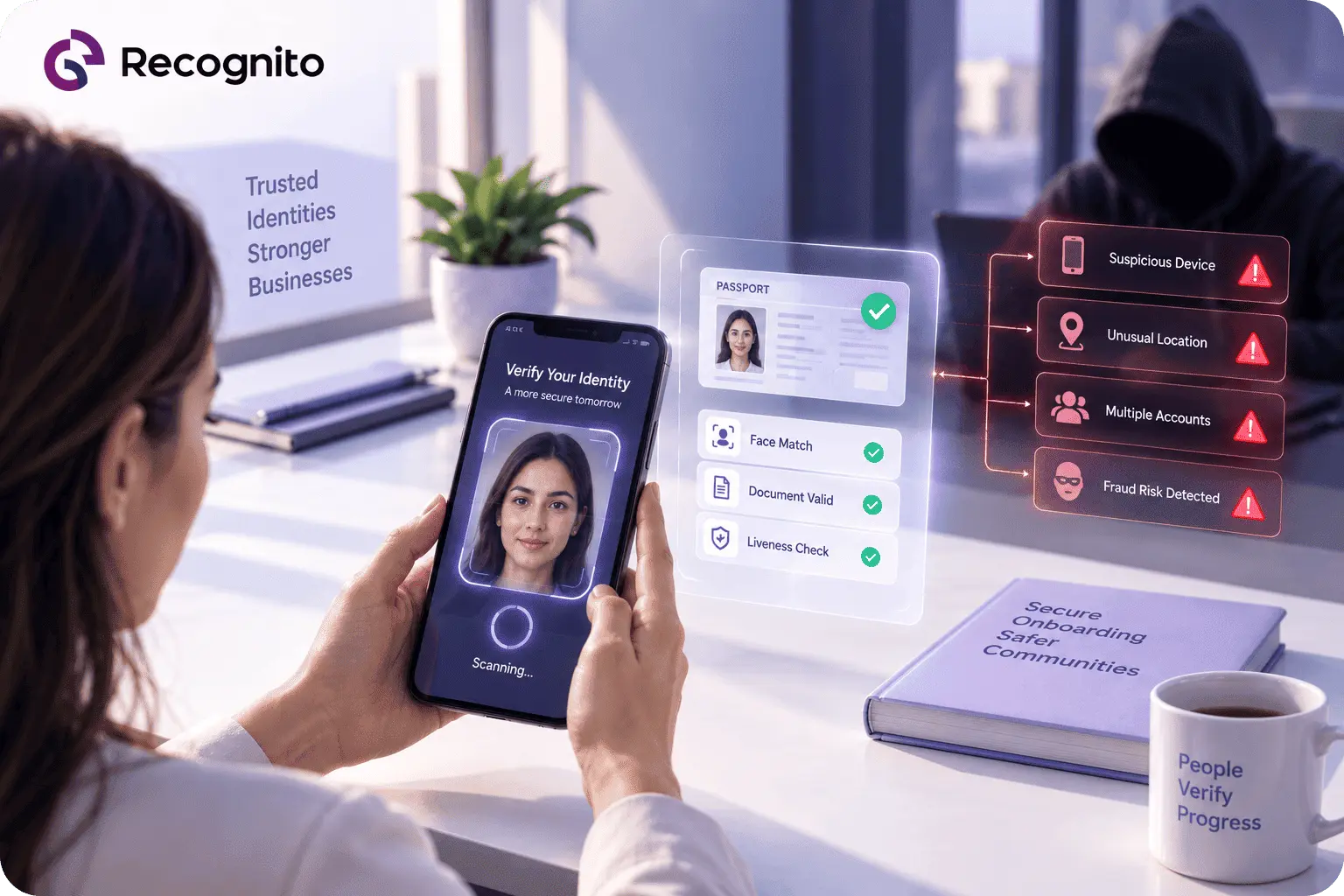
If a system can recognize a face but cannot determine whether the submitted sample came from a real person, an attacker may try to exploit it using a photograph, replayed video, image displayed on another screen, mask, or another presentation attack.
This makes liveness particularly important for digital onboarding, account authentication, financial services, and remote identity verification.
A face liveness detection SDK can complement facial matching by helping determine whether a real person is present during a biometric interaction.
Enterprise buyers should look beyond terms such as “anti-spoofing” and ask how the provider has actually tested its protection.
The ISO/IEC 30107-3:2023 standard provides principles and methods for evaluating presentation attack detection mechanisms.
Understanding the testing framework allows security teams to ask more meaningful questions about the evidence behind a vendor’s claims.
4. Real-World Recognition Performance
A benchmark can show how a system performed under particular testing conditions. It cannot automatically predict how it will behave inside a production application.
Enterprise environments are rarely controlled.
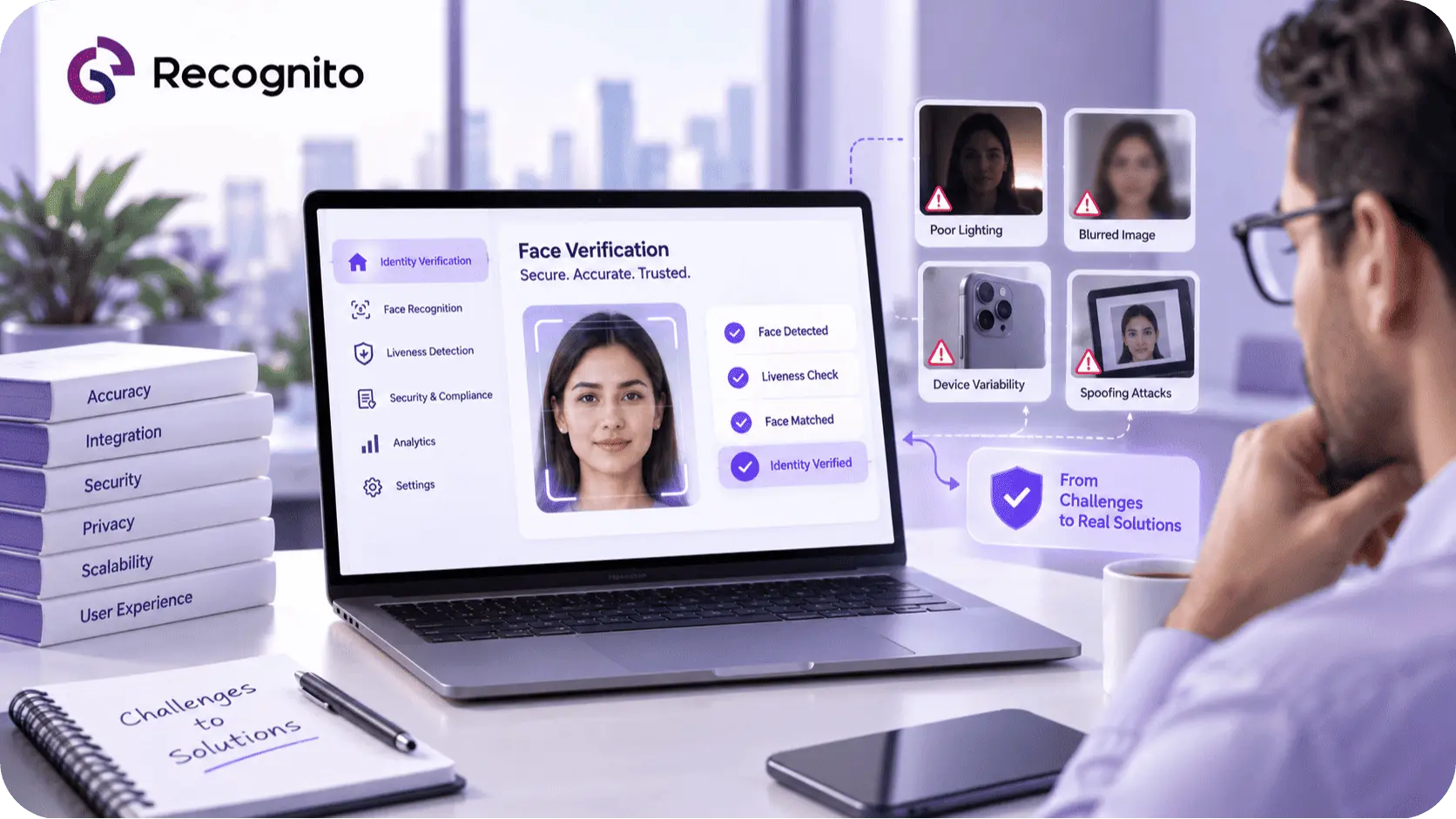
Users may have different smartphones. Cameras can vary in resolution. Lighting can change significantly. People may move during capture, hold the camera at an angle, or submit lower-quality images than those used during testing.
A proof of concept should therefore reproduce the conditions the application is expected to face.
An enterprise may test:
- Different smartphone and camera models
- Indoor and outdoor lighting
- Different facial angles
- Motion and image blur
- Image compression
- Varying capture distances
The test population matters as well. If the production application will serve a broad customer base, a narrow internal trial may not provide enough evidence to predict real-world performance.
5. Platform Compatibility and Integration Effort
A technically strong SDK can still be the wrong enterprise choice if it does not fit the existing architecture.
Engineering teams should map the technology against the platforms and development environments the product actually requires. Depending on the application, that may include mobile environments, backend systems, programming languages, or particular deployment models.
The face recognition SDK service area is relevant when evaluating the core facial recognition capability.
However, platform compatibility is only the starting point.
The real question is how much engineering effort the integration requires. Teams should assess installation, configuration, SDK references, code examples, error handling, troubleshooting, testing resources, versioning, and upgrade procedures.
The developer documentation can also be reviewed during the technical assessment.
The strongest test is practical: let the engineers who would actually implement the solution perform a representative integration and measure the effort required.
6. Developer Experience and Documentation
Developer experience can have a major impact on the real cost of a biometric SDK.
A product may look excellent in a feature comparison, but if developers struggle with installation, configuration, errors, examples, or upgrades, adoption becomes more expensive.
A good SDK should help developers move from installation to a working implementation without unnecessary friction.
During an evaluation, the team should assess:
- Time required to create the first working implementation
- Clarity of technical documentation
- Ease of testing
- Quality of error messages
- Availability of examples
- Amount of vendor assistance required
- Expected upgrade complexity
The Recognito GitHub repository can also be reviewed alongside formal documentation during this assessment.
Developer experience is not merely a convenience. It affects integration time, maintenance effort, support requirements, and total cost of ownership.
7. Privacy, Data Handling, and Deployment Options
Biometric information deserves careful attention because its privacy and security implications can differ substantially from ordinary credentials.
During an SDK evaluation, enterprise security and compliance teams should understand where biometric processing occurs and what information moves between systems.
They should establish whether images are transmitted externally, whether templates are stored, how long information is retained, what deletion controls exist, how biometric information is protected, and which deployment models are available.
Organizations may need:
- Local processing
- Cloud processing
- On-premise deployment
- Specific data residency options
- Custom retention controls
- Defined encryption and access requirements
For organizations handling European personal data, the GDPR framework is an important reference when assessing biometric privacy requirements.
Privacy should be evaluated during vendor selection rather than after implementation.
8. Scalability, Latency, and Production Performance
Proof-of-concept performance is not the same as enterprise production performance.
A system that works well with a small number of test users may behave differently when thousands of verification requests arrive simultaneously.
Enterprise buyers should therefore examine processing latency, concurrency, infrastructure requirements, memory consumption, and how the architecture behaves as workload increases.
A fintech business processing millions of customer verification requests will have different requirements from an enterprise using facial authentication internally.
A practical load assessment should establish:
- What happens when request volume increases?
- Does processing time remain acceptable?
- What infrastructure is required?
- Can the architecture scale horizontally?
- Do practical limitations appear at higher workloads?
A scalable SDK should support business growth without requiring a complete redesign.
9. Security Updates and Long-Term Maintenance
A face recognition SDK becomes a long-term dependency after production integration.
Operating systems change. New devices appear. Vulnerabilities are discovered. Attack methods evolve. Biometric security requirements can also develop over time.
Enterprise buyers should understand how the provider manages the product throughout its lifecycle.
Important questions include:
- How frequently are updates released?
- How are security vulnerabilities addressed?
- How long are previous versions supported?
- How are breaking changes communicated?
- How quickly are new platforms supported?
- What migration assistance is available?
The existing deep learning for face anti-spoofing article provides additional context on why biometric security must continue adapting as attack methods evolve.
10. Vendor Support and Total Cost of Ownership
The cheapest SDK is not necessarily the most economical SDK.
Initial licensing is only one part of the cost. An enterprise may also spend money on development resources, infrastructure, integration, testing, monitoring, maintenance, technical support, scaling, and eventual migration.
A lower licensing fee can become more expensive if the implementation creates significant engineering or operational overhead.
The evaluation should therefore consider:
- Software licensing
- Internal engineering resources
- Infrastructure
- Integration and testing
- Maintenance
- Technical support
- Scaling
- Future migration
Vendor support should be examined just as carefully as pricing.
Enterprise teams should understand how production problems are escalated, what support channels are available, and what assistance is included in the commercial agreement.
How Should Enterprises Compare SDK Providers?
Once the requirements have been defined, a standardized evaluation matrix makes the decision easier to manage.
Every shortlisted provider should be assessed against the same criteria.
| Evaluation Area | What Enterprise Buyers Should Assess |
| Recognition performance | Benchmark evidence, error rates, and real-world testing |
| Verification and identification | Required matching workflows and scalability |
| Security | Liveness and presentation attack protection |
| Integration | Platforms, APIs, documentation, and implementation effort |
| Performance | Latency, concurrency, and infrastructure requirements |
| Privacy | Processing, storage, retention, and deployment options |
| Maintenance | Updates, security fixes, and version support |
| Vendor support | Documentation, escalation, and technical assistance |
| Cost | Licensing and total cost of ownership |
The weighting should reflect the business application.
A financial institution may prioritize security, privacy, fraud resistance, and reliability. A software company embedding facial biometrics into an existing product may place more emphasis on integration speed and developer experience.
There is no universal weighting model. The important part is defining the priorities before comparing vendors.
A Practical Enterprise SDK Evaluation Process
A structured evaluation can prevent an organization from selecting technology before its real strengths and limitations are understood.
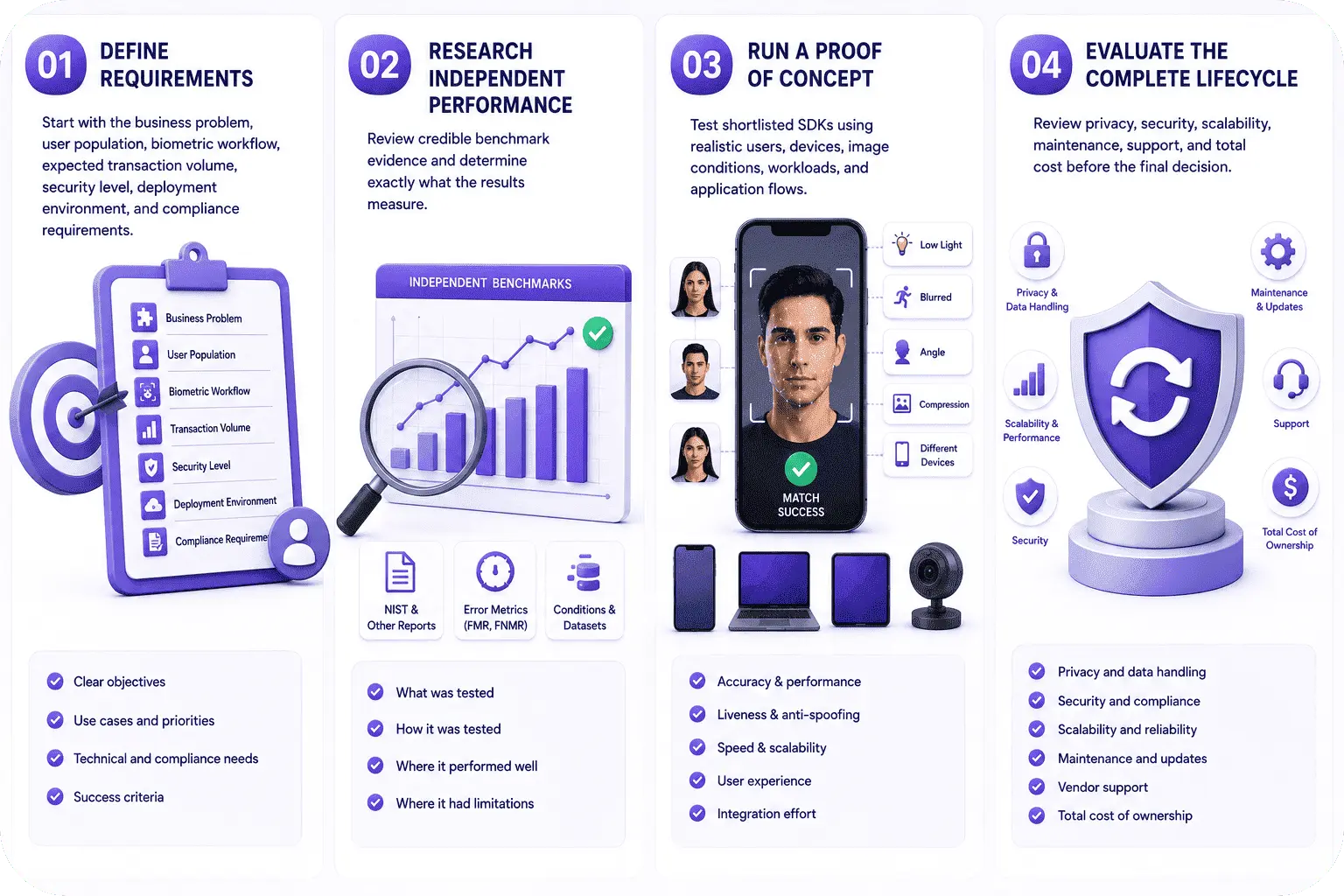
1. Define Requirements
Start with the business problem, user population, biometric workflow, expected transaction volume, security level, deployment environment, and compliance requirements.
2. Research Independent Performance
Review credible benchmark evidence and determine exactly what the results measure.
3. Run a Proof of Concept
Test shortlisted SDKs using realistic users, devices, image conditions, workloads, and application flows.
4. Evaluate the Complete Lifecycle
Review privacy, security, scalability, maintenance, support, and total cost before making the final decision.
This provides a much stronger basis for procurement than choosing a provider from a single benchmark or marketing claim.
Face Recognition SDK vs Building the Technology In-House
Some enterprises consider developing facial recognition technology internally rather than integrating an external SDK.
An internal approach can provide greater control, but it also requires substantial expertise across computer vision, machine learning, biometric algorithms, model optimization, anti-spoofing, security, infrastructure, testing, and maintenance.
For organizations with a specialized biometric research function, internal development may be viable.
For many others, an SDK can provide a faster path to production while allowing internal engineers to focus on the application’s core business functionality.
The decision should consider:
- Internal biometric expertise
- Time-to-market requirements
- Customization needs
- Security responsibilities
- Infrastructure capabilities
- Expected scale
- Maintenance capacity
- Total cost
The question is not whether internal development is possible. It is whether building and maintaining the technology internally creates enough strategic value to justify the added complexity.
How Facial Recognition Fits Into a Wider Identity Workflow
Facial recognition is often one component of a broader identity process.
A remote onboarding workflow may begin with document capture, continue through document analysis and identity verification, and then use facial matching and liveness detection to establish that the person presenting the identity is the legitimate user.
This is why enterprises should evaluate a facial recognition SDK according to how it fits into the complete workflow.
A business may also require ID document recognition alongside facial matching when the technology is being deployed for onboarding or identity verification.
Teams can also explore the face biometric playground to gain practical exposure to facial biometric functionality before committing to a production implementation.
The important consideration is the architecture as a whole.
A solution that performs well but requires complicated integration with every other identity component may not be the strongest enterprise choice. A technology that fits naturally into the wider workflow can reduce implementation complexity and long-term maintenance.
Final Face Recognition SDK Evaluation Checklist
Before moving from proof of concept to production, an enterprise should be able to demonstrate that the major technical and business questions have been answered.
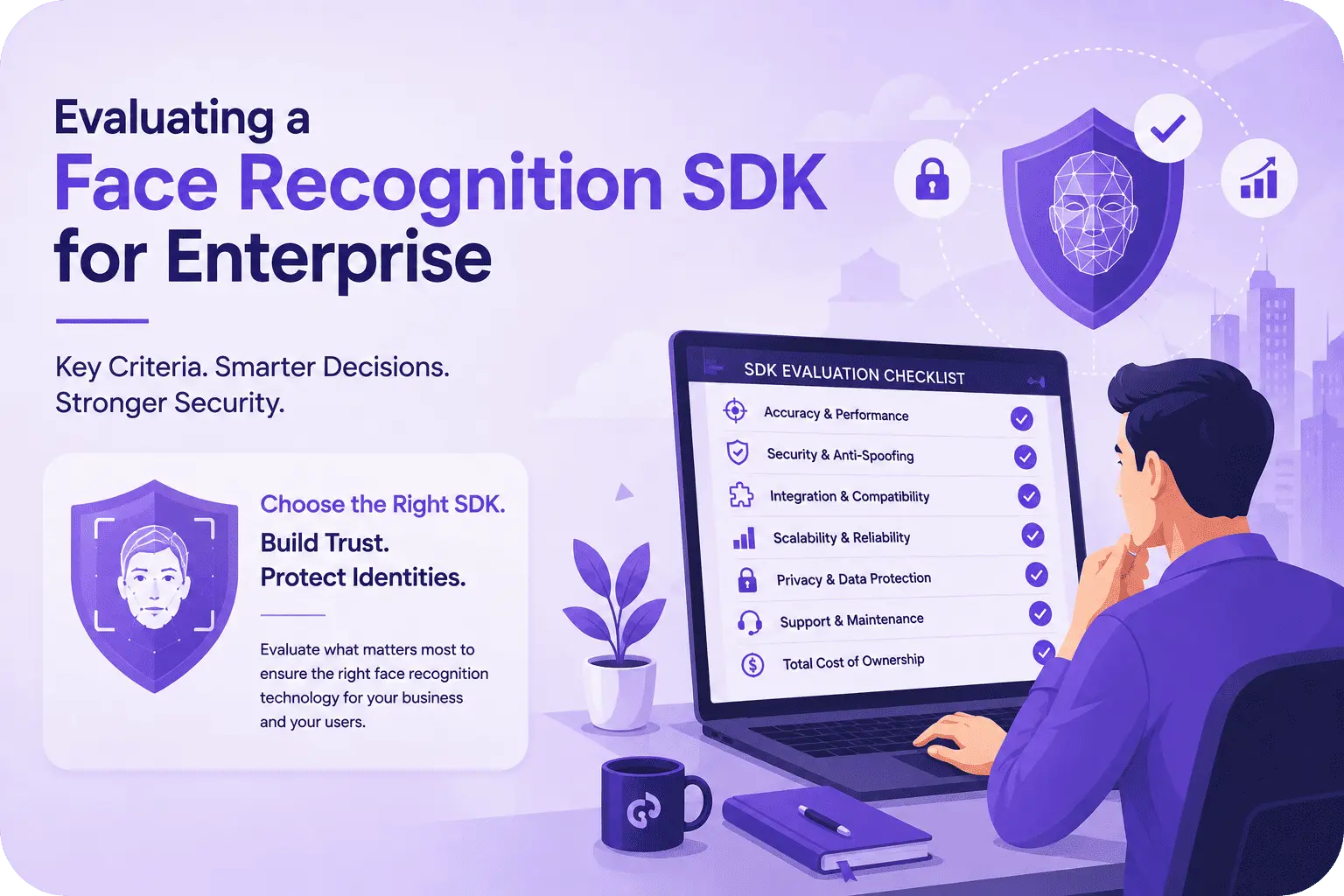
The final review should confirm that:
- Biometric performance is appropriate for the intended workflow.
- Recognition has been tested under representative conditions.
- Security and presentation attack protection have been evaluated.
- Integration has been validated by the development team.
- Expected workloads have been tested.
- Privacy and deployment requirements have been reviewed.
- Vendor support and maintenance have been evaluated.
- Total cost of ownership is understood.
If major questions remain unresolved, moving directly into production creates unnecessary technical and commercial risk.
Conclusion
Selecting a face recognition SDK for enterprise deployment requires much more than comparing advertised accuracy.
The right technology must perform reliably in the intended environment, support the required verification or identification workflow, provide appropriate protection against presentation attacks, integrate cleanly with the existing application architecture, and scale with business growth.
Privacy, developer experience, vendor maintenance, technical support, and total cost of ownership matter just as much once the technology becomes part of a critical production system.
The most reliable approach combines independent biometric evidence with hands-on testing using representative users, devices, workloads, and security requirements.
The objective is not simply to find the face recognition software with the most impressive specification sheet. It is to choose a biometric SDK that can remain reliable, secure, scalable, and maintainable throughout the life of the application.
Organizations evaluating this technology can explore the broader biometric capabilities available from Recognito as part of their enterprise assessment.
Frequently Asked Questions
What should enterprises look for in a face recognition SDK?
Enterprise buyers should evaluate recognition performance, 1:1 and 1:N capabilities, liveness protection, integration requirements, scalability, privacy, documentation, vendor support, maintenance, and total cost of ownership.
Is benchmark accuracy enough to choose a facial recognition SDK?
No. Benchmark results are useful for comparing algorithm performance, but enterprises should also conduct real-world testing because device quality, lighting, image conditions, workflow design, and other environmental factors can influence production results.
Why is liveness detection important for enterprise facial recognition?
Liveness detection helps determine whether a real person is present during a biometric interaction. This adds protection against attacks involving photographs, replayed media, and other presentation techniques that facial matching alone may not address.
Should an enterprise build its own biometric technology?
It depends on the organization’s expertise, resources, customization requirements, security responsibilities, and time-to-market goals. An SDK can be more practical when the business wants established biometric capabilities without taking on the full burden of developing and maintaining them internally.
How should an enterprise test an SDK before purchasing it?
The best approach is a representative proof of concept using real application flows, expected users, relevant devices, realistic image conditions, anticipated workloads, and the security requirements that will apply in production.