

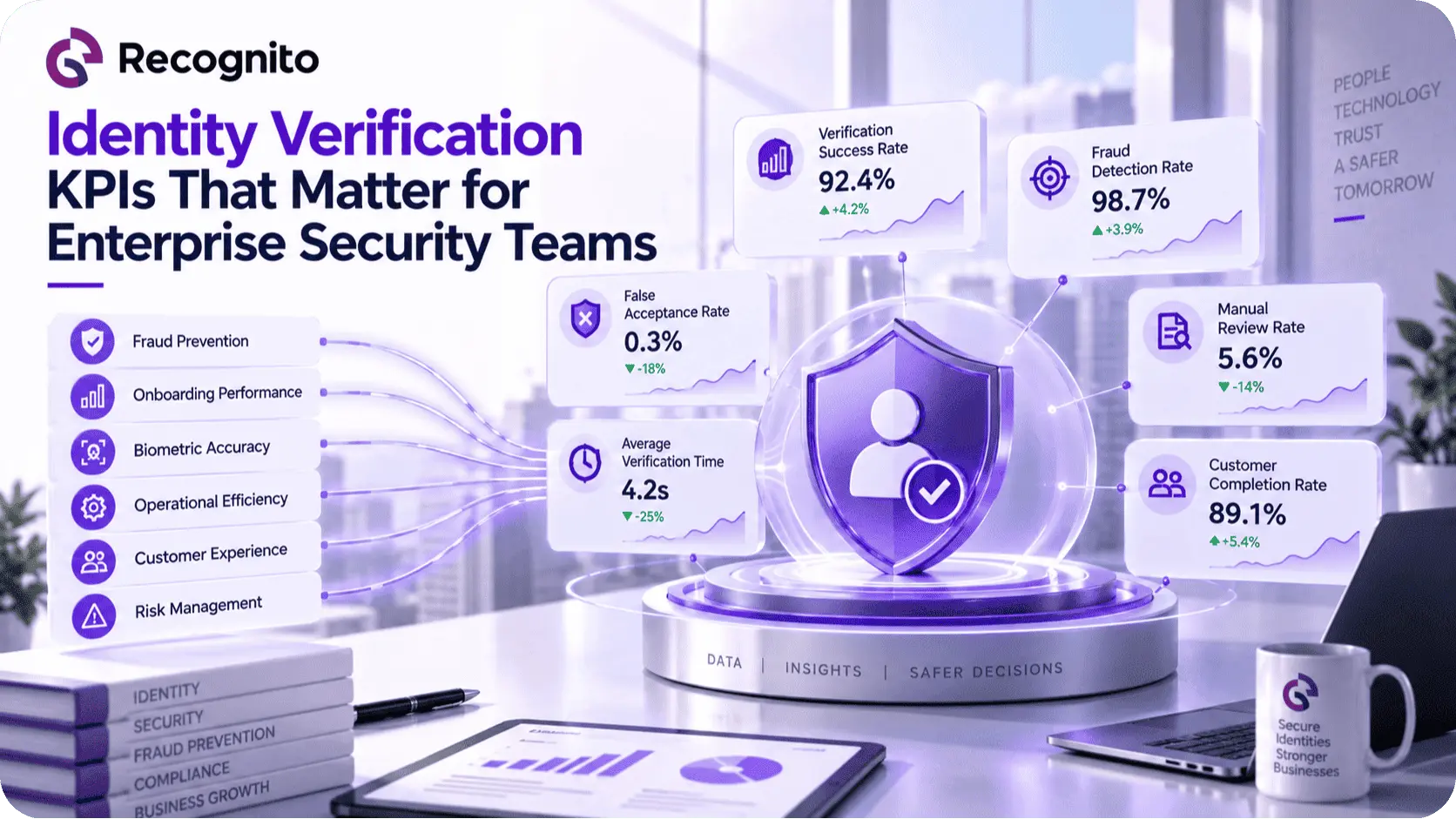
Identity verification is often measured through a simple question: did the customer pass or fail?
For enterprise security teams, that is nowhere near enough.
A financial institution, fintech company, insurer, payment provider, marketplace, or other digital business needs to understand whether its verification process is actually preventing fraud, allowing legitimate customers through, operating efficiently, and remaining reliable as transaction volumes increase.
That requires a broader set of identity verification metrics.
A verification process may achieve a high completion rate while allowing too many fraudulent applications. Another may have excellent fraud detection but reject legitimate customers so frequently that onboarding suffers. A third may perform well technically but require excessive manual review.
The right measurement framework therefore needs to connect security, fraud prevention, customer experience, operations, and biometric performance.
This guide explains the most important verification KPIs enterprise security teams should track, how the metrics relate to each other, and how to avoid optimizing one number while creating problems somewhere else.
Why Identity Verification KPIs Matter
Identity verification is not an isolated event.
The result can determine whether a customer is allowed to open an account, access a financial service, complete a transaction, or move forward with another regulated process.
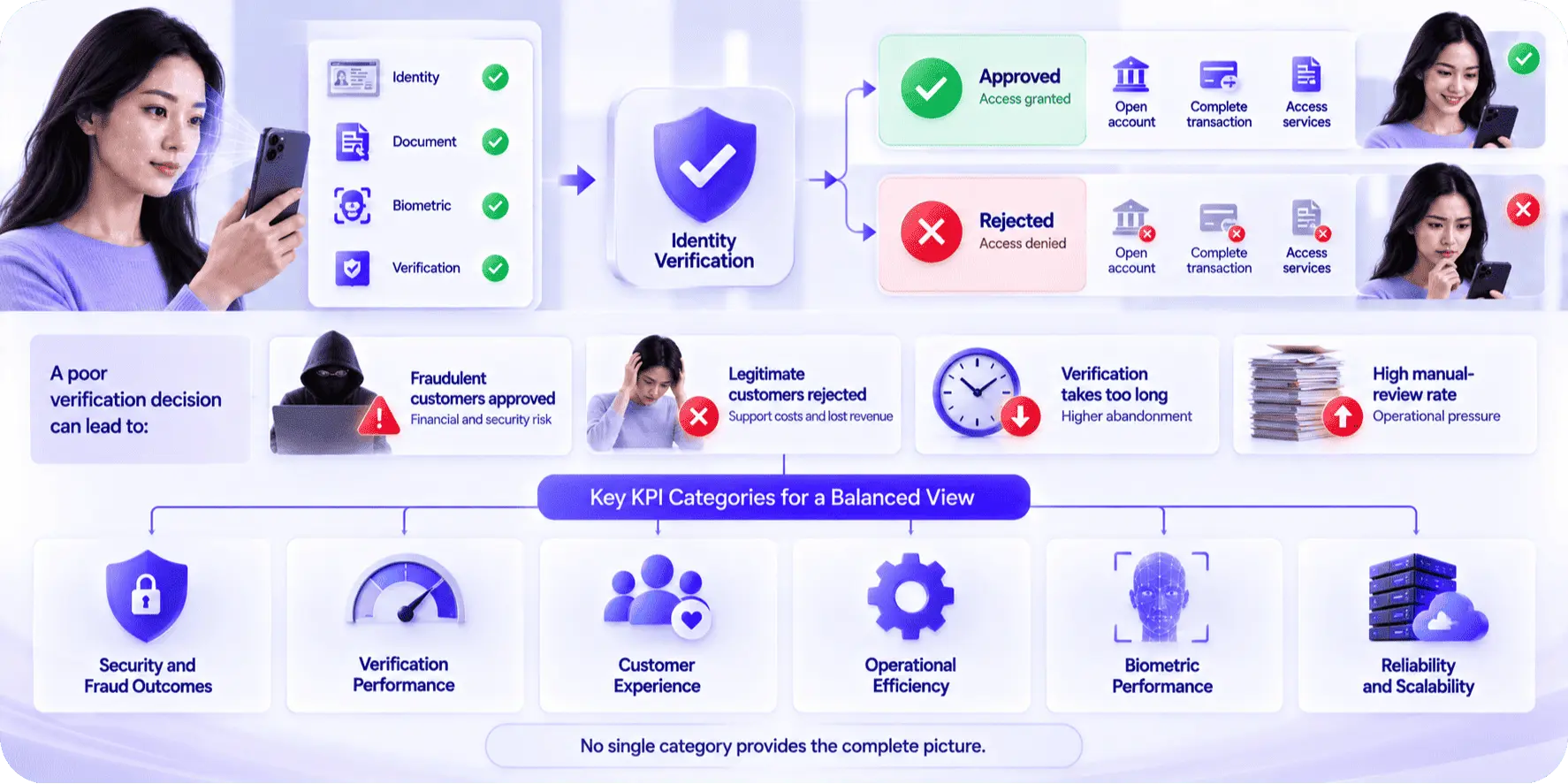
A poor verification decision can create several consequences at once.
A fraudulent customer being approved can create financial and security risk. A legitimate customer being rejected can create customer support costs and lost revenue. A verification process that takes too long can increase abandonment. A high manual-review rate can create operational pressure.
This means security teams need a balanced measurement framework.
The most useful KPIs generally fall into several groups:
- Security and fraud outcomes
- Verification performance
- Customer experience
- Operational efficiency
- Biometric performance
- Reliability and scalability
No single category provides the complete picture.
1. Verification Success Rate
Verification success rate measures the proportion of verification attempts that successfully reach an approved or completed outcome.
It is one of the most basic onboarding metrics, but it becomes useful when tracked alongside the reason for failure.
A low completion rate could mean the verification technology is too strict. It could also indicate poor document capture, inadequate customer instructions, unsupported devices, or other workflow problems.
Security teams should therefore avoid interpreting the number in isolation.
A useful breakdown can separate:
- First-attempt success
- Success after retry
- Success after additional verification
- Manual-review completion
- Final approval
This makes it easier to identify where customers are falling out of the process.
2. False Acceptance Rate
For security teams, false acceptance is one of the most important fraud prevention metrics.
It represents situations where an unauthorized or fraudulent attempt is incorrectly accepted by the verification system.
The acceptable level depends heavily on the use case.
A low-risk onboarding workflow may tolerate a different balance from a high-value financial authentication process.
The key is to establish the acceptable risk level before defining the operating threshold.
Security teams should also examine the source of false acceptances.
Were they caused by identity-document weaknesses, biometric matching, presentation attacks, account duplication, or another part of the workflow?
Understanding the cause makes the KPI actionable rather than merely descriptive.
3. False Rejection Rate
False rejection measures how frequently legitimate customers are incorrectly rejected.
This metric directly affects customer experience and onboarding performance.
A high false rejection rate can lead to repeated verification attempts, manual reviews, customer support requests, and abandonment.
The causes can vary.
Poor image quality, difficult lighting, facial pose, document damage, unsupported document versions, and overly strict biometric thresholds can all contribute.
Recognito’s face recognition accuracy factors resource provides additional context on why environmental and capture conditions can affect facial verification performance.
Security teams should therefore examine false rejection alongside the specific stage where the customer failed.
4. First-Attempt Verification Rate
A customer who succeeds immediately is operationally different from one who requires four retries before passing.
The first-attempt verification rate measures how many customers complete the required verification successfully without needing another attempt.
This is a particularly useful onboarding KPI because it combines technology performance with user experience.
A low first-attempt rate may indicate:
- Poor capture instructions
- Difficult user flows
- Image-quality problems
- Device compatibility issues
- Strict thresholds
- Confusing onboarding design
Improving this metric does not necessarily mean weakening security.
Often, better capture guidance or better workflow design can improve the result without changing the underlying security controls.
5. Verification Completion Rate
Verification completion rate measures how many users who begin the process actually finish it.
This should be separated from successful verification.
A customer can abandon the process before the system makes any final decision.
High abandonment can indicate that:
- The process takes too long
- Too many steps are required
- Users do not understand the instructions
- Repeated failures create frustration
- Technical problems interrupt the journey
This is why completion is an important onboarding metric, even though it is not a direct fraud measure.
A secure system that legitimate customers cannot complete is not an effective enterprise solution.
6. Average Verification Time
Verification time measures how long it takes to move a customer from the beginning of the verification process to a final outcome.
This includes more than biometric processing speed.
The total duration can include document capture, image upload, biometric capture, liveness, API calls, risk analysis, manual review, and other workflow stages.
Security teams should therefore distinguish between:
Technical processing time
and:
Total customer verification time
The second number is usually more relevant to the business.
Longer verification times can increase abandonment and create operational costs even when the underlying biometric technology is fast.
7. Manual Review Rate
Manual review is valuable when automated verification cannot confidently establish identity or risk.
However, a consistently high manual-review rate can indicate that the automated workflow is not handling enough of the expected customer population effectively.
This can create:
- Higher staffing costs
- Longer onboarding times
- Greater operational complexity
- Inconsistent review outcomes
A useful KPI is the percentage of applications routed to manual review and the reason for that escalation.
Security teams should distinguish between manual reviews triggered by genuine high-risk cases and reviews triggered by technical failures.
Those represent very different problems.
8. Fraud Detection Rate
Fraud detection rate helps measure how effectively the identity verification process identifies fraudulent applications.
However, the definition must be clear.
A business may define fraud detection based on confirmed fraudulent applications, prevented losses, suspicious applications escalated for investigation, or another internal measure.
Security teams should establish the methodology before comparing performance over time.
The KPI becomes especially useful when combined with other measures such as false acceptance and false rejection.
A system that detects more fraud but also blocks a large number of legitimate customers may not represent a net improvement.
9. Fraud Loss Avoidance
Not every fraud event has the same financial impact.
A useful enterprise metric can therefore go beyond the number of fraudulent applications detected and measure the estimated or confirmed financial loss prevented.
Depending on the business, this may include:
- Prevented account creation
- Avoided unauthorized transactions
- Prevented credit exposure
- Reduced chargebacks
- Reduced manual investigation costs
This gives leadership a more direct connection between identity verification performance and business value.
The methodology should be consistent, transparent, and clearly distinguished from estimates.

10. Biometric Match Performance
For organizations using facial verification, biometric performance should be tracked independently from the overall onboarding result.
A facial verification workflow can fail for different reasons, so the organization needs to understand whether the issue is related to matching, capture quality, liveness, or another part of the process.
Useful biometric measures can include:
- False match rate
- False non-match rate
- Facial verification success
- Retry rate
- Average matching time
- Device-specific failure rate
A facial biometric SDK can provide the matching component, but the enterprise still needs its own production monitoring to understand how that component behaves within the actual customer workflow.
11. Liveness Verification Metrics
Liveness detection introduces another set of important measures.
Security teams should monitor both security outcomes and legitimate-user outcomes.
Relevant metrics may include:
- Liveness pass rate
- Liveness failure rate
- Retry rate
- Presentation attack detection results
- Processing time
- False rejection associated with liveness
A high liveness failure rate does not automatically mean better biometric security.
It may indicate that legitimate customers are struggling with the capture experience.
A biometric liveness SDK can provide the underlying liveness capability, but the production KPI framework should show whether it is functioning effectively within the organization’s actual environment.
12. Verification Retry Rate
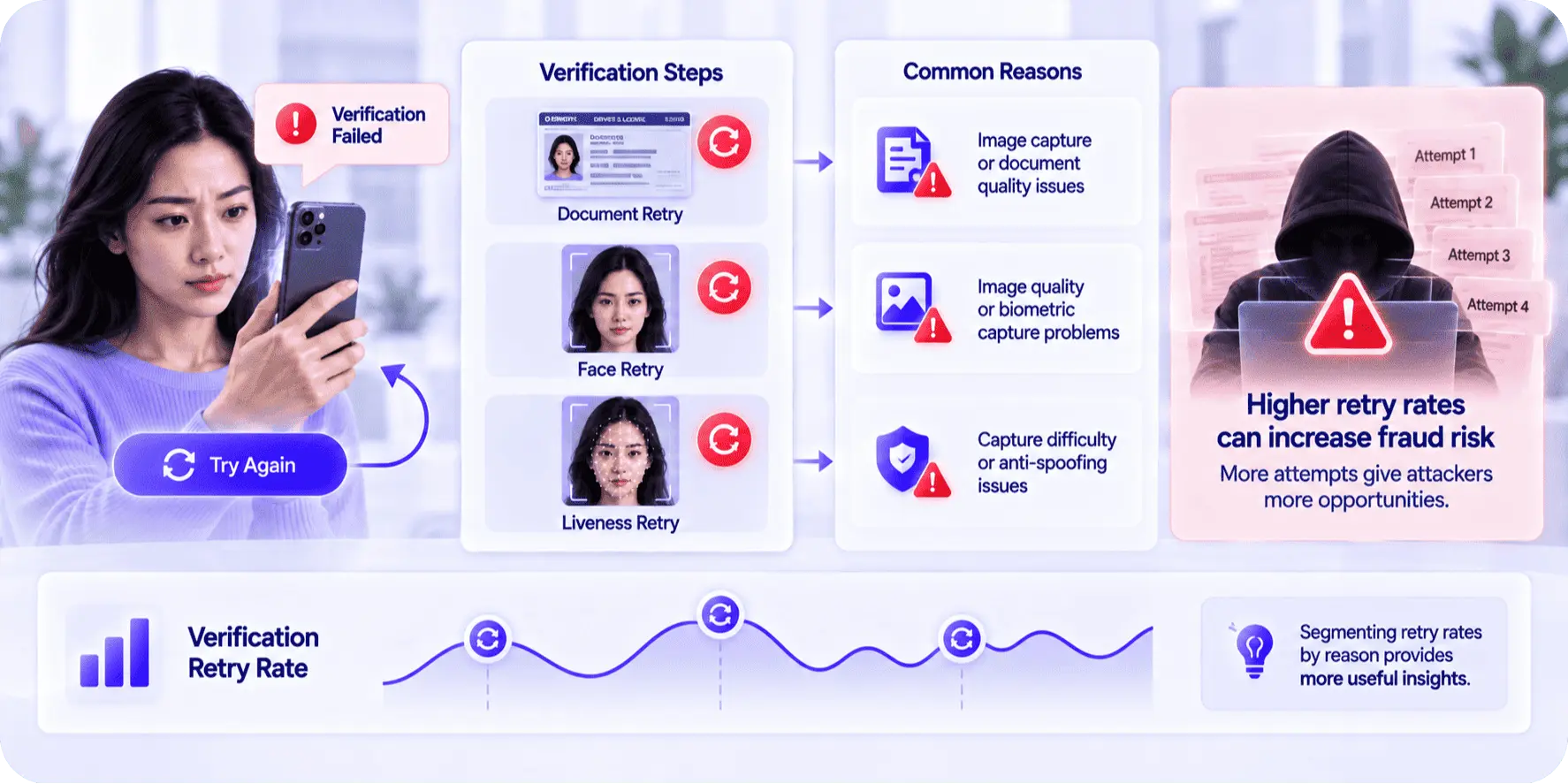
Retry rate tells security teams how often customers need to repeat one or more verification steps.
Retries are not necessarily bad.
A customer might simply have poor lighting during the first attempt.
The metric becomes more useful when segmented by reason.
For example:
Document retry
may suggest image capture or document quality issues.
Face retry
may suggest image quality or biometric capture problems.
Liveness retry
may indicate capture difficulty or an issue with the anti-spoofing layer.
A high retry rate can also increase fraud exposure because repeated attempts give an attacker more opportunities to experiment with the verification process.
13. Device and Platform Failure Rate
Biometric and identity verification performance can vary by device.
Security teams should therefore track failure rates across meaningful device and platform groups.
For example, a verification process might perform well on newer smartphones but have significantly higher failure rates on older hardware.
The KPI should not necessarily lead to excluding those devices immediately.
Instead, it should help teams identify where the verification experience requires improvement or where additional controls may be necessary.
14. Risk Escalation Rate
Risk-based verification works by escalating certain applications to stronger controls.
The risk escalation rate measures how frequently this happens.
An escalation could mean:
- Additional biometric verification
- Liveness
- Additional document evidence
- Manual review
- Enhanced due diligence
A very low escalation rate may indicate that the system is missing risky applications.
A very high rate may indicate that thresholds are too sensitive or the initial verification process is not sufficiently informative.
The useful KPI is therefore not “lowest possible escalation.”
It is the escalation rate that produces the appropriate security outcome for the organization’s risk profile.
15. KPI Framework for Enterprise Identity Verification
Enterprise security teams should bring the metrics together rather than monitoring them as isolated numbers.
| KPI | What It Measures | Why Security Teams Should Track It |
| Verification success rate | Completed successful verification | Overall workflow effectiveness |
| First-attempt success | Customers passing without retry | Capture quality and usability |
| False acceptance rate | Fraudulent attempts incorrectly accepted | Security exposure |
| False rejection rate | Legitimate users incorrectly rejected | Customer and operational impact |
| Verification completion | Users finishing the process | Onboarding effectiveness |
| Manual review rate | Cases requiring human intervention | Operational workload |
| Fraud detection rate | Fraud cases identified | Fraud prevention performance |
| Biometric match performance | Facial verification outcomes | Biometric effectiveness |
| Liveness failure rate | Unsuccessful liveness checks | Biometric security and friction |
| Average verification time | Time to final outcome | Customer experience and efficiency |
| Retry rate | Repeated verification attempts | Workflow quality |
| Escalation rate | Applications requiring stronger checks | Risk-based decisioning |
The value of the framework comes from looking at the relationships between the KPIs.
For example, a significant drop in false acceptance accompanied by a large increase in false rejection may indicate that the biometric threshold became too strict.
Likewise, an increase in manual review alongside a drop in first-attempt success could indicate a technical or workflow problem rather than a genuine increase in fraud.
How Security Teams Should Establish KPI Baselines
A KPI has little value without a baseline.
Organizations should establish expected performance before making major workflow changes.
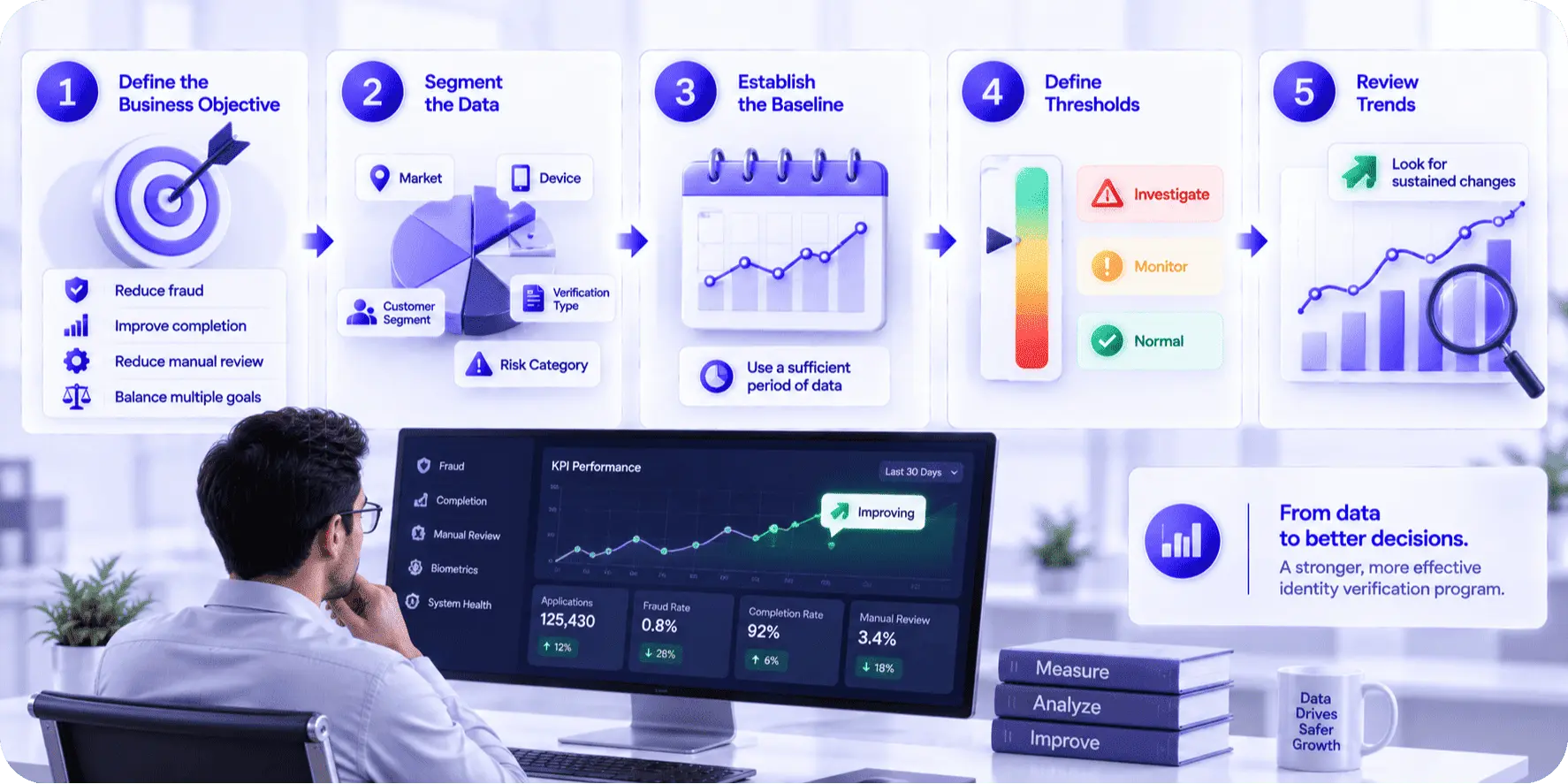
Define the Business Objective
Decide whether the primary objective is reducing fraud, improving completion, reducing manual review, or balancing several goals.
Segment the Data
Break metrics down by market, device, verification type, customer segment, and meaningful risk category where appropriate.
Establish the Baseline
Record normal performance over a sufficient period instead of relying on a single day or unusual traffic period.
Define Thresholds
Establish what level of change should trigger investigation.
Review Trends
Look for sustained changes rather than reacting to every small fluctuation.
This approach makes the KPI framework useful for both security operations and strategic decision-making.
How Biometric KPIs Fit Into the Wider Verification Strategy
Biometric verification should not be evaluated independently from the wider identity process.
For example, an organization may have excellent facial matching performance but poor document verification. The overall onboarding result could still be weak.
Similarly, a strong identity document workflow can remain vulnerable if the person presenting the document is not properly connected to that identity.
This is why security teams should evaluate the identity process as a chain of controls.
Document verification establishes identity evidence.
Biometric verification connects the person to that evidence.
Liveness strengthens the biometric capture process.
Risk decisioning combines the available signals.
Ongoing monitoring determines whether the established identity remains consistent over time.
Using SDK-Based Verification in a KPI Framework
When identity verification capabilities are integrated through SDKs, security teams should track the performance of the individual components as well as the end-to-end workflow.
For example, an ID document verification SDK can have document-level success and failure metrics, while facial matching can have its own biometric performance measures.
This creates much better visibility into where failures are actually occurring.
A development team can also use the Face Biometric Playground during evaluation to understand the user-facing biometric experience before defining production benchmarks.
For technical implementation research, the Recognito GitHub repository can provide another development resource.
The important point is that the KPI system should measure both the SDK-level behavior and the business outcome.
How to Avoid KPI Optimization Problems
Security teams can accidentally optimize one metric at the expense of another.
For example, reducing false acceptance by making thresholds extremely strict may increase false rejection.
Reducing manual review may increase automated fraud losses.
Increasing verification steps may strengthen security but reduce onboarding completion.
This is why enterprise KPI management should use a balanced scorecard rather than one headline number.
The organization should establish which metrics are:
Security-critical
Customer-critical
Operational
Diagnostic
This makes it easier to understand which changes represent genuine improvement.
What Should Security Teams Monitor After Launch?
KPI monitoring should continue after implementation.
Organizations should establish regular reviews of:
- Verification performance
- Fraud outcomes
- Biometric accuracy
- Liveness performance
- Customer completion
- Manual review
- Device and platform behavior
- Verification latency
- Escalation patterns
Significant changes should be investigated to determine whether they are caused by changes in customer behavior, attack activity, application releases, device populations, verification thresholds, or external conditions.
A biometric model or verification SDK update should also trigger appropriate regression testing.
Building a More Mature Identity Verification Measurement Program
As an organization becomes more mature, its KPI program should move beyond simple operational reporting.
Security teams can begin connecting identity verification metrics with downstream fraud outcomes.
For example:
Verification result → account approval → subsequent fraud event
This helps determine whether the verification system is actually identifying the risk that matters to the business.
Similarly, organizations can evaluate whether stronger verification requirements are reducing fraud enough to justify any increase in customer friction.
This creates a more strategic measurement system.
Conclusion
The most valuable identity verification metrics are the ones that help security teams understand whether the verification process is secure, reliable, efficient, and practical for legitimate customers.
False acceptance and false rejection reveal important security and customer-experience trade-offs. Verification completion, first-attempt success, retry rate, manual review, and verification time reveal operational performance. Biometric and liveness metrics provide visibility into the individual security components.
The most important principle is to avoid optimizing one KPI in isolation.
A strong verification process balances fraud prevention, biometric security, customer experience, operational efficiency, privacy, and business objectives.
Organizations implementing SDK-based identity verification should monitor both component-level performance and the final business outcome.
Businesses evaluating biometric and identity verification technologies can explore the broader capabilities available from Recognito as part of their measurement and security strategy.
Frequently Asked Questions
What are the most important identity verification KPIs?
The most important KPIs commonly include false acceptance rate, false rejection rate, verification completion, first-attempt success, fraud detection, manual review, verification time, retry rate, biometric performance, and liveness outcomes.
Why should security teams track false acceptance and false rejection together?
Because improving one can negatively affect the other. A stricter verification threshold may reduce false acceptance while increasing rejection of legitimate customers.
What is a good verification completion rate?
There is no universal target. The appropriate level depends on the customer journey, user population, verification complexity, risk model, and industry. Organizations should establish a baseline and measure meaningful changes over time.
How often should identity verification KPIs be reviewed?
Operational metrics can be monitored continuously, while broader security and performance trends should be reviewed regularly. Significant changes in fraud outcomes, biometric performance, or customer behavior should trigger investigation.
Should biometric verification KPIs be measured separately?
Yes. Component-level biometric metrics help identify whether problems originate in facial matching, liveness, capture quality, or another stage rather than treating every verification failure as one general outcome.