
A face recognition system may correctly recognize a person and still be vulnerable to fraud.
The problem is that facial matching and anti-spoofing solve different security questions. Matching asks whether the captured face resembles a known identity. Anti-spoofing asks whether the biometric input itself should be trusted.
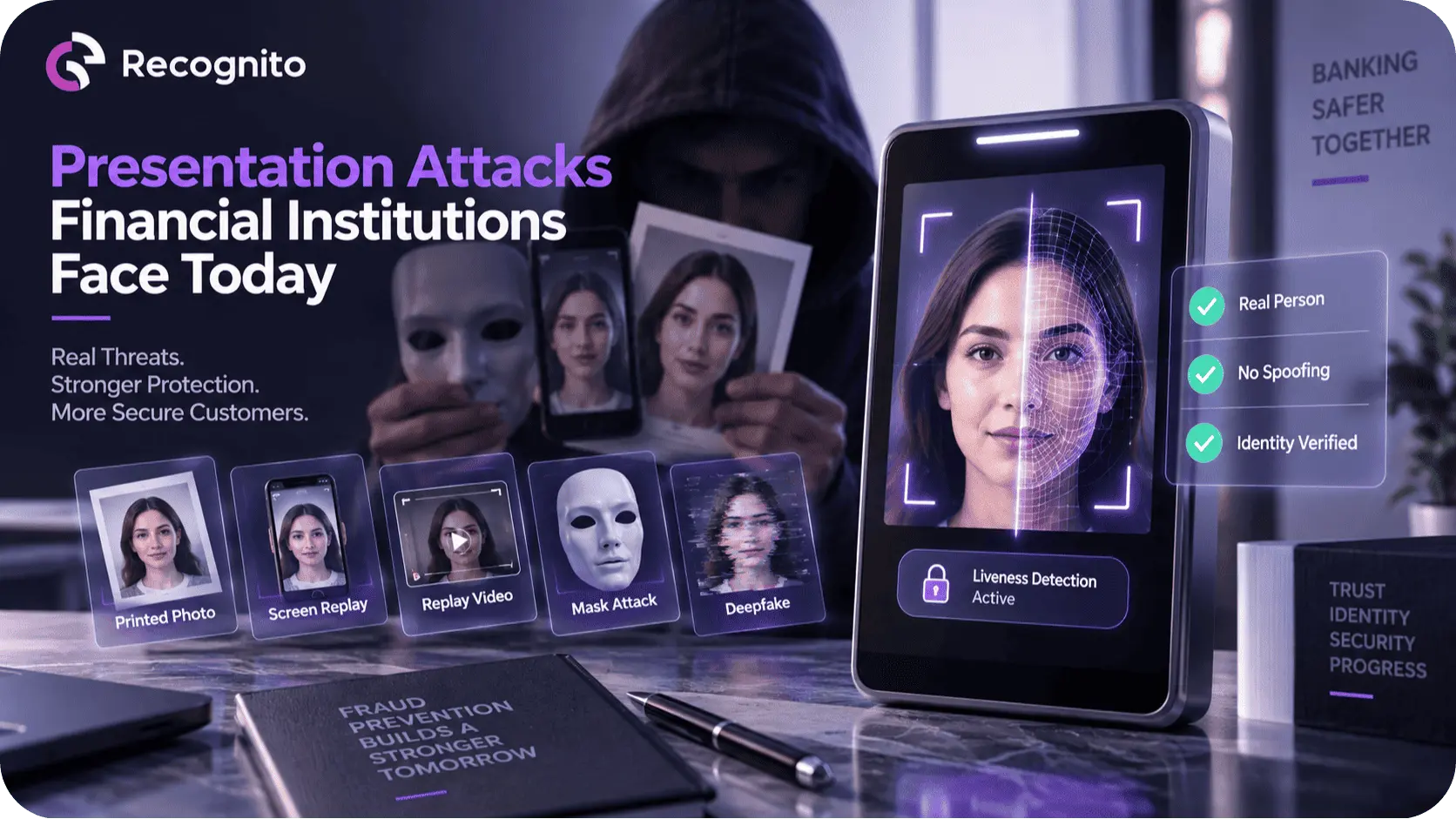
That distinction becomes critical when facial recognition is used remotely. A fraudster does not necessarily need to defeat the underlying recognition algorithm. They may instead present a printed photograph, replayed video, mask, manipulated image, deepfake, or other artificial representation that causes the system to process something that is not a genuine live face.
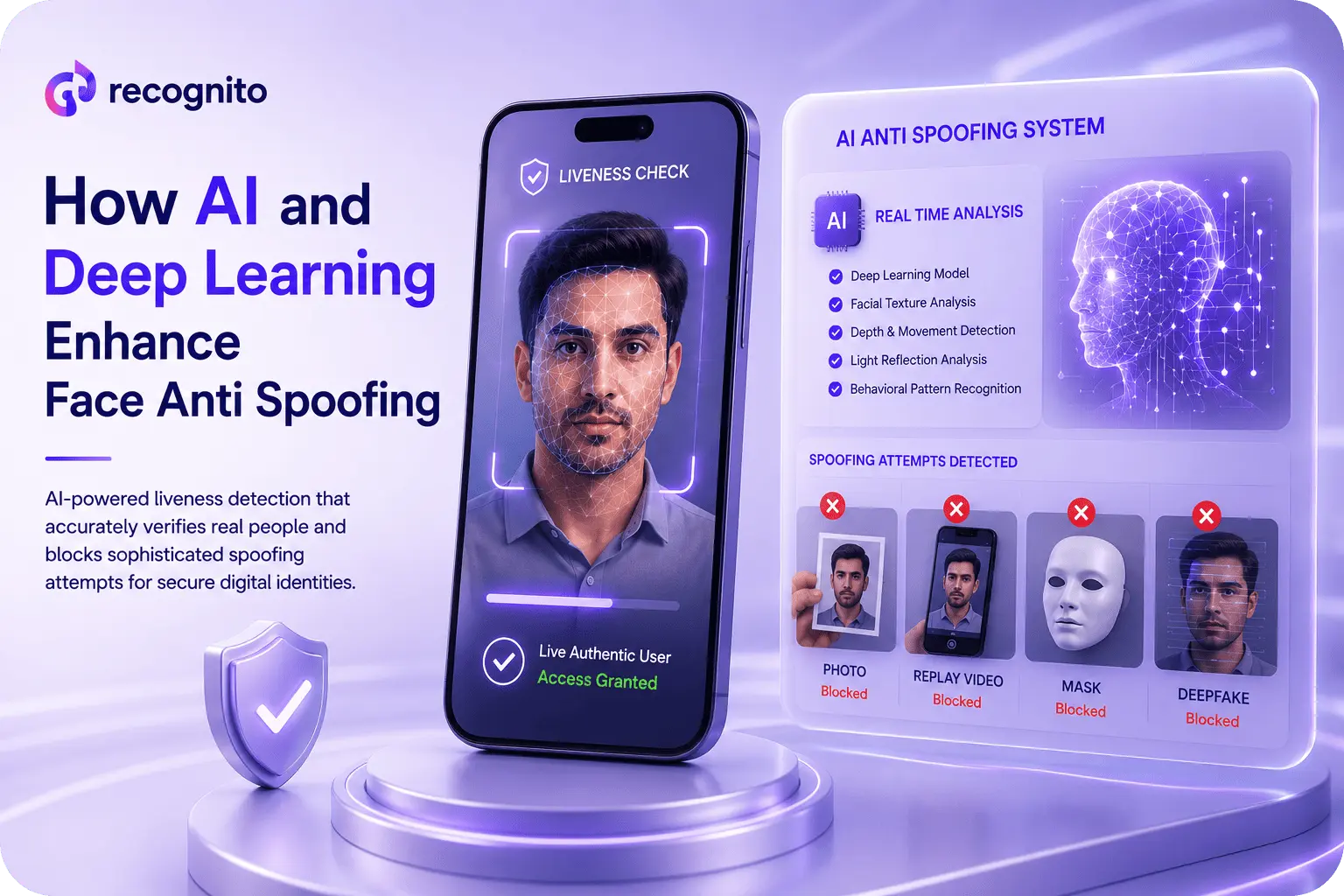
AI and deep learning have become central to addressing this problem because modern anti-spoofing systems need to detect subtle visual, temporal, and contextual patterns that are difficult to capture with simple rules.
The strongest implementations do not treat anti-spoofing as a single classifier. They combine deep neural networks, quality analysis, temporal information, liveness signals, and secure processing into a layered defense.
Why Face Recognition Needs Anti-Spoofing
Facial recognition operates on biometric evidence. If that evidence can be artificially created or manipulated, even a highly accurate recognition model may be misused.
Common presentation attacks include:
- Printed photographs placed in front of a camera
- Images displayed on phones or tablets
- Replayed facial videos
- Paper or physical masks
- Partial prosthetics or makeup
- Digitally manipulated facial content
- Deepfake imagery or video
NIST defines presentation attack detection as the automated determination of a presentation attack and recognizes liveness detection as one category of methods used to establish whether a biometric sample comes from a living subject present at capture. Its current presentation attack detection terminology provides the foundation for understanding this distinction.
The broader security challenge is not limited to one attack type. A face anti-spoofing system must remain useful as attackers move from basic photographs toward increasingly sophisticated artificial media.
What AI Changes in Face Anti-Spoofing
Older anti-spoofing approaches could rely heavily on manually designed rules. For example, a system might look for simple texture differences between skin and a printed photograph.
That approach becomes difficult as attacks become more realistic.
Deep learning changes the process by allowing models to learn discriminative features from large amounts of training data. Instead of depending entirely on predefined characteristics, neural networks can learn patterns associated with genuine and spoofed presentations.
A deep model may identify subtle differences involving:
- Skin texture
- Reflections
- Printing artifacts
- Screen patterns
- Facial edges
- Illumination behavior
- Motion consistency
- Depth-related cues
- Compression characteristics
- Temporal changes
This makes deep learning particularly valuable because spoofing artifacts are often difficult to describe with fixed rules.
NIST’s evaluation of passive software-based PAD demonstrated that machine-learning approaches can detect presentation attacks in conventional 2D face imagery while also revealing trade-offs between detection performance and false alarms. The NIST FATE Part 10 evaluation provides detailed evidence from large-scale evaluation of software-based PAD algorithms.
How Deep Learning Detects Spoofing
Modern face anti-spoofing models can examine more than whether an image simply “looks like a face.”
Spatial analysis
A neural network can analyze the visual structure of a captured face and surrounding regions.
A photograph printed on paper may contain texture, color, and edge characteristics that differ from genuine skin. A face displayed on a screen may produce reflections, moiré patterns, or other artifacts.
Convolutional neural networks and related architectures can learn these characteristics from examples.
Temporal analysis
Video provides information that a single image cannot.
A genuine face changes naturally over time. Head movement, facial expressions, eye activity, illumination changes, and subtle motion patterns can provide evidence about whether the input is genuine.
Deep-learning models can process sequences of frames rather than treating every frame independently. This helps identify inconsistencies that may be invisible in an individual image.
Multi-feature analysis
The strongest models often combine several feature types instead of relying on one cue.
For example, a system may simultaneously evaluate facial texture, movement, image quality, and environmental characteristics. When several signals support the same conclusion, the system can make a more reliable anti-spoofing assessment.
This layered approach is particularly useful because attackers can sometimes reproduce one visual characteristic without reproducing many independent characteristics at once.
For a deeper technical discussion, deep learning for face anti-spoofing explores how deep-learning techniques are applied to biometric spoof detection.
Passive vs Active AI Anti-Spoofing
AI-based anti-spoofing is commonly implemented through passive or active approaches.
Passive systems analyze the capture without requiring the customer to perform a particular task. The model may inspect facial texture, motion, illumination, image quality, and other characteristics automatically.
Active systems introduce an interaction or challenge. A user might be asked to turn their head, blink, move closer, or follow an on-screen instruction.
The choice involves a trade-off between friction, security, compatibility, and attack resistance.
| Approach | How it works | Main strength | Main limitation |
| Passive anti-spoofing | Analyzes captured image or video automatically | Low user friction | Must detect attacks without explicit challenges |
| Active anti-spoofing | Uses guided user interaction or challenge-response | Adds behavioral evidence | Increases interaction and can affect UX |
| Hybrid approach | Combines passive signals with selective interaction | Stronger layered verification | More complex implementation |
| Multi-modal approach | Combines facial, device, depth, or other signals | Broader attack coverage | Higher integration requirements |
The distinction is explored further in active vs passive liveness detection, particularly when choosing an approach for practical identity workflows.
Deep Learning and Deepfake Detection
Deepfakes present a more difficult challenge because an attacker may produce highly realistic facial imagery rather than a simple photograph or replay.
AI-generated content can reproduce facial appearance, expressions, and movement convincingly. As generation technology improves, systems trained only on older spoofing examples may become less effective against new attack patterns.
This creates an ongoing adversarial relationship.
The anti-spoofing system must learn from diverse attack data, while attackers continuously attempt to produce media that falls outside the model’s learned distribution.
That makes training strategy critical. Datasets should contain different attack methods, devices, lighting conditions, image qualities, and demographic characteristics. Models should also be evaluated against attack types that were not simply copied from the training data.
FIDO’s biometric certification requirements include presentation-attack testing and define requirements for evaluating biometric systems against selected attack instruments. This illustrates the importance of testing against structured attack categories rather than relying only on normal-user accuracy.
Why Training Data Matters So Much
Deep learning is only as strong as the data and evaluation process behind it.
An anti-spoofing model trained mostly on high-quality printed photographs may perform well against those attacks while struggling with video replay, screens, masks, or AI-generated content.
Training data should therefore reflect the environments in which the system will operate.
Important variables include:
- Camera models and resolutions
- Mobile and desktop devices
- Indoor and outdoor lighting
- Different facial poses and distances
- Compression and network conditions
- Attack instruments
- Different demographic groups
- Real-world capture behavior
Variation matters because a model can accidentally learn shortcuts. Instead of identifying a genuine liveness characteristic, it might learn something associated with the particular camera, background, or dataset used during training.
That can produce excellent laboratory results but weak performance after deployment.
The Problem of Generalization
Generalization is one of the hardest problems in AI anti-spoofing.
Suppose a model is trained to identify a particular type of printed photograph. An attacker may switch to a high-resolution display or video replay. The model now encounters a presentation that differs significantly from the samples it saw during training.
This is why anti-spoofing systems need continual evaluation.
NIST’s 2025 face and fingerprint performance conference highlighted presentation attack detection, morphing, performance measurement, datasets, and operational considerations as important areas of biometric deployment research.
A strong evaluation process therefore asks two questions:
How well does the model detect known attacks?
How well does it behave against previously unseen or modified attacks?
The second question is particularly important when building defenses against adversarial fraud.
AI Does Not Solve Every Biometric Attack
A major implementation mistake is assuming that anti-spoofing automatically protects the entire biometric pipeline.
There are several points where an attacker may attempt to interfere.
A presentation attack happens at the capture point. An injection attack is different: false image or video data may be inserted after the capture stage, bypassing the sensor entirely.
FIDO’s current requirements for face verification explicitly distinguish presentation attacks from injection attacks and explain why securing communications between capture and downstream processing matters. The distinction appears in the FIDO face verification requirements.
This has an important architecture implication.
A highly effective PAD model can still be undermined if an attacker can bypass the camera and inject manipulated biometric data directly into the recognition pipeline.
Anti-spoofing therefore needs to be paired with secure capture, authenticated components, protected communication, and application-level controls.
Attack Detection Must Be Measured Separately From Recognition Accuracy
A model can have excellent recognition accuracy and poor spoof detection.
These are different performance dimensions.
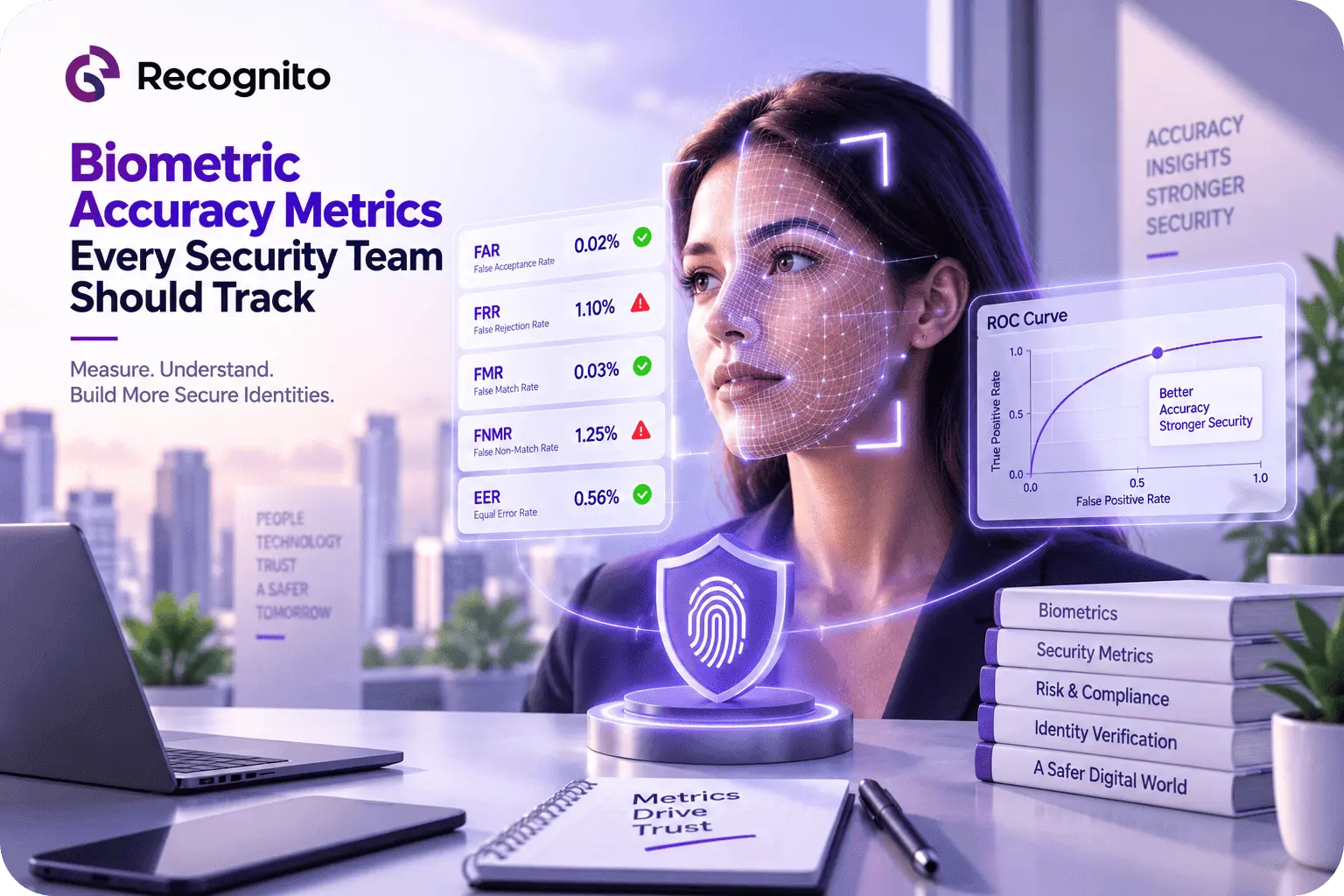
A useful anti-spoofing evaluation should consider measures such as:
- Detection performance against presentation attack instruments
- False acceptance of attack samples
- False alarms on genuine users
- Performance across attack types
- Performance across devices and environmental conditions
- Behavior against unseen attacks
ISO/IEC 30107-3:2023 establishes principles and methods for assessing PAD performance, reporting evaluation results, and classifying known attack types. The ISO/IEC 30107-3 standard also makes clear that PAD testing focuses on attacks occurring at the biometric capture device and is not a complete system-level security assessment.
That limitation matters. Passing a PAD test does not mean an organization’s entire identity system is secure.
Reducing False Alarms Is Just as Important
Security teams sometimes focus entirely on catching attacks.
But excessive false alarms can create another problem: legitimate users repeatedly fail verification.
When anti-spoofing is too aggressive, customers may experience unnecessary retries, support requests, manual reviews, or abandonment.
AI models therefore need to balance attack detection with genuine-user acceptance.
The right threshold depends on the application. A high-value financial transaction may justify stronger controls than a low-risk access experience. Risk-based decisioning can also prevent the anti-spoofing system from applying maximum friction to every user.
A practical approach is to combine the anti-spoofing score with other evidence and trigger additional verification when the risk is ambiguous.
How Businesses Should Evaluate an AI Anti-Spoofing Solution
A successful demonstration is not enough. Organizations should evaluate the complete security behavior.
Test realistic attacks
Use photographs, screens, replayed videos, masks, manipulated media, and other attack types relevant to the application.
Test realistic environments
Evaluate different cameras, lighting conditions, backgrounds, network conditions, and capture distances.
Measure genuine-user impact
Record failure rates, retries, false alarms, and completion rates for legitimate customers.
Test unseen attacks
Avoid evaluating only the attack samples supplied by the vendor. Independent or internally developed attack scenarios can reveal weaknesses that a familiar benchmark may not expose.
Evaluate the entire pipeline
Examine capture security, transport, API integrity, model behavior, application logic, logging, and escalation mechanisms.
For teams implementing face liveness directly into applications, a face liveness SDK can provide the biometric anti-spoofing layer needed for mobile and digital verification workflows.
A practical face biometric playground can also help technical teams explore biometric behavior before committing to a production integration.
Privacy and Security Need to Be Designed Together
AI anti-spoofing systems often process facial images or video, which introduces privacy responsibilities alongside security requirements.
Organizations should establish what data is collected, whether raw imagery is retained, how biometric representations are protected, who can access verification data, and when information is deleted.
Data minimization is particularly important. Anti-spoofing does not automatically justify indefinite storage of every frame captured from a customer.
Security architecture should also separate biometric decision data from unnecessary personal information wherever practical. Strong access controls, encryption, audit logging, and carefully designed retention policies reduce the consequences of compromise.
The underlying principle is simple: improving spoof resistance should not create an unnecessarily large biometric-data footprint.
The Role of AI Monitoring After Deployment
Anti-spoofing should not be treated as a model that is trained once and forgotten.
Production monitoring can reveal attack patterns that were absent from development datasets.
Teams should watch for:
- Sudden changes in spoof attempts
- Rising false-rejection rates
- Device-specific anomalies
- Unusual retry behavior
- New attack patterns
- Geographic or environmental performance differences
- Unexpected shifts in model confidence
Monitoring does not necessarily mean storing large amounts of facial imagery. Useful operational signals can often be collected at the event and performance level while limiting retention of sensitive biometric content.
Model updates should also pass through a controlled evaluation process. Changing a model can alter both attack detection and legitimate-user performance, so improvements in one area should not be assumed to preserve the other automatically.
Why a Layered Defense Works Better
AI-powered anti-spoofing is strongest when it is one part of a broader identity security architecture.
A robust workflow might contain:
Capture controls to establish trusted input.
AI-based PAD to identify presentation attacks.
Facial matching to establish biometric similarity.
Document verification where identity documents are part of the workflow.
Device and transport security to reduce injection opportunities.
Risk orchestration to combine evidence.
Human escalation for ambiguous or high-risk cases.
Each layer addresses a different failure mode.
That is more resilient than expecting one deep-learning classifier to identify every possible attack.
For development teams, the Recognito GitHub repository provides additional technical resources that can complement evaluation and integration work.
What the Future of Face Anti-Spoofing Looks Like
The next generation of anti-spoofing will likely focus on broader context rather than a single visual signal.
Models can increasingly analyze spatial and temporal information together, combine multiple capture characteristics, and adapt to changing attack patterns.
The larger challenge is maintaining that performance outside the laboratory.
Attackers do not use a fixed dataset. They change devices, media quality, generation methods, and delivery techniques. Effective anti-spoofing therefore requires continuous testing and threat-informed model development.
NIST has demonstrated that presentation attack detection can be evaluated systematically, while ISO and FIDO provide structured approaches for testing and certification. Together, these efforts reinforce an important principle: biometric security should be measured against realistic attacks rather than assumed from recognition accuracy alone.
Conclusion
AI and deep learning have fundamentally strengthened face anti-spoofing by allowing biometric systems to detect complex patterns across images, video, texture, motion, and other signals.
But the technology works best when treated as part of a layered defense. Strong anti-spoofing requires representative training data, testing against realistic and unseen attacks, careful threshold selection, protection against injection, and continuous production monitoring.
The objective is not to build a model that recognizes the most faces. It is to build a biometric system that can distinguish trustworthy biometric evidence from increasingly convincing attempts to manufacture it.
For organizations developing secure facial verification workflows, Recognito provides biometric technologies that can support practical face authentication and anti-spoofing architectures.
Frequently Asked Questions
What is face anti-spoofing?
Face anti-spoofing is the process of detecting attempts to fool a facial biometric system with artificial or manipulated biometric presentations rather than a genuine live face.
How does deep learning improve face anti-spoofing?
Deep learning allows models to learn complex visual and temporal patterns from large datasets, helping detect subtle differences between genuine facial presentations and spoofing attempts.
Can AI detect deepfakes?
AI-based PAD can contribute to detecting manipulated facial media, but no single model should be assumed to detect every deepfake. Attack detection should be layered with secure capture and injection defenses.
Is passive liveness better than active liveness?
Neither is universally better. Passive methods usually reduce user interaction, while active approaches can introduce additional evidence through user interaction. The right choice depends on the application’s risk, user experience, and threat model.
Is face anti-spoofing enough to secure a biometric system?
No. Anti-spoofing addresses presentation attacks but does not automatically protect against injection, compromised devices, insecure communication, weak access controls, or other application-level attacks.