
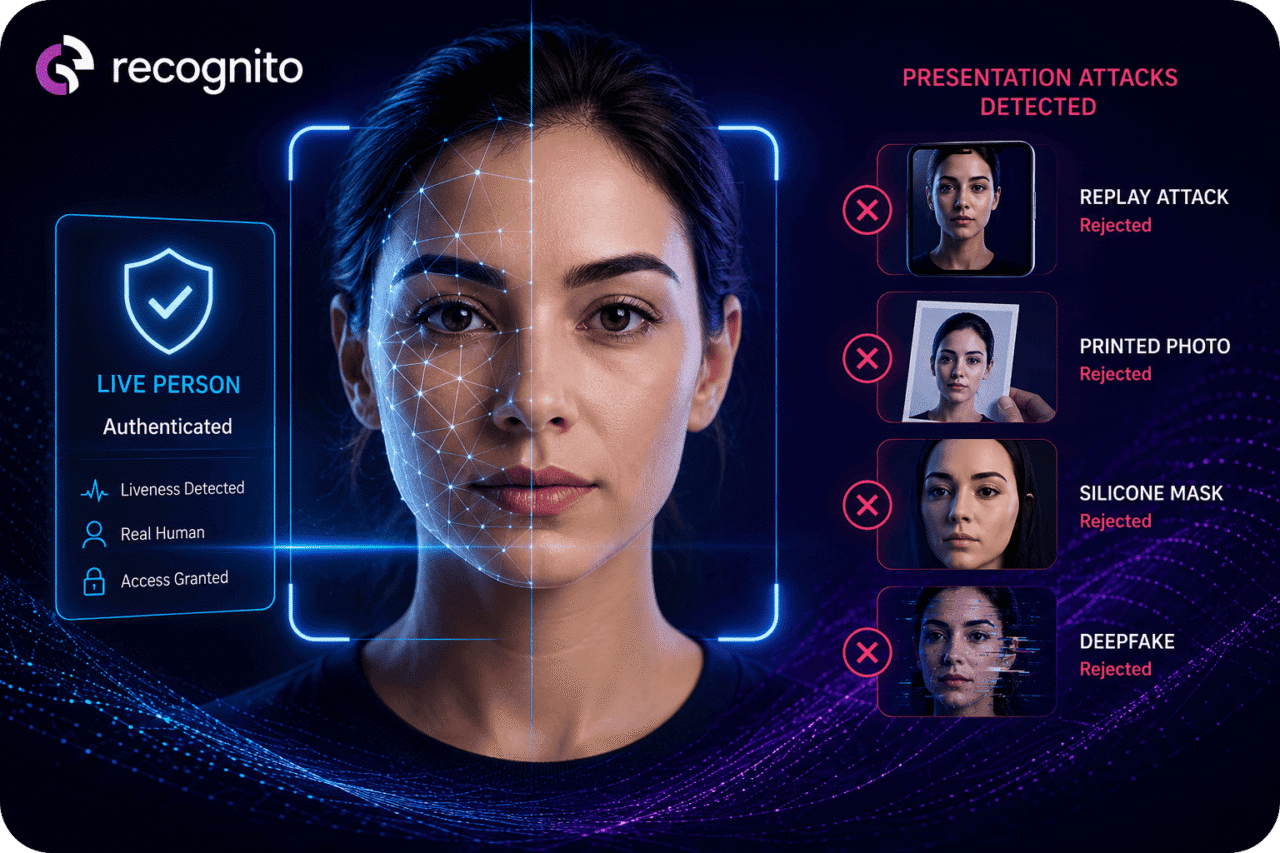
Biometric authentication has transformed how organizations verify identities across digital platforms. Banks, fintech companies, healthcare providers, government agencies, insurance companies, and online businesses increasingly rely on facial recognition and other biometric technologies to secure customer accounts, simplify authentication, and streamline digital onboarding.
However, as biometric systems become more sophisticated, fraudsters continue developing new ways to bypass them. Instead of stealing passwords or credentials, attackers now use printed photographs, replayed videos, silicone masks, AI-generated deepfakes, and other biometric spoofing techniques to impersonate legitimate users.
These attacks, known as presentation attacks, have become one of the biggest challenges facing modern identity verification systems.
To defend against them, organizations are increasingly adopting presentation attack detection (PAD) technologies that can determine whether a real person is physically present during authentication. By combining PAD with facial recognition and biometric verification, businesses can significantly strengthen security while maintaining a seamless user experience.
This guide explains how presentation attack detection works, why it is essential for biometric security, and the technologies organizations use to prevent increasingly sophisticated spoofing attacks.
What Is Presentation Attack Detection?
Presentation Attack Detection (PAD) is a security technology designed to identify and block attempts to deceive biometric authentication systems using fake or manipulated biometric samples.
Instead of simply verifying whether two biometric samples match, PAD determines whether the biometric sample comes from a genuine, live person or from an artificial presentation intended to bypass the system.
Common presentation attacks include:
- Printed photographs
- Mobile phone screens
- Video replay attacks
- Silicone masks
- 3D face models
- AI-generated deepfakes
Without effective PAD, even highly accurate facial recognition systems can become vulnerable to these attacks.
Modern organizations strengthen biometric security by combining facial recognition with the face liveness detection SDK, allowing authentication systems to verify both identity and physical presence before granting access.
For organizations comparing different implementation methods, our guide on active vs passive liveness detection explains how each approach contributes to stronger presentation attack detection.
Why Presentation Attack Detection Matters
Biometric authentication offers significantly stronger security than traditional passwords, but it is not immune to fraud.
If a biometric system only compares facial similarity without verifying that a real person is present, attackers may successfully gain unauthorized access using spoofed biometric samples.
This creates serious risks across industries where identity verification is critical.
Without effective presentation attack detection, organizations may become vulnerable to:
- Account takeover fraud
- Identity theft
- Unauthorized account access
- Financial fraud
- Compliance violations
- Reputational damage
As digital onboarding continues to expand, preventing biometric spoofing has become just as important as accurately matching biometric identities.
Organizations implementing secure authentication solutions should also understand the broader role of biometrics within identity verification. Our guide on biometric authentication vs traditional authentication methods explains why biometrics provide stronger identity assurance than conventional password-based authentication.
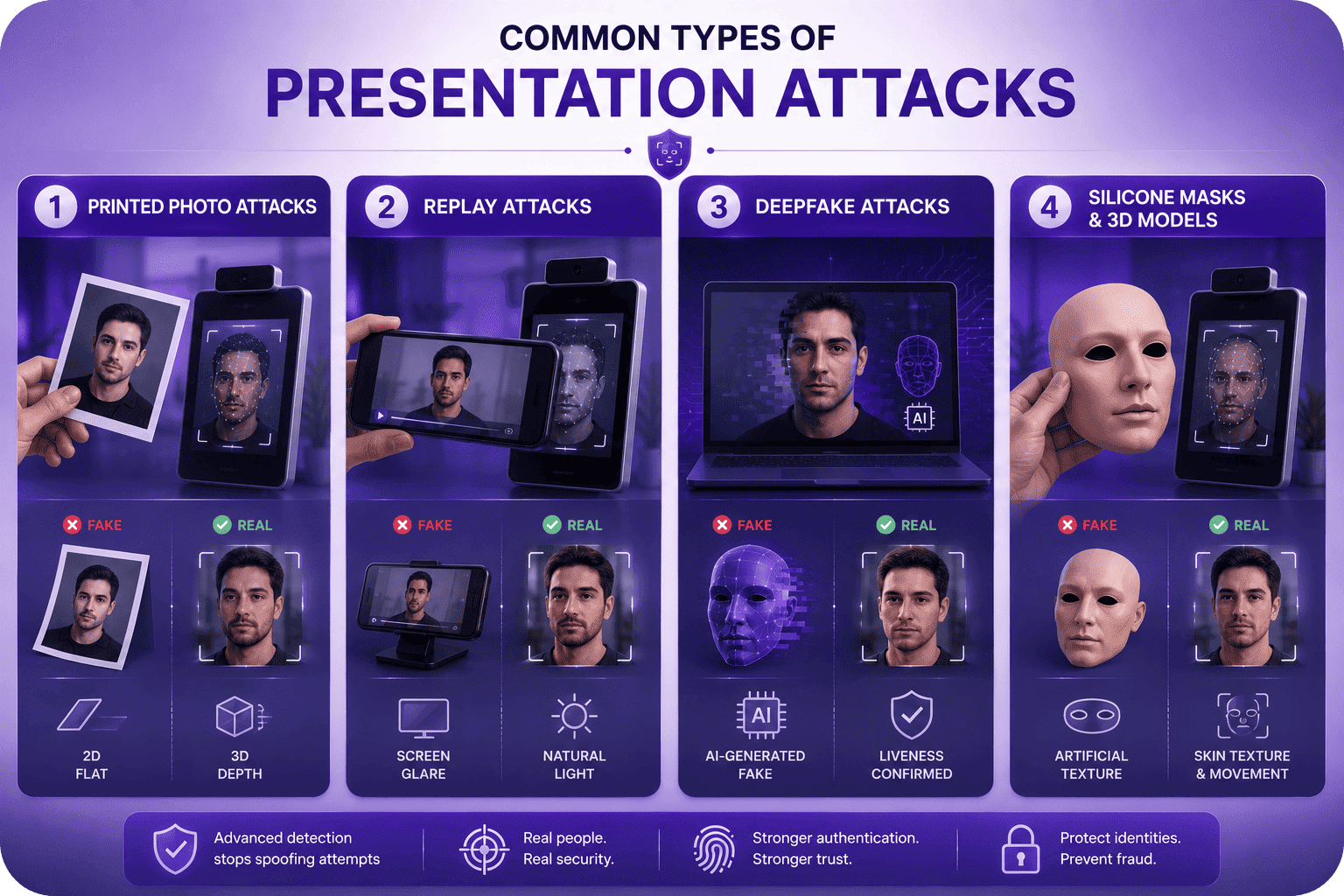
Common Types of Presentation Attacks
Cybercriminals continue developing increasingly sophisticated methods for bypassing biometric systems.
Understanding these attack techniques helps organizations build more resilient authentication processes.
1. Printed Photo Attacks
One of the simplest presentation attacks involves presenting a printed photograph of an authorized user to a facial recognition system.
Although basic facial recognition systems may incorrectly accept these images, modern PAD solutions analyze depth, texture, reflections, and facial dynamics to distinguish printed photographs from genuine human faces.
2. Replay Attacks
Replay attacks use digital media instead of printed photographs.
Fraudsters display high-quality facial videos on smartphones, tablets, or computer monitors in an attempt to fool facial recognition systems.
Modern presentation attack detection solutions evaluate environmental lighting, facial movement, screen reflections, and behavioral characteristics to identify these attacks before authentication is approved.
3. Deepfake Attacks
Artificial intelligence has dramatically increased the sophistication of biometric spoofing.
Attackers can now generate highly realistic facial videos capable of mimicking legitimate users during authentication.
These AI-generated presentations have become a growing concern for financial institutions, government agencies, and organizations relying on remote identity verification.
Businesses looking to understand this rapidly evolving threat can also explore our guide on deepfake attack prevention strategies, which explains how modern verification systems identify AI-generated impersonation attempts.
4. Silicone Masks and 3D Models
Some attackers attempt to bypass biometric systems using realistic silicone masks or three-dimensional facial replicas.
Although these attacks are less common than printed photographs or replay attacks, they can be highly convincing when targeting systems with weak spoofing protection.
Modern face anti spoofing technology analyzes facial depth, skin texture, micro-expressions, and natural movement patterns to distinguish genuine users from artificial facial replicas.
How Presentation Attack Detection Works
Modern PAD systems use multiple technologies simultaneously rather than relying on a single fraud indicator.
Instead of simply checking whether two facial images match, presentation attack detection evaluates a wide range of biometric and environmental signals before making an authentication decision.
Common detection techniques include:
- Facial movement analysis
- Skin texture evaluation
- Reflection detection
- Depth estimation
- Eye movement analysis
- Lighting consistency
- Behavioral analysis
- AI-powered spoof detection
By combining these signals, organizations can significantly reduce false acceptance rates while maintaining a smooth experience for legitimate users.
Many organizations also strengthen overall identity assurance by integrating PAD with a face recognition SDK, allowing both identity matching and spoof detection to operate together within a single authentication workflow.
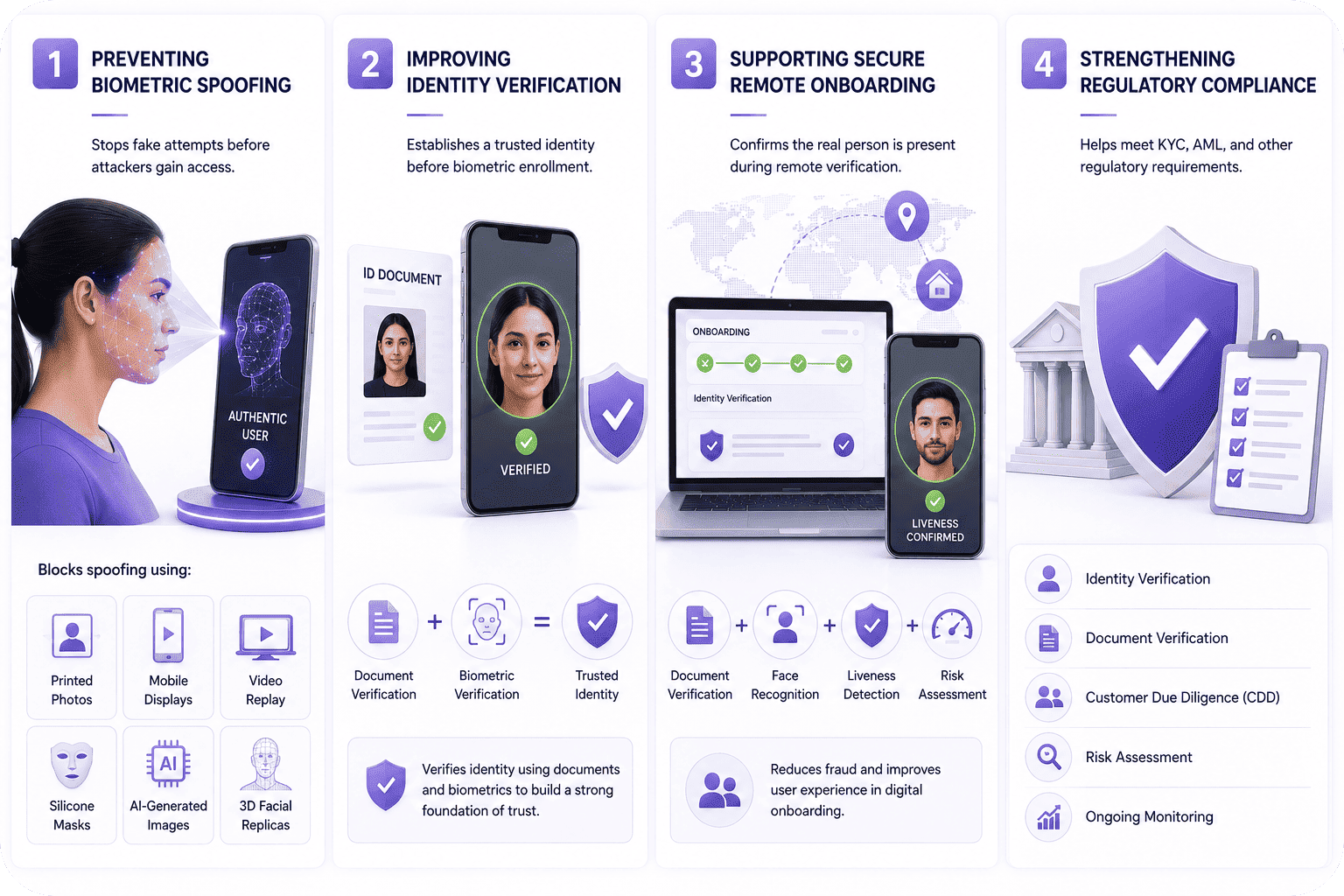
How Presentation Attack Detection Strengthens Biometric Security
Presentation attack detection is no longer considered an optional security feature. It has become a core component of modern biometric authentication because it enables organizations to distinguish between genuine users and increasingly sophisticated spoofing attempts.
Rather than relying solely on facial matching, modern authentication platforms evaluate whether the biometric sample itself is trustworthy before making an authentication decision.
Below are some of the key ways PAD strengthens biometric security.
1. Preventing Biometric Spoofing
The primary purpose of presentation attack detection is to stop biometric spoofing before an attacker gains access to a system.
Without PAD, a biometric system may successfully match a photograph or video to the enrolled user, even though the individual presenting it is not physically present.
Modern PAD solutions help prevent attacks involving:
- Printed photographs
- Mobile phone displays
- Video replay attacks
- Silicone masks
- AI-generated facial images
- Three-dimensional facial replicas
By identifying these attacks during authentication, organizations significantly reduce the risk of unauthorized account access while maintaining a seamless experience for legitimate users.
2. Improving Identity Verification
Strong authentication begins long before a user logs into an account.
Organizations must first establish a trusted identity during customer onboarding before using biometrics for future authentication.
This typically involves verifying government-issued identity documents and confirming that the person presenting them is their legitimate owner.
Many businesses combine biometric verification with the id document recognition SDK to establish trusted digital identities before biometric enrollment begins.
Organizations looking to understand how identity establishment differs from authentication can also read identity proofing vs identity verification explained, which explores how these processes work together within secure onboarding workflows.
3. Supporting Secure Remote Onboarding
As financial services and digital platforms continue moving online, organizations increasingly rely on remote onboarding rather than face-to-face verification.
While remote onboarding improves accessibility and customer experience, it also creates additional opportunities for fraudsters to exploit weak verification systems.
Presentation attack detection provides an additional layer of protection by confirming that applicants are physically present during identity verification.
When combined with document verification, facial recognition, and risk assessment, PAD helps organizations reduce fraud without slowing down the onboarding process.
Businesses building secure digital onboarding workflows can also explore our guide on remote customer onboarding best practices, which explains how multiple verification technologies work together to improve security and compliance.
4. Strengthening Regulatory Compliance
Many industries operate under regulations that require organizations to establish confidence in customer identities before providing access to services.
Financial institutions, fintech companies, payment providers, and cryptocurrency exchanges must comply with KYC and AML requirements while protecting customer information from fraud.
Presentation attack detection supports these obligations by reducing the likelihood that fraudulent applicants successfully bypass identity verification.
Organizations implementing biometric verification often integrate PAD into broader compliance frameworks that include:
- Identity verification
- Document verification
- Customer Due Diligence (CDD)
- Risk assessment
- Ongoing monitoring
This layered approach improves both regulatory readiness and operational efficiency.
Face Anti Spoofing vs Liveness Detection
The terms face anti spoofing and liveness detection are often used interchangeably, but they are closely related rather than identical.
Face anti spoofing focuses on identifying attempts to deceive a biometric system using fake biometric samples.
Liveness detection is one of the primary technologies used to achieve that goal.
Modern face anti spoofing solutions evaluate numerous signals to determine whether a biometric sample comes from a genuine individual instead of an artificial presentation.
These signals may include:
- Facial movement
- Skin texture
- Reflection patterns
- Eye movement
- Depth information
- Lighting consistency
- Behavioral characteristics
Organizations increasingly deploy advanced liveness detection as part of broader face anti spoofing strategies to improve biometric security without disrupting the user experience.
Challenges of Presentation Attack Detection
Although PAD technology continues to improve, organizations still face several challenges when implementing biometric security at scale.
Evolving Attack Techniques
Fraudsters continuously adapt their methods as biometric security becomes more sophisticated.
Advances in generative AI have made deepfake videos and synthetic facial imagery increasingly realistic, requiring authentication systems to evolve just as quickly.
Organizations should regularly update biometric models and fraud detection capabilities to remain effective against emerging threats.
Balancing Security With User Experience
Customers expect authentication to be fast and effortless.
Introducing unnecessary verification steps can increase login times and reduce customer satisfaction.
Modern passive liveness detection helps solve this challenge by operating in the background with minimal user interaction, allowing organizations to improve security while maintaining a frictionless authentication experience.
Accuracy Across Different Environments
Biometric authentication often takes place under varying real-world conditions.
Poor lighting, different camera qualities, unusual viewing angles, facial accessories, and unstable network connections can all affect authentication performance.
Organizations should evaluate PAD solutions based on their ability to maintain high accuracy across diverse operating environments rather than only under ideal testing conditions.
Independent benchmarking initiatives such as the NIST Face Recognition Vendor Test (FRVT) continue to provide valuable insight into the real-world performance of modern biometric technologies.
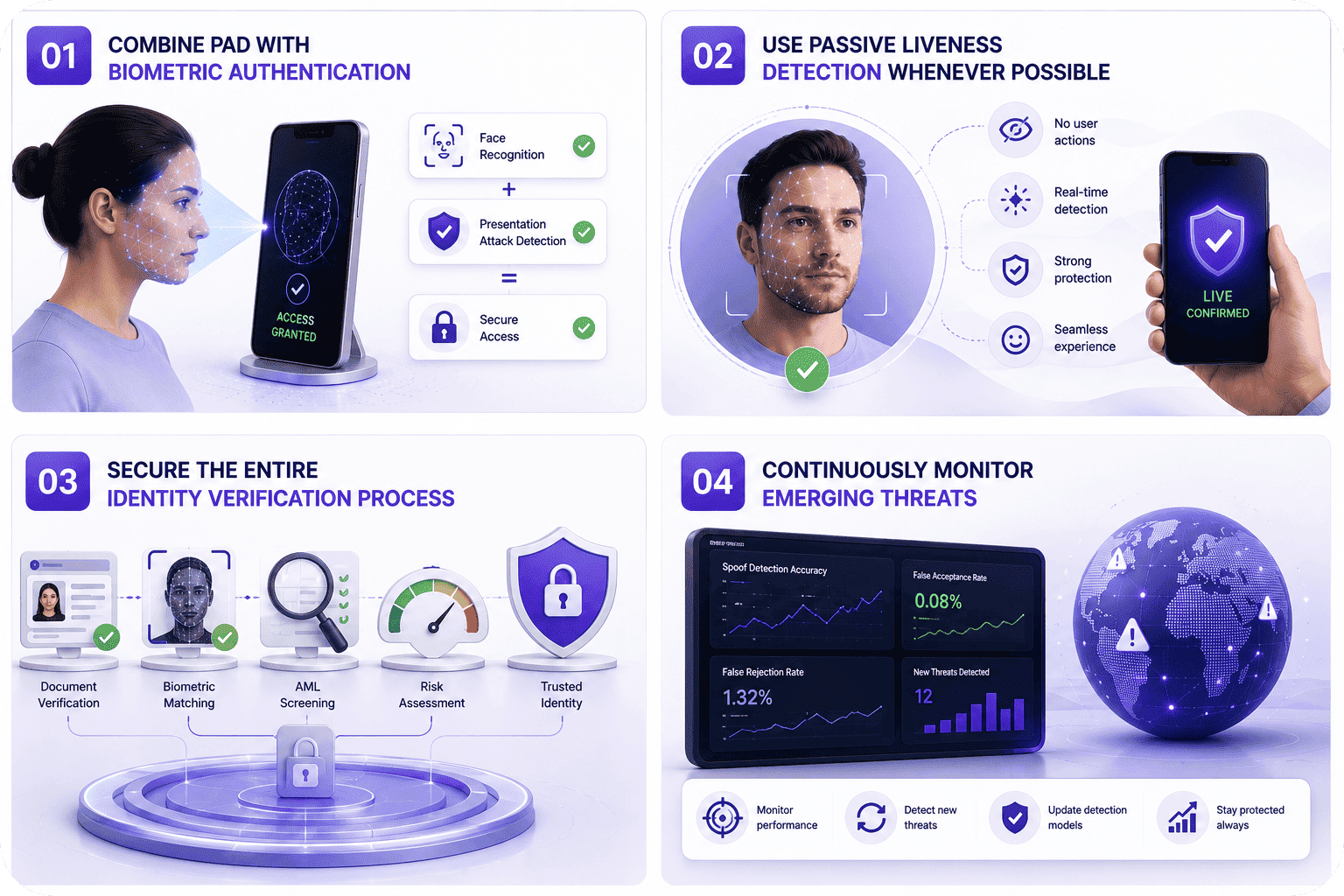
Best Practices for Implementing Presentation Attack Detection
Deploying presentation attack detection successfully requires more than simply adding liveness detection to an authentication workflow. Organizations should adopt a layered security strategy that combines multiple technologies to protect against both current and emerging biometric threats.
The following best practices can help businesses strengthen biometric security while maintaining a smooth user experience.
1. Combine PAD With Biometric Authentication
Presentation attack detection should complement biometric authentication rather than replace it.
A facial recognition system can accurately determine whether two faces belong to the same individual, but without PAD, it may still accept a spoofed biometric sample.
By integrating presentation attack detection with a robust facial recognition SDK, organizations can verify both the user’s identity and their physical presence before granting access.
This layered approach significantly improves authentication security while minimizing false acceptance rates.
2. Use Passive Liveness Detection Whenever Possible
Modern authentication experiences should prioritize both security and convenience.
Passive liveness detection works in the background without requiring users to perform actions such as blinking, smiling, or turning their heads. This reduces friction while still providing strong protection against spoofing attacks.
Organizations evaluating different implementation strategies should choose a liveness solution that balances security, usability, and performance across different devices and environments.
3. Secure the Entire Identity Verification Process
Presentation attack detection is most effective when it forms part of a broader identity verification framework.
Verifying that a live person is present is important, but organizations must also confirm that the identity document is genuine and belongs to the individual completing the verification process.
Businesses can strengthen onboarding security by combining PAD with technologies such as document verification, biometric matching, AML screening, and risk assessment.
Organizations building modern compliance programs may also benefit from reading our guide on AML verification and identity verification in customer onboarding, which explains how these verification layers work together to reduce fraud.
4. Continuously Monitor Emerging Threats
Presentation attacks continue to evolve alongside advances in artificial intelligence.
New spoofing techniques appear regularly, making it essential for organizations to update detection models, review authentication performance, and monitor emerging fraud trends.
Security teams should periodically evaluate:
- Spoof detection accuracy
- False acceptance rates
- False rejection rates
- New attack techniques
- Authentication performance across different devices
Continuous improvement helps ensure biometric security remains effective against future threats rather than only today’s attack methods.
The Future of Presentation Attack Detection
Biometric security is rapidly evolving as artificial intelligence and machine learning improve the ability to distinguish genuine users from increasingly realistic spoofing attempts.
Rather than relying on predefined detection rules, next-generation PAD systems will continuously learn from new attack patterns and adapt automatically.
Several innovations are expected to shape the future of presentation attack detection.
AI-Powered Spoof Detection
Artificial intelligence is enabling PAD systems to analyze subtle facial characteristics that traditional algorithms often overlook.
Future solutions will evaluate hundreds of biometric and environmental signals simultaneously, allowing organizations to identify sophisticated presentation attacks with greater accuracy while reducing false positives.
Multi-Modal Biometrics
Organizations are increasingly moving beyond a single biometric modality.
Future authentication systems are expected to combine facial recognition with additional biometric factors such as voice recognition, fingerprints, or behavioral biometrics to create stronger identity assurance.
Combining multiple biometric signals makes successful spoofing attacks significantly more difficult.
Continuous Authentication
Authentication is gradually shifting from a one-time login event to an ongoing security process.
Instead of verifying users only during account access, organizations are beginning to monitor identity throughout active sessions using behavioral analytics, device intelligence, and biometric confidence.
This approach enables businesses to identify suspicious activity even after authentication has been completed.
Choosing the Right Presentation Attack Detection Solution
Selecting a PAD solution involves more than evaluating spoof detection alone.
Organizations should consider whether the platform can support long-term growth while adapting to new fraud techniques and changing regulatory requirements.
When comparing solutions, evaluate factors such as:
- Presentation attack detection accuracy
- Face anti spoofing performance
- Passive and active liveness support
- Integration flexibility
- Cross-platform compatibility
- Scalability
- AI-powered fraud detection
- Compliance support
- Developer documentation
Platforms that combine facial recognition, liveness detection, document verification, and fraud prevention within a unified solution often simplify implementation while improving overall biometric security.
Development teams interested in implementation resources can also explore the official Recognito GitHub repository for SDK documentation, sample projects, and integration guides.
Conclusion
As biometric authentication becomes increasingly common across financial services, healthcare, government, and digital platforms, protecting these systems from spoofing attacks has become a business-critical requirement.
Presentation attack detection plays a vital role by ensuring that biometric systems authenticate genuine users rather than photographs, replay videos, silicone masks, or AI-generated deepfakes. When combined with facial recognition, liveness detection, and comprehensive identity verification, PAD provides organizations with a stronger defense against modern fraud.
Organizations that invest in advanced presentation attack detection technologies today will be better positioned to reduce biometric spoofing, strengthen compliance, improve customer trust, and deliver secure digital experiences as authentication continues to evolve.
Frequently Asked Questions
What is presentation attack detection?
Presentation attack detection (PAD) is a security technology that identifies attempts to deceive biometric systems using fake biometric samples such as printed photographs, replay videos, silicone masks, or AI-generated deepfakes.
How does presentation attack detection improve biometric security?
PAD verifies that a real person is physically present during authentication, helping prevent biometric spoofing and unauthorized account access.
What is biometric spoofing?
Biometric spoofing is an attempt to bypass biometric authentication by presenting fake biometric samples, including photographs, videos, masks, or synthetic facial images, instead of a genuine live person.
Is presentation attack detection the same as liveness detection?
Liveness detection is one of the primary techniques used within presentation attack detection. While PAD is the broader security framework for identifying spoofing attacks, liveness detection focuses on confirming that the biometric sample comes from a live individual.
Which industries benefit from presentation attack detection?
Presentation attack detection is widely used in banking, fintech, healthcare, government services, telecommunications, insurance, travel, and enterprise security to protect biometric authentication systems from spoofing attacks.
Can presentation attack detection stop deepfake attacks?
Modern PAD solutions are designed to identify many forms of AI-generated impersonation, including deepfake videos and other presentation attacks. When combined with facial recognition, behavioral analysis, and liveness detection, they provide significantly stronger protection against emerging biometric fraud.
