

Fintech onboarding has become a security problem as much as a customer-experience problem. A new customer expects to open an account quickly, while the financial institution must determine whether the applicant is a real person, whether the identity evidence is legitimate, and whether the application presents an unacceptable fraud or compliance risk.
Older onboarding processes often handled those questions separately. Customers filled out forms, uploaded an ID, waited for manual review, and sometimes completed additional checks through disconnected systems. That model becomes difficult to sustain when application volumes increase and fraudsters can produce increasingly convincing fraudulent documents, synthetic identities, and manipulated media.
AI-powered identity verification is changing the architecture. Computer vision, optical character recognition, facial analysis, liveness detection, and risk analytics can now work together inside one onboarding journey. The objective is not simply to automate KYC. It is to turn identity evidence into a faster, more consistent, and more risk-aware decision process.
Why Fintech Onboarding Is Moving Toward AI
Remote onboarding creates a fundamental challenge: the customer and the financial institution are no longer in the same place.
There is no branch employee physically comparing a customer with an identity document. Instead, the institution may receive a photograph of a passport, a selfie, device information, account details, and other digital signals.
Each piece of evidence answers a different question. A document may establish claimed identity attributes. Facial comparison can assess whether the applicant resembles the document portrait. Liveness attempts to establish that the biometric input comes from a live person rather than a presentation attack.
That makes the workflow inherently multi-layered.
The European Banking Authority’s guidelines on remote customer onboarding emphasize safe, effective, and risk-sensitive remote onboarding aligned with AML/CFT and data-protection requirements. The guidance also addresses how financial institutions should assess the adequacy and reliability of the tools they use.
AI fits this environment because it can automate evidence analysis at a scale that manual teams cannot easily match.
What AI-Powered Verification Looks Like in Practice
A modern onboarding workflow may begin when a customer photographs an identity document.
AI-based document recognition can identify the document type, locate fields, extract information, and evaluate the captured image. Depending on the solution, additional checks may assess whether the document appears altered or inconsistent.
The customer may then capture a selfie or short video. Facial analysis generates a biometric representation that can be compared with the portrait associated with the identity evidence.
Liveness detection provides a separate security layer. It attempts to determine whether the captured biometric input represents a live person rather than a photograph, replayed video, mask, or other presentation attack.
The outputs can then be combined with application information and other risk signals.
This architecture is more powerful than treating identity verification as one pass/fail test. Instead, the system asks whether the evidence collectively provides enough confidence to approve the customer, request another check, or escalate the case.
For fintechs reviewing the wider identity stack, eKYC requirements for fintech platforms provides additional context on the broader verification and compliance workflow.
Where AI Delivers the Biggest Operational Gains
Faster document processing
Manual document review consumes analyst time and creates a natural bottleneck.
AI can automate the repetitive parts of document handling: classification, field extraction, quality assessment, and initial anomaly detection. Straightforward applications can move through the workflow without requiring an employee to inspect every field manually.
For developers, an identity document recognition SDK can bring that capability directly into the application experience and reduce dependence on fragmented third-party interfaces.
The improvement is not merely faster processing. Consistent machine-assisted checks can also reduce variation between reviewers.
Better face-based identity assurance
Traditional onboarding often depends heavily on information that can be stolen: names, addresses, identification numbers, dates of birth, and account credentials.
Biometrics provide another form of evidence. Facial verification allows the system to compare the person completing onboarding with a trusted facial reference, often the portrait on an identity document.
That does not make facial recognition infallible. It means the institution is no longer relying solely on information that an attacker can copy.
For teams building this layer into their products, a facial recognition SDK can provide the biometric component needed for mobile or web identity workflows.
Stronger resistance to spoofing
A face match alone does not answer whether a real person is standing in front of the camera.
An attacker could attempt to present a photograph, replay a video, or use other techniques to make a biometric system accept fraudulent input. That is why liveness needs to be considered separately from facial similarity.
A face liveness SDK can provide that additional control inside an identity-verification flow.
The distinction is fundamental: facial matching asks whether two biometric samples are similar; liveness asks whether the submitted biometric evidence appears to originate from a live subject.
AI Is Also Changing the Fraud Problem
The same advances that improve verification are available to attackers.
Synthetic identities can combine legitimate and fabricated information. Generative tools can create convincing manipulated media. Deepfake techniques may be used to impersonate legitimate individuals during remote interactions.
That means AI-based onboarding cannot be designed around a single “smart” detection model.
A safer approach is layered verification. Document evidence, facial comparison, liveness, customer information, device signals, and risk rules should provide independent or partially independent evidence.
The reason is simple: a fraudster may defeat one layer without defeating all of them.
The broader threat is explored in deepfake fraud prevention, where the problem is treated as part of a wider fraud-defense architecture rather than an isolated biometric issue.
The New Customer Journey
A well-designed AI-assisted onboarding flow can hide considerable backend complexity from the customer.
A typical sequence looks like this:
- Capture identity evidence. The customer photographs an identity document and completes a selfie or video capture.
- Analyze the document. AI identifies document characteristics, extracts fields, and evaluates image quality and available authenticity indicators.
- Check identity consistency. Information from the application and document is compared for conflicts or anomalies.
- Verify the face. The captured face is compared with the relevant identity reference.
- Check liveness. The system assesses whether the biometric input appears genuine and live.
- Calculate risk. Verification outputs are combined with other signals and business rules.
- Make a decision. The application is approved, rejected, or routed for additional checks.
The customer does not need to understand each technical step. From the front end, the process may feel like a short sequence of guided captures.
That is where AI has a direct effect on conversion. Less manual intervention can mean fewer waits, fewer handoffs, and fewer opportunities for applicants to abandon the process.
The Trade-Off Between Security and Conversion
The fastest onboarding journey is not necessarily the safest, and the strictest workflow is not automatically the best.
Every verification system has false positives and false negatives. A legitimate applicant may fail because an image is poor, while a fraudulent application may pass because the available evidence is convincing enough to evade the controls.
Fintechs therefore need to decide how much risk they are prepared to accept at different stages.
A low-risk application might proceed with automated verification when document, face, and liveness results agree. A case involving conflicting identity information, unusual device activity, or suspicious document characteristics might trigger additional verification.
This risk-based design is more practical than forcing every customer through the highest-friction workflow.
It also prevents a common mistake: treating verification as a binary technical feature rather than a decision process.
Image Quality Is a Security and Conversion Issue
AI performance depends heavily on the quality of the evidence it receives.
Poor lighting, glare, motion blur, damaged documents, low-resolution cameras, and incorrect framing can cause verification to fail even when the customer is legitimate.
This has two consequences.
First, the fintech may lose a genuine customer because the system cannot obtain sufficient evidence.
Second, support and manual-review teams may receive an unnecessary increase in edge cases.
The solution is not simply to use a more sophisticated model. The capture experience itself should help customers produce usable evidence. Real-time guidance, quality checks, sensible retry handling, and clear instructions can have a major effect on overall verification performance.
For a deeper look at the factors that influence recognition outcomes, face recognition accuracy factors provides a useful technical perspective.
AI Should Reduce Manual Work, Not Eliminate Judgment
Automation changes the role of the compliance and fraud team.
Instead of reviewing every application in the same way, analysts can concentrate on applications where evidence conflicts or the system cannot establish sufficient confidence.
That creates a better use of human judgment.
However, automation also introduces a risk of over-reliance. An employee may assume that a machine-generated “pass” is automatically correct, even when the underlying evidence is weak.
Fintechs should therefore define escalation rules, document important decision logic, and monitor how often automated decisions later prove incorrect.
Human review remains particularly important for ambiguous documents, unusual customer circumstances, and cases where several signals disagree.
What a Fintech Should Look for in an AI Verification Stack
Technology selection should start with the business workflow rather than a vendor feature list.
| Layer | What to evaluate | Business impact |
| Document capture | Supported IDs, capture quality, mobile experience | Fewer failed submissions |
| Document intelligence | OCR, classification, authenticity signals | Faster identity processing |
| Face verification | Matching performance and operating conditions | Stronger identity assurance |
| Liveness | Resistance to relevant presentation attacks | Lower spoofing exposure |
| Risk orchestration | Ability to combine multiple signals | Better risk-based decisions |
| Manual review | Escalation and case-management options | Safer handling of ambiguous cases |
| Monitoring | Error, failure, fraud, and conversion metrics | Continuous improvement |
The integration model matters too.
An excellent algorithm can still become a poor product choice if it introduces excessive latency, unreliable APIs, limited mobile support, weak error handling, or difficult deployment.
Teams should also understand which components are evaluated independently and which are combined within the vendor’s overall risk engine.
Compliance Must Be Built Into the Workflow
AI does not make an onboarding process compliant by itself.
The compliance obligation remains with the financial institution. Technology supports the process; it does not replace customer due diligence or risk assessment.
FATF’s Guidance on Digital Identity explains how appropriately reliable digital identity systems can support customer identification and verification at onboarding and other customer due-diligence activities.
NIST’s Digital Identity Guidelines, published in 2025, cover identity proofing, enrollment, authentication, and federation. Although the guidelines are written for government information systems, they provide a useful technical reference for organizations designing digital identity processes.
This means fintechs should define the evidence they need before selecting the technology. Questions about document collection, biometric processing, data retention, access, auditability, and escalation should be part of the architecture rather than added after implementation.
AI Governance Becomes Part of Identity Governance
A verification model influences whether people receive access to financial services. That gives model performance, monitoring, and change management a direct business impact.
NIST’s AI Risk Management Framework is designed to help organizations manage AI risks and incorporate trustworthiness considerations into the design, development, deployment, and evaluation of AI systems.
For fintechs, practical governance can include:
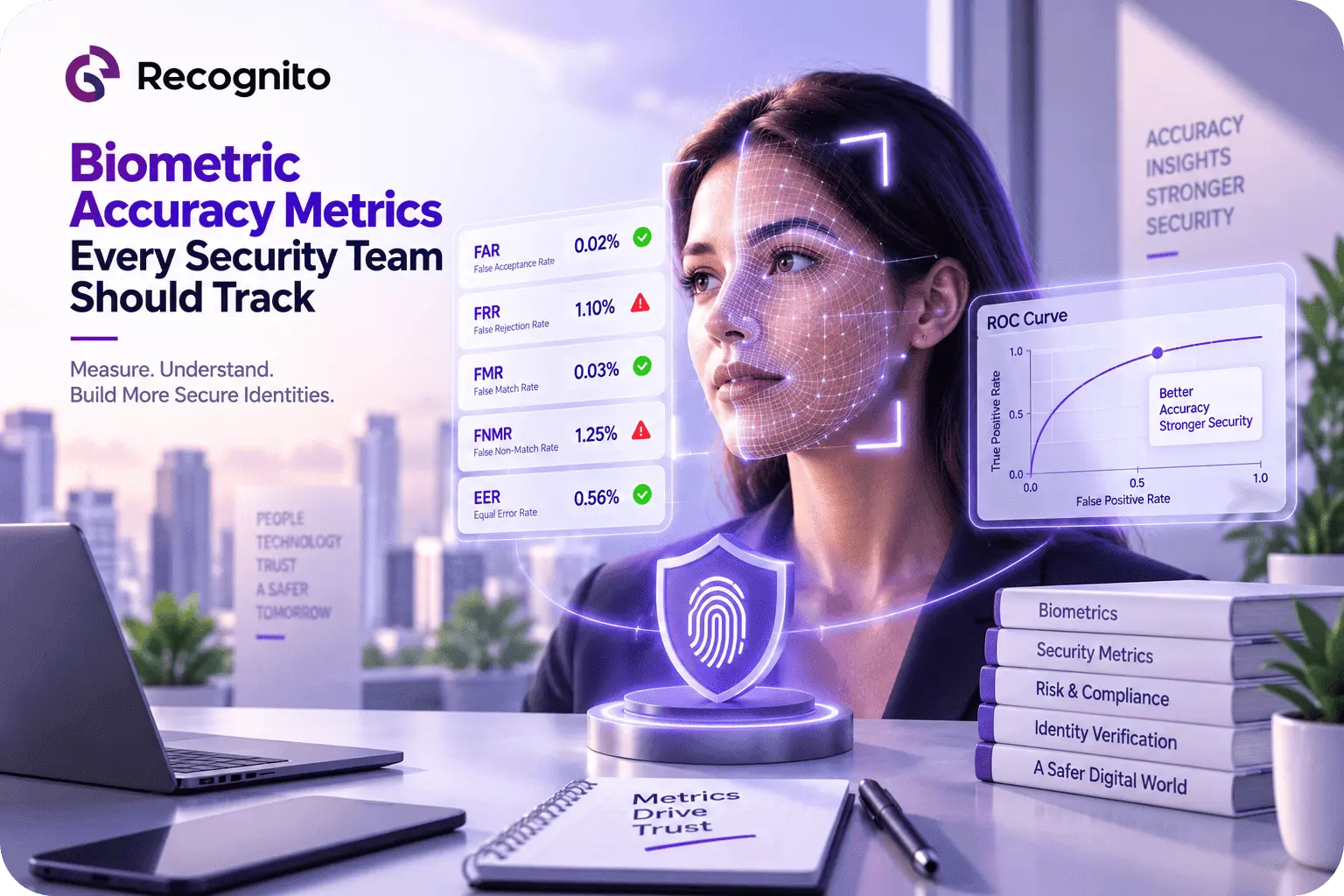
- monitoring false rejection and false acceptance patterns
- testing model or threshold changes before deployment
- reviewing demographic and environmental performance
- documenting material changes to verification logic
- tracking manual-review outcomes
- investigating unusual shifts in fraud or failure rates
The objective is not to remove human involvement from AI systems. It is to ensure that automated decisions remain measurable, reviewable, and controllable.
Measuring Whether AI Onboarding Is Actually Working
Approval rate alone is a poor measure of onboarding quality.
A fintech should look at several metrics together:
Completion rate: How many legitimate applicants finish verification?
Time to decision: How quickly does an application receive an outcome?
Manual-review rate: How much operational work remains after automation?
False rejection rate: How often are legitimate customers unnecessarily blocked?
Fraud detection performance: How effectively does the workflow identify suspicious applications?
Retry rate: How often do customers repeat captures before succeeding?
Post-onboarding fraud: Do applications that pass verification later generate fraud signals?
These metrics expose trade-offs that a single accuracy number cannot.
For example, increasing automated approvals might improve conversion while also increasing fraudulent account creation. Tightening controls might reduce fraud but send legitimate applicants into manual review.
The right target is not maximum automation. It is the best balance between assurance, customer experience, operating cost, and acceptable risk.
Where Fintech Onboarding Is Heading
The next major change is likely to be better orchestration rather than simply better individual models.
Document recognition, facial verification, liveness, fraud detection, device intelligence, and risk scoring are increasingly being treated as connected evidence sources.
That enables adaptive verification.
A straightforward application with consistent evidence may require little intervention. Another application may receive stronger checks because the available evidence is incomplete or contradictory.
This approach also makes the customer experience more proportional to risk. Rather than adding friction to everyone, the system can reserve additional verification for cases that actually warrant it.
Technical teams building these workflows can also review the Recognito GitHub repository for developer-oriented resources alongside formal product and security evaluation.
The important architectural principle is that AI should make the onboarding decision more informed, not merely faster.
Conclusion
AI-powered identity verification is transforming fintech onboarding by replacing fragmented, manual checks with coordinated digital evidence analysis.
The strongest implementations combine document intelligence, facial verification, liveness detection, fraud signals, risk-based orchestration, and human escalation. They also measure what happens after deployment rather than assuming that laboratory accuracy or a vendor’s headline metric represents real customer outcomes.
For fintechs, the goal is not to automate every decision. It is to make trustworthy decisions faster while keeping fraud, compliance, privacy, and customer experience under control.
For organizations building that kind of biometric identity infrastructure, Recognito offers technologies that can support a layered and practical verification workflow.
Frequently Asked Questions
Is AI-powered identity verification the same as KYC?
No. KYC is the broader customer-due-diligence process. AI-powered verification is a technology layer that can automate parts of identity capture, document analysis, biometric verification, and risk assessment.
Can AI detect every fraudulent identity document?
No. AI can identify suspicious characteristics and inconsistencies, but no single model should be treated as capable of detecting every fraud technique. Layered controls and manual escalation remain important.
Why is liveness separate from facial recognition?
Facial recognition determines whether biometric samples are sufficiently similar. Liveness addresses whether the biometric input appears to come from a live subject rather than a presentation attack.
Should fintech onboarding be completely automated?
Not necessarily. Automated processing is most valuable for straightforward cases. Applications containing conflicting, incomplete, or suspicious evidence may require additional verification or human review.
How should a fintech evaluate an AI identity verification provider?
Evaluate the complete workflow rather than one accuracy number. Consider document coverage, biometric performance, liveness, fraud resistance, image quality handling, integration, latency, privacy, monitoring, manual review, and production performance across representative customer conditions.